A Lucrative Guide To Creating A Wealth Mindset

Free to read β€’ Save or share with one click

FreeA Lucrative Guide To Creating A Wealth Mindset Template

At a glance

What it is
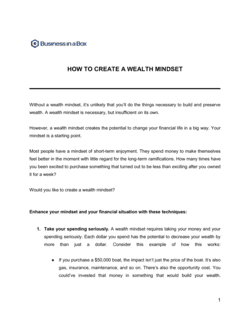
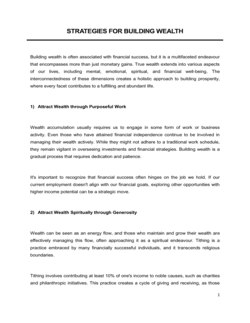
A Lucrative Guide to Creating a Wealth Mindset is a structured Word document that helps individuals and business owners identify limiting financial beliefs, replace them with growth-oriented habits, and build a concrete personal wealth strategy. This free Word download gives you a ready-to-use framework you can edit online and export as PDF to use as a personal development tool, coaching resource, or team workshop guide.
When you need it
Use it when you are ready to move beyond reactive financial behavior and build a deliberate, long-term approach to wealth creation β€” whether launching a business, scaling an existing one, or restructuring your personal finances after a setback.
What's inside
Mindset assessment, limiting belief identification, goal-setting framework, daily habits and disciplines, financial education roadmap, income diversification strategy, investment principles, and a personal wealth action plan with measurable milestones.

What is a Wealth Mindset Guide?

A Wealth Mindset Guide is a structured personal development document that helps individuals identify the financial beliefs, habits, and behavioral patterns that either accelerate or obstruct long-term wealth creation. It combines psychological self-assessment with concrete strategic frameworks β€” covering everything from limiting belief reframing and goal-setting to income diversification, investment principles, and 90-day action planning. Unlike a generic financial plan, it addresses the behavioral layer beneath the numbers: the deeply held assumptions about money that determine whether any financial strategy is consistently followed or quietly abandoned.

Why You Need This Document

Most financial strategies fail not because of bad math but because of unexamined beliefs β€” the conviction that wealth is for other people, that risk is always dangerous, or that consistent financial discipline is simply not possible. Without a structured framework to surface and replace those beliefs, even well-constructed financial plans get overridden by emotion, inertia, or fear at the first obstacle. This guide forces the specific, uncomfortable work that generic motivation content skips: naming exact limiting beliefs, attaching numeric targets to every goal, and building a system of external accountability. Professionals who complete it report faster progress toward savings milestones, more consistent investment behavior, and a measurably clearer sense of financial direction β€” not because the template is magic, but because it makes the invisible visible and the vague specific.

Which variant fits your situation?

If your situation is…Use this template
Individual looking to build a personal financial plan from scratchPersonal Financial Plan
Business owner planning revenue growth and profit reinvestmentBusiness Growth Plan
Coach or trainer delivering a wealth mindset workshopWorkshop Facilitation Guide
Professional needing a structured budget and savings trackerPersonal Budget Template
Entrepreneur mapping out multiple income streamsIncome Diversification Plan
Executive building a long-term investment strategyInvestment Plan Template
Team leader running a financial literacy program for employeesFinancial Wellness Program Plan

Common mistakes to avoid

❌ Skipping the mindset assessment and going straight to goal-setting

Why it matters: Goals set without a clear picture of current beliefs and behaviors are built on an unstable foundation and are abandoned when the first obstacle appears.

Fix: Spend at least 30 minutes completing the assessment before writing a single goal. Use the scores to prioritize which sections of the guide need the most attention.

❌ Writing goals without numeric targets or deadlines

Why it matters: Vague goals like 'build more wealth' or 'invest more' produce no measurable progress and cannot be tracked or course-corrected over time.

Fix: Every goal must include a specific dollar amount and a specific date β€” for example, 'accumulate $50,000 in index funds by December 31, [YEAR].'

❌ Pursuing five or more new habits simultaneously

Why it matters: Behavioral research consistently shows that attempting more than three new habits at once leads to decision fatigue and full abandonment within 30 days.

Fix: Start with two to three high-impact financial habits, practice them for 60 days until they are automatic, then layer in additional behaviors.

❌ Treating the completed guide as a finished document rather than a living plan

Why it matters: Income, life circumstances, and financial markets change β€” a wealth plan that is not reviewed at least annually quickly becomes misaligned with reality.

Fix: Schedule a formal quarterly progress review and an annual full-plan revision as recurring calendar events the moment you complete the guide.

❌ Omitting an accountability structure

Why it matters: Without external accountability, most people revert to prior financial behaviors within 60–90 days of completing the guide, regardless of how well it was filled out.

Fix: Identify a specific accountability partner before finishing the document and schedule the first check-in within two weeks of completing the action plan.

❌ Defining investment principles without setting personal boundaries

Why it matters: Knowing what you will invest in is only half the discipline β€” without explicit rules on what you will not do, emotional market events override the strategy.

Fix: Write a 'do not cross' list alongside your investment principles, covering asset classes, risk thresholds, and leverage limits you will never breach regardless of market conditions.

The 9 key sections, explained

Mindset Assessment

Identifying and Reframing Limiting Beliefs

Wealth Vision and Goal Framework

Daily Habits and Financial Disciplines

Financial Education Roadmap

Income Diversification Strategy

Investment Principles and Strategy

Accountability and Progress Tracking

Personal Wealth Action Plan

How to fill it out

  1. 1

    Complete the mindset assessment honestly

    Work through every question in the mindset assessment section without editing your answers toward the 'right' response. The goal is an accurate baseline, not a flattering one.

    πŸ’‘ Set a timer for 20 minutes and answer without overthinking β€” your first instinct is usually the most revealing data point.

  2. 2

    Identify and write out your three most persistent limiting beliefs

    Review your assessment scores and surface the three beliefs most consistently holding back your financial decisions. Write each one as a specific statement, not a general theme.

    πŸ’‘ Beliefs attached to strong emotion β€” embarrassment, resentment, fear β€” are usually the highest-leverage ones to reframe first.

  3. 3

    Write your wealth vision with specific numbers and a target year

    State your net worth target, target passive income, and target date in a single paragraph. Then break it into 1-year, 3-year, and 5-year milestones with dollar amounts and dates.

    πŸ’‘ A vision without a number is a wish. If you don't know your target net worth, start with your current net worth and multiply by 3 as a 5-year benchmark.

  4. 4

    Select three daily and three weekly financial habits

    From the habits section, choose three behaviors you will commit to daily and three you will perform weekly. Write them into your calendar as recurring appointments before closing the document.

    πŸ’‘ Attach each habit to an existing anchor behavior β€” 'review net worth every morning after opening email' is more likely to stick than a standalone reminder.

  5. 5

    Build your income diversification plan

    List every current income source with its annual amount. Then identify one new income stream you can realistically develop within 12 months and write the first three concrete steps to launch it.

    πŸ’‘ Pick one stream that leverages skills you already have β€” the fastest second income is always an extension of an existing competency.

  6. 6

    Define your investment principles

    Fill in your asset allocation percentages, state your risk tolerance, and write two to three personal investment rules that will govern every future decision.

    πŸ’‘ Write a 'do not invest in' list alongside your investment rules β€” knowing your boundaries prevents costly emotional decisions during market volatility.

  7. 7

    Set up your accountability system

    Name a specific accountability partner or coach, set a recurring monthly review date, and list the three metrics you will report at each check-in: net worth, savings rate, and progress toward the 1-year goal.

    πŸ’‘ A coach or peer with their own active wealth plan is a more effective accountability partner than a supportive friend with no financial goals of their own.

  8. 8

    Write your 90-day action plan with specific deadlines

    Translate every section of the guide into specific tasks with owners and dates. Every action item must have a measurable outcome and a deadline β€” no open-ended items.

    πŸ’‘ Limit the 90-day plan to 10–15 actions. A shorter list with high completion rates builds momentum faster than an exhaustive list that overwhelms.

Frequently asked questions

What is a wealth mindset guide?

A wealth mindset guide is a structured document that combines self-assessment, belief reframing, goal-setting, and actionable financial habits into a single framework. It is designed to help individuals identify the mental and behavioral patterns that limit financial growth and replace them with evidence-based practices that support long-term wealth creation. Unlike a financial plan, it addresses both the psychological and strategic dimensions of building wealth.

Who benefits most from using a wealth mindset guide?

Entrepreneurs, small business owners, corporate professionals, and personal finance coaches all use wealth mindset guides. It is particularly valuable for anyone who has a financial goal β€” saving, investing, building a business β€” but finds that their own habits or beliefs consistently undermine progress. Coaches and HR teams also use it as a structured workshop or client-delivery tool.

How is a wealth mindset guide different from a financial plan?

A financial plan focuses on numbers β€” budgets, projections, investment allocations, and tax strategy. A wealth mindset guide addresses the beliefs and behaviors that determine whether someone follows through on a financial plan in the first place. The two are complementary: the mindset guide changes the psychology; the financial plan defines the mechanics. Most people benefit from working through both together.

How long does it take to complete the guide?

A thorough first pass through all sections takes approximately 3–5 hours. The mindset assessment and limiting belief work typically take 60–90 minutes alone. Building the 90-day action plan adds another 30–60 minutes. Most practitioners recommend spreading the completion over 2–3 sessions rather than attempting it in one sitting, to give reflective sections adequate time.

Can this guide be used in a group or team setting?

Yes. The guide works well as a structured workshop framework for employee financial wellness programs, mastermind groups, or coaching cohorts. In group settings, facilitators typically guide participants through the mindset assessment and limiting belief sections together, then have individuals complete the goal-setting and action plan sections independently. Shared accountability structures are particularly effective in group formats.

How often should the wealth mindset guide be revisited?

A quarterly progress review against the 90-day action plan is the recommended minimum. A full annual revision β€” updating the wealth vision, goals, and investment principles β€” should be scheduled each year. Major life events such as a business exit, marriage, job change, or significant market event should also trigger an unscheduled review regardless of the calendar.

Does completing this guide replace working with a financial advisor?

No. The guide addresses mindset, habits, and strategic direction β€” it is not a substitute for licensed financial advice on tax planning, investment selection, or retirement structuring. Think of it as the behavioral layer that makes professional financial advice more likely to be followed. For investment decisions above $50,000 or complex tax situations, working with a certified financial planner alongside this guide is the recommended approach.

What makes a wealth mindset guide effective versus a generic self-help resource?

Effectiveness comes from structure and specificity. A generic self-help resource offers motivation without a system. A well-structured wealth mindset guide forces specific numeric commitments, identifies exact limiting beliefs with named origins, and ties every mindset shift to a concrete behavioral action with a deadline. The accountability and progress-tracking sections are what separate a document that changes behavior from one that simply feels good to read.

How this compares to alternatives

vs Personal Financial Plan

A personal financial plan is a numbers-first document covering budgets, savings rates, debt payoff schedules, and investment allocations. A wealth mindset guide addresses the psychological and behavioral layer beneath those numbers β€” the beliefs and habits that determine whether the financial plan is ever followed. Most people need both: the mindset guide to change behavior, the financial plan to direct it.

vs Business Growth Plan

A business growth plan maps revenue targets, market expansion, and operational capacity for a company. A wealth mindset guide is focused on the individual owner or professional β€” personal beliefs, habits, and wealth strategy β€” not the business entity. Entrepreneurs benefit from both, but they address separate domains and are used at different times in the planning cycle.

vs Strategic Plan

A strategic plan defines an organization's 3–5 year goals, competitive positioning, and resource allocation. A wealth mindset guide is a personal development tool for the individual, not the organization. Executives sometimes use both in parallel β€” the strategic plan for the business and the wealth guide for their personal financial trajectory alongside it.

vs Goal Setting Template

A goal setting template captures objectives, KPIs, and deadlines across any domain. A wealth mindset guide is specifically structured around financial beliefs, habits, and wealth-building behaviors β€” it includes a goal-setting section but embeds it within a broader framework of mindset assessment, income diversification, investment principles, and accountability. The goal template is narrower and domain-agnostic.

Industry-specific considerations

Financial Services and Coaching

Used by financial coaches and planners as a client onboarding tool to surface limiting beliefs before introducing investment or savings recommendations.

Technology and SaaS

Founders and early employees use it to align personal wealth strategy with equity compensation timelines, vesting schedules, and startup liquidity planning.

Retail and E-commerce

Small business owners in retail apply the income diversification and reinvestment sections to shift from owner-operator dependence to scalable revenue streams.

Professional Services

Consultants and agency owners use the guide to transition from trading time for money to building leveraged income through productized services and passive revenue.

Template vs pro β€” what fits your needs?

PathBest forCostTime
Use the templateIndividuals, entrepreneurs, and professionals building a personal wealth strategy independentlyFree3–5 hours to complete
Template + professional reviewAnyone who wants a financial coach or certified planner to review goals, investment principles, and action plan for alignment with their broader financial situation$150–$500 for a single coaching or advisory session1–2 weeks
Custom draftedCoaches and organizations building a branded wealth mindset program for clients or employees at scale$500–$3,000 for custom content development and facilitation design2–4 weeks

Glossary

Wealth Mindset
A set of beliefs, habits, and mental frameworks that orient a person toward long-term financial growth rather than short-term consumption or fear-driven inaction.
Limiting Belief
An internalized assumption β€” such as 'money is the root of all evil' or 'I'm not good with numbers' β€” that constrains financial decision-making and prevents wealth-building behavior.
Abundance Mentality
The belief that resources, opportunities, and wealth are not fixed in supply β€” and that another person's success does not reduce one's own potential.
Financial Literacy
The practical knowledge required to understand and manage personal or business finances, including budgeting, investing, tax planning, and debt management.
Income Diversification
The practice of building multiple distinct revenue streams so that financial stability does not depend on a single source of income.
Compound Growth
The process by which returns on an investment generate their own returns over time, exponentially increasing wealth when reinvested consistently.
Net Worth
Total assets minus total liabilities β€” the single most commonly used measure of an individual's or household's overall financial position.
Delayed Gratification
The discipline of forgoing immediate consumption in favor of a larger future reward β€” widely identified as a core behavioral trait of wealth builders.
Financial Goal Setting
The practice of defining specific, time-bound financial targets β€” such as a savings rate, investment milestone, or debt payoff date β€” to direct daily money decisions.
Scarcity Mindset
A belief pattern rooted in the assumption that resources are always limited and competition is zero-sum, which leads to risk aversion and underinvestment.

Part of your Business Operating System

This document is one of 3,000+ business & legal templates included in Business in a Box.

  • Fill-in-the-blanks β€” ready in minutes
  • Compatible with all office suites
  • Export to PDF and share electronically

Create your document in 3 simple steps.

From template to signed document β€” all inside one Business Operating System.
1
Download or open template

Access over 3,000+ business and legal templates for any business task, project or initiative.

2
Edit and fill in the blanks with AI

Customize your ready-made business document template and save it in the cloud.

3
Save, Share, Send, Sign

Share your files and folders with your team. Create a space of seamless collaboration.

Save time, save money, and create top-quality documents.

β˜…β˜…β˜…β˜…β˜…

"Fantastic value! I'm not sure how I'd do without it. It's worth its weight in gold and paid back for itself many times."

Managing Director Β· Mall Farm
Robert Whalley
Managing Director, Mall Farm Proprietary Limited
β˜…β˜…β˜…β˜…β˜…

"I have been using Business in a Box for years. It has been the most useful source of templates I have encountered. I recommend it to anyone."

Business Owner Β· 4+ years
Dr Michael John Freestone
Business Owner
β˜…β˜…β˜…β˜…β˜…

"It has been a life saver so many times I have lost count. Business in a Box has saved me so much time and as you know, time is money."

Owner Β· Upstate Web
David G. Moore Jr.
Owner, Upstate Web

Run your business with a system β€” not scattered tools

Stop downloading documents. Start operating with clarity. Business in a Box gives you the Business Operating System used by over 250,000 companies worldwide to structure, run, and grow their business.

Free Forever PlanΒ Β·Β No credit card required