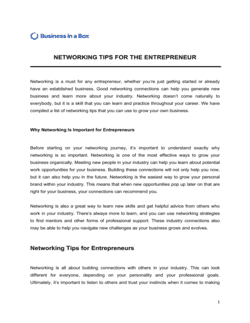
11 Strategies To Elevate Your Networking Game

Free to read β€’ Save or share with one click

Free11 Strategies To Elevate Your Networking Game Template

At a glance

What it is
"11 Strategies To Elevate Your Networking Game" is a structured Word document that walks professionals through eleven actionable tactics for building and sustaining a high-value professional network. This free download gives you an editable, ready-to-personalize guide you can use as a self-coaching tool, share with a team, or adapt into a workshop handout β€” exportable as PDF in minutes.
When you need it
Use it when you are starting a new role, launching a business, re-entering the job market, or preparing for a major conference or industry event where relationship-building directly affects career or revenue outcomes.
What's inside
The guide covers goal-setting for networking, identifying target contacts, crafting a compelling personal introduction, leveraging digital platforms, following up effectively, and sustaining relationships over time β€” all organized into eleven discrete, immediately actionable strategies.

What is "11 Strategies To Elevate Your Networking Game"?

"11 Strategies To Elevate Your Networking Game" is a structured professional guide that breaks down the art of relationship-building into eleven discrete, immediately actionable strategies β€” from mapping your existing contacts and crafting a personal introduction to leveraging digital platforms, asking for warm introductions, and running quarterly reviews of your networking results. Unlike generic advice articles, this template is a working document you personalize with your own goals, target contacts, and follow-up cadences, then use as an ongoing reference throughout your career. It is formatted as a free Word download you can edit online and export as PDF to share with a coach, manager, or workshop group.

Why You Need This Document

Most professionals network reactively β€” reaching out only when they need a job, a referral, or a sales lead β€” and then wonder why their requests go unanswered. Without a deliberate system, relationships go dormant, follow-ups never happen, and the contacts most likely to open doors are the ones you forgot to stay in touch with. The cost is concrete: studies consistently find that the majority of professional opportunities are filled through relationships rather than public channels, which means an underdeveloped network is a direct constraint on career and revenue growth. This guide gives you a repeatable system β€” goal-setting, contact mapping, outreach sequencing, and quarterly review β€” so that networking becomes a habit with measurable outcomes rather than a stressful last resort.

Which variant fits your situation?

If your situation is…Use this template
Using the guide as a personal self-improvement plan11 Strategies To Elevate Your Networking Game
Building a full professional development roadmapPersonal Development Plan
Preparing for a structured job search with networking as the primary tacticCareer Action Plan
Creating a business development strategy that includes networkingBusiness Development Plan
Running a networking workshop or lunch-and-learn for a teamTraining Plan
Setting quarterly goals that include relationship-building targetsAction Plan Template
Tracking outreach and follow-up with contacts systematicallyCRM Contact Tracker (Spreadsheet)

Common mistakes to avoid

❌ Prioritizing quantity of contacts over quality of conversations

Why it matters: Collecting hundreds of connections with no follow-up creates the illusion of a network without any of the value. A contact who does not know you cannot refer you or advocate for you.

Fix: Cap yourself at 5–10 active relationship-building targets per quarter. Depth compounds; breadth does not.

❌ Only networking when you need something

Why it matters: Contacts immediately recognize transactional outreach, especially from someone who has been silent for 18 months. It permanently shifts how they perceive the relationship.

Fix: Build a standing monthly touchpoint routine β€” sharing articles, congratulating milestones, or making introductions β€” so your outreach is never exclusively need-driven.

❌ Skipping the follow-up after an initial meeting

Why it matters: Without a follow-up within 48 hours, most new contacts forget the conversation entirely. The first meeting is an introduction; the follow-up is the beginning of the relationship.

Fix: Send a follow-up email within 24 hours that references one specific detail from the conversation and proposes a clear next step.

❌ Using a one-size-fits-all personal introduction

Why it matters: A pitch optimized for investors will alienate a peer-group networking event. Mismatched framing signals a lack of self-awareness and reduces the likelihood of a meaningful connection.

Fix: Prepare two or three versions of your introduction β€” one for peers, one for senior contacts, one for cross-industry events β€” and choose based on context.

The 11 key sections, explained

Define your networking goals

Map your existing network

Craft your personal introduction

Identify high-value targets

Leverage LinkedIn and digital platforms

Attend and maximize events

Ask for introductions strategically

Follow up and stay in touch

Give value before asking for it

Build your online presence as a networking asset

Review and iterate your networking system

How to fill it out

  1. 1

    Set your networking goals before editing anything else

    Open the template and complete the goal-setting section first. Write one primary outcome goal for the next 90 days β€” specific role, industry, and measurable result.

    πŸ’‘ Anchor the goal to a real deadline, such as a conference date or a job application window, to create urgency.

  2. 2

    Complete your network map

    List current contacts across three tiers: strong active relationships, dormant high-value contacts, and acquaintances worth developing. Note the industry and potential mutual value for each.

    πŸ’‘ Import your email contacts or LinkedIn connections into a spreadsheet first β€” most people have 200–500 contacts they have forgotten about.

  3. 3

    Write and test your personal introduction

    Draft a 30-second verbal introduction and a 2–3 sentence written version for LinkedIn or email. Read both aloud and time them.

    πŸ’‘ Test your introduction on a trusted colleague and ask them to repeat back what you do β€” if they cannot, simplify the language.

  4. 4

    Identify 10–15 specific target contacts

    Name specific people, roles, or companies in the target contacts section. Include a one-sentence rationale for each β€” why this person, why now.

    πŸ’‘ Use LinkedIn's 'People also viewed' and alumni filters to find names you would not have thought of independently.

  5. 5

    Customize the digital presence checklist

    Work through the online presence section and update your LinkedIn headline, summary, and featured section to match the introduction you wrote in Step 3.

    πŸ’‘ Your LinkedIn headline is indexed by search β€” include the job title or industry keyword your target contacts would use to find someone like you.

  6. 6

    Build your follow-up calendar

    Use the follow-up cadence section to schedule specific touchpoint dates for your top 10 contacts in your calendar or CRM β€” not as a vague intention but as actual calendar blocks.

    πŸ’‘ A 15-minute monthly calendar block labeled 'network follow-ups' beats an elaborate system you never open.

  7. 7

    Schedule your first quarterly review

    Set a 30-minute calendar reminder 90 days from today to complete the review section β€” count outcomes, not activities, and adjust the strategy for the next quarter.

    πŸ’‘ Bring your completed template to the review so you can compare what you planned with what actually happened.

Frequently asked questions

What is a professional networking strategy?

A professional networking strategy is a deliberate, structured approach to building and maintaining relationships that support career or business goals. It defines who you want to connect with, how you will initiate and sustain those relationships, and how you will measure outcomes over time. Without a strategy, most networking efforts are reactive and produce inconsistent results.

Why is professional networking important for career growth?

Research consistently shows that 70–80% of jobs are filled through relationships rather than posted applications. Beyond job searches, a strong network provides access to referrals, market intelligence, mentorship, and partnership opportunities that are not available through public channels. Professionals with intentional networking habits consistently outpace peers with equivalent skills but smaller networks.

How do I start networking if I have no existing connections?

Start with the connections you already have β€” former classmates, colleagues, professors, and neighbors are all valid starting points. From there, attend one industry event per month, join one relevant online community, and ask for one introduction per week from your existing contacts. Consistent low-volume activity compounds faster than occasional high-effort bursts.

What is the best way to follow up after meeting someone at a networking event?

Send a short, specific email within 24 hours that references one detail from your conversation β€” a shared connection, a topic you discussed, or something they mentioned about their work. Propose a low-friction next step, such as a 20-minute coffee or a LinkedIn connection. Vague follow-ups like 'great to meet you, let's stay in touch' almost never result in a second interaction.

How do I network effectively on LinkedIn?

Complete your profile with a clear headline, current role, and a featured section with concrete work samples. Send personalized connection requests that name a specific reason β€” shared conference, mutual contact, or a specific post they wrote. Engage with target contacts' content before reaching out directly. Publish short posts or comments in your area of expertise at least twice per week to maintain visibility.

How many people should I be actively networking with at one time?

Most professionals can maintain 50–150 active relationships of varying depth before quality degrades β€” this is consistent with Dunbar's Number research on social group limits. For practical purposes, focus 80% of your active effort on 10–15 priority relationships per quarter, while maintaining lighter touchpoints with a broader group of 50–100.

What is the reciprocity principle in networking?

Reciprocity is the social norm of returning value for value. In networking, it means consistently offering referrals, introductions, resources, or recognition to contacts before asking for anything in return. Contacts who receive genuine value from a relationship are significantly more likely to advocate for you when an opportunity arises.

How do I ask for an introduction without being awkward?

Use the double opt-in method: ask your mutual contact privately whether they are comfortable making the introduction before naming you to the target. Send a forwardable note β€” 2–3 sentences explaining who you are, why you want to connect, and what value you might offer the other person. This removes friction for the introducer and increases the likelihood the target agrees to connect.

How often should I review and update my networking strategy?

A quarterly review is the minimum for anyone actively networking for career or business goals. Review which outreach converted into meaningful conversations, which contacts advanced in relationship depth, and which strategies generated tangible outcomes. Adjust your target contact list and tactics accordingly for the next 90 days.

How this compares to alternatives

vs Personal Development Plan

A personal development plan covers the full scope of skill-building, goal-setting, and career growth β€” networking is one component among many. The 11 Strategies guide focuses exclusively on relationship-building tactics, making it more actionable for someone specifically targeting their network. Use the personal development plan for holistic career planning, and this guide when networking is the primary lever.

vs Business Development Plan

A business development plan addresses pipeline growth, partnership strategy, and revenue targets at an organizational level. The networking strategies guide is individually focused β€” it equips the person executing outreach, not the company setting BD targets. Both documents complement each other when a sales or BD professional is the intended user.

vs Action Plan Template

An action plan provides a generic framework for any goal: tasks, owners, deadlines, and success metrics. The networking strategies guide is pre-populated with the specific tactics and sequencing that make professional networking effective β€” it trades generality for depth. Use the action plan if you need to assign networking tasks across a team; use this guide if you need to coach an individual.

vs Marketing Plan

A marketing plan drives awareness and demand through channels like paid media, content, and SEO β€” largely at scale and often without a human relationship component. The networking strategies guide focuses on one-to-one relationship development. For solo practitioners and consultants, personal networking often outperforms mass marketing in the early stages of business development.

Industry-specific considerations

Professional Services

Referral-based business development makes networking directly tied to revenue β€” lawyers, accountants, and consultants who systematize follow-up fill their pipelines faster than those who rely on organic inbound.

Technology / SaaS

Founder and executive networks drive warm introductions to investors and enterprise buyers; conference circuits like SaaStr and Web Summit are high-ROI networking environments that reward pre-event targeting.

Financial Services

Relationship-driven deal flow in banking, private equity, and wealth management means networking is not optional β€” senior professionals are expected to maintain active client and peer networks as part of the role.

Retail and E-commerce

Buyer-vendor relationships, supplier introductions, and industry association membership are the primary networking channels; LinkedIn is less dominant here than trade shows and category-specific events.

Template vs pro β€” what fits your needs?

PathBest forCostTime
Use the templateIndividual professionals, freelancers, and founders who want a structured self-coaching framework for improving their networking habitsFree1–2 hours to personalize; ongoing 30-minute monthly review
Template + professional reviewSales teams or HR departments adapting the guide into a facilitated workshop or onboarding module$200–$800 for a career coach or facilitator review session3–5 hours to customize for group delivery
Custom draftedOrganizations building a formal business development or employer-brand networking program with measurable KPIs and manager accountability$1,500–$5,000 for a consultant to build a custom program2–4 weeks

Glossary

Weak Ties
Acquaintances and distant contacts β€” as opposed to close friends β€” who are often the source of the most novel job leads and business opportunities.
Elevator Pitch
A concise, 30–60 second personal introduction that clearly communicates who you are, what you do, and what value you offer.
Informational Interview
A short, low-stakes conversation with someone in a target role or industry, initiated by you to learn rather than to ask for a job or sale.
Personal Brand
The professional reputation and distinct value proposition you project consistently across in-person interactions, social profiles, and written communications.
Reciprocity Principle
The social norm of returning favors β€” in networking, giving value first (introductions, referrals, resources) before asking for anything.
Network Mapping
The practice of visually or systematically cataloguing your existing contacts by relationship strength, industry, and potential mutual value.
Follow-Up Cadence
A scheduled sequence of touchpoints β€” email, coffee, LinkedIn message β€” used to maintain a relationship after an initial meeting.
Gatekeeping Contact
A highly connected individual who controls access to a broader community or decision-maker, often worth prioritizing in a targeted networking strategy.
Social Proof
Third-party endorsements, recommendations, or visible credentials that increase the likelihood a new contact will trust and engage with you.
Second-Degree Connection
A person you do not know directly but who is connected to someone in your existing network β€” the most efficient source of warm introductions.

Part of your Business Operating System

This document is one of 3,000+ business & legal templates included in Business in a Box.

  • Fill-in-the-blanks β€” ready in minutes
  • Compatible with all office suites
  • Export to PDF and share electronically

Create your document in 3 simple steps.

From template to signed document β€” all inside one Business Operating System.
1
Download or open template

Access over 3,000+ business and legal templates for any business task, project or initiative.

2
Edit and fill in the blanks with AI

Customize your ready-made business document template and save it in the cloud.

3
Save, Share, Send, Sign

Share your files and folders with your team. Create a space of seamless collaboration.

Save time, save money, and create top-quality documents.

β˜…β˜…β˜…β˜…β˜…

"Fantastic value! I'm not sure how I'd do without it. It's worth its weight in gold and paid back for itself many times."

Managing Director Β· Mall Farm
Robert Whalley
Managing Director, Mall Farm Proprietary Limited
β˜…β˜…β˜…β˜…β˜…

"I have been using Business in a Box for years. It has been the most useful source of templates I have encountered. I recommend it to anyone."

Business Owner Β· 4+ years
Dr Michael John Freestone
Business Owner
β˜…β˜…β˜…β˜…β˜…

"It has been a life saver so many times I have lost count. Business in a Box has saved me so much time and as you know, time is money."

Owner Β· Upstate Web
David G. Moore Jr.
Owner, Upstate Web

Run your business with a system β€” not scattered tools

Stop downloading documents. Start operating with clarity. Business in a Box gives you the Business Operating System used by over 250,000 companies worldwide to structure, run, and grow their business.

Start freeΒ Β·Β No credit card required