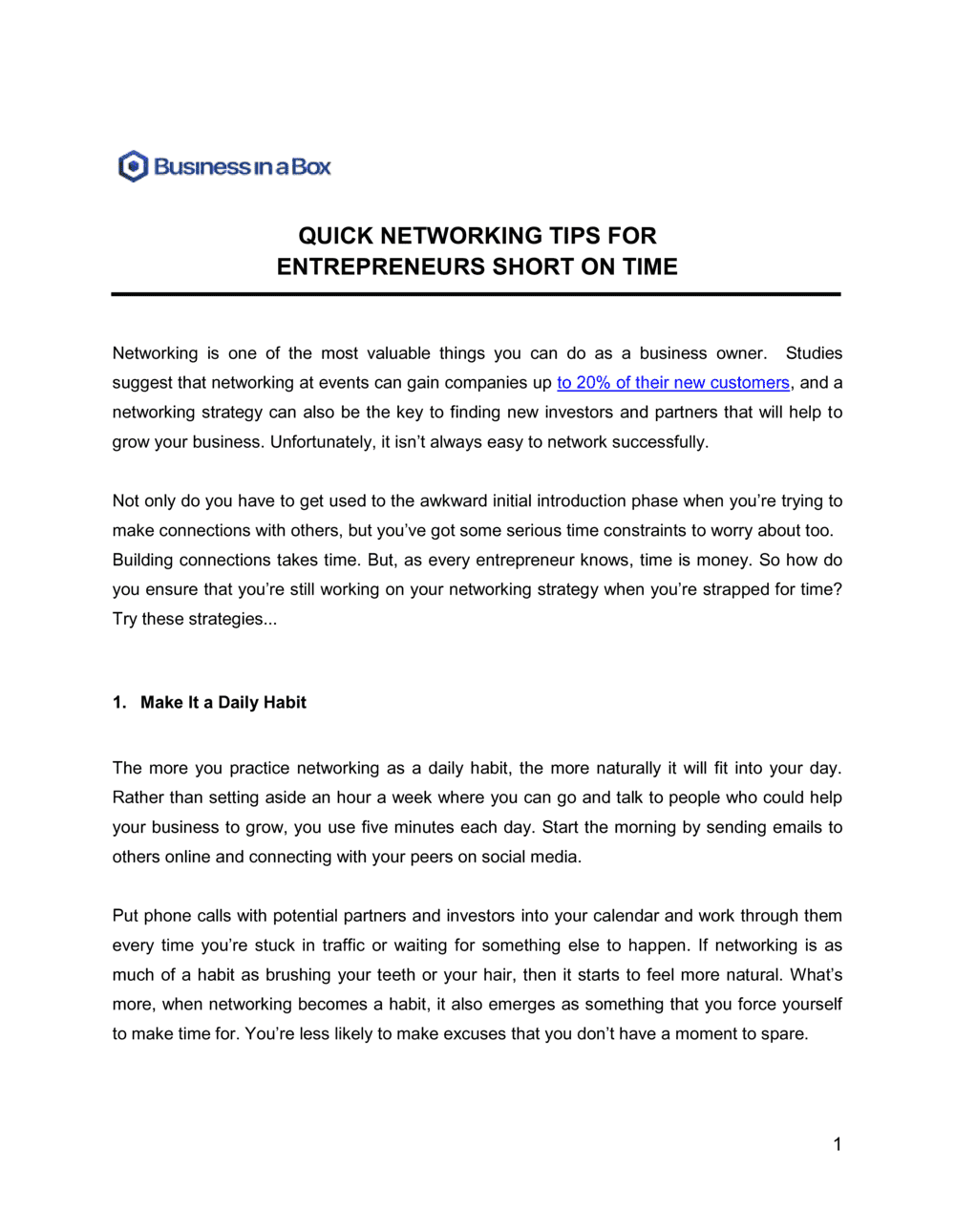
Quick Networking Tips For Entrepreneurs Short On Time

Free Word download β€’ Edit online β€’ Save & share with Drive β€’ Export to PDF

4 pagesβ€’25–30 min to fillβ€’Difficulty: Complexβ€’Signature requiredβ€’Legal review recommended
Learn more ↓
FreeQuick Networking Tips For Entrepreneurs Short On Time Template

At a glance

What it is
A Networking Agreement for Entrepreneurs is a binding document that formalizes the terms under which two or more business owners exchange introductions, referrals, and mutual support. This free Word download lets you define referral fees, confidentiality expectations, exclusivity limits, and dispute procedures in a single document you can edit online and export as PDF.
When you need it
Use it whenever you enter a structured networking relationship that involves sharing client referrals, co-marketing activities, or business introductions where money, leads, or confidential information will change hands. A handshake understanding is sufficient for casual coffee introductions; a signed agreement is essential once commissions, exclusivity, or proprietary data are involved.
What's inside
Defined parties and relationship scope, referral fee structure and payment terms, confidentiality obligations, exclusivity or non-compete parameters, mutual introduction protocols, intellectual property ownership of shared materials, term and termination provisions, and governing law with dispute resolution.

What is a Networking Agreement for Entrepreneurs?

A Networking Agreement for Entrepreneurs is a legally binding contract that formalizes the terms under which two or more business owners exchange introductions, client referrals, and mutual business support. It defines exactly which introductions qualify, how referral fees are calculated and paid, what confidential information each party must protect, and what obligations survive after the relationship ends. Unlike a casual arrangement confirmed over coffee, a properly executed networking agreement creates enforceable rights on both sides β€” specifying the conversion event that triggers a fee, the tail period that protects referrals already in flight, and the dispute resolution process if the parties disagree.

Why You Need This Document

Without a written networking agreement, every introduction you make is a potential dispute waiting to happen. Fee percentages recalled differently by each party, no mechanism for attributing which contact introduced a client, and no protection for the client lists you shared in good faith β€” these are predictable outcomes of informal referral arrangements. The financial exposure is real: a single mid-market client introduction worth a 10% referral fee on a $150,000 contract means $15,000 at stake with nothing in writing to enforce. Beyond money, confidential pipeline data, pricing structures, and client contact information shared between networking partners has no legal protection without an explicit confidentiality clause. This template gives you a signed, timestamped document that closes every one of those gaps in under 30 minutes β€” protecting your referral income, your client relationships, and your proprietary information from the moment the first introduction is made.

Which variant fits your situation?

If your situation is…Use this template
Paying a flat fee per successful introductionReferral Fee Agreement
Ongoing revenue-share arrangement between two businessesRevenue Sharing Agreement
Co-marketing campaign between two complementary brandsCo-Marketing Agreement
Protecting confidential information shared during networkingNon-Disclosure Agreement (NDA)
Long-term strategic alliance between two companiesStrategic Alliance Agreement
Formalizing a joint venture between networking partnersJoint Venture Agreement
Simple letter confirming a one-time introduction with no ongoing obligationLetter of Introduction

Common mistakes to avoid

❌ No documented introduction protocol

Why it matters: Without a clear attribution process, both parties may claim credit for the same client lead, and the agreement provides no mechanism to resolve the conflict.

Fix: Add a written introduction requirement β€” a direct email to both parties confirming the referral β€” and set a deadline (e.g., within five business days) for the introducing party to file it.

❌ Percentage fee tied to gross revenue instead of net contract value

Why it matters: Gross revenue includes taxes, refunds, and pass-through costs that inflate the base, leading to fee calculations the recipient considers unfair and is likely to dispute.

Fix: Define the fee base explicitly as net contract value or net fees received, and list any exclusions (taxes, third-party costs, discounts) in the clause.

❌ Omitting a tail period

Why it matters: A recipient can strategically delay closing an introduced deal until after termination, then convert the lead without paying a fee β€” with no contractual remedy available.

Fix: Include a tail period of at least 60–90 days covering any lead formally introduced before the termination date, with fee obligations surviving termination explicitly.

❌ No survival clause for confidentiality and non-solicitation

Why it matters: If the agreement is silent, courts in some jurisdictions treat all obligations as expiring at termination β€” leaving client lists and shared business intelligence unprotected the moment the relationship ends.

Fix: Add a survival clause listing every provision that continues after termination: confidentiality, non-solicitation, tail period, and dispute resolution at minimum.

❌ Using an at-will or open-ended term with no notice requirement

Why it matters: Either party can exit the arrangement immediately, leaving an active pipeline of introductions in limbo and creating disputes about who owes what for pending deals.

Fix: Set a defined initial term (12 months is standard) and require 30 days' written notice to terminate, giving both parties time to wind down active introductions properly.

❌ Making the agreement exclusive without naming specific competitors

Why it matters: Blanket exclusivity without defined competitors is overbroad and may restrict the referring party from normal business development activities unrelated to the relationship.

Fix: Name the specific companies or categories subject to exclusivity, or limit exclusivity to a narrow defined segment rather than all competitors in the industry.

The 10 key clauses, explained

Parties and relationship definition

In plain language: Identifies both parties by legal name and entity type, and describes the nature of the networking relationship being formalized.

Sample language
This Networking Agreement ('Agreement') is entered into as of [DATE] between [PARTY A LEGAL NAME], a [STATE/PROVINCE] [ENTITY TYPE] ('Referrer'), and [PARTY B LEGAL NAME], a [STATE/PROVINCE] [ENTITY TYPE] ('Recipient').

Common mistake: Using trade names instead of registered legal entity names. If a dispute arises, enforcing the agreement against the correct legal person becomes complicated when names do not match corporate registry records.

Scope of networking activities

In plain language: Defines exactly what activities are covered β€” types of introductions, referral categories, geographic territories, and industries within scope.

Sample language
Referrer agrees to introduce prospective clients within the [INDUSTRY / GEOGRAPHY] sector to Recipient. Introductions shall be limited to [SPECIFIC SERVICE TYPES] and shall not include [EXCLUDED CATEGORIES].

Common mistake: Leaving scope open-ended with language like 'all business opportunities.' This creates disputes about whether a given introduction falls under the agreement and what fee, if any, is owed.

Referral fee structure and payment terms

In plain language: States the fee amount or percentage, the conversion event that triggers payment, the payment deadline, and accepted payment methods.

Sample language
Recipient shall pay Referrer a referral fee equal to [X]% of the net contract value, or $[FLAT AMOUNT], within [30] days of the Conversion Event. Payment shall be made by [ACH / wire transfer / check] to the account designated by Referrer.

Common mistake: Defining the fee as a percentage of 'revenue' without specifying whether gross or net revenue applies. Tax implications, discounts, and refunds can swing the actual payout significantly.

Introduction protocol and warm introduction standard

In plain language: Describes the required process for making a qualifying introduction β€” typically a direct email or meeting facilitation β€” to ensure the referral is properly attributed.

Sample language
A qualifying introduction shall consist of a direct written communication to both parties from Referrer identifying the prospective client and confirming the introduction is made pursuant to this Agreement. Referrer shall notify Recipient within [5] business days of each introduction.

Common mistake: No attribution protocol at all. Without a documented introduction process, both parties may claim credit for the same client, generating fee disputes that the agreement cannot resolve.

Confidentiality

In plain language: Prohibits each party from disclosing client lists, pricing, business strategy, or other non-public information shared in the course of the networking relationship.

Sample language
Each party shall keep all Confidential Information of the other party strictly confidential and shall not disclose or use it for any purpose outside the scope of this Agreement without prior written consent.

Common mistake: Omitting a definition of what constitutes Confidential Information. Courts require reasonable specificity β€” an unlimited confidentiality clause with no definition is often narrowed or voided.

Non-solicitation

In plain language: Prevents each party from directly approaching the other's clients, key employees, or active prospects outside the agreed referral framework.

Sample language
During the Term and for [12] months thereafter, neither party shall directly solicit any client, customer, or employee of the other party without prior written consent.

Common mistake: Using a non-solicitation clause that is broader than necessary for the relationship, covering industries or contacts the party never actually shared. Overly broad restrictions are more likely to be struck down as unreasonable.

Exclusivity and competitive restrictions

In plain language: States whether either party is restricted from entering similar referral or networking arrangements with named competitors, and for how long.

Sample language
This Agreement [is / is not] exclusive. If exclusive, Referrer agrees not to enter into a substantially similar referral arrangement with [LIST OF NAMED COMPETITORS] during the Term.

Common mistake: Making every networking agreement exclusive by default without considering the practical burden. Exclusivity should be reserved for high-value relationships where it is genuinely warranted and reciprocal.

Tail period

In plain language: Sets a window after termination during which the referral fee is still owed if a lead introduced before termination converts into a paying client.

Sample language
For [90] days following termination or expiration of this Agreement, Recipient shall continue to pay Referral Fees for any prospective client introduced by Referrer prior to termination who subsequently becomes a paying client.

Common mistake: No tail period at all. Without one, a recipient can wait for the agreement to lapse before closing an introduced deal, permanently avoiding the fee with no contractual remedy.

Term and termination

In plain language: Sets the agreement's start and end date, the notice required to terminate early, and any obligations that survive termination.

Sample language
This Agreement commences on [START DATE] and continues for [12] months unless earlier terminated. Either party may terminate with [30] days' written notice. Confidentiality, non-solicitation, and tail-period obligations survive termination.

Common mistake: No survival clause. If confidentiality and non-solicitation provisions are not explicitly stated to survive termination, a court may find they expire with the agreement.

Governing law and dispute resolution

In plain language: Specifies which jurisdiction's law applies and how disputes are handled β€” negotiation, mediation, arbitration, or litigation.

Sample language
This Agreement is governed by the laws of [STATE / PROVINCE / COUNTRY]. Any dispute shall first be submitted to good-faith negotiation for [30] days. Unresolved disputes shall be submitted to binding arbitration administered by [AAA / JAMS / ICDR] in [CITY].

Common mistake: Choosing a governing law state with no connection to either party's location or operations. Courts in several jurisdictions will apply local law regardless, making the chosen-law clause ineffective.

How to fill it out

  1. 1

    Confirm legal entity names for both parties

    Enter the full registered legal name and entity type (LLC, corporation, sole proprietor) for both parties. Cross-reference corporate registry records before executing.

    πŸ’‘ Ask the other party to share their certificate of incorporation or business registration number β€” it takes 60 seconds and prevents enforcement problems later.

  2. 2

    Define the scope of qualifying introductions

    Specify the industry, geography, and service type that make an introduction qualify under the agreement. Name any excluded categories explicitly.

    πŸ’‘ Narrow scope is better than broad scope β€” you can always amend to expand coverage, but disputes arise when scope is vague at the outset.

  3. 3

    Set the referral fee structure and conversion event

    Choose between a flat fee per closed deal or a percentage of net contract value. Define the exact trigger (signed contract, first payment received, or project completion) that starts the fee clock.

    πŸ’‘ Percentage-of-net-contract-value arrangements are cleaner than percentage-of-revenue for project-based businesses β€” they avoid ongoing tracking obligations.

  4. 4

    Establish the introduction protocol

    Write out the exact process: a written email to both parties from the introducing party, sent within a specified number of business days, confirming the introduction is made under the agreement.

    πŸ’‘ Create a short email template you both agree to use at signing β€” it eliminates any ambiguity about whether a given introduction is formally attributed.

  5. 5

    Decide on exclusivity and non-solicitation scope

    Determine whether the relationship is exclusive, and if so, name the specific competitors covered. Set the non-solicitation period β€” typically 12 months post-termination.

    πŸ’‘ Reserve exclusivity for relationships with a formal revenue-share component. Non-exclusive referral arrangements are easier to maintain and less likely to generate disputes.

  6. 6

    Set the tail period and payment deadline

    Agree on how long after termination referral fees remain payable for leads already introduced. Sixty to ninety days is the typical range for service businesses.

    πŸ’‘ A 90-day tail is standard for B2B services with longer sales cycles; 30 days may suffice for high-volume, fast-close transactions.

  7. 7

    Select governing law and dispute resolution method

    Choose the jurisdiction where at least one party operates. Select arbitration for faster, less expensive resolution β€” specify the administering body (AAA or JAMS) and the city of proceedings.

    πŸ’‘ Arbitration clauses that specify a city far from one party effectively prevent them from enforcing their rights. Choose a neutral, accessible location.

  8. 8

    Sign before any introductions are made

    Both parties must execute the agreement before the first introduction occurs. Post-introduction signatures raise a consideration problem and may not cover the earliest referrals.

    πŸ’‘ Use a timestamped eSignature to create a clear execution record. Store the fully executed copy in a shared location both parties can access.

Frequently asked questions

What is a networking agreement for entrepreneurs?

A networking agreement for entrepreneurs is a binding contract that formalizes the terms under which two or more business owners exchange introductions, referrals, and mutual support. It defines referral fee structures, confidentiality obligations, introduction protocols, and what happens when the relationship ends. It transforms an informal handshake arrangement into an enforceable legal document that protects both parties' interests.

When does a networking arrangement need a formal written agreement?

A written agreement is warranted whenever money changes hands β€” referral fees, commissions, or revenue shares β€” or whenever confidential client information is exchanged. Casual introductions between friends do not require a contract. But once either party expects compensation for introductions, or when proprietary client lists or pricing data are shared, a signed document is essential to avoid disputes.

What is a referral fee and how should it be structured?

A referral fee is a payment made when an introduction leads to a closed deal or signed contract. It is typically structured as a flat amount per conversion or as a percentage (commonly 5–20%) of the net contract value. The agreement should specify the exact event that triggers payment, the payment deadline, and whether the fee applies to renewals or upsells from the same introduced client.

Is a networking agreement legally enforceable?

A networking agreement is generally enforceable when it is properly executed by both parties, contains clear terms, and is supported by mutual consideration β€” each party gives something of value, such as agreeing to make introductions in exchange for fees or reciprocal referrals. Courts in most jurisdictions will uphold well-drafted referral fee arrangements. Consult a lawyer if the fee structure is complex or the amounts involved are significant.

What is a tail period in a networking agreement?

A tail period is a defined window after the agreement terminates during which referral fees are still owed if a lead introduced before termination converts into a paying client. A standard tail is 60–90 days for service businesses. Without a tail period, a recipient can wait for the agreement to expire before closing an introduced deal, permanently avoiding the fee with no remedy for the referrer.

Can a networking agreement include a non-compete clause?

Yes, but enforceability depends heavily on jurisdiction and scope. In the US, courts apply a reasonableness standard β€” narrow geographic and industry scope, short duration, and a legitimate business interest to protect. California and several other states restrict or ban post-term non-competes even in commercial agreements between businesses. Non-solicitation clauses (preventing either party from poaching the other's clients) are generally more enforceable than broad non-competes.

What is the difference between a networking agreement and a referral fee agreement?

A referral fee agreement focuses narrowly on the financial terms of a single category of introductions β€” fee amount, conversion event, and payment mechanics. A networking agreement is broader, covering the full scope of the relationship: mutual introduction obligations, confidentiality, non-solicitation, exclusivity, and co-marketing activities, in addition to any referral fee structure. Use a referral fee agreement for a transactional arrangement; use a networking agreement when the relationship has multiple dimensions.

Does a networking agreement need to be notarized?

No. Notarization is not required for a networking or referral agreement to be enforceable in most jurisdictions. A witnessed signature or timestamped eSignature is sufficient. Notarization adds a layer of authentication but does not change the legal effect of the document for this type of commercial arrangement.

How long should a networking agreement last?

A 12-month initial term with automatic renewal or a mutual option to renew is the most common structure. This gives both parties time to assess the value of the relationship before committing indefinitely, while providing enough runway for longer B2B sales cycles to produce attributable results. Build in a 30-day written notice requirement for early termination to protect active introductions in the pipeline.

How this compares to alternatives

vs Non-Disclosure Agreement (NDA)

An NDA covers only the confidentiality of information exchanged between parties and creates no obligation to make introductions or pay fees. A networking agreement incorporates confidentiality alongside the full scope of the referral relationship β€” introduction protocols, fees, non-solicitation, and term. Use an NDA alone when exploring a potential relationship; use a networking agreement once the arrangement is active.

vs Strategic Alliance Agreement

A strategic alliance agreement governs a deeper, longer-term collaborative relationship β€” co-developed products, shared resources, joint sales, and integrated operations. A networking agreement is narrower, focused on introductions and referrals between independent businesses that maintain separate operations. Networking agreements are appropriate for referral partnerships; strategic alliance agreements are appropriate when the parties are building something together.

vs Joint Venture Agreement

A joint venture creates a new legal entity or shared commercial undertaking where both parties contribute resources and share profit and liability. A networking agreement involves no shared entity β€” each party remains independent and the only financial flow is a referral fee. Choose a joint venture when the parties are pooling capital or co-delivering a product; choose a networking agreement when they are simply exchanging introductions.

vs Independent Contractor Agreement

An independent contractor agreement engages an individual or company to perform specific services under the direction of a client, with defined deliverables and compensation. A networking agreement governs a peer-to-peer referral relationship between two independent businesses with no direction or control flowing from one to the other. Misusing a contractor agreement for a referral arrangement can create unintended employment classification risk.

Industry-specific considerations

Professional Services

Accountants, lawyers, and consultants frequently exchange client referrals β€” a formal agreement prevents fee disputes and protects client confidentiality when lists are shared.

Technology / SaaS

Startup founders and SaaS companies use networking agreements to formalize channel partner introductions, affiliate referrals, and co-marketing arrangements with complementary tools.

Real Estate

Real estate professionals are subject to strict referral fee regulations in most jurisdictions β€” the agreement must align with RESPA restrictions in the US and provincial rules in Canada.

Creative and Marketing Agencies

Agencies trade client introductions across disciplines β€” a networking agreement sets commission rates for referred projects and prevents direct solicitation of each other's clients.

Jurisdictional notes

United States

Referral fee agreements between businesses are generally enforceable under state contract law. Real estate referral fees are subject to RESPA restrictions at the federal level. In regulated industries such as financial services, referral arrangements may require FINRA disclosure or state licensing. Non-compete enforceability varies sharply by state β€” California, Minnesota, and Oklahoma apply severe restrictions even in B2B commercial agreements.

Canada

Referral arrangements between businesses are governed by provincial contract law. Quebec requires that commercial agreements with provincial parties be available in French. Real estate referral fees are regulated under provincial real estate acts and must comply with licensing requirements. Non-solicitation clauses are enforceable when reasonable in scope and duration; overly broad restrictions are severed rather than upheld.

United Kingdom

Referral fee arrangements are generally enforceable as commercial contracts. However, referral fees in personal injury legal matters are banned under the Legal Aid, Sentencing and Punishment of Offenders Act 2012. Financial services referral arrangements involving regulated activities require FCA authorization or an appointed representative structure. Post-term non-solicitation clauses are enforceable when reasonable and tied to a legitimate business interest.

European Union

Commercial referral arrangements are enforceable across member states, but specific sectors β€” financial services, insurance, real estate β€” are subject to national licensing rules that may restrict fee-sharing. Any sharing of client personal data as part of an introduction triggers GDPR obligations, including lawful basis documentation and data processing agreements. Non-solicitation restrictions must be proportionate and time-limited to be enforceable; requirements vary by member state.

Template vs lawyer β€” what fits your deal?

PathBest forCostTime
Use the templateEntrepreneurs formalizing straightforward referral fee arrangements with trusted peers in a single jurisdictionFree20–30 minutes
Template + legal reviewArrangements with significant fee volumes, exclusivity provisions, or parties in different states or provinces$300–$7002–4 days
Custom draftedComplex multi-party networking structures, regulated industries (real estate, financial services), or cross-border arrangements with material revenue at stake$1,000–$3,500+1–2 weeks

Glossary

Referral Fee
A payment made to a party who introduces a client or customer that results in a completed transaction or signed contract.
Mutual Referral Arrangement
An agreement in which both parties agree to send business opportunities to each other, typically without a direct monetary payment between them.
Exclusivity Clause
A provision restricting one or both parties from entering similar networking or referral arrangements with named competitors during the agreement term.
Warm Introduction
A direct, personally facilitated introduction from one party to a prospective client or contact, as opposed to sharing a name or contact detail without context.
Conversion Event
The specific action β€” such as a signed contract, paid invoice, or closed sale β€” that triggers payment of a referral fee.
Confidential Information
Any non-public data, client lists, pricing, strategy, or business intelligence shared between the parties during the networking relationship.
Non-Solicitation
A restriction preventing one party from directly approaching the other party's clients, employees, or contacts outside the scope of the agreement.
Tail Period
A defined window after the agreement terminates during which referral fees are still owed if a lead introduced before termination converts to a paying client.
Governing Law
The jurisdiction whose laws apply to interpret and enforce the agreement, typically the state, province, or country where one of the parties is incorporated.
Indemnification
A contractual obligation by one party to compensate the other for losses, claims, or costs arising from a specific breach or act.

Part of your Business Operating System

This document is one of 3,000+ business & legal templates included in Business in a Box.

  • Fill-in-the-blanks β€” ready in minutes
  • 100% customizable Word document
  • Compatible with all office suites
  • Export to PDF and share electronically

Create your document in 3 simple steps.

From template to signed document β€” all inside one Business Operating System.
1
Download or open template

Access over 3,000+ business and legal templates for any business task, project or initiative.

2
Edit and fill in the blanks with AI

Customize your ready-made business document template and save it in the cloud.

3
Save, Share, Send, Sign

Share your files and folders with your team. Create a space of seamless collaboration.

Save time, save money, and create top-quality documents.

β˜…β˜…β˜…β˜…β˜…

"Fantastic value! I'm not sure how I'd do without it. It's worth its weight in gold and paid back for itself many times."

Managing Director Β· Mall Farm
Robert Whalley
Managing Director, Mall Farm Proprietary Limited
β˜…β˜…β˜…β˜…β˜…

"I have been using Business in a Box for years. It has been the most useful source of templates I have encountered. I recommend it to anyone."

Business Owner Β· 4+ years
Dr Michael John Freestone
Business Owner
β˜…β˜…β˜…β˜…β˜…

"It has been a life saver so many times I have lost count. Business in a Box has saved me so much time and as you know, time is money."

Owner Β· Upstate Web
David G. Moore Jr.
Owner, Upstate Web

Run your business with a system β€” not scattered tools

Stop downloading documents. Start operating with clarity. Business in a Box gives you the Business Operating System used by over 250,000 companies worldwide to structure, run, and grow their business.

Start freeΒ Β·Β No credit card required