Reminder_The Prices in This Quotation Are Good for a Limited Template

Free Word download β€’ Edit online β€’ Save & share with Drive β€’ Export to PDF

1 pageβ€’20–25 min to fillβ€’Difficulty: Standardβ€’Signature requiredβ€’Legal review recommended
Learn more ↓
FreeReminder_The Prices in This Quotation Are Good for a Limited Template

At a glance

What it is
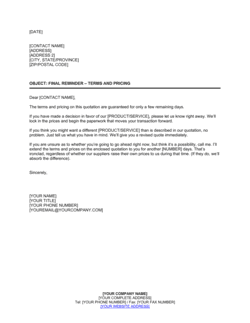
A Price Quotation Reminder Letter is a formal written notice sent to a prospective buyer to communicate that the prices set out in a previously issued quotation remain valid only until a specified expiry date. This free Word download gives sellers a structured, professionally worded letter they can edit online and export as PDF to send to prospects before a quote lapses, protecting agreed pricing terms and prompting timely acceptance.
When you need it
Use it when a quotation you issued to a client or prospect is approaching its expiry date and no order or acceptance has been received. It is especially important when material costs, labor rates, or currency exchange rates are volatile and you cannot honor the quoted price indefinitely.
What's inside
Seller and recipient details, reference to the original quotation number and date, a clear statement of the price validity deadline, the consequences of missing that deadline, a call to action for acceptance, and contact information for follow-up. The letter is structured to function both as a sales prompt and as a documented notice that limits the seller's obligation to honor the quoted price after the stated date.

What is a Price Quotation Reminder Letter?

A Price Quotation Reminder Letter is a formal written notice sent by a seller to a prospective buyer to communicate that the prices contained in a previously issued quotation are valid only until a specific expiry date. It functions as both a sales prompt β€” encouraging the recipient to act before the deadline β€” and a legal notice that establishes a documented record of the seller's intent to limit their pricing obligation to the stated validity window. The letter references the original quotation by number and date, states the exact expiry, explains the commercial reason prices cannot be held indefinitely, and specifies the precise method by which the buyer must accept to secure the quoted terms. Once the validity period lapses without acceptance, the seller is generally free under contract law to revise pricing for any subsequent order.

Why You Need This Document

Without a formal written reminder, buyers routinely attempt to accept quotations weeks or months after they were issued β€” often at exactly the moment when your input costs have risen and the quoted price is no longer viable. An undocumented assumption that pricing remains open-ended exposes you to margin losses, supplier disputes, and in some jurisdictions a legal obligation to honor an offer you can no longer profitably fulfill. A properly structured reminder letter creates a clear record that you notified the buyer of the expiry, stated the consequences of non-acceptance, and gave them a reasonable opportunity to respond β€” making any post-expiry acceptance legally and commercially indefensible at the original price. This template gives you a professionally worded, legally grounded letter you can tailor and send in under 15 minutes, protecting your pricing integrity across every open quote in your pipeline.

Which variant fits your situation?

If your situation is…Use this template
First reminder sent 7–10 days before quote expiryReminder: Prices in This Quotation Are Good for a Limited Time
Final notice sent 1–2 days before expiryFinal Notice of Quotation Expiry Letter
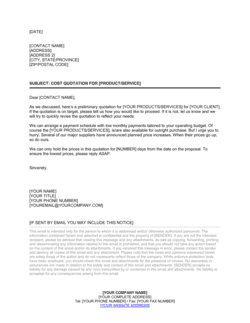
Issuing a revised or updated quotation after the original expiredRevised Quotation Letter
Following up on a prospect who received a quote but has not responded at allSales Follow-Up Letter
Formally confirming an accepted quotation as a binding sales orderSales Order Confirmation
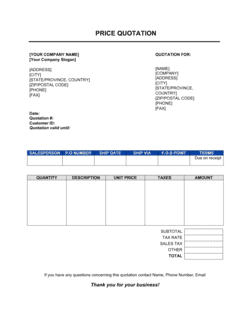
Providing the original price quote with full terms to a new prospectQuotation Template
Documenting agreed pricing and terms in a binding supply agreementSupply Agreement

Common mistakes to avoid

❌ Using a vague expiry date

Why it matters: Phrases like 'prices valid for a limited time' or 'expiring soon' have no legal force β€” they cannot establish a clear offer lapse date if a buyer later claims the price was still valid.

Fix: Always state a specific calendar date in the format DD/MM/YYYY or Month DD, YYYY. Repeat that date in every relevant clause of the letter.

❌ Omitting reference to the original quotation number

Why it matters: A reminder that cannot be tied to a specific quotation document is unenforceable in a dispute β€” the buyer can claim the reminder does not apply to the quotation they received.

Fix: Cite the exact quotation number and issue date in the opening paragraph, and attach a copy of the original quotation to the reminder communication.

❌ Failing to specify the acceptance method

Why it matters: Without a defined acceptance method, a verbal phone call or informal email may be claimed as acceptance β€” creating a contract at the original price even after the expiry date.

Fix: State clearly that acceptance requires a signed purchase order or written confirmation to a named contact by the expiry date. Define what 'written' means β€” email confirmation may be sufficient if stated explicitly.

❌ Sending the reminder unsigned or from a generic inbox

Why it matters: An unsigned notice or one sent from a no-reply address has reduced evidentiary value and signals to the buyer that the deadline is not being enforced seriously.

Fix: Have a named, authorized representative sign the letter and send it from their direct business email address. For large orders, follow up with a phone call on the same day.

❌ Not incorporating terms and conditions by reference

Why it matters: If the buyer accepts the quoted price but the seller's T&Cs are not part of the agreement, disputes over payment terms, delivery, liability, and warranties must be resolved by default statutory rules β€” often less favorable to the seller.

Fix: Include a clause that explicitly incorporates the seller's current standard terms and conditions of sale, and provide a link or attachment.

❌ Waiting until the expiry date to send the reminder

Why it matters: A reminder sent on the same day as the expiry gives the buyer no practical time to obtain internal approvals and issue a purchase order β€” effectively making the deadline meaningless.

Fix: Send the reminder at least 5–10 business days before the expiry date, allowing the buyer enough time to act and the seller time to confirm receipt and acceptance.

The 8 key clauses, explained

Parties and Reference Details

In plain language: Identifies the seller and the recipient by full name and contact details, and references the original quotation by its number and issue date.

Sample language
This reminder is addressed to [RECIPIENT NAME / COMPANY] from [SELLER COMPANY NAME] regarding Quotation No. [QUOTE NUMBER] dated [ORIGINAL QUOTE DATE].

Common mistake: Referencing only an informal description of the quote rather than a unique quotation number β€” making it impossible to tie the reminder to a specific document in a dispute.

Price Validity Statement

In plain language: Clearly states the specific date on which the quoted prices expire and will no longer be binding on the seller.

Sample language
Please be advised that the prices contained in the above-referenced quotation are valid only through [EXPIRY DATE]. After this date, [SELLER COMPANY NAME] reserves the right to revise pricing at its sole discretion.

Common mistake: Using vague language like 'prices are subject to change soon' instead of a specific calendar date β€” ambiguity may create an implied obligation to honor the quoted price beyond the intended window.

Reason for Time Limitation

In plain language: Briefly explains the commercial or logistical reason why prices cannot be held indefinitely β€” material costs, exchange rates, labor rates, or limited inventory.

Sample language
These prices are subject to fluctuations in [RAW MATERIAL / LABOR / EXCHANGE RATE] costs and cannot be guaranteed beyond [EXPIRY DATE].

Common mistake: Omitting any rationale entirely β€” buyers are more likely to act promptly when they understand the business reason behind the deadline.

Consequences of Non-Acceptance

In plain language: States what happens if the buyer does not accept by the expiry date β€” the offer lapses and any subsequent order will be subject to revised pricing.

Sample language
If we do not receive your written acceptance or purchase order by [EXPIRY DATE], the prices in Quotation No. [QUOTE NUMBER] will lapse. Any subsequent order will be subject to pricing in effect at the time of reorder.

Common mistake: Failing to state clearly that a new quotation will be required β€” leaving buyers with a false impression that late acceptance is still possible at the original price.

Call to Action and Acceptance Method

In plain language: Instructs the recipient on exactly how to accept the quotation β€” by signed purchase order, written confirmation, or formal acceptance letter β€” before the expiry date.

Sample language
To secure these prices, please return a signed purchase order or written acceptance to [CONTACT NAME] at [EMAIL / FAX] no later than [EXPIRY DATE].

Common mistake: Not specifying an acceptance method β€” verbal or implied acceptance creates uncertainty about whether a contract was formed and on which terms.

Contact Information and Follow-Up Offer

In plain language: Provides the name, phone number, and email of the appropriate contact and invites the buyer to reach out with questions before the deadline.

Sample language
If you have any questions regarding this quotation or require a revised proposal, please contact [CONTACT NAME] at [PHONE] or [EMAIL]. We would welcome the opportunity to discuss your requirements.

Common mistake: Listing only a general company email or phone number β€” routing responses through an anonymous channel slows follow-up and risks the acceptance being missed before the deadline.

Governing Terms and Conditions

In plain language: Incorporates by reference the seller's standard terms and conditions of sale, confirming they apply to any order placed under the quoted prices.

Sample language
Any order placed in response to Quotation No. [QUOTE NUMBER] is subject to [SELLER COMPANY NAME]'s Standard Terms and Conditions of Sale, a copy of which is available at [URL / ATTACHED].

Common mistake: Omitting reference to terms and conditions in the reminder β€” if an order is placed and a dispute arises, the absence of incorporated terms can leave payment, delivery, and liability obligations undefined.

Authorized Signatory Block

In plain language: Identifies the seller's authorized representative who signs the letter, confirming the notice is issued with organizational authority.

Sample language
Issued by: [AUTHORIZED REPRESENTATIVE NAME] | Title: [TITLE] | Date: [DATE] | Signature: ___________________

Common mistake: Sending the letter without a named signatory or as an unsigned form email β€” unsigned commercial notices carry less evidentiary weight if a pricing dispute later goes to court or arbitration.

How to fill it out

  1. 1

    Enter sender and recipient details

    Fill in your company's full legal name, address, and contact details in the sender block. Enter the recipient's full name, title, and company in the addressee section.

    πŸ’‘ Use the legal entity name on both sides β€” not a trade name or informal abbreviation β€” to ensure the reminder is traceable in any subsequent contractual dispute.

  2. 2

    Reference the original quotation precisely

    Enter the exact quotation number and the date it was originally issued. If your quotation system does not use numbers, create a unique reference now and add it retroactively to the original document.

    πŸ’‘ Keep a copy of the original quotation attached to the reminder email as a PDF β€” this eliminates any claim by the recipient that they cannot locate the document.

  3. 3

    Set a specific price expiry date

    Choose a concrete calendar date β€” not a relative phrase like 'within the next two weeks' β€” and enter it in every expiry-date placeholder in the template.

    πŸ’‘ Industry standard validity windows are typically 14–30 days for most goods and services; high-volatility industries like construction and commodities often use 7–10 days.

  4. 4

    Describe the reason prices are time-limited

    In one to two sentences, explain the business driver β€” material cost fluctuation, exchange rate movement, limited stock availability, or subcontractor pricing windows.

    πŸ’‘ Specificity increases urgency. 'Steel prices have risen 8% in the past 30 days' is more persuasive than 'costs are increasing.'

  5. 5

    State the consequence of missing the deadline

    Make clear that the quoted prices will lapse β€” not merely 'change' β€” and that any subsequent order requires a new quotation at prevailing rates.

    πŸ’‘ Avoid softening language like 'prices may be adjusted.' Clear, direct language about lapsing reduces the likelihood of a buyer claiming they believed the price was still valid.

  6. 6

    Specify the acceptance method and contact

    Name a specific individual as the point of contact for acceptance, and state the exact method required β€” signed PO, email confirmation, or signed acceptance letter β€” along with that individual's direct contact details.

    πŸ’‘ If your company uses a formal purchase order process, include the PO form or a link to your ordering portal so the buyer can act immediately.

  7. 7

    Incorporate your standard terms and conditions

    Reference your standard terms and conditions of sale by name and provide a URL or attach them as an appendix. Confirm they govern any order placed at the quoted price.

    πŸ’‘ If your T&Cs have been updated since the original quotation was issued, note which version applies to orders placed under this quote.

  8. 8

    Sign and send from an authorized representative

    Have the letter signed by the named salesperson or authorized commercial officer before sending. Send via email with read receipt or tracked delivery where contractual certainty is important.

    πŸ’‘ For high-value quotes, consider sending via both email and certified mail β€” physical delivery confirmation is valuable evidence if the buyer later disputes receipt.

Frequently asked questions

What is a price quotation reminder letter?

A price quotation reminder letter is a formal written notice sent by a seller to a prospective buyer to alert them that the prices contained in a previously issued quotation are valid only until a specific expiry date. It serves both as a sales prompt β€” encouraging the buyer to act before the deadline β€” and as a legal notice that limits the seller's obligation to honor the quoted price after that date. The letter references the original quotation by number and date, states the exact expiry, and specifies how the buyer must accept to lock in the quoted pricing.

Is a price quotation legally binding?

A price quotation is generally considered an offer in contract law. Once a buyer accepts the offer β€” by issuing a purchase order or written confirmation β€” before the stated expiry date, a binding contract typically forms. However, the seller is generally free to revise or withdraw pricing after the validity period lapses. The precise rules vary by jurisdiction: in some US states and under the UCC, a firm offer by a merchant is irrevocable during the stated period; in Canada and the UK, the same principle applies under specific conditions. Always consult a lawyer for high-value transactions.

How long should a price quotation be valid?

Validity periods vary by industry and the volatility of underlying costs. For professional services and consulting, 30 days is standard. For construction and trades involving materials, 7–14 days is common given commodity price swings. For manufactured goods and supply-chain-dependent products, 14–21 days is typical. International quotes tied to exchange rates sometimes carry validity windows as short as 48–72 hours. The key is to state the period explicitly in the original quotation and again in any reminder letter.

What happens if a buyer accepts after the expiry date?

A late acceptance is generally treated as a counter-offer rather than a binding acceptance, meaning the seller is not obligated to honor the original price. The seller may choose to accept the late order at the original price, issue a revised quotation at current rates, or decline the order entirely. To avoid ambiguity, the reminder letter should state clearly that any order received after the expiry date will require a new quotation at prevailing prices.

Can I use this letter for international sales?

Yes, but with added considerations. International quotations often involve exchange-rate clauses, Incoterms (such as FOB or CIF), and jurisdiction-specific contract formation rules. For EU buyers, the Consumer Rights Directive may impose additional obligations if selling to individuals. For US-to-Canada cross-border sales, CUSMA/USMCA tariff classifications can affect the quoted landed price. Always state the currency explicitly, reference the applicable Incoterms, and consider having a cross-border commercial lawyer review the terms for high-value transactions.

Does the reminder letter need to be signed?

While no law in most jurisdictions requires a commercial reminder letter to bear a wet signature to be effective, having it signed by an authorized representative significantly strengthens its evidentiary value. A signed, dated letter from a named individual is far harder for a buyer to dispute than an unsigned form email. For quotes above $10,000 or where the buyer has a history of disputing pricing, a signed letter sent via tracked email or certified mail is best practice.

What is the difference between a quotation and an invoice?

A quotation is issued before a sale is agreed β€” it proposes a price and terms and invites acceptance. An invoice is issued after a sale is agreed and goods or services have been delivered β€” it demands payment for a completed transaction. The reminder letter covered by this template relates to a quotation, not an invoice. Once the buyer accepts the quotation and the seller delivers, the transaction moves to the invoicing stage.

Can the seller change the price before the expiry date?

Under the UCC in the US, a merchant's firm offer cannot be revoked during its stated validity period. In Canada and the UK, common-law principles similarly restrict revocation of an offer that the offeree is relying on, particularly once consideration has been exchanged. In practice, revising a quoted price before it lapses damages commercial relationships and may expose the seller to a claim for breach of offer in some jurisdictions. Consult a lawyer before withdrawing or revising a quoted price that is still within its validity window.

How many reminders should I send before a quote expires?

Best practice for most B2B contexts is two reminders: a first notice sent 7–10 business days before expiry, and a final notice sent 1–2 business days before the deadline. For high-value or time-sensitive quotes, a phone call alongside the second written reminder significantly improves response rates. Sending more than two written reminders for a single quote risks appearing aggressive and may signal to the buyer that the deadline is negotiable.

How this compares to alternatives

vs Original Quotation Template

The original quotation is the document that establishes the price, scope, and validity period in the first place. The reminder letter references that quotation and serves only to alert the buyer that its expiry is approaching. If no quotation has been issued yet, use the quotation template first; the reminder comes after.

vs Sales Follow-Up Letter

A general sales follow-up letter checks in on a prospect's interest without anchoring to a specific pricing deadline. The price quotation reminder is narrower β€” it is specifically tied to a quoted price that will lapse on a defined date. Use the follow-up letter when no formal quote has been issued; use this reminder when a formal quotation is on the table and approaching expiry.

vs Invoice Template

An invoice is issued after a sale is confirmed and goods or services have been delivered β€” it demands payment for a completed transaction. This reminder letter precedes the sale entirely; it is part of the pre-contract offer stage. If the buyer accepts in response to the reminder, the next step is a sales order confirmation followed by an invoice upon delivery.

vs Supply Agreement

A supply agreement is a long-form contract governing an ongoing buyer-seller relationship over multiple transactions, including pricing review mechanisms, volume commitments, and delivery schedules. The quotation reminder is a short-form letter for a single transaction or project quote. Once a buyer accepts and the transaction is recurring, a supply agreement provides the appropriate long-term framework.

Industry-specific considerations

Construction and trades

Material costs and subcontractor labor rates fluctuate weekly, making short 7–14 day validity windows and formal written reminders essential before a project estimate lapses.

Manufacturing and wholesale

Raw material and component pricing tied to commodity indices requires sellers to formally notify buyers when a bulk-order quote is approaching its expiry to protect margin.

Professional services

Consultants and agencies use quotation reminder letters to prevent clients from accepting months-old day rates that no longer reflect current team capacity or billing structures.

Export and international trade

Exchange-rate movements and freight cost volatility mean international sales teams must issue formal reminders before currency-sensitive quoted prices expire to avoid margin erosion.

Jurisdictional notes

United States

Under the Uniform Commercial Code (UCC) Article 2, a written firm offer by a merchant to buy or sell goods β€” signed by the merchant and stating it will be held open β€” is irrevocable during the stated period, up to a maximum of three months, even without consideration. Outside UCC Article 2 (e.g., services contracts), an offer can generally be revoked before acceptance. Several states have additional consumer-protection rules that limit how price expiry notices may be communicated to individual consumers.

Canada

Canadian common-law provinces follow the general rule that an offer can be revoked before acceptance unless consideration has been paid to keep it open. Quebec, as a civil law jurisdiction, provides stronger protections: under the Civil Code of Quebec, a firm offer made for a fixed period is generally irrevocable during that period. All provinces require that commercial notices be clear and unambiguous; Quebec additionally requires that commercial communications to Quebec-based recipients be provided in French under the Charter of the French Language.

United Kingdom

English law treats a quotation as an offer that can be revoked before acceptance, unless the seller has received consideration to hold it open as an option. The Late Payment of Commercial Debts (Interest) Act 1998 and the Consumer Rights Act 2015 impose obligations on businesses dealing with consumers β€” price expiry clauses in consumer-facing quotations must be prominently disclosed. For B2B transactions, the Sale of Goods Act 1979 and Supply of Goods and Services Act 1982 govern implied terms once a contract is formed on acceptance.

European Union

EU member state contract laws vary, but the CISG (United Nations Convention on Contracts for the International Sale of Goods), ratified by most EU states, provides that a firm offer β€” one that fixes a period for acceptance β€” is irrevocable during that period. Consumer-facing quotations are additionally subject to the Consumer Rights Directive (2011/83/EU), which requires clear pre-contractual information about price and validity. GDPR compliance should be considered when sending reminder communications to EU data subjects, particularly regarding email marketing consent.

Template vs lawyer β€” what fits your deal?

PathBest forCostTime
Use the templateSmall businesses, freelancers, and sales teams sending standard price reminders for quotes under $50,000Free10–15 minutes per letter
Template + legal reviewMid-market sellers with quotes between $50,000 and $500,000, international transactions, or clients with a history of late acceptance disputes$150–$400 for a commercial lawyer review1–2 business days
Custom draftedHigh-value contracts above $500,000, regulated industries, or cross-border transactions requiring jurisdiction-specific pricing and offer mechanics$500–$2,000+3–7 business days

Glossary

Quotation
A formal seller-issued document stating the price, quantity, and conditions under which goods or services will be supplied, typically valid for a defined period.
Quotation Validity Period
The window of time during which the seller is obligated to honor the prices stated in a quotation β€” after which the seller may revise pricing freely.
Offer and Acceptance
The two-stage process by which a contract forms: the seller makes an offer (the quotation) and the buyer accepts it within the validity window, creating a binding agreement.
Revocation of Offer
The act of withdrawing a price offer before the buyer has accepted β€” permissible in most jurisdictions once the stated validity period has expired.
Firm Offer
A commitment to hold a price open for a stated period, which the seller cannot revoke during that window in jurisdictions that recognize this doctrine.
Counter-Offer
A buyer's response that proposes different terms than those in the original quotation β€” legally this rejects the original offer and creates a new one.
Price Escalation Clause
A contractual provision allowing the seller to adjust prices based on changes in input costs, inflation indices, or exchange rates after a specified trigger point.
FOB (Free on Board)
A shipping term that defines at which point ownership and risk transfer from seller to buyer, often referenced in quotations for physical goods.
Lead Time
The time between a buyer placing an order and the seller completing delivery β€” a factor that can affect whether a quoted price remains feasible.
Force Majeure
An event beyond either party's control β€” a supply disruption, natural disaster, or regulatory change β€” that may justify a seller revising quoted prices.

Part of your Business Operating System

This document is one of 3,000+ business & legal templates included in Business in a Box.

  • Fill-in-the-blanks β€” ready in minutes
  • 100% customizable Word document
  • Compatible with all office suites
  • Export to PDF and share electronically

Create your document in 3 simple steps.

From template to signed document β€” all inside one Business Operating System.
1
Download or open template

Access over 3,000+ business and legal templates for any business task, project or initiative.

2
Edit and fill in the blanks with AI

Customize your ready-made business document template and save it in the cloud.

3
Save, Share, Send, Sign

Share your files and folders with your team. Create a space of seamless collaboration.

Save time, save money, and create top-quality documents.

β˜…β˜…β˜…β˜…β˜…

"Fantastic value! I'm not sure how I'd do without it. It's worth its weight in gold and paid back for itself many times."

Managing Director Β· Mall Farm
Robert Whalley
Managing Director, Mall Farm Proprietary Limited
β˜…β˜…β˜…β˜…β˜…

"I have been using Business in a Box for years. It has been the most useful source of templates I have encountered. I recommend it to anyone."

Business Owner Β· 4+ years
Dr Michael John Freestone
Business Owner
β˜…β˜…β˜…β˜…β˜…

"It has been a life saver so many times I have lost count. Business in a Box has saved me so much time and as you know, time is money."

Owner Β· Upstate Web
David G. Moore Jr.
Owner, Upstate Web

Run your business with a system β€” not scattered tools

Stop downloading documents. Start operating with clarity. Business in a Box gives you the Business Operating System used by over 250,000 companies worldwide to structure, run, and grow their business.

Start freeΒ Β·Β No credit card required