Product Literature in Response to Phone Inquiry Template

Free Word download β€’ Edit online β€’ Save & share with Drive β€’ Export to PDF

1 pageβ€’20–30 min to fillβ€’Difficulty: Standardβ€’Signature requiredβ€’Legal review recommended
Learn more ↓
FreeProduct Literature in Response to Phone Inquiry Template

At a glance

What it is
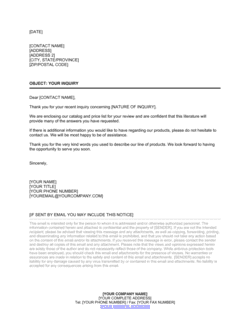
A Product Literature In Response To Phone Inquiry is a formal written document sent to a prospective customer following a telephone conversation about one or more of your products. It summarizes the product details discussed, attaches or references supporting literature, and establishes legally protective language β€” including disclaimers, liability limitations, and terms of sale β€” so that the written record governs any subsequent transaction. This free Word download is ready to edit online and export as PDF.
When you need it
Use it immediately after a phone sales call or customer service conversation in which product specifications, pricing, availability, or capabilities were discussed. It protects your business by ensuring the written record β€” not any verbal representation β€” defines the terms of the relationship going forward.
What's inside
Opening acknowledgment of the phone inquiry, detailed product description and specifications, pricing and availability terms, attached or referenced product literature, disclaimer and limitation-of-liability language, terms of sale and ordering instructions, and a formal closing with authorized signatory block.

What is a Product Literature In Response To Phone Inquiry?

A Product Literature In Response To Phone Inquiry is a formal business letter sent to a prospective customer immediately following a telephone conversation in which your products, specifications, pricing, or capabilities were discussed. It serves two simultaneous functions: fulfilling the customer's request for written product information, and creating a legally protective written record that supersedes any verbal representations made during the call. By invoking standard disclaimer, warranty, and limitation-of-liability language, the letter ensures that the written document β€” not the sales conversation β€” governs the terms of any transaction that follows. This template is a free Word download you can edit online and export as PDF.

Why You Need This Document

Verbal sales conversations create legal exposure that most businesses do not realize until a dispute arises. A sales representative who describes product performance in glowing terms on a phone call may inadvertently create an express warranty β€” and without a written document to contain and qualify those statements, the company is bound by whatever was said. Product literature response letters close this gap by invoking the parol evidence rule: once the prospect has a written document that explicitly supersedes the phone call, prior oral representations lose their contractual force in most jurisdictions. Beyond warranty risk, failing to document the terms discussed β€” pricing validity, shipping terms, minimum order quantities β€” gives prospects grounds to hold you to favorable terms long after they have expired or changed. This template gives sales teams a professionally drafted, legally reviewed starting point that limits liability exposure, protects proprietary technical information, and accelerates the path from inquiry to order with terms that protect the business at every step.

Which variant fits your situation?

If your situation is…Use this template
Responding to a written or email product inquiry instead of a phone callProduct Literature In Response To Written Inquiry
Sending an unsolicited product introduction to a new prospectProduct Introduction Letter
Following up after an in-person sales meeting or trade showPost-Meeting Follow-Up Sales Letter
Providing a formal price quote following the product discussionSales Quotation
Moving the inquiry forward into a binding purchase commitmentSales Agreement
Sending technical specifications to an engineering or procurement teamTechnical Proposal
Documenting agreed product and pricing terms for an ongoing supply relationshipSupply Agreement

Common mistakes to avoid

❌ Including verbal representations not in approved literature

Why it matters: Any claim about product performance or capability that appears in the letter but not in the formal data sheet becomes an express warranty enforceable against the seller. A single unvetted sentence can expose the company to product liability claims.

Fix: Limit the product description section strictly to language from the current approved data sheet. Route any additions through product management for written approval before inclusion.

❌ Omitting a price validity period

Why it matters: Without an expiration date, a quoted price has no natural end point. Prospects have successfully argued that a price quoted in a follow-up letter remained valid months after material costs increased, leaving the seller contractually bound to an unprofitable transaction.

Fix: Insert a specific expiration date β€” '30 days from the date of this letter' is the standard minimum. For commodity products with volatile input costs, 14 days is more appropriate.

❌ Presenting limitation of liability in standard mixed-case text

Why it matters: US and Canadian courts consistently require disclaimer and limitation clauses to be 'conspicuous' β€” meaning visually distinct from surrounding text. Mixed-case limitation language buried in a paragraph has been held unenforceable against consumers in multiple jurisdictions.

Fix: Present all disclaimer, warranty exclusion, and limitation of liability language in ALL CAPS or bold typeface, as demonstrated in the sample language above.

❌ Sending proprietary specifications without a confidentiality notice

Why it matters: Technical data sheets, formulations, and design specifications sent without any confidentiality designation are treated as publicly disclosed information. The recipient has no legal obligation to protect them, and trade secret status may be lost.

Fix: Include the confidentiality clause in every letter that attaches technical specifications, and mark each attachment itself as 'Confidential β€” For Evaluation Purposes Only' in the document footer.

The 10 key clauses, explained

Opening acknowledgment of the phone inquiry

In plain language: Identifies the parties, references the specific phone call by date, and confirms the purpose of the letter β€” to provide the product information discussed.

Sample language
Thank you for your telephone inquiry on [DATE] regarding [PRODUCT NAME / PRODUCT LINE]. As discussed with [REPRESENTATIVE NAME], we are pleased to provide the following information and supporting literature.

Common mistake: Omitting the specific date and representative's name. Without this reference, the letter loses its evidential connection to the phone call and becomes an unsolicited solicitation for legal purposes.

Product description and specifications

In plain language: Summarizes the key features, technical specifications, and intended applications of the product discussed, referencing attached literature for full detail.

Sample language
[PRODUCT NAME] is a [DESCRIPTION] designed for [APPLICATION]. Key specifications include [SPEC 1], [SPEC 2], and [SPEC 3]. Full technical details are provided in the enclosed data sheet (Attachment A).

Common mistake: Including specifications not contained in the approved product literature. Any verbal elaboration that appears in the letter but not in the attached documentation can create an unauthorized express warranty.

Pricing and availability

In plain language: States the current list price or price range, minimum order quantities, lead times, and the period for which the quoted pricing is valid.

Sample language
Current list price: $[AMOUNT] per [UNIT]. Minimum order quantity: [X] units. Estimated lead time: [X] business days from receipt of order. Pricing is valid for [30] days from the date of this letter.

Common mistake: Omitting a price validity period. Without one, a prospect may attempt to hold the seller to a quoted price months later, after costs or market conditions have changed.

Disclaimer of verbal representations

In plain language: Explicitly states that this written document supersedes all verbal statements made during the phone call, protecting the seller from claims based on anything said that differs from the written terms.

Sample language
This letter and the attached literature constitute the complete and accurate description of [COMPANY NAME]'s products and terms. Any verbal representations made prior to this letter are superseded by the contents herein and shall have no binding effect.

Common mistake: Using vague disclaimer language such as 'please refer to our literature for details.' Courts require clear, specific integration language to invoke the parol evidence rule effectively.

Product warranty statement

In plain language: States the scope and duration of any applicable product warranty and explicitly disclaims all implied warranties beyond what is expressly stated.

Sample language
[COMPANY NAME] warrants that [PRODUCT NAME] will be free from defects in materials and workmanship for [X] months from the date of shipment. ALL OTHER WARRANTIES, EXPRESS OR IMPLIED, INCLUDING IMPLIED WARRANTIES OF MERCHANTABILITY AND FITNESS FOR A PARTICULAR PURPOSE, ARE HEREBY DISCLAIMED.

Common mistake: Referencing 'standard warranty terms' without attaching or quoting them. If the warranty document is not included, the reference creates ambiguity about what was actually promised.

Limitation of liability

In plain language: Caps the seller's maximum liability arising from the product or its description at a defined amount β€” typically the purchase price β€” and excludes consequential and indirect damages.

Sample language
IN NO EVENT SHALL [COMPANY NAME]'S LIABILITY EXCEED THE PURCHASE PRICE OF THE PRODUCT. [COMPANY NAME] SHALL NOT BE LIABLE FOR ANY INDIRECT, INCIDENTAL, CONSEQUENTIAL, OR SPECIAL DAMAGES ARISING FROM THE USE OF OR RELIANCE ON THE INFORMATION PROVIDED HEREIN.

Common mistake: Writing the limitation of liability in standard mixed-case text rather than all-caps. Courts in the US and Canada require conspicuous presentation β€” typically all-caps or bold β€” for limitation clauses to be enforceable against consumers.

Terms of sale and ordering instructions

In plain language: Describes how the prospect can place an order, accepted payment methods, applicable taxes, shipping terms, and return or cancellation policy.

Sample language
To place an order, please contact [CONTACT NAME] at [PHONE / EMAIL] or submit a purchase order to [ADDRESS]. Payment terms: [NET 30 / CREDIT CARD / OTHER]. Shipping: [FOB ORIGIN / DESTINATION]. Returns accepted within [X] days with prior authorization.

Common mistake: Failing to specify shipping terms (FOB origin vs. destination). This omission creates ambiguity about who bears the risk of loss during transit β€” a common source of disputes.

Regulatory and compliance notice

In plain language: Advises the prospect of any regulatory requirements, certifications, or compliance considerations relevant to the product's use in their jurisdiction or industry.

Sample language
[PRODUCT NAME] has been certified to [STANDARD, e.g., UL, CE, ISO 9001]. It is the customer's responsibility to ensure the product meets all applicable local, state, or national regulations for their intended use. [COMPANY NAME] makes no representation regarding compliance with regulations not expressly identified herein.

Common mistake: Omitting this clause entirely for regulated products (medical devices, electrical equipment, chemicals). Silence on compliance is interpreted as an implicit representation that the product is universally compliant.

Confidentiality of proprietary information

In plain language: Designates any proprietary technical information in the attached literature as confidential and restricts its use to evaluating the product for potential purchase.

Sample language
The attached literature and any proprietary specifications contained herein are provided in confidence for evaluation purposes only. Recipient agrees not to disclose or reproduce this information without prior written consent of [COMPANY NAME].

Common mistake: Sending proprietary specifications without any confidentiality notice. Without this language, the recipient has no obligation to protect the information and may share it with competitors.

Authorized signatory and contact block

In plain language: Identifies the authorized representative signing the letter, their title, and the primary contact for follow-up questions or orders.

Sample language
Sincerely, [AUTHORIZED REPRESENTATIVE NAME] | [TITLE] | [COMPANY NAME] | [PHONE] | [EMAIL] | For ordering inquiries, contact: [CONTACT NAME] at [PHONE / EMAIL].

Common mistake: Signing with a first name only or an illegible signature without a printed name and title block. If a dispute arises, the identity and authority of the signatory must be immediately verifiable.

How to fill it out

  1. 1

    Record the phone call details

    Enter the exact date of the telephone inquiry, the name of your representative who handled the call, and the prospect's name, company, and contact information. This reference anchors the letter to a specific, documented interaction.

    πŸ’‘ Log the call in your CRM immediately after it ends and pull the details from there β€” relying on memory introduces date and name errors that undermine the letter's evidentiary value.

  2. 2

    Describe only approved product specifications

    Complete the product description and specifications section using language drawn directly from your current, approved product data sheet. Do not paraphrase or expand on capabilities verbally discussed but not in the official literature.

    πŸ’‘ If a specification was mentioned on the call that is not in the current approved data sheet, flag it for your product team before including it β€” adding unapproved specs creates unintended warranties.

  3. 3

    Insert current pricing with a validity window

    Enter the list price, applicable quantity discounts, minimum order quantity, and lead time. Set a specific expiration date for the quoted pricing β€” 30 days is standard for most industries.

    πŸ’‘ Check with your sales manager before quoting prices for large orders. Volume discounts quoted in writing without authorization become binding on the company.

  4. 4

    Attach or reference product literature

    Identify and attach all relevant product literature β€” data sheets, brochures, safety data sheets, certifications β€” as labeled attachments. List each attachment by name in the letter body.

    πŸ’‘ Version-number your attachments (e.g., 'Data Sheet Rev. 3, April 2026') so there is no ambiguity about which version was provided if a dispute arises later.

  5. 5

    Review and customize the disclaimer and limitation of liability

    Ensure the disclaimer of verbal representations is specific, the warranty statement matches your current standard warranty, and the limitation of liability is presented in all-caps or bold as required for enforceability.

    πŸ’‘ Have your legal or compliance team approve the disclaimer language once β€” then save that approved version as your standard template so every letter uses consistent, vetted language.

  6. 6

    Complete the terms of sale and ordering instructions

    Fill in payment terms, accepted methods, shipping terms (FOB origin or destination), and the exact contact for placing orders. Confirm these terms are consistent with your current standard terms of sale.

    πŸ’‘ State 'FOB Origin' explicitly if you want risk of loss to transfer at the point of shipment. Silence on shipping terms typically defaults to seller-favorable terms in some jurisdictions but is contested in others.

  7. 7

    Have an authorized representative sign before sending

    Ensure the letter is signed by a person with actual authority to bind the company to the stated terms β€” typically a sales director, account manager, or officer. Print the signatory's full name and title below the signature.

    πŸ’‘ Do not allow junior sales staff to sign product response letters without reviewing for unauthorized pricing or specification commitments β€” their signature creates binding representations.

Frequently asked questions

What is a product literature response to phone inquiry?

A product literature response to phone inquiry is a formal business letter sent to a prospective customer following a telephone conversation about your products. It summarizes the product information discussed, attaches supporting documentation, and establishes legally protective language β€” disclaimers, warranty terms, and liability limitations β€” so the written record governs any subsequent transaction rather than any verbal representations made during the call.

Why is a written follow-up necessary after a phone inquiry?

Verbal representations made during a sales call can create unintended contractual obligations or warranty claims if not addressed in writing. A properly drafted written response invokes the parol evidence rule, which in most jurisdictions prevents a party from introducing prior oral statements to contradict the written terms. Without a follow-up letter, a customer may claim that a sales representative promised capabilities, pricing, or delivery timelines that the company cannot substantiate or honor.

Does this document constitute a binding contract?

A product literature response letter is generally not itself a binding contract for the sale of goods β€” it is a pre-contractual communication that sets the terms on which the seller is willing to transact. It becomes binding when the buyer places an order and the seller accepts, at which point the terms stated in the letter typically govern the transaction. However, if the letter contains a firm offer with a stated acceptance window, it may be binding on the seller during that period. Consider consulting a lawyer to confirm the legal status in your jurisdiction.

What product literature should I attach to the letter?

Attach all materials that accurately describe the product discussed β€” typically the current product data sheet, any relevant safety data sheet (SDS), certifications (CE, UL, ISO), and a product brochure if available. Label each attachment clearly in the letter body and version-number each document so there is no ambiguity about which revision was provided. Do not attach internal documents, draft specifications, or materials not approved for external distribution.

How long should the pricing quoted in the letter remain valid?

30 days is the most common standard for manufactured goods and professional services. For products with volatile input costs β€” commodities, electronic components, or materials tied to market indexes β€” 14 days is more appropriate. Always state the expiration date explicitly as a calendar date rather than a relative period, to eliminate any ambiguity about when the clock started.

Who should sign this type of letter?

The letter should be signed by a person with actual authority to bind the company to the stated terms β€” typically a sales director, account manager, or company officer. A junior sales representative's signature creates binding representations. If your organization requires pre-approval of pricing or specification commitments, establish an internal review step before any product response letter is signed and sent.

Can this letter be used for international sales inquiries?

Yes, but the governing law, currency, shipping terms (Incoterms), and regulatory compliance notices must be adjusted for the relevant jurisdiction. For EU customers, GDPR requires that any personal data collected during the phone inquiry be handled in accordance with your privacy policy. For UK customers, the Consumer Rights Act 2015 imposes mandatory warranty terms that cannot be excluded for consumer transactions. Engage local counsel when sending product literature to customers in jurisdictions with unfamiliar consumer protection regimes.

What is the difference between an express warranty and an implied warranty?

An express warranty is a specific, affirmative promise about a product's quality or performance made in writing or verbally β€” for example, 'this pump will operate continuously for 10,000 hours.' An implied warranty arises automatically by law, without any written statement β€” the implied warranty of merchantability guarantees the product is fit for its ordinary purpose. The disclaimer clause in this letter attempts to exclude implied warranties to the extent permitted by law, but several jurisdictions restrict or prohibit their exclusion for consumer transactions.

What happens if the product performs differently from what the letter describes?

If the product fails to meet a description in the letter that qualifies as an express warranty, the buyer may have a claim for breach of warranty β€” potentially seeking repair, replacement, refund, or damages. The limitation of liability clause is designed to cap this exposure at the purchase price and exclude consequential damages. However, limitation clauses may be unenforceable if the failure constitutes gross negligence or fraud, or if mandatory consumer protection statutes apply in the buyer's jurisdiction.

How this compares to alternatives

vs Sales Quotation

A sales quotation is a formal, itemized price offer for specific quantities and configurations β€” it is typically the step that follows a product literature response. The product literature response describes and establishes the legal framework around the product; the quotation translates that into a specific commercial offer the buyer can accept. Use the product literature response first, then issue a quotation when the prospect is ready to buy.

vs Sales Agreement

A sales agreement is a binding contract that governs the actual purchase transaction β€” quantities, delivery, payment, and remedies. A product literature response is a pre-contractual communication that precedes and informs the agreement. The terms stated in the letter often become incorporated by reference into the final sales agreement, which is why the language must be consistent across both documents.

vs Product Introduction Letter

A product introduction letter is an unsolicited outbound communication sent to introduce a product to a prospect who has not inquired. A product literature response is reactive β€” it is sent in direct response to a documented phone call. The reactive nature of this document is what activates the parol evidence protections and allows it to explicitly supersede the verbal conversation that preceded it.

vs Non-Disclosure Agreement

An NDA is a standalone bilateral confidentiality agreement signed by both parties before proprietary information is exchanged. The product literature response includes a unilateral confidentiality notice within the letter itself, which is appropriate for standard product inquiries. When sharing highly sensitive proprietary formulations or trade-secret-level specifications, a signed NDA should be executed before β€” or alongside β€” the product literature response rather than relying solely on the in-letter notice.

Industry-specific considerations

Manufacturing

Technical specifications, certifications, material safety data sheets, and MOQ terms are central; limitation of liability language is especially critical for industrial equipment where failure can cause downstream property damage.

Medical Devices and Healthcare

FDA clearance or CE marking status must be referenced explicitly; off-label use disclaimers are mandatory; verbal representations about clinical performance made on sales calls carry heightened regulatory risk.

Retail and Consumer Goods

Consumer protection laws in most jurisdictions restrict the exclusion of implied warranties for retail buyers; pricing validity windows are short due to promotional pricing changes; returns and cancellation policies must be clearly stated.

Technology and Electronics

Version and firmware references must match the attached data sheet precisely; export control compliance notices (EAR, ITAR) are required for certain components; lead time volatility means pricing validity windows rarely exceed 14 days.

Jurisdictional notes

United States

Under the Uniform Commercial Code (UCC), written disclaimers of implied warranties must be conspicuous β€” typically all-caps β€” to be enforceable. Several states, including California, impose additional consumer protection requirements that limit the exclusion of implied warranties in consumer transactions regardless of contractual language. The parol evidence rule under UCC Article 2 generally supports written integration clauses for goods sales, but courts examine whether the written document was intended as a final expression of the parties' agreement.

Canada

Provincial Sale of Goods Acts (Ontario, BC, Alberta, etc.) imply warranties of merchantability and fitness for purpose that cannot be excluded in consumer transactions and may only be limited in commercial ones. Quebec's Civil Code applies different rules from the common-law provinces. Limitation of liability clauses must be clearly brought to the attention of the buyer at or before the time of contracting to be enforceable β€” mere inclusion in standard terms is sometimes insufficient under Quebec civil law.

United Kingdom

The Consumer Rights Act 2015 makes it unlawful to exclude implied terms of satisfactory quality or fitness for purpose in consumer contracts. For B2B transactions, the Unfair Contract Terms Act 1977 requires that limitation and exclusion clauses satisfy a reasonableness test. Product literature sent to UK customers should clearly identify whether the recipient is a consumer or a business, as the applicable statutory regime differs significantly. Post-Brexit, CE marking alone no longer suffices for UK market access β€” UKCA marking may be required.

European Union

The EU Sale of Goods Directive (2019/771) provides mandatory two-year conformity guarantees for consumer sales that cannot be contractually excluded. GDPR applies to any personal data collected during the phone inquiry β€” the customer's name and contact details must be processed in accordance with your privacy policy, and a lawful basis for processing must exist. For regulated products (medical devices under MDR 2017/745, electrical equipment under the Low Voltage Directive), compliance statements in product literature must be accurate and current, as incorrect claims can trigger market surveillance action.

Template vs lawyer β€” what fits your deal?

PathBest forCostTime
Use the templateStandard B2B product inquiries for non-regulated goods where the company already has approved product literature and standard terms of saleFree15–30 minutes per letter
Template + legal reviewRegulated products (medical devices, chemicals, electronics), cross-border inquiries, or high-value transactions where limitation of liability language needs jurisdiction-specific vetting$200–$500 for a legal review of the standard template1–3 days for initial template review; minutes per letter thereafter
Custom draftedPharmaceutical, defense, or industrial equipment companies with complex regulatory compliance requirements, multi-jurisdiction distribution, or significant product liability exposure$1,000–$3,000+1–2 weeks

Glossary

Product Literature
Written materials β€” brochures, data sheets, specifications, or catalogs β€” that describe a product's features, performance, and intended use.
Disclaimer
A statement that limits or negates the legal obligations or liabilities of the sender with respect to information provided in the document.
Limitation of Liability
A clause that caps the maximum financial exposure of one party to another in the event of a claim arising from the product or its description.
Warranty
A promise, express or implied, that a product will meet certain standards of quality or performance for a defined period.
Misrepresentation
A false or misleading statement of fact that induces another party to enter into a contract, potentially giving rise to rescission or damages.
Terms of Sale
The conditions under which a seller offers to sell goods, including pricing, payment terms, delivery, and return policies.
Parol Evidence Rule
A legal principle that prevents parties from introducing prior oral or written statements to contradict the terms of a final written agreement.
Integration Clause
A contract provision stating that the written document represents the entire agreement between the parties, superseding all prior verbal representations.
Force Majeure
A clause excusing a party from performance obligations when events beyond reasonable control β€” such as natural disasters or supply chain disruptions β€” prevent fulfillment.
Authorized Representative
The individual with legal authority to sign and commit the organization to the terms stated in the document.

Part of your Business Operating System

This document is one of 3,000+ business & legal templates included in Business in a Box.

  • Fill-in-the-blanks β€” ready in minutes
  • 100% customizable Word document
  • Compatible with all office suites
  • Export to PDF and share electronically

Create your document in 3 simple steps.

From template to signed document β€” all inside one Business Operating System.
1
Download or open template

Access over 3,000+ business and legal templates for any business task, project or initiative.

2
Edit and fill in the blanks with AI

Customize your ready-made business document template and save it in the cloud.

3
Save, Share, Send, Sign

Share your files and folders with your team. Create a space of seamless collaboration.

Save time, save money, and create top-quality documents.

β˜…β˜…β˜…β˜…β˜…

"Fantastic value! I'm not sure how I'd do without it. It's worth its weight in gold and paid back for itself many times."

Managing Director Β· Mall Farm
Robert Whalley
Managing Director, Mall Farm Proprietary Limited
β˜…β˜…β˜…β˜…β˜…

"I have been using Business in a Box for years. It has been the most useful source of templates I have encountered. I recommend it to anyone."

Business Owner Β· 4+ years
Dr Michael John Freestone
Business Owner
β˜…β˜…β˜…β˜…β˜…

"It has been a life saver so many times I have lost count. Business in a Box has saved me so much time and as you know, time is money."

Owner Β· Upstate Web
David G. Moore Jr.
Owner, Upstate Web

Run your business with a system β€” not scattered tools

Stop downloading documents. Start operating with clarity. Business in a Box gives you the Business Operating System used by over 250,000 companies worldwide to structure, run, and grow their business.

Start freeΒ Β·Β No credit card required