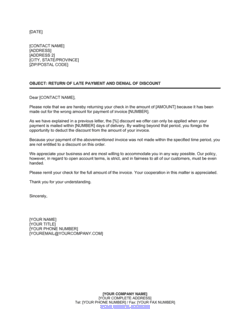
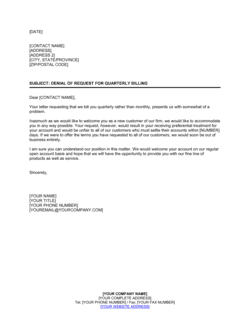
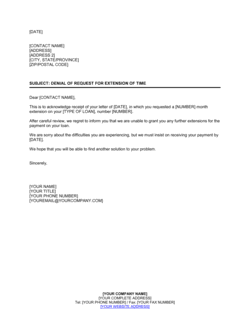
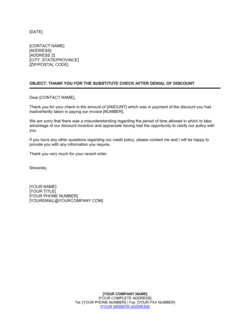
Denial of Request for Additional Discount Template

Free Word download • Edit online • Save & share with Drive • Export to PDF

1 page20–30 min to fillDifficulty: StandardSignature requiredLegal review recommended
Learn more ↓
FreeDenial of Request for Additional Discount Template

At a glance

What it is
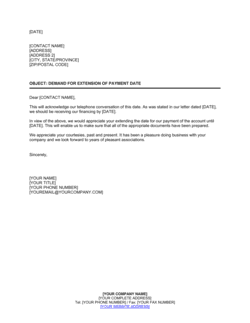
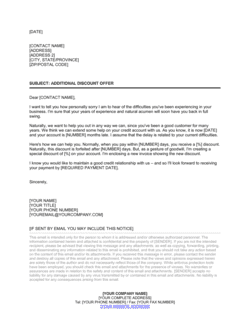
A Denial of Request for Additional Discount is a formal business letter that communicates a company's decision to decline a customer's or partner's request for further price reductions beyond the terms already agreed. This free Word download gives you a professionally structured template you can edit online, customize with your company's specific pricing rationale, and export as PDF or send directly — preserving the business relationship while firmly upholding your pricing policy.
When you need it
Use it when a customer, client, or distribution partner submits a written or verbal request for a discount beyond the current contracted rate, and you need to decline that request in writing. It is especially important when the denial needs to be documented for contract compliance, internal approval records, or to prevent future disputed expectations.
What's inside
The template includes an opening acknowledgment of the request, a clear statement of denial, the business rationale for declining, a reference to existing pricing terms or applicable policy, an offer to explore alternative value options, and a professional closing that preserves goodwill. Each clause is drafted to reduce the risk of the denial being construed as a negotiating position rather than a final decision.

What is a Denial of Request for Additional Discount?

A Denial of Request for Additional Discount is a formal business letter through which a seller, service provider, or vendor communicates a definitive decision to decline a counterparty's request for pricing reductions beyond the terms already agreed in a contract, purchase order, or pricing schedule. The letter performs three simultaneous functions: it acknowledges that the request was received and reviewed, it states the refusal with a clear contractual basis, and it creates a written evidentiary record that the denial was properly communicated on a specific date. Unlike an informal verbal refusal, a written denial letter documents that the existing pricing terms remain in force and protects the issuing party against future claims that a discount was implicitly agreed, delayed, or under active negotiation.

Why You Need This Document

Without a formal written denial, a verbally declined discount request leaves your business exposed to three compounding risks. First, the customer may continue treating the request as open, generating follow-up pressure and internal escalations that consume time without resolution. Second, if a dispute arises over the pricing terms applied, the absence of a documented denial makes it difficult to prove when, how, and on what basis the request was refused. Third, in jurisdictions with good-faith dealing obligations — including Canada, France, Germany, and the Netherlands — the failure to formally acknowledge and respond to a commercial request can itself become a legal liability. A properly drafted denial letter closes all three gaps in a single document: it satisfies good-faith communication requirements, anchors the refusal to the governing contract, and prevents the denial from being characterized as an ongoing negotiation. This template gives you a professionally structured starting point that takes 15 to 30 minutes to complete and delivers a letter indistinguishable from one drafted by a commercial attorney for a standard pricing dispute.

Which variant fits your situation?

If your situation is…Use this template
Denying a first-time discount request from a new customerDenial of Request for Additional Discount
Declining a discount request while offering an alternative concessionCounter Offer Letter
Responding to a request to renegotiate an active contract's pricingContract Negotiation Response Letter
Issuing a partial discount approval with conditionsConditional Discount Approval Letter
Declining a refund request rather than a discount requestDenial of Refund Request Letter
Formally terminating a discount arrangement previously grantedDiscount Termination Notice
Declining a wholesale pricing request from a new distributorDenial of Wholesale Pricing Request

Common mistakes to avoid

❌ Using 'at this time' without a defined timeframe

Why it matters: The phrase signals that the denial is temporary and negotiable. Customers treat it as an invitation to follow up, and in jurisdictions with good-faith dealing obligations, it may be construed as an ongoing obligation to reconsider.

Fix: Replace with a specific boundary: 'for the duration of the current agreement ending [DATE]' or 'until contract renewal in [MONTH/YEAR].' This closes the negotiating door while preserving a defined future re-engagement point.

❌ Failing to cite the governing contract

Why it matters: Without a specific agreement reference, the customer may argue the existing discount is an informal arrangement subject to renegotiation at any time, undermining the contractual basis for the denial.

Fix: Always name the governing agreement, its execution date, and the specific clause or schedule that establishes the current pricing terms.

❌ Disclosing internal margin or cost data as justification

Why it matters: Sharing gross margin percentages or supplier cost breakdowns gives the customer a roadmap for future discount demands and may breach confidentiality obligations if the data is commercially sensitive.

Fix: Cite policy or external market conditions as the rationale: 'our pricing policy does not permit discounts beyond [X]% for this product category' or 'recent input cost increases prevent further reductions.'

❌ Issuing an unsigned or generically signed denial

Why it matters: A denial signed with only a department name or a generic address lacks the evidentiary weight of a named authorized signatory and is easier for a customer to dismiss as a form letter.

Fix: Ensure a named individual with verifiable authority — sales director, VP of finance, or CEO for smaller businesses — signs every denial. Include their direct contact information.

❌ Omitting confirmation that the existing agreement survives

Why it matters: Without an explicit preservation clause, a customer can argue that the denial constituted a modification or partial rescission of the agreement, creating ambiguity about the surviving discount terms.

Fix: Include the preservation clause in every denial: 'all other terms of [AGREEMENT NAME], including the [X]% discount currently applied, remain in full force and effect.'

❌ Offering an alternative that is vaguer than the original discount request

Why it matters: A vague alternative offer — 'we could explore other options' — invites an open-ended negotiation, which can take more time and cost more margin than the original request would have.

Fix: Either omit the alternative offer or make it specific and bounded: 'we offer Net-60 payment terms in place of an additional [X]% discount, applicable on orders placed before [DATE].'

The 9 key clauses, explained

Sender and recipient identification

In plain language: Identifies the company issuing the denial, the authorized signatory, and the specific customer or partner whose request is being declined.

Sample language
[SENDER COMPANY NAME] | [ADDRESS] | [DATE] | Attn: [RECIPIENT NAME], [TITLE] | [RECIPIENT COMPANY NAME] | Re: Denial of Request for Additional Discount — Account #[ACCOUNT NUMBER]

Common mistake: Addressing the letter to a general department rather than a named individual. A denial sent to 'Accounts Payable' rather than the requesting contact is more easily ignored and harder to cite as delivered notice.

Acknowledgment of the discount request

In plain language: Confirms that the company received and reviewed the specific discount request before issuing the denial, preventing the customer from claiming the request was never considered.

Sample language
We acknowledge your request dated [DATE] for an additional discount of [X]% on [PRODUCT/SERVICE] beyond the [X]% currently applied under [CONTRACT/AGREEMENT NAME].

Common mistake: Skipping acknowledgment entirely and opening with a flat refusal. Courts and arbitrators view an unacknowledged denial as evidence of bad faith dealing in jurisdictions that require good-faith negotiation obligations.

Clear statement of denial

In plain language: States unambiguously that the discount request is declined — without hedging language that could be interpreted as a continuing negotiation.

Sample language
After careful review, [COMPANY NAME] is unable to accommodate a discount beyond the [X]% rate currently in effect. This decision is final with respect to the current contract term ending [DATE].

Common mistake: Using language like 'we cannot grant this at this time' without a temporal boundary. The phrase 'at this time' implies the door is open, which can bind you to future negotiation if the customer follows up.

Business rationale for the denial

In plain language: Provides a concise, professional explanation for the denial — such as current pricing policy, cost pressures, or existing contractual commitments — without disclosing sensitive financial information.

Sample language
Our current pricing reflects [COST FACTORS / MARKET CONDITIONS / CONTRACTUAL COMMITMENTS WITH SUPPLIERS], and our pricing policy does not permit discounts beyond [X]% for accounts in [CUSTOMER TIER / CATEGORY].

Common mistake: Providing overly detailed cost breakdowns as justification. Disclosing internal margin data gives the customer a roadmap for future negotiation and may constitute confidential disclosure under NDA.

Reference to governing terms or pricing schedule

In plain language: Anchors the denial to the specific contract, purchase order, or pricing policy that establishes the current rate and makes clear that rate is contractually binding.

Sample language
Your account is governed by [AGREEMENT NAME] dated [DATE], which establishes a [X]% standard discount for [PRODUCT/SERVICE CATEGORY]. That agreement remains in full force and effect through [EXPIRY DATE].

Common mistake: Failing to cite the specific agreement. Without a document reference, the customer may argue the current discount was informal and therefore renegotiable at will.

Alternative value offer (optional but recommended)

In plain language: Offers a non-price alternative — extended payment terms, volume rebates at a higher threshold, or added services — to demonstrate good faith and preserve the relationship without eroding margin.

Sample language
While we are unable to offer an additional percentage discount, we would be pleased to discuss [NET-60 PAYMENT TERMS / VOLUME REBATE AT [X] UNITS / COMPLIMENTARY [SERVICE]] as an alternative arrangement.

Common mistake: Making the alternative offer sound like a consolation prize. Frame it as a genuine commercial option — 'we believe this alternative delivers equivalent value' — not as an apology for refusing.

Preservation of existing agreement terms

In plain language: Confirms that the current agreement, including its existing discount structure, remains unchanged and enforceable, preventing the customer from arguing the denial voided or modified the contract.

Sample language
For the avoidance of doubt, all other terms of [AGREEMENT NAME] — including the [X]% discount currently applied — remain in full force and are not affected by this correspondence.

Common mistake: Omitting this clause when the denial is issued mid-contract. Without explicit confirmation that the existing terms survive, a customer could argue the denial triggered a material change in the commercial relationship.

Future review or renegotiation timing

In plain language: States whether and when the pricing relationship may be renegotiated — typically at contract renewal — so the customer understands the denial is not permanent.

Sample language
We welcome the opportunity to review our pricing arrangement at the time of contract renewal on [RENEWAL DATE]. Please contact your account representative no later than [DATE] to initiate that discussion.

Common mistake: Leaving the future open-ended without a date. Saying 'we can revisit in the future' without a specific event or date creates a floating obligation that is difficult to manage operationally.

Authorized signatory and contact information

In plain language: Identifies the person with authority to issue the denial on behalf of the company, with direct contact details for follow-up questions.

Sample language
Sincerely, [FULL NAME] | [TITLE] | [COMPANY NAME] | [PHONE] | [EMAIL] | [DATE]

Common mistake: Signing with a title but no name, or using a generic company email. An anonymous denial is easier to dismiss and harder to enforce as formal notice under contract.

How to fill it out

  1. 1

    Identify the requesting party and the specific discount request

    Locate the original discount request — email, letter, or verbal record — and confirm the requester's name, title, company, account number, and the exact discount percentage or amount requested.

    💡 Keep a copy of the original request attached to your file copy of this letter. It creates a complete paper trail if the denial is later disputed.

  2. 2

    Enter your company and signatory details

    Complete the sender block with your company's legal name, address, and the name and title of the authorized signatory. Ensure the signatory has actual authority to issue commercial denials on behalf of the company.

    💡 For accounts above a certain revenue threshold, escalate the signatory to a director or VP — a senior signature signals the denial is final and reduces the chance of further escalation.

  3. 3

    Reference the original request by date and amount

    In the acknowledgment clause, insert the date of the request and the specific discount percentage or dollar amount requested. Avoid vague references like 'your recent request.'

    💡 If the request was made verbally, note the date of the verbal request and state 'confirmed in writing on [DATE]' to establish the timeline.

  4. 4

    Write the denial statement with a defined temporal boundary

    State clearly that the request is declined and specify whether the denial applies to the current contract term, the current fiscal year, or permanently. Avoid language that implies future reconsideration unless you mean it.

    💡 Tie the denial period to the contract expiry date — 'for the duration of the current agreement ending [DATE]' — rather than an open-ended 'at this time.'

  5. 5

    Insert the business rationale without disclosing sensitive margins

    Choose from the template's rationale options: pricing policy, cost structure, customer tier, or market conditions. Keep the explanation to two to three sentences — enough to demonstrate reasoned consideration without inviting negotiation.

    💡 Reference an externally verifiable factor (published market index, supplier cost increase) rather than internal margin data whenever possible.

  6. 6

    Cite the governing agreement and existing discount terms

    Insert the exact name and date of the applicable contract, pricing schedule, or purchase order. Confirm the current discount rate and its contractual basis so the customer cannot argue the existing terms are informal.

    💡 If multiple agreements govern the relationship, cite the most recent and highest-authority document — master service agreement over individual order forms.

  7. 7

    Add an alternative value offer if commercially appropriate

    If the customer relationship warrants goodwill preservation, select an alternative from the template options — extended payment terms, volume rebate threshold, or added service — and insert the specific terms.

    💡 Only include an alternative you are prepared to honor. A vague offer 'to explore options' invites a follow-up negotiation that can be harder to close than the original request.

  8. 8

    Obtain authorized signature and deliver by tracked method

    Have the authorized signatory review and sign the final letter. Deliver by email with read receipt, or by certified mail if the contract requires written notice by physical delivery.

    💡 For key accounts or high-value contracts, send the denial by both email and certified mail on the same day and retain the delivery confirmation in the account file.

Frequently asked questions

What is a denial of request for additional discount letter?

A denial of request for additional discount letter is a formal written communication issued by a seller or service provider to decline a customer's request for price reductions beyond the terms already in place. It acknowledges the request, states the refusal clearly, provides a brief business rationale, and references the governing pricing terms. The letter creates a documented record of the denial for contract compliance and dispute-resolution purposes.

Is a discount denial letter legally binding?

A discount denial letter is not a standalone contract, but it is legally significant. It constitutes formal written notice that a request was considered and declined, which can be material evidence in a dispute over whether a discount was agreed or implied. In jurisdictions with implied good-faith dealing obligations, a well-drafted denial that acknowledges the request and provides a rationale satisfies the duty to engage reasonably with a commercial counterparty.

Does a denial letter need to be signed?

Yes, in most commercial contexts a discount denial letter should carry the signature of an authorized representative of the denying company. An unsigned letter lacks the evidentiary weight of formal notice and may be challenged as non-authoritative. The signatory should have actual authority to make pricing decisions on behalf of the company, such as a sales director, VP of finance, or company officer.

Can a customer demand a discount even if there is a signed contract?

A customer can request additional discounts at any time, but where a signed contract specifies pricing terms, the seller is generally under no obligation to grant further reductions outside of a formal contract amendment. Issuing a written denial that cites the governing agreement reinforces this position and documents that the customer's request was considered and declined in accordance with the contract.

What should I include in the rationale for declining a discount?

The rationale should be concise — two to three sentences — and tied to a policy, market condition, or contractual commitment rather than internal margin data. Effective rationales include references to a published pricing policy, tier-based discount structure, recent input cost increases, or existing MFN commitments to other customers. Avoid disclosing gross margins or supplier costs, as this invites further negotiation and may breach confidentiality obligations.

Should I offer an alternative when denying a discount request?

Offering an alternative is not required but is often commercially wise when the relationship has long-term value. An alternative value offer — extended payment terms, volume rebate at a higher threshold, or complimentary services — preserves goodwill without eroding price integrity. If you include an alternative, make it specific and bounded; a vague offer to 'explore options' typically generates more negotiation than it resolves.

Can a discount denial letter affect my relationship with the customer?

A well-drafted denial letter, delivered professionally and promptly, typically does not damage the customer relationship — particularly when it acknowledges the request, provides a clear rationale, cites governing terms, and offers an alternative where appropriate. A poorly written denial that feels dismissive or leaves the customer uncertain about future pricing does more relational damage than the refusal itself.

How quickly should I respond to a discount request?

Respond within five business days of receiving the request. A delayed response creates uncertainty for the customer and may be construed as implicit consideration of the request, which complicates the denial. In contracts with defined response windows for change requests, the clock starts on the date the request is formally received, so prompt action also protects you contractually.

Does this letter apply to both B2B and B2C contexts?

This letter is primarily designed for B2B commercial relationships where pricing is governed by a contract, pricing schedule, or account agreement. In B2C contexts, discount denials are typically handled through customer service processes rather than formal letters, though a formal written denial may be appropriate for high-value consumer contracts or subscription agreements where pricing terms are explicitly documented.

How this compares to alternatives

vs Counter offer letter

A counter offer letter responds to a discount request by proposing different terms — a smaller discount, alternative concession, or revised payment structure. A denial letter closes the negotiation entirely. Use a counter offer when you have flexibility to offer something; use a denial letter when your pricing policy requires a firm refusal with no alternative discount percentage.

vs Contract amendment

A contract amendment formally modifies existing pricing terms by mutual agreement. A denial letter preserves existing terms by refusing to modify them. If both parties agree to a price change, a contract amendment is the correct instrument; if the seller is declining a requested change, the denial letter is the appropriate document.

vs Pricing policy memo

A pricing policy memo is an internal document that establishes discount rules for sales teams. A denial letter is an external communication to a specific counterparty. The policy memo informs the basis for the denial; the denial letter communicates that decision to the customer. Both documents should reference each other for a consistent pricing governance trail.

vs Demand for payment letter

A demand for payment letter addresses an unpaid invoice at the agreed price; a discount denial letter addresses a request to reduce the price before or after payment. They operate at different points in the transaction lifecycle. If a customer withholds payment pending a discount decision, both letters may need to be issued in sequence.

Industry-specific considerations

Manufacturing and wholesale distribution

Distributors frequently request additional discounts at quarter-end to hit purchase targets; a written denial tied to the master distribution agreement protects tiered pricing structures and MFN commitments to other channel partners.

Software and SaaS

Enterprise customers routinely request discounts beyond the negotiated contract rate at renewal; a formal denial that references the executed order form and pricing schedule prevents informal discount expectations from becoming binding precedents.

Professional services

Clients may request fee reductions mid-engagement after scope changes; a denial letter that cites the signed statement of work and billing rate schedule preserves contract integrity without requiring renegotiation.

Retail and consumer goods

Retailers negotiating with suppliers for promotional pricing often submit requests mid-contract; a structured denial that references the current promotional terms agreement and offers a defined future review date manages expectations without disrupting the supply relationship.

Jurisdictional notes

United States

US commercial law (UCC Article 2 for goods, common law for services) generally allows sellers to decline discount requests when pricing is fixed by a written contract. The implied covenant of good faith and fair dealing applies in all states, but this requires honest dealing — not a duty to agree. Price discrimination claims under the Robinson-Patman Act are relevant for sellers offering different discounts to competing buyers of the same goods; a written policy and consistent denial practice reduce exposure.

Canada

Canadian contract law requires good faith in contractual performance in most provinces following the Supreme Court's ruling in Bhasin v Hrynew. A written denial that acknowledges the request and provides a reasoned basis satisfies this duty. Quebec's civil law regime (Civil Code of Québec) imposes a broader duty of good faith at all stages of the contractual relationship, making a documented and reasoned denial particularly important for Quebec-based customers.

United Kingdom

English contract law does not impose a general duty to negotiate in good faith, but courts have found implied duties in long-term relational contracts. A discount denial in a clearly documented commercial agreement is generally straightforward. Under the Unfair Contract Terms Act 1977 and the Consumer Rights Act 2015, terms in B2C agreements must be fair and transparent — but in a B2B context, well-drafted standard pricing terms are generally enforceable without a duty to grant discounts.

European Union

EU commercial law varies significantly by member state, but good faith obligations in contractual dealings are broadly recognized under civil law systems in France, Germany, and the Netherlands. Competition law considerations are relevant: under Article 102 TFEU, dominant market players may face scrutiny for discriminatory pricing or refusal to supply on reasonable terms. For non-dominant businesses, a well-documented denial citing consistent pricing policy and non-discriminatory application is generally sound. GDPR implications arise only if personal data is referenced in the letter.

Template vs lawyer — what fits your deal?

PathBest forCostTime
Use the templateStandard B2B discount denials under an existing written contract with a clearly cited pricing scheduleFree15–30 minutes
Template + legal reviewHigh-value accounts, MFN-clause implications, or contracts governed by jurisdictions with strong good-faith dealing obligations$150–$400 for a single-letter legal review1–2 days
Custom draftedDenials involving regulatory pricing constraints, franchise agreements, or accounts that have already threatened litigation$500–$1,500+3–7 days

Glossary

Pricing Policy
A company's documented rules governing how prices are set, what discounts are permissible, and under what conditions exceptions may be granted.
Contract Rate
The price or discount percentage explicitly agreed upon and recorded in a signed agreement between the seller and the buyer.
Most Favored Nation (MFN) Clause
A contractual provision guaranteeing a buyer the same price or discount offered to any other buyer — making unilateral discount denials critical to protecting MFN integrity.
Price Integrity
The practice of maintaining consistent, justified pricing across customers to avoid discrimination claims, margin erosion, and precedent-setting concessions.
Goodwill Preservation
The deliberate effort to maintain a positive business relationship with a counterparty even when declining their request.
Precedent Risk
The risk that granting a one-time exception — such as an ad hoc discount — creates an expectation or legal basis for the same treatment in future transactions.
Written Denial
A formal, documented refusal of a request, creating an evidentiary record that the denial was communicated clearly and on a specific date.
Alternative Value Offer
A non-price concession — such as extended payment terms, additional services, or volume incentives — offered in place of a requested discount.
Margin Protection
Actions taken by a business to prevent its profit margins from being eroded by price concessions, discounts, or below-cost arrangements.
Governing Terms
The contract, purchase order, or pricing schedule that controls the commercial relationship between the parties and takes precedence over informal requests.

Part of your Business Operating System

This document is one of 3,000+ business & legal templates included in Business in a Box.

  • Fill-in-the-blanks — ready in minutes
  • 100% customizable Word document
  • Compatible with all office suites
  • Export to PDF and share electronically

Create your document in 3 simple steps.

From template to signed document — all inside one Business Operating System.
1
Download or open template

Access over 3,000+ business and legal templates for any business task, project or initiative.

2
Edit and fill in the blanks with AI

Customize your ready-made business document template and save it in the cloud.

3
Save, Share, Send, Sign

Share your files and folders with your team. Create a space of seamless collaboration.

Save time, save money, and create top-quality documents.

★★★★★

"Fantastic value! I'm not sure how I'd do without it. It's worth its weight in gold and paid back for itself many times."

Managing Director · Mall Farm
Robert Whalley
Managing Director, Mall Farm Proprietary Limited
★★★★★

"I have been using Business in a Box for years. It has been the most useful source of templates I have encountered. I recommend it to anyone."

Business Owner · 4+ years
Dr Michael John Freestone
Business Owner
★★★★★

"It has been a life saver so many times I have lost count. Business in a Box has saved me so much time and as you know, time is money."

Owner · Upstate Web
David G. Moore Jr.
Owner, Upstate Web

Run your business with a system — not scattered tools

Stop downloading documents. Start operating with clarity. Business in a Box gives you the Business Operating System used by over 250,000 companies worldwide to structure, run, and grow their business.

Free Forever Plan · No credit card required