- Offer Expiry Date
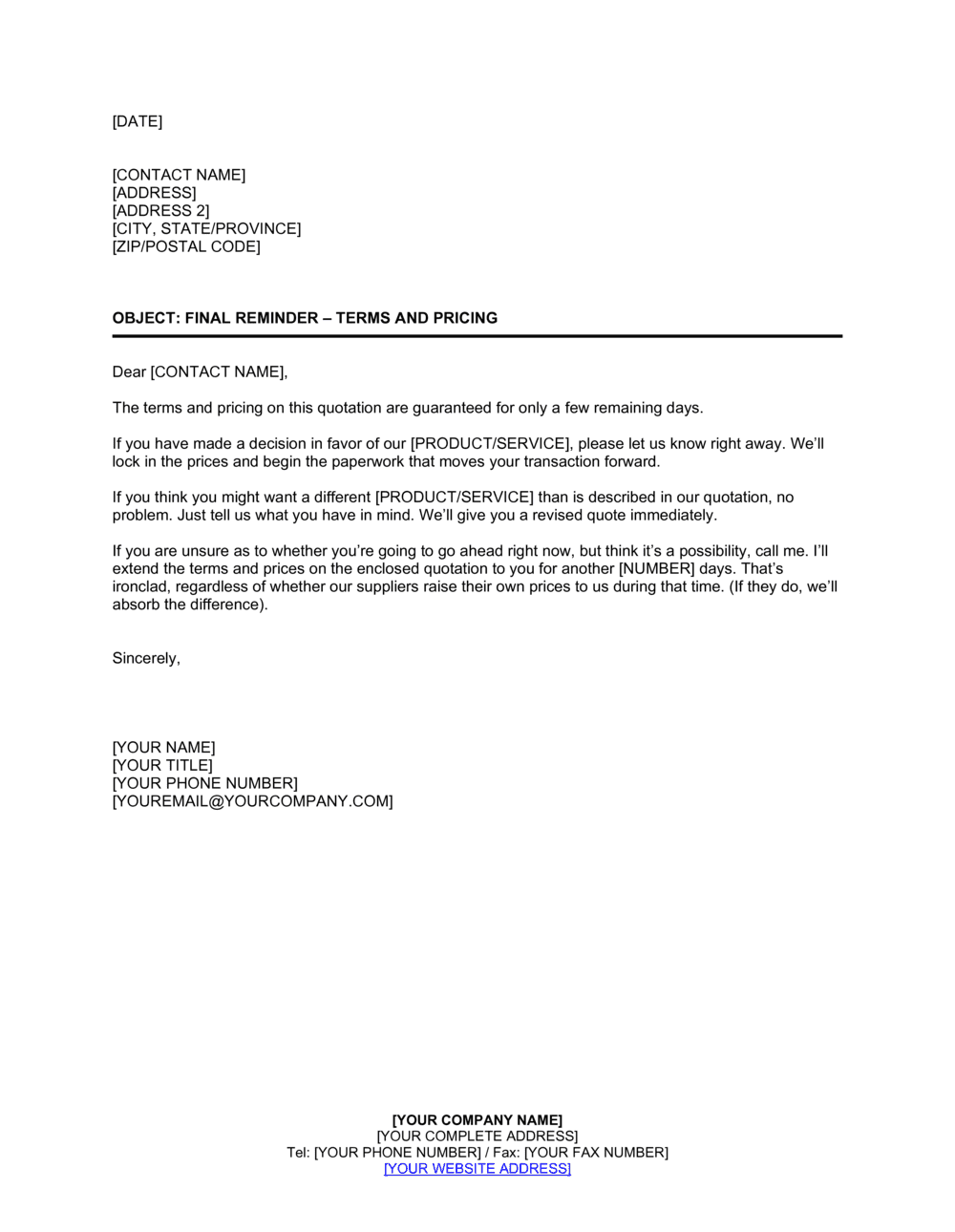
- The specific calendar date and, where applicable, time after which the stated pricing or terms are no longer binding on the sender.
- Price Hold
- A seller's commitment to maintain a quoted price for a defined period, typically to allow the buyer time to obtain internal approvals.
- Acceptance
- The buyer's unambiguous agreement to the stated terms — typically in writing — which, combined with an offer and consideration, forms a binding contract.
- Consideration
- Something of value exchanged between parties that makes a contract legally enforceable — in a sale context, typically money in exchange for goods or services.
- Lapse of Offer
- The automatic termination of an offer when the stated expiry date passes without acceptance, after which the offer cannot be accepted without the offeror's consent.
- Counter-offer
- A response to an offer that changes one or more material terms — treated legally as a rejection of the original offer and the creation of a new one.
- Force Majeure
- A clause excusing a party from performing if extraordinary events outside their control — such as natural disasters or government actions — make performance impossible.
- Escalation Clause
- A provision stating that if the offer is not accepted by the expiry date, pricing or terms will increase or change to a specified new level.
- Material Terms
- The essential elements of a proposed contract — price, scope, delivery timeline, and payment conditions — without which no binding agreement can be formed.
- Binding Commitment
- An obligation that is legally enforceable against the party who made it, provided all elements of a valid contract are present.
- Time Is of the Essence
- A legal phrase indicating that the deadline stated in the agreement is a material condition — missing it constitutes a breach, not merely a delay.