Risk Management Templates
★★★★★4.7from 280+ reviews· Trusted by 20M+ businesses
Identify, assess, and respond to business risks before they become costly problems.
WordEditable onlinePDF16+ risk management templates
Other Administration categories
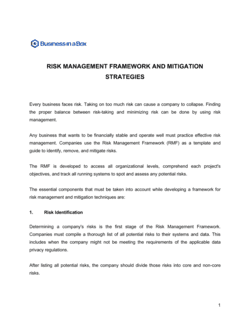
Risk identification and assessment
Risk planning and mitigation
Domain-specific risk policies
Guides, checklists, and educational resources
250K+Clients
20M+Free users
20+Years
190+Countries
10,000+Law firms
50M+Downloads
Trusted across review platforms
- Capterra★★★★☆4.649 reviews
- G2★★★★☆4.713 reviews
- GetApp★★★★☆4.649 reviews
- Google Play★★★★☆4.6179 ratings
- Google Reviews★★★★☆4.567 reviews
Frequently asked questions
What is a risk management plan?
A risk management plan is a document that describes how an organisation will identify, assess, respond to, and monitor risks over a defined period. It covers the scope of risk management activities, who is responsible, what risk appetite the organisation accepts, and how risks will be tracked. It is distinct from the risk register, which is the operational log used to execute the plan.
What is the difference between a risk register and a risk assessment matrix?
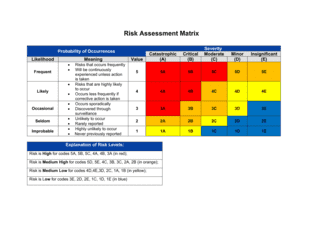
A risk register is a list of all identified risks with their owners, scores, and mitigation actions. A risk assessment matrix (or heat map) is a scoring tool that maps probability against impact to produce a priority ranking. You use the matrix to score individual risks, then record those scores in the register.
How many risks should a risk register contain?
There is no fixed number. Small businesses might maintain 10–20 items; large organisations with complex operations often track hundreds. Aim to capture every risk with a realistic probability of occurring and a material impact if it does — not every theoretical possibility. A focused register that gets reviewed regularly is more useful than an exhaustive one that never changes.
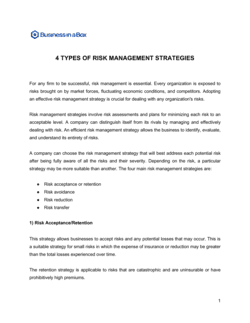
What are the four risk response strategies?
The four standard strategies are: avoid (change the plan to eliminate the risk entirely), reduce (apply controls to lower probability or impact), transfer (shift the financial consequence through insurance or contracts), and accept (acknowledge the risk and monitor it without active intervention). Most risk management plans apply a mix of all four depending on the severity and nature of each risk.
Do small businesses need formal risk management documents?
Yes. Small businesses face the same categories of risk as large ones — financial, operational, legal, reputational — but often have less capacity to absorb losses. A one-page risk register and a basic mitigation plan take a few hours to produce and can prevent far costlier disruptions. Investors, lenders, and enterprise customers increasingly ask for evidence of risk management as a condition of doing business.
How often should a risk management plan be updated?
At a minimum, annually. In practice, the risk register should be reviewed quarterly, and the plan should be updated whenever there is a significant business change — a new product launch, acquisition, regulatory change, major IT system change, or serious incident. Stale risk documents give false confidence.
What is residual risk?
Residual risk is the level of risk that remains after all planned mitigation actions have been applied. It is never zero. Organisations decide in advance what level of residual risk is acceptable (their risk appetite) and escalate to senior leadership or the board any risk that cannot be reduced below that threshold.
Can I use a risk management template for IT or cybersecurity risks?
Yes. The IT Risk Management Checklist in this folder is specifically designed for technology and cybersecurity contexts, covering access controls, data protection, system vulnerabilities, and incident response. For broader programmes, use the Risk Management Plan or Risk Register and add an IT domain section.
Risk Management vs. related documents
A risk assessment is a point-in-time exercise that identifies and scores threats. A risk management plan is the broader document that defines how an organization will govern, assess, and respond to risk on an ongoing basis. The assessment feeds the plan — you typically complete an assessment before writing the mitigation and monitoring sections of a plan.
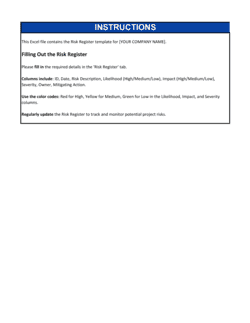
A risk register is a log — it lists every identified risk alongside its owner, probability, impact, and current status. A risk management plan is a strategic document explaining the overall approach. Use the register as the operational tool that makes the plan actionable day to day.
A business continuity plan focuses on keeping operations running after a risk event has already occurred. Risk management templates focus on identifying and reducing the probability or impact of events before they happen. Both are needed: risk management reduces likelihood; continuity planning limits damage when prevention fails.
Compliance management ensures the business meets regulatory and legal obligations; risk management covers a broader range of threats including operational, financial, reputational, and strategic risks. Compliance is one category of risk, so a full risk management programme subsumes the compliance function rather than replacing it.
Key clauses every Risk Management contains
Regardless of scope or domain, effective risk management documents share the same structural building blocks.
- Risk identification. A systematic list or catalogue of potential threats relevant to the scope being assessed.
- Probability rating. A score or label — often low/medium/high or 1–5 — estimating how likely each risk is to occur.
- Impact rating. A score estimating the severity of harm if the risk materialises, covering financial, operational, and reputational dimensions.
- Risk owner. The named individual or role accountable for monitoring and responding to each specific risk.
- Mitigation actions. The specific controls, process changes, or contingency plans designed to reduce probability or limit impact.
- Residual risk. The level of risk that remains after mitigation measures have been applied and accepted by the organisation.
- Review frequency. The schedule for re-evaluating the risk register or plan to reflect changes in the business environment.
- Escalation path. Defines who is notified and what decisions are triggered when a risk exceeds a set threshold.
How to write a risk management plan
A usable risk management plan covers five stages: context, identification, analysis, response, and monitoring. Here is the short version.
1
Define scope and objectives
Decide whether the plan covers the whole organisation, a single project, or a specific domain such as IT or finance.
2
Identify stakeholders and risk owners
Name the people responsible for managing and escalating risks — without owners, plans sit on shelves.
3
Catalogue potential risks
Use brainstorming, historical incidents, and industry frameworks to list every credible threat in your risk register.
4
Score probability and impact
Rate each risk on a consistent scale so you can compare and prioritise across categories.
5
Choose a response strategy
For each risk, select one of four responses: avoid, reduce, transfer (e.g., insure), or accept.
6
Document mitigation actions
Assign specific actions, deadlines, and owners to each risk that will be reduced or avoided.
7
Set a review cadence
Schedule quarterly or event-triggered reviews to update risk scores and actions as conditions change.
At a glance
- What it is
- A risk management template is a structured document that helps organizations identify, evaluate, and respond to threats that could affect operations, finances, projects, or data. Templates provide a repeatable format so that risk analysis is consistent across teams and over time.
- When you need one
- Anytime a business launches a project, undergoes a change, enters a new market, or faces audit requirements, a formal risk management document ensures threats are captured and assigned owners before damage occurs.
Which Risk Management do I need?
The right template depends on whether you need to plan, identify, assess, mitigate, or monitor risk — and whether the scope is organization-wide, project-specific, or domain-specific (IT, finance, vendor, operations).
Your situation
Recommended template
Building an organization-wide risk management program from scratch
Covers governance, risk appetite, roles, and response strategies for the whole business.Running a project and need to track every identified risk
Scoped to a single project with probability, impact, and owner columns built in.Cataloguing all known risks with owners and status in one place
A living log that captures each risk, its likelihood, impact, and mitigation action.Scoring and prioritising risks by likelihood and impact
Colour-coded heat-map grid lets teams rank risks and allocate response effort quickly.Turning risk scores into concrete actions to reduce exposure
Translates identified risks into specific control actions, owners, and deadlines.Auditing IT systems for cyber, data, and infrastructure threats
Covers access controls, data protection, system vulnerabilities, and incident response.Evaluating financial exposure and cash-flow threats
Structured worksheet for analysing credit, liquidity, market, and operational financial risks.Assessing the risk a vendor or supplier poses to operations
Scores vendors on financial stability, security posture, compliance, and continuity.Glossary
- Risk appetite
- The level of risk an organisation is willing to accept in pursuit of its objectives, set by senior leadership or the board.
- Risk register
- A living log that records every identified risk, its owner, probability, impact score, mitigation actions, and current status.
- Risk assessment matrix
- A grid that maps the probability of a risk occurring against its potential impact to produce a priority score.
- Inherent risk
- The level of risk that exists before any controls or mitigation measures are applied.
- Residual risk
- The level of risk that remains after mitigation controls have been applied and accepted.
- Risk owner
- The named individual accountable for monitoring a specific risk and triggering the agreed response if it materialises.
- Mitigation
- Actions taken to reduce the probability of a risk occurring or to limit the harm if it does.
- Risk transfer
- Shifting the financial consequence of a risk to a third party, typically through insurance or contractual indemnities.
- Risk avoidance
- Changing a plan or activity to eliminate a risk entirely rather than reducing or accepting it.
- Operational risk
- The risk of loss resulting from failed internal processes, systems, human error, or external events affecting day-to-day operations.
- Escalation threshold
- The risk score or trigger condition at which a risk must be reported to a higher level of management for a decision.
What is a risk management template?
A risk management template is a structured, reusable document that guides organisations through the process of identifying threats, evaluating their likelihood and potential impact, assigning ownership, and defining how each risk will be addressed. Rather than starting from a blank page every time a new project launches or a regulatory audit approaches, teams use templates to apply a consistent methodology across departments, projects, and time periods.
Risk management documents range from high-level strategy documents — like a Risk Management Plan or Framework — to granular operational tools like a Risk Register, Risk Assessment Matrix, or domain-specific checklists for IT, finance, or vendor relationships. Together they form a system: the plan sets the rules, the register captures the risks, the matrix scores them, and the mitigation plan turns scores into actions.
Well-designed templates embed industry-standard practices such as ISO 31000 or COSO ERM principles into a format any business team can use without needing a specialist risk background.
When you need a risk management template
Risk surfaces at every stage of business operations — not just in major crises. Any time the organisation faces uncertainty that could affect its ability to deliver on its objectives, a risk management document should be in play.
Common triggers:
- Starting a new project, product launch, or business venture where unknowns are high
- Preparing for an external audit, investor due diligence, or regulatory review
- Onboarding a new vendor or supplier that will handle sensitive data or critical operations
- Experiencing a near-miss incident that exposed an unmanaged vulnerability
- Undergoing a significant change such as a system migration, merger, or restructure
- Setting annual operational plans that require sign-off from the board or leadership team
- Responding to a sector-specific risk event — a cyberattack, supply chain disruption, or sudden regulatory change
Organisations that manage risk informally — relying on experience and memory rather than documented processes — are consistently slower to detect problems and more expensive to recover from them. A risk register reviewed quarterly is not bureaucracy; it is the earliest warning system most small and mid-sized businesses have.
Award-winning platform
- Great Place to Work 2025
- BIG Award — Product of the Year 2025
- Smartest Companies 2025
- Global 100 Excellence 2026
- Best of the Best 2025