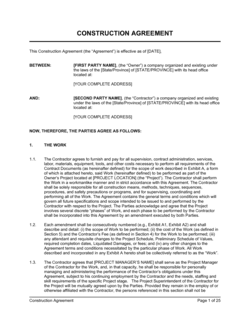
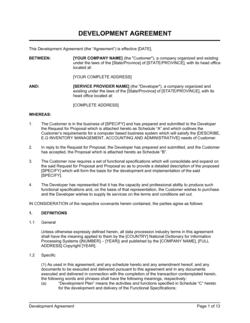
Development Agreement Templates
★★★★★4.7from 280+ reviews· Trusted by 20M+ businesses
Protect your IP, define deliverables, and set payment terms for every development engagement.
WordEditable onlinePDF26+ development agreement templates
Other Legal Agreements categories
Most popular development agreements
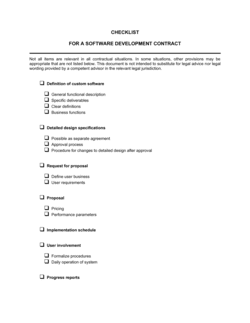
Software development contracts
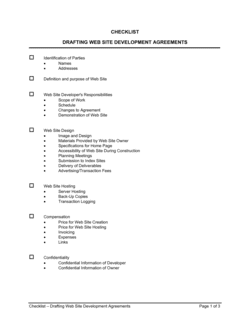
Web and multimedia development
Checklists and drafting guides
Planning, strategy, and development resources
More development agreement templates
250K+Clients
20M+Free users
20+Years
190+Countries
10,000+Law firms
50M+Downloads
Trusted across review platforms
- Capterra★★★★☆4.649 reviews
- G2★★★★☆4.713 reviews
- GetApp★★★★☆4.649 reviews
- Google Play★★★★☆4.6179 ratings
- Google Reviews★★★★☆4.567 reviews
Frequently asked questions
Who owns the intellectual property created under a development agreement?
Ownership depends entirely on what the agreement says. By default in many jurisdictions, an independent developer retains ownership of work they create unless a written assignment transfers it to the client. Most client-developer agreements explicitly assign all work product to the client upon full payment. Always confirm the IP clause before signing, and consider consulting a lawyer if the project involves significant proprietary technology.
What is the difference between a development agreement and a work-for-hire arrangement?
A work-for-hire arrangement (in US copyright law) makes the commissioning party the legal author and owner of the work automatically in certain circumstances. A development agreement is a broader contract that covers scope, payment, acceptance, and other commercial terms — and should include an explicit IP assignment clause regardless of work-for-hire status, since the doctrine does not apply in all jurisdictions or to all types of work.
Do I need a development agreement for a small website project?
Yes, even for small projects. The most common disputes — whether revisions are in scope, who owns the final code, and what happens if the project is cancelled — all require a written agreement to resolve clearly. A short-form client and developer agreement takes minutes to complete and saves significant cost and conflict if something goes wrong.
What should I include in the scope of work section?
The scope should describe every deliverable the developer will produce: specific features, technical specifications, platforms, integrations, design standards, and performance requirements. Include what is explicitly excluded to prevent scope creep. Attaching a detailed project brief or technical specification as a schedule is good practice for complex builds.
How are payments typically structured in a development agreement?
Most development agreements use milestone-based payments: an upfront deposit (typically 25–50% of the total fee), payments tied to delivery and approval of major milestones, and a final payment on project acceptance. Time-and-materials arrangements are also common for open-ended or exploratory projects, with monthly invoicing against an hourly or daily rate.
What happens if the developer misses a milestone deadline?
The agreement should specify the consequences — typically a cure period during which the developer has a fixed number of days to remedy the delay, followed by termination rights if the cure is unsuccessful. Some agreements include liquidated damages for schedule overruns on time-sensitive projects. Without written terms, the client's options are limited.
Can a development agreement cover both development and ongoing support?
Yes. Many agreements include a maintenance and support schedule alongside the development terms, covering bug fixes, updates, and SLA commitments post-launch. Alternatively, a separate maintenance agreement can be executed once the project is complete. The Software Development and Consulting Services Agreement in this folder covers combined engagements.
Is a joint development agreement the same as a joint venture?
No. A joint development agreement governs the collaborative creation of a specific product or technology, including how resulting IP is owned and commercialized. It terminates when the project concludes. A joint venture creates an ongoing business relationship or legal entity for a broader commercial purpose. Use a joint development agreement when the collaboration is project-specific.
Development Agreement vs. related documents
An independent contractor agreement governs an ongoing service relationship without reference to a specific project or deliverable. A development agreement is project-scoped: it defines what gets built, who owns it, and how acceptance is determined. Use a development agreement whenever IP ownership and deliverable acceptance are central to the engagement; use a contractor agreement for open-ended service retainers.
A software license agreement governs how existing software may be used after it is built. A development agreement governs the process of building it — scope, milestones, IP assignment, and payment. Many engagements require both: a development agreement during the build phase and a license agreement to govern distribution of the finished product.
A statement of work is typically an exhibit or attachment that details the specific deliverables, timeline, and fees for a single project under a master services agreement. A development agreement is a standalone contract that includes both the commercial and legal terms. For repeat engagements with the same developer, an MSA plus SOW is common; for a one-off project, a standalone development agreement is simpler.
A joint venture agreement establishes a shared business entity or commercial relationship for an ongoing purpose. A joint development agreement is narrower: it covers the co-creation of a specific product or technology, governs how IP arising from the project is owned, and typically terminates when the project is complete. Use a joint development agreement when the collaboration is project-specific rather than entity-forming.
Key clauses every Development Agreement contains
Every development agreement — regardless of project type — is built on the same core clauses; the specifics vary by context.
- Scope of work. Describes the deliverables in enough detail that both parties agree on what 'done' means before work begins.
- Milestones and schedule. Sets the development timeline in phases, with dates tied to payment releases or approval checkpoints.
- Payment terms. Specifies fees, invoicing schedule, milestone-based payments, and consequences for late payment.
- Intellectual property assignment. Determines who owns the work product — client, developer, or both — once the project is complete and paid for.
- Acceptance testing. Defines the process by which the client reviews deliverables and either approves them or requests revisions.
- Warranties and representations. Developer confirms the work is original, free of third-party IP claims, and will perform as specified.
- Confidentiality. Prevents either party from disclosing technical specifications, business logic, or proprietary information shared during the project.
- Termination and exit. Covers how either party can end the agreement, what notice is required, and how deliverables and payments are handled on exit.
- Governing law and dispute resolution. Names the jurisdiction whose laws apply and specifies whether disputes go to litigation, mediation, or arbitration.
How to write a development agreement
A well-drafted development agreement prevents the disputes that derail projects — typically disagreements over scope, IP, or payment.
1
Identify and name the parties correctly
Use full registered legal names for both the client and the developer or development company — not trade names or informal handles.
2
Define the scope of work in detail
Describe every deliverable, feature set, and technical specification; attach a separate schedule if the project is complex.
3
Set milestones and link them to payments
Break the project into phases with clear acceptance criteria, and tie each payment release to a specific milestone approval.
4
Decide and document IP ownership
Explicitly state whether the client receives full assignment of all work product or a license, and address pre-existing IP the developer brings.
5
Include an acceptance testing process
Define how the client reviews deliverables, what criteria trigger approval, and how many revision rounds are included.
6
Add confidentiality and non-disclosure obligations
Protect business logic, source code, and proprietary information shared during the engagement on both sides.
7
Cover termination, warranties, and governing law
State what happens if either party terminates early, what warranties the developer provides, and which jurisdiction's law governs.
At a glance
- What it is
- A development agreement is a legal contract between a client and a developer (or between two companies) that defines the scope of work, ownership of deliverables, payment terms, and confidentiality obligations for a development project.
- When you need one
- Any time you commission or perform custom software, website, multimedia, or product development work — especially when IP ownership and payment milestones are at stake.
Which Development Agreement do I need?
The right development agreement depends on the type of project, the relationship between the parties, and who will own the finished work. Match your situation below.
Your situation
Recommended template
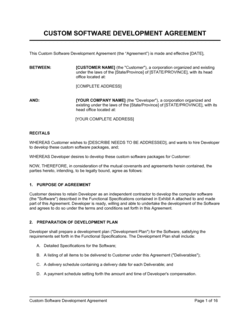
Hiring a developer to build custom software for your business
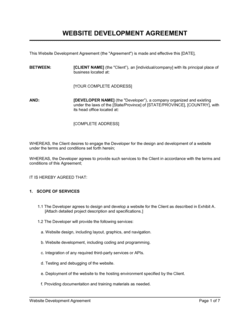
Covers specifications, milestones, IP assignment, and warranties specific to bespoke software builds.Commissioning a new business website from an agency or freelancer
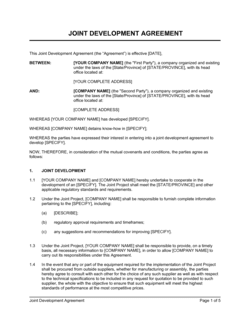
Includes hosting handover, content ownership, and acceptance testing clauses common to web projects.Two companies co-developing a product or technology together
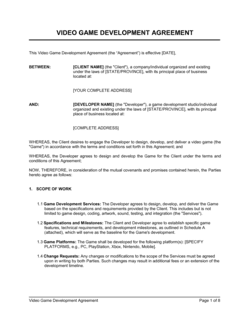
Governs shared IP rights, cost allocation, and exit provisions when both parties contribute.Commissioning a video game from an external studio or developer
Addresses game-specific deliverables, engine licensing, and platform submission requirements.A client engaging a developer with a straightforward project scope
Concise general-purpose contract that works for a wide range of client-developer relationships.Developing software that will also be licensed to third parties
Combines development scope with downstream licensing rights in a single instrument.Developing software alongside an ongoing consulting engagement
Covers both the development deliverables and the advisory services running in parallel.Developing multimedia content for publishing or distribution
Handles multimedia-specific IP layers including audio, video, and interactive content rights.Glossary
- Deliverable
- A specific, agreed output — such as source code, a working application, or design files — that the developer is contractually obligated to produce.
- Milestone
- A defined phase or checkpoint in the project schedule, often linked to payment release or client sign-off.
- IP assignment
- A contractual transfer of ownership of intellectual property from the developer to the client, effective on specified conditions such as full payment.
- Acceptance testing
- A formal review process in which the client evaluates deliverables against agreed criteria before approving them.
- Scope creep
- The gradual expansion of project requirements beyond what was agreed, often the result of an insufficiently detailed scope of work.
- Work for hire
- A legal doctrine (in US copyright law) under which certain commissioned works are owned by the commissioning party from creation, without needing a separate assignment.
- Source code escrow
- An arrangement where source code is deposited with a neutral third party and released to the client if the developer fails to maintain it or goes out of business.
- Pre-existing IP
- Intellectual property the developer owned before the project began, often licensed to the client rather than assigned.
- Time and materials
- A payment structure in which the client pays for actual hours worked and costs incurred, rather than a fixed project fee.
- Liquidated damages
- A pre-agreed sum payable if a specific breach occurs — such as a missed deadline — calculated in advance rather than proven after the fact.
What is a development agreement?
A development agreement is a legally binding contract between a client and a developer — or between two companies collaborating on a project — that defines the scope of work, payment structure, timeline, and ownership of all deliverables produced during a development engagement. Development agreements are used across software, web, multimedia, video game, and product development contexts wherever one party commissions creative or technical work from another.
At the core of every development agreement is the IP ownership question: who owns the code, design, or content once the project is complete? Without an explicit written assignment, developers in many jurisdictions retain ownership of the work they produce, even if the client paid for it. A properly drafted development agreement resolves this before work begins, protecting both parties from expensive disputes later.
Development agreements range from short-form client-developer agreements suitable for straightforward freelance projects to multi-party joint development agreements governing co-creation arrangements where both parties contribute technology and share in the resulting IP. The right template depends on the project type, the number of parties involved, and whether the finished work will be licensed, sold, or kept proprietary.
When you need a development agreement
Any time you commission or perform development work — software, a website, a video game, a multimedia product — you need a written agreement in place before work begins. The informal "we'll sort it out later" approach is a reliable source of disputes over scope, missed deadlines, and IP ownership.
Common triggers:
- A business hires a developer or agency to build custom software
- A company commissions a new website or web application
- Two companies agree to co-develop a shared technology or product
- A publisher engages a studio to create a video game
- A client engages a developer for a project that includes ongoing consulting
- A company outsources software development to an offshore or nearshore team
- A startup builds its core product with a founding technical contractor
- A business licenses software that is also being built to specification
The cost of skipping a development agreement is rarely visible at the start of a project — it shows up when a developer claims ownership of code the client paid for, when "minor" additional features turn into a billing dispute, or when a missed deadline has no contractual remedy. A clear, signed development agreement shifts the entire project onto predictable terms from day one.
Award-winning platform
- Great Place to Work 2025
- BIG Award — Product of the Year 2025
- Smartest Companies 2025
- Global 100 Excellence 2026
- Best of the Best 2025