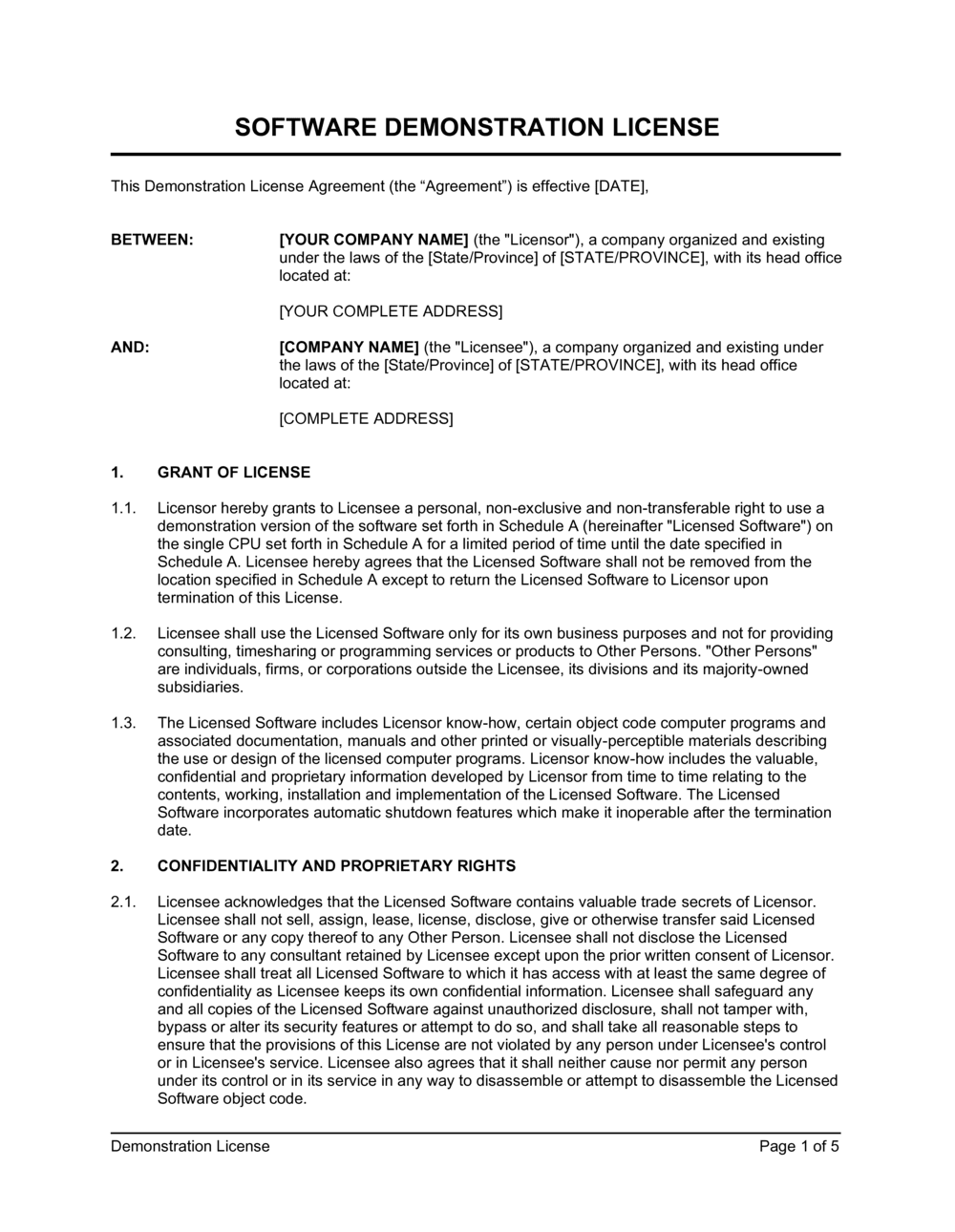
Demonstration Software License Template

Free Word download • Edit online • Save & share with Drive • Export to PDF

5 pages25–35 min to fillDifficulty: ComplexSignature requiredLegal review recommended
Learn more ↓
FreeDemonstration Software License Template

At a glance

What it is
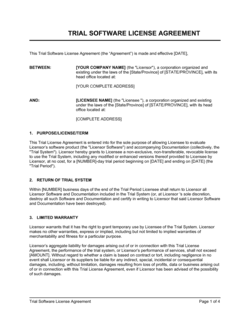
A Demonstration Software License is a legally binding agreement between a software vendor and a prospective customer that grants limited, temporary, non-commercial access to software for evaluation purposes only. This free Word download gives you a structured starting point — covering permitted use, time limits, IP ownership, confidentiality, and liability — that you can edit online and export as PDF for signature before handing over any demo build or evaluation credentials.
When you need it
Use it whenever you provide a prospect, partner, or reseller with access to a software product — whether a full build, a sandbox environment, or a feature-limited trial — before a commercial license agreement is signed. It is especially important when the demo version contains unreleased features, proprietary algorithms, or access to live or near-live data.
What's inside
Permitted-use restrictions, evaluation period and automatic termination, IP ownership and no-transfer clauses, confidentiality obligations, warranty disclaimer, limitation of liability, data handling, return or destruction of software on termination, and governing law.

What is a Demonstration Software License?

A Demonstration Software License is a legally binding agreement between a software vendor (the licensor) and a prospective customer, partner, or reseller (the licensee) that grants a limited, temporary, non-commercial right to access and evaluate a software product before any commercial license is executed. It defines the precise boundaries of permitted use — internal evaluation only — and expressly prohibits production use, redistribution, reverse engineering, and any commercial application of the software or knowledge gained from it. Unlike an informal handshake or a click-through terms page, a signed demonstration software license establishes a clear contractual record of what was shared, under what restrictions, and for how long, protecting the licensor's intellectual property and trade secrets throughout the sales process.

Why You Need This Document

Providing demo access without a signed agreement is one of the most common and costly oversights in software sales. Without a binding license in place, you are distributing proprietary code under no enforceable restriction — and courts in many jurisdictions will imply a license on terms more favorable to the person who received access. A single unsecured demo build handed to a prospect who later decompiles it, shares credentials with a competitor, or builds a competing product using what they learned can trigger trade secret litigation that is expensive to pursue and difficult to win without documented evidence of a confidentiality obligation. A properly executed demonstration software license closes that gap before access is granted: it restricts use to evaluation, binds the licensee to confidentiality, assigns any feedback to you, and ensures automatic termination when the evaluation period ends. This template gives you a Word document you can customize in minutes, covering every material clause — so your next proof-of-concept conversation starts with your IP protected, not exposed.

Which variant fits your situation?

If your situation is…Use this template
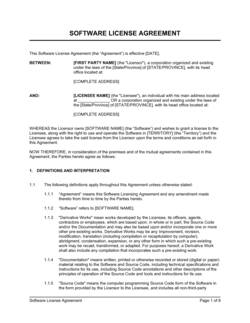
Granting full production software access to a paying customerSoftware License Agreement
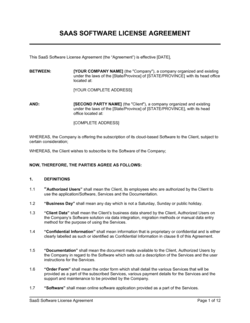
Licensing software on an ongoing SaaS subscription basisSaaS Subscription Agreement
Sharing source code or software under open-source termsOpen Source Software License
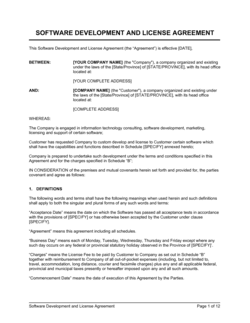
Engaging a developer to build software on your behalfSoftware Development Agreement
Protecting proprietary information shared during pre-sales discussionsNon-Disclosure Agreement
Authorizing a reseller to sublicense your software commerciallySoftware Reseller Agreement
Running a structured beta program with multiple testersBeta Software Testing Agreement

Common mistakes to avoid

❌ Delivering demo access before the agreement is signed

Why it matters: Without a signed agreement, the licensee may use the software under implied license terms set by the governing jurisdiction's law — which are almost always more favorable to the licensee than your intended restrictions.

Fix: Build an automated gate into your demo provisioning workflow: no credentials or download link until a countersigned copy is received and logged.

❌ No fixed end date on the evaluation period

Why it matters: Courts in several jurisdictions have treated open-ended demo licenses as perpetual implied commercial licenses, giving the licensee rights the vendor never intended to grant.

Fix: Always state a specific calendar end date and include automatic termination language so the license expires by operation of contract, not at anyone's discretion.

❌ Omitting the reverse engineering prohibition

Why it matters: A licensee who decompiles your demo build can extract proprietary algorithms, database schemas, or UI logic — and your trade secret protection evaporates if you did not expressly prohibit it.

Fix: Add an explicit reverse engineering, decompiling, and disassembly prohibition in the restrictions clause, and reference it in the confidentiality section for double coverage.

❌ No feedback assignment clause

Why it matters: A prospective customer who submits detailed feature suggestions during an evaluation could later claim co-inventorship of improvements you implement, complicating a future acquisition or patent filing.

Fix: Include an irrevocable feedback assignment clause stating that all suggestions, ideas, and bug reports become the licensor's property upon submission, with no compensation owed.

❌ Using a consumer-grade disclaimer format

Why it matters: In the US, warranty disclaimers under the UCC must be conspicuous — typically all caps — to be enforceable. A disclaimer buried in body-text prose may be deemed ineffective, leaving the licensor exposed to implied warranty claims.

Fix: Format all warranty disclaimers and liability limitations in all capitals, and place them in a separately labeled clause — not embedded mid-paragraph.

❌ Choosing a governing law jurisdiction with slow IP enforcement

Why it matters: When a licensee uses demo software commercially in breach of the agreement, you need a court that can issue an injunction within days — not months. A poorly chosen forum can leave you without a practical remedy.

Fix: Select the jurisdiction where your company's legal team operates and where you have established counsel who can file for emergency injunctive relief quickly if needed.

The 10 key clauses, explained

Grant of license

In plain language: Defines the narrow, non-exclusive, non-transferable right given to the licensee to use the demonstration software solely for internal evaluation during the evaluation period.

Sample language
[LICENSOR NAME] grants [LICENSEE NAME] a limited, non-exclusive, non-transferable, royalty-free license to use the Demonstration Software solely for internal evaluation purposes during the Evaluation Period commencing [START DATE] and ending [END DATE].

Common mistake: Omitting an explicit statement that the license is non-transferable and non-sublicensable. Without this, a prospect could share the demo build with third parties, including competitors.

Permitted use and restrictions

In plain language: Lists exactly what the licensee may and may not do — permitted internal testing versus prohibited production use, redistribution, modification, and benchmarking disclosure.

Sample language
Licensee shall not: (a) use the Demonstration Software for any production, commercial, or revenue-generating purpose; (b) copy, modify, or create derivative works; (c) sublicense, sell, or transfer access; or (d) publish benchmark or performance test results without Licensor's prior written consent.

Common mistake: Forgetting to prohibit benchmark publication. Competitors regularly use demo access to run and publish performance comparisons that damage the licensor's market position.

Evaluation period and automatic termination

In plain language: Sets the fixed end date of the evaluation and specifies that the license terminates automatically — no notice required — when that date passes or if the licensee breaches any term.

Sample language
This Agreement commences on [START DATE] and terminates automatically on [END DATE] ('Evaluation Period') without further notice. The license also terminates immediately upon any breach by Licensee of this Agreement.

Common mistake: Setting no end date at all or using vague language like 'a reasonable period.' Open-ended demo licenses create implied commercial licenses in some jurisdictions.

Intellectual property ownership

In plain language: Confirms that all IP in the software — including code, documentation, UI, and any improvements — belongs exclusively to the licensor and that nothing in the agreement transfers any ownership rights.

Sample language
The Demonstration Software and all copies thereof are proprietary to [LICENSOR NAME] and title thereto remains solely in [LICENSOR NAME]. All rights in the Demonstration Software not specifically granted herein are reserved to [LICENSOR NAME].

Common mistake: Failing to include a clause covering improvements or feedback. If the licensee suggests a feature and it is implemented, ambiguity arises over who owns the resulting IP without an explicit assignment.

Confidentiality

In plain language: Requires the licensee to keep the software, its features, and any related technical information confidential and not disclose them to any third party during or after the evaluation.

Sample language
Licensee agrees to maintain the Demonstration Software in strict confidence, using at least the same degree of care it uses to protect its own confidential information (but in no event less than reasonable care), and shall not disclose it to any third party without Licensor's prior written consent.

Common mistake: Not specifying that confidentiality survives termination. Once the agreement ends, the licensee must still protect pre-release features and undisclosed functionality — omitting survival language loses that protection.

Feedback and improvements

In plain language: Establishes that any feedback, suggestions, or bug reports the licensee provides become the licensor's property, with no compensation or attribution obligation.

Sample language
Any feedback, suggestions, or recommendations provided by Licensee regarding the Demonstration Software ('Feedback') shall be owned exclusively by [LICENSOR NAME]. Licensee hereby irrevocably assigns all right, title, and interest in and to any Feedback to [LICENSOR NAME].

Common mistake: Omitting a feedback clause entirely. Without it, a licensee who submits detailed enhancement suggestions could later claim a co-inventorship interest or right to compensation.

Warranty disclaimer

In plain language: States in plain terms that the demonstration software is provided as-is, with no warranty of any kind — no promise it will work, be error-free, or fit any particular purpose.

Sample language
THE DEMONSTRATION SOFTWARE IS PROVIDED 'AS IS' WITHOUT WARRANTY OF ANY KIND. [LICENSOR NAME] DISCLAIMS ALL WARRANTIES, EXPRESS OR IMPLIED, INCLUDING BUT NOT LIMITED TO IMPLIED WARRANTIES OF MERCHANTABILITY, FITNESS FOR A PARTICULAR PURPOSE, AND NON-INFRINGEMENT.

Common mistake: Writing the warranty disclaimer in mixed case or body text without capitalization. Courts and regulators in the US and Canada require conspicuous presentation — typically all caps — for disclaimer clauses to be enforceable.

Limitation of liability

In plain language: Caps the licensor's total financial liability to the licensee at zero or a nominal amount, and excludes all indirect, consequential, and punitive damages.

Sample language
IN NO EVENT SHALL [LICENSOR NAME] BE LIABLE FOR ANY INDIRECT, INCIDENTAL, SPECIAL, CONSEQUENTIAL, OR PUNITIVE DAMAGES. [LICENSOR NAME]'S TOTAL LIABILITY UNDER THIS AGREEMENT SHALL NOT EXCEED [USD $0 / THE AMOUNT PAID FOR THE DEMONSTRATION SOFTWARE].

Common mistake: Failing to exclude consequential damages in addition to capping direct damages. A cap on direct liability without a consequential damages exclusion still leaves the licensor exposed to lost-profit claims.

Return and destruction of software

In plain language: Requires the licensee to delete all copies of the demonstration software immediately upon termination and, if requested, provide written certification that deletion is complete.

Sample language
Upon termination or expiration of this Agreement, Licensee shall immediately cease all use of the Demonstration Software and destroy all copies in its possession or control. Upon Licensor's written request, Licensee shall certify such destruction in writing within [5] business days.

Common mistake: Not requiring a written destruction certificate. Without one, the licensor has no practical way to confirm compliance or establish a record if the licensee later uses the software commercially.

Governing law and dispute resolution

In plain language: Specifies which jurisdiction's law governs the agreement and how any disputes will be handled — typically litigation or arbitration in a named forum.

Sample language
This Agreement shall be governed by the laws of [STATE / PROVINCE / COUNTRY], without regard to its conflict-of-laws principles. Any dispute arising hereunder shall be resolved by binding arbitration administered by [AAA / JAMS / ICC] in [CITY], except that either party may seek injunctive relief in any court of competent jurisdiction.

Common mistake: Choosing a governing law jurisdiction where the licensor has no presence and no ability to enforce an injunction quickly. If a licensee breaches and starts using the software commercially, speed of enforcement matters more than a favorable statute.

How to fill it out

  1. 1

    Identify both parties with legal entity names

    Enter the full registered legal name and address of the licensor (you or your company) and the licensee (the prospect or partner). Do not use trade names or DBA names in place of the legal entity name.

    💡 Confirm the licensee's exact legal entity name from their website's terms of service or a corporate registry search — mismatched names create enforcement headaches.

  2. 2

    Define the demonstration software precisely

    Name the specific software product, version number, and delivery method (download link, cloud sandbox URL, or physical media). Attach a Schedule A if multiple modules or environments are included.

    💡 Specifying the version number prevents the licensee from arguing that a newer release falls outside the agreement's scope.

  3. 3

    Set a fixed evaluation period with a calendar end date

    Enter a specific start date and end date — typically 14, 30, or 60 days from the delivery date. Avoid open-ended language like 'until further notice' or 'at the licensor's discretion.'

    💡 30 days is the industry standard for enterprise software evaluations; anything longer should trigger a formal pilot agreement with defined success criteria.

  4. 4

    List all permitted-use restrictions explicitly

    Include prohibitions on production use, sublicensing, benchmarking disclosure, modification, and reverse engineering. Use a numbered list so each restriction is individually acknowledged.

    💡 Add a catch-all restriction: 'any use not expressly permitted herein is prohibited.' Courts read license grants narrowly — the catch-all closes unanticipated gaps.

  5. 5

    Complete the confidentiality and feedback clauses

    Specify the confidentiality standard (at least reasonable care), what constitutes confidential information, and that any feedback the licensee provides is automatically assigned to the licensor.

    💡 If you are also sharing a pitch deck or roadmap during the demo process, consider whether a standalone NDA is needed alongside this agreement.

  6. 6

    Review warranty disclaimer and liability cap formatting

    Ensure the warranty disclaimer and limitation of liability are in all-capital letters or otherwise conspicuously formatted. Enter the liability cap amount — typically $0 for a no-fee demo license.

    💡 In the EU and UK, some implied warranties cannot be disclaimed for consumer transactions — confirm the licensee is a business entity before relying on a blanket disclaimer.

  7. 7

    Set the governing law and dispute forum

    Choose the jurisdiction where your company is incorporated or where your legal team operates. For international prospects, consider adding an ICC arbitration clause rather than domestic court jurisdiction.

    💡 If the licensee is in a country with unfavorable IP enforcement, add an express acknowledgment that breach would cause irreparable harm justifying immediate injunctive relief.

  8. 8

    Execute before delivering demo access

    Obtain a countersigned copy from an authorized signatory at the licensee before sending login credentials, download links, or any build of the software. Store the executed copy in a secure location.

    💡 Use an e-signature tool to timestamp acceptance and create an audit trail — email threads saying 'sounds good' are not a substitute for a signed agreement.

Frequently asked questions

What is a demonstration software license?

A demonstration software license is a binding agreement that grants a prospective customer or partner temporary, non-commercial access to a software product for evaluation purposes only. It defines exactly what the licensee can and cannot do with the software, sets a fixed evaluation period, protects the licensor's IP and confidential information, and establishes what happens when the evaluation ends. It is distinct from a commercial software license because it grants no rights to use the software in production or for revenue-generating activities.

Is a demonstration software license legally binding?

Yes — a properly executed demonstration software license is generally enforceable as a binding contract in most jurisdictions when it meets standard contract formation requirements: offer, acceptance, and consideration. The licensor's offer of access and the licensee's agreement to the usage restrictions constitute the exchange. Courts have consistently enforced demo and evaluation license restrictions, including confidentiality and reverse-engineering prohibitions, when the agreement was signed before access was granted.

Do I need a separate NDA if I have a demonstration software license?

It depends on what you are disclosing. A demonstration software license typically contains confidentiality obligations covering the software itself and associated technical materials. However, if you are also sharing a product roadmap, pricing strategy, unreleased business plans, or customer data during the sales process, a standalone NDA is advisable because it covers a broader set of information. Many vendors use both documents in tandem for enterprise prospects.

How long should a software evaluation period be?

Thirty days is the most common evaluation period for B2B enterprise software. Fourteen days is standard for simpler SaaS tools. Sixty to ninety days is used for complex integrations or proof-of-concept deployments. Avoid open-ended periods — any evaluation running longer than 90 days without a commercial agreement should be converted to a formal pilot agreement with defined success criteria and a clear path to a paid license.

Can a licensee use demonstration software for any commercial purpose?

No — under a properly drafted demonstration software license, the licensee is expressly prohibited from using the software for any production, commercial, or revenue-generating purpose. The permitted use is limited to internal evaluation only. Using demonstration software commercially without converting to a paid license is a breach of contract and may also constitute copyright infringement, exposing the licensee to significant legal liability.

What happens to the software when the evaluation period ends?

The license terminates automatically on the end date, and the licensee is required to immediately cease all use and delete or destroy all copies of the demonstration software. A well-drafted agreement requires the licensee to provide written certification of destruction within a short window — typically five business days. If the parties wish to continue, they must enter into a separate commercial license agreement before the evaluation period expires.

Is a click-through agreement sufficient, or does the demo license need a wet or e-signature?

For most B2B software evaluations, a click-through or click-wrap agreement is generally enforceable in the US, Canada, and the UK when the terms are clearly presented and the user takes an affirmative action to accept them. However, for high-value enterprise prospects where the demo software contains sensitive pre-release features or proprietary IP, a countersigned agreement provides stronger evidentiary value and signals to both parties that the terms are taken seriously. E-signatures via tools like DocuSign are equally enforceable as wet signatures in most major jurisdictions.

Does the demonstration software license protect my trade secrets?

A demonstration software license strengthens trade secret protection by establishing that access was granted under an obligation of confidentiality — one of the key requirements for trade secret status in most jurisdictions. Providing demo access without any agreement or confidentiality obligation can be interpreted as public disclosure, potentially destroying trade secret protection for the features exposed in the demo. Always execute a signed agreement before granting access to any build containing unreleased or proprietary functionality.

Do I need a lawyer to use a demonstration software license template?

For straightforward evaluations involving standard commercial prospects in familiar jurisdictions, a high-quality template is typically sufficient. Legal review is advisable when the licensee is a large enterprise that will heavily negotiate the terms, when the software contains patentable or highly sensitive IP, when the prospect is in a jurisdiction with unusual software licensing laws (such as France or Germany), or when the demo is part of a larger transaction involving equity, acquisition, or a strategic partnership.

How this compares to alternatives

vs Software License Agreement

A software license agreement grants full, ongoing commercial rights to use the software in production. A demonstration software license is strictly limited to pre-commercial evaluation with no production rights. The demo license terminates automatically; the commercial license runs until cancelled or expires on a defined term. Never use a demo license for a paying customer.

vs Non-Disclosure Agreement

An NDA covers the confidentiality of information shared between parties but does not address software access rights, IP ownership, or liability. A demonstration software license includes confidentiality obligations but also grants and restricts a specific usage right. Both documents are often used together during an enterprise sales process — the NDA governs the sales conversation; the demo license governs access to the build.

vs Beta Software Testing Agreement

A beta testing agreement is designed for structured feedback collection from a defined group of testers, typically involving obligations to report bugs and may include compensation or early access incentives. A demonstration software license is a one-way grant of access to a prospect with no testing obligations. Beta agreements often run longer and include detailed feedback and IP assignment provisions that differ from a standard demo license.

vs SaaS Subscription Agreement

A SaaS subscription agreement governs ongoing paid access to a cloud-delivered software service, including uptime SLAs, data processing terms, support obligations, and renewal or cancellation rights. A demonstration software license is a pre-commercial, zero-fee agreement with none of those service obligations. Converting a prospect from demo to paid requires a new SaaS agreement — the demo license does not extend or convert automatically.

Industry-specific considerations

SaaS / Technology

Sandbox and staging environment access governed by evaluation terms; pre-release feature protection critical before a product launch.

Enterprise Software

Proof-of-concept deployments running 30–90 days require explicit scope limits, data handling provisions, and a clear conversion path to a commercial agreement.

FinTech

Demo environments may expose live or near-live financial data integrations, making data protection clauses and regulatory compliance references especially important.

Healthcare / MedTech

Demonstration software that processes or displays any patient-adjacent data requires HIPAA-aligned confidentiality language and explicit prohibitions on data export or retention.

Jurisdictional notes

United States

Software licenses are governed by state contract law and, where applicable, the UCC. Warranty disclaimers must be conspicuous — typically all caps — to be enforceable under UCC §2-316. The Defend Trade Secrets Act (DTSA) provides federal civil remedies for misappropriation, but only if the licensor took reasonable steps to keep the information secret, which a signed demo license evidences. Non-compete-style restrictions on post-evaluation use of learned information are generally not enforceable in California.

Canada

Canadian courts generally enforce software evaluation licenses as binding contracts. PIPEDA and provincial privacy legislation (notably Quebec Law 25) may apply if the demonstration software processes personal data — even in a test environment. Quebec's Civil Code imposes additional consumer protection considerations, though most B2B demo licenses fall outside consumer protection statutes. Ensure the confidentiality clause survives termination explicitly, as Quebec courts apply civilian interpretation principles that differ from common-law provinces.

United Kingdom

UK software licenses are governed by the law of contract and, for consumer transactions, the Consumer Rights Act 2015 — though B2B demo licenses are outside its scope. The UK GDPR applies if the demonstration software processes personal data, including test data derived from real individuals. Unfair contract terms under the Unfair Contract Terms Act 1977 can void limitation-of-liability clauses in B2B contexts if they are unreasonable, so the liability cap must be proportionate to the transaction value.

European Union

EU GDPR applies if the demo software handles any personal data, including synthetic data derived from real data sets — this is a common oversight in SaaS demo environments. The EU Software Directive (2009/24/EC) permits decompilation for interoperability purposes as a statutory right that cannot be fully contractually waived in all member states, so reverse engineering prohibitions may not be fully enforceable in every jurisdiction. German and French courts apply mandatory statutory rules that may supplement or override contractual terms, making local legal review advisable for high-value evaluations.

Template vs lawyer — what fits your deal?

PathBest forCostTime
Use the templateSoftware vendors providing standard evaluation access to SMB or mid-market prospects in familiar domestic jurisdictionsFree20–30 minutes
Template + legal reviewEnterprise prospects who will negotiate terms, cross-border evaluations, or demos involving sensitive pre-release IP or near-live data$300–$8001–3 days
Custom draftedHigh-value strategic partnerships, regulated industries (fintech, healthcare), or demos preceding a potential acquisition or major commercial deal$1,500–$4,000+1–2 weeks

Glossary

Demonstration Software
A version of a software product provided solely for evaluation purposes, which may be feature-limited, time-restricted, or watermarked to prevent commercial use.
Evaluation Period
The fixed number of days during which the licensee is permitted to use the demonstration software, after which access must cease or be converted to a commercial license.
Permitted Use
The specific, enumerated activities the licensee is allowed to perform with the demonstration software — typically internal evaluation only, explicitly excluding production use or sublicensing.
Licensor
The software vendor or IP owner who grants the limited right to use the demonstration software under the terms of the agreement.
Licensee
The company or individual receiving the right to use the demonstration software, bound by all restrictions and obligations in the agreement.
Intellectual Property (IP) Ownership
A clause confirming that all rights in the software — including source code, algorithms, and documentation — remain exclusively with the licensor regardless of the evaluation.
Confidentiality Obligation
A binding requirement that the licensee keep the demonstration software and all associated technical information secret and not disclose it to third parties.
Warranty Disclaimer
A provision stating the demonstration software is provided 'as is' with no guarantees of fitness, performance, or error-free operation — standard in all evaluation licenses.
Limitation of Liability
A cap on the licensor's financial exposure for any losses the licensee suffers while using the demonstration software, typically set at zero or a nominal amount.
Return or Destruction Obligation
A post-termination requirement that the licensee delete, destroy, or return all copies of the demonstration software and certify in writing that this has been done.
Reverse Engineering Prohibition
An express ban on decompiling, disassembling, or otherwise attempting to derive the source code or architecture of the demonstration software.

Part of your Business Operating System

This document is one of 3,000+ business & legal templates included in Business in a Box.

  • Fill-in-the-blanks — ready in minutes
  • 100% customizable Word document
  • Compatible with all office suites
  • Export to PDF and share electronically

Create your document in 3 simple steps.

From template to signed document — all inside one Business Operating System.
1
Download or open template

Access over 3,000+ business and legal templates for any business task, project or initiative.

2
Edit and fill in the blanks with AI

Customize your ready-made business document template and save it in the cloud.

3
Save, Share, Send, Sign

Share your files and folders with your team. Create a space of seamless collaboration.

Save time, save money, and create top-quality documents.

★★★★★

"Fantastic value! I'm not sure how I'd do without it. It's worth its weight in gold and paid back for itself many times."

Managing Director · Mall Farm
Robert Whalley
Managing Director, Mall Farm Proprietary Limited
★★★★★

"I have been using Business in a Box for years. It has been the most useful source of templates I have encountered. I recommend it to anyone."

Business Owner · 4+ years
Dr Michael John Freestone
Business Owner
★★★★★

"It has been a life saver so many times I have lost count. Business in a Box has saved me so much time and as you know, time is money."

Owner · Upstate Web
David G. Moore Jr.
Owner, Upstate Web

Run your business with a system — not scattered tools

Stop downloading documents. Start operating with clarity. Business in a Box gives you the Business Operating System used by over 250,000 companies worldwide to structure, run, and grow their business.

Free Forever Plan · No credit card required