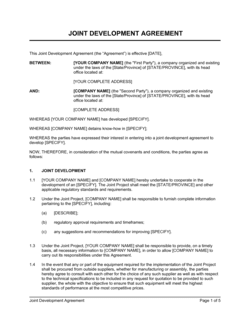
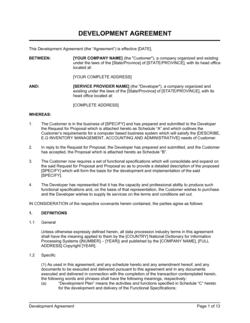
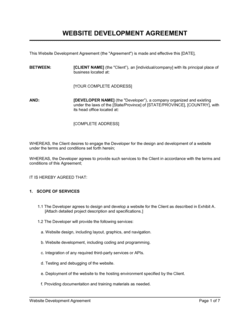
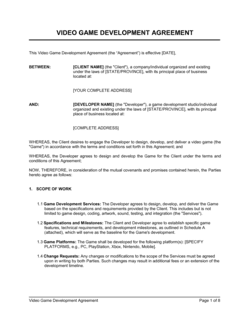
Development and Publishing Agreement Template

Free Word download • Edit online • Save & share with Drive • Export to PDF

18 pages35–45 min to fillDifficulty: ComplexSignature requiredLegal review recommended
Learn more ↓
FreeDevelopment and Publishing Agreement Template

At a glance

What it is
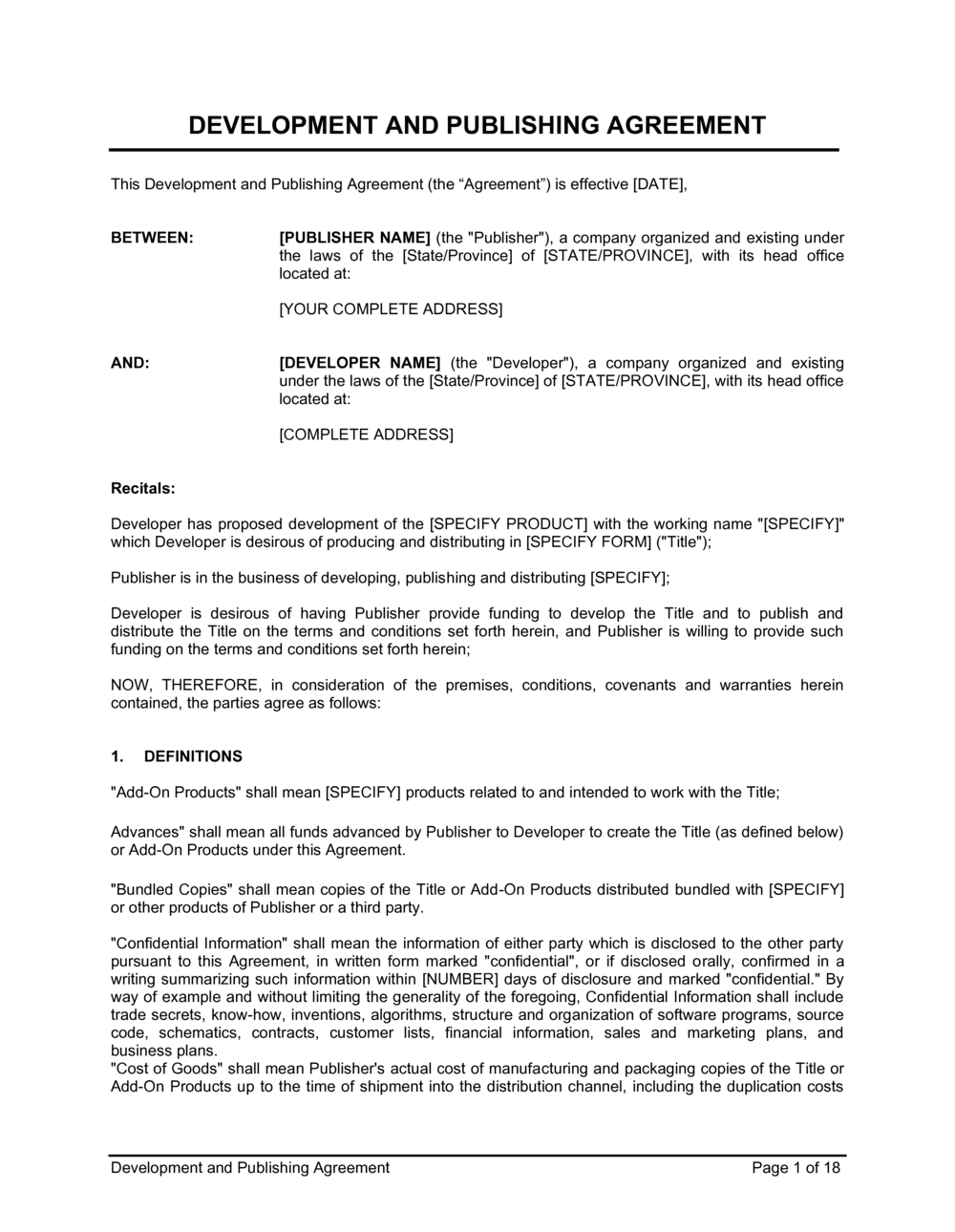
A Development and Publishing Agreement is a legally binding contract between a developer — an individual or studio creating a product such as a video game, software application, or digital content — and a publisher that funds, markets, and distributes the finished work. This free Word download covers IP ownership, funding milestones, royalty structures, approval rights, and termination in a single document you can edit online and export as PDF.
When you need it
Use it whenever a publisher is financing or co-financing development in exchange for distribution rights, or when a developer needs a binding framework that protects IP ownership and guarantees milestone-based payments. It is also the governing document when a publisher holds marketing and distribution exclusivity for a defined territory or platform.
What's inside
Scope of work and deliverable schedule, funding and milestone payments, royalty rates and recoupment mechanics, intellectual property ownership and licensing, approval and quality assurance rights, publishing and distribution rights by territory and platform, representations and warranties, termination triggers, and governing law.

What is a Development and Publishing Agreement?

A Development and Publishing Agreement is a legally binding contract between a developer — the studio or individual creating a product such as a video game, software application, or digital content work — and a publisher that funds, markets, and distributes the finished product to consumers. The agreement governs the entire commercial relationship: how development is funded through milestone-based advance payments, who owns the intellectual property, on which platforms and in which territories the publisher holds distribution rights, how royalties are calculated and paid after the advance is recouped, and what triggers the right to terminate and reclaim those rights. Unlike a simple work-for-hire arrangement, a development and publishing agreement typically allows the developer to retain IP ownership while granting the publisher a time-limited, territory-specific license to exploit the product commercially.

Why You Need This Document

Without a signed development and publishing agreement in place before any funding is transferred or development begins, both parties are exposed to serious legal and financial risk. A developer who relies on informal emails or a term sheet has no enforceable milestone payment schedule, no mechanism to reclaim publishing rights if the publisher shelves the product, and no protection against a publisher claiming ownership of the underlying engine or tools. A publisher who proceeds without a signed agreement has no contractual basis to enforce delivery deadlines, require quality standards, or recoup its advance if the developer fails to deliver. The consequences are concrete: developers have lost rights to their own IP through broad license language they did not scrutinize; publishers have funded products that were never delivered with no legal recourse; and royalty disputes over vaguely defined net revenue figures have ended long-term business relationships. This template gives both parties a structured, negotiated framework — with milestone schedules, royalty accounting standards, IP carve-outs, and reversion mechanics — that protects the deal from the first payment to the last royalty statement.

Which variant fits your situation?

If your situation is…Use this template
Video game studio seeking publisher funding and global distributionDevelopment and Publishing Agreement (Games)
Software company licensing an app to a third-party publisherSoftware Licensing Agreement
Author granting a publisher rights to publish and distribute written contentBook Publishing Agreement
Freelance developer building a product owned entirely by the clientSoftware Development Agreement
Two studios co-developing a product with shared IP ownershipJoint Venture Agreement
Publisher acquiring full ownership of a completed productIP Assignment Agreement
Developer self-publishing and retaining all rightsIndependent Contractor Agreement

Common mistakes to avoid

❌ Vague net revenue definition

Why it matters: The difference between a 20% royalty on a broadly defined net revenue and a 20% royalty on a narrowly defined net revenue can be several hundred thousand dollars over a product's commercial life. Publishers have strong incentive to expand deductions post-signature if the definition is unclear.

Fix: List every permitted deduction explicitly and close the definition with language confirming that no other deductions are permitted without written amendment.

❌ No objective milestone acceptance criteria

Why it matters: When acceptance is at the publisher's sole discretion, the publisher can reject milestones without reason, withhold payments indefinitely, and accumulate grounds to terminate while the developer has no contractual basis to escalate.

Fix: Attach a schedule specifying the technical, functional, and content criteria each milestone must meet, and require the publisher to provide written, specific reasons for any rejection within a defined review window.

❌ Broad IP license or assignment that sweeps in pre-existing tools

Why it matters: A developer who transfers or broadly licenses all IP in the product may inadvertently surrender rights to the engine, pipeline tools, and reusable code they depend on for every subsequent project — a commercially catastrophic outcome.

Fix: Attach a Schedule of pre-existing IP at execution, and include a carve-out clause confirming that no rights in pre-existing IP are transferred or exclusively licensed to the publisher.

❌ No committed release date in the publishing obligations clause

Why it matters: Without a release obligation, a publisher that has recouped its advance from ancillary revenue — early access sales, licensing — has no contractual pressure to invest in a commercial launch. The developer loses royalty income while the publisher holds distribution exclusivity.

Fix: Negotiate a hard release date no more than [X] months after gold master acceptance, with automatic reversion of publishing rights if the deadline is missed without developer consent.

❌ Uncapped developer indemnity for IP infringement

Why it matters: A developer who indemnifies the publisher without a liability cap faces exposure that can far exceed the total advance received. IP litigation in the software and games industry routinely involves claims in the millions of dollars.

Fix: Cap the developer's indemnity obligation at the total advance paid by the publisher and exclude claims arising from publisher modifications to the product.

❌ Reversion clause without an asset delivery obligation

Why it matters: A developer who wins back publishing rights but cannot obtain the gold master build, platform certification submissions, or localization files from the publisher is effectively unable to republish — the reversion right is worthless without the assets.

Fix: Add a specific asset delivery obligation requiring the publisher to deliver all product assets, documentation, and third-party submissions to the developer within 15 business days of any termination or rights reversion event.

The 10 key clauses, explained

Parties, recitals, and definitions

In plain language: Identifies the developer and publisher as legal entities, states the purpose of the agreement, and defines key terms used throughout — including 'Product,' 'Net Revenue,' 'Advance,' 'Territory,' and 'Platform.'

Sample language
This Development and Publishing Agreement is entered into as of [DATE] between [DEVELOPER LEGAL NAME], a [STATE/COUNTRY] [ENTITY TYPE] ('Developer'), and [PUBLISHER LEGAL NAME], a [STATE/COUNTRY] [ENTITY TYPE] ('Publisher'), with respect to the development and publication of [PRODUCT NAME] (the 'Product').

Common mistake: Defining 'Net Revenue' loosely without specifying which deductions are permitted. Publishers and developers routinely dispute whether platform fees, chargebacks, and marketing costs are deductible — vague definitions consistently produce the largest royalty disputes.

Development obligations and milestone schedule

In plain language: Sets out what the developer must deliver, the schedule of milestones with specific completion dates, and the acceptance criteria the publisher applies to approve each milestone.

Sample language
Developer shall develop and deliver the Product in accordance with the Development Schedule attached as Schedule A. Each milestone shall be submitted to Publisher by the date specified. Publisher shall have [15] business days to accept or reject each milestone submission with written reasons.

Common mistake: Omitting objective acceptance criteria for milestones. When 'approval' is entirely at the publisher's discretion with no defined standards, developers face indefinite delays and withheld payments with no contractual recourse.

Funding and advance payments

In plain language: States the total development advance, the amount payable at each milestone, the currency, payment timing, and whether any portion is non-recoupable.

Sample language
Publisher shall pay Developer a total development advance of [CURRENCY][AMOUNT], payable as follows: [X]% upon execution, [X]% upon acceptance of Milestone 2, [X]% upon Gold Master acceptance. The advance is fully recoupable from Developer's royalty share.

Common mistake: No mechanism for the developer to escalate if the publisher delays milestone approval beyond the review window. Without an escalation clause, a publisher can hold up payments indefinitely simply by not responding.

Intellectual property ownership and license

In plain language: Specifies whether the developer retains ownership of the underlying IP and grants the publisher a license, or whether IP transfers to the publisher, and defines what underlying technology, tools, and engines the developer retains regardless.

Sample language
Developer retains ownership of all intellectual property in the Product, including underlying engine, tools, and code. Developer hereby grants Publisher an exclusive license to publish, distribute, and sublicense the Product in the Territory for the Term, subject to the terms of this Agreement.

Common mistake: Failing to carve out the developer's pre-existing IP and underlying tools from the scope of any license or assignment. A broad grant that sweeps in the developer's engine or reusable codebase can prevent the developer from using their own technology in future projects.

Publishing rights, territory, and platform

In plain language: Defines the geographic territory in which the publisher holds rights, the platforms covered (PC, console, mobile, streaming), whether rights are exclusive, and any reserved rights the developer retains for self-publishing.

Sample language
Publisher is granted the exclusive right to publish and distribute the Product on [PLATFORMS] in [TERRITORY] for the Term. Developer retains all rights in [EXCLUDED TERRITORIES / PLATFORMS]. Publisher shall not sublicense distribution rights without Developer's prior written consent.

Common mistake: Granting worldwide rights across all platforms when the publisher only has meaningful distribution capacity on two or three platforms. Broad exclusivity with an under-resourced publisher blocks the developer from pursuing other distribution deals.

Royalties, recoupment, and royalty accounting

In plain language: Sets the royalty rate payable to the developer, defines the recoupment mechanics (how and in what order advances are recouped), specifies the accounting period and payment schedule, and grants the developer audit rights.

Sample language
Publisher shall pay Developer a royalty of [X]% of Net Revenue. Royalties shall accrue from first sale and shall be applied first to recoup the Advance. Publisher shall provide quarterly royalty statements within [45] days of each quarter end and remit payment within [30] days of the statement.

Common mistake: Agreeing to a royalty rate without defining what is deducted to arrive at 'Net Revenue.' A 25% royalty on a narrowly defined net figure may yield less than a 15% royalty on a broader net definition — the deduction list matters more than the headline rate.

Approvals, quality assurance, and gold master

In plain language: Defines the publisher's right to review and require changes to the product at defined points, the process for reaching a gold master certification, and what happens if the developer and publisher cannot agree on whether the product meets the required standard.

Sample language
Publisher shall have the right to review the Product at each milestone and at Gold Master submission. If Publisher rejects a submission, Publisher shall provide written notice specifying required corrections within [15] business days. If the parties cannot agree, the matter shall be referred to [DISPUTE MECHANISM].

Common mistake: No time limit on the gold master review and approval process. An uncapped approval window allows the publisher to delay the product's release indefinitely, which directly delays the developer's royalty income.

Marketing and release obligations

In plain language: States the publisher's minimum marketing spend or obligations, the agreed release window, what happens if the publisher delays the release date, and whether the developer has any approval over marketing materials.

Sample language
Publisher shall commercially release the Product no later than [DATE] and shall commit a minimum marketing budget of [CURRENCY][AMOUNT]. Developer shall have the right to approve marketing materials that use Developer's name, trademarks, or likeness, such approval not to be unreasonably withheld.

Common mistake: No committed release date or minimum marketing spend. Without these, a publisher can shelve the product indefinitely after recouping the advance from any ancillary revenue, leaving the developer with no path to royalties.

Termination and reversion of rights

In plain language: Sets out the grounds on which either party may terminate — including material breach, insolvency, missed payments, and failure to release — the notice and cure periods, and the consequences of termination including reversion of publishing rights to the developer.

Sample language
Either party may terminate this Agreement upon [30] days' written notice of a material breach if the breach is not cured within the notice period. Upon termination for Publisher's breach, all publishing rights shall immediately revert to Developer, and Publisher shall deliver all Product assets and materials to Developer within [15] days.

Common mistake: Providing reversion of rights without requiring the publisher to deliver all product assets — builds, source files, marketing materials, and platform submissions. A developer who wins rights back but cannot access their own build files is no better off.

Representations, warranties, and indemnification

In plain language: Each party confirms it has the authority to enter the agreement, the developer warrants the product does not infringe third-party IP, and each party agrees to indemnify the other for losses arising from its own breach of these warranties.

Sample language
Developer represents and warrants that it has full right, power, and authority to enter this Agreement, and that the Product does not infringe any third-party intellectual property rights. Each party shall indemnify and hold harmless the other from claims arising from its own breach of the representations set out in this Section.

Common mistake: Developer giving an uncapped indemnity for IP infringement claims. Third-party IP disputes in the gaming and software industry can run into millions of dollars — developers should negotiate a liability cap tied to the total advance received.

How to fill it out

  1. 1

    Identify the parties and describe the product

    Enter the full legal names and registered addresses of the developer and publisher. Write a clear, specific description of the product — including working title, genre or category, target platforms, and the stage of development at execution.

    💡 Use the same product description language in every exhibit and schedule — inconsistent naming across a multi-exhibit agreement is one of the most common sources of contract disputes.

  2. 2

    Attach a milestone schedule as Schedule A

    List every milestone, its completion criteria, the delivery date, and the payment amount triggered on acceptance. Include objective acceptance criteria — specific features, performance benchmarks, or QA pass rates — not just 'publisher satisfaction.'

    💡 Build in a 10–15% time buffer on each milestone date. Developers who miss milestone dates due to scope creep often lose their right to cure before the publisher can terminate.

  3. 3

    Define the advance and funding structure

    State the total advance amount, the currency, the percentage payable at each milestone, and whether any tranche is non-recoupable. Confirm payment timing — days from acceptance, not days from publisher's internal processing.

    💡 Negotiate at least the first tranche (typically 15–20% of the total advance) as non-recoupable to cover initial development costs that cannot be recovered if the publisher terminates early.

  4. 4

    Specify IP ownership and carve out pre-existing technology

    State clearly whether the developer retains IP ownership and grants a license, or whether IP transfers. Attach a Schedule listing the developer's pre-existing IP, tools, engines, and licensed middleware that are excluded from any grant or transfer.

    💡 If the developer retains ownership, confirm in the body of the agreement that no provision shall be construed as an assignment — courts in some jurisdictions read broad license language as implicit transfer.

  5. 5

    Define territory, platform, and exclusivity scope

    List every territory and platform where the publisher holds rights. Mark each as exclusive or non-exclusive. Explicitly reserve all territories and platforms not listed. Include a best-efforts clause requiring the publisher to actively distribute on each covered platform.

    💡 Sunset exclusivity on underperforming platforms after 12–18 months of release. A sunset clause prevents a publisher from blocking distribution on a platform it is not actively using.

  6. 6

    Set the royalty rate and define net revenue deductions

    Agree the royalty percentage and list every permitted deduction from gross receipts to arrive at net revenue — platform fees, distribution costs, taxes, returns, and chargebacks. Anything not listed should not be deductible.

    💡 Request a sample royalty statement calculation at negotiation so both parties confirm they apply the net revenue definition the same way before signing.

  7. 7

    Add termination triggers and reversion mechanics

    List every event that permits termination by each party, including cure periods. Specify that on termination for publisher's breach, all publishing rights revert and the publisher must deliver all product assets — builds, source code, platform submissions, and marketing materials — within a defined number of days.

    💡 Include a 'failure to release' termination right: if the publisher has not commercially released the product within [X] months of gold master acceptance, the developer may terminate and reclaim all rights regardless of advance recoupment status.

  8. 8

    Review governing law and dispute resolution before signing

    Confirm the governing law matches the jurisdiction where enforcement is most likely needed. Choose a dispute resolution mechanism — arbitration is common for cross-border deals; litigation may be preferred for deals within a single jurisdiction.

    💡 For cross-border agreements between a US developer and a European publisher, consider ICC arbitration seated in a neutral city — it provides an enforceable award in both jurisdictions under the New York Convention.

Frequently asked questions

What is a development and publishing agreement?

A development and publishing agreement is a legally binding contract between a developer — typically a game studio, software company, or content creator — and a publisher that funds, markets, and distributes the finished work. It defines who owns the intellectual property, how development is funded through milestone-based advances, what royalty the developer earns after the advance is recouped, and the territory and platform scope of the publisher's distribution rights. It is the primary governing document for the entire developer-publisher relationship.

Who owns the IP in a development and publishing agreement?

IP ownership depends entirely on what the contract says. Developers typically retain ownership of the underlying intellectual property and grant the publisher a license to distribute. However, some publishers — particularly those funding development in full — require an IP transfer as a condition of the deal. Developers should negotiate hard to retain ownership, especially of engines, tools, and reusable technology, and should ensure any license grant is limited in territory, platform, and duration rather than perpetual and worldwide.

What is recoupment and how does it affect royalties?

Recoupment is the mechanism by which the publisher recovers its advance from the developer's share of revenue before paying royalties. If a publisher pays a $500,000 advance and the royalty rate is 25% of net revenue, the developer receives no royalty payments until 25% of net revenue accumulates to $500,000 — meaning the product must generate $2 million in net revenue before the developer sees any royalty income beyond the advance. Developers should negotiate to limit what costs are recoupable and push for a portion of the advance to be non-recoupable.

What milestones should be included in the development schedule?

A well-structured milestone schedule typically includes: execution and initial funding, vertical slice or proof of concept, alpha build, beta build, code complete, gold master submission, and post-launch support period. Each milestone should have a specific delivery date, defined acceptance criteria, and a corresponding payment amount. The schedule should also specify the publisher's review window — typically 10 to 20 business days — and what happens if the publisher does not respond within that window.

What happens if the publisher does not release the product?

If the agreement contains a release obligation — a clause requiring the publisher to commercially release the product within a defined window after gold master acceptance — the developer can typically terminate and reclaim publishing rights if that deadline is missed. Without a release obligation, the publisher can hold distribution exclusivity indefinitely. Developers should always negotiate a hard release deadline with an automatic rights reversion consequence for non-compliance.

Can a developer self-publish on platforms not covered by the agreement?

Only if the agreement explicitly reserves those platforms to the developer. Publishers often seek exclusive worldwide rights across all platforms as a default negotiating position. Developers should push to limit exclusivity to the specific platforms where the publisher has genuine distribution capability and retain self-publishing rights for all unlisted platforms, territories, or formats such as physical editions or streaming services.

How is net revenue defined in a publishing agreement?

Net revenue is typically defined as gross receipts from sales minus a list of permitted deductions — commonly including platform fees (typically 15–30%), distribution costs, sales taxes, VAT, returns, and chargebacks. The specific deductions permitted vary significantly by agreement, and the definition can have a larger impact on actual royalties paid than the headline royalty rate. Developers should request a worked example using realistic sales figures before agreeing to any net revenue definition.

Do I need a lawyer to sign a development and publishing agreement?

For most developer-publisher agreements, legal review is strongly recommended. The financial stakes — advances, royalty structures, and IP ownership — are significant, and standard publisher contracts tend to be drafted in the publisher's favor. A lawyer experienced in entertainment or technology transactions can typically review and redline a development and publishing agreement in 4 to 8 hours. For deals involving advances above $100,000 or multi-territory exclusivity, the cost of legal review is a small fraction of what a poorly negotiated contract can cost over the product's commercial life.

What audit rights should a developer have in a publishing agreement?

Developers should negotiate the right to audit the publisher's relevant financial records — typically once per year with 30 days' notice — to verify that royalty statements are accurate. The audit clause should specify that the publisher bears the cost of the audit if a discrepancy of more than 5% is found in the developer's favor. Without audit rights, a developer has no practical mechanism to verify whether royalty calculations are correct.

How this compares to alternatives

vs Software Development Agreement

A software development agreement governs a work-for-hire relationship where the client commissions and owns the finished product outright. A development and publishing agreement is a commercial partnership where the developer typically retains IP and the publisher receives distribution rights in exchange for funding. Use a development agreement when a client is paying for a bespoke build they will own; use a publishing agreement when a developer is creating a commercial product and seeking a publishing partner.

vs Software License Agreement

A software license agreement grants a licensee the right to use a completed product under defined conditions. A development and publishing agreement governs the creation of a product that does not yet exist and includes funding, milestone, and distribution terms that a simple license agreement does not address. Once a product is complete and commercially released, a separate license agreement may govern end-user or enterprise distribution.

vs Joint Venture Agreement

A joint venture agreement establishes a shared entity or project where both parties contribute resources and share ownership. A development and publishing agreement keeps the parties separate — the developer creates, the publisher distributes — with each retaining their own entity and defined rights. Use a joint venture when both parties are co-creating and co-owning; use a publishing agreement when roles and rights are clearly divided between creator and distributor.

vs Independent Contractor Agreement

An independent contractor agreement engages an individual or company to complete defined work with ownership of the output typically transferring to the client. A development and publishing agreement is a commercial deal between two businesses with ongoing obligations, shared revenue, and IP ownership retained by the developer. If a developer is building a product for a client who will own it outright, the contractor agreement is appropriate; if the developer is building for commercial release with a publishing partner, use the publishing agreement.

Industry-specific considerations

Video Games

Milestone schedules tied to alpha, beta, and gold master builds; platform certification requirements for console storefronts; recoupment structures that include first-party certification costs and localization fees.

Software and SaaS

Distribution rights scoped by platform and enterprise tier; source code escrow requirements; SLA and post-launch support obligations integrated into the milestone schedule.

Publishing and Digital Media

Rights carve-outs for audiobook, translation, and adaptation formats; royalty stacking across distribution channels; reversion triggers tied to out-of-print or minimum sales thresholds.

Film and Interactive Entertainment

Co-production funding structures; territory splits between streaming and theatrical distribution; talent and guild compliance obligations integrated into development obligations.

Jurisdictional notes

United States

US law governs most major game and software publishing deals, with California and New York being the most common governing law choices. California has particular relevance given the concentration of game publishers and studios; its courts apply a strong presumption in favor of IP creators and scrutinize non-compete provisions. The FTC's guidance on endorsements and digital advertising also affects how marketing obligations in publishing agreements should be drafted.

Canada

Canadian developers should ensure that royalty and advance provisions account for withholding tax obligations on payments from foreign publishers under the Canada-US Tax Treaty and similar treaties. Ontario and British Columbia are the primary hubs for Canadian game studios, and their courts generally enforce IP license and publishing agreements as written. Quebec studios should confirm that the agreement is available in French or that both parties have expressly waived that requirement.

United Kingdom

UK development and publishing agreements are governed by the Copyright, Designs and Patents Act 1988, which grants authors and creators specific moral rights that must be explicitly waived if the publisher requires freedom to modify the product. Post-Brexit, territorial rights clauses must distinguish between UK and EU distribution separately, as they are now separate regulatory territories. UK courts enforce reasonable restraint-of-trade and exclusivity provisions but will strike down terms that are disproportionate.

European Union

GDPR compliance is directly relevant when the product collects user data, and the publishing agreement should specify which party is the data controller and processor for purposes of platform analytics and in-app purchases. The EU's Digital Markets Act may affect distribution exclusivity provisions for products released on regulated gatekeeper platforms. Royalty payments from EU publishers to non-EU developers may be subject to withholding tax obligations that vary significantly by member state — Germany, France, and the Netherlands each have different treaty rates.

Template vs lawyer — what fits your deal?

PathBest forCostTime
Use the templateDevelopers and publishers structuring straightforward deals with advances under $50,000 and single-territory distributionFree1–2 hours to complete
Template + legal reviewDeals with advances of $50,000–$500,000, multi-platform exclusivity, or any cross-border IP licensing element$600–$2,000 for legal review and redline3–7 days
Custom draftedMajor publisher deals, advances above $500,000, multi-territory exclusivity, or complex IP structures with existing licensors$3,000–$15,000+2–6 weeks

Glossary

Recoupment
The process by which a publisher recovers its development funding advances from the developer's share of revenue before royalties begin flowing to the developer.
Milestone
A defined deliverable or completion checkpoint in the development schedule that triggers a contractually specified payment from publisher to developer.
Royalty Rate
The percentage of net revenue or net receipts paid to the developer after the publisher recoups its advance and any other recoupable costs.
Net Revenue
Gross receipts from sales minus defined deductions such as platform fees, taxes, returns, and distribution costs — the base on which royalties are typically calculated.
Publishing Rights
The contractual authority granted to the publisher to market, distribute, sell, and sublicense the finished product within defined territories and on defined platforms.
Gold Master
The final, publisher-approved build of a product — typically a game or software title — that is certified ready for manufacturing or digital release.
Approval Right
A publisher's contractual entitlement to review and accept or reject a development milestone or the final product before it is deemed complete and payment is released.
Reversion
A clause that returns publishing or distribution rights to the developer if the publisher fails to perform — for example, by missing payment deadlines or failing to release the product within a defined window.
Advance
Upfront funding paid by the publisher to the developer against future royalties — recouped from the developer's royalty share before any additional royalty payments are made.
Territory
The geographic scope within which the publisher holds exclusive or non-exclusive rights to distribute and sell the product.
Platform
The specific distribution channel or device ecosystem — such as PC, console, iOS, or Android — on which the publisher holds distribution rights.

Part of your Business Operating System

This document is one of 3,000+ business & legal templates included in Business in a Box.

  • Fill-in-the-blanks — ready in minutes
  • 100% customizable Word document
  • Compatible with all office suites
  • Export to PDF and share electronically

Create your document in 3 simple steps.

From template to signed document — all inside one Business Operating System.
1
Download or open template

Access over 3,000+ business and legal templates for any business task, project or initiative.

2
Edit and fill in the blanks with AI

Customize your ready-made business document template and save it in the cloud.

3
Save, Share, Send, Sign

Share your files and folders with your team. Create a space of seamless collaboration.

Save time, save money, and create top-quality documents.

★★★★★

"Fantastic value! I'm not sure how I'd do without it. It's worth its weight in gold and paid back for itself many times."

Managing Director · Mall Farm
Robert Whalley
Managing Director, Mall Farm Proprietary Limited
★★★★★

"I have been using Business in a Box for years. It has been the most useful source of templates I have encountered. I recommend it to anyone."

Business Owner · 4+ years
Dr Michael John Freestone
Business Owner
★★★★★

"It has been a life saver so many times I have lost count. Business in a Box has saved me so much time and as you know, time is money."

Owner · Upstate Web
David G. Moore Jr.
Owner, Upstate Web

Run your business with a system — not scattered tools

Stop downloading documents. Start operating with clarity. Business in a Box gives you the Business Operating System used by over 250,000 companies worldwide to structure, run, and grow their business.

Start free · No credit card required