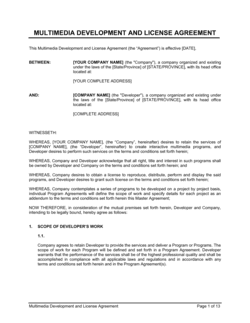
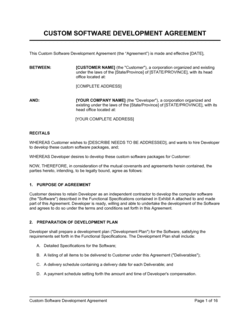
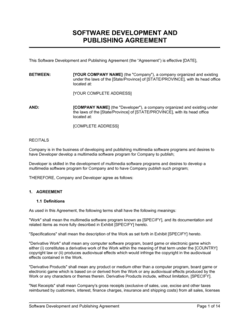
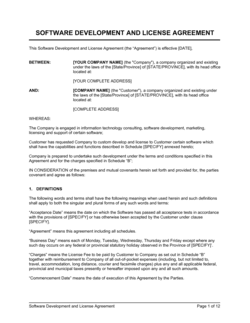
Video Game Development Agreement Template

Free Word download • Edit online • Save & share with Drive • Export to PDF

8 pages25–35 min to fillDifficulty: ComplexSignature requiredLegal review recommended
Learn more ↓
FreeVideo Game Development Agreement Template

At a glance

What it is
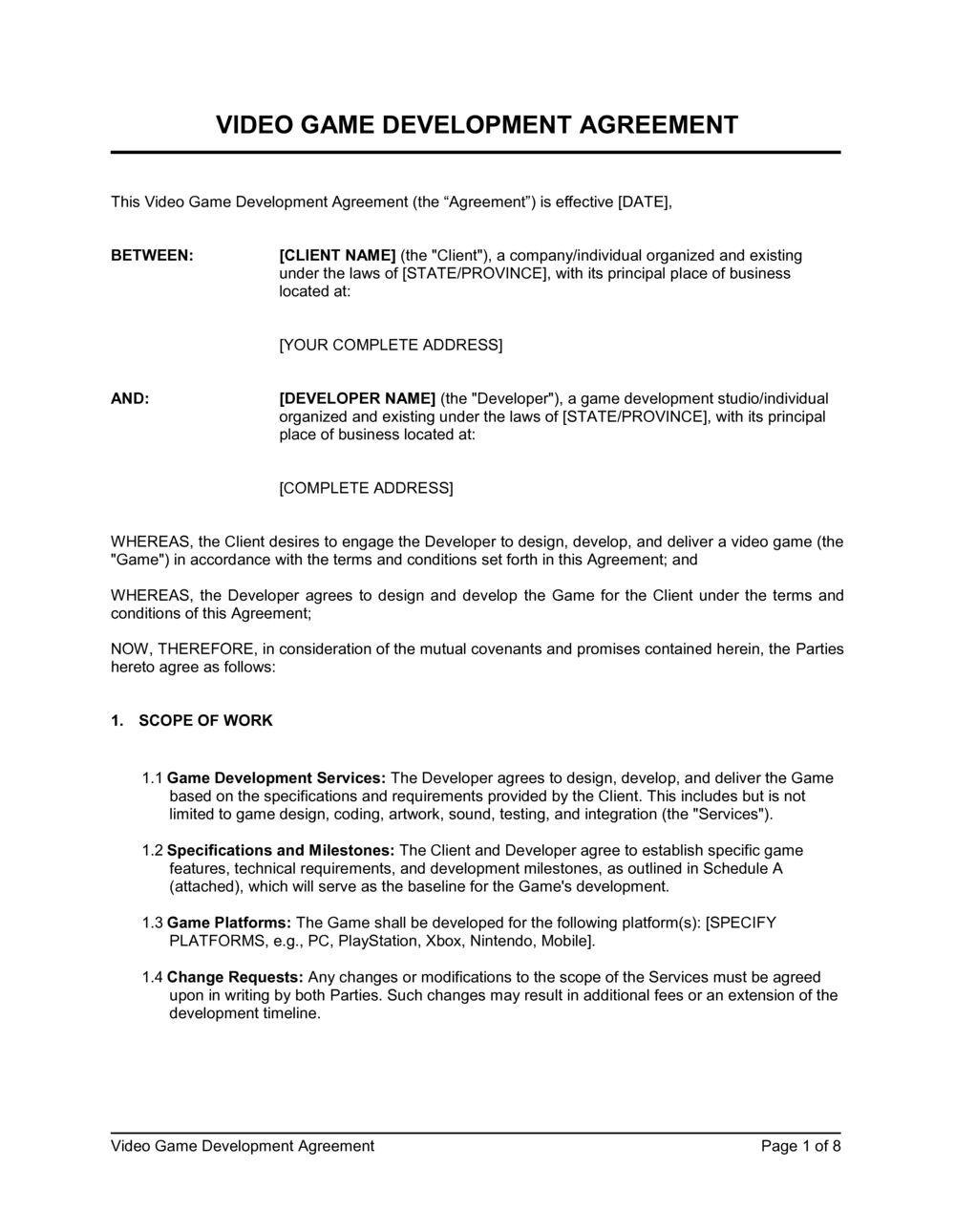
A Video Game Development Agreement is a legally binding contract between a game publisher or client and a development studio or individual developer that governs the creation, delivery, and ownership of a video game or game component. This free Word download covers scope of work, milestones, payment, IP assignment, royalties, source code ownership, and termination — and can be edited online and exported as PDF for execution.
When you need it
Use it whenever a publisher or studio commissions an external developer to build a game, or when two parties collaborate on a co-development project where budget, deliverables, and IP ownership need to be formally defined before work begins.
What's inside
Scope of work and technical specifications, milestone schedule with payment triggers, IP and source code assignment, revenue sharing and royalty terms, confidentiality and NDA obligations, representations and warranties, termination rights, and governing law.

What is a Video Game Development Agreement?

A Video Game Development Agreement is a legally binding contract between a publisher or commissioning client and a development studio or individual developer that governs every material aspect of creating a video game: scope of work, technical specifications, milestone schedule, payment triggers, intellectual property ownership, source code delivery, royalties, confidentiality, and termination rights. Unlike a generic services contract, it incorporates game-industry-specific mechanics — milestone greenlight approvals, alpha and gold master delivery standards, platform certification obligations, and royalty recoupment structures — that reflect the way games are actually built and commercialized. The agreement defines who owns the game, its code, its characters, and any sequels or derivative works from the first day of development through the full commercial lifecycle.

Why You Need This Document

Without a written development agreement, IP ownership defaults to the creator under copyright law in most jurisdictions — meaning a developer you paid to build your game may legally own it. Payment disputes over incomplete milestones, scope creep arguments about unspecified features, and post-launch royalty disagreements are the three most common causes of litigation in the games industry, and all three are preventable with a well-drafted contract. A developer who is terminated mid-project without a kill fee clause has every incentive to withhold source code; a publisher who approved milestones without a deemed-acceptance provision has no enforceable delivery date. This template closes all four gaps — IP assignment, payment mechanics, source code access, and termination consequences — before a single asset is created, giving both parties a clear framework to build the game and resolve disputes without going to court.

Which variant fits your situation?

If your situation is…Use this template
Publisher funding full development with full IP ownershipVideo Game Development Agreement (Work for Hire)
Co-development with shared IP and revenue splitCo-Development and Revenue Sharing Agreement
Hiring a freelance developer for a single module or featureIndependent Contractor Agreement
Licensing an existing engine or game IP to a developerSoftware License Agreement
Engaging a composer or artist for game assets onlyCreative Services Agreement
Outsourcing QA and testing to a third-party studioSoftware Testing Agreement
Publishing an existing game across new platformsGame Publishing Agreement

Common mistakes to avoid

❌ No deemed-approval clause on milestone review

Why it matters: Without a deadline for publisher review, a publisher can delay milestone acceptance indefinitely, blocking payment and halting the development schedule with no contractual remedy for the developer.

Fix: Add a provision stating that if the publisher does not approve or reject a milestone within 14 business days of submission, the milestone is deemed accepted and payment becomes due.

❌ Undefined net revenue deductions in the royalty clause

Why it matters: Publishers can deduct platform fees, marketing costs, chargebacks, and overhead from gross revenue before calculating royalties — leaving developers with a fraction of the expected payout on a commercially successful title.

Fix: List every permitted deduction explicitly in the contract and cap aggregate deductions as a percentage of gross revenue to protect the royalty base.

❌ Omitting a pre-existing IP schedule

Why it matters: Without a defined list of the developer's pre-existing tools and libraries, the IP assignment clause may transfer ownership of assets the developer relies on for other clients — exposing them to breach of contract with third parties.

Fix: Before signing, prepare a Pre-existing IP Schedule identifying every engine, library, tool, and asset the developer is bringing to the project. Attach it as an exhibit and cross-reference it in the IP assignment clause.

❌ No source code escrow or delivery obligation

Why it matters: If the developer closes or becomes unresponsive mid-project, the publisher has no legal or practical path to access the source code — even with a valid IP assignment — because the code was never physically transferred.

Fix: Require periodic source code deposits with an escrow agent or direct delivery to the publisher at each milestone, with a clear release trigger mechanism.

❌ No kill fee on termination for convenience

Why it matters: Developers who are terminated mid-project for convenience after completing substantial work in progress between milestones receive only approved milestone payments, leaving weeks or months of labor uncompensated.

Fix: Include a kill fee — typically 25–50% of the next unpaid milestone — payable immediately on notice of termination for convenience, regardless of the work-in-progress percentage.

❌ Choosing a governing law with no connection to the developer's jurisdiction

Why it matters: Mandatory contractor or employment protection laws in the developer's country may override the chosen governing law — making key clauses unenforceable while leaving the publisher with false confidence in the contract.

Fix: Consult a lawyer familiar with both parties' jurisdictions before fixing the governing law clause, particularly when the publisher and developer are in different countries.

The 10 key clauses, explained

Parties, recitals, and definitions

In plain language: Identifies the publisher and developer as legal entities, summarizes the project background, and defines all capitalized terms used throughout the agreement.

Sample language
This Video Game Development Agreement ('Agreement') is entered into as of [DATE] between [PUBLISHER LEGAL NAME], a [STATE/COUNTRY] [ENTITY TYPE] ('Publisher'), and [DEVELOPER LEGAL NAME], a [STATE/COUNTRY] [ENTITY TYPE] ('Developer'). Publisher wishes to engage Developer to develop the video game tentatively titled '[GAME TITLE]' as further described in Schedule A.

Common mistake: Using informal project names or trade names instead of registered legal entity names. If the contracting party name does not match the entity that holds the IP or the bank account, enforcing payment or IP transfer becomes complicated.

Scope of work and technical specifications

In plain language: Defines exactly what the developer is building — platforms, engine, feature list, performance targets, and any content restrictions — by reference to a Schedule A that can be updated without amending the main contract.

Sample language
Developer shall design, develop, and deliver the Game in accordance with the Technical Specifications set out in Schedule A ('Specifications'). The Game shall target [PLATFORM(S)] and achieve [PERFORMANCE BENCHMARK]. Any change to the Specifications requires a written change order signed by both parties.

Common mistake: Embedding detailed technical specifications in the main contract body instead of a Schedule. When specs evolve — as they always do — every update requires a full contract amendment rather than a simple schedule revision.

Milestone schedule and deliverables

In plain language: Lists each development phase with a due date, a description of what must be delivered, and the acceptance criteria the publisher will use to approve or reject the deliverable.

Sample language
Developer shall deliver each Milestone on or before the date set out in Schedule B. Publisher shall review each Milestone within [14] business days of receipt and provide written approval or a detailed list of material deficiencies. Failure to respond within [14] business days constitutes approval.

Common mistake: Omitting a deemed-approval provision. Without one, a publisher can stall indefinitely on milestone review, blocking both payment to the developer and progress to the next phase.

Fees, payment schedule, and royalties

In plain language: States the total development fee, when each payment is triggered (typically on milestone approval), and any royalty percentage payable after commercial release — including the royalty base, payment frequency, and reporting obligations.

Sample language
Publisher shall pay Developer a total development fee of $[AMOUNT], payable in installments as set out in Schedule B. Following commercial release, Publisher shall pay Developer a royalty of [X]% of Net Revenue, calculated and paid quarterly within [30] days of each quarter end, with supporting statements.

Common mistake: Defining royalties on 'gross revenue' without specifying what deductions are permitted. Publishers routinely deduct platform fees, chargebacks, and marketing costs — without a defined net revenue formula, disputes are nearly guaranteed.

Intellectual property ownership and assignment

In plain language: Specifies who owns the game's IP — code, art, audio, story, and brand elements — after completion, and carves out pre-existing IP that remains owned by the developer but is licensed to the publisher.

Sample language
All right, title, and interest in the Game and all Deliverables, excluding Developer's Pre-existing IP, shall vest in Publisher upon creation and are hereby irrevocably assigned to Publisher. Developer grants Publisher a perpetual, royalty-free license to use Developer's Pre-existing IP solely as incorporated in the Game.

Common mistake: Failing to define and list the developer's pre-existing IP before signing. Without a clear schedule of pre-existing tools, engines, and libraries, the assignment clause may inadvertently transfer ownership of assets the developer needs for other clients.

Confidentiality and NDA

In plain language: Prohibits both parties from disclosing the game's existence, design, source code, financials, or business terms to any third party during development and for a defined period after the agreement ends.

Sample language
Each party ('Receiving Party') shall hold the other party's Confidential Information in strict confidence and shall not disclose it to any third party without prior written consent. This obligation survives termination for [3] years. 'Confidential Information' excludes information that is publicly available through no fault of the Receiving Party.

Common mistake: Setting the confidentiality period to 'indefinitely' for general business information. Courts in several jurisdictions view indefinite confidentiality obligations as unreasonable and may decline to enforce them, leaving you with weaker protection than a defined 3–5 year term.

Representations, warranties, and indemnification

In plain language: Each party warrants that it has the legal right to enter the agreement, the developer warrants that the game will not infringe third-party IP, and each party agrees to indemnify the other against losses arising from their own breach.

Sample language
Developer represents and warrants that: (a) it has full authority to enter this Agreement; (b) the Game, as delivered, will not infringe any third-party intellectual property right; and (c) the Game will conform to the Specifications for [90] days following Publisher's acceptance. Developer shall indemnify Publisher against any third-party claim arising from a breach of these warranties.

Common mistake: Accepting a warranty disclaimer that limits the developer's representations to 'best efforts.' A best-efforts warranty on IP non-infringement provides almost no practical protection — the publisher bears the full cost of any infringement claim.

Termination rights and consequences

In plain language: Sets out the conditions under which either party may terminate — for cause (material breach, insolvency) or for convenience — and what happens to deliverables, payments, and IP rights upon termination.

Sample language
Either party may terminate this Agreement for material breach upon [30] days' written notice if the breach is not cured within that period. Publisher may terminate for convenience on [60] days' notice, in which case Publisher shall pay Developer for all approved Milestones completed as of the termination date, plus [X]% of the next Milestone fee as a kill fee.

Common mistake: No kill fee or termination-for-convenience payment formula. A developer who has completed 70% of a project and is terminated for convenience with only approved milestone payments has no recourse for work in progress — this routinely ends in litigation.

Source code escrow and delivery

In plain language: Requires the developer to deposit source code with a neutral escrow agent or deliver it to the publisher at defined intervals, ensuring the publisher can maintain and update the game if the developer becomes unavailable.

Sample language
Developer shall deposit a current copy of the Source Code with [ESCROW AGENT NAME] within [30] days of each Milestone approval. The Source Code shall be released to Publisher upon: (a) Developer's insolvency or cessation of business; (b) Developer's material breach that is not cured within the notice period; or (c) completion of the final Milestone.

Common mistake: Skipping source code escrow entirely for indie or small-studio projects. If the developer closes or becomes unresponsive mid-project, the publisher has no path to continue development without source code access — even with full IP ownership on paper.

Governing law, dispute resolution, and entire agreement

In plain language: Specifies which jurisdiction's law governs the agreement, whether disputes go to arbitration or court, the venue, and confirms that this document supersedes all prior discussions or agreements.

Sample language
This Agreement shall be governed by the laws of [STATE/COUNTRY]. Any dispute shall be resolved by binding arbitration administered by [AAA / JAMS / WIPO] in [CITY], conducted in English. This Agreement constitutes the entire agreement between the parties and supersedes all prior representations, negotiations, and understandings.

Common mistake: Choosing a governing law based on where the publisher is incorporated rather than where the developer works. Developers in a different jurisdiction may be entitled to mandatory local employment or contractor protections that override the chosen governing law.

How to fill it out

  1. 1

    Identify both parties using full legal entity names

    Enter the registered legal name, entity type, and jurisdiction of both the publisher and the developer. Confirm these match the entities that will actually sign, receive payment, and hold IP.

    💡 If the developer is a sole trader or LLC, confirm the correct legal name before drafting — mismatches between the contracting entity and the payment entity void the IP assignment in some jurisdictions.

  2. 2

    Complete Schedule A with detailed technical specifications

    List the target platforms, engine, core feature set, content rating requirements, performance benchmarks, and any third-party middleware to be used. Be specific enough that a technical reviewer could use this document as an acceptance checklist.

    💡 Attach concept documents, design bibles, or wireframes as exhibits to Schedule A — they become part of the contract and reduce scope disputes significantly.

  3. 3

    Build the milestone schedule in Schedule B

    List each development phase (pre-production, alpha, beta, gold master) with a specific calendar due date, a description of what must be delivered, and the dollar amount triggered by publisher approval of that milestone.

    💡 Include a deemed-approval provision: if the publisher does not respond to a milestone submission within 14 business days, it is automatically approved. This prevents payment stalling.

  4. 4

    Define the fee structure and royalty formula

    Enter the total development fee, each milestone payment amount, and — if applicable — the royalty percentage, royalty base definition (net revenue with a precise deduction list), payment frequency, and reporting obligations.

    💡 Cap the deductions allowed from gross revenue before the net royalty base is calculated. Unlimited deductions can reduce the net base to zero even on a commercially successful title.

  5. 5

    Identify and schedule pre-existing IP

    List all tools, engines, libraries, and assets the developer brings to the project that will not be transferred to the publisher. Attach this list as a Pre-existing IP Schedule before signing.

    💡 If the developer uses a licensed third-party engine (Unreal, Unity), confirm the engine license allows the publisher to use the delivered build — some licenses restrict commercial use to the original licensee.

  6. 6

    Set confidentiality period and carve-outs

    Enter the duration of confidentiality obligations (typically 3–5 years post-termination), list permitted disclosures (lawyers, accountants, investors under NDA), and define the carve-outs for publicly available information.

    💡 If the developer is a studio working on multiple projects, consider a narrower confidentiality scope — only game design, source code, and commercial terms — rather than all business information.

  7. 7

    Configure termination rights and kill fee

    Set the notice period for termination for cause (typically 30 days with a cure period) and for convenience (typically 60 days). Calculate and enter the kill fee — a percentage of the next unpaid milestone — that applies on termination for convenience.

    💡 A kill fee of 25–50% of the next milestone value is standard in the industry and gives developers sufficient protection to accept projects from publishers they haven't worked with before.

  8. 8

    Choose governing law and dispute resolution method

    Select the governing jurisdiction, decide between arbitration (faster, private) and court litigation (public record, no mandatory arbitration clause), and name the arbitration body and city if using arbitration.

    💡 WIPO arbitration is specifically designed for IP disputes and is increasingly preferred for cross-border game development agreements over AAA or JAMS, which are primarily US-focused.

Frequently asked questions

What is a video game development agreement?

A video game development agreement is a legally binding contract between a publisher or client and a development studio or freelance developer that defines the scope, schedule, payment, IP ownership, and termination terms for creating a video game or game component. It protects both parties by establishing enforceable obligations before a single line of code is written, and it replaces informal emails and verbal understandings as the authoritative record of the deal.

Who needs a video game development agreement?

Any publisher commissioning an external studio, any studio taking on a client project, any freelance developer building a game for a third party, and any brand or company paying for a branded game experience needs a written development agreement. Without one, IP ownership, payment triggers, and termination rights are undefined — and disputes typically end in costly litigation or complete project abandonment.

What is the difference between a work-for-hire agreement and a co-development agreement?

In a work-for-hire arrangement, the publisher pays a flat fee and owns all IP created during the project from the moment of creation — the developer retains no rights to the game. In a co-development agreement, both parties contribute resources and share IP ownership and revenue according to a negotiated split. The right structure depends on who is funding the project and how much creative or financial risk the developer is willing to accept in exchange for a stake in the game's success.

How are royalties typically structured in a game development agreement?

Royalties are usually expressed as a percentage of net revenue — gross revenue minus defined deductions such as platform fees (typically 30% for major storefronts), refunds, and applicable taxes. Percentages for independent developers range from 15% to 40% of net revenue depending on the development fee paid upfront. Many agreements also include a recoupment period during which the publisher recoups the development fee from the developer's royalty share before full royalty payments begin.

Who owns the source code and IP after the game is delivered?

In a work-for-hire agreement, the publisher typically owns all IP and source code upon full payment. The developer retains ownership of pre-existing IP — engines, tools, and libraries brought to the project — which is licensed (not assigned) to the publisher for use in the specific game. In co-development structures, IP ownership is shared and specified in the agreement. The contract must explicitly address sequels, DLC, and derivative works, as these are common sources of post-launch disputes.

What happens if the publisher terminates the agreement mid-development?

Termination consequences depend on the contract. For termination for cause (material breach by the developer), the publisher typically pays only for approved milestones. For termination for convenience, standard practice requires the publisher to pay all approved milestone amounts plus a kill fee — commonly 25–50% of the next unpaid milestone — to compensate the developer for work in progress. Without a kill fee clause, the developer may have no recourse for weeks of completed but un-milestoned work.

Is a video game development agreement enforceable across borders?

Generally yes, but enforceability depends heavily on the governing law chosen and the mandatory employment or contractor protections in the developer's jurisdiction. A contract governed by California law may still be subject to EU or Canadian employment standards if the developer works there. Cross-border agreements should be reviewed by lawyers in both jurisdictions, particularly regarding IP assignment validity, contractor classification rules, and royalty withholding tax obligations.

Do I need a lawyer to draft a video game development agreement?

For projects below $25,000 with a trusted studio in the same jurisdiction, a high-quality template reviewed by one party's lawyer is typically sufficient. For projects above $50,000, cross-border engagements, deals with revenue-share or royalty structures, or situations where IP ownership is commercially critical, engaging a lawyer with entertainment or technology IP experience is strongly recommended. The legal review cost of $500–$2,000 is modest relative to the risk of a disputed IP ownership claim on a commercially successful title.

What is source code escrow and do I need it?

Source code escrow is an arrangement where a neutral third party holds a copy of the game's source code and releases it to the publisher under defined trigger conditions — typically developer insolvency, material breach, or project abandonment. It is especially important when the publisher has full IP ownership on paper but the developer retains physical possession of the code. Without escrow, the publisher may be unable to maintain, patch, or continue developing the game even after full payment, because there is no practical mechanism to access the code.

How this compares to alternatives

vs Independent Contractor Agreement

An independent contractor agreement covers general services engagement — payment, deliverables, and basic IP assignment — but lacks the milestone approval mechanics, royalty structures, source code escrow, and game-specific acceptance criteria a development project requires. Use a contractor agreement for small, isolated tasks like a single asset pack; use a full development agreement for any project involving a complete game or major game component.

vs Software Development Agreement

A generic software development agreement addresses IP ownership and delivery for business software but omits game-industry specifics: milestone naming conventions (alpha, beta, gold master), platform certification obligations, royalty recoupment structures, and content rating compliance. A video game development agreement adapts these concepts to the publishing and distribution realities of the gaming industry.

vs Game Publishing Agreement

A game publishing agreement governs how an already-completed (or near-complete) game is marketed, distributed, and monetized by a publisher — it assumes the game exists. A development agreement governs the creation of the game from concept through delivery. Many deals require both: a development agreement first, followed by a publishing agreement for the commercial release phase.

vs Co-Development Agreement

A co-development agreement structures a project where both parties contribute creative or financial resources and share IP ownership and revenue. A standard video game development agreement places the publisher in a commissioning role with full IP ownership. Co-development suits situations where the developer brings a proprietary engine, established IP, or substantial funding — and demands a stake in the game's commercial upside.

Industry-specific considerations

Gaming and Interactive Entertainment

Full-cycle game development agreements covering console, PC, and mobile titles with milestone-based payment, platform certification requirements, and royalty structures tied to net storefront revenue.

Mobile and App Publishing

Short development cycles (3–9 months), in-app purchase revenue sharing, platform-specific (iOS/Android) performance benchmarks, and live-service update obligations after initial launch.

Advertising and Brand Marketing

Branded game experiences commissioned by advertisers require strict brand guidelines compliance, content approval rights at each milestone, and indemnification for brand-related IP claims.

Education and Training (Serious Games)

Serious game agreements for corporate training or e-learning platforms include SCORM compliance requirements, LMS integration obligations, and content accuracy warranties tied to subject-matter expert sign-off.

Jurisdictional notes

United States

US copyright law automatically recognizes work-for-hire for employees; for independent contractors, a written assignment is required — the contract must explicitly state the work is 'made for hire' and fall within one of the statutory categories, or include a separate assignment clause. Non-compete clauses for developers are severely restricted in California and Minnesota. DMCA provisions should be addressed if the game includes user-generated content.

Canada

Canadian copyright does not recognize a broad work-for-hire doctrine for independent contractors — IP assignment must be explicit and in writing. Ontario and British Columbia have contractor classification rules that may reclassify long-term embedded developers as employees, triggering statutory benefits obligations. Quebec contracts may need to be in French for provincially-regulated entities. Royalty payments to non-residents may be subject to withholding tax under the Income Tax Act.

United Kingdom

UK copyright law vests first ownership in the creator for independent contractors — a written assignment to the publisher is essential and must use the word 'assign' rather than 'license' to be effective. IR35 rules may reclassify developers working through personal service companies as employees if the engagement resembles employment. Post-Brexit, EU data protection rules no longer apply automatically; UK GDPR governs any player data handling obligations.

European Union

EU member states vary significantly on IP assignment validity — France, Germany, and Spain impose moral rights on creators that cannot be fully waived, potentially limiting the publisher's ability to alter or exploit the game without the developer's consent. GDPR applies to any game collecting player data, and the development agreement should allocate controller and processor responsibilities. Non-compete clauses typically require financial compensation to the developer in France, Germany, and the Netherlands to be enforceable.

Template vs lawyer — what fits your deal?

PathBest forCostTime
Use the templateProjects under $25,000 with a known developer in the same jurisdiction, using a flat development fee with no royalty structureFree30–60 minutes
Template + legal reviewProjects from $25,000–$150,000, cross-jurisdiction engagements, or agreements with royalty and revenue-sharing clauses$500–$2,0003–5 days
Custom draftedMajor title commissions above $150,000, co-development with shared IP, console platform certification requirements, or multi-territory publishing rights$3,000–$10,000+2–4 weeks

Glossary

Work for Hire
A legal doctrine under which creative work produced by a developer is owned by the commissioning party from the moment of creation, with no residual rights remaining with the creator.
Milestone
A defined development checkpoint — such as alpha, beta, or gold master — at which specific deliverables are reviewed and a corresponding payment is released.
Gold Master
The final, approved build of a game that is certified for distribution, manufacturing, or platform submission.
Royalty
A percentage of net or gross revenue paid to the developer on an ongoing basis after commercial release, in addition to or instead of a flat development fee.
Source Code Escrow
An arrangement where the game's source code is held by a neutral third party and released to the publisher under defined conditions, such as developer insolvency.
Pre-existing IP
Intellectual property — engines, tools, libraries, or assets — owned by the developer before the project began, which is licensed (not transferred) to the publisher for use in the game.
Greenlight
A formal approval by the publisher to proceed from one development phase to the next, typically following milestone review and sign-off.
Recoupment
The process by which a publisher recovers development costs from the developer's share of revenue before royalty payments begin.
Net Revenue
Gross revenue minus defined deductions — platform fees, refunds, taxes, and distribution costs — used as the royalty base when gross revenue is not applicable.
Derivative Works
Games, expansions, DLC, sequels, or adaptations based on the original game's characters, engine, or storyline, which typically fall under the IP ownership terms of the original agreement.
Force Majeure
A clause excusing a party from performance obligations when an event outside their control — natural disaster, pandemic, or government action — makes performance impossible.
Technical Specifications
The agreed document defining the game's platform targets, performance requirements, feature set, and design parameters that serve as the acceptance benchmark for deliverables.

Part of your Business Operating System

This document is one of 3,000+ business & legal templates included in Business in a Box.

  • Fill-in-the-blanks — ready in minutes
  • 100% customizable Word document
  • Compatible with all office suites
  • Export to PDF and share electronically

Create your document in 3 simple steps.

From template to signed document — all inside one Business Operating System.
1
Download or open template

Access over 3,000+ business and legal templates for any business task, project or initiative.

2
Edit and fill in the blanks with AI

Customize your ready-made business document template and save it in the cloud.

3
Save, Share, Send, Sign

Share your files and folders with your team. Create a space of seamless collaboration.

Save time, save money, and create top-quality documents.

★★★★★

"Fantastic value! I'm not sure how I'd do without it. It's worth its weight in gold and paid back for itself many times."

Managing Director · Mall Farm
Robert Whalley
Managing Director, Mall Farm Proprietary Limited
★★★★★

"I have been using Business in a Box for years. It has been the most useful source of templates I have encountered. I recommend it to anyone."

Business Owner · 4+ years
Dr Michael John Freestone
Business Owner
★★★★★

"It has been a life saver so many times I have lost count. Business in a Box has saved me so much time and as you know, time is money."

Owner · Upstate Web
David G. Moore Jr.
Owner, Upstate Web

Run your business with a system — not scattered tools

Stop downloading documents. Start operating with clarity. Business in a Box gives you the Business Operating System used by over 250,000 companies worldwide to structure, run, and grow their business.

Start free · No credit card required