Zero Tolerance Policy Template

Free Word download β€’ Edit online β€’ Save & share with Drive β€’ Export to PDF

3 pagesβ€’20–25 min to fillβ€’Difficulty: Standard
Learn more ↓
FreeZero Tolerance Policy Template

At a glance

What it is
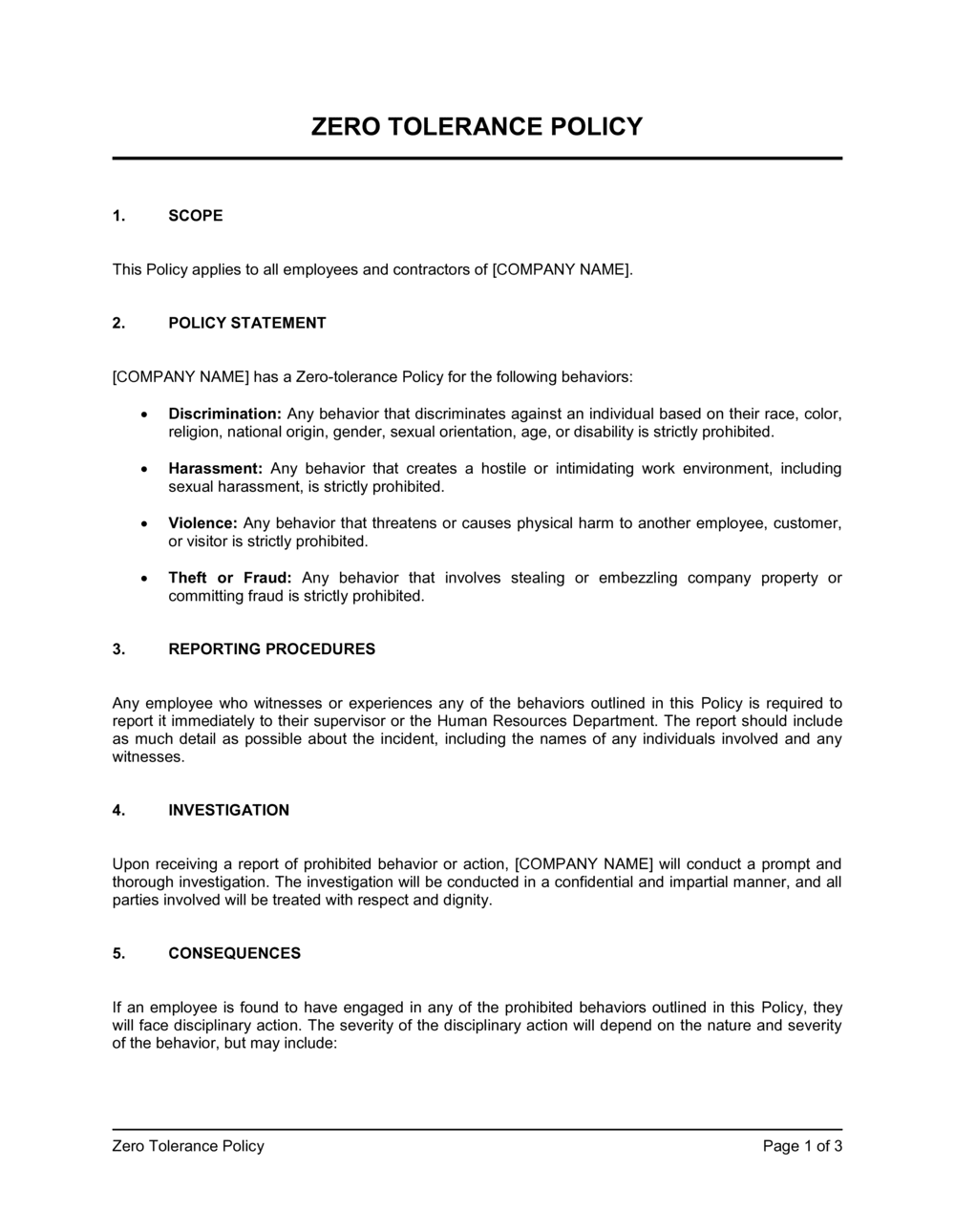
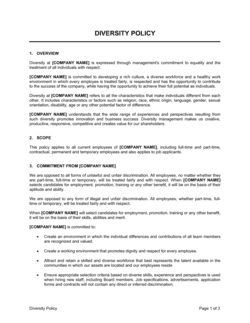
A Zero Tolerance Policy is a formal written statement that defines specific categories of workplace conduct β€” typically harassment, violence, discrimination, or substance use β€” and establishes that any confirmed violation will result in immediate disciplinary action, up to and including termination. This free Word download gives you a structured, editable template you can tailor to your organization's specific prohibited behaviors, reporting channels, and consequences, then export as PDF for distribution to all staff.
When you need it
Use it when onboarding new employees, updating your employee handbook, responding to a workplace incident that exposed a policy gap, or meeting compliance requirements from an industry regulator, insurer, or government contractor. Organizations operating in regulated industries or multi-site environments typically maintain a standalone zero tolerance document rather than relying on handbook language alone.
What's inside
Policy purpose and scope, definitions of prohibited conduct, covered parties, reporting procedures, investigation process, consequences and disciplinary outcomes, anti-retaliation protections, and acknowledgment and signature block for employee records.

What is a Zero Tolerance Policy?

A Zero Tolerance Policy is a formal workplace document that names specific categories of conduct β€” typically harassment, workplace violence, discrimination, weapons possession, or substance use β€” and establishes that any confirmed violation will result in immediate disciplinary action, up to and including termination, with no discretion to apply a lesser consequence. Unlike a standard progressive discipline framework, which escalates consequences across multiple offenses, a zero tolerance policy draws a hard line: certain behaviors are treated as terminable on the first confirmed incident, regardless of the employee's tenure, seniority, or prior performance record. The policy also defines how employees report violations, how the organization investigates complaints, and how it protects reporters from retaliation.

Why You Need This Document

Without a written zero tolerance policy, managers apply conduct standards inconsistently β€” a high-performing employee receives a warning for behavior that gets a junior employee fired, and the disparity becomes an equal-treatment claim. When a harassment or violence incident reaches litigation, the absence of a documented policy and investigation process removes the employer's most significant legal defense. Regulators, insurers, and government contractors frequently require evidence of written conduct standards as a condition of doing business. Beyond legal protection, the policy itself changes behavior: employees who understand that certain conduct triggers automatic termination are significantly less likely to test the line. This template gives you a complete, editable starting point β€” covering prohibited conduct, reporting channels, investigation procedures, and acknowledgment forms β€” so you can have a defensible policy in place within hours rather than weeks.

Which variant fits your situation?

If your situation is…Use this template
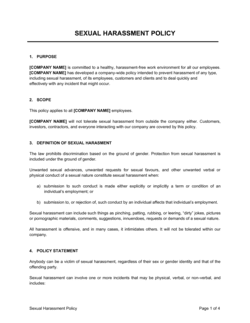
Addressing sexual harassment and gender-based misconduct specificallySexual Harassment Policy
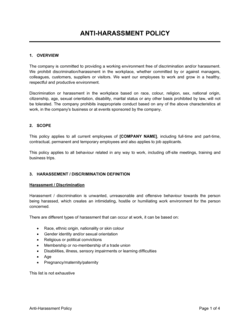
Covering all forms of workplace harassment, bullying, and intimidationAnti-Harassment Policy
Setting rules around alcohol and drug use at workDrug and Alcohol Policy
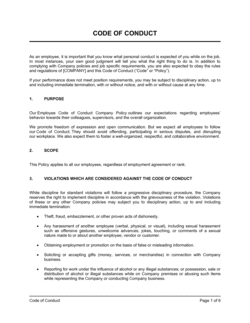
Documenting expected conduct standards across a broader range of behaviorsCode of Conduct
Providing employees with a single reference for all workplace rulesEmployee Handbook
Establishing formal procedures for investigating reported incidentsWorkplace Investigation Policy
Recording and tracking a specific disciplinary action after a violationEmployee Written Warning

Common mistakes to avoid

❌ Using 'may result in termination' instead of 'will result in termination'

Why it matters: Discretionary language converts a zero tolerance standard into a judgment call, undermining consistent enforcement and creating equal-treatment exposure when one employee is terminated and another is not.

Fix: Replace 'may' with 'will' for the specific conduct categories the policy treats as zero tolerance. Reserve discretionary language for a separate progressive discipline tier.

❌ Naming only the direct manager as the reporting channel

Why it matters: When the manager is the alleged violator β€” which is common β€” employees have no safe path to report, so incidents go undisclosed until they escalate into litigation or regulatory complaints.

Fix: Designate at least two reporting channels: HR and a senior executive outside the employee's chain of command. Add an anonymous option for organizations above 20 employees.

❌ Collecting acknowledgments only at hire and never updating them

Why it matters: A policy revised after an employee's hire date is the effective policy, but an employee who never signed it can credibly claim they weren't informed of the updated standard.

Fix: Re-distribute and re-collect signed acknowledgments every time the policy is materially revised. Track acknowledgment status in your HRIS.

❌ Omitting the anti-retaliation clause or burying it in fine print

Why it matters: Employees who fear job loss, demotion, or social exclusion for reporting do not report. A policy with no visible retaliation protection produces a culture of silence, not safety.

Fix: Give anti-retaliation its own numbered section with the same prominence as the prohibited conduct list. Train managers on it explicitly.

The 9 key sections, explained

Policy purpose and statement of commitment

Scope and covered parties

Definitions of prohibited conduct

Reporting procedures

Investigation process

Consequences and disciplinary outcomes

Anti-retaliation protections

Manager and supervisor responsibilities

Employee acknowledgment and receipt

How to fill it out

  1. 1

    Identify the specific conduct categories your policy covers

    Before editing the template, list every behavior you intend to prohibit β€” physical violence, harassment, discrimination, weapons, substance use, or others. The policy's credibility depends on naming them explicitly rather than relying on catch-all language.

    πŸ’‘ Review any past incidents, HR complaints, or near-misses in your organization. The categories that have actually occurred in your workplace should be named first.

  2. 2

    Define the scope of covered parties and locations

    Enter all parties the policy covers β€” employees, contractors, vendors, volunteers β€” and all settings, including remote work, company events, and digital communication channels. Gaps in scope are gaps in protection.

    πŸ’‘ If your workforce is fully or partly remote, add explicit language covering conduct in video calls, messaging platforms, and email, not just physical premises.

  3. 3

    Write specific definitions for each prohibited behavior

    For each conduct category, write a definition precise enough that a reasonable employee understands what is and is not covered. Use examples where helpful, and include an 'including but not limited to' clause to preserve flexibility.

    πŸ’‘ Test each definition by asking: 'If a manager asked whether a specific behavior falls under this rule, does the definition give a clear answer?' If not, tighten the language.

  4. 4

    Set up at least two reporting channels

    Name a primary contact (typically HR), a secondary contact (e.g., a senior executive or ombudsperson), and, where feasible, an anonymous reporting option. Record contact details β€” name, email, phone β€” directly in the policy.

    πŸ’‘ For organizations under 25 employees where everyone knows everyone, an anonymous third-party hotline is worth the $50–$100/month cost to ensure staff actually report.

  5. 5

    Define the investigation timeline and process

    Set a realistic acknowledgment window (e.g., 2 business days) and a target investigation completion period (e.g., 15 business days for standard cases). Name who conducts investigations and when a third party is called in.

    πŸ’‘ Add a clause reserving the right to extend the investigation timeline for complex cases with written notice to the complainant β€” this protects you without locking in an unrealistic deadline.

  6. 6

    State consequences in mandatory, not discretionary, language

    Write consequences as 'will result in termination' rather than 'may result in termination' for the behaviors your policy treats as zero tolerance. Reserve discretionary language only for conduct categories outside the zero tolerance core.

    πŸ’‘ If your legal counsel insists on 'may' language for liability reasons, create a two-tier structure: a zero tolerance tier with mandatory termination and a standard misconduct tier with progressive discipline.

  7. 7

    Add manager-specific obligations and the anti-retaliation clause

    Give managers a dedicated section with explicit reporting timelines and a prohibition on informal resolution. Place the anti-retaliation clause in its own numbered section β€” not buried in a paragraph β€” so employees can find and cite it.

    πŸ’‘ Train managers on these obligations separately from the all-staff distribution. A policy managers haven't internalized is a policy they won't follow.

  8. 8

    Distribute and collect signed acknowledgments

    Send the finalized policy to all staff, collect signed acknowledgment forms, and file them in each employee's personnel record. Set a calendar reminder to re-distribute and re-collect acknowledgments any time the policy is revised.

    πŸ’‘ Use your HRIS or document management system to track acknowledgment status β€” chasing paper signatures delays compliance and creates gaps in your records.

Frequently asked questions

What is a zero tolerance policy?

A zero tolerance policy is a formal workplace document that identifies specific categories of conduct β€” typically harassment, violence, discrimination, or substance use β€” and mandates a defined disciplinary consequence, usually immediate termination, for any confirmed violation. Unlike progressive discipline frameworks, zero tolerance policies remove managerial discretion for the covered behaviors, ensuring consistent enforcement regardless of the violator's seniority or performance record.

What behaviors should a zero tolerance policy cover?

The most common categories are physical violence or credible threats of violence, sexual harassment, discrimination based on protected characteristics, possession of weapons on company premises, and workplace substance abuse. Some organizations extend zero tolerance to data theft, fraud, or serious safety violations. The policy should name each prohibited behavior explicitly rather than relying on broad catch-all language.

Is a zero tolerance policy legally required?

No federal or most state laws in the US mandate a written zero tolerance policy by that name, but anti-harassment and anti-discrimination policies are strongly advisable and, in some jurisdictions, practically required as a defense in employment litigation. Government contractors, federally funded organizations, and certain regulated industries may have specific written policy requirements. Even where not legally mandated, a documented policy significantly strengthens an employer's position in discrimination or hostile work environment claims.

What's the difference between a zero tolerance policy and a code of conduct?

A code of conduct is a broad document covering a wide range of expected behaviors β€” ethics, communication standards, conflict of interest, and general professional conduct. A zero tolerance policy is narrower and more specific: it names a defined set of severe violations and states that any confirmed instance will result in immediate disciplinary action. Many organizations include zero tolerance language inside a code of conduct but maintain a standalone policy for visibility and legal clarity.

Does a zero tolerance policy need to include an investigation process?

Yes. Even when a policy mandates termination for confirmed violations, "confirmed" requires an investigation. Terminating an employee without a documented investigation β€” even for an obvious offense β€” creates wrongful termination risk and can expose the company to discrimination claims if the process is applied inconsistently. The investigation section should specify who investigates, the target timeline, and how findings are recorded.

Can a zero tolerance policy protect an employer from lawsuits?

A well-drafted, consistently enforced zero tolerance policy strengthens an employer's defense in harassment and discrimination claims by demonstrating that the company took reasonable steps to prevent and address misconduct. Courts have recognized that organizations with documented policies, accessible reporting channels, and prompt investigation processes are in a materially better legal position than those without. However, the policy only provides protection if it is actually followed β€” a policy that exists on paper but is never enforced may worsen legal exposure.

How should a zero tolerance policy be distributed to employees?

Distribute the policy to all employees at onboarding and whenever it is materially revised. Collect a signed acknowledgment form from each employee confirming they received and read the policy, and file it in the personnel record. For organizations using an HRIS or document management system, track acknowledgment completion centrally so you can demonstrate 100% coverage during audits or litigation.

Should managers receive separate training on the zero tolerance policy?

Yes. Managers have specific obligations the policy assigns to them β€” mandatory reporting timelines, prohibition on informal resolution, and anti-retaliation duties β€” that go beyond what rank-and-file employees need to understand. Manager-level training should cover how to receive a complaint, what to do and not do in the first 24 hours, and the consequences of failing to escalate. This training should be documented.

How often should a zero tolerance policy be reviewed and updated?

Review the policy at least once per year, and immediately after any workplace incident, regulatory change, or significant workforce expansion. When legislation in your jurisdiction changes the definition of harassment or expands protected characteristics, the policy definitions must be updated to match. Each revision should be distributed to all staff with a new acknowledgment cycle.

How this compares to alternatives

vs Anti-Harassment Policy

An anti-harassment policy focuses specifically on harassment, discrimination, and hostile work environment conduct. A zero tolerance policy is broader β€” it may cover violence, weapons, substance use, and other severe misconduct beyond harassment. Where harassment is the primary concern, the anti-harassment policy goes deeper on definitions and protected characteristics; the zero tolerance policy is the right choice when you need a single document covering multiple categories of serious misconduct.

vs Code of Conduct

A code of conduct covers the full spectrum of expected workplace behavior β€” ethics, communication, conflict of interest, and professional standards. A zero tolerance policy is a narrower, more enforceable document that names specific severe violations and mandates defined consequences. Most organizations use both: the code sets the culture standard; the zero tolerance policy draws the hard lines that trigger immediate termination.

vs Employee Handbook

An employee handbook is a comprehensive reference document covering all workplace policies, benefits, and procedures. Zero tolerance language is often included in a handbook, but maintaining a standalone zero tolerance policy gives the prohibited conduct standards higher visibility, makes them easier to distribute and acknowledge separately, and avoids burying critical conduct rules among unrelated HR information.

vs Progressive Discipline Policy

A progressive discipline policy escalates consequences from verbal warning to written warning to suspension and ultimately termination for repeated or escalating misconduct. A zero tolerance policy deliberately bypasses this sequence for the most severe violations, mandating immediate termination on first confirmed offense. Organizations typically need both: progressive discipline for ordinary performance and conduct issues, zero tolerance for the specific behaviors that cannot be tolerated at any level.

Industry-specific considerations

Healthcare

Patient-facing environments require zero tolerance policies that explicitly cover patient abuse, workplace violence against clinical staff, and substance impairment on shift β€” categories with direct regulatory and licensing implications.

Education

K-12 schools and universities apply zero tolerance frameworks to student and staff conduct alike, with specific provisions for weapons, bullying, and mandatory reporting obligations under Title IX and state law.

Construction and Trades

High-hazard job sites require zero tolerance policies covering substance use, safety rule violations, and workplace violence that are integrated with OSHA compliance programs and subcontractor requirements.

Retail and Hospitality

High-turnover, customer-facing environments rely on zero tolerance policies to set clear conduct standards across large, distributed workforces where informal management norms are inconsistently applied.

Financial Services

Regulatory obligations from FINRA, the SEC, and banking supervisors mean zero tolerance policies in financial services frequently extend to fraud, data misuse, and conflicts of interest alongside harassment.

Manufacturing

Zero tolerance for substance use and safety violations is standard in manufacturing environments where impairment directly causes equipment accidents, injuries, and OSHA recordable incidents.

Template vs pro β€” what fits your needs?

PathBest forCostTime
Use the templateSmall and mid-size businesses establishing a written conduct standard for the first timeFree1–2 hours to customize and distribute
Template + professional reviewOrganizations in regulated industries, multi-state employers, or those updating policy after a workplace incident$200–$500 for an HR consultant or employment attorney review3–5 business days
Custom draftedLarge employers, government contractors, or organizations with complex workforce structures requiring tailored definitions and investigation protocols$800–$2,500+1–3 weeks

Glossary

Zero Tolerance
A policy stance that mandates a defined disciplinary response β€” typically termination β€” for any confirmed violation, without case-by-case discretion on whether to impose a lesser consequence.
Prohibited Conduct
Specific behaviors explicitly named in the policy as grounds for immediate disciplinary action, such as physical violence, harassment, or possession of weapons on premises.
Anti-Retaliation Clause
A policy provision protecting employees who report violations or participate in investigations from adverse employment actions such as demotion, schedule changes, or termination.
Covered Parties
The individuals to whom the policy applies β€” typically all employees, contractors, vendors, and visitors on company premises or participating in company activities.
Reporting Channel
The designated method or person through which employees submit complaints β€” e.g., a direct manager, HR representative, anonymous hotline, or online form.
Acknowledgment Form
A signed document confirming that the employee has received, read, and understood the policy β€” used as evidence that the employer communicated the standard.
Progressive Discipline
A disciplinary framework that escalates consequences from verbal warning to written warning to suspension and then termination; zero tolerance policies typically bypass this sequence for covered violations.
Investigation Protocol
The documented steps an employer follows after receiving a complaint β€” including who conducts the review, timelines, confidentiality obligations, and how findings are recorded.
Constructive Notice
Legal concept establishing that an employee is considered to have been informed of a policy if it was distributed through standard channels, regardless of whether they personally recall receiving it.
Hostile Work Environment
A workplace condition in which pervasive or severe misconduct β€” based on protected characteristics β€” unreasonably interferes with an employee's ability to perform their job.

Part of your Business Operating System

This document is one of 3,000+ business & legal templates included in Business in a Box.

  • Fill-in-the-blanks β€” ready in minutes
  • 100% customizable Word document
  • Compatible with all office suites
  • Export to PDF and share electronically

Create your document in 3 simple steps.

From template to signed document β€” all inside one Business Operating System.
1
Download or open template

Access over 3,000+ business and legal templates for any business task, project or initiative.

2
Edit and fill in the blanks with AI

Customize your ready-made business document template and save it in the cloud.

3
Save, Share, Send, Sign

Share your files and folders with your team. Create a space of seamless collaboration.

Save time, save money, and create top-quality documents.

β˜…β˜…β˜…β˜…β˜…

"Fantastic value! I'm not sure how I'd do without it. It's worth its weight in gold and paid back for itself many times."

Managing Director Β· Mall Farm
Robert Whalley
Managing Director, Mall Farm Proprietary Limited
β˜…β˜…β˜…β˜…β˜…

"I have been using Business in a Box for years. It has been the most useful source of templates I have encountered. I recommend it to anyone."

Business Owner Β· 4+ years
Dr Michael John Freestone
Business Owner
β˜…β˜…β˜…β˜…β˜…

"It has been a life saver so many times I have lost count. Business in a Box has saved me so much time and as you know, time is money."

Owner Β· Upstate Web
David G. Moore Jr.
Owner, Upstate Web

Run your business with a system β€” not scattered tools

Stop downloading documents. Start operating with clarity. Business in a Box gives you the Business Operating System used by over 250,000 companies worldwide to structure, run, and grow their business.

Free Forever PlanΒ Β·Β No credit card required