1
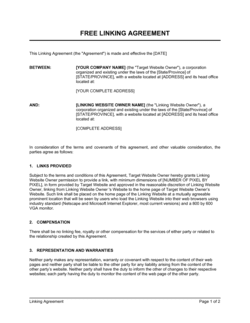
Identify both parties with their legal entity names
Enter the full registered legal name of both the linking party and the linked party, along with their respective website URLs. Avoid using brand names or domain names in place of legal entity names.
💡 Check the corporate registry of the other party's jurisdiction before execution to confirm you have the correct registered name.
2
Define the exact URLs that may be linked
List every approved destination URL explicitly — homepage, specific product pages, or landing pages. Do not use wildcard language like 'any page on the website' unless you intend unrestricted deep-link access.
💡 If you expect the approved URL list to change over time, add a process for written approval of new URLs rather than amending the full agreement each time.
3
Specify approved brand assets in an exhibit
Attach the current logo files, approved color versions, and minimum size requirements as Exhibit A. State clearly that only the assets in the exhibit may be used and that outdated or modified versions are prohibited.
💡 Link to a hosted brand portal or provide a dated ZIP file — this prevents the linking party from claiming they used the most recent version when they used an old one.
4
List all prohibited link practices
Confirm that framing, inline image hotlinking, and deep linking beyond approved URLs are explicitly prohibited. Review the linking party's site structure before signing to check whether any current practices already violate these terms.
💡 Test the linking party's website before execution — if a problematic linking practice already exists, address it in the agreement rather than discovering it post-signing.
5
Set the term, notice period, and link-removal deadline
Enter the agreement start date, initial term length (commonly 12 months, auto-renewing), notice period for termination without cause (30 days is standard), and the number of business days the linking party has to remove all links after termination.
💡 Five business days for link removal is typical and technically feasible for most sites. Allow up to 10 for large site networks or CMS-managed link libraries.
6
Select the governing law and dispute forum
Choose the jurisdiction whose law will govern and name a specific city for arbitration or litigation. If both parties are in different countries, consider a neutral jurisdiction and an internationally recognized arbitration body such as the ICC or LCIA.
💡 For cross-border agreements, stipulate that the arbitration language is English and that awards are enforceable under the New York Convention — this dramatically simplifies international enforcement.
7
Execute before any link goes live
Both parties' authorized representatives must sign before the linking party publishes any link or brand asset. Post-publication execution creates a gap period during which the linking party operated without permission.
💡 Use timestamped electronic signatures to create an auditable record of exactly when authority to link was granted.
8
Store the executed agreement with both parties' IT and legal teams
Distribute the signed agreement to the web team responsible for the link and the legal or compliance contact at each party. A link-removal obligation is only actionable if the right people know it exists.
💡 Set a calendar reminder 60 days before the agreement's anniversary to review whether the terms still reflect current link placements and brand assets.