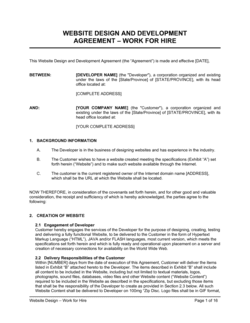
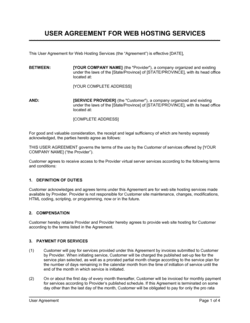
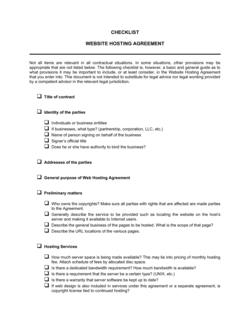
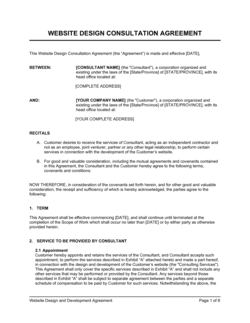
Website Design, Hosting and Commercial Services Agreement Template

Free Word download • Edit online • Save & share with Drive • Export to PDF

20 pages35–45 min to fillDifficulty: ComplexSignature requiredLegal review recommended
Learn more ↓
FreeWebsite Design, Hosting and Commercial Services Agreement Template

At a glance

What it is
A Website Design, Hosting, and Commercial Services Agreement is a legally binding contract between a web services provider and a client that governs the full lifecycle of a website engagement — from initial design and development through ongoing hosting, maintenance, and any ancillary commercial services such as e-commerce integration or SEO. This free Word download gives you a structured, attorney-informed starting point you can edit online and export as PDF before signature.
When you need it
Use it whenever a web design agency, freelance developer, or hosting provider takes on a client project that combines creative deliverables with ongoing technical services. It is especially critical when the engagement includes e-commerce functionality, payment processing, or recurring hosting fees — where service interruptions have direct revenue consequences for the client.
What's inside
Scope of work and deliverables, IP ownership and licensing, hosting service levels and uptime commitments, payment schedules and late-fee provisions, client content responsibilities, acceptable use policy, confidentiality, liability limitations, and termination with data-return obligations.

What is a Website Design, Hosting, and Commercial Services Agreement?

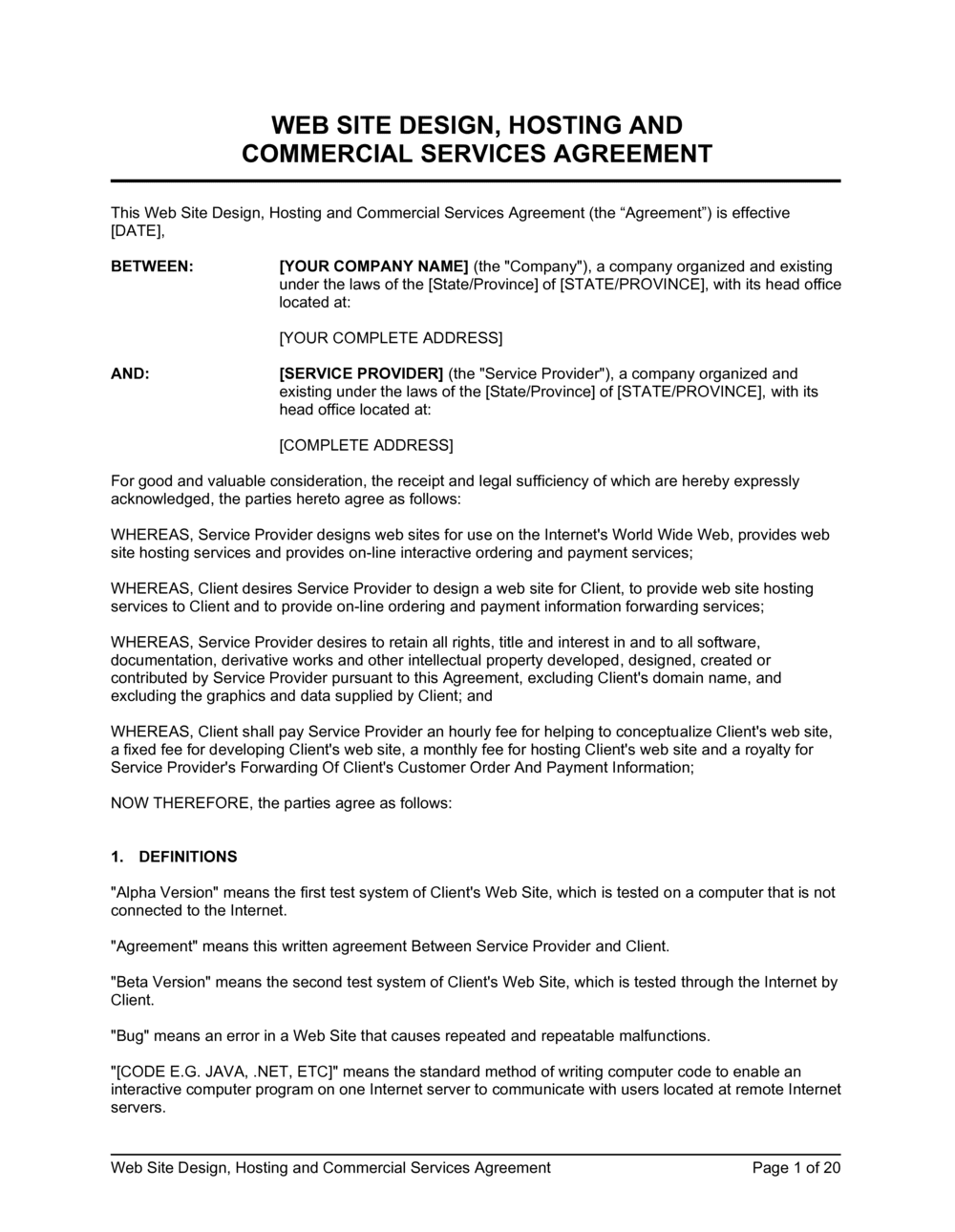
A Website Design, Hosting, and Commercial Services Agreement is a legally binding contract between a web services provider — an agency, freelance developer, or managed hosting company — and a client that governs the complete engagement from initial design and development through ongoing hosting and ancillary commercial services. It establishes who owns the finished work, what uptime the provider must deliver, how and when the client pays, what the client may and may not do with the hosting infrastructure, and how either party may exit the relationship without losing access to critical website assets. Unlike a general service agreement or a standalone hosting contract, this document is purpose-built to address the overlapping IP, infrastructure, and ongoing commercial obligations that arise when design, development, and hosting are bundled into a single engagement.

Why You Need This Document

Without a signed agreement in place before work begins, four serious problems emerge simultaneously. First, copyright in any custom-designed assets and original code vests by default in the creator under US, Canadian, and UK law — meaning the client may not legally own the website they paid to have built. Second, there is no enforceable payment schedule, leaving the provider with no contractual basis to suspend work or recover fees when a client delays or disappears mid-project. Third, the provider has no contractual right to suspend hosting for acceptable use violations — illegal content, spam, or bandwidth abuse — until a lengthy termination process concludes. Fourth, when the engagement ends, there is nothing compelling the provider to return files and database credentials, which can leave a client locked out of their own site. This template closes all four gaps with attorney-informed clauses covering IP assignment, payment milestones, acceptable use and suspension rights, liability caps, and data return obligations — giving both parties a clear, enforceable framework before a single line of code is written.

Which variant fits your situation?

If your situation is…Use this template
Standalone web design and build project with no hosting componentWeb Design Services Agreement
Hosting-only arrangement with no design or development workWebsite Hosting Agreement
Ongoing website maintenance retainer after launchWebsite Maintenance Agreement
Engaging a freelance developer for a single defined projectIndependent Contractor Agreement
SaaS platform providing white-label website services to resellersSoftware as a Service (SaaS) Agreement
E-commerce store build with ongoing performance marketing servicesDigital Marketing Services Agreement
Agency needing to subcontract part of the work to a third-party developerSubcontractor Agreement

Common mistakes to avoid

❌ Starting work before the agreement is signed

Why it matters: Without a signed contract, IP ownership defaults to the creator, payment obligations are unenforceable, and scope has no formal definition — any dispute becomes a credibility contest.

Fix: Execute the agreement and collect the deposit payment before writing a single line of code, creating any design mockups, or sharing any account credentials with the provider.

❌ No delay clause for client-side content delivery

Why it matters: Providers routinely lose months of billable capacity waiting for client copy, images, and approvals — with no contractual remedy to recover costs or extend the timeline.

Fix: Include a clause stating that client delays beyond a defined threshold (e.g., 10 business days) automatically extend the delivery schedule by the same period and may trigger a weekly delay fee.

❌ Omitting the provider's pre-existing IP carve-out

Why it matters: If the agreement assigns all deliverables to the client without reserving the provider's proprietary frameworks and tools, the provider may inadvertently transfer IP they use across their entire client base.

Fix: List all pre-existing tools, libraries, CMS platforms, and plugins in a Schedule and confirm they are licensed — not sold — to the client as part of the deliverables.

❌ No liability cap on hosting-related revenue loss claims

Why it matters: An e-commerce client can claim thousands of dollars in lost sales for even a brief hosting outage. Without a cap, a $200/month hosting contract becomes a vehicle for unlimited liability.

Fix: Cap total liability at fees paid in the prior 12 months and explicitly exclude indirect, consequential, and lost-profit claims in a clearly worded disclaimer clause.

❌ No data-return or transition-assistance clause

Why it matters: Providers who refuse to release website files, databases, or DNS credentials after termination face breach-of-contract claims and, in the EU and UK, potential data protection violations.

Fix: Include a clause committing to provide all files, databases, and documentation within 30 days of termination, and specify a deletion timeline for any copies retained thereafter.

❌ Using a one-size-fits-all agreement for clients with e-commerce or payment processing

Why it matters: E-commerce engagements carry PCI DSS compliance obligations, payment gateway liability, and consumer data responsibilities that a standard web design contract does not address — leaving both parties exposed.

Fix: Add a Schedule or addendum specifically addressing PCI scope, data handling, payment gateway access credentials, and each party's responsibility for compliance with applicable consumer data laws.

The 10 key clauses, explained

Parties, Recitals, and Definitions

In plain language: Identifies the provider and client as legal entities, states the purpose of the agreement, and defines key terms used throughout.

Sample language
This Website Design, Hosting, and Commercial Services Agreement ('Agreement') is entered into as of [DATE] by and between [PROVIDER LEGAL NAME], a [STATE] [ENTITY TYPE] ('Provider'), and [CLIENT LEGAL NAME], a [STATE] [ENTITY TYPE] ('Client').

Common mistake: Using trade names instead of registered legal entity names. If the suing party's name doesn't match the signatory, enforcing payment obligations or IP clauses becomes procedurally complicated.

Scope of Work and Deliverables

In plain language: Describes exactly what the provider will design, build, and host — pages, features, integrations, and hosting tier — typically by reference to an attached Schedule A.

Sample language
Provider shall design and develop the Website as described in Schedule A ('Deliverables'), including [NUMBER] page templates, [PLATFORM] CMS integration, and [FEATURE LIST]. Hosting services are described in Schedule B.

Common mistake: Embedding granular feature lists in the contract body instead of a numbered Schedule. When scope changes arise, a Schedule amendment is simpler than a full contract redline.

Fees, Payment Schedule, and Late Charges

In plain language: States the project fee, hosting fee, payment milestones (typically deposit, mid-project, and launch), and the interest or suspension right triggered by late payment.

Sample language
Client shall pay Provider a total project fee of $[AMOUNT], due as follows: [X]% upon execution ($[AMOUNT]), [X]% upon delivery of design mockups ($[AMOUNT]), and [X]% upon site launch ($[AMOUNT]). Hosting fees of $[AMOUNT]/month are due on the [DAY] of each month. Overdue balances accrue interest at [1.5]% per month.

Common mistake: Collecting only a 10–15% deposit on large projects. A deposit below 30–40% of the project fee leaves the provider exposed to sunk labor costs if the client stalls or disappears mid-project.

Intellectual Property Ownership and License

In plain language: Assigns ownership of custom deliverables to the client upon full payment, while the provider retains rights to underlying tools, frameworks, and pre-existing IP licensed to the client.

Sample language
Upon receipt of all fees due, Provider assigns to Client all right, title, and interest in the custom Deliverables. Provider retains all rights in Provider's pre-existing tools, libraries, and methodologies ('Provider IP'), and grants Client a non-exclusive license to use Provider IP solely as incorporated in the Website.

Common mistake: No carve-out for the provider's pre-existing IP — frameworks, component libraries, and reusable code modules. Without it, clients could claim ownership of tools the provider uses across dozens of projects.

Client Responsibilities and Content

In plain language: Specifies what the client must provide — copy, images, brand assets, access credentials, and timely approvals — and the consequences of client delays on the project timeline.

Sample language
Client shall provide all content, images, and materials listed in Schedule C by [DATE]. Client delays exceeding [10] business days may extend the delivery timeline by an equal period and may be subject to a delay fee of $[AMOUNT]/week.

Common mistake: No delay-fee or timeline-extension clause. When clients take 3 months to deliver content, the provider's capacity is blocked and project profitability collapses — with no contractual remedy.

Hosting Services, SLA, and Uptime

In plain language: Defines the hosting tier, data center location, uptime commitment (e.g., 99.9% monthly), measurement methodology, and service credits for breach of the SLA.

Sample language
Provider shall host the Website on [HOSTING PLATFORM] in [DATA CENTER REGION] with a monthly uptime target of [99.9]%. Downtime below this threshold entitles Client to a service credit of [X]% of the monthly hosting fee for each full hour of excess downtime, up to a maximum of [50]% of the monthly fee.

Common mistake: Promising 100% uptime. No hosting infrastructure can guarantee zero downtime — scheduled maintenance windows and upstream provider outages make 100% an unenforceable and misleading commitment.

Acceptable Use Policy

In plain language: Prohibits the client from using the hosted infrastructure for illegal activity, spamming, excessive bandwidth consumption, or content that violates third-party rights — and gives the provider the right to suspend for violations.

Sample language
Client shall not use the hosting services to transmit illegal content, send unsolicited commercial email, infringe third-party IP rights, or consume resources in a manner that degrades service to other clients. Provider may suspend hosting immediately upon discovery of a material AUP violation, with notice to Client within [24] hours.

Common mistake: No suspension right. Without it, the provider must pursue termination — a slower process — while a client's malicious or illegal content continues to expose the provider to liability and DMCA takedown requests.

Confidentiality

In plain language: Restricts both parties from disclosing the other's non-public business information — pricing, technical architecture, client data — obtained during the engagement.

Sample language
Each party agrees to hold in confidence the other's Confidential Information and not to disclose or use it except as necessary to perform under this Agreement. Confidential Information excludes information that is publicly known, independently developed, or lawfully received from a third party.

Common mistake: No mutual confidentiality — provider confidentiality only. The client shares sensitive business strategy, revenue data, and customer information with the provider; one-sided clauses leave clients understandably reluctant to share what the provider needs to do the work.

Limitation of Liability and Disclaimer of Warranties

In plain language: Caps the provider's total financial exposure — typically to fees paid in the prior 12 months — and disclaims liability for indirect damages like lost profits or data loss caused by hosting interruptions.

Sample language
Provider's total liability under this Agreement shall not exceed the fees paid by Client in the [12] months preceding the claim. In no event shall either party be liable for indirect, incidental, consequential, or punitive damages, including lost profits or data loss, even if advised of the possibility.

Common mistake: No liability cap at all. For a $5,000 web project, unlimited liability exposure for hosting interruptions that cause client revenue loss could exceed the entire engagement value by orders of magnitude.

Term, Termination, and Data Return

In plain language: Sets the initial term, auto-renewal conditions, each party's right to terminate for cause or convenience, notice periods, and the provider's obligation to return website files and data after termination.

Sample language
This Agreement commences on [DATE] and continues for an initial term of [12] months, renewing automatically on a month-to-month basis unless either party provides [30] days' written notice. Upon termination, Provider shall make Client's website files and database available for download for [30] days, after which Provider may delete all Client data.

Common mistake: No data-return window after termination. Providers who delete client data immediately or refuse to release files without additional payment create serious legal exposure and reputational damage — and may violate data protection laws in several jurisdictions.

How to fill it out

  1. 1

    Enter legal entity names and contact details

    Fill in the full registered legal names of both the provider and the client, including entity type (LLC, corporation, sole trader) and principal business address. Do not use brand names or trading names.

    💡 Confirm the client's exact legal name against their business registration before execution — mismatches complicate enforcement of payment obligations.

  2. 2

    Complete Schedule A with a detailed scope of work

    List every page template, feature, platform, integration, and deliverable by name. If the project has phases, number them and assign target completion dates to each.

    💡 Anything not listed in Schedule A is out of scope. Err on the side of specificity — vague scope is the single biggest driver of scope creep disputes.

  3. 3

    Set the fee structure and payment milestones

    Enter the total project fee, the deposit percentage (minimum 30%), and the dates or trigger events (design approval, staging delivery, go-live) for each payment installment. Add the monthly hosting fee and billing date.

    💡 Tie the final payment milestone to client sign-off rather than a calendar date — this prevents clients from claiming the site is 'not done' while withholding the final payment indefinitely.

  4. 4

    Define IP ownership and pre-existing IP carve-outs

    Confirm that custom deliverables transfer to the client upon full payment. List in Schedule D any pre-existing tools, frameworks, or third-party libraries that remain the provider's property and are licensed — not assigned — to the client.

    💡 If you use a proprietary CMS, page builder, or plugin you license to all clients, list it in Schedule D explicitly — otherwise a client could argue it was sold to them outright.

  5. 5

    Configure the hosting SLA and uptime terms

    Enter the hosting platform, data center region, monthly uptime target (99.9% is the industry standard), and the service credit formula for breach. Include scheduled maintenance windows and how they are treated in uptime calculations.

    💡 Exclude scheduled maintenance windows (with at least 48 hours' notice) from uptime calculations — planned outages are normal and should not trigger service credits.

  6. 6

    Insert the acceptable use policy

    Review the AUP clause and confirm it covers prohibited content types, bandwidth and resource limits, security restrictions, and your right to suspend immediately for material violations.

    💡 Reference your hosting provider's own AUP by URL in this clause so that upstream restrictions automatically flow down to your client without requiring contract amendments.

  7. 7

    Set term, renewal, and termination notice periods

    Enter the initial contract term (typically 12 months), the auto-renewal mechanism, and the notice period required for non-renewal or termination for convenience (30 days is standard for monthly hosting).

    💡 For multi-year hosting agreements, include an annual price adjustment clause tied to CPI or a fixed percentage (e.g., 3–5%) to protect against cost increases.

  8. 8

    Sign before work begins and before any credentials are shared

    Obtain countersignatures from both parties before the provider accesses domain registrars, CMS platforms, or payment gateways. The agreement is the authorization for that access.

    💡 Use a timestamped e-signature platform so the exact moment of execution is documented — critical if a payment or IP dispute arises before the site launches.

Frequently asked questions

What is a website design, hosting, and commercial services agreement?

It is a single binding contract that governs a web services provider's full engagement with a client — covering the design and development of a website, the ongoing hosting of that site on the provider's or a third-party's infrastructure, and any additional commercial services such as e-commerce integration, maintenance, or SEO. Combining all three in one document eliminates the gaps that arise when design, hosting, and ancillary services are governed by separate agreements with conflicting terms.

Who should sign this agreement?

Any web design agency, freelance developer, or managed hosting provider that simultaneously delivers a website build and provides ongoing hosting should use this agreement. It is equally important for clients — especially e-commerce businesses and those with high-traffic sites — to insist on a signed agreement before granting access to domain registrars, CMS platforms, or payment gateways. Both parties need the protections it provides.

Who owns the website once it is built?

Ownership depends entirely on what the contract says. Without an IP assignment clause, copyright in custom-designed assets and original code typically vests in the creator — the developer or agency — not the client. A properly drafted agreement assigns ownership of custom deliverables to the client upon full payment, while the provider retains rights to pre-existing tools and frameworks that are licensed to the client as part of the deliverable.

What uptime percentage should a hosting agreement guarantee?

99.9% monthly uptime is the industry standard for commercial hosting agreements. This allows approximately 43 minutes of unplanned downtime per month. 99.99% (about 4.3 minutes per month) is available at higher price points and is appropriate for high-volume e-commerce or mission-critical applications. Avoid promising 100% — no infrastructure can deliver it, and the commitment is unenforceable in practice.

What happens to the website files if I terminate the hosting agreement?

A well-drafted agreement requires the provider to make all website files, databases, and associated content available for client download for a defined period — typically 30 days — after termination. The provider may then delete its copies. Agreements that lack this clause can leave clients locked out of their own site files, which creates significant business disruption and, in the EU and UK, potential data protection compliance issues for the provider.

Can the provider raise hosting fees after the agreement is signed?

Only if the agreement permits it. Include an annual price adjustment clause tied to a CPI index or a fixed percentage (typically 3–5%) to allow for cost inflation while giving the client predictability. Without such a clause, the provider cannot unilaterally increase fees during the contract term. For multi-year agreements, most providers negotiate a fee schedule with defined annual increases rather than a fixed rate.

What is an acceptable use policy and why does the agreement need one?

An acceptable use policy defines what the client may and may not do with the hosting infrastructure — prohibiting illegal content, spam, excessive resource use, and security attacks. Providers need it because they are legally and commercially responsible for content hosted on their servers under DMCA, CAN-SPAM, and various EU regulations. It also gives the provider a contractual right to suspend the client immediately if a violation occurs, rather than waiting out a full termination process.

Does this agreement cover GDPR or other data protection obligations?

A standard agreement addresses confidentiality and data return but typically does not constitute a full Data Processing Agreement (DPA) under GDPR or the UK GDPR. If the provider processes personal data on behalf of the client — visitor analytics, form submissions, e-commerce customer data — a separate DPA or addendum is required in the EU and UK. In the US, state privacy laws (California CCPA, etc.) may impose similar requirements depending on the nature of the data handled.

What liability does the provider have for hosting downtime that causes lost sales?

Without a limitation-of-liability clause, exposure is theoretically unlimited — a client with a high-revenue e-commerce site can claim substantial lost profits for even a short outage. In practice, courts in most jurisdictions will consider whether the damages were foreseeable, but litigation is expensive regardless of outcome. A well-drafted agreement caps total liability at fees paid in the prior 12 months and explicitly excludes indirect and consequential damages, including lost profits and lost data — making the provider's exposure proportionate to the value of the contract.

How this compares to alternatives

vs Independent Contractor Agreement

An independent contractor agreement governs the engagement of a self-employed individual for defined project work — it addresses worker classification and basic deliverable ownership but lacks hosting SLAs, acceptable use provisions, and ongoing service terms. A website design, hosting, and commercial services agreement is purpose-built for the full lifecycle of a web engagement including post-launch obligations.

vs SaaS Agreement

A SaaS agreement governs access to a software platform delivered over the internet — it addresses subscription terms, data processing, and platform availability for a pre-built product. A website design, hosting, and commercial services agreement covers custom-built deliverables unique to a specific client, IP assignment, and bespoke hosting arrangements. Use a SaaS agreement when selling access to your platform; use this agreement when building and hosting a custom site for a client.

vs Service Agreement

A general service agreement covers the provision of professional services but does not address hosting SLAs, website IP ownership, acceptable use policies, or data return obligations after termination. It is appropriate for consulting and advisory engagements. This agreement adds the infrastructure and IP-specific provisions that a general service agreement lacks.

vs Non-Disclosure Agreement

An NDA protects confidential information exchanged during negotiations or project scoping but creates no payment obligation, IP transfer, or service delivery commitment. It is typically signed before this agreement, during initial client conversations. Once the project proceeds, the confidentiality obligations in the NDA should be superseded by or incorporated into this comprehensive services agreement.

Industry-specific considerations

E-commerce and Retail

Payment gateway integration, PCI DSS scope allocation, shopping cart and inventory system build, and uptime SLAs tied directly to peak-season revenue periods.

Professional Services

Firm-branded portals, client intake forms, appointment scheduling integrations, and confidentiality obligations covering client data submitted through the site.

Healthcare and MedTech

HIPAA-compliant hosting requirements, patient data handling obligations, BAA addendum needs, and strict access control provisions for medical record integrations.

SaaS and Technology

Marketing site build tied to product launch timelines, CDN and performance SLA requirements, technical SEO deliverables, and CMS handoff for in-house content teams.

Hospitality and Tourism

Booking engine and reservation system integration, multi-currency and multi-language requirements, and high-availability SLAs around peak booking seasons.

Media and Publishing

High-bandwidth and CDN requirements for video and image-heavy content, advertising network integrations, and content licensing clauses covering third-party media assets.

Jurisdictional notes

United States

IP ownership in website deliverables is governed by US copyright law — without an explicit written assignment, the creator retains ownership. The 'work for hire' doctrine applies only in narrow circumstances for independent contractors, so an assignment clause is essential. State laws vary on non-compete enforceability for any restrictive covenants included in the agreement. DMCA safe harbor provisions protect providers from liability for client-posted infringing content only if a takedown procedure is implemented and referenced in the acceptable use policy.

Canada

Canadian copyright law similarly vests IP in the creator by default, making a written assignment clause necessary. PIPEDA (and its provincial equivalents in Quebec, Alberta, and BC) imposes obligations on parties collecting or processing personal data through hosted websites — a data processing addendum may be required for sites with user registration or e-commerce. Quebec's Act Respecting the Protection of Personal Information in the Private Sector (Law 25) introduced GDPR-like requirements effective 2023, including mandatory privacy policies and consent mechanisms for Quebec-resident users.

United Kingdom

Under UK copyright law, IP vests in the creator unless a written assignment is made — the same need for an explicit clause applies as in North America. Post-Brexit, the UK GDPR and the Data Protection Act 2018 govern personal data processing; if the hosted website collects data from UK residents, a Data Processing Agreement is required and the agreement should reference the applicable lawful basis for processing. Consumer-facing e-commerce sites are also subject to the UK Consumer Contracts Regulations, which the provider should advise the client to address in website terms and conditions.

European Union

GDPR Article 28 requires a written Data Processing Agreement between controller (client) and processor (hosting provider) when personal data of EU residents is processed — this is a legal obligation, not optional, and cannot be satisfied by a standard services agreement alone. Hosting servers within the EU is strongly advisable for data-minimization compliance; cross-border transfers to the US require Standard Contractual Clauses or another approved transfer mechanism. Several member states — Germany and France in particular — impose additional e-commerce and consumer protection obligations that flow down to the website operator and, contractually, to the provider where the provider has built the relevant functionality.

Template vs lawyer — what fits your deal?

PathBest forCostTime
Use the templateFreelance developers and small agencies with standard design-and-host engagements under $10,000Free30–45 minutes
Template + legal reviewAgencies with e-commerce clients, healthcare data handling, or contracts above $10,000$400–$800 for a 1–2 hour attorney review2–5 days
Custom draftedEnterprise-level engagements, multi-jurisdiction clients, or hosting of regulated data (health, finance, government)$2,000–$6,000+2–4 weeks

Glossary

Scope of Work
The documented list of deliverables, tasks, and features the provider agrees to build or maintain — changes outside this list require a written change order.
Service Level Agreement (SLA)
A contractual commitment specifying minimum hosting uptime (e.g., 99.9%), response times, and the remedies — typically service credits — when those levels are not met.
Intellectual Property (IP) Assignment
A clause that transfers ownership of custom-designed assets, code, and content from the creator to the client upon full payment.
Work for Hire
A US copyright doctrine under which original work created by an employee or contractor in certain categories is deemed owned by the commissioning party from creation.
Acceptable Use Policy (AUP)
A set of rules defining how the client may use the hosting infrastructure — prohibiting spam, illegal content, excessive resource consumption, and security attacks.
Change Order
A signed written amendment that adds, removes, or modifies deliverables or fees after the original agreement is executed.
Uptime Guarantee
The provider's commitment to keep the hosted website accessible for a defined percentage of time per month, typically expressed as 99.9% (allowing ~43 minutes of downtime per month).
Limitation of Liability
A clause capping the maximum damages one party can recover from the other — typically limited to fees paid in the prior 3 or 12 months.
Data Return Obligation
A contractual requirement that the provider return or transfer the client's website files, databases, and content within a defined window after termination.
Indemnification
An obligation by one party to cover the other's legal costs and damages arising from a specified type of claim — commonly triggered by IP infringement or content violations.
Force Majeure
A clause excusing non-performance caused by events outside a party's reasonable control, such as natural disasters, cyberattacks on upstream infrastructure, or government actions.

Part of your Business Operating System

This document is one of 3,000+ business & legal templates included in Business in a Box.

  • Fill-in-the-blanks — ready in minutes
  • 100% customizable Word document
  • Compatible with all office suites
  • Export to PDF and share electronically

Create your document in 3 simple steps.

From template to signed document — all inside one Business Operating System.
1
Download or open template

Access over 3,000+ business and legal templates for any business task, project or initiative.

2
Edit and fill in the blanks with AI

Customize your ready-made business document template and save it in the cloud.

3
Save, Share, Send, Sign

Share your files and folders with your team. Create a space of seamless collaboration.

Save time, save money, and create top-quality documents.

★★★★★

"Fantastic value! I'm not sure how I'd do without it. It's worth its weight in gold and paid back for itself many times."

Managing Director · Mall Farm
Robert Whalley
Managing Director, Mall Farm Proprietary Limited
★★★★★

"I have been using Business in a Box for years. It has been the most useful source of templates I have encountered. I recommend it to anyone."

Business Owner · 4+ years
Dr Michael John Freestone
Business Owner
★★★★★

"It has been a life saver so many times I have lost count. Business in a Box has saved me so much time and as you know, time is money."

Owner · Upstate Web
David G. Moore Jr.
Owner, Upstate Web

Run your business with a system — not scattered tools

Stop downloading documents. Start operating with clarity. Business in a Box gives you the Business Operating System used by over 250,000 companies worldwide to structure, run, and grow their business.

Free Forever Plan · No credit card required