1
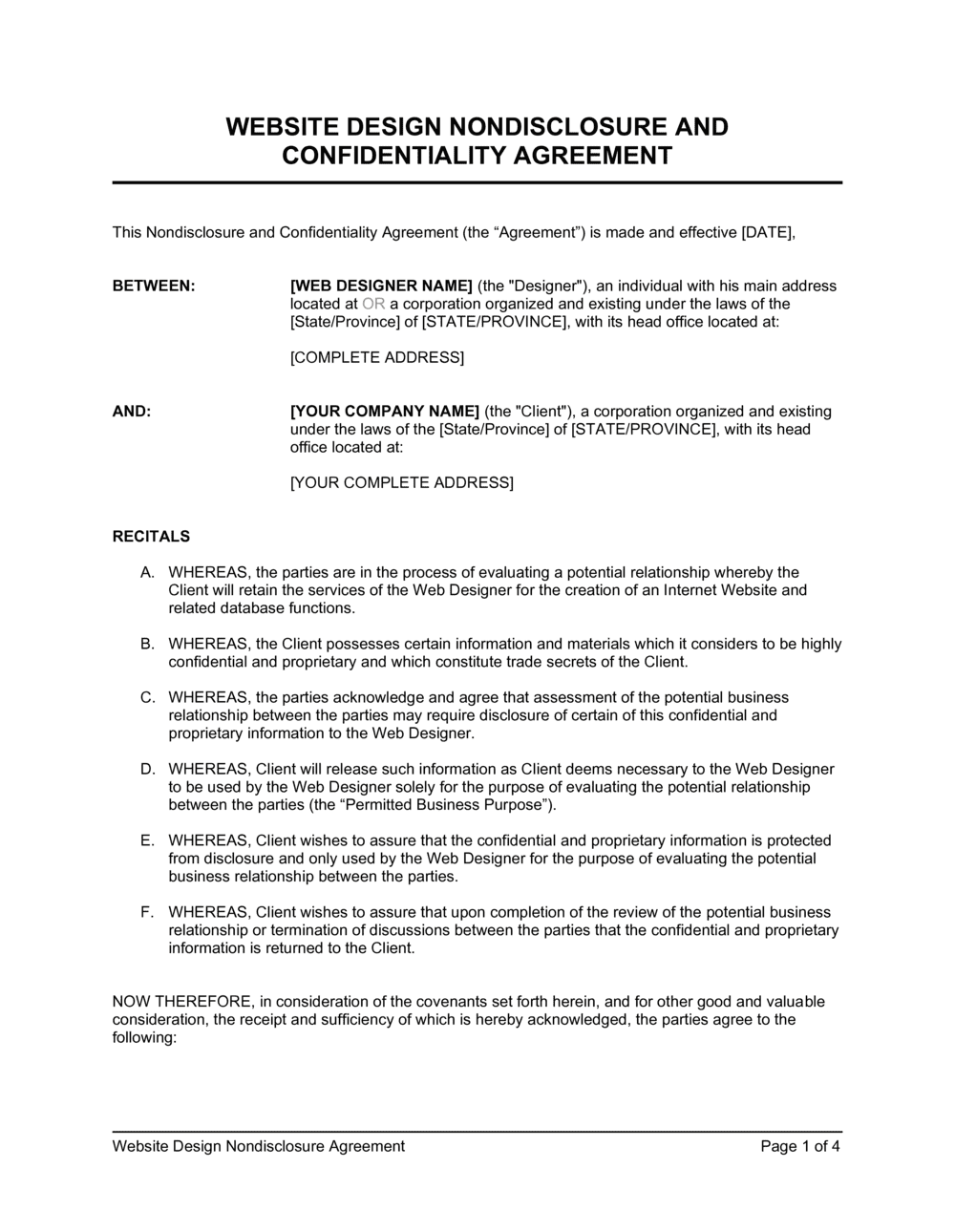
Enter the parties' full legal names and the effective date
Replace all placeholder fields with the registered legal name of the client and the designer or agency. Enter the date the agreement is signed, not the project start date.
💡 Verify the designer's entity type — an LLC and a sole proprietor have different enforcement profiles. Use the entity name, not the individual's name, if the designer operates through a company.
2
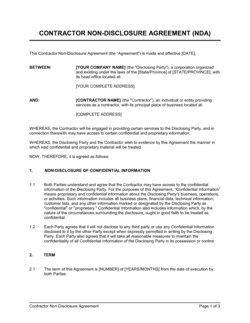
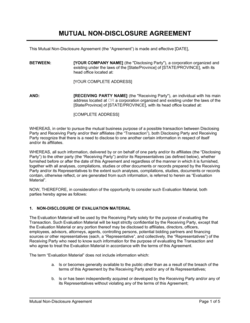
Choose unilateral or mutual structure
Decide whether only the client discloses confidential information (unilateral) or whether both parties will share sensitive materials (mutual). Label the disclosing and receiving parties accordingly, or make both parties both disclosing and receiving.
💡 If the designer will share proprietary design system components, pricing, or methodology, a mutual NDA better reflects the actual exchange and is less likely to be challenged as one-sided.
3
Define the scope of confidential information
Tailor the definition to your project — add specific categories like UX research data, analytics dashboards, conversion benchmarks, or unreleased feature specifications that are unique to your engagement.
💡 The more specific the definition, the easier it is to prove a breach. Generic 'all information' definitions are routinely challenged as unenforceable overreach.
4
Describe the permitted purpose precisely
Name the specific project — for example, 'the redesign of CLIENT's e-commerce storefront at [DOMAIN]' — rather than a generic phrase like 'web design services.'
💡 A precise permitted purpose prevents the designer from using your customer journey data or brand positioning insights on a competitor's project.
5
Set the term and survival period
Enter the agreement duration and the post-termination survival period. For projects involving unreleased products or long-term brand strategy, a 3–5 year survival period is appropriate.
💡 Align the survival period with how long the shared information will remain competitively sensitive — a two-week campaign brief needs less protection than a five-year brand platform.
6
Add the governing law and dispute resolution clause
Enter the jurisdiction whose law will govern and specify whether disputes go to arbitration, mediation, or litigation. For cross-border engagements, specify the city and forum explicitly.
💡 Avoid jurisdictions where neither party operates — courts in a neutral third country may have no reason to hear the case and enforcement of any judgment may be impractical.
7
Review exceptions and permitted disclosures
Confirm the standard carve-outs (public domain, prior knowledge, independent development, legal compulsion) are included and that no additional permitted disclosures have been agreed verbally.
💡 If the designer plans to share materials with a specific sub-contractor, name that sub-contractor in the permitted-disclosure section rather than leaving a vague 'need-to-know' standard.
8
Sign before any confidential information is shared
Both parties must sign and retain a countersigned copy before the first briefing, pitch deck, or brand guideline is exchanged. Retroactive NDAs are enforceable in many jurisdictions but create evidentiary complications.
💡 Use a timestamped eSign tool to create an auditable execution record. Store the fully-executed copy in a secure location alongside any project brief or SOW.