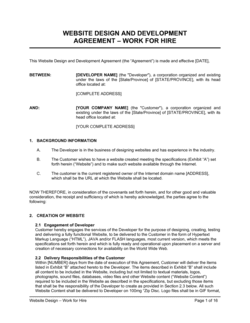
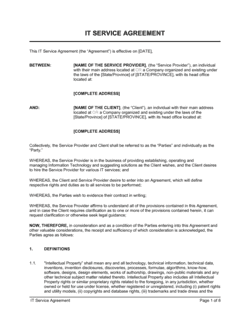
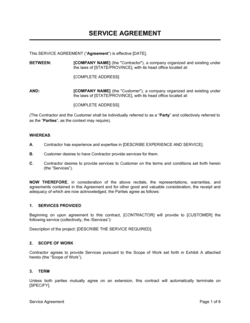
Web Site Hosting Agreement Template

Free Word download • Edit online • Save & share with Drive • Export to PDF

2 pages25–30 min to fillDifficulty: StandardSignature requiredLegal review recommended
Learn more ↓
FreeWeb Site Hosting Agreement Template

At a glance

What it is
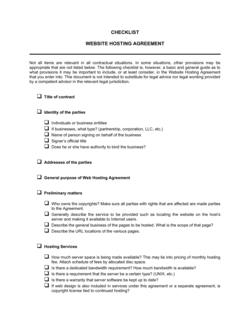
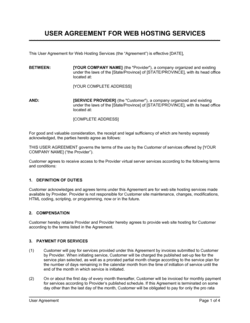
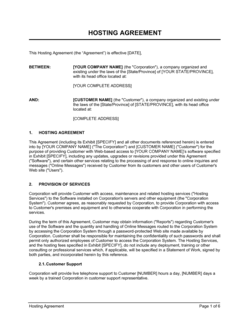
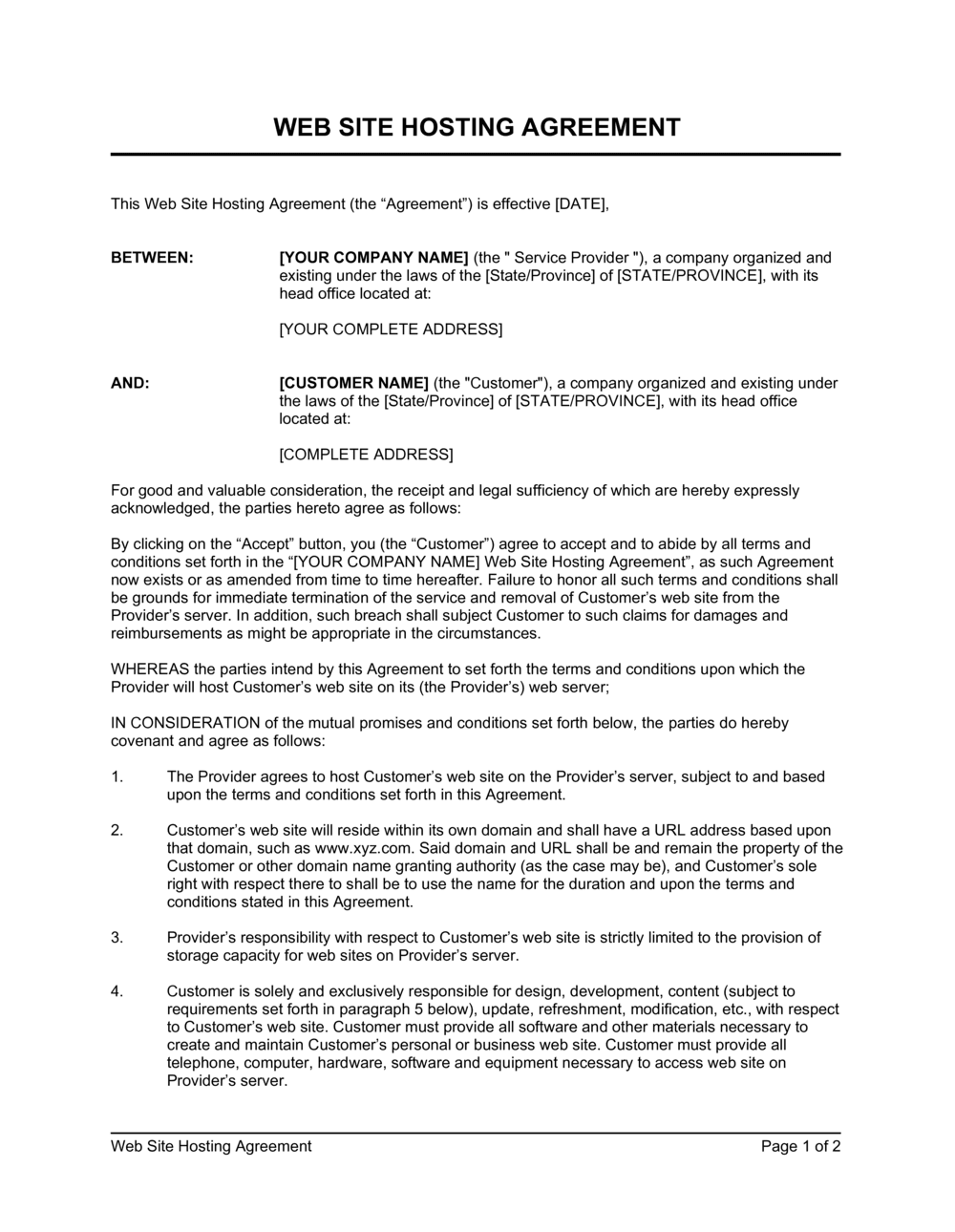
A Web Site Hosting Agreement is a legally binding contract between a hosting provider and a client that defines the terms under which the provider will host the client's website on its servers. This free Word download covers service scope, uptime commitments, data ownership, acceptable use, payment, liability limits, and termination in a single structured document you can edit online and export as PDF.
When you need it
Use it whenever a hosting provider agrees to store and serve a client's website or web application — whether that is a managed WordPress site, a custom application, or a dedicated server arrangement. It protects both parties the moment files are transferred and billing begins.
What's inside
Service description and server specifications, uptime SLA and maintenance windows, fees and billing cycle, acceptable use policy, data ownership and backups, security obligations, intellectual property, liability limitations, indemnification, and termination and data-return procedures.

What is a Web Site Hosting Agreement?

A Web Site Hosting Agreement is a legally binding contract between a hosting provider and a client that establishes the terms under which the provider stores, maintains, and serves the client's website on its servers. It defines the precise scope of services — server type, storage, bandwidth, and included software — alongside uptime commitments, data ownership, acceptable use restrictions, security responsibilities, liability limits, and the process for returning or deleting client data when the relationship ends. Unlike an informal service signup, a signed hosting agreement creates enforceable obligations on both sides and eliminates the ambiguity that arises when performance expectations, payment disputes, or data-loss incidents occur.

Why You Need This Document

Operating a hosting arrangement without a written agreement exposes both the provider and the client to predictable and avoidable risks. A provider without a liability cap can face a client's claim for all lost revenue during a server outage — amounts that can be hundreds of times the monthly hosting fee. A client without a defined SLA has no contractual remedy when their site goes down during peak traffic. Without a data-return clause, clients who leave a provider may find their files deleted the day the contract ends, with no recourse if they are subject to regulatory retention requirements. For providers, the absence of an acceptable use policy removes the contractual basis to suspend accounts distributing malware or illegal content without risking a breach-of-contract counterclaim. This template gives hosting providers a professionally structured starting point that protects their infrastructure and limits their liability, while giving clients the service-level and data-protection assurances they need before transferring control of their online presence to a third party.

Which variant fits your situation?

If your situation is…Use this template
Hosting a simple shared-server website for a small business clientWeb Site Hosting Agreement (Standard)
Providing dedicated server or VPS hosting with enhanced SLA guaranteesManaged Hosting Services Agreement
Delivering hosting as part of a broader web design and maintenance packageWeb Design and Maintenance Agreement
Engaging a third-party vendor to host your company's internal systemsIT Services Agreement
Hosting cloud-based software for end users under SaaS termsSaaS Subscription Agreement
Reselling hosting services originally provided by a larger providerReseller Hosting Agreement
Providing colocation services for client-owned hardwareColocation Services Agreement

Common mistakes to avoid

❌ Vague service scope with no server or bandwidth specifications

Why it matters: Without defined storage, bandwidth, and server type, clients escalate usage beyond what the provider priced, and there is no contractual basis to charge overages or throttle service.

Fix: List server type, storage allocation in GB, monthly bandwidth cap, and any included software in the services section — and add a Schedule A for multi-domain or multi-tier arrangements.

❌ No liability cap or an uncapped consequential-damages exposure

Why it matters: A hosting provider whose server suffers a prolonged outage can face a client claim for all lost revenue during the downtime — amounts that can be hundreds of times the monthly hosting fee.

Fix: Cap total liability at 3–6 months of paid fees and explicitly disclaim liability for lost profits, lost data, and business interruption in a standalone clause.

❌ Promising 100% uptime without maintenance exclusions

Why it matters: Any scheduled maintenance window — even one minute for a security patch — constitutes a breach of a 100% uptime commitment, giving the client a recurring contract claim.

Fix: Commit to 99.9% or 99.99% uptime and carve out scheduled maintenance windows notified at least 48 hours in advance, client-caused outages, and force majeure events.

❌ No data-return window after termination

Why it matters: Immediately deleting client data upon contract expiry exposes the provider to claims of wrongful destruction, especially when the client is subject to regulatory data-retention requirements.

Fix: Provide a 15-to-30-day window after termination during which the client may download their data, then confirm deletion in writing and retain a destruction log.

❌ Assigning all security responsibility to the provider

Why it matters: The majority of website compromises originate at the application layer — outdated CMS plugins, weak passwords, or unpatched themes — which are entirely within the client's control.

Fix: Use shared-responsibility language: the provider secures the server infrastructure; the client secures their application, CMS, and credentials. State that application-layer breaches are the client's liability.

❌ No immediate-suspension right for AUP violations

Why it matters: A notice-and-cure period before suspension is appropriate for billing disputes but not for active malware distribution or illegal content — every hour of delay increases the provider's legal exposure and harms other clients on shared infrastructure.

Fix: Add a carve-out granting the provider the right to suspend or remove content immediately and without prior notice when the violation involves malware, spam, illegal content, or a material threat to server integrity.

The 10 key clauses, explained

Parties, Services, and Scope

In plain language: Identifies the hosting provider and the client as legal entities and describes the specific hosting services being provided — server type, storage allocation, bandwidth, and any included software or control panel access.

Sample language
This Web Site Hosting Agreement ('Agreement') is entered into on [DATE] between [PROVIDER LEGAL NAME], a [STATE/COUNTRY] [ENTITY TYPE] ('Provider'), and [CLIENT LEGAL NAME], a [STATE/COUNTRY] [ENTITY TYPE] ('Client'). Provider shall host Client's website located at [DOMAIN NAME] on a [SHARED/DEDICATED/VPS] server with [X] GB storage and [X] GB/month bandwidth.

Common mistake: Describing services only as 'web hosting' without specifying server type, storage, and bandwidth. Vague scope leads to billing disputes when the client's site grows beyond what the provider intended to include.

Fees, Payment, and Billing Cycle

In plain language: States the monthly or annual hosting fee, the billing date, accepted payment methods, and the consequences of late payment — including suspension or termination thresholds.

Sample language
Client shall pay Provider a hosting fee of $[AMOUNT] per [month/year], billed on the [DAY] of each billing period via [PAYMENT METHOD]. Invoices unpaid for more than [10] days are subject to a late fee of [1.5]% per month. Provider may suspend service after [30] days of non-payment.

Common mistake: No suspension or termination threshold for non-payment. Without it, the provider continues bearing infrastructure costs indefinitely for a non-paying client with no clear contractual right to act.

Uptime SLA and Service Credits

In plain language: Sets the provider's uptime commitment as a monthly percentage and defines the service-credit remedy if the commitment is missed — including how downtime is measured and what is excluded (scheduled maintenance, client-caused outages).

Sample language
Provider warrants [99.9]% monthly uptime for the hosted services, excluding scheduled maintenance windows notified at least [48] hours in advance. For each hour of excess downtime, Client shall receive a service credit equal to [5]% of the monthly fee, not to exceed [30]% of the monthly fee in any calendar month.

Common mistake: Promising 100% uptime or omitting exclusions for scheduled maintenance. Both create unmanageable liability — even brief maintenance windows breach an unqualified 100% commitment.

Acceptable Use Policy

In plain language: Lists prohibited content and activities — spam, malware distribution, copyright-infringing material, illegal content — and grants the provider the right to suspend or remove content that violates the policy immediately.

Sample language
Client shall not use the hosting services to store, transmit, or distribute: (a) spam or unsolicited bulk email; (b) malware, viruses, or malicious code; (c) content that infringes any third-party intellectual property right; or (d) content that is unlawful in [GOVERNING JURISDICTION]. Provider may suspend or remove violating content immediately and without prior notice.

Common mistake: Failing to include an immediate-suspension right for AUP violations. A notice-and-cure period is appropriate for many breaches, but malware or illegal content requires instant action to protect the provider's infrastructure and other clients.

Data Ownership and Backups

In plain language: Confirms that the client retains ownership of all website content and data, states the provider's backup frequency and retention period, and clarifies that backups are a convenience — not a substitute for the client's own data management.

Sample language
Client retains all ownership rights in website content and data stored on Provider's servers. Provider shall perform automated backups of hosted data [daily/weekly], retaining backups for [30] days. Client acknowledges that Provider's backups are made as a convenience only and that Client is solely responsible for maintaining independent copies of critical data.

Common mistake: Providers omitting the 'convenience only' backup disclaimer. Without it, courts may hold the provider liable for data loss even when backups were performed in good faith but failed to capture the most recent data.

Security Obligations

In plain language: Defines each party's security responsibilities — the provider's server-level obligations (patching, firewalls, DDoS mitigation) and the client's application-level obligations (keeping CMS software updated, using strong credentials).

Sample language
Provider shall implement commercially reasonable server-level security measures, including firewall protection, operating system patches applied within [72] hours of release, and DDoS mitigation. Client is solely responsible for securing its web applications, CMS installations, and login credentials. Client shall notify Provider within [24] hours of discovering any suspected security breach.

Common mistake: Assigning all security responsibility to the provider. Shared-responsibility language protects the provider from liability for breaches caused by the client's outdated plugins or weak passwords — which are among the most common attack vectors.

Intellectual Property

In plain language: Confirms that the provider does not acquire any rights in the client's content and that the client does not acquire any rights in the provider's platform, software, or infrastructure.

Sample language
Provider acquires no rights, title, or interest in Client's website content by virtue of hosting it. Client acquires no rights in Provider's software, infrastructure, or proprietary systems. Client grants Provider a limited, non-exclusive license to host, cache, and transmit Client's content solely to deliver the hosting services.

Common mistake: Omitting the limited license grant to the provider. Without it, a strict reading of copyright law means the provider technically lacks permission to cache or replicate client content for backup and CDN delivery purposes.

Liability Limitation and Disclaimer

In plain language: Caps the provider's total liability — typically at fees paid in the prior 3–6 months — and disclaims liability for indirect damages such as lost revenue, lost data, or business interruption.

Sample language
Provider's total liability under this Agreement shall not exceed the fees paid by Client in the [3] months preceding the claim. In no event shall either party be liable for indirect, incidental, consequential, or punitive damages, including lost profits or business interruption, even if advised of the possibility of such damages.

Common mistake: No liability cap at all, or a cap expressed as a percentage of an annual fee on a month-to-month contract. A hosting provider's server failure could theoretically expose it to the client's entire lost-revenue claim — which can dwarf the monthly hosting fee — without an explicit cap.

Term, Termination, and Data Return

In plain language: Sets the contract term (monthly, annual, or multi-year), notice requirements for non-renewal, grounds for immediate termination for cause, and the process for returning or deleting the client's data after termination.

Sample language
This Agreement commences on [START DATE] and continues for [12] months, renewing automatically unless either party provides [30] days' written notice of non-renewal. Either party may terminate immediately for material breach. Upon termination, Provider shall make Client's data available for download for [15] days, after which Provider may permanently delete all hosted data.

Common mistake: No data-return window after termination. Providers who delete data immediately upon contract end expose themselves to client claims of data destruction, particularly where the client is subject to record-retention obligations.

Governing Law and Dispute Resolution

In plain language: Specifies the jurisdiction whose law governs the agreement and how disputes are resolved — litigation, arbitration, or mediation — and the venue for any proceedings.

Sample language
This Agreement is governed by the laws of [STATE/PROVINCE/COUNTRY]. Any dispute arising under or relating to this Agreement shall be resolved by binding arbitration administered by [AAA/JAMS] in [CITY, STATE], except that either party may seek injunctive relief in any court of competent jurisdiction.

Common mistake: Choosing a governing law with no meaningful connection to where either party operates. Some jurisdictions — particularly in the EU — apply local consumer protection and data law regardless of the governing-law clause.

How to fill it out

  1. 1

    Enter the parties' legal entity names and effective date

    Use the registered legal name of the hosting provider and the client — not brand names or trading names. Include the state or country of incorporation and the agreement's effective date.

    💡 Cross-check the client's legal name against their business registration before signing. Enforcing the agreement against the wrong entity is a common and expensive mistake.

  2. 2

    Define the hosting services and server specifications

    Specify the server type (shared, VPS, dedicated, or cloud), storage allocation in GB, monthly bandwidth, included software (cPanel, Plesk), and the domain name being hosted.

    💡 If the client hosts multiple domains or subdomains, list them in a Schedule A rather than the body of the agreement to allow easy amendments.

  3. 3

    Set the fees, billing cycle, and late-payment consequences

    Enter the monthly or annual fee, billing date, accepted payment methods, late fee percentage, and the number of days after which the provider may suspend service for non-payment.

    💡 State the fee in a specific currency, especially for clients in a different country. USD and CAD ambiguity has generated real billing disputes.

  4. 4

    Complete the uptime SLA and service-credit formula

    Set your uptime percentage (99.9% is the standard for shared hosting; 99.99% for dedicated or mission-critical environments), define how downtime is measured, list maintenance exclusions, and set the service-credit rate per hour of excess downtime.

    💡 Cap total monthly service credits at 30% of the monthly fee — uncapped credits can exceed the monthly revenue from a single client in a bad-outage month.

  5. 5

    Customize the acceptable use policy

    Review the AUP list and add any industry-specific prohibitions relevant to your infrastructure. Confirm that the immediate-suspension right for serious violations is clearly stated.

    💡 Reference your full AUP document by URL if it is published on your website, and note that you may update it with [15] days' notice — this avoids amending the contract every time the AUP changes.

  6. 6

    Confirm the backup frequency and data-return window

    Enter your actual backup schedule and retention period. Set the post-termination data-availability window — 15 to 30 days is standard — and state the deletion method after that window closes.

    💡 If you cannot reliably deliver daily backups, commit only to weekly. Overpromising on backups and then failing to deliver is one of the most litigated hosting disputes.

  7. 7

    Set the liability cap and disclaim consequential damages

    Enter the liability cap as the fees paid in the prior 3 months (or 6 months for higher-risk deployments). Confirm the consequential-damages disclaimer covers lost profits, data loss, and business interruption.

    💡 Some US states and several EU jurisdictions restrict consequential-damage disclaimers in consumer contracts. If your clients include consumers, have a lawyer review this clause before execution.

  8. 8

    Set the term, auto-renewal notice period, and data-deletion timeline

    Choose the initial term (monthly or annual), set the non-renewal notice window (30 days is standard), and specify the exact number of days the client has to retrieve data after termination.

    💡 Send a non-renewal reminder 45 days before the notice deadline — giving the client time to act before you are contractually obligated to begin deletion.

Frequently asked questions

What is a website hosting agreement?

A website hosting agreement is a legally binding contract between a hosting provider and a client that governs the terms under which the provider stores and serves the client's website on its servers. It defines service scope, uptime commitments, fees, data ownership, acceptable use, security responsibilities, liability limits, and what happens to the client's data when the contract ends. Without one, both parties rely on informal understandings that are difficult to enforce.

Is a website hosting agreement legally required?

No law requires a formal hosting agreement, but operating without one exposes both the provider and the client to significant risk. For the provider, it means no contractual basis for the uptime disclaimer, liability cap, or acceptable use restrictions. For the client, there is no guaranteed SLA, no data-return obligation, and no defined remedy for downtime. A signed agreement protects both parties from the moment hosting begins.

What uptime guarantee should a hosting agreement include?

99.9% monthly uptime is the industry standard for shared hosting and translates to approximately 43 minutes of allowed downtime per month. Mission-critical applications and dedicated servers typically warrant 99.99% uptime, which allows fewer than 5 minutes of downtime per month. The agreement should also specify how downtime is measured, what events are excluded (scheduled maintenance, client-caused outages, force majeure), and what service credits apply when the SLA is missed.

Who owns the website data under a hosting agreement?

The client retains full ownership of all website content and data stored on the provider's servers. The hosting agreement should make this explicit and include a limited license granting the provider the right to cache, replicate, and transmit the content solely to deliver the hosting service. Without the limited license grant, the provider technically lacks permission to perform backup and CDN functions under copyright law.

What happens to my data if I cancel my hosting agreement?

A well-drafted hosting agreement requires the provider to make the client's data available for download for a defined period after termination — typically 15 to 30 days — before permanently deleting it. Clients subject to regulatory record-retention requirements should negotiate a longer window. Always download a full backup before initiating termination rather than relying on the provider's post-termination window.

What does a hosting agreement's liability cap mean for clients?

A liability cap limits the provider's maximum financial exposure to the client — typically the fees paid in the prior 3 to 6 months. This means that even if a prolonged outage costs your business significantly more in lost revenue, the provider's contractual obligation is capped at that amount. Clients who need higher protection for mission-critical sites should negotiate a higher cap or carry their own business interruption insurance.

What is an acceptable use policy in a hosting agreement?

An acceptable use policy (AUP) is a list of prohibited content and activities — spam, malware, illegal content, copyright infringement — that the client agrees not to host on the provider's servers. It also grants the provider the right to suspend or remove violating content, in some cases immediately and without notice. AUP violations are one of the most common grounds for immediate contract termination in hosting arrangements.

Can a hosting agreement cover multiple websites?

Yes. The agreement can list multiple domains in a Schedule A, with each domain's storage and bandwidth allocation noted separately. This approach keeps the main contract clean while allowing the schedule to be amended as the client adds or removes sites without requiring a full contract re-execution. Agencies and resellers managing dozens of client sites should use a master hosting agreement with a domain-level schedule structure.

Do I need a lawyer to draft a website hosting agreement?

For standard shared or VPS hosting arrangements, a high-quality template is generally sufficient for most providers and clients. Consider engaging a lawyer when the arrangement involves dedicated infrastructure for a regulated industry (healthcare, finance), when the client requires HIPAA or PCI DSS compliance representations from the provider, when the annual contract value exceeds $10,000, or when the client is located in a jurisdiction with stringent data protection laws that require specific contractual language.

How this compares to alternatives

vs Web Design Agreement

A web design agreement governs the one-time creation of a website — deliverables, revision rounds, IP ownership, and project timeline. A hosting agreement governs the ongoing service of keeping that site live, accessible, and maintained after launch. Many projects need both: the design agreement covers build; the hosting agreement covers run. Combining them in a single document blurs responsibility and complicates termination.

vs IT Services Agreement

An IT services agreement covers a broad range of technology support — helpdesk, infrastructure management, software licensing, and network administration. A website hosting agreement is narrowly focused on server-based delivery of a specific website or application. Use the IT services agreement when the vendor manages your entire technology environment; use the hosting agreement when the engagement is limited to hosting a defined site.

vs SaaS Subscription Agreement

A SaaS subscription agreement governs access to a software platform delivered over the internet — it covers licensing, feature access, user seats, and support tiers. A hosting agreement governs the server infrastructure on which a website or custom application runs. The key distinction is ownership: the SaaS client accesses someone else's software; the hosting client runs their own application on rented infrastructure.

vs Service Level Agreement (SLA)

A standalone SLA is an exhibit or addendum that defines measurable performance metrics — uptime percentage, response time, resolution time, and service credits — in technical detail. A hosting agreement is the governing contract that incorporates the SLA by reference. The SLA provides the metrics; the hosting agreement provides the legal framework, payment terms, liability limits, and termination rights that make those metrics enforceable.

Industry-specific considerations

Technology / SaaS

SaaS providers hosting client-facing applications require enhanced uptime SLAs (99.99%), shared-responsibility security clauses, and explicit data-processing addenda for GDPR and CCPA compliance.

Healthcare

Hosting agreements for healthcare sites must incorporate HIPAA Business Associate Agreement language, define server-side encryption standards, and establish breach notification timelines aligned to the 60-day HIPAA deadline.

Retail / E-commerce

E-commerce hosting agreements need PCI DSS compliance representations from the provider, explicit uptime protections covering peak sales periods, and clear liability allocation for payment data breaches.

Professional Services

Law firms, accountants, and consultancies require confidentiality clauses covering client data stored on hosted sites, jurisdiction-specific data residency requirements, and audit-access rights for compliance purposes.

Jurisdictional notes

United States

US hosting agreements are primarily governed by state contract law, with no single federal statute specifically regulating hosting services. The Computer Fraud and Abuse Act (CFAA) is relevant to security obligations and unauthorized access. California's CCPA imposes data-handling requirements on providers processing personal data of California residents regardless of the provider's location. Liability caps and consequential-damage disclaimers are generally enforceable but may be limited in consumer contracts under certain state consumer protection statutes.

Canada

Canada's Personal Information Protection and Electronic Documents Act (PIPEDA) and provincial privacy laws require hosting providers processing personal data of Canadian residents to implement appropriate safeguards and, in some provinces, report breaches within 72 hours. Quebec's Law 25 (effective 2023) imposes additional data residency and privacy impact assessment obligations. Limitation-of-liability clauses are generally enforceable in B2B hosting contracts but subject to reasonableness review in consumer arrangements.

United Kingdom

Post-Brexit, UK hosting agreements are governed by the UK GDPR and the Data Protection Act 2018 for data involving UK residents. Providers acting as data processors must execute a Data Processing Agreement (DPA) alongside the hosting agreement. The Unfair Contract Terms Act 1977 and Consumer Rights Act 2015 restrict the enforceability of liability exclusions in consumer contracts. The UK's NIS Regulations also impose security and incident-reporting obligations on providers of certain digital services.

European Union

GDPR requires that any hosting agreement involving personal data of EU residents include a Data Processing Agreement meeting the requirements of GDPR Article 28, including specific sub-processor disclosure obligations. The EU's NIS2 Directive (effective October 2024) imposes security and incident-reporting requirements on digital infrastructure providers. Liability caps in consumer-facing contracts may be restricted by the Unfair Contract Terms Directive, and governing-law clauses cannot override mandatory EU consumer protection laws applicable in the consumer's country of residence.

Template vs lawyer — what fits your deal?

PathBest forCostTime
Use the templateFreelance developers and small hosting providers offering standard shared or VPS hosting to non-regulated clientsFree30 minutes
Template + legal reviewHosting providers with annual contract values above $5,000, multi-site agency arrangements, or clients in regulated industries$300–$7002–4 days
Custom draftedDedicated or cloud infrastructure providers, HIPAA or PCI DSS compliance requirements, or enterprise clients with negotiated SLA terms$1,500–$5,000+1–3 weeks

Glossary

Uptime SLA
A contractual commitment by the hosting provider to keep the client's website accessible for a defined percentage of time per month — commonly 99.9%, which allows roughly 43 minutes of downtime per month.
Bandwidth
The volume of data transferred between the server and visitors per billing period; exceeding the contracted limit can trigger overage charges or throttling.
Acceptable Use Policy (AUP)
A set of rules prohibiting specific content or activities on hosted servers — such as spam, illegal content, or resource-intensive processes — that protect other users and the provider's infrastructure.
Shared Hosting
A hosting arrangement in which multiple clients' websites reside on the same physical server, sharing its CPU, memory, and storage resources.
Dedicated Server
A hosting arrangement in which the client leases an entire physical server exclusively, providing maximum performance and isolation from other clients.
DNS (Domain Name System)
The system that translates a human-readable domain name (e.g., example.com) into the IP address of the server hosting the website.
SSL/TLS Certificate
A digital certificate that encrypts data in transit between the server and visitors' browsers, indicated by HTTPS in the URL.
Data Backup
Copies of website files and databases stored separately from the live server so they can be restored after data loss, corruption, or a security incident.
Force Majeure
A contract clause that excuses a party from performance obligations when failure results from events outside their control — such as natural disasters, power grid failures, or government actions.
Service Credits
Partial refunds or billing credits issued to a client when the provider fails to meet its uptime SLA, typically expressed as a percentage of the monthly fee per hour of excess downtime.
Indemnification
A clause requiring one party to compensate the other for losses, damages, or legal costs arising from specified events — such as the client's content infringing a third-party copyright.
Termination for Cause
The right to end the contract immediately and without penalty when the other party materially breaches its obligations — such as non-payment or AUP violations.

Part of your Business Operating System

This document is one of 3,000+ business & legal templates included in Business in a Box.

  • Fill-in-the-blanks — ready in minutes
  • 100% customizable Word document
  • Compatible with all office suites
  • Export to PDF and share electronically

Create your document in 3 simple steps.

From template to signed document — all inside one Business Operating System.
1
Download or open template

Access over 3,000+ business and legal templates for any business task, project or initiative.

2
Edit and fill in the blanks with AI

Customize your ready-made business document template and save it in the cloud.

3
Save, Share, Send, Sign

Share your files and folders with your team. Create a space of seamless collaboration.

Save time, save money, and create top-quality documents.

★★★★★

"Fantastic value! I'm not sure how I'd do without it. It's worth its weight in gold and paid back for itself many times."

Managing Director · Mall Farm
Robert Whalley
Managing Director, Mall Farm Proprietary Limited
★★★★★

"I have been using Business in a Box for years. It has been the most useful source of templates I have encountered. I recommend it to anyone."

Business Owner · 4+ years
Dr Michael John Freestone
Business Owner
★★★★★

"It has been a life saver so many times I have lost count. Business in a Box has saved me so much time and as you know, time is money."

Owner · Upstate Web
David G. Moore Jr.
Owner, Upstate Web

Run your business with a system — not scattered tools

Stop downloading documents. Start operating with clarity. Business in a Box gives you the Business Operating System used by over 250,000 companies worldwide to structure, run, and grow their business.

Start free · No credit card required