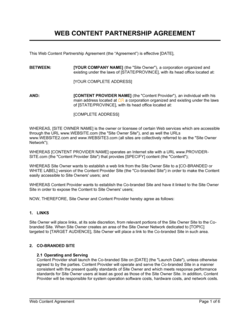
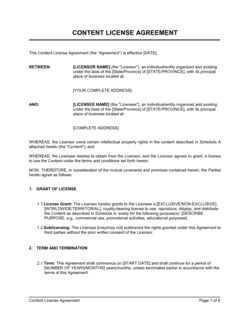
Content Provider Agreement Template

Free Word download β€’ Edit online β€’ Save & share with Drive β€’ Export to PDF

5 pagesβ€’25–35 min to fillβ€’Difficulty: Complexβ€’Signature requiredβ€’Legal review recommended
Learn more ↓
FreeContent Provider Agreement Template

At a glance

What it is
A Content Provider Agreement is a legally binding contract between a content creator or owner and a platform, publisher, or distributor that defines the terms under which the content may be used, distributed, and monetized. This free Word download covers IP ownership, license scope, content standards, fees, confidentiality, and termination in a single structured document you can edit online and export as PDF.
When you need it
Use it whenever you supply original content β€” articles, videos, audio, data feeds, software, or other digital assets β€” to a third party for publication, distribution, or sub-licensing. It protects your ownership rights while clearly defining the platform's permitted uses.
What's inside
License grant and scope, content ownership and IP assignment, content standards and delivery obligations, fees and payment terms, confidentiality, representations and warranties, indemnification, termination rights, and governing law. A Schedule A for a content catalog description is included as an attachment.

What is a Content Provider Agreement?

A Content Provider Agreement is a legally binding contract between a party that owns or creates content β€” articles, videos, audio recordings, data feeds, or other digital assets β€” and a platform, publisher, or distributor that wishes to host, display, or commercialize that content. The agreement establishes that the arrangement is a license, not a transfer of ownership: the provider retains all underlying intellectual property rights and grants only the specific permissions defined in the contract. It governs the scope of the license, content quality standards, fees and payment mechanics, confidentiality obligations, and the rights and obligations of both parties when the relationship ends.

Why You Need This Document

Without a signed content provider agreement, both parties are exposed in ways that become expensive quickly. A provider who delivers content before execution may find a court implying a license on terms the platform assumed rather than the ones the provider intended β€” potentially including royalty-free or perpetual rights the provider never agreed to grant. A platform that uses content beyond the agreed scope, modifies it without authorization, or distributes it outside the licensed territory faces copyright infringement liability regardless of intent. When the business relationship ends, content that remains live on a platform without a defined removal obligation creates ongoing infringement exposure for the provider and legal risk for the platform. This template gives both parties a precise, enforceable framework β€” covering IP ownership, license boundaries, revenue definitions, and takedown timelines β€” that protects each side and eliminates the ambiguity that generates disputes.

Which variant fits your situation?

If your situation is…Use this template
Licensing your own written or multimedia content to a third-party platformContent Provider Agreement
Hiring a freelancer to create content you will own outrightContent Creation Agreement
Commissioning an independent contractor for ongoing content workIndependent Contractor Agreement
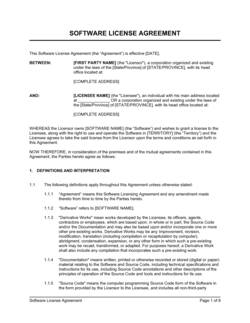
Licensing software or a software-embedded content productSoftware License Agreement
Distributing branded content through a formal partnership channelStrategic Partnership Agreement
Syndicating written editorial content to newspapers or magazinesContent Syndication Agreement
Transferring full copyright ownership rather than licensing itCopyright Assignment Agreement

Common mistakes to avoid

❌ Delivering content before the agreement is signed

Why it matters: Providing content before execution may create an implied license β€” courts have found that a recipient who receives and uses content before a formal agreement is signed acquires an informal license on the terms they assumed, not the ones the provider intended.

Fix: Hold all content delivery until both parties have executed the agreement. Use eSign with timestamping to eliminate any ambiguity about the sequence of events.

❌ Omitting a post-termination takedown obligation

Why it matters: Without a defined removal timeline, the platform may leave licensed content live indefinitely after the agreement ends, creating ongoing copyright infringement and reputational risk for the provider.

Fix: Add an explicit takedown clause requiring removal within 48–72 hours of termination and written certification of removal within 5 business days.

❌ Using 'all rights' or 'work for hire' language in a licensing agreement

Why it matters: These phrases can be interpreted as a full copyright assignment in some jurisdictions, permanently stripping the provider of ownership even if the intent was only to grant a limited license.

Fix: Use precise license grant language β€” 'Provider grants a non-exclusive license to...' β€” and include an explicit statement that no ownership is transferred.

❌ Leaving 'Net Revenue' undefined in a revenue-share structure

Why it matters: Platforms routinely deduct processing fees, partner commissions, refunds, and infrastructure costs before calculating net β€” undefined deductions can reduce a 30% revenue share to effectively 10–15%.

Fix: Define Net Revenue exhaustively: list every permitted deduction by category and cap aggregate deductions at a fixed percentage of gross revenue.

❌ No sublicensing clarification when the platform uses CDNs or resellers

Why it matters: Hosting content through a CDN, white-label partner, or affiliate technically constitutes sublicensing β€” if not expressly authorized, every downstream delivery is a breach of the license.

Fix: Either grant sublicensing rights expressly for named categories of sub-processors, or require the platform to warrant that its CDN and infrastructure arrangements do not require a sublicense.

❌ One-sided indemnification covering all third-party claims regardless of cause

Why it matters: If the platform modifies the content, distributes it beyond the licensed territory, or uses it for an unlicensed purpose and a claim arises, a provider-only indemnity clause forces the provider to defend a breach they did not commit.

Fix: Limit the provider's indemnity to claims arising from the content as originally delivered, and ensure the platform's indemnity covers all claims arising from its own modifications or out-of-scope use.

The 10 key clauses, explained

Parties and recitals

In plain language: Identifies the content provider and the platform or distributor by their legal entity names and summarizes the purpose of the agreement.

Sample language
This Content Provider Agreement ('Agreement') is entered into as of [DATE] between [CONTENT PROVIDER LEGAL NAME], a [STATE/COUNTRY] [ENTITY TYPE] ('Provider'), and [PLATFORM/DISTRIBUTOR LEGAL NAME], a [STATE/COUNTRY] [ENTITY TYPE] ('Platform').

Common mistake: Using trade names or DBA names instead of registered legal entity names β€” this creates ambiguity about which entity is bound by the agreement and can complicate enforcement.

Content description and delivery obligations

In plain language: Defines exactly what content will be supplied, in what format, on what schedule, and through what delivery method.

Sample language
Provider shall deliver the Content described in Schedule A in [FORMAT] via [DELIVERY METHOD] no later than [DATE / on a rolling basis per the schedule in Schedule A]. Each delivery shall include complete metadata as specified in Exhibit B.

Common mistake: Leaving content scope vague by referring only to a general category. Without a Schedule A listing specific titles, formats, and quantities, disputes over what was owed are almost guaranteed.

License grant and scope

In plain language: States whether the license is exclusive or non-exclusive, the permitted uses, geographic territory, and duration.

Sample language
Provider grants Platform a [non-exclusive / exclusive], [worldwide / territory-limited], [royalty-free / royalty-bearing], [sublicensable / non-sublicensable] license to host, display, distribute, and reproduce the Content solely for [PERMITTED PURPOSE] during the Term.

Common mistake: Omitting sublicensing rights when the platform uses CDN providers, resellers, or white-label partners β€” those third parties may technically require a sublicense, creating latent infringement exposure.

Intellectual property ownership

In plain language: Confirms that the provider retains ownership of all underlying IP and that the agreement is a license, not an assignment.

Sample language
All right, title, and interest in the Content, including all copyright and related intellectual property rights, remain exclusively with Provider. Nothing in this Agreement transfers ownership of any IP to Platform. Platform acquires only the license rights expressly set out in Section [X].

Common mistake: Using ambiguous language like 'work for hire' or 'all rights granted' in a content supply context β€” courts in some jurisdictions have read these phrases as full assignments, stripping the creator of ownership.

Content standards and compliance

In plain language: Sets the quality, accuracy, and legal compliance requirements the content must meet, and allocates responsibility for content that violates applicable law.

Sample language
Provider warrants that all Content will: (a) meet the quality standards in Schedule B; (b) not infringe any third-party IP rights; (c) comply with all applicable laws, including [GDPR / CCPA] where applicable; and (d) not contain defamatory, obscene, or unlawful material.

Common mistake: Omitting content standards entirely and relying on the provider's warranty. Without defined standards, the platform has no clear basis to reject noncompliant content or trigger a cure period.

Fees, royalties, and payment terms

In plain language: Defines how and when the provider is paid β€” flat fee, per-view royalty, revenue share, or subscription β€” and the invoicing and payment schedule.

Sample language
Platform shall pay Provider a [flat fee of $[X] per content unit / royalty of [X]% of Net Revenue / monthly fee of $[X]] within [30] days of [invoice date / end of reporting period]. Payments shall be accompanied by a usage report in the format set out in Schedule C.

Common mistake: Defining revenue share without defining 'Net Revenue.' Platforms commonly deduct processing fees, taxes, chargebacks, and partner costs before calculating net β€” without a definition, the provider may receive far less than expected.

Representations and warranties

In plain language: Each party's formal assurances β€” the provider warrants it owns the content and has authority to license it; the platform warrants it has authority to enter the agreement.

Sample language
Provider represents and warrants that: (a) it is the sole owner of all rights in the Content or has obtained all necessary licenses; (b) the Content does not infringe any third-party rights; and (c) it has full authority to enter this Agreement. Platform represents and warrants that it has the legal authority to enter and perform this Agreement.

Common mistake: No warranty that the provider has cleared all underlying rights β€” including music, photography, and third-party quotes embedded in the content. A blanket 'does not infringe' warranty with no underlying diligence is a liability waiting to be triggered.

Indemnification

In plain language: Allocates financial responsibility if a third party brings a claim β€” typically, the provider indemnifies the platform for IP infringement claims in the content, and the platform indemnifies the provider for claims arising from the platform's use.

Sample language
Provider shall indemnify, defend, and hold harmless Platform from any third-party claim arising out of: (a) Provider's breach of its representations and warranties; or (b) any allegation that the Content infringes a third party's IP rights. Platform shall indemnify Provider for claims arising from Platform's modification, redistribution, or misuse of the Content beyond the scope of this Agreement.

Common mistake: One-sided indemnification that holds only the provider liable for all claims, including those arising from the platform's own modifications or out-of-scope distribution of the content.

Term, termination, and content takedown

In plain language: Defines the agreement duration, how either party may end it, what happens to the content upon termination, and the timeframe for removing content from the platform.

Sample language
This Agreement commences on [DATE] and continues for [X] year(s), renewing automatically unless either party provides [30] days' written notice of non-renewal. Either party may terminate for material breach upon [30] days' written notice if the breach is not cured within that period. Upon termination, Platform shall remove all Content from its platform within [72] hours and certify removal in writing.

Common mistake: No post-termination content removal obligation or timeline. Without a defined takedown window, content can remain live on the platform indefinitely after the agreement ends, creating ongoing infringement exposure for the provider.

Governing law and dispute resolution

In plain language: Specifies which jurisdiction's law governs and how disputes are resolved β€” arbitration, mediation, or litigation β€” and in which venue.

Sample language
This Agreement is governed by the laws of [STATE / PROVINCE / COUNTRY], without regard to its conflict-of-laws rules. Any dispute shall be resolved by binding arbitration administered by [AAA / JAMS / ICC] in [CITY], except that either party may seek injunctive relief in any court of competent jurisdiction to protect IP rights.

Common mistake: Choosing a governing law with no connection to either party's location or the content's primary distribution territory β€” some jurisdictions limit enforceability of foreign-law clauses in consumer-facing or copyright-specific disputes.

How to fill it out

  1. 1

    Identify both parties by their full legal entity names

    Enter the registered legal name of the content provider and the platform or distributor. Include entity type (LLC, Inc., Ltd.) and state or country of formation for each.

    πŸ’‘ Check the counterparty's corporate registry filing to confirm the exact legal name before execution β€” mismatches create enforceability gaps.

  2. 2

    Complete Schedule A with a specific content description

    List every category, title, format, and delivery specification of the content being licensed. Include quantity, file format, resolution or bitrate standards, and any metadata requirements.

    πŸ’‘ The more specific Schedule A is, the harder it becomes for either party to dispute what was owed β€” vague descriptions are the single largest source of content contract disputes.

  3. 3

    Choose and define the license type

    Select exclusive or non-exclusive, define the permitted territory (worldwide or named regions), set the duration, and specify whether sublicensing is permitted. Each choice has commercial and legal consequences.

    πŸ’‘ If the platform operates a content delivery network or uses reseller partners, sublicensing rights must be expressly granted β€” or those downstream uses are technically unlicensed.

  4. 4

    Define the fee structure and 'Net Revenue' precisely

    Enter the payment model β€” flat fee per unit, royalty rate, or revenue share. If using revenue share, define Net Revenue in detail: what deductions are permitted and which are excluded.

    πŸ’‘ Request a sample calculation from the platform showing how Net Revenue is computed on a hypothetical $10,000 gross β€” this surfaces hidden deductions before you sign.

  5. 5

    Set content standards and the cure period for noncompliant content

    Attach Schedule B defining quality, accuracy, format, and legal compliance requirements. Add a cure period β€” typically 10–15 business days β€” giving the provider time to correct rejected content before termination rights arise.

    πŸ’‘ Include a rejection notice requirement: the platform must identify the specific deficiency in writing within a fixed window, not reject silently.

  6. 6

    Draft the indemnification clause to reflect actual risk allocation

    Ensure the provider's indemnity covers IP infringement in the content as delivered, while the platform's indemnity covers claims arising from modifications, out-of-scope use, or distribution beyond the licensed territory.

    πŸ’‘ Cap each party's indemnification liability at a specific dollar amount β€” typically 12 months of fees paid under the agreement β€” to avoid unlimited exposure on both sides.

  7. 7

    Set the termination timeline and post-termination takedown window

    Define the agreement term, auto-renewal notice period, cure period for material breach, and the specific number of hours or days the platform has to remove content after termination.

    πŸ’‘ 72 hours is the industry standard takedown window for digital content β€” shorter is better for the provider, longer is more practical for large platforms with complex CMS systems.

  8. 8

    Execute before any content is delivered

    Both parties must sign the agreement before the first piece of content is transferred. Delivering content before execution weakens the provider's IP position and may constitute an implied license on terms the platform defines.

    πŸ’‘ Use a timestamped eSign platform to record execution date and generate a certified copy for both parties' records.

Frequently asked questions

What is a content provider agreement?

A content provider agreement is a legally binding contract between a party that owns or creates content β€” articles, videos, audio, data, or other digital assets β€” and a platform, publisher, or distributor that wants to host, display, or distribute that content. It defines the scope of the license, IP ownership, payment terms, content standards, and what happens when the relationship ends. It protects the provider's ownership rights while giving the platform clear authorization to use the content.

Who needs a content provider agreement?

Any creator, data company, media agency, publisher, or software developer supplying original content to a third-party platform or distributor needs this agreement. It is commonly used by freelance writers licensing articles to digital publishers, SaaS companies providing data feeds to enterprise clients, e-learning instructors hosting courses on third-party platforms, and news aggregators acquiring content from multiple editorial sources. Without it, both parties operate on unconfirmed assumptions about rights and compensation.

What is the difference between a content provider agreement and a content creation agreement?

A content provider agreement is used when the provider already owns the content and is licensing it to a platform β€” ownership stays with the creator. A content creation agreement (or work-for-hire agreement) is used when the platform commissions a creator to produce new content and the platform owns the resulting work. The two documents have opposite ownership structures and should never be substituted for each other.

What should the license grant clause specify?

At minimum: whether the license is exclusive or non-exclusive, the permitted uses (hosting, display, distribution, reproduction, or sub-licensing), the geographic territory, the duration of the license, and whether the platform may create derivative works. Each of these parameters has commercial consequences β€” an exclusive license prevents the provider from licensing the same content to any other platform for the duration of the term, so exclusivity should always command a premium fee.

How should revenue sharing be structured in a content provider agreement?

Revenue share arrangements should specify the percentage, define Net Revenue precisely β€” listing every permitted deduction β€” and require monthly or quarterly usage reports with payment within a fixed number of days after the reporting period closes. Without a defined Net Revenue calculation, platforms can apply deductions that significantly erode the provider's effective share. Request a sample calculation before executing any revenue-share agreement.

What happens to the content when the agreement is terminated?

Upon termination, the license reverts to the provider and the platform is obligated to remove all content from its systems within the timeframe specified in the agreement β€” typically 48–72 hours for digital content. The platform should provide written certification of removal. Without this clause, content may remain live indefinitely after the agreement ends, creating ongoing copyright infringement exposure for the provider.

Are content provider agreements enforceable internationally?

Generally yes, provided the agreement specifies a governing law and dispute resolution forum. However, enforceability of specific clauses β€” particularly IP ownership, moral rights waivers, and indemnification β€” varies by jurisdiction. The EU's copyright framework, UK's CDPA, and Canada's Copyright Act each have provisions that can affect how these agreements operate locally. For cross-border content licensing, legal review tailored to each relevant jurisdiction is advisable.

Do I need a lawyer to draft a content provider agreement?

For standard domestic content licensing arrangements, a high-quality template reviewed with your specific terms is typically sufficient. Engage a lawyer when the content has significant commercial value, when exclusivity is involved, when the distribution is cross-border, or when the revenue share or fee structure is complex. A 1–2 hour template review by a commercial or IP lawyer typically costs $300–$600 and is worthwhile whenever the content represents a material revenue stream.

How this compares to alternatives

vs Independent Contractor Agreement

An independent contractor agreement engages a creator to produce new content on behalf of a client, typically with the client owning the resulting work. A content provider agreement licenses existing or ongoing content the provider already owns, with ownership remaining with the creator. Using the wrong document can inadvertently transfer copyright in the opposite direction from what was intended.

vs Software License Agreement

A software license agreement governs the right to use executable software and is designed around the technical and functional characteristics of code. A content provider agreement governs editorial, media, or data content and focuses on display, distribution, and attribution rights. Software embedded with licensed third-party content may require both agreements operating in parallel.

vs Non-Disclosure Agreement

An NDA restricts disclosure of confidential information shared during a business relationship but does not grant any right to use, publish, or distribute that information. A content provider agreement expressly grants specific usage rights. NDAs are often signed before content provider negotiations begin to protect unreleased content shared for evaluation purposes.

vs Strategic Partnership Agreement

A strategic partnership agreement governs a broad collaborative relationship between two organizations, covering joint marketing, revenue sharing, and operational coordination across multiple activities. A content provider agreement is a narrower document focused exclusively on the supply, licensing, and commercialization of specific content. If content supply is one component of a broader partnership, both documents may be needed.

Industry-specific considerations

Media and Publishing

Editorial content syndication, exclusive licensing windows for breaking news, and moral rights considerations for attributed journalism.

E-learning and EdTech

Instructor-platform revenue share structures, platform exclusivity requirements, and content update obligations tied to course accuracy standards.

SaaS and Data Services

API-delivered data feeds, real-time content refresh obligations, uptime SLAs attached to content delivery, and GDPR compliance clauses for personal-data-embedded content.

Entertainment and Streaming

Territorial windowing for exclusive broadcast rights, reversion clauses tied to minimum viewership thresholds, and clearance obligations for embedded music and third-party IP.

Jurisdictional notes

United States

US copyright law under 17 U.S.C. governs content ownership; work-for-hire doctrine can transfer authorship to the commissioning party in specific circumstances β€” ensure the agreement clearly states it is a license, not an assignment. California's strong IP protections and New York's status as a media and publishing hub make state-specific legal review advisable for high-value content deals. DMCA safe harbor provisions affect platform takedown obligations and should be referenced where applicable.

Canada

Canada's Copyright Act provides authors with moral rights that cannot be assigned β€” only waived β€” so content provider agreements should include an explicit moral rights waiver if the platform requires editorial modifications. Quebec's civil law tradition may affect contract interpretation differently from common-law provinces. Agreements with Quebec-based parties should consider French-language contract requirements under the Charter of the French Language.

United Kingdom

The Copyright, Designs and Patents Act 1988 governs UK content agreements, providing strong author protections and database rights not recognized in all other jurisdictions. Post-Brexit, UK and EU copyright rules have diverged on several points including the EU Copyright Directive's press publisher rights. Content provider agreements distributing to both UK and EU audiences should address each regime separately.

European Union

The EU Copyright Directive (2019/790) introduced new obligations for online content-sharing platforms, including upload filter requirements and mandatory licensing for press publishers. GDPR applies when content incorporates or processes personal data. Member states have implemented the Directive with variation β€” Germany and France, in particular, have enacted strong press publisher rights provisions that affect revenue-share calculations for news content syndication.

Template vs lawyer β€” what fits your deal?

PathBest forCostTime
Use the templateContent creators and small publishers licensing non-exclusive content domestically with standard payment termsFree30–60 minutes
Template + legal reviewExclusive licensing arrangements, revenue-share structures, or cross-border content distribution$300–$6002–4 days
Custom draftedHigh-value content catalogs, multi-territory exclusive licensing, streaming or broadcast rights, or enterprise data feed agreements$2,000–$8,000+2–4 weeks

Glossary

License Grant
The specific permission given by the content owner to the recipient, defining what they can and cannot do with the content.
Exclusive License
A license that prevents the content owner from granting the same rights to any other party for the duration of the agreement.
Non-Exclusive License
A license that allows the content owner to grant the same or similar rights to multiple parties simultaneously.
Sublicense
Permission granted by the licensee to a third party to use the content β€” requires explicit authorization from the original content owner.
Moral Rights
An author's right to attribution and to object to modifications that distort or damage their work β€” distinct from economic copyright and waivable in some jurisdictions.
Derivative Work
A new creation based on or incorporating the original content, such as a translation, adaptation, or edited compilation.
Content Standards
Contractual specifications defining acceptable quality, format, accuracy, and compliance requirements the content must meet before delivery.
Indemnification
A clause requiring one party to compensate the other for losses arising from specified breaches β€” commonly triggered by IP infringement claims.
Takedown Obligation
A contractual requirement to remove specified content from a platform promptly upon written notice, typically within 24–72 hours.
Reversion of Rights
The automatic return of licensed rights to the content owner upon expiration or termination of the agreement.
Metadata
Descriptive data accompanying the content β€” title, author, format, keywords, rights information β€” required for indexing, attribution, and licensing management.
Perpetual License
A license with no fixed end date, allowing the licensee to continue using the content indefinitely unless otherwise terminated for cause.

Part of your Business Operating System

This document is one of 3,000+ business & legal templates included in Business in a Box.

  • Fill-in-the-blanks β€” ready in minutes
  • 100% customizable Word document
  • Compatible with all office suites
  • Export to PDF and share electronically

Create your document in 3 simple steps.

From template to signed document β€” all inside one Business Operating System.
1
Download or open template

Access over 3,000+ business and legal templates for any business task, project or initiative.

2
Edit and fill in the blanks with AI

Customize your ready-made business document template and save it in the cloud.

3
Save, Share, Send, Sign

Share your files and folders with your team. Create a space of seamless collaboration.

Save time, save money, and create top-quality documents.

β˜…β˜…β˜…β˜…β˜…

"Fantastic value! I'm not sure how I'd do without it. It's worth its weight in gold and paid back for itself many times."

Managing Director Β· Mall Farm
Robert Whalley
Managing Director, Mall Farm Proprietary Limited
β˜…β˜…β˜…β˜…β˜…

"I have been using Business in a Box for years. It has been the most useful source of templates I have encountered. I recommend it to anyone."

Business Owner Β· 4+ years
Dr Michael John Freestone
Business Owner
β˜…β˜…β˜…β˜…β˜…

"It has been a life saver so many times I have lost count. Business in a Box has saved me so much time and as you know, time is money."

Owner Β· Upstate Web
David G. Moore Jr.
Owner, Upstate Web

Run your business with a system β€” not scattered tools

Stop downloading documents. Start operating with clarity. Business in a Box gives you the Business Operating System used by over 250,000 companies worldwide to structure, run, and grow their business.

Free Forever PlanΒ Β·Β No credit card required