Washington State Lien Waiver Form Template

Free Word download β€’ Edit online β€’ Save & share with Drive β€’ Export to PDF

2 pagesβ€’20–25 min to fillβ€’Difficulty: Standard
Learn more ↓
FreeWashington State Lien Waiver Form Template

At a glance

What it is
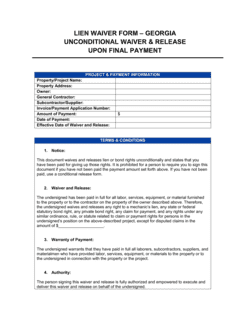
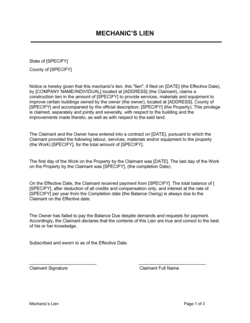
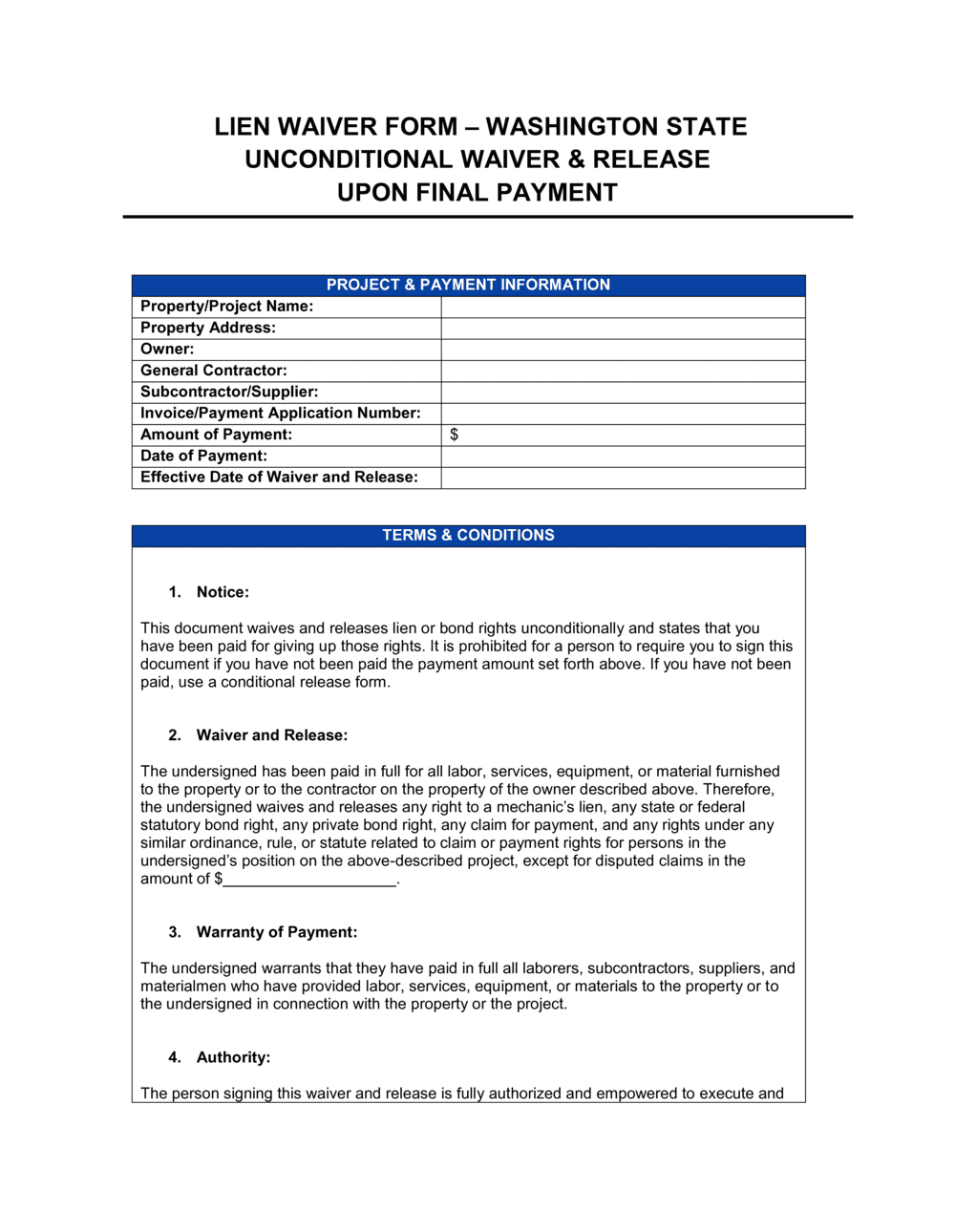
A Washington State Lien Waiver Form is a standardized document a contractor, subcontractor, or supplier signs to waive their right to file a mechanic's lien against a property in exchange for payment. This free Word download covers both conditional and unconditional variants for progress and final payments, and can be edited online and exported as PDF in minutes.
When you need it
Use it whenever a property owner, general contractor, or lender requires proof that downstream parties have been paid and will not file liens against the project property. It is typically exchanged at each payment milestone β€” progress draws and final completion.
What's inside
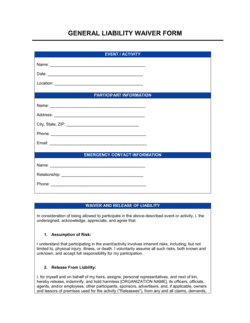
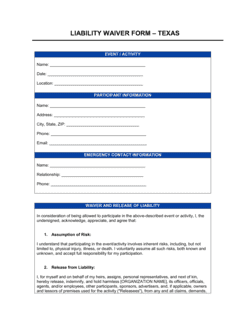
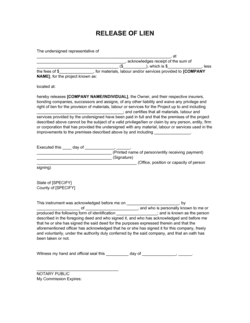
Project and property identification fields, claimant and owner details, payment amount and through-date, waiver type selection (conditional or unconditional), exception carve-outs for retention or disputed amounts, and a signature block with notarization option.

What is a Washington State Lien Waiver Form?

A Washington State Lien Waiver Form is a structured document a contractor, subcontractor, or material supplier signs to waive their right to file a mechanic's lien against a property in exchange for a specific payment. Under Washington RCW Chapter 60.04, unpaid construction parties have the right to encumber a property's title β€” a lien waiver is the mechanism that releases or prevents that encumbrance at each payment milestone. The form exists in four standard variants: conditional on progress payment, unconditional on progress payment, conditional on final payment, and unconditional on final payment. Selecting the correct type is the single most consequential decision when completing the form.

Why You Need This Document

Without a properly executed lien waiver at each payment milestone, property owners risk having their title encumbered by claims from subcontractors and suppliers they may not even be aware of β€” blocking refinancing, sales, and future draws. General contractors who fail to collect waivers from every tier before releasing payment expose themselves to paying twice: once to the subcontractor and again to satisfy a lien. For subcontractors and suppliers, signing the wrong waiver type β€” unconditional before payment clears β€” permanently surrenders lien rights with no legal recourse if the check bounces. This template provides a Washington State-specific form with all four waiver variants, through-date and retention carve-out fields, and clear conditional payment language, so every party in the payment chain is protected at every draw.

Which variant fits your situation?

If your situation is…Use this template
Payment not yet received β€” waiver takes effect only when check clearsConditional Lien Waiver on Progress Payment
Payment already received and cleared β€” waiver is effective immediatelyUnconditional Lien Waiver on Progress Payment
Final payment not yet received β€” project complete, payment pendingConditional Lien Waiver on Final Payment
Final payment received and cleared β€” releasing all lien rights permanentlyUnconditional Lien Waiver on Final Payment
Partial release of lien rights tied to a specific portion of a projectPartial Lien Release Form
Releasing a previously recorded lien after payment dispute is resolvedLien Release and Discharge Form
Lender requiring waiver from every tier before disbursing a drawJoint Check Agreement with Lien Waiver

Common mistakes to avoid

❌ Signing an unconditional waiver before payment clears

Why it matters: An unconditional waiver is effective the moment it is signed. If the check bounces or the wire is reversed, the claimant has permanently released lien rights with nothing received.

Fix: Always use a conditional waiver until the payment check has cleared the bank or the wire has settled β€” then issue an unconditional waiver if requested.

❌ Using a generic lien waiver not tailored to Washington State

Why it matters: Washington RCW Chapter 60.04 governs construction liens and imposes specific requirements. A generic form may omit language required by state statute, reducing enforceability.

Fix: Use a form that references Washington State statutory requirements and includes the project address, through date, and waiver type fields required under RCW 60.04.

❌ Omitting the retention carve-out on progress waivers

Why it matters: A progress waiver without a carve-out for withheld retention can be read as releasing lien rights for the full contract value, including amounts not yet paid.

Fix: Always state the retained amount explicitly in the exception field of every progress waiver until retention is released separately at project closeout.

❌ Collecting waivers only from the general contractor

Why it matters: In Washington State, subcontractors and material suppliers have independent lien rights. A GC waiver does not release the owner's title from sub-tier claims.

Fix: Require conditional lien waivers from every subcontractor and supplier who furnished labor or materials before releasing each progress draw.

The 9 key fields, explained

Project name and address

Property owner name

Claimant name and role

Waiver type selection

Payment amount

Through date

Retention / exception carve-out

Conditional payment language (conditional waivers only)

Signature block and date

How to fill it out

  1. 1

    Select the correct waiver type before anything else

    Determine whether this is a progress or final payment waiver, and whether payment has already cleared (unconditional) or is pending (conditional). These are four distinct forms β€” using the wrong type exposes the claimant to lost rights or leaves the owner's title uncleared.

    πŸ’‘ Default to conditional until the payment check or wire is confirmed cleared β€” switching to unconditional after clearance takes one minute and eliminates all risk.

  2. 2

    Enter the full legal project and property details

    Fill in the project name and the job site street address in Washington State. Confirm this matches the property address on the construction contract and any recorded preliminary notices.

    πŸ’‘ Cross-reference the legal property description from the building permit if the project involves a large parcel with multiple addresses.

  3. 3

    Identify the owner and claimant by legal name

    Enter the property owner's registered legal name and the claimant's registered entity name β€” not a trade name or DBA. Verify both against the executed construction contract.

    πŸ’‘ For LLCs and corporations, use the name exactly as it appears in the Washington Secretary of State's business registry.

  4. 4

    Enter the exact payment amount in numbers and words

    State the dollar amount of the specific payment this waiver covers, written both numerically and in full words to prevent alteration disputes.

    πŸ’‘ Never write 'all amounts owed' β€” always tie the waiver to a specific, enumerated payment so future claims remain open.

  5. 5

    Set the through date accurately

    Enter the last date that labor or materials were furnished on the project for this payment cycle β€” not the invoice date and not today's date unless they coincide.

    πŸ’‘ Confirm the through date with your project manager before signing; an incorrect date can either over-release or under-release lien rights.

  6. 6

    Add retention and exception carve-outs

    If any retention is being withheld or if there are disputed amounts not included in this payment, list them explicitly in the exception field so they are not inadvertently released.

    πŸ’‘ Keep a running retention log for each project so the carve-out amount is always accurate at each draw.

  7. 7

    Have an authorized signatory execute the form

    Ensure the person signing has actual authority to bind the claimant entity β€” typically an officer, owner, or designated project manager with a written delegation of authority.

    πŸ’‘ For high-value waivers, collect a copy of the signer's authorization letter or corporate resolution to attach to your project file.

  8. 8

    Exchange the waiver simultaneously with payment

    For conditional waivers, deliver the signed form at the same time as the check or wire instruction β€” do not sign and deliver in advance of receiving payment confirmation.

    πŸ’‘ Use a joint delivery process: hand the waiver to the GC or owner rep at the moment you receive the payment confirmation email or physical check.

Frequently asked questions

What is a Washington State lien waiver form?

A Washington State lien waiver form is a document a contractor, subcontractor, or material supplier signs to give up their right to file a mechanic's lien against a property in exchange for payment. Washington RCW Chapter 60.04 governs construction liens in the state, and lien waivers are the standard mechanism property owners and lenders use to confirm that downstream parties have been paid and will not encumber the title.

What is the difference between a conditional and unconditional lien waiver?

A conditional lien waiver takes effect only when a specific payment actually clears β€” if the check bounces, the claimant retains full lien rights. An unconditional waiver is effective the moment it is signed, regardless of whether payment has been received. Always use a conditional waiver when payment has not yet cleared, and only upgrade to unconditional after you confirm the funds have settled in your account.

Does Washington State require lien waivers on construction projects?

Washington State does not legally mandate lien waivers on every project, but they are universally required by construction lenders, title companies, and most general contractors as a condition of releasing progress draws. Construction loan agreements and owner-GC contracts almost always include a lien waiver exchange requirement at each payment milestone.

Who should sign a lien waiver in Washington State?

The party who holds or could hold lien rights β€” typically the contractor, subcontractor, or material supplier β€” signs the waiver. The signer must have actual authority to bind the company, such as an owner, officer, or a project manager with a written delegation. A field employee without authority cannot validly waive the company's lien rights.

What is the lien filing deadline in Washington State?

Under RCW 60.04.141, most claimants must record a mechanic's lien within 90 days of the last date they furnished labor, services, or materials on the project. The through date on your lien waiver should align precisely with this window β€” an incorrect through date can either inadvertently release rights you intended to preserve or fail to clear the full period the owner needs cleared.

Can a lien waiver be revoked after it is signed?

An unconditional lien waiver generally cannot be revoked once signed and delivered β€” it is a release of legal rights. A conditional waiver, however, never becomes effective if the specified payment fails to clear, so no formal revocation is needed in that scenario. If you signed a waiver in error, consult a construction attorney promptly about available remedies under Washington State law.

Should a Washington State lien waiver be notarized?

Washington State does not require notarization for a lien waiver to be valid. However, some lenders, title companies, and owners request a notarized signature for high-value waivers or final unconditional releases to reduce the risk of a later authenticity challenge. Check the specific requirements of the requesting party before preparing the form.

What happens if a subcontractor refuses to sign a lien waiver?

A subcontractor is not legally obligated to sign a lien waiver before receiving payment in Washington State. However, most contracts include a lien waiver exchange provision as a condition of payment. If a sub refuses, the GC or owner typically cannot release the draw, creating a payment dispute that may need to be resolved through the contract's dispute-resolution mechanism or direct negotiation.

Does a lien waiver release bond claims as well as lien claims?

A standard lien waiver releases mechanic's lien rights only β€” it does not automatically release claims against a payment bond, which is a separate legal remedy available on bonded projects. If the project is bonded, confirm whether the waiver form includes separate bond claim release language, and negotiate that language carefully before signing.

How this compares to alternatives

vs Lien Release Form

A lien release is filed after a mechanic's lien has already been recorded against a title β€” it formally discharges the recorded encumbrance. A lien waiver is signed before or at the time of payment to prevent a lien from ever being filed. Use a waiver proactively at each payment; use a release only if a lien was actually recorded.

vs Preliminary Notice

A preliminary notice is sent early in a project by a subcontractor or supplier to preserve their right to file a mechanic's lien in Washington State. A lien waiver is signed later β€” at each payment milestone β€” to release those preserved rights. The notice creates the right; the waiver surrenders it.

vs Joint Check Agreement

A joint check agreement ensures payment is made by a check payable to both the GC and subcontractor jointly, guaranteeing the sub receives funds before signing a waiver. A lien waiver alone does not guarantee the sub is paid β€” combining both documents provides the strongest payment-and-release protection for all parties.

vs Affidavit of Payment

An affidavit of payment is a sworn statement by the property owner or GC declaring that all contractors and suppliers have been paid. A lien waiver is signed by each individual claimant releasing their own rights. Both are used in construction closings, but the waiver is party-specific while the affidavit is a broader sworn representation.

Industry-specific considerations

Residential construction

Single-family and multifamily homebuilders collect progress waivers from every subcontractor at each draw to keep title clear for construction lenders and future buyers.

Commercial real estate development

Lenders on commercial projects require a full lien waiver package β€” GC plus all subs and suppliers β€” before releasing each draw from the construction loan escrow.

Government and public works

Public projects in Washington cannot have mechanics' liens recorded against them, but lien waivers are still used to document payment compliance and support bond claim releases.

Specialty trades and suppliers

Electrical, plumbing, HVAC contractors and material suppliers sign conditional progress waivers with each monthly billing cycle to satisfy GC draw requirements.

Template vs pro β€” what fits your needs?

PathBest forCostTime
Use the templateContractors, subcontractors, and suppliers exchanging standard progress or final payment waivers on typical residential or commercial projectsFree5 minutes per waiver
Template + professional reviewHigh-value final waivers, disputed payment situations, or projects where a lender requires customized waiver language$100–$300 (construction attorney or title company review)1–2 business days
Custom draftedComplex multi-tier projects, public-private partnerships, or disputes requiring bond claim release language alongside the lien waiver$500–$1,500+ (construction attorney)3–7 business days

Glossary

Mechanic's Lien
A legal claim recorded against a property by an unpaid contractor, subcontractor, or supplier, encumbering the title until the debt is resolved.
Conditional Lien Waiver
A waiver that becomes effective only when a specific payment β€” identified by check number or amount β€” actually clears the bank.
Unconditional Lien Waiver
A waiver that is effective immediately upon signing, regardless of whether payment has actually been received or cleared.
Claimant
The contractor, subcontractor, or supplier who holds or could hold lien rights and is signing away those rights in the waiver.
Through Date
The specific date up to which the claimant is waiving lien rights, covering all labor and materials furnished on or before that date.
Retention (Retainage)
A percentage of each progress payment β€” typically 5–10% β€” withheld by the owner or GC until project completion, which can be carved out of a progress waiver.
Preliminary Notice
A notice sent by a subcontractor or supplier early in a project to preserve their right to file a mechanic's lien in Washington State.
Lien Period
The window within which a claimant must record a mechanic's lien β€” 90 days from last furnishing in Washington State for most parties.
Joint Check Agreement
An arrangement where payment is made by check payable to both the GC and subcontractor jointly, ensuring the sub receives funds before signing a waiver.
Notice of Completion
A document recorded by the property owner when construction is substantially complete, which triggers the start of the lien filing deadline for most claimants.

Part of your Business Operating System

This document is one of 3,000+ business & legal templates included in Business in a Box.

  • Fill-in-the-blanks β€” ready in minutes
  • 100% customizable Word document
  • Compatible with all office suites
  • Export to PDF and share electronically

Create your document in 3 simple steps.

From template to signed document β€” all inside one Business Operating System.
1
Download or open template

Access over 3,000+ business and legal templates for any business task, project or initiative.

2
Edit and fill in the blanks with AI

Customize your ready-made business document template and save it in the cloud.

3
Save, Share, Send, Sign

Share your files and folders with your team. Create a space of seamless collaboration.

Save time, save money, and create top-quality documents.

β˜…β˜…β˜…β˜…β˜…

"Fantastic value! I'm not sure how I'd do without it. It's worth its weight in gold and paid back for itself many times."

Managing Director Β· Mall Farm
Robert Whalley
Managing Director, Mall Farm Proprietary Limited
β˜…β˜…β˜…β˜…β˜…

"I have been using Business in a Box for years. It has been the most useful source of templates I have encountered. I recommend it to anyone."

Business Owner Β· 4+ years
Dr Michael John Freestone
Business Owner
β˜…β˜…β˜…β˜…β˜…

"It has been a life saver so many times I have lost count. Business in a Box has saved me so much time and as you know, time is money."

Owner Β· Upstate Web
David G. Moore Jr.
Owner, Upstate Web

Run your business with a system β€” not scattered tools

Stop downloading documents. Start operating with clarity. Business in a Box gives you the Business Operating System used by over 250,000 companies worldwide to structure, run, and grow their business.

Start freeΒ Β·Β No credit card required