New York Lien Waiver Form Template

Free Word download β€’ Edit online β€’ Save & share with Drive β€’ Export to PDF

2 pagesβ€’20–25 min to fillβ€’Difficulty: Standard
Learn more ↓
FreeNew York Lien Waiver Form Template

At a glance

What it is
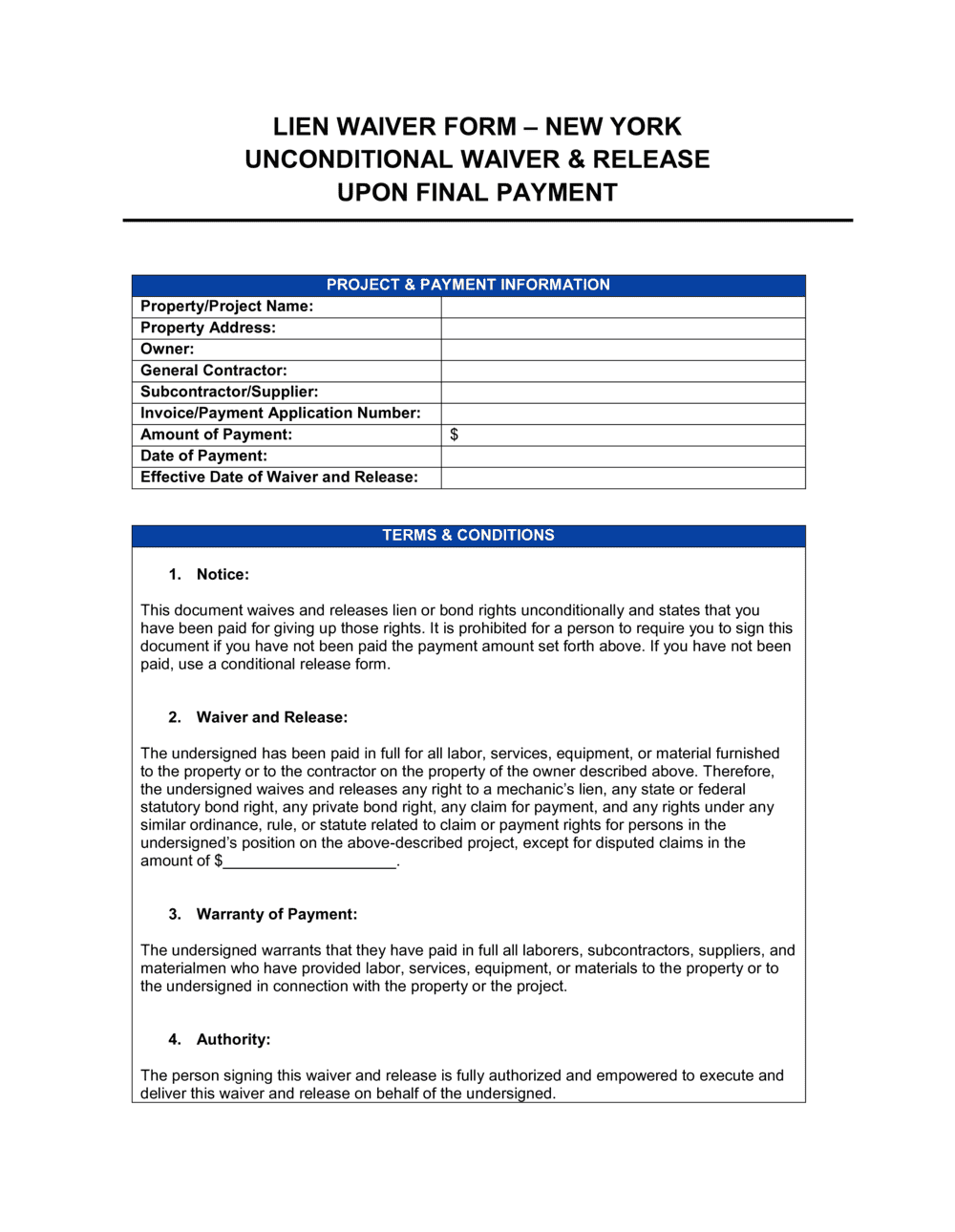
A New York Lien Waiver Form is a signed document in which a contractor, subcontractor, or material supplier relinquishes their right to file a mechanic's lien against a property in exchange for payment. This free Word download is pre-structured for New York construction projects and can be edited online and exported as PDF in minutes.
When you need it
Use it when a property owner or general contractor requires written confirmation that a payee waives lien rights upon receiving a progress payment or final payment on a construction project in New York State.
What's inside
Party identification fields, property and project description, payment amount and date, waiver scope (conditional or unconditional), claimant signature block, and notarization space where required by the contracting party.

What is a New York Lien Waiver Form?

A New York Lien Waiver Form is a signed document in which a contractor, subcontractor, laborer, or material supplier relinquishes their right to file a mechanic's lien against a property under New York's Lien Law, in exchange for a specified payment. It identifies both parties, describes the project property, states the payment amount and the date through which work is covered, and specifies whether the release is conditional on payment clearing or unconditional upon signing. Lien waivers are the primary tool used on New York construction projects to protect property titles and keep payment chains moving cleanly from owner to general contractor to subcontractors and suppliers.

Why You Need This Document

Without signed lien waivers on file, a property owner who pays the general contractor in full can still have a valid mechanic's lien filed against their title by an unpaid subcontractor or material supplier β€” with no practical remedy short of paying again or litigating. For contractors and subcontractors, submitting a waiver without specifying a through date or listing open change orders can inadvertently release rights to payment for work that was never included in the amount received. A properly completed New York Lien Waiver Form eliminates these risks on both sides: owners get clean title protection at each payment milestone, and claimants release only what they were actually paid for. This template gives you a pre-structured form you can complete in under five minutes, with placeholder fields that enforce the specificity New York courts expect when lien rights are in dispute.

Which variant fits your situation?

If your situation is…Use this template
Waiving lien rights contingent on a check clearing before the waiver is effectiveConditional Lien Waiver (Progress Payment)
Waiving lien rights permanently after payment has already been confirmed receivedUnconditional Lien Waiver (Progress Payment)
Final payment made and all work is complete β€” waiving all remaining lien rightsUnconditional Lien Waiver (Final Payment)
Payment not yet received but owner requires waiver before final close-outConditional Lien Waiver (Final Payment)
Documenting lien rights for a multi-state project that includes New York workGeneral Contractor Lien Waiver
Owner needs a sworn statement of all lower-tier subcontractors and suppliersContractor's Sworn Statement
Supplier providing a partial release for goods delivered in one shipment onlyPartial Lien Waiver

Common mistakes to avoid

❌ Signing an unconditional waiver before payment clears

Why it matters: Once signed, an unconditional waiver immediately releases your lien rights β€” even if the check bounces or the wire is reversed. You lose your primary collection leverage with no automatic remedy.

Fix: Always use a conditional waiver for progress payments. Only convert to unconditional after your bank confirms the funds have settled.

❌ Leaving the through date blank

Why it matters: Without a through date, the waiver may be interpreted to cover all past and future work on the project, stripping lien rights for labor and materials you haven't yet invoiced.

Fix: Enter a specific calendar date matching the end of the billing period covered by the payment being made.

❌ Failing to list open change orders as exceptions

Why it matters: Broad waiver language can inadvertently release rights to payment for approved or pending change orders that were never included in the payment being made.

Fix: Before signing, list every outstanding change order by number and dollar amount in the exceptions field, even if the amounts are still being negotiated.

❌ Using the wrong entity name for the claimant

Why it matters: A waiver signed in a trade name or DBA may not bind β€” or protect β€” the correct legal entity, creating disputes about whether the right party's lien rights were actually released.

Fix: Verify the claimant name against the New York Department of State entity registry and the original contract before completing the form.

The 9 key fields, explained

Claimant name and company

Property owner name

Project and property description

Payment amount

Payment date and through date

Waiver type (conditional or unconditional)

Scope of lien rights waived

Exceptions and retained claims

Claimant signature and date

How to fill it out

  1. 1

    Identify the correct claimant legal name

    Enter the registered legal name of the entity waiving lien rights β€” not a DBA or project nickname. Confirm it matches the name on the contract and any preliminary notices already filed.

    πŸ’‘ Cross-check the name against the New York Department of State entity search before signing to avoid a name mismatch that invalidates the waiver.

  2. 2

    Confirm the property owner and project address

    Enter the full legal name of the property owner and the complete street address of the project site. Use the same property description that appears on the contract.

    πŸ’‘ For condominium or co-op projects, list both the building address and the unit or tax lot number to eliminate any ambiguity.

  3. 3

    Choose the correct waiver type

    Select conditional if payment has not yet cleared β€” conditional waivers protect you if a check bounces. Select unconditional only after funds are confirmed received in your account.

    πŸ’‘ Default to conditional on progress payments; switch to unconditional only when your bank confirms ACH settlement or a check has fully cleared.

  4. 4

    Enter the exact payment amount and through date

    Write the dollar amount numerically and in words. Set the through date to the last day of the billing period covered by this payment β€” not the payment date itself.

    πŸ’‘ Align the through date with the schedule of values line items or the pay application period to ensure no gap or overlap with the next waiver.

  5. 5

    List any exceptions for unpaid change orders

    If any change orders, disputed amounts, or retention balances remain unpaid, list them explicitly in the exceptions field before signing.

    πŸ’‘ A brief note β€” 'CO-04 pending approval, $12,500' β€” is enough to preserve your rights on that item without holding up the waiver for the paid portion.

  6. 6

    Have an authorized representative sign

    Confirm the signer has authority to bind the company β€” typically the owner, president, or a corporate officer. Print their name and title next to the signature.

    πŸ’‘ For LLCs and corporations, check your operating agreement or bylaws to confirm signing authority before routing the form.

  7. 7

    Retain a copy before delivering the original

    Scan or photograph the signed waiver before handing it over to the GC or owner. File it alongside the corresponding pay application or invoice.

    πŸ’‘ Store waivers by project and payment date in a single folder β€” you may need them quickly if a lien dispute arises months later.

Frequently asked questions

What is a New York lien waiver form?

A New York lien waiver form is a signed document in which a contractor, subcontractor, laborer, or material supplier releases their right to file a mechanic's lien against a property under New York's Lien Law in exchange for a specified payment. It is typically exchanged simultaneously with β€” or as a condition of β€” payment on a construction project.

Are lien waivers required in New York?

New York does not have a statutory standard form for lien waivers, unlike some other states. However, they are widely required by contract β€” general contractors, owners, and lenders routinely make payment contingent on receiving a signed waiver. The enforceability of a waiver depends on its clarity, the consideration paid, and whether it was signed knowingly.

What is the difference between a conditional and unconditional lien waiver?

A conditional waiver only becomes effective once a specific payment has actually cleared β€” protecting the claimant if a check bounces or a wire is reversed. An unconditional waiver takes effect immediately upon signing, regardless of whether payment has been received. Always use a conditional waiver when payment has not yet been confirmed in your bank account.

Does a New York lien waiver need to be notarized?

New York does not legally require notarization for a lien waiver to be valid. However, some general contractors, owners, and title companies request notarized waivers as an additional assurance of authenticity and the signer's identity. Review your contract to determine whether notarization is contractually required on your specific project.

Can a lien waiver waive more than I was paid for?

Yes β€” if the waiver language is too broad or the through date is not specified, a waiver can inadvertently release rights to payment for work performed or materials delivered beyond the payment amount. Always include a specific through date and list any unpaid change orders or retention balances as explicit exceptions before signing.

What happens if I sign a lien waiver and the check bounces?

If you signed a conditional waiver, it never became effective because the payment condition was not met β€” your lien rights are preserved. If you signed an unconditional waiver, the release is generally effective even if the payment was not honored, leaving you without lien protection. This is why using conditional waivers for progress payments is strongly recommended.

How long do I have to file a mechanic's lien in New York if I don't sign a waiver?

Under New York Lien Law, a contractor or subcontractor generally has eight months from the last date of furnishing labor or materials to file a mechanic's lien. For single-family residential properties, the deadline is four months. A signed lien waiver eliminates this right for the scope and amounts covered, so review each waiver carefully before execution.

Should I get a lien waiver from every subcontractor on my project?

Yes β€” as a general contractor or property owner, collecting waivers from every tier of subcontractor and supplier is the primary way to protect the property title from downstream lien claims. Even if you pay the GC in full, an unpaid sub or supplier can file a lien directly against the property under New York law without a signed waiver on file.

Is a lien waiver the same as a lien release?

They are closely related but technically distinct. A lien waiver is signed before or simultaneously with payment, relinquishing the right to file a future lien. A lien release discharges a lien that has already been filed with the county clerk. If a mechanic's lien has already been recorded, you need a formal lien release β€” not a waiver β€” to clear title.

How this compares to alternatives

vs Mechanic's Lien Form

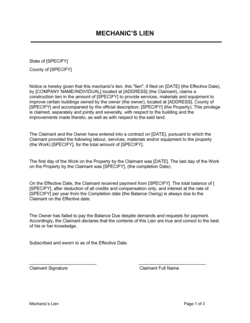
A mechanic's lien form is filed with the county clerk to assert an unpaid claim against a property β€” it is the claim itself. A lien waiver is the document that releases or prevents that claim in exchange for payment. You file a mechanic's lien when you have not been paid; you sign a lien waiver when you have.

vs Lien Release Form

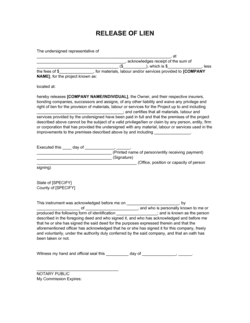
A lien release discharges a mechanic's lien that has already been recorded in the county property records. A lien waiver prevents a lien from being filed in the first place. If no lien has been filed yet, use a waiver; if a lien is already on record, you need a formal release to clear title.

vs Contractor Final Pay Application

A final pay application (AIA G702/G703) requests the remaining contract balance from the owner or GC. A lien waiver accompanies or follows that application to confirm the claimant releases lien rights upon receipt of the final amount. Both documents are typically exchanged together at project close-out.

vs Sworn Contractor's Statement

A sworn contractor's statement is a notarized list of all subcontractors and suppliers on a project, the amounts owed to each, and their payment status. A lien waiver is a release from a single claimant. Owners and lenders often require both β€” the sworn statement to identify who needs to sign, and individual waivers as the actual releases.

Industry-specific considerations

Construction and Contracting

Progress-draw lien waivers collected at each AIA G702 pay application submission protect the owner's title and the GC's payment chain simultaneously.

Real Estate Development

Developers and lenders require unconditional final waivers from all tiers of contractors and suppliers before issuing a certificate of occupancy or releasing construction loan funds.

Specialty Trades

Electricians, plumbers, and HVAC contractors use conditional progress waivers to comply with GC payment requirements while protecting against dishonored checks on multi-phase projects.

Material Supply and Distribution

Lumber yards, steel suppliers, and equipment rental companies issue partial lien waivers per delivery invoice to align releases with each shipment payment rather than the full contract value.

Template vs pro β€” what fits your needs?

PathBest forCostTime
Use the templateContractors, subcontractors, and suppliers exchanging standard progress or final payment waivers on New York construction projectsFree5 minutes per waiver
Template + professional reviewProjects with complex change order disputes, retention balances, or waivers requested by institutional lenders$100–$300 (construction attorney review)1–2 business days
Custom draftedLarge commercial developments, public works projects, or disputes where lien rights are actively contested$500–$2,000+ (construction attorney)3–7 business days

Glossary

Mechanic's Lien
A legal claim filed against real property by a contractor, subcontractor, or supplier who has not been paid for work or materials provided.
Lien Waiver
A signed document in which a claimant voluntarily relinquishes the right to file a mechanic's lien, typically in exchange for a specified payment.
Conditional Lien Waiver
A waiver that becomes effective only when a specific payment β€” such as a check β€” has actually cleared and funds are confirmed received.
Unconditional Lien Waiver
A waiver that takes effect immediately upon signing, regardless of whether payment has actually been received or cleared.
Progress Payment
A partial payment issued at a defined milestone or billing period during a construction project, before the work is fully complete.
Final Payment
The last payment issued on a project, releasing the remaining contract balance after all work is accepted as complete.
Claimant
The contractor, subcontractor, laborer, or supplier who holds or could hold a mechanic's lien right and is signing the waiver.
Preliminary Notice
A notice sent early in a project by a subcontractor or supplier to preserve their right to file a mechanic's lien later if unpaid.
New York Lien Law
New York State's statutory framework (Article 2 of the Lien Law) governing the filing, enforcement, and discharge of mechanic's liens on real property.
Through Date
The specific date through which a lien waiver covers work performed or materials supplied, defining the waiver's temporal scope.

Part of your Business Operating System

This document is one of 3,000+ business & legal templates included in Business in a Box.

  • Fill-in-the-blanks β€” ready in minutes
  • 100% customizable Word document
  • Compatible with all office suites
  • Export to PDF and share electronically

Create your document in 3 simple steps.

From template to signed document β€” all inside one Business Operating System.
1
Download or open template

Access over 3,000+ business and legal templates for any business task, project or initiative.

2
Edit and fill in the blanks with AI

Customize your ready-made business document template and save it in the cloud.

3
Save, Share, Send, Sign

Share your files and folders with your team. Create a space of seamless collaboration.

Save time, save money, and create top-quality documents.

β˜…β˜…β˜…β˜…β˜…

"Fantastic value! I'm not sure how I'd do without it. It's worth its weight in gold and paid back for itself many times."

Managing Director Β· Mall Farm
Robert Whalley
Managing Director, Mall Farm Proprietary Limited
β˜…β˜…β˜…β˜…β˜…

"I have been using Business in a Box for years. It has been the most useful source of templates I have encountered. I recommend it to anyone."

Business Owner Β· 4+ years
Dr Michael John Freestone
Business Owner
β˜…β˜…β˜…β˜…β˜…

"It has been a life saver so many times I have lost count. Business in a Box has saved me so much time and as you know, time is money."

Owner Β· Upstate Web
David G. Moore Jr.
Owner, Upstate Web

Run your business with a system β€” not scattered tools

Stop downloading documents. Start operating with clarity. Business in a Box gives you the Business Operating System used by over 250,000 companies worldwide to structure, run, and grow their business.

Start freeΒ Β·Β No credit card required