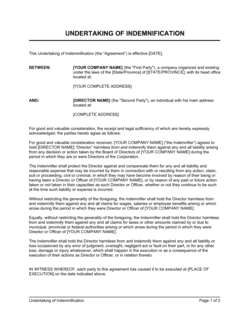
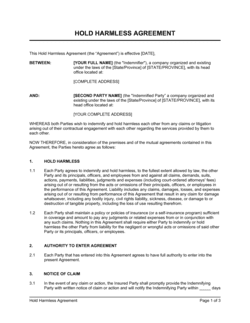
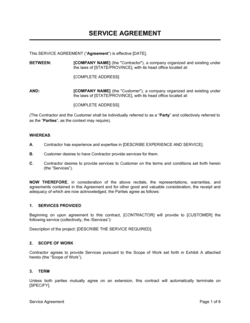
Undertaking of Indemnification Template

Free Word download • Edit online • Save & share with Drive • Export to PDF

3 pages25–30 min to fillDifficulty: StandardSignature requiredLegal review recommended
Learn more ↓
FreeUndertaking of Indemnification Template

At a glance

What it is
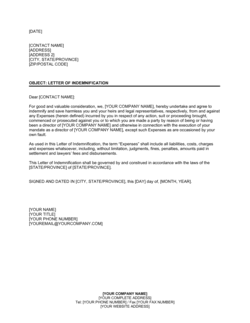
An Undertaking of Indemnification is a legally binding document in which one party (the indemnitor) formally commits to compensate another party (the indemnitee) for specified losses, liabilities, costs, or damages that arise from defined events or actions. This free Word download gives you a professionally structured starting point you can edit online and export as PDF — covering scope of indemnity, defense obligations, liability caps, and exclusions in a single enforceable instrument.
When you need it
Use it whenever one party assumes financial responsibility for risks generated by another — such as a vendor indemnifying a client against third-party claims, a contractor protecting a property owner from worksite injuries, or a director being indemnified by the company for actions taken in their official capacity.
What's inside
Identification of the indemnitor and indemnitee, a precise definition of indemnifiable events, the duty to defend and advance costs, liability caps and exclusions (such as gross negligence and willful misconduct), notice and cooperation obligations, and governing law with dispute resolution provisions.

What is an Undertaking of Indemnification?

An Undertaking of Indemnification is a legally binding document in which one party — the indemnitor — formally commits to compensate another party — the indemnitee — for specified losses, liabilities, costs, and expenses arising from defined events, actions, or omissions. Unlike a general contractual indemnification clause buried within a broader agreement, a standalone undertaking is a dedicated legal instrument that can be executed independently, assigned separately, and enforced on its own terms without requiring access to the underlying contract. It typically combines three distinct obligations: the duty to indemnify (pay for covered losses), the duty to defend (fund or manage the legal defense), and a hold harmless commitment (waive the right to bring counterclaims for covered risks).

Why You Need This Document

Without a signed undertaking of indemnification, your business absorbs the financial consequences of risks created by parties outside your direct control — contractors whose employees are injured on your premises, software vendors whose code generates IP infringement claims against your customers, or directors whose decisions expose the company to regulatory liability. A single unindemnified third-party lawsuit can cost $100,000 to $500,000 in defense costs alone before any judgment is entered. The document also serves as a due-diligence signal: insurers, lenders, and prospective investors treat the absence of indemnification undertakings with key vendors and counterparties as a red flag in risk assessments. This template gives you a professionally structured, jurisdiction-aware starting point that closes the most common gaps — duty to defend, survival clause, insurance requirements, and liability cap — so you can transfer risk cleanly and enforce the agreement if a claim arises.

Which variant fits your situation?

If your situation is…Use this template
Vendor or supplier indemnifying a business client against third-party claimsVendor Indemnification Agreement
Company indemnifying a director or officer for acts in their official capacityDirector and Officer Indemnification Agreement
Contractor indemnifying a property owner for worksite injuries or property damageContractor Hold Harmless Agreement
Mutual indemnification between two equal parties entering a partnershipMutual Indemnification Agreement
Software vendor indemnifying a client against IP infringement claimsIP Indemnification Agreement
One-time event organizer indemnifying a venue against participant claimsEvent Indemnification Agreement
Borrower indemnifying a lender against losses on a secured loanLender Indemnification Agreement

Common mistakes to avoid

❌ Omitting the duty to defend

Why it matters: Defense costs — including attorney fees, expert witnesses, and court costs — routinely exceed the final judgment amount. An indemnification that covers only the judgment leaves the indemnitee exposed to years of litigation expense.

Fix: Add an explicit duty-to-defend clause requiring the indemnitor to assume control of covered claims promptly upon notice, and state who selects defense counsel.

❌ No survival clause after contract termination

Why it matters: Without survival language, a court may hold that the indemnification obligation expires when the underlying agreement ends — leaving the indemnitee unprotected for latent claims that surface months or years later.

Fix: Include a clause stating that indemnification obligations survive termination for any period during which claims arising from the covered period may still be brought — typically 2–6 years depending on the applicable statute of limitations.

❌ Setting a liability cap below realistic single-claim exposure

Why it matters: A cap set at one month of fees for a multi-year services contract effectively renders the indemnification illusory — and courts in several jurisdictions have voided nominal caps on public policy grounds.

Fix: Benchmark the cap to the largest single foreseeable loss category and ensure it is backed by the insurance minimums required in the agreement.

❌ Ignoring insurance requirements

Why it matters: An undertaking of indemnification is only enforceable against a solvent counterparty. Without minimum insurance requirements, an insolvency or dissolution event leaves the indemnitee holding an unenforceable promise.

Fix: Require the indemnitor to maintain coverage throughout the term, provide a certificate of insurance before execution, and notify the indemnitee of any material change or cancellation within 30 days.

❌ Using overly broad triggering language without exclusions

Why it matters: Phrases like 'any claim arising in any way in connection with this Agreement' can sweep in losses caused by the indemnitee's own negligence — courts in many jurisdictions refuse to enforce indemnification for a party's own negligence unless that intent is expressed in clear and unequivocal language.

Fix: Pair any broad triggering language with equally specific exclusions for the indemnitee's negligence, willful misconduct, and independent contractual breaches.

❌ Signing after the underlying transaction has already begun

Why it matters: In common-law jurisdictions, consideration flowing from the indemnitee to the indemnitor must exist at the time of signing. An indemnification signed after the transaction begins may lack fresh consideration, making restrictive obligations unenforceable.

Fix: Execute the undertaking simultaneously with or before the underlying contract. If circumstances require a later signature, document the additional consideration provided — such as a fee reduction, extended payment terms, or a bonus.

The 10 key clauses, explained

Parties and recitals

In plain language: Identifies the indemnitor and indemnitee by their full legal names and entity types, and briefly describes the underlying transaction or relationship that gives rise to the indemnification.

Sample language
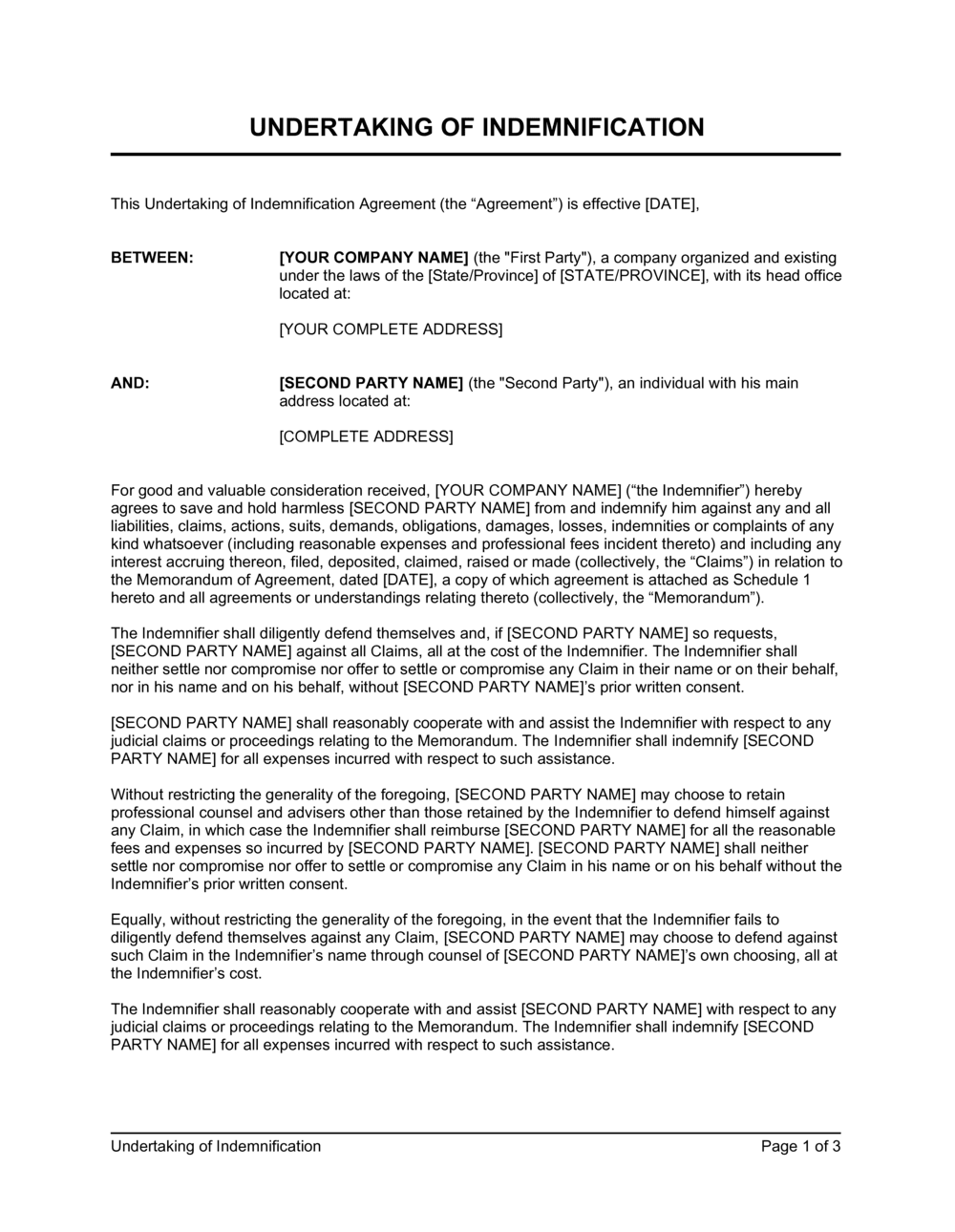
This Undertaking of Indemnification (the 'Agreement') is entered into as of [DATE] by [INDEMNITOR LEGAL NAME], a [STATE/PROVINCE] [ENTITY TYPE] ('Indemnitor'), in favor of [INDEMNITEE LEGAL NAME], a [STATE/PROVINCE] [ENTITY TYPE] ('Indemnitee'), in connection with [DESCRIPTION OF UNDERLYING TRANSACTION OR RELATIONSHIP].

Common mistake: Using trade names instead of registered legal entity names. If the indemnitor is sued, enforcement against the wrong entity can invalidate the entire undertaking.

Scope of indemnification

In plain language: Defines precisely which events, claims, losses, and liabilities are covered — the heart of the document. A narrowly defined scope protects the indemnitor; a broad one protects the indemnitee.

Sample language
Indemnitor shall indemnify, defend, and hold harmless Indemnitee from and against any and all claims, damages, losses, costs, and expenses (including reasonable attorneys' fees) arising out of or relating to [SPECIFIC EVENTS — e.g., Indemnitor's performance of services under the [CONTRACT NAME] dated [DATE]].

Common mistake: Using 'arising out of or in connection with' without further qualification. This language can sweep in losses the indemnitor never intended to cover, creating unquantifiable exposure.

Duty to defend

In plain language: States whether the indemnitor must actively manage the legal defense of covered claims — separate from the obligation to pay a final judgment — and who controls the defense.

Sample language
Upon written notice from Indemnitee of any third-party claim covered hereunder, Indemnitor shall assume control of the defense using counsel reasonably acceptable to Indemnitee. Indemnitee may participate in the defense at its own expense using separate counsel.

Common mistake: Omitting the duty to defend entirely and only stating a duty to indemnify. Defense costs often exceed judgment amounts; without this clause the indemnitee bears litigation costs until final resolution.

Exclusions from indemnification

In plain language: Carves out losses caused by the indemnitee's own gross negligence, willful misconduct, fraud, or breach of the underlying agreement — preventing the indemnitee from profiting from its own wrongdoing.

Sample language
Notwithstanding the foregoing, Indemnitor shall have no obligation to indemnify Indemnitee for any loss arising from: (a) Indemnitee's gross negligence or willful misconduct; (b) Indemnitee's material breach of this Agreement; or (c) any loss for which Indemnitee has received full compensation from a third party.

Common mistake: No exclusion clause at all. Courts in most jurisdictions will still refuse to enforce indemnification for an indemnitee's own intentional acts, but the resulting litigation is expensive and avoidable.

Liability cap

In plain language: Sets the maximum dollar amount the indemnitor is obligated to pay in aggregate under the undertaking, protecting the indemnitor from open-ended exposure.

Sample language
The aggregate liability of Indemnitor under this Agreement shall not exceed [DOLLAR AMOUNT / X times the total fees paid by Indemnitee to Indemnitor under the [CONTRACT NAME] in the twelve months preceding the claim].

Common mistake: Setting the cap below the realistic value of the risks being transferred. If the cap is lower than a single foreseeable claim, the indemnitee receives illusory protection and may challenge enforceability.

Notice and cooperation obligations

In plain language: Requires the indemnitee to notify the indemnitor promptly upon learning of a covered claim and to cooperate in the defense, and specifies the consequences of late notice.

Sample language
Indemnitee shall provide written notice to Indemnitor within [NUMBER] days of becoming aware of any claim or circumstance that may give rise to an indemnification obligation. Failure to provide timely notice shall relieve Indemnitor of liability only to the extent Indemnitor is materially prejudiced by such delay.

Common mistake: Setting a notice period shorter than 10 business days. Indemnitees are often mid-litigation before they realize the undertaking applies, and forfeiture for late notice generates more disputes than it prevents.

Settlement control

In plain language: Allocates the right to control settlement negotiations and establishes when the non-controlling party's consent is required before a settlement may be accepted.

Sample language
Indemnitor shall not settle any claim without the prior written consent of Indemnitee, which shall not be unreasonably withheld, conditioned, or delayed, provided that any settlement requires Indemnitee to admit liability or incur any unindemnified obligation.

Common mistake: Giving the indemnitor unconditional settlement control. Without a consent requirement, the indemnitor may settle on terms that include admissions of liability by the indemnitee that harm the indemnitee in future disputes.

Insurance requirements

In plain language: Requires the indemnitor to maintain specified insurance coverage sufficient to back the indemnification obligation and to name the indemnitee as an additional insured where applicable.

Sample language
Indemnitor shall maintain, at its own expense, commercial general liability insurance with limits of no less than $[AMOUNT] per occurrence and $[AMOUNT] in the aggregate, and shall name Indemnitee as an additional insured on such policy throughout the term of this Agreement.

Common mistake: Omitting insurance requirements entirely. An undertaking of indemnification is only as valuable as the indemnitor's ability to pay — without insurance backing, an insolvency event renders the document worthless.

Term and survival

In plain language: States how long the undertaking remains in effect and confirms that the indemnification obligation survives expiration or termination of the underlying agreement for claims that arose during the covered period.

Sample language
This Agreement shall remain in effect for [TERM / the duration of the [UNDERLYING AGREEMENT] and for [NUMBER] years thereafter]. The indemnification obligations set forth herein shall survive the expiration or termination of this Agreement with respect to any claim arising from events occurring prior to such expiration or termination.

Common mistake: No survival clause. Without explicit survival language, a court may find that indemnification obligations expire with the underlying contract, leaving the indemnitee unprotected for latent claims.

Governing law and dispute resolution

In plain language: Identifies which jurisdiction's laws govern interpretation and enforcement, and specifies whether disputes go to arbitration, mediation, or court — and in which venue.

Sample language
This Agreement shall be governed by and construed in accordance with the laws of [STATE/PROVINCE/COUNTRY], without regard to conflict-of-laws principles. Any dispute arising hereunder shall be resolved by binding arbitration in [CITY] under the rules of [AAA/JAMS/applicable institution], except that either party may seek injunctive relief in any court of competent jurisdiction.

Common mistake: Selecting a governing law with no connection to either party's location or the underlying transaction. Several jurisdictions — including California and New York — apply local public policy rules regardless of a governing law choice.

How to fill it out

  1. 1

    Identify both parties by their full legal names

    Enter the indemnitor's and indemnitee's complete registered legal names, entity types, and jurisdictions of formation. Do not use trade names, DBAs, or abbreviations.

    💡 Verify the exact registered name against the relevant corporate registry before execution — a name mismatch is one of the most common grounds for challenging enforceability.

  2. 2

    Describe the underlying transaction precisely

    In the recitals, summarize the contract, relationship, or event that creates the need for indemnification — for example, a services agreement, a lease, or a director appointment. Reference the underlying document by name and date.

    💡 The more precisely you describe the triggering transaction, the easier it is to determine which claims fall inside the scope of coverage and which do not.

  3. 3

    Draft the scope of indemnification with specific triggering events

    List the specific events, acts, or omissions that will trigger the indemnitor's obligation. Avoid open-ended phrases like 'any claim whatsoever' — instead, tie the scope to identifiable risk categories such as bodily injury, property damage, IP infringement, or regulatory violations.

    💡 If the underlying contract already contains an indemnification clause, make sure the undertaking's scope mirrors — rather than contradicts — that language.

  4. 4

    Set the liability cap at a commercially reasonable level

    Choose a cap that reflects the realistic maximum exposure — typically a multiple of annual contract value (1–3× is common for services agreements) or a fixed dollar amount benchmarked to the largest single foreseeable claim.

    💡 A cap below the value of the most foreseeable single claim can be challenged as unconscionable or as failing its fundamental purpose, especially in consumer-facing contexts.

  5. 5

    Define the exclusions clearly

    Explicitly carve out gross negligence, willful misconduct, fraud, and the indemnitee's own breach of contract. If the indemnitor is a vendor, also exclude losses caused by indemnitee's failure to follow product instructions or warnings.

    💡 Courts read exclusion clauses narrowly — if you want to exclude a specific scenario, name it expressly rather than relying on general language.

  6. 6

    Specify insurance requirements with policy limits

    State the minimum insurance types and dollar limits the indemnitor must carry (e.g., commercial general liability, professional liability, cyber liability), and require the indemnitor to provide a certificate of insurance before the undertaking takes effect.

    💡 Ask for additional insured status on the policy, not just a certificate of insurance — a certificate alone provides no direct right to coverage.

  7. 7

    Set the notice period and cooperation standard

    Choose a notice period (10–30 business days is standard) and state that failure to give timely notice only prejudices rights to the extent the indemnitor is materially harmed by the delay.

    💡 Avoid notice periods shorter than 10 business days — insurers and counsel often need at least that long to evaluate a new claim before taking any action.

  8. 8

    Execute before the underlying transaction closes

    Both parties must sign the undertaking before the underlying contract or transaction takes effect. Retroactive indemnification agreements are unenforceable in several jurisdictions and invite challenges based on lack of consideration.

    💡 Use a witnessed or notarized execution block when the indemnification involves real property, large financial transactions, or cross-border enforcement.

Frequently asked questions

What is an undertaking of indemnification?

An undertaking of indemnification is a binding legal document in which one party (the indemnitor) formally promises to compensate another party (the indemnitee) for losses, liabilities, costs, or damages arising from defined events or actions. It is used across business, construction, technology, and corporate governance contexts to allocate risk between parties and is generally enforceable when properly executed and supported by adequate consideration.

What is the difference between indemnification and a hold harmless agreement?

Indemnification is the obligation to compensate the other party for covered losses after they occur. A hold harmless clause is a promise not to hold the other party legally responsible for specified risks — it prevents a claim from arising rather than compensating for one after the fact. In practice, most undertakings combine both: an indemnification obligation (pay for losses) and a hold harmless commitment (waive the right to sue). The two terms are often used interchangeably in commercial contracts, though their legal effect can differ depending on the jurisdiction.

Is an undertaking of indemnification legally binding?

Yes — an undertaking of indemnification is generally enforceable as a binding contract when it satisfies the standard requirements of offer, acceptance, and consideration, is signed by the indemnitor, and does not violate applicable public policy. Enforceability varies by jurisdiction, particularly for anti-indemnity statutes in construction contexts and for attempts to indemnify a party for its own gross negligence. Consider having a lawyer review the document before execution for high-value or cross-border arrangements.

When should a business require an undertaking of indemnification?

Require one whenever a third party's activities create a risk of loss or liability for your business that you cannot control directly — for example, when engaging contractors who work on your premises, engaging vendors whose software could generate IP infringement claims, appointing directors who need protection for good-faith decisions, or entering joint ventures where one partner assumes specific operational risks. The cost of obtaining one is far lower than the cost of an unindemnified third-party claim.

What is the difference between a one-sided and mutual indemnification?

A one-sided indemnification requires only one party — typically the vendor, contractor, or lower-bargaining-power party — to indemnify the other. A mutual indemnification requires both parties to indemnify each other for their respective acts, omissions, or breaches. Mutual indemnification is more common in joint ventures, technology partnerships, and equal-power commercial relationships. One-sided arrangements typically favor the party with greater bargaining power or more exposure to third-party claims.

Does an undertaking of indemnification need to be notarized?

Notarization is not required for most commercial indemnification agreements in the US, Canada, or the UK. However, notarization or witnessing may be required or strongly advisable when the undertaking relates to real property transactions, when it is intended to be registered against land, or when it will be enforced across borders in jurisdictions that require authenticated documents. Always check the requirements of the specific jurisdiction and transaction type.

What insurance should back an undertaking of indemnification?

The appropriate insurance depends on the risk category. For construction contractors, commercial general liability ($1–2M per occurrence) and workers' compensation are minimum requirements. For technology vendors, professional liability (errors and omissions) and cyber liability are essential. For directors and officers, D&O insurance is standard. The undertaking should specify minimum coverage types and limits, and require the indemnitor to name the indemnitee as an additional insured on CGL policies.

Can a company indemnify its own directors and officers?

Yes — director and officer indemnification by the company is both common and, in most jurisdictions, permitted or even required by corporate statutes for good-faith acts within the scope of the director's or officer's authority. The indemnification is typically backed by a D&O insurance policy. The scope, limits, and exclusions of the undertaking must comply with the applicable corporate statute — for example, Delaware General Corporation Law Section 145 in the US or the Canada Business Corporations Act in Canada.

What are anti-indemnity statutes and how do they affect this document?

Anti-indemnity statutes are laws — common in the US construction industry — that void contractual provisions requiring one party to indemnify another for that party's own negligence. Approximately 40 US states have enacted some form of anti-indemnity statute for construction contracts. If your undertaking relates to construction work, confirm that the indemnification scope does not violate the statute in the governing jurisdiction, as the entire clause — or just the offending portion — may be voided.

How does an undertaking of indemnification interact with a limitation of liability clause?

Indemnification and limitation of liability clauses operate in opposite directions — indemnification expands one party's financial responsibility, while limitation of liability caps it. When both appear in the same agreement, courts typically read them together. If the indemnification obligation is unlimited and the limitation of liability clause caps total damages, the more specific cap usually prevails. To avoid ambiguity, state explicitly whether the liability cap applies to the indemnification obligation and, if so, at what amount.

How this compares to alternatives

vs Hold Harmless Agreement

A hold harmless agreement focuses on preventing the protected party from bringing a claim — it is a prospective waiver of liability. An undertaking of indemnification goes further by requiring the indemnitor to actively compensate losses and fund a legal defense after a claim arises. Most robust risk-transfer arrangements include both a hold harmless provision and an affirmative indemnification obligation in the same document.

vs Indemnification Clause in a Service Agreement

An indemnification clause embedded in a broader service agreement applies only within that contract's context and terminates when the agreement ends. A standalone undertaking of indemnification is a dedicated instrument that can survive the underlying contract, be assigned independently, and be enforced separately without requiring access to the full services agreement.

vs Liability Waiver

A liability waiver is signed by the party accepting a risk — releasing the other party from responsibility for future harm. An undertaking of indemnification is signed by the party assuming a risk — promising to cover the other party's losses. They flow in opposite directions: a waiver protects the party with exposure; an indemnification protects the party without direct control over the risk.

vs Guarantee Agreement

A guarantee is a secondary obligation — the guarantor steps in only if the primary obligor defaults on a specific financial obligation. An undertaking of indemnification is a primary obligation — the indemnitor is directly liable for covered losses without any requirement for the indemnitee to first exhaust remedies against another party. Guarantees are common in loan and lease contexts; indemnification undertakings cover a broader range of operational and legal risks.

Industry-specific considerations

Construction and Engineering

Contractors and subcontractors issue undertakings to property owners and general contractors covering bodily injury, property damage, and worksite liability — subject to anti-indemnity statute restrictions in most US states.

Technology and SaaS

Software vendors indemnify enterprise clients against IP infringement claims, data-breach liability arising from the vendor's platform, and regulatory penalties caused by the vendor's non-compliance.

Financial Services

Banks, lenders, and investment managers require undertakings from borrowers, fund managers, and counterparties covering losses from misrepresentations, regulatory violations, and collateral deficiencies.

Real Estate

Tenants, developers, and joint-venture partners issue indemnification undertakings to landlords and co-investors covering environmental liability, construction defects, and tenant-caused injuries to third parties.

Professional Services

Consulting firms and managed service providers indemnify clients against third-party claims arising from negligent advice, errors in deliverables, or confidentiality breaches involving client data.

Healthcare and Life Sciences

Medical device suppliers, clinical research organizations, and contract manufacturers indemnify healthcare providers and sponsors against product liability claims, regulatory actions, and clinical trial adverse events.

Jurisdictional notes

United States

Indemnification agreements are broadly enforceable across US states, but approximately 40 states have enacted anti-indemnity statutes that void indemnification for a party's own negligence in construction contracts. California, New York, and Texas each have specific statutory limitations. Clauses indemnifying a party for its own gross negligence or willful misconduct are routinely struck down as against public policy regardless of state.

Canada

Undertakings of indemnification are enforceable across Canadian provinces under common-law contract principles. Provincial construction lien acts in Ontario, British Columbia, and Alberta impose restrictions on indemnification clauses in construction subcontracts. Quebec applies civil law principles and requires indemnification language to be express and unambiguous to override statutory protections. Director indemnification is governed by the Canada Business Corporations Act or the applicable provincial corporations statute.

United Kingdom

Indemnification clauses are enforceable in England, Wales, Scotland, and Northern Ireland subject to the Unfair Contract Terms Act 1977 and, for consumer contracts, the Consumer Rights Act 2015. Clauses that attempt to indemnify a business for its own negligence must satisfy a reasonableness test. In construction contracts, the Construction Act imposes additional payment and adjudication requirements that interact with indemnification obligations.

European Union

Indemnification enforceability varies significantly by member state — France, Germany, and the Netherlands each apply their own civil code rules governing the allocation of contractual risk. The EU's GDPR creates a mandatory liability and indemnification framework between data controllers and processors that cannot be contracted away. Broad indemnification of a party for its own intentional acts is generally unenforceable across EU jurisdictions as contrary to public policy.

Template vs lawyer — what fits your deal?

PathBest forCostTime
Use the templateStandard vendor, contractor, or event indemnifications where the risk is well-defined and the contract value is under $250KFree30–45 minutes
Template + legal reviewTechnology vendors, construction subcontractors, or director indemnifications where anti-indemnity statutes or D&O implications apply$400–$8002–4 days
Custom draftedHigh-value transactions, cross-border arrangements, regulated industries, or undertakings backing obligations above $1M$1,500–$5,000+1–3 weeks

Glossary

Indemnitor
The party who agrees to bear financial responsibility and compensate the other party for specified losses or claims.
Indemnitee
The party who receives the promise of compensation and is protected from specified losses or liabilities under the undertaking.
Indemnifiable Loss
Any loss, damage, cost, expense, or liability that falls within the defined scope of events the indemnitor has agreed to cover.
Duty to Defend
An obligation requiring the indemnitor to actively manage or fund the legal defense of claims covered by the indemnification, in addition to paying any resulting judgment.
Hold Harmless
A provision in which one party agrees not to hold the other legally responsible for specified risks — often used alongside an indemnification clause.
Gross Negligence
A level of carelessness significantly worse than ordinary negligence, typically excluded from indemnification coverage as a matter of public policy.
Willful Misconduct
An intentional act or deliberate failure to act where harm was known to be a likely consequence — universally excluded from indemnification obligations.
Liability Cap
A contractual ceiling on the maximum amount an indemnitor must pay under the indemnification obligation, often expressed as a multiple of contract value or a fixed dollar amount.
Subrogation
The right of an insurer or indemnitor who has paid a claim to step into the shoes of the indemnitee and recover those costs from the responsible third party.
Indemnification Notice
A formal written notification the indemnitee must deliver to the indemnitor within a specified time period after becoming aware of a claim or potential loss.
Third-Party Claim
A demand, lawsuit, or action brought against the indemnitee by a party other than the indemnitor, which triggers the indemnitor's obligation to defend and compensate.

Part of your Business Operating System

This document is one of 3,000+ business & legal templates included in Business in a Box.

  • Fill-in-the-blanks — ready in minutes
  • 100% customizable Word document
  • Compatible with all office suites
  • Export to PDF and share electronically

Create your document in 3 simple steps.

From template to signed document — all inside one Business Operating System.
1
Download or open template

Access over 3,000+ business and legal templates for any business task, project or initiative.

2
Edit and fill in the blanks with AI

Customize your ready-made business document template and save it in the cloud.

3
Save, Share, Send, Sign

Share your files and folders with your team. Create a space of seamless collaboration.

Save time, save money, and create top-quality documents.

★★★★★

"Fantastic value! I'm not sure how I'd do without it. It's worth its weight in gold and paid back for itself many times."

Managing Director · Mall Farm
Robert Whalley
Managing Director, Mall Farm Proprietary Limited
★★★★★

"I have been using Business in a Box for years. It has been the most useful source of templates I have encountered. I recommend it to anyone."

Business Owner · 4+ years
Dr Michael John Freestone
Business Owner
★★★★★

"It has been a life saver so many times I have lost count. Business in a Box has saved me so much time and as you know, time is money."

Owner · Upstate Web
David G. Moore Jr.
Owner, Upstate Web

Run your business with a system — not scattered tools

Stop downloading documents. Start operating with clarity. Business in a Box gives you the Business Operating System used by over 250,000 companies worldwide to structure, run, and grow their business.

Free Forever Plan · No credit card required