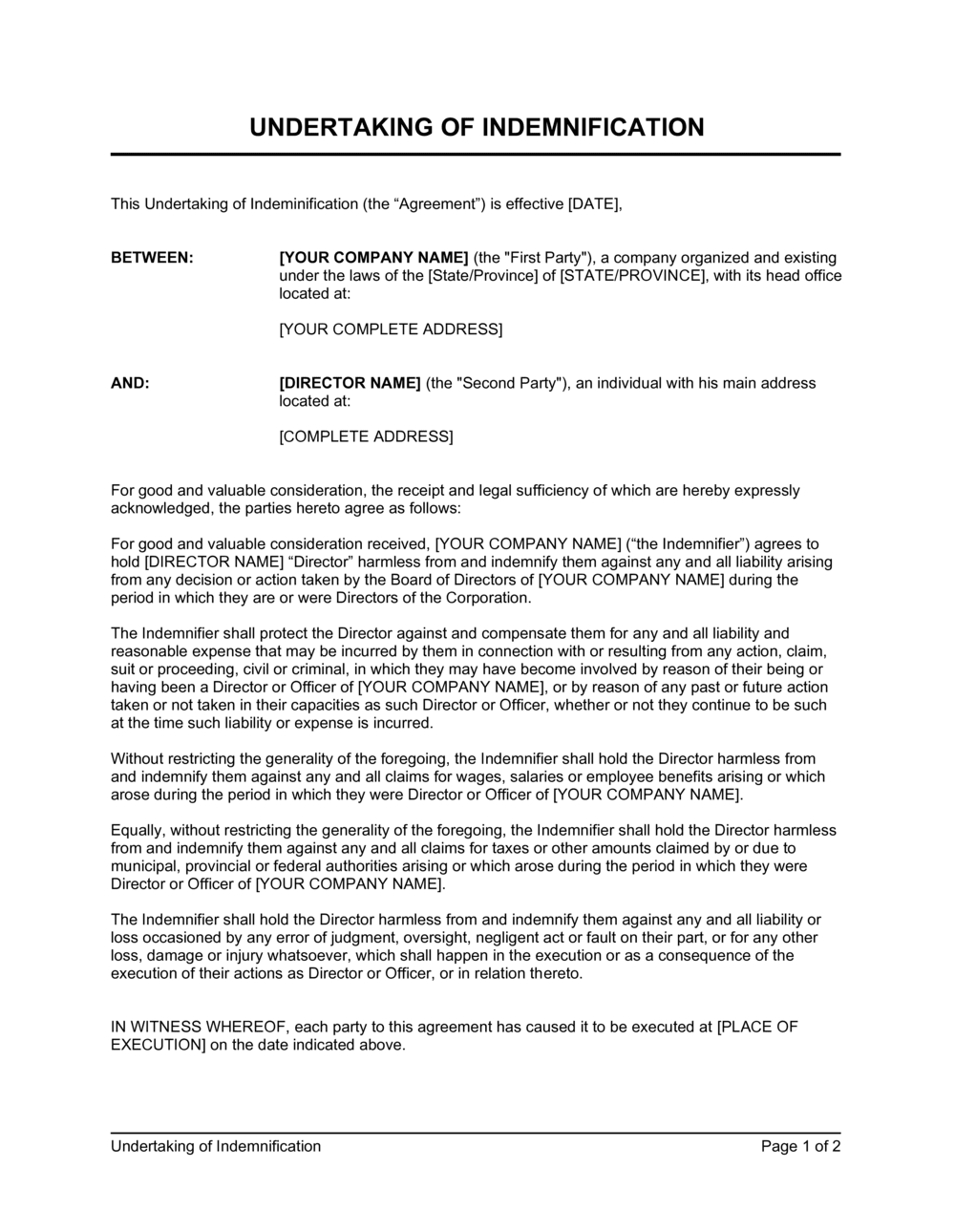
Undertaking of Indemnification - Director Template

Free Word download • Edit online • Save & share with Drive • Export to PDF

2 pages20–30 min to fillDifficulty: StandardSignature requiredLegal review recommended
Learn more ↓
FreeUndertaking of Indemnification -  Director Template

At a glance

What it is
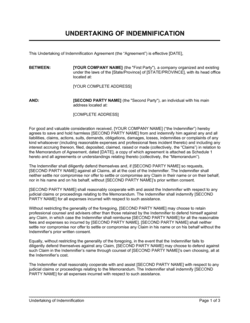
An Undertaking of Indemnification (Director) is a binding corporate document by which a company formally commits to indemnify and hold harmless a current or former director against personal liability, legal costs, and damages arising from acts or omissions taken in good faith in the performance of their directorial duties. This free Word download gives you a professionally structured template you can edit online and export as PDF, covering indemnification scope, advancement of expenses, exclusions, and governing law.
When you need it
Use it when appointing a new director who requires contractual indemnification as a condition of accepting the role, when an existing director faces or anticipates litigation arising from board decisions, or when a company wants to supplement the indemnification provisions already contained in its bylaws or articles with a direct, enforceable commitment to each individual director.
What's inside
Identification of the company and director, scope of indemnification, advancement of legal expenses pending final determination, exclusions for fraud and wilful misconduct, D&O insurance coordination, repayment obligation if indemnification is later denied, and governing law and dispute resolution clauses.

What is an Undertaking of Indemnification (Director)?

An Undertaking of Indemnification (Director) is a binding contractual commitment by a company to protect a current or former director against personal financial liability — including legal defence costs, settlements, judgments, and regulatory fines — arising from acts or omissions taken in good faith in the exercise of their directorial duties. Unlike the indemnification provisions embedded in a company's bylaws (which can be amended by shareholder vote without the director's consent), a signed undertaking creates a direct, enforceable individual right that the director can rely on regardless of subsequent changes to the company's governing documents. The document defines the scope of coverage, the mechanics for advancing legal expenses before a final determination is made, the exclusions for fraudulent or wilful conduct, the process for determining entitlement, and how coverage coordinates with any Directors and Officers (D&O) insurance policy in place.

Why You Need This Document

Without a written indemnification undertaking, qualified directors — particularly independent directors, investor-appointed board members, and professionals in regulated industries — routinely decline appointments or resign when litigation risk materializes. The exposure is real: shareholder derivative suits, regulatory investigations, and third-party claims regularly name directors personally, and defence costs alone can reach six figures before any judgment is entered. A bylaw indemnification provision offers some protection but can be watered down or repealed by future shareholders at any time. An undertaking closes that gap permanently for each individual director. For the company, the cost of not having one is concrete: difficulty recruiting experienced board members, heightened director turnover at the moment of crisis, and the reputational damage of a director publicly unable to fund their own defence. This template gives you a professionally structured, jurisdiction-aware starting point that covers all critical mechanics — advancement, exclusions, D&O coordination, and survival — and can be reviewed by counsel and executed in a single session before a director's first board meeting.

Which variant fits your situation?

If your situation is…Use this template
Indemnifying a director in connection with a specific litigation or regulatory proceedingUndertaking of Indemnification Director
Indemnifying an officer (CEO, CFO, or other executive) rather than a board directorUndertaking of Indemnification Officer
Providing mutual indemnification protections to all board members through the company's governing documentCorporate Bylaws with Indemnification Provisions
Protecting a director serving on a subsidiary or affiliate boardSubsidiary Director Indemnification Agreement
Covering an independent contractor serving in an advisory board capacityIndependent Contractor Agreement with Indemnification
Formalizing D&O insurance coordination alongside individual indemnificationDirector and Officer Insurance Side Letter
Providing indemnification for a director serving on a nonprofit boardNonprofit Director Indemnification Agreement

Common mistakes to avoid

❌ Omitting the expense advancement clause

Why it matters: Without advancement, a director must personally fund a multi-year legal defence before receiving any reimbursement — making the undertaking practically worthless and deterring qualified candidates from accepting board appointments.

Fix: Include an unconditional expense advancement clause with a specific payment deadline (20–30 days from written request) and require only a basic repayment undertaking from the director, not a full indemnification determination, before advancing funds.

❌ Exclusions triggered by unproven allegations

Why it matters: If the exclusion applies when a claim merely alleges fraud or misconduct — rather than when it is adjudicated — the company can cut off advancement and indemnification at the moment the director needs it most.

Fix: Limit all exclusions to conduct that has been 'finally adjudicated' or 'determined by a court of competent jurisdiction' — not conduct that is 'alleged' or 'claimed' by a plaintiff.

❌ No survival clause after the director's term ends

Why it matters: The majority of D&O claims are filed after a director's tenure ends — sometimes years later. An undertaking that expires with the appointment leaves former directors entirely unprotected for their entire period of service.

Fix: Add explicit survival language stating that the undertaking covers all proceedings arising from acts or omissions during the director's service, regardless of when those proceedings are commenced.

❌ Governing law inconsistent with the jurisdiction of incorporation

Why it matters: Corporate indemnification is governed by the law of the place of incorporation — not the place of business or the director's residence. A mismatch creates unresolvable conflicts between the contract's chosen law and the applicable corporate statute.

Fix: Always set governing law to the jurisdiction of incorporation. If the company is incorporated in Delaware, the contract must be governed by Delaware law regardless of where the company operates.

❌ Allowing interested directors to determine indemnification entitlement

Why it matters: When the full board — including directors with a personal stake in the outcome — votes on whether a colleague is entitled to indemnification, the process is structurally conflicted and courts have set aside such determinations.

Fix: Require entitlement determinations to be made by a majority of disinterested directors, independent legal counsel, or a court — and specify the fallback method when no disinterested directors are available.

❌ No coordination with D&O insurance

Why it matters: When a claim triggers both the D&O policy and the contractual undertaking, the order of priority is unresolved — the insurer may argue the company must pay first, leaving the company exposed and the director caught in a coverage dispute.

Fix: Include an explicit coordination clause stating that D&O insurance responds first and that the undertaking covers any gap above the policy limit or within the deductible, and commit to maintaining a minimum policy limit.

The 10 key clauses, explained

Parties and recitals

In plain language: Identifies the company (by full legal name, jurisdiction of incorporation, and entity type) and the director (by full legal name and board appointment date), and states the purpose of the undertaking.

Sample language
This Undertaking of Indemnification is entered into as of [DATE] between [COMPANY LEGAL NAME], a [STATE/PROVINCE] [ENTITY TYPE] (the 'Company'), and [DIRECTOR FULL NAME] ('Director'), appointed to the Board of Directors of the Company on [APPOINTMENT DATE].

Common mistake: Using a trade name or parent company name instead of the exact registered legal entity. If the indemnifying entity is not the actual employer of record or the entity against which the claim is brought, the undertaking may be unenforceable.

Scope of indemnification

In plain language: Defines what the company will indemnify — losses, settlements, judgments, fines, and legal expenses arising from the director's service — and the standard of conduct required (good faith, in the best interests of the company).

Sample language
The Company shall indemnify and hold harmless Director against all Losses (as defined herein) arising out of any Proceeding by reason of Director's status as a director of the Company, provided that Director acted in good faith and in a manner Director reasonably believed to be in the best interests of the Company.

Common mistake: Defining 'Losses' so narrowly that settlement amounts or regulatory fines are excluded. Courts have found that indemnification undertakings that omit settlement payments fail their core purpose — directors settle most claims rather than litigating to judgment.

Advancement of expenses

In plain language: Commits the company to advance legal fees, expert costs, and other reasonable defence expenses to the director as they arise, before any final determination of whether the conduct qualifies for indemnification.

Sample language
The Company shall advance to Director all reasonable Expenses incurred in connection with any Proceeding within [30] days of Director's written request, accompanied by reasonable evidence of the Expenses incurred.

Common mistake: Omitting the advancement clause and relying on indemnification alone. Without advancement, a director must fund their own defence for years before receiving reimbursement — defeating the practical purpose of the undertaking and making the position unattractive to qualified candidates.

Repayment obligation

In plain language: Requires the director to repay all advanced amounts if it is ultimately determined that the director is not entitled to indemnification — for example, because a court finds the conduct constituted fraud or wilful misconduct.

Sample language
Director hereby undertakes to repay all Expenses advanced by the Company in the event that it shall ultimately be determined, by a final, non-appealable judgment, that Director is not entitled to indemnification under this Undertaking or applicable law.

Common mistake: Making repayment contingent on the company's demand rather than the underlying legal determination. A demand-triggered clause creates an adversarial collection process; tying repayment to a final court determination is cleaner and more enforceable.

Exclusions from indemnification

In plain language: Lists the categories of conduct or proceedings for which the company will not indemnify the director — typically fraud, knowing violation of law, self-dealing, wilful misconduct, and claims where the director is required to disgorge improper personal profits.

Sample language
Notwithstanding any other provision hereof, the Company shall have no obligation to indemnify Director for Losses arising from: (a) fraud or dishonesty; (b) wilful misconduct or gross negligence; (c) deliberate breach of the Director's fiduciary duty to the Company; or (d) any claim in which Director is adjudicated to have acted in bad faith.

Common mistake: Using an exclusions list so broad that it swallows the indemnification commitment — for example, excluding 'any breach of duty' without limiting it to deliberate or knowing breaches. A court may read such a clause as leaving the director with no meaningful coverage.

D&O insurance coordination

In plain language: Addresses how the undertaking interacts with any Directors and Officers liability insurance policy maintained by the company — typically providing that insurance responds first and that the undertaking covers the gap above the policy limit or within any retention.

Sample language
The indemnification obligations of the Company under this Undertaking shall be secondary to, and shall not reduce or limit, any coverage available to Director under any D&O insurance policy maintained by the Company. The Company shall use commercially reasonable efforts to maintain D&O insurance in amounts no less than $[POLICY LIMIT].

Common mistake: Failing to address the interaction between contractual indemnification and D&O insurance at all. When both exist and a claim arises, the order of priority between insurance and the contractual obligation becomes a dispute between the company and its insurer — which the director should not be caught in.

Determination of entitlement

In plain language: Specifies the process by which the company will determine whether a particular claim qualifies for indemnification — typically by independent legal counsel, a disinterested committee of the board, or court order.

Sample language
Any determination that Director is entitled to indemnification under this Undertaking shall be made by (a) a majority of Disinterested Directors, (b) Independent Legal Counsel in a written opinion, or (c) a court of competent jurisdiction if neither of the foregoing is available.

Common mistake: Allowing the full board — including directors with a conflict of interest in the underlying proceeding — to make the indemnification determination. Interested parties on the decision-making body creates a structural conflict that can void the determination entirely.

Term and survival

In plain language: Confirms that the undertaking survives the director's resignation, removal, or the expiration of their term, and continues to cover claims arising from acts taken during the period of service.

Sample language
This Undertaking shall continue in effect following the termination of Director's service on the Board of Directors of the Company and shall cover all Proceedings arising from acts or omissions during the period Director served as a director of the Company, regardless of when such Proceedings are commenced.

Common mistake: Limiting the undertaking to the director's active term without survival language. Most D&O claims are filed months or years after the director's departure — an undertaking that terminates with the appointment leaves the former director entirely exposed.

Governing law and dispute resolution

In plain language: Specifies the jurisdiction whose law governs the agreement and how disputes about indemnification entitlement are resolved — typically through courts in the state or province of incorporation, with an option for expedited proceedings.

Sample language
This Undertaking shall be governed by and construed in accordance with the laws of [STATE/PROVINCE/COUNTRY], without regard to conflict-of-law principles. Any dispute shall be resolved exclusively in the courts of [JURISDICTION], and the parties consent to personal jurisdiction therein.

Common mistake: Choosing a governing law that differs from the company's jurisdiction of incorporation. Corporate indemnification law is determined by the law of the place of incorporation — selecting a different governing law creates a conflict that courts resolve against the drafter.

Integration and amendment

In plain language: States that the undertaking is the entire agreement on the subject of director indemnification, supersedes prior representations, and can only be amended in writing signed by both parties.

Sample language
This Undertaking constitutes the entire agreement between the Company and Director with respect to the subject matter hereof and supersedes all prior representations, understandings, or agreements. This Undertaking may be amended only by a written instrument signed by both parties.

Common mistake: Omitting integration language when the company's bylaws also contain indemnification provisions. Without an explicit statement of which document governs in the event of conflict, a court must resolve the ambiguity — often in the direction least favorable to the company.

How to fill it out

  1. 1

    Identify the correct legal entities

    Enter the company's full registered legal name, jurisdiction of incorporation, and entity type. Enter the director's full legal name as it appears on government-issued identification and confirm their board appointment date.

    💡 Cross-check the company name against the corporate registry filing — the indemnifying entity must be the same legal entity that appointed the director.

  2. 2

    Define 'Losses' and 'Proceedings' broadly

    Specify that 'Losses' includes judgments, fines, penalties, settlement amounts, and reasonable legal fees. Define 'Proceedings' to cover civil, criminal, administrative, regulatory, and investigative actions — not just formal court proceedings.

    💡 Regulatory investigations are increasingly common and expensive; excluding them from the definition of 'Proceedings' leaves directors unprotected at the stage where they need coverage most.

  3. 3

    Set the expense advancement timeline and documentation requirements

    Specify the number of days (typically 20–30) within which the company must advance expenses after a written request, and state what documentation the director must provide — itemized invoices, counsel retention letters, or expense receipts.

    💡 A 30-day advancement window is standard; shorter windows (10–15 days) are appropriate where the director faces imminent legal deadlines.

  4. 4

    Draft the exclusions with precision

    Limit exclusions to conduct that is adjudicated — not merely alleged — to constitute fraud, wilful misconduct, or bad faith. Exclusions triggered by allegations alone defeat the purpose of advancement of expenses.

    💡 Mirror the exclusion language to the standard used in your D&O insurance policy to avoid gaps where neither the policy nor the undertaking responds.

  5. 5

    Address D&O insurance coordination

    State the order of priority: D&O insurance responds first, then the contractual undertaking covers any gap above the policy limit or within the retention. Include a commitment to maintain D&O insurance at a specified minimum coverage level.

    💡 If the company does not currently carry D&O insurance, the undertaking becomes the director's sole protection — this increases the company's financial exposure significantly and should be disclosed to the board.

  6. 6

    Select the indemnification determination process

    Choose between disinterested board majority, independent legal counsel opinion, or court determination. If the board is small or all directors are potential parties to the underlying claim, default to independent legal counsel.

    💡 Naming independent legal counsel as the default determination method reduces the risk that a board conflict of interest voids the entitlement determination.

  7. 7

    Confirm governing law matches jurisdiction of incorporation

    Set the governing law to the jurisdiction in which the company is incorporated — this is where corporate indemnification statutes apply and where courts will interpret the document.

    💡 For companies with directors in multiple countries, consult counsel on whether local employment or corporate law in each director's jurisdiction creates mandatory indemnification obligations that interact with the undertaking.

  8. 8

    Execute before the director's first board meeting

    Both parties must sign before the director attends their first meeting or takes any board action. Signing after the fact raises a consideration problem in common-law jurisdictions and may leave early acts uncovered.

    💡 Use a countersignature block and date each signature independently. An undated signature creates ambiguity about when coverage commenced.

Frequently asked questions

What is an undertaking of indemnification for a director?

An undertaking of indemnification for a director is a binding written commitment by a company to protect a current or former director from personal financial liability for losses, legal costs, and damages arising from actions taken in good faith in their role as a director. It supplements — and in many cases makes enforceable — the indemnification provisions already contained in the company's bylaws or articles of incorporation. Unlike a bylaw provision, which can theoretically be amended by a shareholder vote, a signed undertaking creates a direct contractual right the director can enforce against the company.

Why would a director require an indemnification undertaking?

Directors face personal liability exposure for decisions made on behalf of the company — shareholder derivative suits, regulatory investigations, and third-party claims can all name directors personally. An undertaking ensures that the company will cover defence costs and any resulting judgments or settlements, protecting directors' personal assets. Without one, qualified candidates may decline board appointments, particularly in regulated industries or companies facing litigation risk. It also provides certainty that indemnification is available even if the company's bylaws are later amended.

Is a director indemnification undertaking legally binding?

Yes — when properly executed, an undertaking of indemnification is generally enforceable as a contract in most jurisdictions. The company's obligation to indemnify is the consideration the director receives in exchange for their service on the board. Courts in the US, Canada, the UK, and the EU have consistently enforced such agreements where they comply with the applicable corporate statute's indemnification limits and the director acted within the standard of conduct required by the agreement. Legal review is recommended to confirm the undertaking does not conflict with mandatory statutory provisions.

What is the difference between a D&O insurance policy and a director indemnification undertaking?

D&O insurance is a third-party policy under which an insurer pays defence costs and damages up to the policy limit — the insurer, not the company, bears the financial risk. A director indemnification undertaking is a direct contractual promise by the company itself to cover the same costs. The two typically work together: the insurance policy responds first, and the undertaking covers any gap above the limit or within the retention. If the company becomes insolvent, D&O insurance is the director's primary protection because the undertaking is only as good as the company's ability to pay.

What conduct is typically excluded from director indemnification?

Standard exclusions cover conduct that has been adjudicated to constitute fraud, wilful misconduct, gross negligence, bad faith, or deliberate breach of fiduciary duty. Most statutes also prohibit indemnification where the director received an improper personal benefit from the transaction at issue, or where a court finds the director liable to the company in a derivative action. Critically, well-drafted undertakings limit these exclusions to finally adjudicated conduct — not merely alleged conduct — so that advancement of legal expenses is available during the defence period.

Can a company indemnify a director for a criminal proceeding?

In most jurisdictions, companies can indemnify directors for the costs of defending criminal proceedings if the director had no reasonable cause to believe their conduct was unlawful. However, statutory indemnification rules typically prohibit coverage of criminal fines or penalties where the director is convicted or pleads guilty. Consult legal counsel to confirm what is permissible under the corporate statute of the company's jurisdiction of incorporation before including or excluding criminal proceedings from the undertaking's scope.

Does the undertaking survive after a director leaves the board?

It should — and any well-drafted undertaking will include explicit survival language. The majority of D&O claims are filed after a director's term ends, sometimes years later. An undertaking that expires with the appointment leaves former directors unprotected for their entire period of service. The survival clause should confirm coverage for all proceedings arising from acts or omissions during the director's tenure, regardless of when those proceedings are commenced or concluded.

Who typically signs an undertaking of indemnification for a director?

The undertaking is signed by the director (as the party receiving the benefit) and by an authorized officer of the company — typically the CEO, General Counsel, or Corporate Secretary acting on authority granted by the board. Where the director seeking indemnification is also the CEO, a disinterested director or the full board should authorize the signing to avoid a self-dealing argument. Both signatures should be dated independently, and execution should occur before the director's first board meeting.

How does an indemnification undertaking interact with the company's bylaws?

The undertaking typically supplements the bylaw indemnification provision by creating a direct, enforceable contractual right. Bylaws can be amended by shareholder vote without the director's consent — an undertaking prevents the company from retroactively reducing a director's coverage. The undertaking should include an integration clause specifying that in the event of any conflict between the undertaking and the bylaws, whichever provides the director with broader protection shall govern.

How this compares to alternatives

vs Corporate Bylaws Indemnification Provision

A bylaw indemnification provision applies to all directors as a class and can be amended or repealed by a shareholder vote without individual directors' consent. An undertaking of indemnification creates a direct contractual right for the specific director that cannot be unilaterally reduced. Directors in litigation-risk environments should hold both: the bylaw provision as the baseline and the undertaking as a non-revocable backstop.

vs D&O Insurance Policy

A D&O insurance policy is a third-party product that shifts financial risk to an insurer up to a defined policy limit; it does not create a direct obligation from the company to the director. An indemnification undertaking is the company's own promise — it covers the gap above the policy limit and responds when the insurer disputes coverage. If the company becomes insolvent, D&O insurance is the director's primary protection because the undertaking is only as good as the company's solvency.

vs General Indemnification Agreement

A general indemnification agreement is used in commercial transactions between counterparties — vendors, contractors, or business partners — to allocate risk for third-party claims. A director indemnification undertaking is specifically calibrated to corporate governance: it reflects the statutory framework for director protection, includes expense advancement mechanics, and addresses fiduciary duty standards. Using a commercial indemnification form for a director appointment is likely to omit critical provisions.

vs Executive Employment Agreement with Indemnification Clause

An executive employment agreement may contain an indemnification clause, but it governs the overall employment relationship — compensation, benefits, non-compete, and termination — and is not designed to serve as a standalone indemnification instrument. A director may not have an employment relationship with the company at all (independent directors do not); a separate undertaking provides clean, purpose-built protection that is not bundled with employment terms and survives termination of any employment relationship.

Industry-specific considerations

Technology / SaaS

Investor-appointed directors on SaaS boards typically require indemnification undertakings covering IP litigation, regulatory investigations, and securities claims arising from fundraising representations.

Financial Services

Directors of banks, fintechs, and investment firms face heightened regulatory exposure from FINRA, SEC, FCA, and OSFI proceedings, making advancement of legal expenses and regulatory fine coverage critical components of the undertaking.

Healthcare / Life Sciences

Directors in healthcare and pharma face FDA enforcement actions, False Claims Act exposure, and HIPAA-related investigations — the undertaking must address regulatory proceedings explicitly and coordinate with specialized D&O and clinical trial insurance.

Nonprofit Organizations

Volunteer nonprofit directors often serve without compensation but carry full fiduciary exposure; an undertaking is frequently the primary — and sometimes only — protection available, as many nonprofits carry limited or no D&O insurance.

Manufacturing

Directors in manufacturing face product liability claims and environmental regulatory actions that can name board members personally; the undertaking should address both third-party claims and government enforcement proceedings.

Real Estate

Directors of real estate investment companies and REITs are exposed to securities class actions, fiduciary duty claims from limited partners, and zoning or environmental enforcement — indemnification scope should expressly cover investor-initiated derivative suits.

Jurisdictional notes

United States

Director indemnification is primarily governed by the corporate statute of the state of incorporation — most commonly Delaware, which permits broad indemnification under DGCL §§145 and 102(b)(7). Delaware allows advancement of expenses as a matter of right if the undertaking so provides. California and New York impose statutory limits on indemnification of directors found liable to the corporation. Federal securities laws prohibit indemnification for SEC enforcement penalties in some circumstances — legal review is essential for public companies or companies that have made public securities offerings.

Canada

The Canada Business Corporations Act (CBCA) and provincial equivalents (e.g., the Ontario Business Corporations Act) authorize director indemnification for costs, charges, and expenses reasonably incurred in connection with any civil, criminal, or administrative action, provided the director acted honestly and in good faith with a view to the best interests of the corporation. Indemnification of amounts paid to settle a proceeding or satisfy a judgment requires court approval in some provinces. Quebec's civil law framework applies distinct rules for companies incorporated under the Quebec Business Corporations Act.

United Kingdom

Under the UK Companies Act 2006, companies may grant 'qualifying third party indemnity provisions' (QTPIs) to directors covering third-party claims but not fines imposed by regulatory bodies, penalties for non-compliance, or the cost of an unsuccessful defence against company-brought proceedings. QTPIs must be disclosed in the company's annual report and maintained for at least one year after termination. An undertaking must be carefully drafted to comply with these restrictions or the indemnification is void.

European Union

Director indemnification rules vary significantly across EU member states and are governed by national company law. Germany allows indemnification through D&O insurance but places restrictions on contractual indemnity arrangements under the GmbHG and AktG. France permits indemnification for acts within the director's authority but not for fraud or gross misconduct. The EU's Shareholder Rights Directive II encourages transparency in director remuneration and related-party transactions, which may require disclosure of indemnification undertakings to shareholders. Legal counsel in the specific member state of incorporation is essential.

Template vs lawyer — what fits your deal?

PathBest forCostTime
Use the templateSmall companies appointing directors in straightforward domestic arrangements with existing D&O insurance coverageFree30–45 minutes
Template + legal reviewCompanies in regulated industries, cross-border director appointments, or situations where the director is a major shareholder or investor$400–$800 for a corporate counsel review2–5 business days
Custom draftedPublic companies, companies facing active litigation, executive appointments with material severance and equity, or multi-jurisdiction boards$1,500–$5,000+1–3 weeks

Glossary

Indemnification
A contractual obligation by one party (the company) to compensate another party (the director) for losses, liabilities, or legal costs incurred in a defined context.
Undertaking
A formal, binding written promise — in this context, the company's commitment to stand behind the director financially against covered claims.
Advancement of Expenses
The company's obligation to pay a director's legal fees and costs as they are incurred, before a final determination of whether indemnification is ultimately owed.
Repayment Undertaking
The director's reciprocal promise to return advanced funds if it is later determined that they are not entitled to indemnification under the agreement.
D&O Insurance
Directors and Officers liability insurance, which covers defence costs and damages for claims against directors — typically coordinated with contractual indemnification so that insurance responds first.
Fiduciary Duty
The legal obligation of a director to act in the best interests of the company and its shareholders, including duties of care, loyalty, and good faith.
Good Faith
Honest, reasonable conduct undertaken without intent to defraud or harm — a threshold condition that most indemnification undertakings require the director's conduct to meet.
Wilful Misconduct
Intentional wrongdoing or reckless disregard for the consequences of one's actions — a standard exclusion from indemnification coverage.
Business Judgment Rule
A legal presumption that directors who make informed, good-faith decisions without a conflict of interest are protected from personal liability for the outcome of those decisions.
Excluded Claim
A category of claims expressly carved out from indemnification coverage — typically fraud, self-dealing, deliberate breach of duty, or conduct that violates applicable law.
Subrogation
The right of the indemnifying party (the company) to step into the director's shoes and pursue any third-party claim or insurance recovery that offsets the amounts it has paid.

Part of your Business Operating System

This document is one of 3,000+ business & legal templates included in Business in a Box.

  • Fill-in-the-blanks — ready in minutes
  • 100% customizable Word document
  • Compatible with all office suites
  • Export to PDF and share electronically

Create your document in 3 simple steps.

From template to signed document — all inside one Business Operating System.
1
Download or open template

Access over 3,000+ business and legal templates for any business task, project or initiative.

2
Edit and fill in the blanks with AI

Customize your ready-made business document template and save it in the cloud.

3
Save, Share, Send, Sign

Share your files and folders with your team. Create a space of seamless collaboration.

Save time, save money, and create top-quality documents.

★★★★★

"Fantastic value! I'm not sure how I'd do without it. It's worth its weight in gold and paid back for itself many times."

Managing Director · Mall Farm
Robert Whalley
Managing Director, Mall Farm Proprietary Limited
★★★★★

"I have been using Business in a Box for years. It has been the most useful source of templates I have encountered. I recommend it to anyone."

Business Owner · 4+ years
Dr Michael John Freestone
Business Owner
★★★★★

"It has been a life saver so many times I have lost count. Business in a Box has saved me so much time and as you know, time is money."

Owner · Upstate Web
David G. Moore Jr.
Owner, Upstate Web

Run your business with a system — not scattered tools

Stop downloading documents. Start operating with clarity. Business in a Box gives you the Business Operating System used by over 250,000 companies worldwide to structure, run, and grow their business.

Free Forever Plan · No credit card required