Turn Your Big Dreams Into Bigger Realities Template

Free Word download • Edit online • Save & share with Drive • Export to PDF

2 pages20–30 min to fillDifficulty: StandardSignature requiredLegal review recommended
Learn more ↓
FreeTurn Your Big Dreams Into Bigger Realities Template

At a glance

What it is
A Vision and Goals Agreement is a binding legal document that formally captures the shared objectives, strategic priorities, milestones, and accountability structures agreed upon by co-founders, business partners, or key stakeholders. This free Word download gives you a structured, editable starting point you can customize online and export as PDF to execute with your partners before committing capital or resources.
When you need it
Use it when launching a new venture with co-founders, entering a strategic partnership, or aligning investors and executives around a defined set of business objectives and measurable milestones. It is especially critical before any significant financial commitment or operational decision is made jointly.
What's inside
Party identification, shared vision statement, defined business goals and milestones, individual responsibilities and accountability terms, decision-making authority, performance review schedule, amendment procedures, and governing law. Together these clauses replace informal verbal agreements with an enforceable written record.

What is a Vision and Goals Agreement?

A Vision and Goals Agreement is a binding legal contract between co-founders, business partners, or key stakeholders that formally records the shared vision, defined business objectives, measurable milestones, individual responsibilities, and accountability structures governing their working relationship. Unlike an informal alignment conversation or a one-page summary, a properly executed vision and goals agreement creates enforceable obligations on each party — establishing clear standards for performance, a scheduled review cadence, and defined consequences when milestones are missed or responsibilities are abandoned. It bridges the gap between strategic aspiration and legal accountability.

Why You Need This Document

Without a written, signed vision and goals agreement, shared ambitions remain vulnerable to the most common cause of partnership failure: differing assumptions about who agreed to do what, by when, and with what resources. When those assumptions collide — after capital has been committed, after work has begun, or after market conditions have shifted — there is no authoritative record to resolve the dispute. Courts fill that gap with jurisdiction-specific default rules that rarely reflect what either party intended. An unambiguous agreement executed before any resources change hands protects both sides: it gives the motivated partner legal standing to hold the other accountable, and it gives every party a clear, low-cost path to amend, exit, or escalate if circumstances change. This template gives you the structure to move from a handshake to an enforceable document in hours, not weeks.

Which variant fits your situation?

If your situation is…Use this template
Two or more founders splitting equity and roles in a new companyCo-Founder Agreement
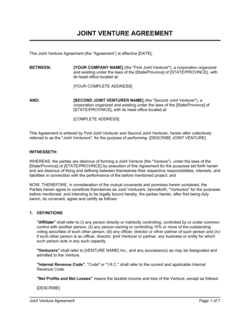
Two businesses contributing resources toward a shared projectJoint Venture Agreement
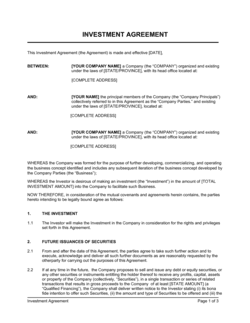
Investor and startup agreeing on funding milestones and reportingInvestment Agreement
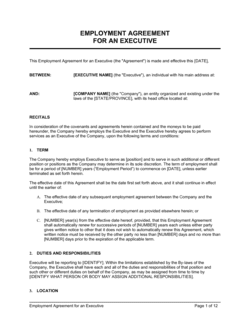
Executive and board aligning on performance targets and compensationExecutive Employment Agreement
Business partners defining long-term operating and profit-sharing termsPartnership Agreement
Internal team committing to annual departmental objectivesStrategic Planning Template
Early-stage company mapping goals before first external hireOne-Page Business Plan

Common mistakes to avoid

❌ Vague vision and goal language

Why it matters: Aspirational but unmeasurable goals — 'build a great company' or 'grow significantly' — give neither party a basis to assess performance or trigger accountability provisions. Disputes about whether a goal was met become credibility contests rather than contract interpretation.

Fix: Attach Schedule A with specific metrics, target dates, and measurement methods for every goal. Rewrite any goal that cannot be objectively scored as met or not met.

❌ Signing after resources are already committed

Why it matters: In common-law jurisdictions, a contract requires fresh consideration. If one party has already contributed capital, IP, or labor before signing, the restrictive clauses — confidentiality, accountability, exit terms — may be unenforceable without documented additional consideration.

Fix: Execute the agreement before any money, work, or sensitive information changes hands. If circumstances require a later signing, document a specific new benefit provided to each party at the time of execution.

❌ No dispute resolution mechanism

Why it matters: When partners disagree on whether a milestone was met or a responsibility was fulfilled, the absence of a defined process means disputes escalate immediately to litigation — expensive, slow, and relationship-ending.

Fix: Include a tiered dispute resolution clause: informal negotiation first (15 days), then mediation (30 days), then binding arbitration. Specify the arbitration rules and city upfront.

❌ Omitting a termination and exit clause

Why it matters: Without defined exit terms, a party who wants to leave has no clear path — and a party who wants to stay has no basis to demand a transition period or protect shared assets. Courts fill the gap with default rules that rarely match what either party intended.

Fix: Include a minimum notice period (30–90 days is typical), a cure period for material breach, and a list of obligations that survive exit — at minimum, confidentiality and any ongoing financial commitments.

❌ No entire-agreement clause

Why it matters: Prior emails, pitch decks, and verbal conversations can be introduced as contractual terms if the written agreement does not explicitly supersede them. This is especially problematic when early partnership discussions included informal commitments that were never formalized.

Fix: Include a standard entire-agreement clause and have both parties sign acknowledgment that no representations outside the written agreement form part of their bargain.

❌ Using a trade name instead of a registered legal entity

Why it matters: An agreement signed by 'Acme Ventures' instead of 'Acme Ventures LLC' may not be enforceable against the legal entity — especially in insolvency, dispute, or succession scenarios where the precise identity of the contracting party matters.

Fix: Verify each party's exact registered legal name from the applicable corporate registry before populating the parties clause, and confirm the signatory has authority to bind the entity.

The 10 key clauses, explained

Parties and Recitals

In plain language: Identifies each party by their full legal name and entity type, and explains the background context — why the parties are entering the agreement and what they intend to accomplish together.

Sample language
This Vision and Goals Agreement ('Agreement') is entered into as of [DATE] between [PARTY A LEGAL NAME], a [ENTITY TYPE] incorporated in [JURISDICTION] ('Party A'), and [PARTY B LEGAL NAME], a [ENTITY TYPE] incorporated in [JURISDICTION] ('Party B'), collectively referred to as the 'Parties.'

Common mistake: Using trade names or nicknames instead of registered legal entity names — if the named party doesn't match the entity's corporate registry entry, the agreement may be unenforceable against the correct legal person.

Shared Vision Statement

In plain language: Articulates the agreed-upon long-term purpose and direction of the business or partnership in clear, specific language that all parties formally adopt as the guiding intent of the agreement.

Sample language
The Parties share the vision of [SPECIFIC VISION STATEMENT] to be achieved by [TARGET DATE / HORIZON]. This vision serves as the governing purpose against which all goals, decisions, and obligations under this Agreement are measured.

Common mistake: Writing a vague aspirational statement instead of a specific directional commitment — phrases like 'become the best company' create no measurable standard and offer no basis for accountability.

Defined Business Goals and Milestones

In plain language: Lists the specific, measurable objectives each party agrees to pursue, with target dates and the metrics used to determine whether each goal has been achieved.

Sample language
The Parties agree to pursue the following Goals: (a) [GOAL 1 DESCRIPTION], to be achieved by [DATE], measured by [METRIC]; (b) [GOAL 2 DESCRIPTION], to be achieved by [DATE], measured by [METRIC]. A complete list of Goals and Milestones is set out in Schedule A.

Common mistake: Describing goals in output terms ('launch a product') rather than outcome terms ('achieve $X in monthly recurring revenue by DATE') — output goals cannot trigger accountability clauses because completion is subjective.

Individual Roles and Responsibilities

In plain language: Specifies which party is responsible for each goal, initiative, or operational function, preventing duplicated effort and establishing a clear basis for performance assessment.

Sample language
Party A shall be responsible for [RESPONSIBILITY A], including [SPECIFIC TASKS]. Party B shall be responsible for [RESPONSIBILITY B], including [SPECIFIC TASKS]. Neither Party shall undertake the other's assigned responsibilities without prior written consent.

Common mistake: Assigning overlapping responsibilities without defining a tiebreaker — when both parties believe they own a decision, execution stalls and disputes escalate quickly.

Decision-Making Authority

In plain language: Defines which decisions each party can make independently and which require unanimous or majority consent, along with the voting or approval threshold for significant strategic actions.

Sample language
Routine operational decisions within [Party A's / Party B's] assigned responsibilities may be made unilaterally. Decisions involving expenditures exceeding $[AMOUNT], changes to the Vision Statement, or new strategic partnerships require written consent of both Parties.

Common mistake: Failing to specify a dollar threshold for unilateral spending — without a clear limit, one partner can commit the business to significant financial obligations the other didn't approve.

Performance Review and Accountability

In plain language: Establishes a scheduled cadence for formal review meetings where parties assess milestone progress, address shortfalls, and document agreed corrective actions.

Sample language
The Parties shall conduct a formal Performance Review on a [QUARTERLY / ANNUAL] basis, on or before [DATE] of each [QUARTER / YEAR]. Each review shall include a written report assessing progress against each Goal in Schedule A and any corrective actions agreed.

Common mistake: Omitting a consequence clause for missed milestones — a review mechanism with no defined remedy for underperformance creates process without accountability.

Confidentiality

In plain language: Prohibits each party from disclosing the terms of the agreement or any shared strategic information to third parties without prior written consent.

Sample language
Each Party agrees to keep the terms of this Agreement and all shared strategic, financial, and operational information ('Confidential Information') strictly confidential and shall not disclose it to any third party without the other Party's prior written consent, except as required by law.

Common mistake: No definition of what constitutes Confidential Information — without a clear scope, parties disagree on what is protected and courts apply an unpredictable reasonableness standard.

Amendment Procedure

In plain language: Specifies that changes to the agreement are only effective when made in writing and signed by all parties, preventing informal conversations from inadvertently modifying binding obligations.

Sample language
This Agreement may only be amended by a written instrument signed by all Parties. No oral modification, course of dealing, or prior practice shall be construed as an amendment to any term of this Agreement.

Common mistake: Allowing verbal amendments by implication — courts in several jurisdictions have found that consistent deviation from a written term constitutes a constructive amendment, especially when the party seeking to enforce the original term stood by silently.

Term, Termination, and Exit

In plain language: States the agreement's duration, the conditions under which a party may exit early, the required notice period, and what obligations survive termination — such as confidentiality and any transition duties.

Sample language
This Agreement commences on [START DATE] and continues for [TERM], unless earlier terminated. Either Party may terminate upon [X] days' written notice if the other Party commits a Material Breach that remains uncured for [Y] days after written notice. Confidentiality obligations survive termination for [Z] years.

Common mistake: No survival clause — parties assume confidentiality and accountability obligations end on the termination date, leaving sensitive strategic information unprotected after the relationship ends.

Governing Law, Dispute Resolution, and Entire Agreement

In plain language: Specifies the jurisdiction whose law governs interpretation and enforcement, the method for resolving disputes (arbitration, mediation, or court), and confirms the written agreement supersedes all prior understandings.

Sample language
This Agreement is governed by the laws of [STATE / PROVINCE / COUNTRY]. Any dispute shall first be submitted to non-binding mediation, and if unresolved within [30] days, to binding arbitration in [CITY] under [AAA / JAMS / applicable rules]. This Agreement constitutes the entire agreement between the Parties and supersedes all prior representations, discussions, and understandings.

Common mistake: Selecting a governing law jurisdiction that has no connection to where either party operates — courts may decline to enforce choice-of-law provisions that appear designed solely to avoid protective local employment or consumer law.

How to fill it out

  1. 1

    Identify all parties with their legal entity names

    Enter the full registered legal name, entity type (LLC, corporation, individual), and jurisdiction of incorporation for each party in the recitals block. Do not use brand names or informal names.

    💡 Pull entity names directly from your state or provincial corporate registry to avoid mismatches that could affect enforceability.

  2. 2

    Draft a specific, measurable vision statement

    Write one to three sentences defining what the partnership or business intends to achieve and by when. Include a time horizon (e.g., 'by December 31, 2028') so the vision can be evaluated objectively.

    💡 Run the vision statement through a simple test: could a third party reading it determine whether the parties succeeded? If not, sharpen it.

  3. 3

    Define goals and milestones in Schedule A

    List each goal with a specific metric and target date. Use outcome metrics — revenue, users, units, or market share — rather than activity metrics like 'complete a launch' or 'hire a team.'

    💡 Limit Schedule A to five to eight goals. More than eight dilutes accountability and makes performance reviews unmanageable.

  4. 4

    Assign individual responsibilities clearly

    For each goal in Schedule A, name the responsible party and define the specific actions they own. Where responsibilities overlap, define the lead party and the support role explicitly.

    💡 If both parties will work on a goal together, designate one as the 'accountable owner' and the other as a 'contributing party' — clear ownership prevents inaction.

  5. 5

    Set decision-making thresholds

    Agree on a dollar amount and a list of decision categories that require joint consent. Enter these explicitly in the decision-making authority clause rather than leaving them to interpretation.

    💡 A $5,000–$10,000 unilateral spending threshold is typical for early-stage partnerships — calibrate to the capitalization of the venture.

  6. 6

    Schedule performance reviews and define consequences

    Set specific review dates (e.g., the last Friday of each quarter) and document what happens if a milestone is missed — whether that triggers a renegotiation, a cure period, or a right to exit.

    💡 Add the review dates as recurring calendar events at signing so neither party claims they forgot.

  7. 7

    Execute before any money or resources change hands

    Both parties must sign before any capital is contributed, work is performed, or strategic information is shared. Post-commitment signatures weaken enforceability and may require fresh consideration.

    💡 Use a timestamped eSign platform to record the exact execution date and store the fully executed copy in a shared, access-controlled location.

Frequently asked questions

What is a vision and goals agreement?

A vision and goals agreement is a binding legal document that formally records the shared objectives, individual responsibilities, decision-making authority, and accountability structures agreed upon by co-founders, business partners, or key stakeholders. It converts informal alignment conversations into enforceable obligations, giving each party a clear standard against which performance can be measured and disputes can be resolved.

When should I use a vision and goals agreement?

Use it before launching a new venture with a co-founder or partner, before committing capital or resources to a joint initiative, or when investors and founders need to document agreed milestones and reporting expectations. It is most critical at the start of any relationship where two or more parties are making asymmetric contributions — different amounts of money, time, or expertise — and need a written record of what each side has agreed to deliver.

Is a vision and goals agreement legally binding?

Yes, when properly drafted and executed, a vision and goals agreement is generally enforceable as a binding contract in most jurisdictions, provided it meets the basic requirements of offer, acceptance, and consideration. Consideration typically exists in the form of each party's mutual commitment to perform their respective obligations. As with any contract, enforceability depends on specificity — vague goals and unmeasurable milestones are difficult to enforce even in a signed agreement.

What is the difference between a vision and goals agreement and a partnership agreement?

A partnership agreement governs the full legal and financial structure of a business partnership — profit sharing, capital contributions, liability, dissolution, and ownership interests. A vision and goals agreement focuses specifically on aligned objectives, milestones, and accountability without necessarily establishing a formal legal partnership or equity structure. For new ventures with equity at stake, both documents are typically needed.

Do I need a lawyer to create a vision and goals agreement?

For straightforward partnerships with similar contributions and clear goals, a well-structured template is often sufficient for early alignment. Legal review is strongly recommended when the agreement involves significant capital, IP ownership, equity stakes, multi-jurisdiction parties, or material non-compete or confidentiality obligations. A one-hour review typically costs $200–$500 and is worthwhile any time the financial or strategic stakes are meaningful.

What should the milestones section include?

Each milestone should specify the goal description, the metric used to measure success, the target date, and the responsible party. For example: 'Achieve 500 paying customers by March 31, 2027, measured by active paid accounts in the CRM, led by Party A.' Milestones tied to financial thresholds should specify the currency and measurement period. Attach the full milestone schedule as a named exhibit — Schedule A — to keep the main agreement body clean and easy to amend.

What happens if one party does not meet their goals?

The agreement should specify a consequence for missed milestones — a cure period, a renegotiation trigger, a reduced ownership stake, or a right to exit. Without a defined consequence, a missed milestone creates no legal remedy beyond a general breach-of-contract claim, which requires demonstrating actual damages. Clearly defined remedies in the agreement give both parties a faster, lower-cost path to resolution.

Can a vision and goals agreement be amended after signing?

Yes, but any amendment must follow the procedure specified in the amendment clause — typically a written instrument signed by all parties. Verbal agreements to change terms are generally not enforceable if the contract includes a no-oral-modification clause. Parties should document changes formally and date the amended schedule or addendum to maintain a clear version history.

How long should a vision and goals agreement last?

Term length depends on the nature of the initiative. For co-founder relationships, an indefinite term with defined exit rights is most common. For project-based partnerships, a fixed term (12–36 months) with an option to renew is typical. For investor-company milestone agreements, the term usually runs to the next funding round or a defined performance review date. Always include provisions addressing what happens at the end of the term — automatic renewal, renegotiation, or termination.

How this compares to alternatives

vs Partnership Agreement

A partnership agreement establishes the full legal and financial framework of a business partnership — capital contributions, profit sharing, liability, and dissolution terms. A vision and goals agreement focuses specifically on aligned objectives and accountability without necessarily creating a formal legal partnership. For equity-bearing ventures, both documents are typically used together.

vs Joint Venture Agreement

A joint venture agreement governs a discrete, time-limited collaboration between two businesses — defining contributions, revenue splits, IP ownership, and exit terms for that specific project. A vision and goals agreement addresses ongoing strategic alignment across the full relationship rather than a single bounded initiative. Use a joint venture agreement when the collaboration has a defined scope and end date.

vs Strategic Planning Template

A strategic planning template is an internal operational document for mapping goals, KPIs, and initiatives within a single organization. A vision and goals agreement is a binding legal contract between two or more separate parties, creating enforceable obligations. The strategic plan informs the content of the agreement; it does not replace it.

vs Investment Agreement

An investment agreement governs the financial terms of a capital contribution — valuation, equity stake, liquidation preferences, and investor rights. A vision and goals agreement captures the shared strategic objectives and accountability structures that govern how the funded business will be operated. For funded ventures, investors often require both documents to be in place simultaneously.

Industry-specific considerations

Technology / SaaS

MRR and ARR milestones, product roadmap checkpoints, and co-founder IP assignment references are commonly integrated into the goals schedule for software ventures.

Professional Services

Client acquisition targets, billable utilization rates, and partner contribution expectations are defined per partner, with quarterly performance reviews tied to profit-share adjustments.

Retail / E-commerce

Revenue per channel, inventory turnover milestones, and new market entry timelines are typical goal metrics, with decision-making authority clauses governing supplier contracts above a set threshold.

Nonprofit / Social Enterprise

Program reach targets, grant milestone compliance, and board-approved budget thresholds are structured as accountable goals with formal reporting periods aligned to funder requirements.

Manufacturing

Production capacity targets, supplier relationship milestones, and capital expenditure approval thresholds are standard goal categories, with joint-consent requirements for any capex above a defined amount.

Healthcare / MedTech

Regulatory approval milestones, clinical trial enrollment targets, and compliance review checkpoints are built into the goals schedule, with enhanced confidentiality clauses covering patient data and proprietary protocols.

Jurisdictional notes

United States

Contract enforceability is governed at the state level. Courts generally enforce clearly defined milestone and accountability clauses when both parties are represented or had the opportunity for review. California courts apply a higher standard of reasonableness to restrictive clauses. Arbitration agreements in commercial contracts are broadly enforceable under the Federal Arbitration Act, but clause drafting should specify the seat, rules, and number of arbitrators to avoid procedural disputes.

Canada

Canadian common-law provinces (all except Quebec) follow English contract law principles — offer, acceptance, consideration, and certainty of terms are required for enforceability. Quebec's civil law framework under the Civil Code of Quebec applies different rules of contract formation and interpretation. For partnerships with Quebec parties, French-language copies may be required under the Charter of the French Language. Courts will strike vague or one-sided clauses under unconscionability doctrine.

United Kingdom

English contract law requires offer, acceptance, consideration, and an intention to create legal relations. For agreements between business partners, an intention to create legal relations is presumed. Dispute resolution clauses specifying English arbitration are strongly enforced. Post-Brexit, choice-of-law and jurisdiction clauses in commercial contracts with EU counterparties should be reviewed to confirm enforcement pathways under applicable bilateral arrangements.

European Union

EU member states follow their own national contract law, with no unified pan-EU commercial contract statute. Rome I Regulation governs which national law applies to cross-border commercial agreements within the EU — parties may freely choose the governing law, but mandatory protective rules of the counterparty's home country may still apply. GDPR requires that confidentiality and data-sharing clauses address personal data processing obligations where any party handles EU residents' data.

Template vs lawyer — what fits your deal?

PathBest forCostTime
Use the templateEarly-stage co-founders, internal leadership teams, and straightforward two-party goal-alignment arrangements with no equity at stakeFree1–2 hours
Template + legal reviewPartnerships involving capital contributions, IP ownership, cross-jurisdictional parties, or material confidentiality obligations$300–$7002–5 days
Custom draftedMulti-party ventures with equity, investor milestone agreements, regulated industries, or complex international arrangements$1,500–$5,000+1–3 weeks

Glossary

Vision Statement
A concise declaration of what the business or partnership intends to achieve over a defined time horizon, used as the governing purpose of the agreement.
Milestone
A specific, measurable outcome with a defined target date that marks meaningful progress toward a stated goal.
Accountability Structure
The agreed framework specifying who is responsible for each objective, how performance will be measured, and what happens if a milestone is missed.
Decision-Making Authority
The clause specifying which decisions each party can make unilaterally and which require mutual consent or a vote.
Material Breach
A failure to fulfill a core obligation under the agreement significant enough to justify termination or legal remedy by the non-breaching party.
Performance Review Period
A scheduled interval — typically quarterly or annually — at which parties formally assess progress against agreed goals and update terms if needed.
Amendment Procedure
The process parties must follow to formally change any term of the agreement, typically requiring written consent from all signatories.
Governing Law
The jurisdiction whose laws apply to interpret and enforce the agreement, independent of where the parties happen to be located.
Entire Agreement Clause
A provision stating that the written agreement supersedes all prior verbal or written representations, preventing outside promises from being treated as binding terms.
Severability
A clause providing that if any individual provision is found unenforceable, the remainder of the agreement stays in force.
Good Faith Obligation
An implied or express duty requiring each party to act honestly and with fair dealing when performing their obligations under the agreement.

Part of your Business Operating System

This document is one of 3,000+ business & legal templates included in Business in a Box.

  • Fill-in-the-blanks — ready in minutes
  • 100% customizable Word document
  • Compatible with all office suites
  • Export to PDF and share electronically

Create your document in 3 simple steps.

From template to signed document — all inside one Business Operating System.
1
Download or open template

Access over 3,000+ business and legal templates for any business task, project or initiative.

2
Edit and fill in the blanks with AI

Customize your ready-made business document template and save it in the cloud.

3
Save, Share, Send, Sign

Share your files and folders with your team. Create a space of seamless collaboration.

Save time, save money, and create top-quality documents.

★★★★★

"Fantastic value! I'm not sure how I'd do without it. It's worth its weight in gold and paid back for itself many times."

Managing Director · Mall Farm
Robert Whalley
Managing Director, Mall Farm Proprietary Limited
★★★★★

"I have been using Business in a Box for years. It has been the most useful source of templates I have encountered. I recommend it to anyone."

Business Owner · 4+ years
Dr Michael John Freestone
Business Owner
★★★★★

"It has been a life saver so many times I have lost count. Business in a Box has saved me so much time and as you know, time is money."

Owner · Upstate Web
David G. Moore Jr.
Owner, Upstate Web

Run your business with a system — not scattered tools

Stop downloading documents. Start operating with clarity. Business in a Box gives you the Business Operating System used by over 250,000 companies worldwide to structure, run, and grow their business.

Free Forever Plan · No credit card required