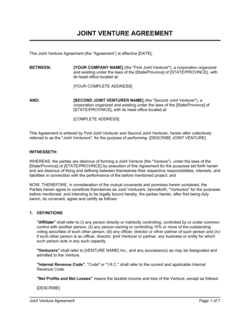
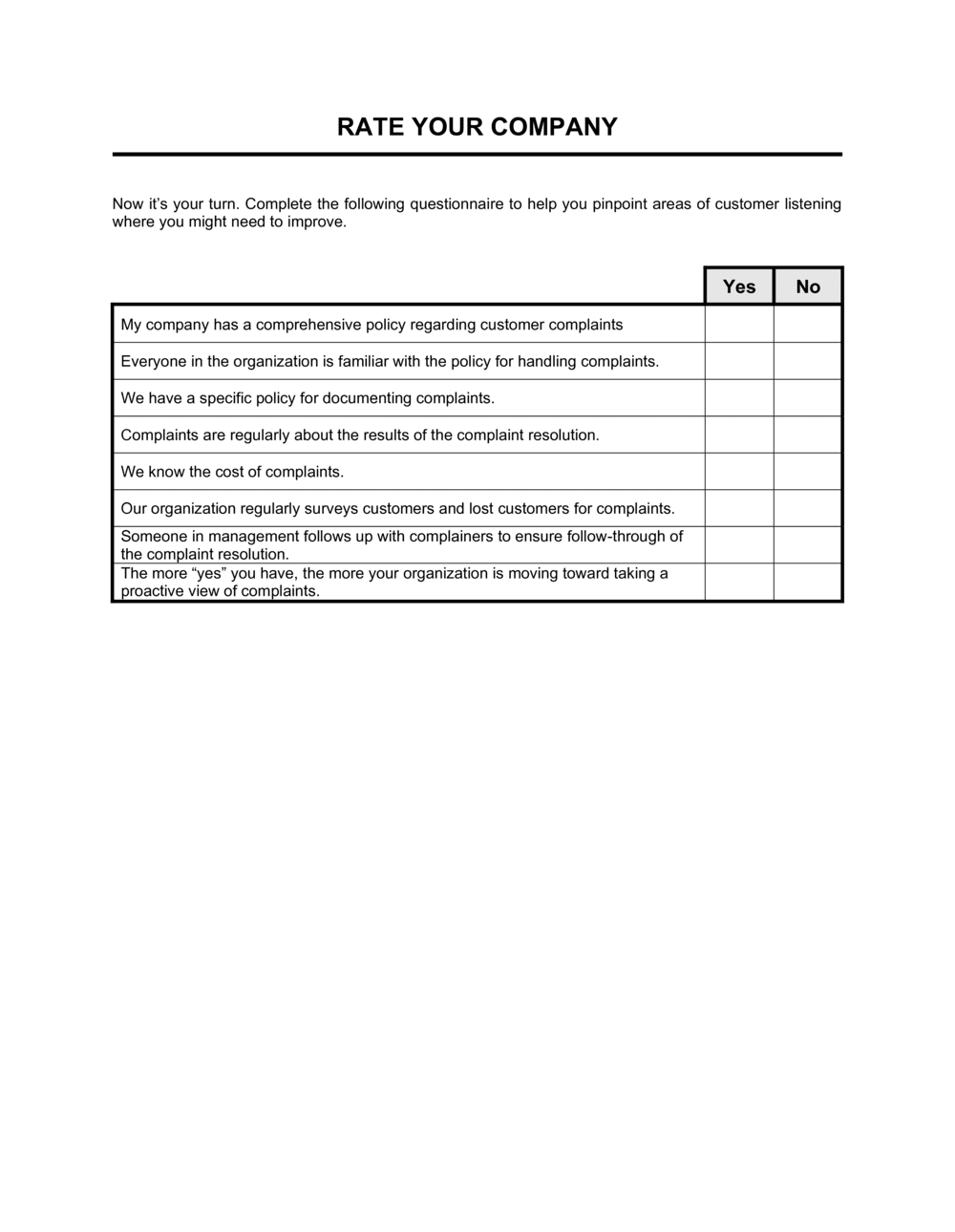
Rate your Company Template

Free Word download β€’ Edit online β€’ Save & share with Drive β€’ Export to PDF

1 pageβ€’20–30 min to fillβ€’Difficulty: Standardβ€’Signature requiredβ€’Legal review recommended
Learn more ↓
FreeRate your Company Template

At a glance

What it is
A Rate Your Company document is a formal, binding self-assessment instrument that a business uses to declare its credit standing, operational performance, and financial health to third parties such as lenders, partners, suppliers, or prospective investors. This free Word download gives you a structured template you can edit online and export as PDF β€” covering financial metrics, operational KPIs, creditworthiness declarations, and authorized signatory blocks in a single legally executed document.
When you need it
Use it when applying for trade credit, negotiating supplier payment terms, entering a new commercial partnership, or responding to a counterparty's due-diligence request for a formal declaration of your company's financial and operational standing.
What's inside
Company identification details, declared financial metrics and credit standing, operational performance indicators, representations and warranties as to accuracy, limitation-of-liability language, authorized signatory block, and governing law provisions.

What is a Rate Your Company Document?

A Rate Your Company document is a formal, signed declaration in which a business provides a structured assessment of its own financial standing, credit history, and operational performance to a third party relying on that information for a commercial decision. It functions as a binding self-assessment instrument: the declaring company warrants that all figures and statements are true, complete, and not misleading as of the execution date, and accepts legal accountability if a counterparty suffers a loss by relying on materially false information. Unlike a standard financial statement, which simply presents historical numbers, a Rate Your Company document attaches representations, warranties, a liability cap, and confidentiality terms β€” giving the recipient contractual recourse while protecting the disclosing company from open-ended exposure.

Why You Need This Document

Without a properly structured company rating document, your business faces two distinct risks simultaneously. First, submitting financial information informally β€” in an email, a spreadsheet, or a casual letter β€” creates unlimited liability for any inaccuracy, because informal disclosures carry no liability cap and no agreed scope of use. Second, operating without a confidentiality clause means the recipient can share your financial metrics, credit standing, and performance data with competitors, other creditors, or the market at large. A formal Rate Your Company document closes both gaps: it limits your exposure to a defined dollar cap for honest inaccuracies, restricts use of the data to the stated purpose, and signals to the counterparty that your company takes its disclosure obligations seriously. For trade credit applications, supplier prequalification, franchise approvals, and partnership due diligence, a signed, warranted declaration consistently receives faster approval and better terms than informal financial submissions.

Which variant fits your situation?

If your situation is…Use this template
Declaring financial standing to a trade creditor for credit termsRate Your Company (Trade Credit)
Providing a full financial health profile to a prospective lenderBusiness Financial Statement
Assessing a vendor's or supplier's standing before awarding a contractVendor Assessment Form
Documenting internal KPIs and performance against annual targetsBusiness Performance Report
Providing formal creditworthiness attestation as part of a loan applicationCredit Application Form
Responding to a partner's request for representations about your companyRepresentations and Warranties Agreement
Submitting a comprehensive company profile during an M&A due-diligence processDue Diligence Checklist

Common mistakes to avoid

❌ Presenting unaudited figures as final accounts

Why it matters: A recipient who relies on management estimates believing them to be audited figures has a strong misrepresentation claim if the figures later prove materially different from the audited result.

Fix: Label all unaudited figures explicitly β€” 'management accounts, unaudited, subject to audit adjustment' β€” and provide the last audited accounts reference as a separate line.

❌ Omitting known adverse credit events

Why it matters: Failing to disclose a known CCJ, pending insolvency inquiry, or disputed creditor claim in a signed representations document crosses from inaccuracy into potential fraud.

Fix: Run a business credit check on your own company before completing the document and disclose all adverse entries in the MAC schedule, however minor.

❌ Signing with an unauthorized representative

Why it matters: If the signatory lacked actual authority β€” whether a junior employee or a director who resigned before the signing date β€” the representations are not binding on the company and may be challenged.

Fix: Confirm signatory authority against your current articles, shareholder agreement, or a fresh board resolution executed on or before the document date.

❌ No limitation-of-liability clause

Why it matters: A document containing financial representations and warranties without a liability cap exposes the company to unlimited damages claims if any figure proves inaccurate β€” even as a result of a clerical error.

Fix: Always include a specific dollar cap tied to either the value of the underlying transaction or your professional indemnity policy limit, and limit recovery to direct losses only.

❌ Leaving the confidentiality clause vague about permitted use

Why it matters: An unrestricted recipient can share your financial data with competitors, use it in unrelated negotiations, or disclose it to the press β€” none of which you authorized.

Fix: Define the exact permitted purpose β€” 'solely for evaluating a trade credit application dated [DATE]' β€” and prohibit all other uses and redistributions in writing.

❌ Reporting figures as of an outdated date without a MAC clause

Why it matters: Financial conditions can change materially between a reporting date and the signature date. Without a MAC clause, the recipient has no contractual recourse if your business has deteriorated significantly in the intervening period.

Fix: Always include a MAC disclosure clause and update the Schedule A disclosure right up to the execution date, even if it means a same-day review before signing.

The 10 key clauses, explained

Company Identification and Legal Status

In plain language: States the company's full legal name, registration number, jurisdiction of incorporation, registered address, and operating status β€” confirming the entity making the declarations is a validly existing legal person.

Sample language
[COMPANY LEGAL NAME] (Registration No. [NUMBER]), a [ENTITY TYPE] incorporated under the laws of [JURISDICTION], with its registered office at [REGISTERED ADDRESS], is in good standing as of [DATE].

Common mistake: Using a trading name instead of the registered legal entity name. If the declaring entity doesn't match corporate registry records, the document's representations cannot be legally attributed to the correct legal person.

Financial Metrics Declaration

In plain language: Sets out the company's key financial figures β€” annual revenue, gross profit, net income, total assets, total liabilities, and cash position β€” as of a stated reporting date.

Sample language
As of [REPORTING DATE], [COMPANY NAME] reports: Annual Revenue $[AMOUNT]; Gross Profit $[AMOUNT]; Net Income $[AMOUNT]; Total Assets $[AMOUNT]; Total Liabilities $[AMOUNT]; Cash and Equivalents $[AMOUNT].

Common mistake: Reporting unaudited management estimates without labeling them as such. Counterparties who rely on figures presented as final and audited when they are preliminary estimates have a misrepresentation claim.

Credit Standing and Payment History

In plain language: Declares the company's credit rating (if externally assigned), payment record with existing creditors, and any defaults, judgments, or insolvency proceedings β€” past or pending.

Sample language
As of [DATE], [COMPANY NAME] holds a [CREDIT RATING / SCORE] with [AGENCY / BUREAU]. The Company has no outstanding defaults, unsatisfied judgments, or pending insolvency proceedings. All trade payables are current within agreed terms.

Common mistake: Omitting a pending or recent CCJ, lien, or informal creditor dispute. Failing to disclose known adverse credit events in a representations document exposes the company to fraud or misrepresentation liability.

Operational Performance Indicators

In plain language: Summarizes the company's operating KPIs β€” employee headcount, years in operation, customer or client count, geographic footprint, and any key certifications or accreditations.

Sample language
[COMPANY NAME] has been in continuous operation since [YEAR] ([NUMBER] years), employs [NUMBER] full-time staff, serves [NUMBER] active clients across [GEOGRAPHIES], and holds [CERTIFICATIONS / ACCREDITATIONS].

Common mistake: Including forward-looking projections in this section without labeling them as projections. Blending historical facts with future estimates creates ambiguity about what is being warranted as true today.

Representations and Warranties as to Accuracy

In plain language: States that all information provided in the document is true, complete, and not misleading as of the date signed, and that no material facts have been omitted.

Sample language
The undersigned represents and warrants that the information contained in this document is true, complete, and accurate in all material respects as of [DATE], and that no material information has been omitted that would render any statement misleading.

Common mistake: Using vague hedging language like 'believed to be accurate' without specifying knowledge qualifiers. Courts read warranty language strictly β€” unqualified assertions of accuracy carry greater liability than knowledge-qualified ones.

Material Adverse Change Disclosure

In plain language: Requires the declaring party to disclose any known event or circumstance since the last reporting date that has materially and adversely affected the company's financial condition, operations, or prospects.

Sample language
Since [REPORTING DATE], [COMPANY NAME] has not experienced any Material Adverse Change to its financial condition, operations, or business prospects, except as disclosed in Schedule [X] attached hereto.

Common mistake: Leaving this clause out entirely. Without a MAC disclosure clause, counterparties have no explicit recourse if a significant negative event occurred between the reporting date and the date of signing.

Limitation of Liability

In plain language: Caps the company's financial exposure to the recipient if any representation in the document turns out to be inaccurate, typically limiting liability to direct losses only or to a stated dollar cap.

Sample language
The Company's aggregate liability to [RECIPIENT NAME] arising from any inaccuracy in this document shall not exceed $[CAP AMOUNT] and shall be limited to direct losses only, excluding consequential, indirect, or punitive damages.

Common mistake: Omitting a liability cap for a document that contains financial representations. Without one, a single incorrect figure β€” even a clerical error β€” could theoretically expose the company to unlimited damages claims.

Confidentiality of Disclosed Information

In plain language: Restricts the recipient from sharing the financial and operational data in this document with third parties, limiting use to the stated evaluation or transaction purpose.

Sample language
The information contained in this document is confidential and provided solely for [PURPOSE]. [RECIPIENT NAME] shall not disclose any information herein to any third party without the prior written consent of [COMPANY NAME].

Common mistake: No confidentiality clause at all β€” treating the document as public information. Company financial metrics and credit standing are commercially sensitive; an unrestricted recipient can share them with competitors or use them adversely in negotiations.

Governing Law and Dispute Resolution

In plain language: Specifies which jurisdiction's law governs the document and the mechanism for resolving disputes β€” arbitration, mediation, or courts.

Sample language
This document is governed by the laws of [JURISDICTION]. Any dispute arising from or relating to its contents shall be resolved by [binding arbitration / the courts of [JURISDICTION]], and the parties submit to the exclusive jurisdiction thereof.

Common mistake: Selecting a governing law with no connection to either party's location or the underlying transaction. Some jurisdictions impose implied warranties or disclosure obligations that conflict with the document's liability-limiting intent.

Authorized Signatory and Date

In plain language: Identifies the individual signing on behalf of the company, confirms their authority to do so, and records the execution date.

Sample language
Signed by [FULL NAME], [TITLE], duly authorized to execute this document on behalf of [COMPANY LEGAL NAME] on [DATE].

Common mistake: Having a non-authorized employee sign β€” such as an office manager or junior accountant β€” without a board resolution or power of attorney confirming authority. The document's representations may be unenforceable if the signatory lacked actual authority.

How to fill it out

  1. 1

    Enter the company's full legal details

    Add the company's registered legal name, registration or incorporation number, jurisdiction, registered address, and date of incorporation. Cross-check against the current entry in your corporate registry.

    πŸ’‘ Pull these details directly from your certificate of incorporation or latest annual return β€” not from your marketing materials or website.

  2. 2

    Specify the reporting date and financial period

    State the exact date to which all financial figures relate β€” this should be the last completed fiscal year-end or the most recent management accounts date. Indicate whether figures are audited or unaudited.

    πŸ’‘ Label unaudited estimates clearly as 'management accounts β€” unaudited' to limit your representations exposure and maintain credibility with sophisticated recipients.

  3. 3

    Complete the financial metrics declaration

    Enter revenue, gross profit, net income, total assets, total liabilities, and cash and equivalents from your most recent financial statements. Include key ratios β€” current ratio and debt-to-equity β€” where the recipient has requested them.

    πŸ’‘ Use the same line items and labels as your statutory accounts to make it easy for the recipient to verify figures independently.

  4. 4

    Declare credit standing and payment history

    State your credit score or rating if you have one from a bureau such as Dun & Bradstreet, Equifax Business, or Experian Business. Confirm there are no outstanding defaults, CCJs, liens, or insolvency proceedings.

    πŸ’‘ Run a fresh credit report on your own company before signing β€” discovering an error on the report after submission is far more costly than finding it beforehand.

  5. 5

    Fill in the operational performance indicators

    Enter years in operation, current employee count, active customer or client count, geographic markets served, and any relevant certifications (ISO, SOC 2, industry accreditations).

    πŸ’‘ Use the trailing 12-month average for headcount rather than a single snapshot date β€” it gives a more accurate picture and avoids misrepresentation if you recently hired or reduced staff.

  6. 6

    Review and complete the MAC disclosure schedule

    Identify any event since your reporting date that has materially affected financial condition or operations β€” loss of a major customer, litigation filed, key personnel departure, or a banking facility withdrawn. Disclose these in Schedule A.

    πŸ’‘ When in doubt, disclose. Non-disclosure of a known MAC is more legally damaging than a disclosed adverse event with context.

  7. 7

    Set the liability cap and confirm the confidentiality scope

    Enter a specific dollar amount for the limitation-of-liability cap. Confirm the stated purpose for which the recipient may use the information and that redistribution is prohibited.

    πŸ’‘ Align the liability cap with your professional indemnity insurance coverage limit so any claim falls within an insured range.

  8. 8

    Execute with an authorized signatory before the submission deadline

    Have the document signed by a director, officer, or other person with documented authority β€” supported by a board resolution or authorization letter if needed. Record the exact execution date.

    πŸ’‘ Date the document on the day of actual signature, not the day it is sent. Back-dating creates an unintended warranty that the representations were true on a date earlier than you verified them.

Frequently asked questions

What is a Rate Your Company document?

A Rate Your Company document is a formal, signed declaration in which a business provides verified information about its financial health, credit standing, and operational performance to a counterparty β€” such as a supplier, lender, or business partner. It functions as a binding self-assessment that creates legal accountability for the accuracy of the information provided, typically backed by representations, warranties, and a liability cap.

When would a business be required to submit a Rate Your Company form?

Common triggers include applying for trade credit or extended payment terms with a supplier, entering a new commercial partnership that requires financial due diligence, responding to a lender's pre-qualification request, applying for a franchise territory, or participating in a government or corporate procurement process that requires vendor financial qualification. Some industries require periodic resubmission to maintain approved-supplier status.

What financial information should be included in a Rate Your Company document?

At minimum: annual revenue, gross profit, net income, total assets, total liabilities, and cash and equivalents β€” all referenced to a specific reporting date and labeled as audited or unaudited. Key ratios such as current ratio and debt-to-equity ratio are commonly requested by sophisticated recipients. Any known material adverse changes since the reporting date must be disclosed separately.

Is a Rate Your Company document legally binding?

Yes, when properly executed by an authorized signatory, the representations and warranties in the document are generally binding on the company. A recipient who suffers a loss by relying on materially false information may have grounds for a misrepresentation claim or breach of warranty action. Including a limitation-of-liability clause does not eliminate liability β€” it caps the financial exposure for honest inaccuracies, but fraudulent misrepresentation typically cannot be contractually excluded.

Does the document need to include audited financial figures?

Audited figures are not always required, but you must clearly label what you are providing. Management accounts, unaudited interim financials, and audited annual accounts all have different levels of reliability, and sophisticated recipients know the difference. Presenting unaudited figures without labeling them as such is a common source of misrepresentation disputes. Where audited accounts are unavailable, include the most recent available figures and state when the audit is expected to be completed.

What is the difference between a Rate Your Company form and a credit application?

A credit application is typically completed on a form provided by the creditor and requests information the creditor has specified. A Rate Your Company document is initiated and structured by the declaring company itself, presenting its standing in a format it controls β€” including its own liability-limiting and confidentiality terms. The two are complementary: many transactions require both β€” a creditor's application form and the company's own formal declaration.

How often should a Rate Your Company document be updated?

Any time you submit the document to a new counterparty, it should reflect financial figures no older than 12 months and should be re-executed by an authorized signatory. For ongoing supplier or lender relationships, annual reissuance aligned with your fiscal year-end is standard practice. If a material adverse change occurs between submissions β€” such as a significant loss, litigation, or banking facility change β€” proactive disclosure to existing counterparties relying on a prior version is advisable and in some jurisdictions legally required.

Can a company limit its liability for inaccurate information in this document?

In most jurisdictions, a company can contractually limit liability for honest inaccuracies through a limitation-of-liability clause, provided the clause is clearly drafted and brought to the recipient's attention. However, liability for fraudulent misrepresentation β€” knowingly providing false information β€” cannot typically be excluded by contract. Limitations must also be reasonable to be enforceable; courts in the UK and EU may strike down caps that are disproportionately low relative to the transaction size.

What happens if a material adverse change occurs after signing?

If the document includes a MAC disclosure clause, the company may have a contractual obligation to notify the recipient promptly. Even without an explicit clause, continuing to allow a counterparty to rely on materially outdated representations without correction can give rise to a continuing misrepresentation claim. Best practice is to reissue or formally amend the document as soon as a material change is identified, rather than waiting until the counterparty discovers it independently.

How this compares to alternatives

vs Credit Application Form

A credit application is a form issued by the creditor and completed by the applicant on the creditor's terms. A Rate Your Company document is issued and controlled by the declaring company itself, allowing it to include its own liability cap and confidentiality terms. Most formal trade-credit processes require both documents.

vs Business Financial Statement

A business financial statement presents historical accounting figures β€” P&L, balance sheet, and cash flow β€” without representations, warranties, or legal accountability language. A Rate Your Company document adds the legal framework: the company formally warrants the accuracy of the figures and the recipient has contractual recourse if they are materially false.

vs Due Diligence Checklist

A due diligence checklist is a request list used by a buyer or investor to gather information from a target company β€” it drives the information-gathering process. A Rate Your Company document is the responding instrument: a signed, warranted declaration the subject company provides in response to such requests, with legal accountability attached.

vs Representations and Warranties Agreement

A representations and warranties agreement is embedded in a larger transaction document β€” such as an acquisition agreement or loan β€” and covers a wide range of legal, financial, and operational matters. A Rate Your Company document is a standalone, self-contained declaration focused specifically on current financial standing and operational metrics, typically used before a transaction reaches the formal agreement stage.

Industry-specific considerations

Wholesale and Distribution

Suppliers require formal company ratings before extending Net 60 or Net 90 trade credit on high-volume purchase orders, with particular focus on current ratio and payment history.

Construction

Main contractors and government bodies require subcontractors to submit company ratings as part of prequalification, covering financial standing, insurance certifications, and years in operation.

Professional Services

Accounting, legal, and consulting firms use company ratings when onboarding high-value clients or entering joint-venture arrangements where financial exposure to the counterparty is material.

Retail and Franchising

Franchisors require applicants to submit formal company or personal financial ratings demonstrating the liquidity and net worth thresholds required to fund a new location.

Jurisdictional notes

United States

In the US, false statements in a business credit or financial declaration can trigger federal wire fraud or bank fraud liability if submitted to a federally regulated lender. State-level misrepresentation laws vary, but most allow rescission and damages for material inaccuracies. Limitation-of-liability clauses are generally enforceable in commercial transactions between sophisticated parties, though courts in some states scrutinize caps that are disproportionate to the transaction value.

Canada

Canadian common law provinces treat misrepresentation in commercial documents consistently with general contract principles β€” fraudulent and negligent misrepresentation both give rise to damages claims. Quebec's civil law framework under the Civil Code applies similar principles. Limitation-of-liability clauses must not violate provincial consumer protection statutes, though B2B transactions are generally exempt. Annual re-execution is advisable for ongoing supplier relationships given evolving disclosure obligations.

United Kingdom

The Misrepresentation Act 1967 applies to commercial declarations in England and Wales β€” it allows rescission and damages for negligent or fraudulent misrepresentation and cannot be excluded by contract unless the exclusion is reasonable under the Unfair Contract Terms Act 1977. Limitation-of-liability clauses are enforceable between businesses if they satisfy the reasonableness test. Scotland applies similar principles under common law. Companies House information must be consistent with figures declared in this document.

European Union

EU member states apply varying civil law standards to commercial misrepresentation, but the general principle of good faith in commercial dealings β€” codified in German, French, and Dutch contract law β€” imposes a duty of honest disclosure. GDPR applies to any personal data embedded in the document (e.g., individual financial guarantor details). Limitation-of-liability clauses are more strictly scrutinized in France and Germany than in common-law jurisdictions, and proportionality to transaction value is a common judicial test.

Template vs lawyer β€” what fits your deal?

PathBest forCostTime
Use the templateSmall businesses and freelancers submitting company ratings for trade credit or routine supplier qualificationFree30–60 minutes
Template + legal reviewCompanies declaring financial standing for transactions above $100K or in regulated industries$300–$7001–2 days
Custom draftedLarge enterprises, cross-border transactions, or high-value partnerships where material liability exposure requires tailored warranty and indemnity language$1,500–$4,000+1–2 weeks

Glossary

Trade Credit
An arrangement where a supplier allows a buyer to receive goods or services immediately and pay at a later agreed date, typically Net 30, Net 60, or Net 90.
Credit Standing
A company's overall reputation and assessed ability to meet its financial obligations based on payment history, financial ratios, and current liabilities.
Representations and Warranties
Formal statements of fact made by one party to another in a legal document, which, if false, give the receiving party grounds for legal recourse.
Due Diligence
The process of investigating and verifying a company's financial, legal, and operational status before entering a significant business transaction.
Debt-to-Equity Ratio
A financial metric comparing total liabilities to shareholders' equity, used to assess how much a company is financing operations through debt versus owner investment.
Current Ratio
A liquidity metric calculated as current assets divided by current liabilities; a ratio above 1.0 indicates the company can cover short-term obligations.
Authorized Signatory
An individual legally empowered by a company's governing documents to sign contracts and make binding representations on the company's behalf.
Material Adverse Change
A significant negative development in a company's financial condition, operations, or prospects that would affect a counterparty's decision to enter or continue a transaction.
Limitation of Liability
A clause capping one party's financial exposure to the other in the event a representation or warranty in the document proves inaccurate.
KPI (Key Performance Indicator)
A quantifiable measure used to evaluate how effectively a company is achieving its operational or financial objectives over a defined period.
Indemnification
A contractual obligation by one party to compensate the other for losses arising from a breach of representations, warranties, or other stated obligations.

Part of your Business Operating System

This document is one of 3,000+ business & legal templates included in Business in a Box.

  • Fill-in-the-blanks β€” ready in minutes
  • 100% customizable Word document
  • Compatible with all office suites
  • Export to PDF and share electronically

Create your document in 3 simple steps.

From template to signed document β€” all inside one Business Operating System.
1
Download or open template

Access over 3,000+ business and legal templates for any business task, project or initiative.

2
Edit and fill in the blanks with AI

Customize your ready-made business document template and save it in the cloud.

3
Save, Share, Send, Sign

Share your files and folders with your team. Create a space of seamless collaboration.

Save time, save money, and create top-quality documents.

β˜…β˜…β˜…β˜…β˜…

"Fantastic value! I'm not sure how I'd do without it. It's worth its weight in gold and paid back for itself many times."

Managing Director Β· Mall Farm
Robert Whalley
Managing Director, Mall Farm Proprietary Limited
β˜…β˜…β˜…β˜…β˜…

"I have been using Business in a Box for years. It has been the most useful source of templates I have encountered. I recommend it to anyone."

Business Owner Β· 4+ years
Dr Michael John Freestone
Business Owner
β˜…β˜…β˜…β˜…β˜…

"It has been a life saver so many times I have lost count. Business in a Box has saved me so much time and as you know, time is money."

Owner Β· Upstate Web
David G. Moore Jr.
Owner, Upstate Web

Run your business with a system β€” not scattered tools

Stop downloading documents. Start operating with clarity. Business in a Box gives you the Business Operating System used by over 250,000 companies worldwide to structure, run, and grow their business.

Start freeΒ Β·Β No credit card required