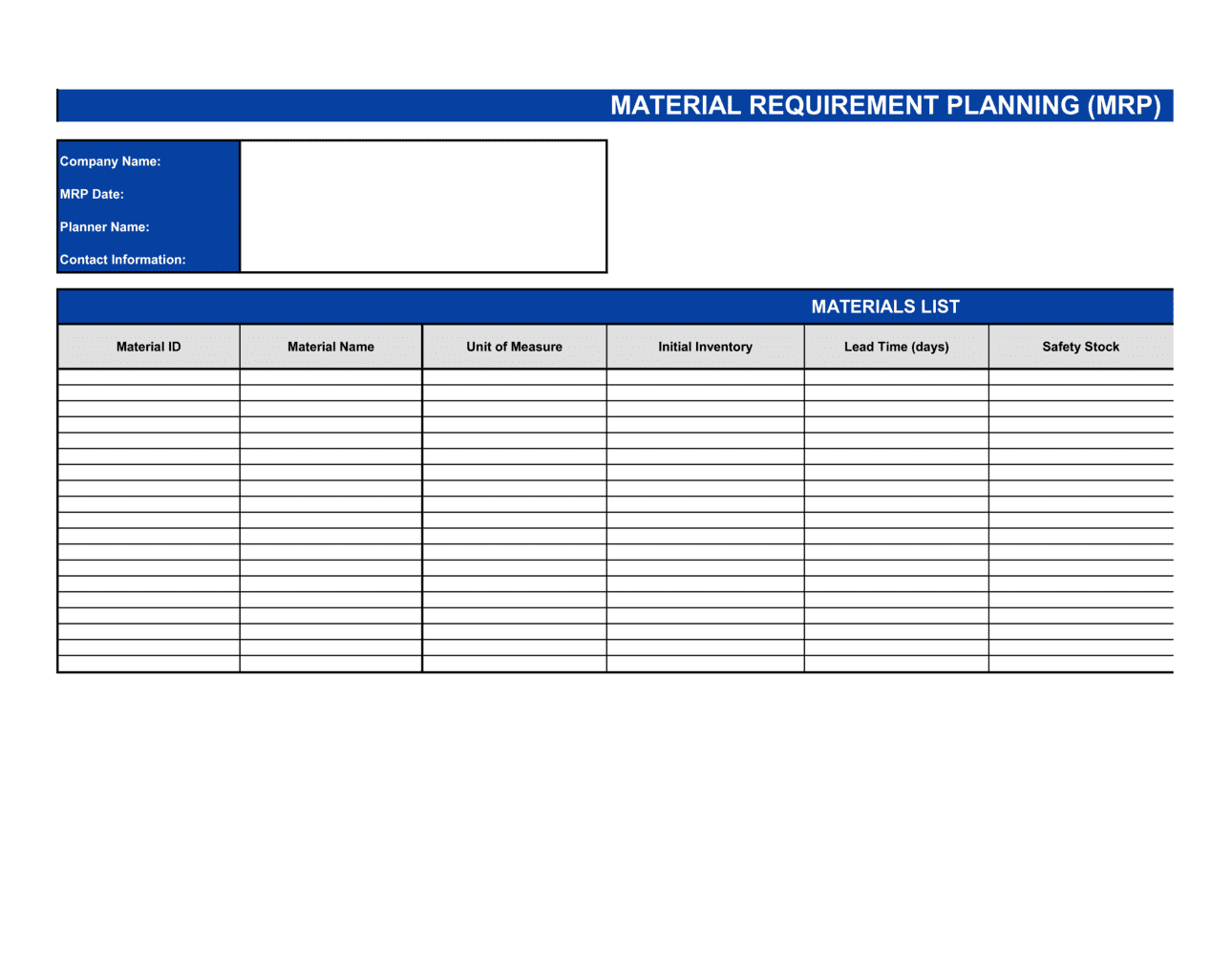
Material Requirement Planning Template

Free Excel download β€’ Edit online β€’ Save & share with Drive β€’ Export to PDF

1 pageβ€’20–30 min to fillβ€’Difficulty: Standardβ€’Signature requiredβ€’Legal review recommended
Learn more ↓
FreeXLSMaterial Requirement Planning Template

At a glance

What it is
A Material Requirement Planning (MRP) agreement is a binding document between a manufacturer or production operator and its suppliers that formalizes the scheduling, procurement, and delivery of raw materials and components needed to meet production targets. This free Word download provides a structured, editable template covering inventory obligations, lead times, demand forecasts, and supplier performance standards β€” ready to export as PDF and execute with your supply chain partners.
When you need it
Use it when entering into a supply relationship that requires coordinated production scheduling β€” particularly when production downtime from a missed delivery carries significant financial or contractual consequences. It is especially important when managing multi-tier suppliers, just-in-time inventory systems, or long-lead-time components.
What's inside
Party definitions and scope, demand forecasting obligations, inventory replenishment schedules, lead time commitments, quality and compliance standards, allocation and shortage protocols, change order procedures, termination rights, and governing law. Supporting schedules cover component specifications and approved supplier lists.

What is a Material Requirement Planning Agreement?

A Material Requirement Planning (MRP) Agreement is a binding contract between a manufacturer or buyer and one or more suppliers that formalizes the scheduling, procurement, and delivery obligations necessary to keep a production operation supplied with the right materials at the right time. It translates the outputs of an MRP system β€” planned order releases, rolling demand forecasts, and lead-time parameters β€” into enforceable legal commitments, ensuring that both the buyer's scheduling obligations and the supplier's delivery obligations are documented in a single governing document. Unlike a standard purchase order, which governs a single transaction, an MRP agreement establishes the planning framework under which many future orders will be issued, acknowledged, and fulfilled over a defined supply period.

Why You Need This Document

Without a formal MRP agreement, your supply chain planning exists on a foundation of informal purchase orders, email exchanges, and verbal understandings β€” none of which provide enforceable remedies when a critical delivery is late or a shortage leaves your production line idle. The consequences are concrete: a single missed delivery of a long-lead-time component can halt an entire assembly line for days, triggering penalty clauses in your downstream customer contracts and creating expediting costs that far exceed the value of the missed shipment. A signed MRP agreement locks in lead-time commitments, firm-horizon purchase obligations, shortage notification requirements, and wind-down terms before a disruption occurs β€” giving you a legal basis to recover damages, reallocate supply, or terminate for cause when a supplier fails to perform. This template provides the structure to formalize those obligations in under two hours, with clear schedules for materials, pricing, and compliance standards that your procurement and legal teams can adapt to each supplier relationship.

Which variant fits your situation?

If your situation is…Use this template
Managing a single critical component supplier with long lead timesMaterial Requirement Planning Agreement (Single Supplier)
Running a just-in-time production model with daily or weekly replenishmentJust-in-Time Supply Agreement
Sourcing finished goods rather than raw materials or componentsPurchase Order Agreement
Engaging a third party to manage warehousing and replenishment on your behalfThird-Party Logistics Agreement
Procuring materials across international borders with customs obligationsInternational Supply Agreement
Establishing a long-term exclusive supply relationship for proprietary componentsExclusive Supply Agreement
Formalizing subcontractor obligations within a contract manufacturing arrangementSubcontractor Agreement

Common mistakes to avoid

❌ No firm-horizon commitment from the buyer

Why it matters: If the buyer treats the entire forecast as non-binding, the supplier has no basis to pre-purchase long-lead-time materials, leaving production vulnerable to delays that the contract does not compensate.

Fix: Designate the first 4–8 weeks of the rolling forecast as binding purchase commitments that the buyer must take and pay for regardless of production changes.

❌ Vague or missing lead-time definitions

Why it matters: Without specifying the triggering event and delivery endpoint, disputes about whether the supplier met its lead-time obligation cannot be resolved objectively β€” and remedies are unenforceable.

Fix: State the lead time as a specific number of business days from a defined trigger (EDI acknowledgment, purchase order timestamp) to confirmed delivery at the buyer's named facility.

❌ No wind-down obligation for buyer-caused cancellations

Why it matters: A supplier who has pre-built inventory against the buyer's forecast will have stranded material costs if the buyer cancels without a contractual obligation to purchase that inventory.

Fix: Include a cancellation and wind-down clause requiring the buyer to purchase all materials within the firm horizon and reimburse the supplier for materials in process at agreed prices.

❌ Oral or email-only change orders

Why it matters: Production environments generate frequent informal schedule changes; without a written change-order requirement, disputed schedules result in either over-delivery or production stoppages with no clear liability.

Fix: Require all changes to quantity, specification, or delivery schedule to be submitted via a written Change Order form acknowledged in writing by the supplier within a defined timeframe.

❌ Listing certifications in the contract body rather than a versioned schedule

Why it matters: Regulatory and quality certification requirements change frequently; embedding them in the body of the agreement requires a formal amendment every time a standard is updated.

Fix: Move all certification and compliance requirements to Schedule B with a version date, and include a clause allowing updates by mutual written notice rather than full amendment.

❌ Governing law that conflicts with the supplier's jurisdiction

Why it matters: Several jurisdictions apply local commercial law regardless of the governing-law clause β€” particularly consumer-protection and commercial code provisions β€” creating unenforceable terms the buyer relied on.

Fix: Confirm with counsel that the chosen governing law is respected in the supplier's country of operation, and include a dispute-resolution clause with a neutral arbitration seat if the parties are in different jurisdictions.

The 10 key clauses, explained

Parties, scope, and effective date

In plain language: Identifies both parties as legal entities, defines the scope of materials covered, and states when the agreement takes effect.

Sample language
This Material Requirement Planning Agreement ('Agreement') is entered into as of [DATE] between [BUYER LEGAL NAME], a [STATE/COUNTRY] [ENTITY TYPE] ('Buyer'), and [SUPPLIER LEGAL NAME], a [STATE/COUNTRY] [ENTITY TYPE] ('Supplier'). This Agreement governs the planning, procurement, and delivery of the materials listed in Schedule A ('Covered Materials').

Common mistake: Defining scope by product category rather than by specific component or SKU. Vague scope language leaves disputes about whether a material is 'covered' and shifts the risk of planning gaps onto the buyer.

Demand forecasting obligations

In plain language: Requires the buyer to share rolling production forecasts with the supplier at defined intervals so the supplier can plan purchasing and capacity in advance.

Sample language
Buyer shall provide Supplier with a rolling [12]-week demand forecast, updated every [2] weeks, specifying the quantity of each Covered Material required by week. Forecasts beyond [4] weeks are non-binding estimates; weeks [1]–[4] constitute firm purchase commitments.

Common mistake: Treating the entire forecast as non-binding. Suppliers who cannot rely on any firm horizon will not pre-purchase materials or reserve capacity, defeating the purpose of MRP coordination.

Inventory replenishment and order schedule

In plain language: Specifies the replenishment cycle, minimum order quantities, and the mechanism by which planned orders are converted into binding purchase orders.

Sample language
Supplier shall maintain a minimum of [X] weeks of Covered Materials in finished or semifinished inventory to support Buyer's forecast. Planned Order Releases generated by Buyer's MRP system shall automatically constitute binding purchase orders upon Supplier's acknowledgment within [48] hours.

Common mistake: No acknowledgment deadline β€” leaving it unclear when a planned order becomes binding. Disputes about whether a supplier accepted an order are among the most common MRP-related claims.

Lead time commitments

In plain language: Sets the maximum time from order placement to delivery at the buyer's facility, and the consequences for exceeding it.

Sample language
Supplier guarantees a maximum lead time of [X] business days from receipt of a binding purchase order to delivery at Buyer's facility located at [ADDRESS]. Lead times exceeding [X + 3] business days without prior written notice constitute a delivery breach.

Common mistake: Stating lead time without defining where the clock starts. 'From order placement' is ambiguous when orders are sent by email, ERP EDI, or portal β€” specify the triggering event precisely.

Quality, specification, and compliance standards

In plain language: Requires materials to conform to the buyer's technical specifications, applicable regulatory standards, and any industry certifications listed in the agreement.

Sample language
All Covered Materials shall conform to the specifications in Schedule B and comply with applicable requirements of [ISO 9001 / REACH / RoHS / UL / AS9100] as noted per material. Supplier shall provide a Certificate of Conformance with each shipment.

Common mistake: Listing certifications in the body of the agreement rather than in a versioned schedule. When certification requirements change, updating only the schedule avoids a full contract amendment.

Shortage, allocation, and force majeure

In plain language: Defines what happens when the supplier cannot fulfill a planned order β€” including allocation priority, advance notice requirements, and force majeure events that excuse non-performance.

Sample language
In the event of a supply shortage, Supplier shall notify Buyer within [24] hours and allocate available stock on a pro-rata basis among affected buyers, prioritizing Buyer's orders for [CRITICAL COMPONENTS] up to [X]% of available supply. Force majeure events must be notified in writing within [72] hours of occurrence.

Common mistake: Omitting a shortage protocol entirely. Without one, a supplier in an allocation situation has no contractual obligation to prioritize the buyer over other customers.

Change order and specification modification procedure

In plain language: Establishes the written procedure for modifying quantities, schedules, or material specifications after the agreement is signed, including lead time for changes to take effect.

Sample language
Buyer may request changes to scheduled quantities or material specifications by submitting a written Change Order to Supplier. Changes to firm-horizon orders (weeks 1–4) require Supplier's written acceptance. Changes outside the firm horizon take effect in the next planning cycle. Supplier shall respond to all Change Order requests within [3] business days.

Common mistake: Allowing oral change orders. Production environments move fast, and verbal agreements to adjust schedules are routinely disputed when a delivery falls short or a surplus is left on the warehouse floor.

Pricing, invoicing, and payment terms

In plain language: States the agreed unit prices for each covered material, the invoicing trigger, and the payment due date β€” including any price adjustment mechanisms for commodity inputs.

Sample language
Unit prices for Covered Materials are as listed in Schedule C and are fixed for [12] months from the Effective Date. Supplier shall invoice upon confirmed delivery. Payment is due [Net 30] from the invoice date. Prices may be adjusted after the fixed period by mutual written agreement, with [60] days' advance notice.

Common mistake: No price adjustment mechanism for commodity-linked materials. Suppliers who bear the risk of commodity price spikes will either pad initial prices or seek to exit the agreement when margins compress.

Termination and wind-down

In plain language: Sets the notice period for termination, conditions for immediate termination for cause, and the procedure for winding down open orders and inventory on hand.

Sample language
Either party may terminate this Agreement with [90] days' written notice. Buyer may terminate for cause immediately if Supplier fails to meet lead time commitments in [3] or more consecutive delivery cycles. Upon termination, Buyer shall purchase all Covered Materials manufactured or procured by Supplier within the firm horizon at the agreed Schedule C prices.

Common mistake: No wind-down obligation for the buyer. A supplier who has pre-built inventory or pre-purchased long-lead-time materials on the buyer's forecast is entitled to compensation β€” without this clause, recovery requires litigation.

Governing law, dispute resolution, and entire agreement

In plain language: Specifies which jurisdiction's law governs the agreement, how disputes are resolved, and confirms the document supersedes all prior supply arrangements for covered materials.

Sample language
This Agreement is governed by the laws of [STATE / PROVINCE / COUNTRY]. Disputes shall be submitted first to [30]-day good-faith negotiation, then to binding arbitration under [AAA / JAMS] rules in [CITY]. This Agreement constitutes the entire agreement between the parties regarding the Covered Materials and supersedes all prior purchase orders, emails, and verbal understandings.

Common mistake: Omitting the entire-agreement clause when there is a long history of purchase orders and emails between the parties. Prior communications can be introduced as terms if the contract does not expressly supersede them.

How to fill it out

  1. 1

    Identify all parties and confirm legal entity names

    Enter the full registered legal names of the buyer and supplier, their entity types, and states or countries of formation. Cross-reference articles of incorporation or company registry filings to avoid mismatches.

    πŸ’‘ If the supplier operates under a trade name, include both the legal entity name and the trade name in the recitals to prevent disputes about which entity is bound.

  2. 2

    Define covered materials in Schedule A

    List every material, component, or sub-assembly governed by the agreement by SKU, part number, or specification reference. Attach the buyer's Bill of Materials if available.

    πŸ’‘ Use the BOM from your ERP system as Schedule A β€” it ensures the contractual scope matches what your MRP engine actually plans against.

  3. 3

    Set the demand forecast horizon and firm-commitment window

    Decide how many weeks of rolling forecast the buyer will share and how many of those weeks constitute binding purchase commitments. Common structures are 12-week rolling with 4 weeks firm, or 8-week rolling with 2 weeks firm.

    πŸ’‘ Align the firm-commitment window to the supplier's actual manufacturing lead time β€” committing shorter than lead time defeats the purpose of MRP and leaves the supplier unable to fulfill.

  4. 4

    Negotiate and record lead time commitments

    For each material or material category in Schedule A, agree on the maximum lead time and enter it in the agreement or a supplementary table. Specify the delivery location and the event that starts the clock.

    πŸ’‘ Request the supplier's own lead-time data from their ERP system as a cross-check β€” suppliers routinely quote optimistic lead times that their historical performance data does not support.

  5. 5

    Complete the quality and compliance schedule

    List all applicable standards, certifications, and test requirements for each material in Schedule B. Include Certificate of Conformance requirements and incoming inspection rights.

    πŸ’‘ If your finished product is subject to regulatory review (FDA, CE marking, UL listing), include the right to audit supplier quality records in this clause β€” it becomes your documentation trail during an investigation.

  6. 6

    Define the shortage protocol and force majeure notice window

    Specify the allocation priority the buyer is entitled to during a shortage, the advance notice period the supplier must give, and the list of force majeure events that excuse non-performance.

    πŸ’‘ Pandemic-era supply chain disruptions exposed the vagueness of standard force majeure language β€” define what qualifies explicitly rather than relying on 'acts beyond reasonable control.'

  7. 7

    Complete Schedule C with agreed unit prices and adjustment terms

    Enter the unit price for each covered material, the fixed-price period, and the price adjustment mechanism (index-linked, annual negotiation, or cost-plus). State the notice period required before a price change takes effect.

    πŸ’‘ For commodity-linked materials (aluminum, copper, resins), index the price to a published commodity benchmark β€” it removes subjectivity from future price negotiations.

  8. 8

    Execute before the first planned order is released

    Both parties must sign and date the agreement before the first MRP-generated order is transmitted. Confirm that both signatories have authority to bind their respective entities.

    πŸ’‘ Send a Board or officer authorization confirmation with the executed agreement if the supplier is a corporate entity β€” it eliminates the authority defense in a dispute.

Frequently asked questions

What is a Material Requirement Planning agreement?

A Material Requirement Planning (MRP) agreement is a binding contract between a manufacturer or buyer and its suppliers that formalizes the scheduling, procurement, and delivery of raw materials and components needed to meet production targets. It translates the output of an MRP system β€” planned order releases, lead times, and demand forecasts β€” into enforceable obligations, so both parties understand their commitments before a production disruption occurs.

Who needs an MRP agreement?

Any manufacturer, assembler, or contract producer that relies on external suppliers for critical materials should have a formal MRP agreement in place. It is especially important for operations running just-in-time inventory, multi-tier supply chains, or products with long-lead-time components where a missed delivery directly halts production. Procurement and supply chain teams use it to convert informal supply relationships into accountable, enforceable arrangements.

Is a Material Requirement Planning agreement legally binding?

Yes β€” when properly drafted and executed by authorized signatories, an MRP agreement is generally enforceable as a commercial contract under the laws of most jurisdictions. It creates specific obligations on the supplier to deliver materials according to agreed schedules and on the buyer to provide forecasts and take delivery of firm-horizon orders. Consider having a commercial lawyer review the agreement before execution, particularly for cross-border supply relationships.

What is the difference between an MRP agreement and a standard purchase order?

A purchase order is a single transactional document that triggers one specific delivery at an agreed price. An MRP agreement is a framework contract that governs an ongoing supply relationship β€” covering rolling forecasts, replenishment schedules, lead-time commitments, shortage protocols, and change procedures across many future purchase orders. Purchase orders issued under an MRP agreement reference the framework terms rather than restating them each time.

What should the firm-commitment horizon be?

The firm-commitment horizon should be equal to or slightly longer than the supplier's manufacturing lead time for the covered materials. A common structure is a 12-week rolling forecast with weeks 1–4 as binding commitments. For long-lead-time components β€” semiconductors, castings, specialty chemicals β€” a 12-week or longer firm window may be necessary. Setting the firm horizon shorter than the supplier's lead time means the supplier cannot pre-purchase materials against any reliable demand signal.

What happens when a supplier cannot fulfill a planned order?

A well-drafted MRP agreement includes a shortage protocol that requires the supplier to notify the buyer within a defined window (typically 24–72 hours), specifies how available supply is allocated among the supplier's customers, and sets out the buyer's remedies β€” including the right to source the material elsewhere and charge the supplier for any cost differential. Without this clause, the buyer has only general contract remedies, which are harder to quantify and enforce quickly.

Does an MRP agreement need to be reviewed by a lawyer?

For standard domestic supply relationships, a well-structured template is often sufficient to cover the core terms. Legal review is strongly recommended when the supply relationship is cross-border, the materials are subject to export controls or regulatory requirements (FDA, REACH, ITAR), the contract value is material to either party's business, or non-performance could trigger downstream liability to the buyer's customers. A 2–3 hour commercial law review typically costs $500–$1,500 and is worthwhile for critical supply chains.

How does an MRP agreement interact with existing purchase orders?

The MRP agreement should include an entire-agreement or order-of-precedence clause stating that its terms govern in the event of any conflict with a purchase order, acknowledgment, or supplier's standard terms. Without this clause, each purchase order may incorporate the supplier's standard conditions through a battle-of-the-forms dispute, potentially overriding the protections the MRP agreement was designed to provide.

Can an MRP agreement be used with multiple suppliers?

The standard template governs a single buyer-supplier relationship for a defined set of covered materials. For multi-supplier environments, a separate agreement should be executed with each supplier for the materials they provide. Procurement teams often maintain a master form with supplier-specific schedules (BOM scope, lead times, pricing) that vary per supplier while keeping core terms consistent across the network.

How this compares to alternatives

vs Purchase Order

A purchase order is a single transactional instrument for one delivery at a set price and date. An MRP agreement is a framework governing an ongoing supply relationship, setting the rules under which many purchase orders will be issued over time. Purchase orders issued under an MRP agreement are governed by the framework terms without restating them.

vs Supply Agreement

A general supply agreement establishes commercial terms β€” pricing, payment, warranty β€” for an ongoing supply relationship but does not address production scheduling, rolling forecasts, or MRP system integration. An MRP agreement goes further by formalizing the planning cadence, lead-time commitments, and firm-horizon obligations that govern how orders are generated and communicated.

vs Subcontractor Agreement

A subcontractor agreement governs the engagement of a party to perform work or manufacture goods on behalf of the principal, typically on a project or deliverable basis. An MRP agreement governs the recurring supply of materials and components into a buyer's own production process, with the buyer retaining control over manufacturing. The distinction determines who bears production risk and who owns the work in progress.

vs Vendor Agreement

A vendor agreement sets general commercial terms for a supplier relationship β€” pricing, liability, confidentiality β€” without specifying production planning mechanics. An MRP agreement adds the scheduling layer: rolling forecasts, planned order release procedures, lead-time guarantees, and shortage protocols. Organizations often use both: a vendor agreement for the commercial framework and an MRP agreement to govern the operational planning interface.

Industry-specific considerations

Automotive manufacturing

Just-in-time delivery windows measured in hours, IATF 16949 quality compliance, multi-tier BOM management, and production-line-stop liability clauses for delivery failures.

Electronics and semiconductors

Long-lead-time component allocation during supply constrained periods, RoHS and REACH compliance schedules, and end-of-life material buy notifications built into the agreement.

Aerospace and defense

AS9100 certification requirements, government contract flow-down clauses, ITAR export control compliance, and traceability obligations for every component lot.

Food and beverage manufacturing

Perishable material shelf-life and date-coding requirements, FDA food safety compliance, seasonal demand volatility provisions, and cold-chain delivery standards.

Jurisdictional notes

United States

MRP agreements are governed by Article 2 of the Uniform Commercial Code (UCC) in most states, which implies terms such as merchantability and fitness for purpose unless expressly disclaimed. The battle-of-the-forms rules under UCC Β§2-207 make an order-of-precedence clause essential when purchase orders and acknowledgments carry standard terms. Export-controlled materials may require compliance with EAR or ITAR regulations, which should be explicitly addressed in the quality and compliance clause.

Canada

Canada's Sale of Goods Acts (varying by province) imply quality and fitness warranties similar to the UCC; Quebec is governed by the Civil Code of Quebec rather than common law. Cross-provincial supply relationships should specify which provincial law governs to avoid ambiguity. The Carriage of Goods by Road Act and provincial transport regulations may affect delivery obligation terms, particularly for hazardous materials.

United Kingdom

The Sale of Goods Act 1979 and the Supply of Goods and Services Act 1982 imply satisfactory quality and fitness-for-purpose terms that cannot be excluded in consumer contracts and are subject to reasonableness tests in B2B contracts under the Unfair Contract Terms Act 1977. Post-Brexit, UK REACH regulations operate independently of EU REACH, and supply agreements covering chemicals or electronics should address both regimes if the buyer sells into EU markets.

European Union

EU REACH and RoHS Directives impose mandatory substance restriction and reporting obligations on suppliers of components placed on the EU market β€” these should be incorporated by reference in the compliance schedule. The Late Payment Directive (2011/7/EU) entitles suppliers to statutory interest on overdue invoices, which affects payment term drafting. Member state contract law varies significantly β€” German law, for example, imposes good-faith obligations that may limit the enforceability of shortage allocation clauses that favor one buyer over others.

Template vs lawyer β€” what fits your deal?

PathBest forCostTime
Use the templateDomestic supplier relationships for non-critical materials where both parties are familiar with MRP principlesFree1–2 hours to complete and negotiate schedules
Template + legal reviewCritical or single-source supply relationships, cross-border suppliers, or materials subject to regulatory compliance obligations$500–$1,500 for a commercial lawyer review3–5 business days
Custom draftedHigh-value aerospace, defense, or automotive supply chains with flow-down government contract obligations, ITAR controls, or complex multi-tier liability$2,500–$8,000+2–4 weeks

Glossary

Material Requirement Planning (MRP)
A production-planning methodology that calculates the materials and components needed to manufacture a product, when they are needed, and in what quantities β€” used to coordinate purchasing and scheduling.
Bill of Materials (BOM)
A structured list of all raw materials, components, sub-assemblies, and quantities required to produce one unit of a finished product.
Lead Time
The elapsed time between placing a purchase order for materials and receiving them at the point of use β€” a critical constraint in MRP scheduling.
Safety Stock
A buffer quantity of inventory held above the calculated minimum requirement to absorb demand variability or supplier delivery delays without halting production.
Planned Order Release
A scheduled instruction generated by an MRP system authorizing the purchase or manufacture of a specific quantity of material on a specific date.
Net Requirements
The quantity of a component actually needed after accounting for on-hand inventory and stock already on order β€” the output that drives purchasing decisions.
Lot Sizing
The rule or policy used to determine how much of a component to order at once, balancing ordering costs against carrying costs β€” examples include fixed-quantity, lot-for-lot, and economic order quantity.
Allocation
A supplier's commitment to reserve a defined quantity of a material or component for a specific buyer during a constrained supply period.
Change Order
A formal written instruction modifying the quantity, specification, delivery schedule, or pricing agreed in the original material planning document.
Demand Forecast
A projection of future material consumption, typically expressed in weekly or monthly quantities, shared by the buyer with the supplier to allow advance production or procurement planning.
On-Hand Inventory
The physical quantity of a material or component currently in the buyer's possession and available for production use.
Shortage Protocol
The agreed procedure for allocating available supply among competing demands when a supplier cannot fulfill a planned order in full or on time.

Part of your Business Operating System

This document is one of 3,000+ business & legal templates included in Business in a Box.

  • Fill-in-the-blanks β€” ready in minutes
  • 100% customizable Word document
  • Compatible with all office suites
  • Export to PDF and share electronically

Create your document in 3 simple steps.

From template to signed document β€” all inside one Business Operating System.
1
Download or open template

Access over 3,000+ business and legal templates for any business task, project or initiative.

2
Edit and fill in the blanks with AI

Customize your ready-made business document template and save it in the cloud.

3
Save, Share, Send, Sign

Share your files and folders with your team. Create a space of seamless collaboration.

Save time, save money, and create top-quality documents.

β˜…β˜…β˜…β˜…β˜…

"Fantastic value! I'm not sure how I'd do without it. It's worth its weight in gold and paid back for itself many times."

Managing Director Β· Mall Farm
Robert Whalley
Managing Director, Mall Farm Proprietary Limited
β˜…β˜…β˜…β˜…β˜…

"I have been using Business in a Box for years. It has been the most useful source of templates I have encountered. I recommend it to anyone."

Business Owner Β· 4+ years
Dr Michael John Freestone
Business Owner
β˜…β˜…β˜…β˜…β˜…

"It has been a life saver so many times I have lost count. Business in a Box has saved me so much time and as you know, time is money."

Owner Β· Upstate Web
David G. Moore Jr.
Owner, Upstate Web

Run your business with a system β€” not scattered tools

Stop downloading documents. Start operating with clarity. Business in a Box gives you the Business Operating System used by over 250,000 companies worldwide to structure, run, and grow their business.

Start freeΒ Β·Β No credit card required