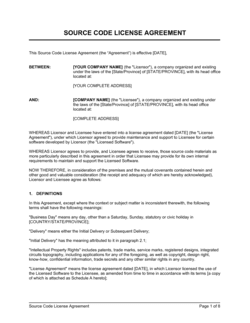
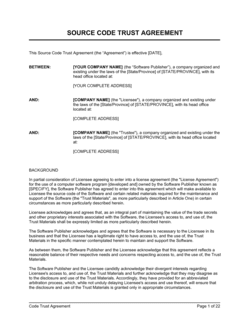
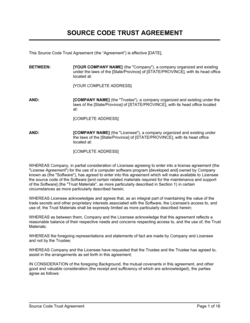
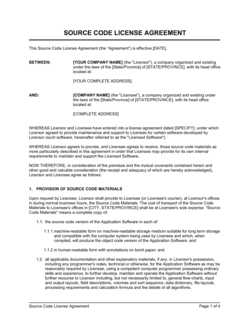
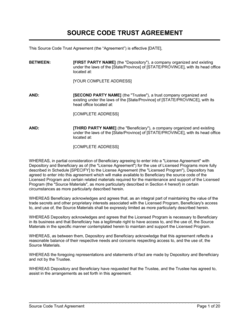
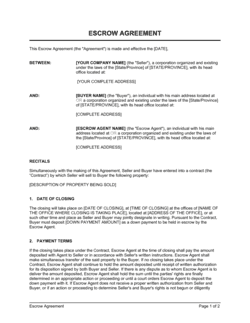
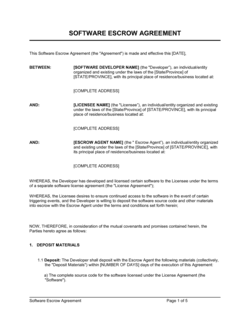
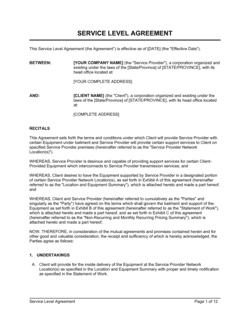
Source Code Escrow Agreement Template

Free Word download • Edit online • Save & share with Drive • Export to PDF

8 pages30–40 min to fillDifficulty: ComplexSignature requiredLegal review recommended
Learn more ↓
FreeSource Code Escrow Agreement Template

At a glance

What it is
A Source Code Escrow Agreement is a legally binding three-party contract between a software licensor, a licensee, and a neutral escrow agent that governs the deposit, safekeeping, and conditional release of proprietary source code. This free Word download gives you a structured, attorney-reviewed starting point you can edit online and export as PDF to protect both parties when a critical software relationship is at stake.
When you need it
Use it whenever a licensee depends on mission-critical software whose source code is owned by a third-party vendor — particularly when the licensor's insolvency, acquisition, or breach of maintenance obligations would leave the licensee unable to operate or maintain the application.
What's inside
Party definitions and escrow agent appointment, deposit obligations and technical specifications, verification procedures, release conditions and triggers, licensee use restrictions post-release, fees and payment terms, confidentiality, term and termination, liability limitations, and governing law and dispute resolution.

What is a Source Code Escrow Agreement?

A Source Code Escrow Agreement is a legally binding three-party contract between a software licensor, a licensee, and a neutral escrow agent that governs the deposit, safekeeping, and conditional release of proprietary source code. The licensor deposits its codebase — along with build scripts, dependency manifests, and technical documentation — with the escrow agent, which holds those materials in strict confidence and releases them to the licensee only when a defined trigger event occurs, such as licensor insolvency, cessation of operations, or a material breach of maintenance obligations. The agreement protects the licensee's ability to maintain and operate critical software even if the vendor can no longer support it, while giving the licensor comfort that its most sensitive IP remains protected under controlled release conditions.

Why You Need This Document

When a business depends on third-party software to run its core operations, the vendor's continued existence and willingness to provide support are existential dependencies that most organizations never formally protect. If the licensor files for bankruptcy, is acquired by a competitor, or quietly winds down without filing for anything, the licensee is left operating software it cannot maintain, patch, or modify — with no legal path to the source code needed to keep it running. The consequences range from regulatory non-compliance and operational downtime to forced emergency migrations costing hundreds of thousands of dollars. A source code escrow agreement converts that unmanaged dependency into a documented, enforceable contingency plan. For enterprise buyers, regulated industries, and any organization running mission-critical software on a vendor platform with fewer than several hundred employees, this agreement is not a precaution — it is a baseline operational risk control. This template gives you a structured, attorney-reviewed starting point that closes the most common drafting gaps before they become crisis-point liabilities.

Which variant fits your situation?

If your situation is…Use this template
Single licensee and one software vendor using a specialist escrow agentThree-Party Source Code Escrow Agreement
Multiple licensees sharing escrow costs for the same software productMulti-Licensee Source Code Escrow Agreement
Licensor depositing source code with no named licensee at signingBeneficiary Source Code Escrow Agreement
SaaS product where access to the hosted environment is also neededSaaS Escrow and Technology Escrow Agreement
Short-term project with a defined delivery milestone rather than ongoing maintenanceSoftware Development Escrow Agreement
IP assignment combined with escrow pending full payment of purchase priceIP Transfer and Escrow Agreement
Open-source component with proprietary modifications requiring selective escrowHybrid Source Code Escrow Agreement

Common mistakes to avoid

❌ Vague deposit materials description

Why it matters: If the deposit clause says only 'source code,' the licensor can deposit a subset of files that technically satisfies the clause but cannot be compiled or deployed without missing components.

Fix: Define deposit materials by reference to a technical Schedule A listing every required component, file type, toolchain version, and dependency — reviewed and signed off by a developer from each side.

❌ No update obligation on the licensor

Why it matters: Software evolves rapidly; a deposit made at signing becomes obsolete within months. A licensee who triggers release and receives a two-year-old codebase cannot maintain the production system it actually runs.

Fix: Include an explicit update obligation requiring deposit of new materials within 30–60 days of each material release, with failure to update treated as a standalone release condition.

❌ Release conditions limited to formal bankruptcy only

Why it matters: A licensor can cease all development, stop responding to support tickets, and effectively abandon a product without ever filing for bankruptcy — leaving the licensee without a release trigger.

Fix: Add independent release conditions for cessation of operations, persistent failure to provide maintenance services, and failure to meet update obligations — each operable without the others.

❌ No verification clause or optional verification with no cost allocation

Why it matters: Industry studies show that a significant proportion of source code deposits fail technical verification — the deposited files are incomplete, encrypted, or reference unavailable dependencies. Discovering this at the moment of a crisis is catastrophic.

Fix: Require at least one verification within the first 90 days of the initial deposit and annually thereafter, with a clear allocation of costs and a cure period if the deposit fails verification.

❌ Allowing the licensor to terminate escrow unilaterally

Why it matters: A licensor facing financial distress has direct incentive to cancel the escrow to eliminate the annual fee. Without a notice requirement to the licensee, the protection disappears silently.

Fix: Require that any licensor-initiated termination provide at least 60 days' written notice to the licensee and prohibit termination while any release request or dispute is pending.

❌ Omitting the post-release use restriction

Why it matters: Without an explicit use-restriction clause, a licensee receiving released source code may have broader rights than either party intended, including the ability to modify and redistribute the code.

Fix: Draft a use license that expressly limits post-release access to internal maintenance and support of the licensed software, and exclude sublicensing, distribution, and competitive development by name.

The 10 key clauses, explained

Parties and escrow agent appointment

In plain language: Identifies the licensor, licensee, and escrow agent by their full legal names, and formally appoints the escrow agent to act in that capacity under the terms of the agreement.

Sample language
This Source Code Escrow Agreement is entered into on [DATE] among [LICENSOR LEGAL NAME] ('Licensor'), [LICENSEE LEGAL NAME] ('Licensee'), and [ESCROW AGENT LEGAL NAME] ('Escrow Agent'). The parties hereby appoint Escrow Agent to receive, hold, and release the Deposit Materials in accordance with this Agreement.

Common mistake: Naming a division or brand name instead of the registered legal entity. If the licensor is later acquired, the escrow obligation cannot be cleanly transferred to the successor without the correct legal name.

Description of deposit materials

In plain language: Specifies exactly what the licensor must deposit — source code files, build scripts, compiler and toolchain versions, dependency manifests, and any documentation required to compile and operate the software from scratch.

Sample language
Deposit Materials shall include: (a) all source code files for [SOFTWARE NAME] version [X.X]; (b) build scripts, makefiles, and toolchain specifications; (c) third-party library licenses; (d) technical documentation sufficient to compile and deploy the software without assistance from Licensor.

Common mistake: Defining deposit materials as 'the source code' without listing build dependencies and toolchain versions. A deposit that cannot be compiled without undocumented libraries is worthless at release.

Initial deposit and update obligations

In plain language: Sets the deadline for the first deposit after agreement execution and requires the licensor to deposit updated materials within a defined number of days after each material software release.

Sample language
Licensor shall make the initial deposit within [30] days of execution. Licensor shall deposit updated Deposit Materials within [30] days of each Major Release and within [60] days of each Minor Release of the Software, as defined in Schedule A.

Common mistake: Omitting update obligations entirely. A deposit made at signing becomes outdated within months — licensees relying on a two-year-old deposit may receive code that no longer matches the software in production.

Verification procedures

In plain language: Defines the process by which the deposited materials are technically audited to confirm they are complete and compilable — either by the escrow agent, a named third-party auditor, or both parties jointly.

Sample language
Either party may request a Technical Verification of the Deposit Materials no more than [ONCE / TWICE] per calendar year. Verification shall be conducted by [ESCROW AGENT / MUTUALLY AGREED THIRD-PARTY AUDITOR] within [30] days of the request. Costs of verification shall be borne by [REQUESTING PARTY / LICENSOR / LICENSEE].

Common mistake: Skipping the verification clause or making it optional without specifying who pays. Unverified deposits are frequently found to be incomplete or uncommittable — discovered only at the worst possible moment.

Release conditions

In plain language: Lists the specific events that entitle the licensee to request release of the deposit materials from the escrow agent — typically insolvency, material breach of maintenance obligations, or cessation of operations.

Sample language
Escrow Agent shall release the Deposit Materials to Licensee upon the occurrence of any of the following: (a) Licensor files for bankruptcy or has a receiver appointed; (b) Licensor ceases business operations; (c) Licensor materially breaches its maintenance obligations under the License Agreement and fails to cure within [30] days of written notice; (d) Licensor is acquired and the successor fails to assume Licensor's obligations within [60] days.

Common mistake: Defining release conditions so narrowly — e.g., only upon formal bankruptcy filing — that the licensor can effectively wind down operations without triggering release. Include cessation of business and failure to maintain as independent triggers.

Release procedure and dispute resolution

In plain language: Sets out the mechanics of how a release request is made, how the escrow agent notifies the licensor, the licensor's right to object within a defined window, and how disputes about whether a release condition has been met are resolved.

Sample language
Licensee shall notify Escrow Agent in writing of a Release Condition, with supporting evidence. Escrow Agent shall notify Licensor within [5] business days. Licensor may object within [15] business days by written notice to Escrow Agent. If no objection is received, Escrow Agent shall release the Deposit Materials. Disputes shall be resolved by [ARBITRATION / COURT ORDER] before any release is made.

Common mistake: Giving the licensor an indefinite right to object without specifying a resolution mechanism. An unresolved objection can block release indefinitely, defeating the purpose of the escrow.

Post-release use license

In plain language: Grants the licensee a limited, non-transferable license to use the released source code solely to maintain and support the licensed software for its own internal operations — not to sublicense, distribute, or create competing products.

Sample language
Upon release, Licensor grants Licensee a non-exclusive, non-transferable, royalty-free license to use the Deposit Materials solely to maintain and support the Software for Licensee's internal business operations. Licensee shall not sublicense, distribute, or use the Deposit Materials to develop competing products.

Common mistake: Omitting the use restriction entirely. Without it, a licensee could theoretically use released source code to build and sell competing software — a result no licensor intends and courts may not fill by implication.

Confidentiality of deposit materials

In plain language: Binds all three parties — licensor, licensee, and escrow agent — to keep the deposited source code confidential, with the escrow agent prohibited from accessing or disclosing the materials except as required to perform verification or release.

Sample language
Each party shall maintain the Deposit Materials in strict confidence. Escrow Agent shall access the Deposit Materials only as necessary to perform verification and release services. Licensee shall protect released materials with at least the same degree of care it uses to protect its own most sensitive proprietary information, but in no event less than reasonable care.

Common mistake: Applying confidentiality only to the licensee post-release and failing to bind the escrow agent. Escrow agents employ staff who handle deposits — without an explicit obligation, internal access is uncontrolled.

Fees, payment, and escrow agent liability

In plain language: Specifies who pays the escrow agent's setup, annual storage, and verification fees, and limits the escrow agent's liability to gross negligence or willful misconduct — protecting it from claims that arise solely from following the agreement's release procedures.

Sample language
Licensee shall pay Escrow Agent an annual fee of $[AMOUNT], due on the anniversary of execution. Verification fees of $[AMOUNT] per audit are payable by [REQUESTING PARTY]. Escrow Agent's liability to either party shall not exceed the fees paid in the [12] months preceding the event giving rise to the claim, except in cases of gross negligence or willful misconduct.

Common mistake: Failing to state explicitly who pays which fee. Disputes over fee responsibility cause agreements to lapse unpaid — escrow agents routinely terminate dormant escrow arrangements, destroying the protection both parties intended.

Term, termination, and governing law

In plain language: Sets the initial term, auto-renewal mechanics, conditions under which any party may terminate, what happens to the deposit materials on termination, and the jurisdiction whose law governs the agreement.

Sample language
This Agreement shall commence on [DATE] and continue for [1] year, renewing automatically for successive one-year terms unless either party provides [60] days' written notice of non-renewal. Upon termination, Escrow Agent shall return the Deposit Materials to Licensor unless a release request is pending. This Agreement is governed by the laws of [STATE / JURISDICTION].

Common mistake: Allowing the licensor to terminate the escrow unilaterally without notice to the licensee. A licensor in financial distress has every incentive to cancel escrow quietly — the agreement should require joint consent or advance notice to the licensee before termination takes effect.

How to fill it out

  1. 1

    Identify and name all three parties correctly

    Enter the full registered legal names of the licensor, licensee, and escrow agent. Confirm each entity's name against corporate registry records before signing.

    💡 If the escrow agent is a professional escrow provider (e.g., Iron Mountain, NCC Group, Escrow London), use their exact registered company name — not their brand name — to ensure obligations transfer on any internal restructuring.

  2. 2

    Define the deposit materials with technical specificity

    List every component required to compile, build, and deploy the software from scratch: source files, build scripts, dependency manifests, compiler versions, environment configuration, and any third-party component licenses. Attach this as Schedule A.

    💡 Have a developer from each side jointly draft Schedule A — a legal drafter alone will miss technical dependencies that make the deposit useless at release.

  3. 3

    Set the initial deposit deadline and update schedule

    Specify the number of days after execution for the first deposit and define update obligations tied to major and minor software releases. Typical ranges: 30 days for initial deposit, 30–60 days for updates.

    💡 Tie update obligations to version numbering conventions already used in the license agreement — don't create a new definition of 'major release' that conflicts with the main contract.

  4. 4

    Draft release conditions with precision

    List every event that triggers release: insolvency, cessation of operations, material breach of maintenance, failed acquisition assumption. Use 'any of the following' language so each trigger operates independently.

    💡 Add a catch-all for 'licensor's failure to update deposit materials within [90] days of a required update deadline' as a standalone release trigger — this covers quiet wind-downs that never formally file for bankruptcy.

  5. 5

    Establish the release procedure and objection window

    Define how the licensee submits a release request, how quickly the escrow agent must notify the licensor, and how long the licensor has to object (typically 10–15 business days). Specify the dispute resolution mechanism — arbitration is faster than litigation for urgent release scenarios.

    💡 Expedited arbitration clauses (resolution within 30 days) are worth the extra drafting cost for release disputes — waiting 12 months for a court order when your business is down is commercially catastrophic.

  6. 6

    Specify the post-release use license scope

    Write the use license to cover only what the licensee genuinely needs: internal maintenance and support of the licensed software. Explicitly exclude sublicensing, distribution, and competitive use.

    💡 Consider adding a time limit on the post-release use license — for example, 5 years — to give the licensor (or its successor) a path to renegotiating terms if the software remains commercially viable.

  7. 7

    Confirm fees and payment responsibility

    Enter the escrow agent's annual fee, verification fee schedule, and who pays each. State the payment due date and consequences of non-payment (typically 30-day cure period before the escrow agent may suspend services).

    💡 Negotiate a fee split rather than placing 100% on the licensee when the licensor also benefits from the escrow relationship — for instance, it satisfies enterprise customer procurement requirements that would otherwise block a sale.

  8. 8

    Execute before the software license goes live

    All three parties must sign before the underlying software license takes effect. A retroactive escrow arrangement may not be enforceable as part of the original bargain in common-law jurisdictions.

    💡 Use eSign with timestamped execution records — escrow agent, licensor, and licensee signatures should be dated within the same business day to avoid any fresh-consideration arguments.

Frequently asked questions

What is a source code escrow agreement?

A source code escrow agreement is a three-party contract among a software licensor, a licensee, and a neutral escrow agent. The licensor deposits its proprietary source code with the escrow agent, which holds it under strict confidentiality and releases it to the licensee only if a defined trigger event occurs — such as licensor insolvency or a material breach of maintenance obligations. It protects the licensee's ability to maintain and operate critical software even if the vendor is no longer able to support it.

When should a licensee require source code escrow?

Source code escrow is most important when the licensed software is mission-critical to the licensee's operations, when the licensor is a small or mid-sized vendor whose long-term viability is uncertain, or when the licensee has no practical alternative to the software and would face significant downtime or cost to replace it. Financial institutions, healthcare providers, and enterprise buyers routinely require escrow as a standard procurement condition for any third-party software running core operational systems.

Who are the three parties in a source code escrow agreement?

The licensor is the software developer or vendor that owns and deposits the source code. The licensee is the business that has licensed the software and is the beneficiary of the escrow arrangement. The escrow agent is an independent third party — typically a specialist escrow provider or law firm — that receives, stores, and releases the deposit materials according to the terms of the agreement.

What events typically trigger release of source code from escrow?

Common release triggers include the licensor filing for bankruptcy or entering receivership, the licensor ceasing its business operations, a material and uncured breach of the licensor's maintenance and support obligations, the licensor's acquisition by a competitor where the successor fails to assume the licensor's obligations, or persistent failure by the licensor to update the escrow deposit following material software releases. Well-drafted agreements list each trigger independently so that one can operate without requiring others to also be satisfied.

What is a technical verification and why does it matter?

A technical verification is an audit of the deposited source code to confirm it is complete, accurate, and sufficient to compile and deploy the software without assistance from the licensor. Industry experience shows that a meaningful percentage of unverified deposits are incomplete or contain files that cannot be built — making them useless at the moment of a crisis. Requiring verification within 90 days of the initial deposit and annually thereafter is considered best practice.

What can the licensee do with released source code?

The post-release use license is typically narrow: the licensee may use the source code solely to maintain and support the licensed software for its own internal operations. It generally cannot sublicense the code, distribute it, or use it to build competing products. Some agreements permit the licensee to engage a third-party developer to perform maintenance on its behalf, provided that developer is bound by equivalent confidentiality obligations.

Does a SaaS product need source code escrow?

SaaS products present unique escrow challenges because the licensee typically accesses the software via a hosted environment rather than a local installation. In these cases, source code escrow alone may be insufficient — the licensee also needs access to infrastructure configurations, deployment scripts, and database schemas to recreate the hosted environment. Specialist SaaS escrow arrangements, sometimes called technology escrow or continuity escrow, address these additional components alongside the source code.

Is a source code escrow agreement enforceable?

A source code escrow agreement is generally enforceable in most jurisdictions when properly drafted and executed by all three parties before the underlying license takes effect. Enforceability is strongest when release conditions are specific and objectively verifiable, the escrow agent is a professional independent party, and the agreement is signed as part of the original licensing transaction rather than added retroactively. Consider consulting a lawyer for high-value or cross-border arrangements.

Who typically pays the escrow agent's fees?

In most commercial arrangements, the licensee pays the escrow agent's annual storage and administration fees, since the licensee is the primary beneficiary of the escrow protection. However, when the escrow arrangement satisfies enterprise procurement requirements that enable the licensor to close a sale it would otherwise lose, the parties sometimes negotiate a fee split or the licensor absorbs the cost as a sales condition. Verification fees are typically paid by the requesting party.

How this compares to alternatives

vs Software License Agreement

A software license agreement governs the rights to use the compiled software — what the licensee may do with it, support obligations, and fees. A source code escrow agreement is a companion document that protects the licensee's ability to maintain that software if the licensor can no longer support it. The two documents work in tandem and should cross-reference each other explicitly.

vs Non-Disclosure Agreement

An NDA protects confidential information shared between parties during negotiations or an ongoing relationship. A source code escrow agreement addresses a more specific concern — the controlled release of deposited IP to a third party upon defined events. While the escrow agreement contains confidentiality provisions, it is not a substitute for a standalone NDA covering the broader relationship.

vs Technology Transfer Agreement

A technology transfer agreement transfers ownership or broad license rights in IP — typically used in M&A, university commercialization, or joint ventures. A source code escrow agreement does not transfer ownership; it merely provides the licensee with conditional access to maintain existing software. Use a technology transfer agreement when the goal is to assign or broadly license IP outright.

vs SaaS Agreement

A SaaS agreement governs access to software delivered as a hosted service and typically includes uptime SLAs and data portability provisions. Source code escrow is a supplementary protection layer addressing what happens if the SaaS provider ceases to operate. Enterprise SaaS deals increasingly combine a SaaS agreement with a technology continuity escrow arrangement covering source code, deployment scripts, and infrastructure configurations.

Industry-specific considerations

Financial Services

Regulatory business continuity requirements mandate escrow for core banking, trading, and payment processing platforms — often with annual verification as a compliance condition.

Healthcare and Life Sciences

Clinical management, EHR, and medical device software require escrow to ensure patient data access and operational continuity if a vendor exits the market or is acquired.

SaaS and Technology

Enterprise SaaS vendors include escrow as a standard deal term to satisfy Fortune 500 procurement requirements, with SaaS continuity escrow covering hosted environments alongside source code.

Government and Public Sector

Public procurement regulations in the US, UK, and EU frequently mandate escrow for licensed software used in critical national infrastructure, defense, and public service delivery.

Manufacturing and Industrial

Embedded software controlling production equipment or SCADA systems requires escrow because replacement lead times can run 12–24 months, making continuity of the existing codebase operationally critical.

Professional Services and Legal

Law firms and professional services firms licensing practice management or document automation software increasingly require escrow given the sensitivity of client data dependent on those systems.

Jurisdictional notes

United States

Source code escrow agreements are governed by state contract law and the Uniform Commercial Code where applicable. California and Delaware are common choices of governing law for technology companies. Bankruptcy proceedings under Chapter 11 trigger automatic stay provisions that can delay release — include an explicit carve-out referencing 11 U.S.C. § 365(n), which protects licensees' rights to licensed IP in bankruptcy. Non-compete provisions restricting post-release development activity should be reviewed for enforceability in the licensor's home state.

Canada

Canadian escrow agreements are governed by provincial contract law — Ontario and British Columbia are the most common choices for technology contracts. The Companies' Creditors Arrangement Act (CCAA) and Bankruptcy and Insolvency Act (BIA) govern insolvency triggers; Canadian courts have generally upheld licensees' IP rights in restructuring proceedings. Quebec-based parties should note that contracts governed by Quebec civil law have distinct interpretive rules, and bilingual documentation may be required for provincially regulated entities.

United Kingdom

UK source code escrow agreements are governed by English contract law, with specialist escrow providers regulated under applicable financial services and data protection rules. NCSC (National Cyber Security Centre) guidance recommends escrow for software used in critical national infrastructure. Post-Brexit, EU IP and data protection rules no longer apply automatically; cross-border arrangements with EU licensees or licensors require separate GDPR transfer mechanisms for any personal data embedded in deposit materials. Standard Chartered terms from the Society for Computers and Law provide a widely accepted framework for UK escrow arrangements.

European Union

EU member states apply domestic contract law to escrow arrangements, with no harmonized escrow framework across the union. German and French courts are among the most active in enforcing software escrow terms in insolvency proceedings. GDPR applies where deposit materials include personal data — even embedded test data in source code — requiring a data processing addendum with the escrow agent if personal data is present. The EU Cyber Resilience Act and NIS2 Directive are increasing regulatory pressure on software vendors to provide continuity mechanisms, making escrow a de facto compliance tool for critical software suppliers.

Template vs lawyer — what fits your deal?

PathBest forCostTime
Use the templateStandard two-party software relationships where the licensee wants a documented escrow arrangement and the licensor is a cooperative domestic vendorFree1–2 hours
Template + legal reviewEnterprise software deals above $100K ACV, regulated industries, or cross-border arrangements where release conditions need jurisdictional tailoring$500–$1,5002–5 business days
Custom draftedMission-critical infrastructure software, multi-licensee arrangements, SaaS continuity escrow, or deals where the licensor is a major software company with negotiating leverage$2,500–$8,000+2–4 weeks

Glossary

Escrow Agent
A neutral third party that accepts, stores, and releases the deposited source code strictly according to the conditions agreed in the escrow agreement.
Deposit Materials
All items the licensor places into escrow — typically source code, build instructions, developer documentation, and any third-party component licenses needed to compile and run the software.
Release Condition
A specific, pre-agreed event — such as licensor insolvency, breach of maintenance obligations, or cessation of business — that triggers the escrow agent to release the deposit materials to the licensee.
Verification
A technical audit of the deposited materials to confirm they are complete, accurate, and sufficient to compile and operate the software as described in the license agreement.
Licensor
The software developer or vendor that owns the intellectual property and deposits the source code into escrow as security for its obligations to the licensee.
Licensee
The company or individual that has licensed the software and is the intended beneficiary of the escrow — entitled to receive the source code if a release condition is triggered.
Insolvency Trigger
A release condition activated when the licensor enters bankruptcy, receivership, or makes a general assignment for the benefit of creditors.
Update Obligation
A contractual requirement for the licensor to deposit a new, updated version of the source code within a defined period — typically 30 to 60 days — after each material software release.
Use License
The limited, post-release right granted to the licensee to use the deposited source code solely to maintain and support the licensed software for its own internal operations.
Escrow Fee
The annual or per-event fee charged by the escrow agent for setup, storage, verification services, and release administration — typically paid by the licensee or split between parties.
Successor in Interest
An entity — such as an acquirer or assignee — that inherits the licensor's obligations under the escrow agreement when the original licensor transfers its business or IP.

Part of your Business Operating System

This document is one of 3,000+ business & legal templates included in Business in a Box.

  • Fill-in-the-blanks — ready in minutes
  • 100% customizable Word document
  • Compatible with all office suites
  • Export to PDF and share electronically

Create your document in 3 simple steps.

From template to signed document — all inside one Business Operating System.
1
Download or open template

Access over 3,000+ business and legal templates for any business task, project or initiative.

2
Edit and fill in the blanks with AI

Customize your ready-made business document template and save it in the cloud.

3
Save, Share, Send, Sign

Share your files and folders with your team. Create a space of seamless collaboration.

Save time, save money, and create top-quality documents.

★★★★★

"Fantastic value! I'm not sure how I'd do without it. It's worth its weight in gold and paid back for itself many times."

Managing Director · Mall Farm
Robert Whalley
Managing Director, Mall Farm Proprietary Limited
★★★★★

"I have been using Business in a Box for years. It has been the most useful source of templates I have encountered. I recommend it to anyone."

Business Owner · 4+ years
Dr Michael John Freestone
Business Owner
★★★★★

"It has been a life saver so many times I have lost count. Business in a Box has saved me so much time and as you know, time is money."

Owner · Upstate Web
David G. Moore Jr.
Owner, Upstate Web

Run your business with a system — not scattered tools

Stop downloading documents. Start operating with clarity. Business in a Box gives you the Business Operating System used by over 250,000 companies worldwide to structure, run, and grow their business.

Free Forever Plan · No credit card required