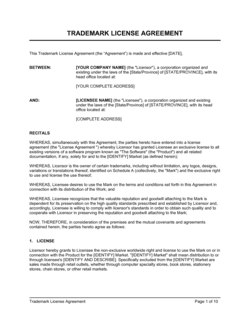
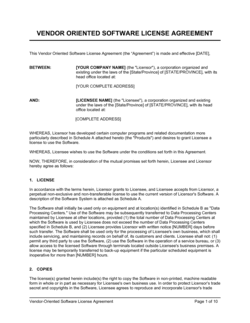
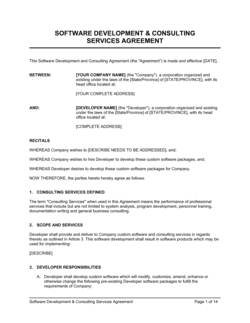
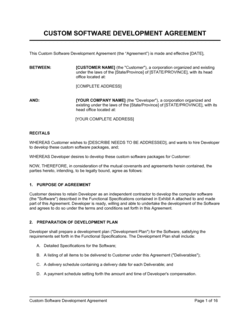
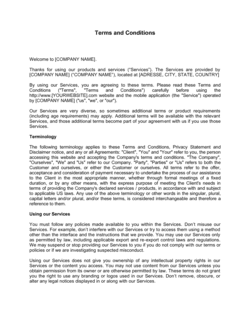
End-User Software License Agreement Template

Free Word download • Edit online • Save & share with Drive • Export to PDF

14 pages30–45 min to fillDifficulty: ComplexSignature requiredLegal review recommended
Learn more ↓
FreeEnd-User Software License Agreement Template

At a glance

What it is
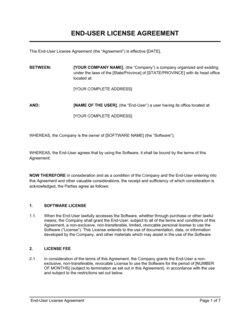
An End User Software License Agreement (EULA) is a legally binding contract between a software publisher and the end user that defines the terms under which the software may be installed, accessed, and used. This free Word download covers license grant, permitted and prohibited uses, intellectual property ownership, warranty disclaimers, liability limitations, and termination — and can be edited online and exported as PDF for deployment with any desktop, mobile, or SaaS application.
When you need it
Use a EULA before distributing, selling, or making any software application available to users — whether via download, CD, SaaS portal, or an app store. It is especially critical when the software handles user data, integrates with third-party systems, or is licensed rather than sold outright.
What's inside
License grant and scope, permitted use and restrictions, intellectual property ownership and reservation of rights, warranty disclaimers, limitation of liability, data collection and privacy notice, update and maintenance terms, termination conditions, and governing law. The template includes placeholder brackets throughout so you can tailor it to your product and jurisdiction in under an hour.

What is an End User Software License Agreement?

An End User Software License Agreement (EULA) is a legally binding contract between a software publisher and the individual or organization that installs or uses the software. It establishes that the software is being licensed — not sold — and defines the precise scope of that license: which devices it covers, what uses are permitted, what is prohibited, and how long the license lasts. Beyond governing the license itself, a well-drafted EULA assigns intellectual property ownership unambiguously to the publisher, disclaims implied warranties, caps the publisher's financial liability, and sets the terms under which the license terminates. Without one, distributing software leaves the publisher exposed to uncapped liability claims, IP disputes, and users who legally resell or redistribute the product under the first-sale doctrine.

Why You Need This Document

Every time someone downloads, installs, or accesses your software without a binding EULA in place, you are distributing a product with no legal framework protecting you or defining the user's obligations. If the software crashes a user's system, corrupts data, or fails to perform as expected, an absent or unenforceable EULA leaves you without the warranty disclaimer and liability cap that would otherwise limit your exposure to the fees the user paid. Competitors can legally decompile, study, and replicate your product if you have not contractually prohibited it. Users can redistribute or resell your software, undermining your pricing and licensing model. Regulators in the EU and California can treat your data-collection practices as undisclosed and unlawful if the EULA does not contain adequate privacy language. This template gives independent developers, SaaS founders, and enterprise software vendors a professionally structured starting point that addresses all of these risks in a single document — ready to deploy as a click-wrap screen before your first user accepts the license.

Which variant fits your situation?

If your situation is…Use this template
Distributing desktop or on-premise software to consumersEnd User Software License Agreement
Providing a cloud-based SaaS platform to business customersSoftware as a Service Agreement
Sharing proprietary code with a business partner or integratorSoftware License Agreement (B2B)
Open-source project with contribution and use restrictionsOpen Source Software License
Engaging a developer to build software you will ownSoftware Development Agreement
Licensing software that processes personal data under GDPR or CCPAData Processing Agreement
Distributing a mobile game with in-app purchasesMobile App End User License Agreement

Common mistakes to avoid

❌ Burying the EULA after installation without click-wrap acceptance

Why it matters: A EULA displayed only in a readme file or accessible only via a help menu after installation has been found unenforceable in multiple US and EU cases because the user never affirmatively assented to it.

Fix: Present the EULA as a mandatory click-wrap screen during installation or account creation, with a checkbox the user must actively select before proceeding.

❌ Omitting an AI and machine learning use prohibition

Why it matters: Without an explicit restriction, users may legally feed your software's output, interfaces, or documentation into AI training datasets, effectively giving competitors access to your proprietary methods at no cost.

Fix: Add a clause expressly prohibiting use of the software or its output to train, fine-tune, or benchmark any artificial intelligence or machine learning model without written consent.

❌ Using a lowercase warranty disclaimer

Why it matters: Under the UCC and equivalent statutes in Canada and the UK, warranty disclaimers must be conspicuous — meaning a reasonable person would notice them. Lowercase text embedded in a body paragraph consistently fails this test in court.

Fix: Format all warranty disclaimer and limitation of liability language in all-capital letters, and consider bolding the block as an additional safeguard.

❌ Failing to address what happens to user data upon termination

Why it matters: Without a post-termination data clause, users in GDPR and CCPA jurisdictions may assert ongoing data rights even after the license ends, creating compliance exposure and complicating account closure.

Fix: Include a clause specifying that the publisher will delete or return user data within a defined period (e.g., 30 days) following termination, and describe any archival exceptions clearly.

❌ Copying a competitor's EULA without jurisdiction review

Why it matters: EULAs are heavily jurisdiction-specific. A EULA drafted for US consumers may lack mandatory EU consumer-protection clauses, void warranty disclaimers, or fail GDPR consent requirements — exposing you to regulatory fines from the first EU user.

Fix: Have a qualified technology attorney review the EULA for each major jurisdiction in which you distribute the software before launch, even if you start from a high-quality template.

❌ No severability clause

Why it matters: Courts routinely void overbroad restrictions in EULAs — particularly reverse-engineering bans, non-circumvention clauses, and data-use provisions. Without severability, a single voided clause can invalidate the entire agreement.

Fix: Include a standard severability clause confirming that if any provision is held invalid, the remaining provisions continue in full force.

The 10 key clauses, explained

License grant and scope

In plain language: Defines exactly what the user is permitted to do with the software — install on a specified number of devices, use for personal or commercial purposes, and for what duration.

Sample language
[COMPANY NAME] grants you a limited, non-exclusive, non-transferable, revocable license to install and use [SOFTWARE NAME] on [NUMBER] device(s) solely for your personal or internal business purposes during the License Term.

Common mistake: Using an overly broad grant such as 'install on any device you own' without a seat or device limit. This prevents the publisher from upselling additional licenses and complicates enforcement.

Restrictions on use

In plain language: Lists prohibited activities — reverse engineering, sublicensing, redistribution, and using the software to build a competing product.

Sample language
You may not: (a) copy, modify, or distribute the Software; (b) reverse engineer, decompile, or disassemble the Software; (c) sublicense, rent, lease, or transfer the Software to any third party; or (d) use the Software to develop a competing product or service.

Common mistake: Omitting a prohibition on using the software to train AI or machine learning models. This gap is increasingly exploited, particularly with developer tools and data-processing software.

Intellectual property ownership

In plain language: Confirms that the publisher owns all rights to the software, its underlying code, documentation, and updates — and that the EULA is a license, not a sale.

Sample language
The Software is licensed, not sold. [COMPANY NAME] retains all right, title, and interest in and to the Software, including all patents, copyrights, trademarks, trade secrets, and other intellectual property rights.

Common mistake: Failing to state that the EULA is a license and not a sale. Without this language, the 'first sale doctrine' in the US may allow users to resell or redistribute their copy.

User data and privacy

In plain language: Discloses what data the software collects from the user's device or usage, how it is stored and used, and references the publisher's full privacy policy.

Sample language
The Software may collect certain usage data and diagnostic information as described in our Privacy Policy at [URL]. By using the Software, you consent to such collection and processing in accordance with applicable data protection laws.

Common mistake: Referencing a privacy policy URL that changes or goes offline. Courts have found that broken links undermine consent and may render the data collection clause unenforceable.

Updates, maintenance, and support

In plain language: States whether the publisher will provide updates, bug fixes, or new versions — and whether doing so is an obligation or purely at the publisher's discretion.

Sample language
[COMPANY NAME] may, at its sole discretion, provide updates or new versions of the Software. Any such updates are subject to this Agreement unless accompanied by a separate license. [COMPANY NAME] has no obligation to provide support unless set out in a separate Support Agreement.

Common mistake: Promising automatic updates without reserving the right to change features or discontinue the software. This exposes the publisher to breach claims when updates alter functionality users depend on.

Warranty disclaimer

In plain language: Explicitly disclaims implied warranties — merchantability, fitness for a particular purpose, and non-infringement — so the publisher is not liable if the software fails to meet the user's expectations.

Sample language
THE SOFTWARE IS PROVIDED 'AS IS' WITHOUT WARRANTY OF ANY KIND. [COMPANY NAME] DISCLAIMS ALL IMPLIED WARRANTIES, INCLUDING BUT NOT LIMITED TO WARRANTIES OF MERCHANTABILITY, FITNESS FOR A PARTICULAR PURPOSE, AND NON-INFRINGEMENT, TO THE FULLEST EXTENT PERMITTED BY APPLICABLE LAW.

Common mistake: Using mixed-case or lowercase text for the disclaimer. In the US, the UCC and most courts require conspicuous, typically all-caps language for warranty disclaimers to be enforceable against consumers.

Limitation of liability

In plain language: Caps the publisher's total financial exposure to the user — typically the fees paid for the software in the prior 12 months — and excludes liability for indirect, consequential, or punitive damages.

Sample language
TO THE MAXIMUM EXTENT PERMITTED BY LAW, [COMPANY NAME]'S TOTAL LIABILITY TO YOU SHALL NOT EXCEED THE AMOUNTS PAID BY YOU FOR THE SOFTWARE IN THE TWELVE (12) MONTHS PRECEDING THE CLAIM. IN NO EVENT SHALL [COMPANY NAME] BE LIABLE FOR INDIRECT, INCIDENTAL, SPECIAL, OR CONSEQUENTIAL DAMAGES.

Common mistake: Setting the liability cap at a nominal fixed amount (e.g., $100) rather than fees paid. Courts in several jurisdictions have struck down unconscionably low caps, especially in consumer-facing software.

Term and termination

In plain language: Specifies how long the license lasts, what events trigger automatic termination (e.g., breach, non-payment), and what happens to the user's data and installations upon termination.

Sample language
This Agreement is effective until terminated. Your rights under this Agreement terminate automatically and without notice if you fail to comply with any term. Upon termination, you must cease all use of the Software and destroy all copies in your possession.

Common mistake: No post-termination obligations on the user. Without a clause requiring deletion of copies, users can continue to run software they are no longer licensed to use.

Governing law and dispute resolution

In plain language: Identifies the jurisdiction whose law governs the agreement and specifies whether disputes go to arbitration, mediation, or court — and where.

Sample language
This Agreement is governed by the laws of [STATE / JURISDICTION], without regard to conflict-of-law principles. Any dispute shall be resolved by binding arbitration administered by [AAA / JAMS] in [CITY], except that either party may seek injunctive relief in any court of competent jurisdiction.

Common mistake: Choosing a governing law jurisdiction with no connection to where the software is developed or the user base is located. Some jurisdictions — particularly US states with strong consumer-protection laws — apply local law regardless of a contractual choice-of-law clause.

Entire agreement and severability

In plain language: States that the EULA is the complete agreement between the parties, superseding prior representations, and that invalid clauses are severed rather than voiding the whole agreement.

Sample language
This Agreement constitutes the entire agreement between you and [COMPANY NAME] with respect to the Software and supersedes all prior agreements and understandings. If any provision of this Agreement is held invalid or unenforceable, that provision shall be severed and the remaining provisions shall remain in full force.

Common mistake: Omitting a severability clause. If a court voids an overbroad restriction clause — which is common with non-circumvention or data-use provisions — the entire EULA can unravel without it.

How to fill it out

  1. 1

    Identify the parties and software product

    Enter the publisher's full legal entity name and the exact product name and version number. Specify whether the user is an individual consumer or a business entity, as this affects warranty and liability clause enforceability.

    💡 Use the same product name here as you use in your app store listing, installer, and marketing materials — inconsistency creates ambiguity in enforcement.

  2. 2

    Define the license scope and seat count

    Choose perpetual or subscription, specify the number of permitted device installations, and state whether the license is for personal, commercial, or combined use. Tie the seat count to your pricing model.

    💡 For consumer software, 'up to 3 personal devices' is the current market norm and reduces support friction compared to a single-device limit.

  3. 3

    Complete the restrictions list

    Review the standard prohibited-use list and add any product-specific restrictions — such as prohibiting use in safety-critical systems, banning AI training use, or restricting geographic deployment where you have export-control obligations.

    💡 If your software exports data to third-party APIs, explicitly prohibit users from reverse engineering those integrations — this is a common gap that competitors exploit.

  4. 4

    Link the privacy policy and data collection disclosures

    Insert a live, stable URL to your privacy policy and confirm that the data-collection language in the EULA matches what the privacy policy actually describes. These two documents are read together by regulators.

    💡 Use a versioned or dated privacy policy URL (e.g., /privacy-v2) so that the link in older EULAs still resolves to the correct historical version if you are ever audited.

  5. 5

    Set the warranty disclaimer in all-caps

    Ensure the warranty disclaimer block is formatted in all-capital letters in the final document. This is a UCC and common-law requirement for the disclaimer to be considered 'conspicuous' and therefore enforceable in the US and Canada.

    💡 Bold the all-caps block as well — courts have accepted both uppercase and bold as meeting the conspicuousness standard, and using both removes ambiguity.

  6. 6

    Calibrate the liability cap to your pricing

    Set the limitation of liability to the greater of fees paid in the prior 12 months or a minimum floor amount (e.g., $50). Confirm the cap is not so low that it would be struck down as unconscionable in your target markets.

    💡 If you offer a free tier, explicitly address zero-fee users in the cap — 'fees paid, or $50 if no fees were paid' is cleaner than a blank limitation for free users.

  7. 7

    Choose governing law and dispute venue

    Select a governing law jurisdiction where your company is incorporated or has substantial operations. For consumer-facing software in the EU, note that consumer-protection law applies regardless of your choice-of-law clause.

    💡 Delaware is the most commonly chosen US governing law for software companies — its commercial court precedents are well-developed and generally favorable to publishers.

  8. 8

    Deploy the EULA at the point of acceptance

    Integrate the EULA into your installer as a click-wrap screen, or display it during account creation with a mandatory 'I Agree' checkbox. Store a timestamped record of each user's acceptance in your database.

    💡 Scroll-through enforcement — requiring users to scroll to the bottom before the 'Agree' button activates — has been upheld in multiple US and UK cases as evidence of meaningful assent.

Frequently asked questions

What is an End User Software License Agreement (EULA)?

A EULA is a legally binding contract between a software publisher and the person or organization using the software. It grants the user a limited right to install and use the software under defined conditions while reserving all intellectual property rights for the publisher. EULAs are distinct from a sale: you purchase a license to use the software, not ownership of the software itself. Nearly every commercial software product — desktop applications, mobile apps, and SaaS platforms — is governed by some form of EULA.

Is a EULA legally enforceable?

A EULA is generally enforceable when the user has adequate notice of its terms and affirmatively accepts them — typically via a click-wrap checkbox during installation or account creation. Courts in the US, UK, Canada, and the EU have upheld click-wrap EULAs as binding contracts. However, specific clauses may be voided if they are unconscionable, violate consumer-protection law, or fail formal requirements — such as all-caps warranty disclaimers under the UCC. Enforceability is jurisdiction-specific, so review by a local attorney is advisable before distributing in new markets.

What is the difference between a EULA and a Terms of Service?

A EULA governs the use of installed or downloaded software and focuses on license scope, IP ownership, and restrictions on copying or modifying the code. A Terms of Service (ToS) governs use of a website or online platform and typically addresses account conduct, content ownership, payment terms, and service availability. SaaS products often use both: a EULA for the software component and a ToS for the platform and account relationship. For most desktop or mobile applications, a EULA alone is sufficient.

Does a EULA need to be signed?

A traditional wet signature is not required for most consumer and business EULAs. Click-wrap acceptance — clicking an 'I Agree' button or checking an acknowledgment box — constitutes a valid electronic signature in the US under the E-SIGN Act, in Canada under PIPEDA and provincial e-commerce laws, and in the EU under the eIDAS Regulation. For enterprise software licenses with significant commercial value, a separately executed order form or signed addendum is common practice to create a stronger paper trail.

What should a EULA always include?

At minimum, a EULA should cover: the license grant and scope, permitted and prohibited uses, intellectual property ownership, a warranty disclaimer in conspicuous text, a limitation of liability with a defined cap, data collection and privacy disclosures, term and termination conditions (including post-termination obligations), and governing law. Missing any of these leaves meaningful legal gaps — particularly the warranty disclaimer and liability cap, which are the primary mechanisms protecting the publisher from user claims.

Can a EULA restrict reverse engineering?

In the US, reverse-engineering restrictions are generally enforceable under contract law, though the Computer Fraud and Abuse Act and DMCA provide additional statutory protections. In the EU, the Software Directive (2009/24/EC) grants users a statutory right to decompile software for interoperability purposes that cannot be contractually waived — meaning a blanket reverse-engineering prohibition is only partially enforceable for EU users. In Canada and the UK, enforceability is similarly limited for interoperability-related decompilation.

How do app store EULAs interact with Apple and Google requirements?

Apple's App Store and Google Play each require developers to agree to their standard developer agreements, which include baseline EULA terms. Apple provides a standard EULA template that applies if you do not supply a custom one. If you provide a custom EULA, it must comply with Apple's or Google's requirements and cannot conflict with their platform terms. Custom EULAs are recommended for any app that collects sensitive data, has significant commercial licensing terms, or restricts user rights beyond platform defaults.

Does a EULA cover GDPR and data privacy compliance?

A EULA can incorporate privacy disclosures and consent language, but it does not replace a standalone Privacy Policy or, where required, a Data Processing Agreement (DPA). Under GDPR, if your software processes personal data on behalf of business customers, a DPA is a separate mandatory document. The EULA should reference the Privacy Policy URL and confirm that use of the software constitutes consent to data collection as described — but the detailed rights and obligations under GDPR belong in dedicated privacy documentation.

What happens if a user violates the EULA?

A breach of the EULA typically triggers automatic termination of the license, requiring the user to stop using the software and delete all copies. The publisher may also seek injunctive relief to prevent ongoing misuse, and damages for any quantifiable harm. In practice, enforcement against individual consumers is rare due to cost, but EULA violations by businesses — particularly unauthorized redistribution or use to build a competing product — are pursued through cease-and-desist letters and, where justified, litigation.

How this compares to alternatives

vs Software as a Service Agreement

A SaaS Agreement governs access to cloud-hosted software where the user never downloads or installs anything locally — it covers uptime SLAs, subscription billing, data processing, and service credits that a EULA does not address. A EULA governs installed or downloaded software where the user runs code on their own device. SaaS products often combine both: a EULA for any installed client components and a SaaS Agreement for the hosted platform.

vs Software Development Agreement

A Software Development Agreement is between a client and a developer to build custom software — it governs who owns the resulting code, payment milestones, and delivery obligations. A EULA is between the publisher of finished software and its end users. If you commission software to be built and then distribute it, you need both: a development agreement with your developer and a EULA with your users.

vs Non-Disclosure Agreement

An NDA protects confidential information shared between two parties during a business relationship or negotiation. A EULA's confidentiality provisions protect the publisher's proprietary software from disclosure by end users, but do not create the reciprocal obligations or the breadth of protection that a standalone NDA provides. Where a software demo or beta program involves sharing unreleased features, an NDA should accompany the EULA.

vs Terms of Service Agreement

Terms of Service govern how users may interact with a website or online platform — covering account rules, content policies, payment terms, and dispute resolution. A EULA governs the use of software code itself. For a SaaS business, both documents are typically needed: Terms of Service for the web platform and user accounts, and a EULA for any downloadable components or APIs. Using Terms of Service alone for installed software leaves IP ownership and reverse-engineering restrictions unaddressed.

Industry-specific considerations

SaaS / Technology

Cloud-delivered software requires EULA clauses addressing uptime commitments, API access scope, data residency, and subscription auto-renewal terms alongside standard IP and liability provisions.

Gaming and Entertainment

Game EULAs add restrictions on cheating software, unauthorized mods, virtual currency rules, and streamer/content-creator licensing terms that standard software EULAs omit.

Healthcare / MedTech

Software handling patient data requires HIPAA Business Associate Agreement language embedded in or appended to the EULA, plus explicit disclaimers that the software is not a certified medical device.

Financial Services

Fintech and trading software EULAs must disclaim investment advice, address regulatory compliance obligations on the user, and restrict use in jurisdictions where the publisher is not licensed.

Jurisdictional notes

United States

EULAs are enforced under contract law, the DMCA, and the Computer Fraud and Abuse Act. Warranty disclaimers must be conspicuous — typically all-caps — to satisfy UCC Article 2 requirements. California's CLRA and consumer-protection statutes may void clauses that limit remedies for defective software sold to consumers, regardless of choice-of-law provisions. The FTC's enforcement of data-collection disclosures means privacy language in EULAs must match actual software behavior precisely.

Canada

Click-wrap EULAs are enforceable under provincial electronic commerce legislation, provided terms are adequately disclosed before acceptance. Quebec's Language Charter requires that software and accompanying agreements distributed to Quebec consumers be available in French. Canada's Anti-Spam Legislation (CASL) affects any in-app messaging or update notifications that constitute commercial electronic messages. PIPEDA and provincial privacy laws govern data collection disclosures.

United Kingdom

The UK's Unfair Contract Terms Act 1977 and the Consumer Rights Act 2015 limit the extent to which liability for defective software can be excluded in consumer-facing EULAs — blanket exclusions of all liability are generally void for consumer products. The UK GDPR (post-Brexit equivalent of EU GDPR) applies to data collection from UK users. The Copyright, Designs and Patents Act 1988 governs software copyright protection and permits decompilation for interoperability purposes that a EULA cannot contractually override.

European Union

The EU Software Directive (2009/24/EC) grants users a statutory right to make backup copies and to decompile for interoperability — these rights cannot be waived by contract. The Unfair Contract Terms Directive prohibits clauses that create a significant imbalance between the parties in consumer contracts, which courts have applied to eliminate one-sided liability exclusions. GDPR requires a lawful basis for all personal data processing, explicit consent language, and a standalone Privacy Policy; EULA data-collection clauses alone are insufficient. The Digital Services Act and Digital Markets Act impose additional obligations on large software platform operators.

Template vs lawyer — what fits your deal?

PathBest forCostTime
Use the templateIndependent developers and small software businesses distributing to consumers or small business users in a single jurisdictionFree1–2 hours
Template + legal reviewSoftware distributed in multiple countries, apps handling sensitive user data, or products with significant commercial licensing value$400–$9003–5 business days
Custom draftedEnterprise software vendors, regulated industries (healthcare, fintech), or publishers facing material IP infringement or export-control risk$2,000–$8,000+2–4 weeks

Glossary

License Grant
The specific permission a software publisher gives an end user to install and use the software, defining scope, number of permitted installations, and duration.
Shrink-Wrap License
A EULA delivered with packaged software that the user accepts by opening the packaging or installing the product, without a separate signed agreement.
Click-Wrap Agreement
A EULA accepted by clicking an 'I Agree' button during installation or account creation, which courts generally treat as an enforceable contract when adequately disclosed.
Proprietary Software
Software whose source code is owned by the publisher and may not be copied, modified, or redistributed without explicit permission — as opposed to open-source software.
Reverse Engineering
The process of decompiling or disassembling software to discover its underlying code or logic, typically prohibited in a EULA to protect trade secrets.
Warranty Disclaimer
A clause in which the publisher expressly states that the software is provided 'as is' and disclaims implied warranties of merchantability and fitness for a particular purpose.
Limitation of Liability
A clause capping the publisher's total financial exposure to the end user — typically the amount paid for the software in the preceding 12 months.
Perpetual License
A license that grants the user the right to use the software indefinitely after a one-time payment, as distinct from a subscription that requires ongoing fees.
Subscription License
A time-limited license tied to recurring payments; access to the software terminates automatically if the subscription lapses.
Governing Law
The jurisdiction whose laws will be used to interpret the EULA and resolve any disputes arising from it.
Indemnification
A contractual obligation requiring one party to compensate the other for specified losses, claims, or damages — often used to protect the publisher from user misuse claims.
Force Majeure
A clause excusing a party from performance obligations due to extraordinary events outside their control, such as natural disasters or government actions.

Part of your Business Operating System

This document is one of 3,000+ business & legal templates included in Business in a Box.

  • Fill-in-the-blanks — ready in minutes
  • 100% customizable Word document
  • Compatible with all office suites
  • Export to PDF and share electronically

Create your document in 3 simple steps.

From template to signed document — all inside one Business Operating System.
1
Download or open template

Access over 3,000+ business and legal templates for any business task, project or initiative.

2
Edit and fill in the blanks with AI

Customize your ready-made business document template and save it in the cloud.

3
Save, Share, Send, Sign

Share your files and folders with your team. Create a space of seamless collaboration.

Save time, save money, and create top-quality documents.

★★★★★

"Fantastic value! I'm not sure how I'd do without it. It's worth its weight in gold and paid back for itself many times."

Managing Director · Mall Farm
Robert Whalley
Managing Director, Mall Farm Proprietary Limited
★★★★★

"I have been using Business in a Box for years. It has been the most useful source of templates I have encountered. I recommend it to anyone."

Business Owner · 4+ years
Dr Michael John Freestone
Business Owner
★★★★★

"It has been a life saver so many times I have lost count. Business in a Box has saved me so much time and as you know, time is money."

Owner · Upstate Web
David G. Moore Jr.
Owner, Upstate Web

Run your business with a system — not scattered tools

Stop downloading documents. Start operating with clarity. Business in a Box gives you the Business Operating System used by over 250,000 companies worldwide to structure, run, and grow their business.

Start free · No credit card required