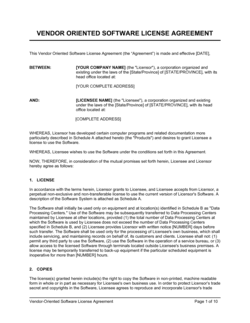
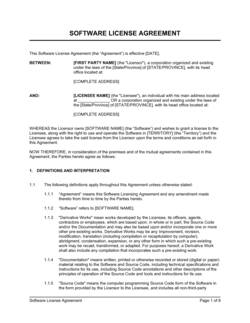
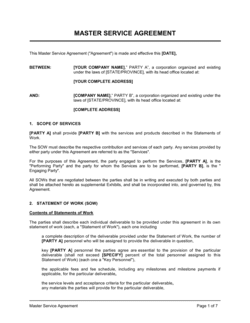
Licensee Oriented Software License Agreement Template

Free Word download • Edit online • Save & share with Drive • Export to PDF

17 pages35–45 min to fillDifficulty: ComplexSignature requiredLegal review recommended
Learn more ↓
FreeLicensee Oriented Software License Agreement Template

At a glance

What it is
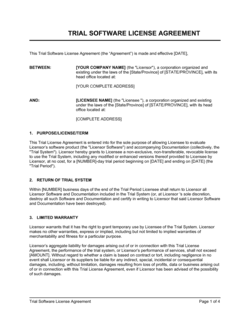
A Licensee Oriented Software License Agreement is a binding contract between a software licensor and a licensee that defines the scope, conditions, and protections governing the licensee's right to use the software. Unlike standard vendor-drafted licenses that heavily favor the licensor, this template is drafted to maximize licensee protections — broader usage rights, stronger warranty language, meaningful liability caps, and clear source code escrow provisions. This free Word download gives licensees a balanced starting point for negotiating software procurement contracts.
When you need it
Use it when your organization is procuring commercial or custom software and you want to negotiate from a licensee-favorable position rather than accepting the vendor's standard terms. It is particularly important when the software is mission-critical, the license fee is material, or the vendor's default agreement strips the licensee of audit rights, warranties, and meaningful remedies.
What's inside
Grant of license and permitted use, restrictions and authorized users, delivery and acceptance testing, warranty and fitness obligations on the licensor, limitation of liability favoring the licensee, intellectual property ownership and escrow, confidentiality, term and termination rights, and governing law.

What is a Licensee Oriented Software License Agreement?

A Licensee Oriented Software License Agreement is a binding contract between a software licensor and a licensee that defines the scope, conditions, and protections governing the licensee's right to use the software — drafted specifically to favor the party acquiring the license rather than the party granting it. While most commercial software licenses are written by vendors to minimize their obligations and liability, a licensee-oriented agreement provides express warranties that the software will perform as documented, requires the licensor to indemnify the licensee against third-party IP claims, imposes a meaningful liability cap on the licensor, and secures the licensee's right to access source code through escrow if the vendor ceases operations. It is the document organizations use when they have the leverage and importance of the deal to negotiate, rather than simply accepting click-wrap terms.

Why You Need This Document

Accepting a vendor's standard software license without negotiation exposes your organization to four distinct categories of risk simultaneously. First, as-is disclaimers mean the licensor bears no liability if the software simply does not work — leaving your organization to absorb remediation costs, business disruption, and regulatory fines resulting from a defective system. Second, without source code escrow, the vendor's insolvency or acquisition can immediately strand your operations with no path to self-support or migration. Third, a cap-free or negligibly capped licensor liability means that even a significant data breach or extended system outage generates no meaningful recovery. Fourth, the absence of a wind-down period gives the vendor the ability to cut access instantly in any dispute — including one the vendor caused — creating enormous one-sided leverage. A properly negotiated licensee-oriented software license agreement closes all four gaps and establishes a commercial relationship where the licensor's obligations match the operational reliance the licensee is placing on their product.

Which variant fits your situation?

If your situation is…Use this template
Procuring a SaaS platform on a subscription basisSaaS Subscription Agreement (Licensee Oriented)
Engaging a developer to build custom software for your organizationSoftware Development Agreement
Licensing software you own to a third partyLicensor Oriented Software License Agreement
Granting an open-source or community-use licenseOpen Source Software License Agreement
Reselling or sublicensing software to end customersSoftware Reseller Agreement
Embedding third-party software components in your own productOEM Software License Agreement
Licensing software with source code access and modification rightsSource Code License Agreement

Common mistakes to avoid

❌ Accepting an 'as-is' warranty disclaimer

Why it matters: An as-is clause shifts all risk of software defects, performance failures, and fitness-for-purpose entirely to the licensee — meaning the licensor bears no liability if the software simply does not work as described.

Fix: Require an express warranty that the software will perform materially in accordance with its documentation for at least 12 months post-acceptance, and that it is free of malicious code and known security vulnerabilities.

❌ Omitting source code escrow entirely

Why it matters: If the licensor becomes insolvent, is acquired, or ceases maintenance, the licensee loses access to a mission-critical system with no ability to self-support or migrate — potentially halting business operations indefinitely.

Fix: Include a source code escrow clause with a named escrow agent, a defined initial deposit deadline, update obligations at each new release, and specific release triggers covering insolvency, acquisition, and support failure.

❌ No defined wind-down period on termination

Why it matters: Without a contractual wind-down period, the licensor can disable access immediately upon termination — even a termination the licensor initiated — leaving the licensee unable to operate or export data.

Fix: Negotiate a minimum 90-day wind-down period post-termination during which the licensee retains read access, can export all data, and can complete any in-flight business processes.

❌ Accepting the licensor's jurisdiction as governing law

Why it matters: A licensee forced to litigate under the licensor's home law — in a distant jurisdiction — faces significantly higher legal costs and procedural disadvantages, which often effectively prevents enforcement of valid claims.

Fix: Negotiate governing law to be the licensee's home jurisdiction, or agree on a neutral jurisdiction with well-developed commercial contract law such as Delaware, New York, or England and Wales.

❌ Defining authorized users as named individuals only

Why it matters: Named-user restrictions create compliance exposure as staff turn over and as contractors or affiliate employees access the system — each access by an unlisted individual is technically a license breach.

Fix: Define authorized users by category and cap rather than by name — e.g., 'employees and contractors of Licensee and its Affiliates, not to exceed [X] concurrent users' — and include a process for adjusting the cap.

❌ Accepting a mutual liability cap without asymmetric carve-outs

Why it matters: A symmetrical cap benefits the licensor disproportionately because the licensor's fees are modest while the licensee's exposure from a software failure — regulatory fines, lost revenue, remediation costs — can be orders of magnitude larger.

Fix: Ensure IP indemnity, confidentiality breaches, data breaches, fraud, and gross negligence are carved out of any liability cap, and consider making the primary cap one-directional so it applies only to licensee liability, not licensor liability.

The 10 key clauses, explained

License grant and scope of use

In plain language: Defines exactly what the licensee may do with the software — install on specific hardware, deploy across named entities, copy for backup purposes, and integrate with other systems.

Sample language
[LICENSOR NAME] hereby grants to [LICENSEE NAME] a non-exclusive, [perpetual / term], worldwide license to install, access, and use the Software solely for [LICENSEE NAME]'s internal business operations by up to [NUMBER] Authorized Users.

Common mistake: Accepting a license scope limited to a single named legal entity when the licensee operates through subsidiaries or affiliates — usage by any related entity becomes a breach, creating unexpected compliance exposure.

Authorized users and access controls

In plain language: Identifies who may access the software, how access is provisioned, and what happens if the number of users expands beyond the contracted limit.

Sample language
'Authorized Users' means employees and contractors of [LICENSEE NAME] and its Affiliates who are granted access credentials. Licensee may add Authorized Users upon written notice to Licensor, subject to the fee schedule in Schedule B.

Common mistake: Defining authorized users narrowly as full-time employees only — contractors, consultants, and affiliate staff who routinely need access are excluded, creating inadvertent license violations.

Delivery and acceptance testing

In plain language: Sets out the delivery timeline, the acceptance testing period the licensee has to evaluate the software against agreed specifications, and the right to reject or request remediation.

Sample language
Licensor shall deliver the Software to Licensee by [DELIVERY DATE]. Licensee shall have [30] days following delivery to conduct acceptance testing. If the Software fails to meet the Specifications, Licensee shall notify Licensor in writing and Licensor shall remedy all defects within [15] business days.

Common mistake: Omitting a defined acceptance period and deemed-acceptance clause — without it, payment obligations may trigger before the licensee has verified the software meets functional requirements.

Licensor warranties and fitness obligations

In plain language: Requires the licensor to warrant that the software will perform materially in accordance with documentation, is free of malicious code, and does not infringe third-party intellectual property.

Sample language
Licensor warrants that: (a) the Software will perform materially in accordance with the Documentation for [12] months following acceptance; (b) the Software does not contain any Malicious Code; and (c) the Software does not, to Licensor's knowledge, infringe any third-party intellectual property rights.

Common mistake: Accepting a license with an 'as-is' warranty disclaimer. In a licensee-oriented agreement, the licensor should bear the risk that the software works as described — 'as-is' clauses shift that risk entirely to the licensee.

Intellectual property ownership and indemnity

In plain language: Confirms the licensor retains ownership of the software's IP while requiring the licensor to defend and indemnify the licensee against third-party IP infringement claims arising from use of the software.

Sample language
Licensor shall, at its own expense, defend Licensee against any third-party claim that the Software infringes a patent, copyright, or trade secret, and shall indemnify Licensee for damages and costs finally awarded, provided Licensee gives Licensor prompt notice and reasonable cooperation.

Common mistake: Accepting IP indemnity that is conditioned on the licensee having made no modifications whatsoever — most enterprise deployments involve configuration or integration that voids indemnity under this language.

Limitation of liability (licensee-favorable)

In plain language: Caps the licensor's liability at a meaningful amount — typically 12 months of license fees paid — and carves out uncapped liability for IP infringement, data breaches, fraud, and gross negligence.

Sample language
Licensor's total liability to Licensee shall not exceed the greater of (a) fees paid by Licensee in the [12] months preceding the claim, or (b) $[MINIMUM FLOOR]. The foregoing cap shall not apply to: IP indemnity obligations, breaches of confidentiality, gross negligence, or willful misconduct.

Common mistake: Accepting a mutual cap that limits both parties equally — the licensor collects a modest fee and faces capped liability, while the licensee's business disruption from a software failure can far exceed the cap.

Source code escrow

In plain language: Requires the licensor to deposit current source code with a neutral escrow agent and grants the licensee the right to access it upon defined trigger events such as licensor insolvency or material support failure.

Sample language
Within [30] days of execution, Licensor shall deposit the Software's source code with [ESCROW AGENT NAME] under an escrow agreement naming Licensee as beneficiary. Escrow Release Triggers include: (a) Licensor insolvency or bankruptcy; (b) Licensor's acquisition resulting in discontinuation of support; (c) Licensor's failure to provide maintenance for [60] consecutive days.

Common mistake: Agreeing to escrow in principle but failing to name a specific escrow agent or define release triggers — without these details, the escrow provision is unenforceable as a practical matter.

Confidentiality obligations

In plain language: Requires both parties to protect each other's confidential information, with specific carve-outs for publicly available information, independently developed materials, and legally compelled disclosure.

Sample language
Each party shall protect the other's Confidential Information with at least the same degree of care it uses for its own confidential information, but no less than reasonable care, and shall not disclose it to third parties without prior written consent. This obligation survives termination for [5] years.

Common mistake: Accepting a mutual confidentiality clause that treats the licensee's business data and the licensor's source code as equivalent — the licensee's operational data warrants stronger protection given GDPR and data-residency obligations.

Term, termination, and wind-down rights

In plain language: Sets the license term, the conditions under which either party may terminate, and critically, the licensee's right to a reasonable wind-down period and data export before access is cut off.

Sample language
This Agreement commences on [START DATE] and continues for [TERM]. Either party may terminate for material breach upon [30] days' written notice if the breach is not cured. Upon termination, Licensor shall provide Licensee a [90]-day wind-down period during which Licensee may continue to access the Software and export all Licensee Data.

Common mistake: No wind-down period on termination — vendors who can immediately disable access to mission-critical software hold significant leverage in any dispute, even a dispute they caused.

Governing law and dispute resolution

In plain language: Specifies the jurisdiction whose law governs the agreement and the process for resolving disputes — typically the licensee's home jurisdiction, with mediation before arbitration or litigation.

Sample language
This Agreement is governed by the laws of [LICENSEE JURISDICTION], without regard to conflict-of-laws rules. Disputes shall first be submitted to non-binding mediation administered by [MEDIATOR / INSTITUTION]. If not resolved within [30] days, disputes shall be resolved by binding arbitration in [CITY], except claims for injunctive relief.

Common mistake: Accepting the licensor's home jurisdiction as governing law without negotiation — this forces a licensee in a dispute to litigate under unfamiliar law, in a distant forum, at significantly higher cost.

How to fill it out

  1. 1

    Identify the parties and the software precisely

    Enter the full legal names of the licensor and licensee entities, including jurisdiction of incorporation. Attach a Schedule A that describes the software by name, version, and functional scope — vague descriptions create scope disputes.

    💡 Include a brief functional description of what the software is expected to do, not just its product name — this anchors the warranty and acceptance testing clauses.

  2. 2

    Define the license scope and authorized users

    Specify whether the license is perpetual or term-based, the permitted deployment model (on-premise, cloud-hosted, hybrid), the geographic territory, and the category and number of authorized users including affiliates and contractors.

    💡 If your organization expects to grow, negotiate a user band rather than a fixed seat count — e.g., 'up to 250 Authorized Users' rather than '50 named users,' to avoid renegotiation as headcount grows.

  3. 3

    Set the delivery timeline and acceptance testing window

    Enter the agreed delivery date and the number of days the licensee has to test the software against the documented specifications. Specify what happens if tests fail — remediation timeline, escalation steps, and the licensee's right to reject.

    💡 30 days is a standard acceptance window; for complex enterprise deployments, negotiate 45–60 days and document the acceptance criteria in a separate Schedule B.

  4. 4

    Draft warranty and fitness language

    Complete the warranty clause to cover: performance in accordance with documentation for at least 12 months, absence of malicious code, and non-infringement of third-party IP. Ensure the 'as-is' disclaimer is removed or narrowed.

    💡 If the licensor insists on limiting warranty to 90 days, negotiate an extended maintenance and support obligation that effectively provides ongoing fitness assurance beyond the warranty period.

  5. 5

    Negotiate and enter the liability cap and carve-outs

    Set the licensor's liability cap at a minimum of 12 months of fees paid. List the uncapped carve-outs: IP indemnity, confidentiality breaches, fraud, and gross negligence. Confirm the cap is one-directional or asymmetric in the licensee's favor.

    💡 If annual fees are low, negotiate a hard-floor dollar amount for the cap — e.g., 'the greater of fees paid in 12 months or $50,000' — so the cap is meaningful even in year one.

  6. 6

    Complete the source code escrow details

    Name the specific escrow agent, the deposit schedule (initial deposit plus updates at each new version release), and all release triggers. Both parties must sign a separate three-party escrow agreement with the agent.

    💡 Iron Mountain and Escrow Associates are widely used escrow agents with standard addenda — using a recognized agent reduces negotiation time and gives both parties comfort.

  7. 7

    Finalize termination, wind-down, and data export terms

    Enter the notice period for cure (30 days is standard), the wind-down period post-termination (90 days minimum for mission-critical software), and the licensee's right to receive a complete export of all licensee data in a standard machine-readable format.

    💡 For SaaS deployments, specify the data export format explicitly — CSV, JSON, or XML — to prevent the licensor from providing data in a proprietary format that requires additional paid tools to use.

  8. 8

    Confirm governing law is the licensee's jurisdiction

    Set the governing law to the state or country where the licensee is headquartered or primarily operates. Confirm the dispute resolution mechanism — mediation then arbitration is typical — and the seat of arbitration.

    💡 If the licensor is in a different country, consider an international arbitration institution (ICC or AAA-ICDR) with a neutral seat rather than either party's home courts.

Frequently asked questions

What is a licensee oriented software license agreement?

A licensee oriented software license agreement is a contract drafted to protect the interests of the party acquiring the right to use software, rather than the vendor selling it. Standard vendor-drafted licenses disclaim warranties, cap licensor liability at negligible amounts, and give licensees few remedies for non-performance. A licensee-oriented version reverses many of these defaults — requiring meaningful warranties, IP indemnity, source code escrow, and a wind-down period on termination. It is the starting point licensees use when they have sufficient bargaining power to negotiate, rather than simply clicking "I agree."

What is the difference between a licensor-oriented and a licensee-oriented software agreement?

A licensor-oriented agreement is written by the vendor to minimize the licensor's obligations and exposure — typically featuring as-is disclaimers, low or no liability caps on the licensor, broad termination rights for the vendor, and no source code escrow or wind-down provisions. A licensee-oriented agreement flips these defaults: the licensor provides express warranties, bears meaningful liability for IP infringement and software failures, and grants the licensee data-export and wind-down rights on termination. Most enterprise software negotiations land somewhere between the two starting positions.

When should I use a licensee oriented software license agreement?

Use it whenever you are procuring commercial or custom software that is material to your operations and you have sufficient negotiating leverage to request contract changes from the vendor. It is most valuable for on-premise enterprise software, mission-critical SaaS platforms, and custom-developed software where the failure of the system would cause significant business disruption. For low-cost, widely used consumer software, vendors typically will not negotiate and licensees accept standard terms.

Does a software license agreement need to be signed by both parties?

Yes, a negotiated software license agreement should be signed by authorized representatives of both the licensor and licensee before software is delivered or access is granted. Click-wrap and browse-wrap agreements are sometimes enforceable for consumer software, but for enterprise procurement contracts involving material fees and negotiated terms, a wet or electronic signature from both parties is the standard and ensures all negotiated terms are properly documented.

What is source code escrow and do I need it?

Source code escrow is an arrangement where the licensor deposits the software's source code with a neutral third-party agent who will release it to the licensee upon defined trigger events — typically licensor insolvency, acquisition leading to discontinuation, or failure to maintain the software. You need it when the software is mission-critical and self-support or migration would be necessary if the licensor ceased operations. For widely-used commercial platforms with large user bases, escrow is less critical because the risk of total abandonment is low.

Can I sublicense software I have licensed from a vendor?

Only if the license agreement explicitly grants sublicense rights. Most standard software licenses prohibit sublicensing unless the licensee is acting as a reseller or OEM under a separate agreement. If your use case requires distributing the software — or products incorporating it — to third parties, you must negotiate explicit sublicense rights before execution. Operating without sublicense rights typically constitutes a material breach and may expose you to IP infringement claims.

What warranties should a software licensor provide in a licensee-oriented agreement?

At minimum, the licensor should warrant that the software performs materially in accordance with its documentation for at least 12 months after acceptance, that it does not contain malicious code or undisclosed security vulnerabilities, and that it does not infringe any third-party intellectual property rights to the licensor's knowledge. The licensor should also provide an IP indemnity — a commitment to defend and compensate the licensee if a third party brings an infringement claim arising from use of the software.

How is a software license agreement different from a software development agreement?

A software license agreement governs the right to use software that already exists or will be delivered as a finished product. A software development agreement governs the creation of custom software — covering milestones, deliverables, acceptance criteria, payment schedules, and IP ownership of the software being built. If you are procuring custom development, you need both: a development agreement during the build phase and a license agreement governing ongoing use of the finished product.

What governing law should a software license agreement use?

From a licensee's perspective, the governing law should be the licensee's home jurisdiction — the state or country where the licensee is headquartered or where the software is primarily used. This reduces the cost and complexity of enforcing the agreement if a dispute arises. Common neutral choices for international contracts include New York, Delaware, and England and Wales, all of which have well-developed commercial contract law and experienced judiciary. Avoid accepting a governing law clause that defaults to the licensor's jurisdiction without negotiation.

Is a limitation of liability clause enforceable in software license agreements?

In most jurisdictions, limitation of liability clauses are generally enforceable between commercial parties of roughly equal bargaining power, provided the cap is not so low as to be unconscionable and the clause is clearly drafted. However, carve-outs are typically required for certain categories — fraud, willful misconduct, death or personal injury, and in some jurisdictions, data protection breaches. Courts in the UK and EU apply reasonableness and transparency tests that can invalidate disproportionately one-sided caps. Consider consulting a lawyer to ensure the liability structure is enforceable in your specific jurisdiction.

How this compares to alternatives

vs Licensor Oriented Software License Agreement

A licensor-oriented agreement is drafted by or for the software vendor to minimize the licensor's obligations — featuring as-is disclaimers, low liability caps, and limited remedies for the licensee. A licensee-oriented agreement reverses these defaults to protect the buyer. Licensees with bargaining power use their own template as a starting point; licensors use theirs. The final signed agreement typically reflects negotiated compromises between both positions.

vs Software Development Agreement

A software development agreement governs the creation of custom software — milestones, deliverables, development fees, and IP ownership of the work being built. A software license agreement governs the right to use software once it exists. For custom development, you need both: a development agreement during the build, and a license agreement for ongoing use of the finished product.

vs Non-Disclosure Agreement

An NDA protects confidential information exchanged during evaluation or negotiation but creates no license or usage rights. A software license agreement is the operative contract that grants access and use rights while incorporating confidentiality obligations within a broader framework of warranties, liability, and termination. An NDA is often signed first, before the license agreement is negotiated.

vs SaaS Subscription Agreement

A SaaS subscription agreement governs cloud-hosted software delivered as a service on a recurring subscription basis — focusing on uptime SLAs, data processing, and subscription renewal terms. A traditional software license agreement governs on-premise or perpetual-license software where the licensee takes delivery of the software itself. The key distinction is who hosts and operates the software: the licensee (license agreement) or the vendor (SaaS agreement).

Industry-specific considerations

Financial Services

Regulatory data residency requirements, audit rights over cloud-hosted software, and enhanced confidentiality for customer financial data make licensee-favorable terms essential.

Healthcare and Life Sciences

HIPAA business associate agreement integration, validated software requirements for FDA-regulated processes, and strict data breach notification obligations must be incorporated by reference.

SaaS and Technology

API access rights, uptime SLA commitments with service credits, and source code escrow for platform dependencies are standard negotiation points for technology companies procuring third-party tools.

Manufacturing and Logistics

ERP and supply-chain software failures carry operational downtime costs that far exceed license fees, making meaningful liability caps, warranty periods, and wind-down rights particularly important.

Professional Services

Practice management and billing software contains privileged client data, requiring confidentiality provisions aligned with professional responsibility obligations and extended post-termination data retention rights.

Government and Public Sector

Statutory procurement rules, open-data obligations, and Freedom of Information requirements create unique license scope and data-access provisions that must be explicitly addressed in the agreement.

Jurisdictional notes

United States

Software license agreements in the US are governed primarily by state contract law; the UCC Article 2 may apply to software with a goods component, though courts are split. California and New York are the most common governing-law choices. Limitation of liability clauses are generally enforceable between commercial parties, but California courts scrutinize unconscionable provisions. The Computer Fraud and Abuse Act may add federal criminal and civil exposure for unauthorized access beyond the license scope.

Canada

Canadian software licenses are governed by provincial contract law, with Ontario and British Columbia being common choices for governing law. PIPEDA (and Quebec's Law 25 with its stricter requirements) imposes data protection obligations that should be reflected in the confidentiality and data handling provisions. Unlike the US, Canada has no equivalent to the CFAA, but Criminal Code provisions on unauthorized computer access apply. Quebec requires that contracts with Quebec-domiciled parties be available in French.

United Kingdom

The Unfair Contract Terms Act 1977 and the Consumer Rights Act 2015 (for B2C) impose a reasonableness test on limitation of liability and exclusion clauses — clauses that are unreasonably one-sided may be struck down. The UK GDPR (post-Brexit retained law) requires data processing agreements where the licensor processes personal data on behalf of the licensee. IP indemnity clauses are strongly advisable given the UK's active software patent and copyright enforcement environment.

European Union

EU GDPR requires a Data Processing Agreement (Article 28) where the licensor processes personal data on the licensee's behalf — this is often incorporated as a schedule to the software license. The EU Software Directive grants licensees the right to make backup copies and study the software's functioning regardless of contractual restrictions. Member state unfair contract terms directives (implementing the EU Unfair Contract Terms Directive) can render disproportionately one-sided limitation of liability clauses unenforceable, particularly in B2B contracts in France and Germany.

Template vs lawyer — what fits your deal?

PathBest forCostTime
Use the templateOrganizations procuring non-mission-critical software with a moderate annual license fee under $25,000Free1–2 hours to complete and redline
Template + legal reviewEnterprise procurement of mission-critical software, deals with annual fees between $25,000 and $250,000, or cross-border licensing$500–$1,500 for a technology lawyer review3–5 business days
Custom draftedHigh-value software procurement above $250,000, regulated industries, software embedded in products, or public sector contracts$3,000–$10,000+2–4 weeks

Glossary

License Grant
The contractual clause that defines the specific rights the licensee receives to install, use, copy, or modify the software.
Authorized Users
The employees, contractors, or entities explicitly permitted under the agreement to access and use the licensed software.
Acceptance Testing
A defined process by which the licensee evaluates whether the delivered software meets agreed functional specifications before final acceptance and payment.
Source Code Escrow
An arrangement where a neutral third party holds the software's source code and releases it to the licensee if the licensor becomes insolvent or fails to maintain the software.
Limitation of Liability
A clause capping the maximum financial exposure of one or both parties — in a licensee-oriented agreement, this cap is structured to protect the licensee from disproportionate liability.
Intellectual Property Indemnity
A licensor obligation to defend and compensate the licensee if a third party claims the software infringes their intellectual property rights.
Perpetual License
A license that grants the right to use the software indefinitely, rather than for a defined subscription term, typically in exchange for an upfront fee.
Warranty of Fitness
A representation by the licensor that the software will perform in accordance with its documentation and be fit for the licensee's stated business purpose.
Audit Rights
The licensee's contractual right to inspect the licensor's records or systems to verify compliance, billing accuracy, or software performance.
Escrow Release Trigger
A specific event — such as licensor insolvency, acquisition, or failure to maintain — that causes the escrow agent to release source code to the licensee.
Sublicense
The right to grant a third party the same or narrower usage rights than those received under the primary license — typically restricted in vendor-drafted agreements.
Service Level Agreement (SLA)
A contractual commitment specifying minimum performance standards for the software, such as uptime percentage, response times, and remedies for failure to meet them.

Part of your Business Operating System

This document is one of 3,000+ business & legal templates included in Business in a Box.

  • Fill-in-the-blanks — ready in minutes
  • 100% customizable Word document
  • Compatible with all office suites
  • Export to PDF and share electronically

Create your document in 3 simple steps.

From template to signed document — all inside one Business Operating System.
1
Download or open template

Access over 3,000+ business and legal templates for any business task, project or initiative.

2
Edit and fill in the blanks with AI

Customize your ready-made business document template and save it in the cloud.

3
Save, Share, Send, Sign

Share your files and folders with your team. Create a space of seamless collaboration.

Save time, save money, and create top-quality documents.

★★★★★

"Fantastic value! I'm not sure how I'd do without it. It's worth its weight in gold and paid back for itself many times."

Managing Director · Mall Farm
Robert Whalley
Managing Director, Mall Farm Proprietary Limited
★★★★★

"I have been using Business in a Box for years. It has been the most useful source of templates I have encountered. I recommend it to anyone."

Business Owner · 4+ years
Dr Michael John Freestone
Business Owner
★★★★★

"It has been a life saver so many times I have lost count. Business in a Box has saved me so much time and as you know, time is money."

Owner · Upstate Web
David G. Moore Jr.
Owner, Upstate Web

Run your business with a system — not scattered tools

Stop downloading documents. Start operating with clarity. Business in a Box gives you the Business Operating System used by over 250,000 companies worldwide to structure, run, and grow their business.

Start free · No credit card required