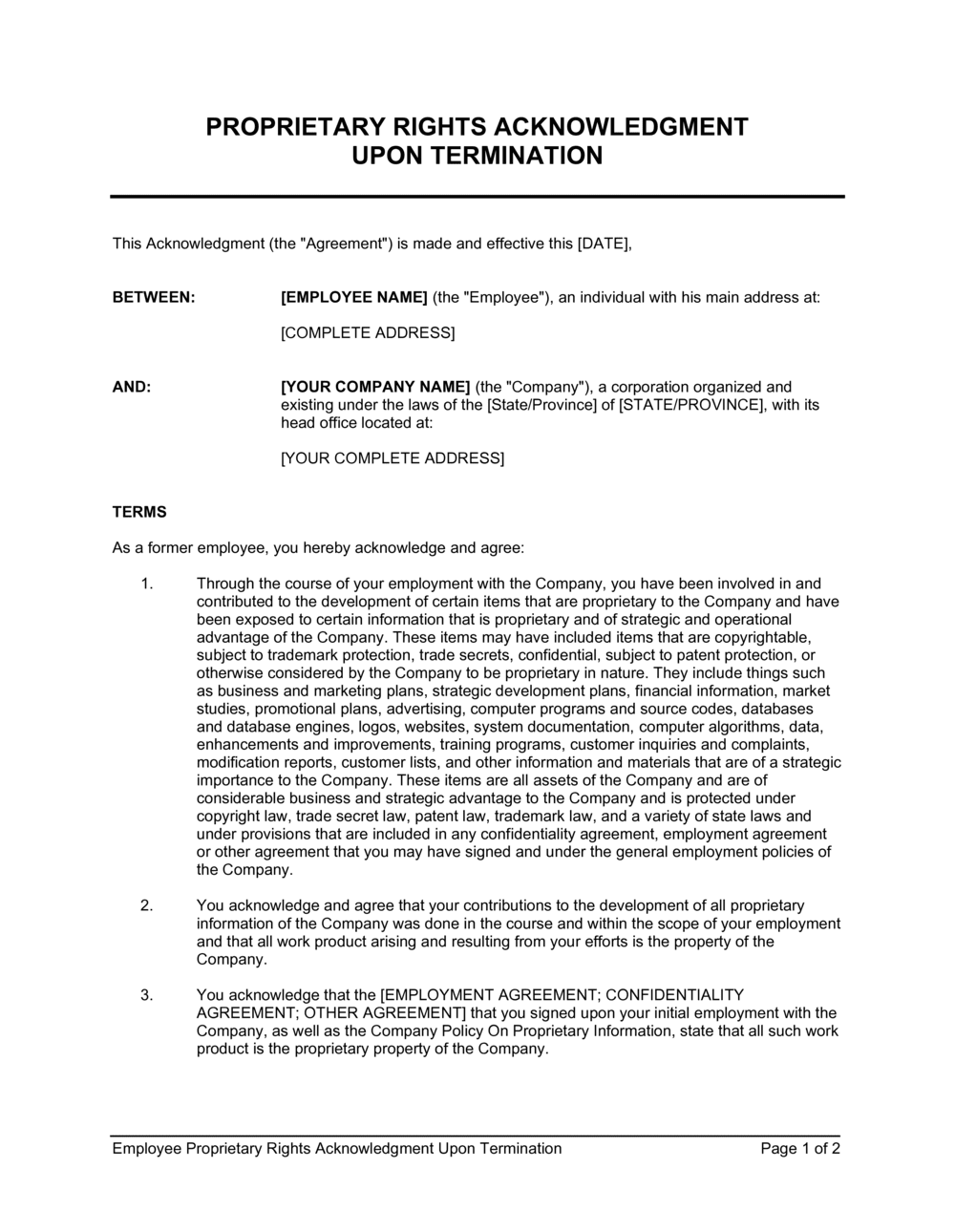
Employee Proprietary Rights Acknowledgment Upon Termination Template

Free Word download • Edit online • Save & share with Drive • Export to PDF

2 pages25–30 min to fillDifficulty: StandardSignature requiredLegal review recommended
Learn more ↓
FreeEmployee Proprietary Rights Acknowledgment Upon Termination Template

At a glance

What it is
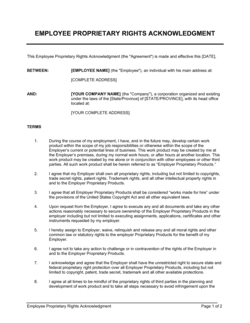
An Employee Proprietary Rights Acknowledgment Upon Termination is a signed legal document an employer obtains from a departing employee confirming that all company intellectual property, confidential information, and proprietary materials have been returned or destroyed, and that post-employment obligations — confidentiality, non-solicitation, and IP ownership — remain in full force. This free Word download gives employers a structured, enforceable offboarding document they can edit online and export as PDF to execute on or before an employee's last day.
When you need it
Use it at the conclusion of every employment relationship — voluntary resignation, layoff, or termination for cause — before issuing final pay or severance. It is especially critical when the departing employee had access to trade secrets, source code, customer data, product roadmaps, or other sensitive proprietary information.
What's inside
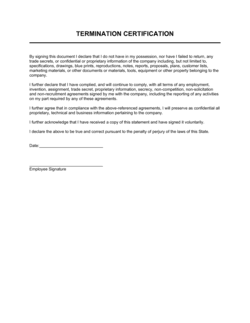
Confirmation of IP assignment and return of company property, restatement of ongoing confidentiality and non-solicitation obligations, employee certification that no proprietary materials remain in their possession, and a binding acknowledgment that prior agreements survive termination — executed with dated signatures from both parties.

What is an Employee Proprietary Rights Acknowledgment Upon Termination?

An Employee Proprietary Rights Acknowledgment Upon Termination is a legally binding document executed on or before an employee's last day of work, in which the departing employee formally confirms that all company intellectual property, confidential information, and proprietary materials have been returned or permanently destroyed, and that post-employment obligations — including confidentiality, IP ownership, and non-solicitation — remain in full force. Unlike a general resignation letter or a dismissal notice, this document is specifically designed to create a contemporaneous, signed evidentiary record of the employee's compliance with their IP and confidentiality obligations at the precise moment of departure, closing the window during which proprietary information is most at risk of misappropriation.

Why You Need This Document

The period immediately surrounding an employee's departure is when trade secret exposure is highest. Studies of trade secret litigation consistently show that the majority of misappropriation claims arise within the first 90 days after an employee joins a competitor — meaning the materials they took left with them on or before their last day. Without a signed acknowledgment, an employer has no contemporaneous record that the departing employee was reminded of their obligations, returned all company property, or certified that no copies of proprietary data were retained. In litigation, that silence works against you. A properly executed acknowledgment, by contrast, gives you a signed admission of the obligations, a certified return of property, and a documented date of notice — all of which are material to obtaining a temporary restraining order or proving misappropriation. For the cost of 15 minutes on an employee's last day, this template closes one of the most consequential gaps in the standard offboarding process.

Which variant fits your situation?

If your situation is…Use this template
Departing employee had access to source code, algorithms, or technical trade secretsEmployee Proprietary Rights Acknowledgment Upon Termination
Separation involves a formal severance package and mutual release of claimsSeparation Agreement and Release
Employee is resigning voluntarily and a brief confirmation letter sufficesEmployee Resignation Acceptance Letter
Company needs to restate ongoing confidentiality obligations without full offboarding formalityEmployee Confidentiality Agreement
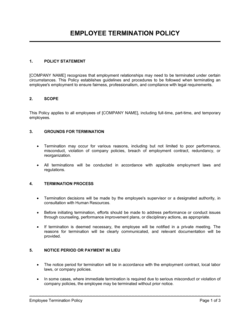
Termination for cause requires documentation of misconduct and IP exposureEmployee Dismissal Letter
Senior executive departure with equity, clawback, and enhanced non-compete termsExecutive Separation Agreement
Contractor engagement ends and assignment of work product must be confirmedIndependent Contractor Agreement

Common mistakes to avoid

❌ Signing after final pay is issued

Why it matters: Once the employee has received all compensation owed, there is no consideration remaining for the acknowledgment. Courts in multiple jurisdictions have voided post-employment restrictions signed after the final paycheck was already issued.

Fix: Make signing the acknowledgment a condition of processing final pay or severance. Execute the document on or before the last day of work, before the payroll run is released.

❌ Omitting cloud and personal device storage from the return clause

Why it matters: Employees who synced company files to personal Dropbox, Google Drive, or iCloud accounts technically retain copies even after returning a company laptop. A clause limited to physical property leaves those copies unaddressed and unenforceable.

Fix: Explicitly list cloud storage accounts, personal devices used for company work, and any local backups in the property return clause. Require the employee to certify deletion of all remote copies.

❌ Extending non-solicitation or confidentiality periods beyond the original agreement

Why it matters: Attempting to impose longer or broader restrictions in the acknowledgment than existed in the employment agreement creates a new contractual obligation. Without documented fresh consideration, that extension is likely unenforceable.

Fix: Mirror the exact duration and scope from the original employment agreement. If you want to extend or add restrictions, obtain separate legal advice, provide clear fresh consideration, and document both in writing.

❌ Using a trade name instead of the registered legal entity name

Why it matters: If enforcement becomes necessary — a trade secret lawsuit or injunction — the party named in the document must match the plaintiff's legal identity. A mismatch between the document and court filings creates procedural delays and can allow the former employee to challenge the document.

Fix: Verify the exact registered legal name in the state or provincial corporate registry before inserting it. Include both the legal name and the doing-business-as name in the parties clause if both are relevant.

❌ Having only the employee sign

Why it matters: A document signed by only one party is a unilateral declaration, not a mutual agreement. Courts may treat it as unenforceable, particularly the consideration and cooperation clauses that impose obligations on both sides.

Fix: Always obtain a dated signature from an authorized employer representative — typically the HR director, CEO, or a designated officer — alongside the employee's signature.

❌ No reference to or attachment of the original employment agreement

Why it matters: Clauses that say 'as set forth in the Employment Agreement' without identifying or attaching that agreement leave courts to determine what terms were actually agreed. If the employee denies the original terms, the acknowledgment's reference is unverifiable.

Fix: Include the exact date of the original employment agreement in every reference clause and attach a copy as an exhibit. Have the employee initial the exhibit at signing.

The 10 key clauses, explained

Parties and Termination Date

In plain language: Identifies the employer entity and the departing employee by full legal name and records the official last day of employment.

Sample language
This Acknowledgment is entered into as of [DATE] between [EMPLOYER LEGAL NAME], a [STATE/PROVINCE] [ENTITY TYPE] ('Company'), and [EMPLOYEE FULL NAME] ('Employee'), whose employment with the Company ended on [TERMINATION DATE].

Common mistake: Using a trade name instead of the registered legal entity name — if enforcement becomes necessary, the mismatch between the document and court filings creates procedural delays.

Acknowledgment of IP Assignment

In plain language: The employee confirms that all work product, inventions, and IP created during employment belong to the company and that no residual ownership claim exists.

Sample language
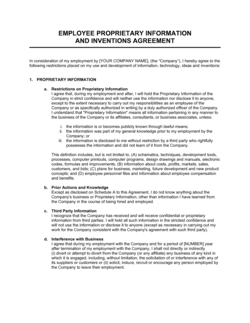
Employee acknowledges that all work product, inventions, developments, software, and improvements created by Employee during the course of employment, or relating to the Company's business, are the sole property of the Company and were irrevocably assigned to the Company pursuant to the Employment Agreement dated [DATE].

Common mistake: Referencing the original employment agreement without attaching a copy — if the employee later disputes the terms of that agreement, the acknowledgment becomes difficult to enforce without the underlying document on record.

Return of Company Property

In plain language: The employee certifies that all physical and digital company property — devices, files, credentials, copies of proprietary data — has been returned or permanently deleted.

Sample language
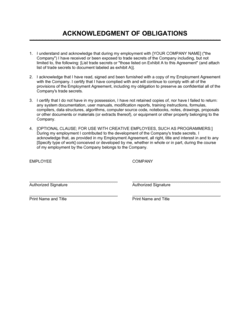
Employee certifies that, as of [DATE], Employee has returned to the Company all property belonging to the Company, including but not limited to: laptops, mobile devices, access cards, documents, files, and all copies of Proprietary Information in any format, whether stored locally, on personal devices, or in cloud storage accounts.

Common mistake: Omitting cloud storage and personal devices from the return list — employees who synced company files to personal Google Drive or Dropbox accounts retain copies that a device-only return clause does not cover.

Confirmation of No Retained Copies

In plain language: The employee affirms they have not retained — in any medium — any copies, summaries, notes, or extracts of proprietary company information.

Sample language
Employee represents and warrants that Employee has not retained, and will not retain, any copies, summaries, abstracts, or extracts of any Proprietary Information of the Company in any form, including electronic, physical, or any other medium.

Common mistake: Failing to include notes and summaries in addition to verbatim copies — employees often argue they retained only their own 'notes' rather than company documents, so the clause must explicitly cover derivative materials.

Restatement of Confidentiality Obligations

In plain language: Reminds the departing employee that their duty to protect the company's confidential information continues indefinitely after termination.

Sample language
Employee acknowledges that the confidentiality obligations set forth in the Employment Agreement dated [DATE] survive the termination of Employee's employment and remain in full force and effect. Employee agrees not to disclose, use, or permit access to any Proprietary Information of the Company for any purpose.

Common mistake: Using vague language such as 'for a reasonable period' instead of explicitly stating the obligations survive indefinitely — trade secret protection under statutes like the US DTSA has no time limit, and a cap in the contract creates a lower standard than the law provides.

Non-Solicitation Reminder

In plain language: Reaffirms that the employee remains bound by any non-solicitation restrictions covering the company's customers and employees for the duration specified in the original employment agreement.

Sample language
Employee acknowledges that, for a period of [X] months following the Termination Date, Employee shall not, directly or indirectly, (a) solicit any customer or client of the Company with whom Employee had material contact during the [X] months preceding termination, or (b) solicit or recruit any employee of the Company.

Common mistake: Restating a longer non-solicitation period than was contained in the original employment agreement — courts treat the acknowledgment as a new contract and may require fresh consideration to extend the original restriction.

Cooperation Covenant

In plain language: The employee agrees to cooperate with the company on pending matters — litigation, audits, regulatory inquiries, or client transitions — that require their knowledge after departure.

Sample language
Employee agrees to cooperate fully with the Company, at the Company's reasonable request, in connection with any legal proceedings, regulatory inquiries, or business matters relating to Employee's period of employment, provided that such cooperation shall not unreasonably interfere with Employee's subsequent employment.

Common mistake: Omitting a provision for reimbursement of the former employee's time and expenses — without it, courts may find the cooperation obligation unenforceable as an uncompensated restraint.

Survival and Integration

In plain language: Confirms that obligations in this acknowledgment survive termination and that this document supplements — rather than replaces — the original employment agreement.

Sample language
The obligations set forth in this Acknowledgment shall survive the termination of Employee's employment. This Acknowledgment supplements the Employment Agreement and does not supersede or limit any rights or obligations contained therein. In the event of conflict, the terms most protective of the Company's proprietary rights shall govern.

Common mistake: Writing that the acknowledgment 'supersedes' the employment agreement — this can inadvertently void non-compete or IP assignment clauses in the original contract that were broader than the acknowledgment's language.

Consideration

In plain language: States what the employee receives in exchange for signing — typically final pay, severance, or a positive reference — making the document binding as a contract.

Sample language
In consideration for the agreements set forth herein, the Company agrees to [provide Employee's final paycheck in the amount of $[AMOUNT] / pay severance of $[AMOUNT] / provide a standard employment reference letter], the receipt and sufficiency of which Employee hereby acknowledges.

Common mistake: Relying on continued employment or final paycheck alone as consideration in jurisdictions that require independent fresh consideration for post-employment restrictions — in several Canadian provinces and UK contexts, this renders the acknowledgment unenforceable.

Governing Law and Signatures

In plain language: Specifies which jurisdiction's law governs the document and provides execution blocks for dated signatures from both parties.

Sample language
This Acknowledgment shall be governed by the laws of [STATE / PROVINCE / COUNTRY]. Each party has read and understood this Acknowledgment and executes it voluntarily. [EMPLOYER REPRESENTATIVE NAME], [TITLE], on behalf of [EMPLOYER LEGAL NAME] — Signature: ___ Date: ___ | [EMPLOYEE FULL NAME] — Signature: ___ Date: ___

Common mistake: Having only the employee sign — courts treat an unsigned employer copy as a unilateral declaration rather than a mutual agreement, weakening enforceability of the consideration and cooperation clauses.

How to fill it out

  1. 1

    Enter the legal entity name and employee details

    Insert the employer's full registered legal name — not a brand name — and the departing employee's name exactly as it appears on their employment agreement. Record the official termination date.

    💡 Cross-check the entity name against your state or provincial registry filing to avoid a mismatch that could complicate enforcement.

  2. 2

    Reference the original employment agreement

    Insert the exact date of the original employment agreement in the IP assignment and confidentiality clauses. Attach a copy of that agreement to the acknowledgment as an exhibit.

    💡 If no written employment agreement exists, describe the IP assignment terms explicitly in this document rather than referencing an absent contract.

  3. 3

    Complete the return of property certification

    List all specific property categories the employee is returning — laptop model and serial number, mobile device, access cards, and any cloud storage accounts where company files were stored. Have IT confirm deletion of remote data before signing.

    💡 Add a physical equipment checklist as Schedule A so the employee initials each returned item individually — this creates a granular record if a specific device is later in dispute.

  4. 4

    Set the non-solicitation period

    Insert the duration and scope of the non-solicitation restriction exactly as stated in the original employment agreement. Do not extend or shorten the period in this document unless you have obtained separate legal advice on fresh consideration.

    💡 If the original agreement is silent on solicitation, this acknowledgment can introduce a reasonable restriction — but get legal review first, as this constitutes a new contractual obligation requiring adequate consideration.

  5. 5

    State the consideration clearly

    Identify the specific benefit the employee receives for signing — final pay amount, severance amount, or a reference letter. State the dollar amount or the nature of the benefit explicitly.

    💡 In Ontario and several other Canadian provinces, courts have voided post-employment obligations where consideration was described vaguely. A specific dollar figure or tangible benefit is far safer than 'continued cooperation.'

  6. 6

    Select the governing law jurisdiction

    Enter the state, province, or country whose employment law governs. This should match the governing law clause in the original employment agreement unless you have a specific reason to change it.

    💡 If the employee worked remotely from a different jurisdiction than the employer's home state, consult counsel on which law applies — courts sometimes override governing-law clauses in favor of the employee's work location.

  7. 7

    Execute before or on the last day of employment

    Both the employer representative and the employee must sign and date the document. Obtain the employee's signature before or on the termination date — never after final pay has already been issued without a signed document.

    💡 Use a timestamped eSignature platform to create an irrefutable execution record. Store the executed copy in the employee's HR file and send a copy to the employee immediately.

  8. 8

    Revoke system access on the same day as signing

    Coordinate with IT to revoke all credentials, VPN access, cloud service logins, and email access on the same day the acknowledgment is signed. The document alone does not prevent access — access removal must happen in parallel.

    💡 Document the specific time each access was revoked in your IT system and cross-reference it in the employee's offboarding file alongside the signed acknowledgment.

Frequently asked questions

What is an employee proprietary rights acknowledgment upon termination?

An employee proprietary rights acknowledgment upon termination is a legal document signed by a departing employee confirming that all company intellectual property has been returned or destroyed, that no proprietary materials remain in their possession, and that post-employment obligations — confidentiality, IP ownership, and non-solicitation — remain in effect. It creates a signed evidentiary record at the moment of departure and strengthens the employer's position if a trade secret or IP dispute arises later.

Is this document required by law?

No jurisdiction mandates this specific document, but obtaining it is widely considered best practice in employment law. Under statutes like the US Defend Trade Secrets Act and equivalent laws in Canada, the UK, and the EU, employers must demonstrate they took reasonable steps to protect proprietary information. A signed acknowledgment at termination is one of the strongest forms of evidence that those steps were taken.

What is the difference between this document and a separation agreement?

A separation agreement is a comprehensive document that addresses termination terms holistically — severance, mutual release of claims, benefits continuation, and non-disparagement. An employee proprietary rights acknowledgment focuses narrowly on IP, confidential information, and the return of company property. The two are complementary: a separation agreement governs the financial terms of departure; this acknowledgment protects the company's ongoing IP interests. Many employers use both simultaneously.

Can I use this document for contractor terminations?

A version adapted for contractors can work, but the language must be adjusted. Employment-law concepts like IP assignment under work-made-for-hire doctrine differ between employees and independent contractors. For contractors, the IP assignment must be explicit in the original contractor agreement, and the acknowledgment should reference that agreement. Consider using or adapting an Independent Contractor Agreement with a built-in termination certification clause for contractor engagements.

What consideration do I need to provide for this acknowledgment to be enforceable?

Consideration requirements vary by jurisdiction. In the US, final pay already owed to the employee is generally not sufficient fresh consideration for new post-employment restrictions — but severance, accelerated vesting, or a positive reference letter typically qualifies. In Ontario and several other Canadian provinces, courts apply a stricter standard: the consideration must be a genuine benefit above what the employee was already entitled to receive. The safest approach is to tie the acknowledgment to a documented, tangible benefit — even a nominal severance payment — and state it explicitly in the document.

Does this document need to be notarized?

Notarization is not required in most jurisdictions for an employee proprietary rights acknowledgment to be enforceable. Dated signatures from both parties — ideally executed through a timestamped eSignature platform — provide sufficient evidentiary weight in the vast majority of trade secret and IP disputes. Notarization may be appropriate if the document will be used in cross-border enforcement or if local practice in the governing jurisdiction treats notarized signatures as significantly stronger evidence.

What happens if a departing employee refuses to sign?

A refusal to sign does not eliminate the employee's underlying obligations if those obligations were established in the original employment agreement. IP assignment, confidentiality, and non-solicitation clauses from a signed employment contract remain enforceable regardless of whether the employee signs the acknowledgment. The risk of a refusal is evidentiary: you lose the signed record of the return of property and the employee's certification that no copies were retained. Document the refusal in writing, revoke all system access immediately, and consult legal counsel if the employee had access to sensitive trade secrets.

How long should I retain the signed acknowledgment?

Retain the signed acknowledgment for at least the duration of any applicable statute of limitations for trade secret or IP claims — typically three to five years in the US under the DTSA, though state statutes vary. In practice, many employment lawyers recommend retaining all offboarding documents for the full duration of the former employee's career in the relevant industry, since trade secret misappropriation claims can arise years after departure when a competitor product or patent application reveals the breach.

Does this document cover non-compete restrictions?

This acknowledgment focuses on IP and confidentiality obligations rather than non-compete restrictions. If the original employment agreement included a non-compete clause, this document can restate and reaffirm it — but given the rapidly changing legal landscape around non-compete enforceability (California, Minnesota, and FTC developments as of 2025), any non-compete restatement should be reviewed by legal counsel before inclusion. A standalone non-compete agreement or a carefully drafted separation agreement may be more appropriate vehicles for those restrictions.

How this compares to alternatives

vs Separation Agreement and Release

A separation agreement addresses the full financial terms of departure — severance, benefits continuation, and a mutual release of claims. An employee proprietary rights acknowledgment focuses exclusively on IP ownership, return of property, and post-employment confidentiality. The two documents serve different functions and are commonly executed together on the employee's last day. Where they overlap on non-solicitation, the more specific or protective clause typically governs.

vs Employee Confidentiality Agreement

An employee confidentiality agreement is executed at the start of employment and governs ongoing obligations during the employment relationship. The proprietary rights acknowledgment is executed at termination and serves as a closing confirmation that those obligations remain in effect. If a confidentiality agreement was never signed at onboarding, the acknowledgment can fill part of that gap — but it cannot fully substitute for a properly drafted original agreement, and legal review is recommended.

vs Employee Dismissal Letter

An employee dismissal letter communicates the fact and terms of termination — final day, reasons, and next steps. It is a notification, not a binding legal acknowledgment. The proprietary rights acknowledgment is the legally operative document that captures the employee's signed confirmation of IP and confidentiality obligations. Both should be prepared and delivered as part of the same offboarding process, but they serve distinct functions.

vs Non-Disclosure Agreement (NDA)

An NDA is a standalone contract governing confidential information exchange — often used before business discussions or at onboarding. The proprietary rights acknowledgment is a termination-specific document that restates and reinforces those confidentiality obligations at the point of departure, adds IP return certification, and creates a contemporaneous evidentiary record. An NDA at onboarding does not eliminate the need for an acknowledgment at offboarding.

Industry-specific considerations

Technology / SaaS

Departing engineers, product managers, and data scientists typically had access to source code, API keys, training data, and product roadmaps — making a granular return-of-property clause and cloud account certification especially critical.

Financial Services

Client lists, trading algorithms, and financial models are high-value trade secrets subject to regulatory scrutiny; the acknowledgment creates a compliance record in addition to its contractual function.

Healthcare / Life Sciences

Departing employees may have had access to patient data, clinical trial results, or proprietary formulas; HIPAA obligations and research confidentiality must be explicitly referenced alongside standard IP terms.

Professional Services

Client relationships and billing data are the primary proprietary assets; non-solicitation of clients and referral sources is the central concern, and the acknowledgment should specifically address client contact information and engagement files.

Manufacturing

Process specifications, supplier pricing, and proprietary formulations are common trade secrets; the return clause must cover physical samples and prototypes in addition to documents and digital files.

Retail / E-commerce

Customer purchase data, supplier terms, and pricing algorithms are competitively sensitive; employees with access to CRM and ERP systems should certify deletion of any downloaded customer or vendor records.

Jurisdictional notes

United States

The federal Defend Trade Secrets Act (DTSA) provides a private right of action for trade secret misappropriation and requires employers to include a whistleblower immunity notice in any agreement governing trade secret confidentiality. California Labor Code §2870 limits IP assignment to work performed on company time using company resources; employees must be notified of this limitation. Non-compete enforceability varies sharply by state, and the FTC's proposed non-compete ban should be monitored for current status.

Canada

Canadian courts apply a strict fresh-consideration requirement: post-employment obligations introduced at termination must be supported by a genuine benefit beyond what the employee was already entitled to receive. Ontario courts have historically awarded significant common-law notice, making the consideration clause especially important. Quebec employees must receive communications in French, and any acknowledgment issued to a Quebec-based employee should be prepared in bilingual form.

United Kingdom

UK law provides strong statutory protections for employees, and post-termination restrictions must be reasonable in scope and duration to be enforceable. Garden leave clauses in the original employment contract are commonly used alongside the acknowledgment to control the transition period. The document should reference the employee's statutory rights under the Employment Rights Act 1996 and confirm that nothing in the acknowledgment limits those rights.

European Union

EU member states vary significantly in their treatment of post-employment restrictions — France, Germany, and the Netherlands require financial compensation to the employee for non-compete and some confidentiality obligations to be enforceable. GDPR requires that any reference to personal data handling in the acknowledgment comply with data minimization and purpose-limitation principles. Member state labor law may also require works council consultation before implementing a standard offboarding document across a local workforce.

Template vs lawyer — what fits your deal?

PathBest forCostTime
Use the templateStandard employee departures where a written employment agreement with IP and confidentiality clauses is already in placeFree15–20 minutes per departure
Template + legal reviewSenior employees, those with access to critical trade secrets, or departures in jurisdictions with complex post-employment restriction rules$200–$500 for a one-time attorney review of your standard template2–5 days
Custom draftedExecutive departures with equity, disputed IP ownership, cross-border employment, or situations where litigation risk is elevated$800–$3,000+ depending on complexity1–2 weeks

Glossary

Proprietary Information
Non-public information belonging to the company — including trade secrets, customer lists, financial data, and product plans — that the employee accessed during employment.
IP Assignment
The legal transfer of ownership of inventions, code, designs, or other work product created by the employee in connection with their role to the employer.
Work Product
Any output — documents, software, designs, processes, or inventions — that an employee creates as part of their job duties during the employment relationship.
Survival Clause
A contract provision stating that certain obligations — confidentiality, IP assignment, non-solicitation — remain enforceable after the employment agreement is terminated.
Trade Secret
Commercially valuable information that derives its value from being kept secret and is subject to reasonable measures by the owner to maintain its confidentiality.
Non-Solicitation Obligation
A post-employment restriction preventing the departing employee from recruiting the company's employees or soliciting its customers for a defined period.
Return of Company Property
The obligation for a departing employee to return all physical and digital materials belonging to the employer — devices, documents, credentials, and copies of proprietary data.
Certification
The employee's sworn or signed statement confirming that the facts represented in the document are true — here, that all company property has been returned and no proprietary materials remain.
Post-Employment Obligations
Duties that bind a former employee after their last day of work, typically including confidentiality, non-solicitation, and in some jurisdictions, non-compete restrictions.
Offboarding
The formal process of transitioning a departing employee out of the organization, including document execution, access revocation, and knowledge transfer.
Consideration
Something of value — final pay, severance, a reference letter, or continued benefits — exchanged at the time of signing to make a post-employment agreement legally binding.

Part of your Business Operating System

This document is one of 3,000+ business & legal templates included in Business in a Box.

  • Fill-in-the-blanks — ready in minutes
  • 100% customizable Word document
  • Compatible with all office suites
  • Export to PDF and share electronically

Create your document in 3 simple steps.

From template to signed document — all inside one Business Operating System.
1
Download or open template

Access over 3,000+ business and legal templates for any business task, project or initiative.

2
Edit and fill in the blanks with AI

Customize your ready-made business document template and save it in the cloud.

3
Save, Share, Send, Sign

Share your files and folders with your team. Create a space of seamless collaboration.

Save time, save money, and create top-quality documents.

★★★★★

"Fantastic value! I'm not sure how I'd do without it. It's worth its weight in gold and paid back for itself many times."

Managing Director · Mall Farm
Robert Whalley
Managing Director, Mall Farm Proprietary Limited
★★★★★

"I have been using Business in a Box for years. It has been the most useful source of templates I have encountered. I recommend it to anyone."

Business Owner · 4+ years
Dr Michael John Freestone
Business Owner
★★★★★

"It has been a life saver so many times I have lost count. Business in a Box has saved me so much time and as you know, time is money."

Owner · Upstate Web
David G. Moore Jr.
Owner, Upstate Web

Run your business with a system — not scattered tools

Stop downloading documents. Start operating with clarity. Business in a Box gives you the Business Operating System used by over 250,000 companies worldwide to structure, run, and grow their business.

Start free · No credit card required