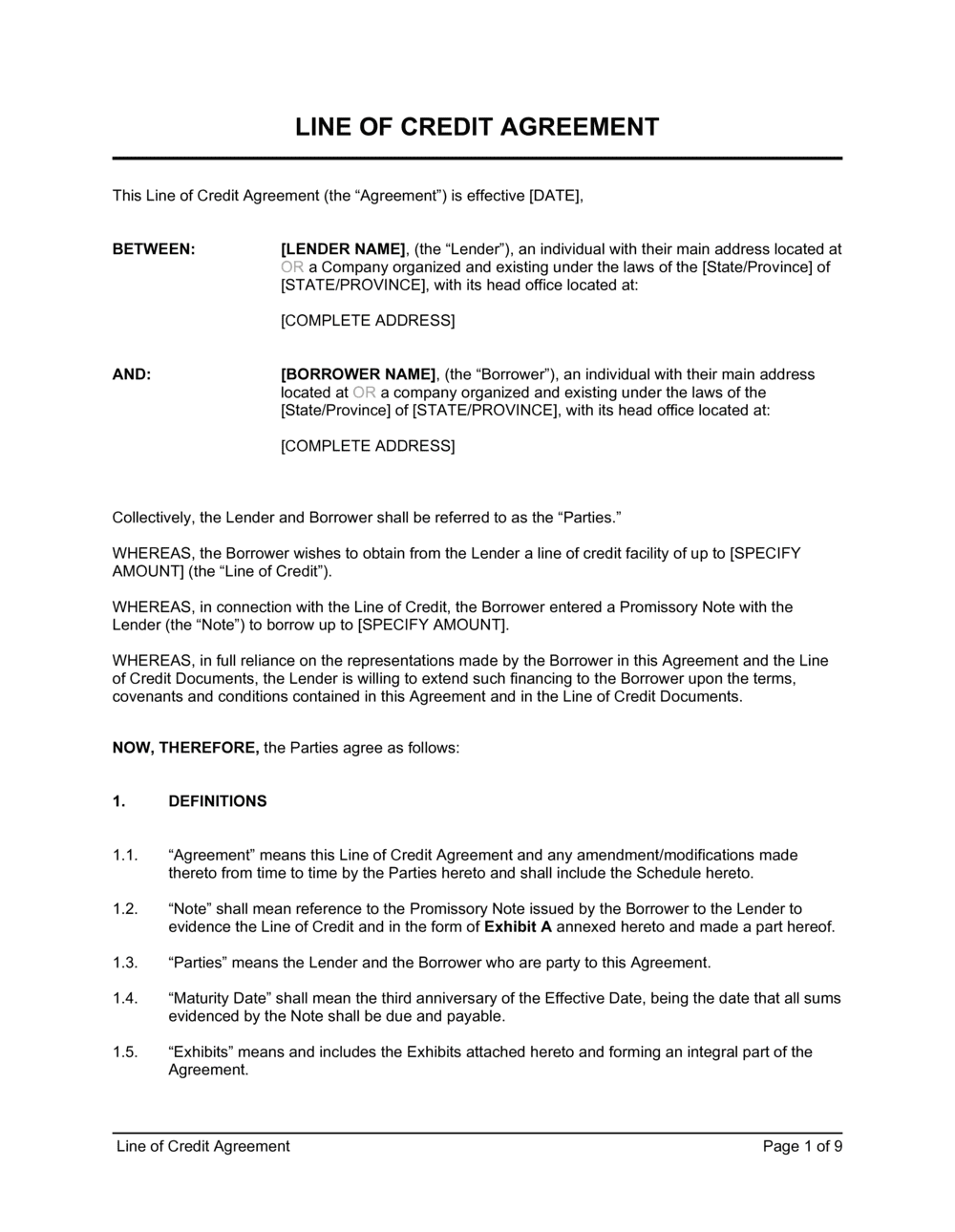
Line Of Credit Agreement Template

Free Word download β€’ Edit online β€’ Save & share with Drive β€’ Export to PDF

9 pagesβ€’30–40 min to fillβ€’Difficulty: Complexβ€’Signature requiredβ€’Legal review recommended
Learn more ↓
FreeLine Of Credit Agreement Template

At a glance

What it is
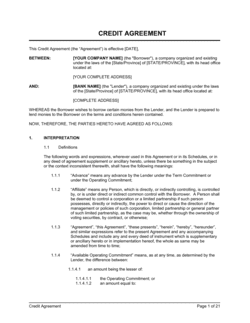
A Line of Credit Agreement is a legally binding contract between a lender and a borrower that establishes a revolving credit facility β€” setting the maximum commitment amount, interest rate, advance and repayment mechanics, financial covenants, fees, security, and termination conditions. This free Word download gives you a professionally structured template you can edit online and export as PDF for working-capital, equipment, or general business-financing purposes.
When you need it
Use it when a lender and borrower are entering a revolving credit arrangement and need a single enforceable document governing every draw, repayment, and covenant obligation over the life of the facility. It is equally appropriate for private lender-to-business arrangements and formal inter-company credit lines.
What's inside
Maximum commitment and availability mechanics, interest rate and fee schedule, advance request procedure, repayment and clean-up periods, affirmative and negative covenants, events of default, security and collateral provisions, representations and warranties, and termination conditions.

What is a Line of Credit Agreement?

A Line of Credit Agreement is a legally binding contract between a lender and a borrower that establishes a revolving credit facility β€” defining the maximum commitment amount, the interest rate and benchmark, the mechanics for drawing and repaying funds, financial covenants, fees, collateral, and the conditions under which the facility terminates or can be accelerated. Unlike a term loan that disburses a fixed sum at closing, a revolving line allows the borrower to draw up to the commitment limit, repay, and draw again repeatedly during the facility term, with interest accruing only on the outstanding balance. This structure makes it the standard instrument for working-capital financing, seasonal inventory purchases, and bridging cash-flow gaps between billing and collection cycles.

Why You Need This Document

Operating a credit facility without a written agreement exposes both parties to significant and asymmetric risk. Without defined advance procedures, a lender has no contractual basis to refuse an improper draw request. Without financial covenants, there is no early-warning mechanism before a borrower's deteriorating balance sheet becomes an unrecoverable default. Without a perfected security interest, an unsecured lender joins the general creditor queue in a bankruptcy proceeding β€” often recovering cents on the dollar while a secured lender with a properly filed UCC-1 or PPSA registration recovers first from the pledged collateral. For the borrower, a clearly documented facility with defined cure periods and a reasonable covenant structure prevents a single bad quarter from triggering immediate acceleration. This template provides the full contractual framework β€” commitment mechanics, rate provisions, covenants, default remedies, and perfection language β€” so both parties enter the facility with their rights and obligations unambiguously documented from the first advance.

Which variant fits your situation?

If your situation is…Use this template
Revolving facility for general working-capital needsLine of Credit Agreement
Single lump-sum loan with fixed repayment scheduleLoan Agreement
Short-term bridge loan between financing eventsBridge Loan Agreement
Secured loan backed by specific equipment or assetsSecured Loan Agreement
Convertible note for a startup roundConvertible Note Agreement
Personal loan between individualsPersonal Loan Agreement
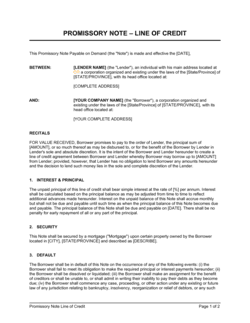
Promissory note documenting a simple debt obligationPromissory Note

Common mistakes to avoid

❌ Failing to perfect the security interest

Why it matters: An unperfected security interest is treated as unsecured debt in the borrower's bankruptcy. The lender joins the queue of general creditors instead of exercising first-priority rights over the collateral.

Fix: File a UCC-1 financing statement in the borrower's jurisdiction of organization (US) or a PPSA financing statement in the applicable province (Canada) on the same day the agreement is signed.

❌ Setting financial covenants with no headroom

Why it matters: A covenant set at the borrower's current ratio triggers default on the first quarter of any minor softness, forcing acceleration or waiver negotiations that damage the lending relationship.

Fix: Set the covenant floor at least 10–15% below the borrower's trailing twelve-month ratio and include a 30-day cure period for first-time breaches.

❌ Omitting a benchmark replacement provision

Why it matters: If the named benchmark is discontinued and the agreement is silent, neither party has a clear contractual mechanism to reprice the facility β€” creating a dispute or unintentional zero-rate period.

Fix: Include a fallback rate clause referencing ARRC-recommended SOFR Term Rate language for USD facilities, or the applicable IBOR replacement language for other currencies.

❌ No cure period for covenant breaches

Why it matters: Automatic default with no cure period for a technical covenant breach is commercially unreasonable and courts in several jurisdictions have refused to enforce accelerated remedies on that basis, leaving the lender in a worse position than if a cure period had been included.

Fix: Include a tiered cure structure: 5 business days for payment defaults and 30 days for covenant breaches, with lender notification required to start the cure clock.

❌ Using a trade name instead of the registered legal entity

Why it matters: A security filing against a trade name does not perfect the lender's interest β€” it must be made against the exact legal name of the registered entity, or it is seriously misleading and ineffective.

Fix: Obtain a certificate of good standing or corporate registry printout for the borrower and copy the entity name character-for-character into the agreement and all financing statements.

❌ Omitting the clean-up period on a working-capital facility

Why it matters: Without a clean-up period, a revolving line quietly converts into permanent term financing over time, changing the lender's risk profile and potentially triggering accounting reclassification of the debt.

Fix: Include a 30-consecutive-day zero-balance requirement in each calendar year and a covenant requiring the borrower to certify compliance within 10 days of the clean-up period ending.

The 10 key clauses, explained

Parties, Recitals, and Defined Terms

In plain language: Identifies the lender and borrower as legal entities, states the purpose of the facility, and defines every capitalized term used throughout the agreement.

Sample language
This Line of Credit Agreement (the 'Agreement') is entered into as of [DATE] between [LENDER LEGAL NAME], a [STATE/PROVINCE] [ENTITY TYPE] ('Lender'), and [BORROWER LEGAL NAME], a [STATE/PROVINCE] [ENTITY TYPE] ('Borrower'). The defined terms used herein have the meanings set out in Schedule A.

Common mistake: Using trade names instead of registered legal entity names. If the entity name on the agreement doesn't match the security filing or bank records, enforcing the security interest or pursuing recovery becomes procedurally complicated.

Commitment Amount and Availability

In plain language: States the maximum credit limit, how availability is calculated, and any borrowing base or concentration limits that reduce what the borrower can draw.

Sample language
Lender hereby establishes a revolving line of credit in favor of Borrower in the maximum principal amount of $[AMOUNT] (the 'Commitment'). Availability at any time equals the Commitment minus the aggregate outstanding principal of all Advances.

Common mistake: Omitting a borrowing base formula when the facility is tied to receivables or inventory. Without one, the lender has no contractual mechanism to reduce availability as the collateral base shrinks.

Advance Procedure

In plain language: Specifies how the borrower requests a draw β€” the required notice period, minimum advance amounts, the form of the advance request, and the lender's disbursement timeline.

Sample language
Borrower may request an Advance by delivering a written Advance Request to Lender no later than [2] Business Days prior to the requested disbursement date. Each Advance shall be in a minimum amount of $[MINIMUM AMOUNT]. Lender shall disburse approved Advances to Borrower's account at [BANK NAME], Account No. [XXXXXXXX].

Common mistake: Leaving the advance procedure silent on what happens if the lender disputes the request. Without a defined cure or dispute process, a rejected advance becomes an immediate litigation trigger.

Interest Rate and Calculation

In plain language: Sets the applicable interest rate β€” fixed or floating β€” the benchmark it is tied to, the spread, and the day-count convention used to calculate accrued interest.

Sample language
Outstanding Advances shall bear interest at a per annum rate equal to [SOFR / Prime Rate / Fixed Rate of X%] plus [SPREAD]%, calculated on the basis of a 365-day year (or 360-day year for SOFR-based facilities) on the actual number of days elapsed. Interest accrues daily and is payable on the [1st] day of each calendar month.

Common mistake: Failing to include a benchmark replacement provision. If the named benchmark (e.g., SOFR) is discontinued, the agreement needs a fallback rate β€” otherwise reprice negotiations become contentious or legally ambiguous.

Fees

In plain language: Lists every fee the borrower owes the lender: commitment fee on the undrawn balance, origination fee, annual renewal fee, and any prepayment or early-termination fee.

Sample language
Borrower shall pay to Lender: (a) a Commitment Fee equal to [X]% per annum on the average daily unused portion of the Commitment, payable quarterly; (b) an Origination Fee of $[AMOUNT] due on the Closing Date; and (c) an Annual Renewal Fee of $[AMOUNT] payable on each anniversary of the Closing Date.

Common mistake: Omitting the commitment fee entirely on small private facilities. Lenders who skip it lose compensation for holding capital available during periods when the borrower draws nothing.

Repayment, Clean-Up Period, and Maturity

In plain language: Defines the repayment mechanics β€” interest-only or principal-plus-interest β€” the clean-up period requirement, and the final maturity date on which all outstanding amounts become due.

Sample language
Borrower shall repay each Advance on or before the Maturity Date of [DATE]. Borrower shall repay all outstanding Advances in full for a period of not less than [30] consecutive days during each calendar year (the 'Clean-Up Period'). All outstanding principal, accrued interest, and fees are due and payable on the Maturity Date.

Common mistake: No clean-up period on a working-capital facility. Without one, a short-term line quietly converts into permanent financing, and the lender loses the legal and tax distinction between the two.

Affirmative and Negative Covenants

In plain language: Requires the borrower to maintain certain financial ratios, provide periodic reporting, and carry insurance (affirmative); and prohibits additional indebtedness, asset sales, or change of control without lender consent (negative).

Sample language
Borrower covenants to: (a) maintain a Debt Service Coverage Ratio of not less than [1.25:1.00]; (b) deliver quarterly financial statements within [45] days of quarter-end; and (c) maintain general liability insurance of not less than $[AMOUNT]. Borrower shall not, without Lender's prior written consent: (i) incur additional indebtedness exceeding $[THRESHOLD]; (ii) sell or encumber material assets; or (iii) permit a Change of Control.

Common mistake: Setting financial covenants without headroom above current ratios. A covenant set at the borrower's exact current ratio triggers default on the first quarter of any softness, even if the underlying business is healthy.

Events of Default and Remedies

In plain language: Lists the specific events β€” missed payment, covenant breach, insolvency, material misrepresentation β€” that constitute a default, and grants the lender the right to accelerate the loan and enforce security.

Sample language
Each of the following constitutes an Event of Default: (a) failure to pay any amount due within [5] Business Days of its due date; (b) breach of any covenant not cured within [30] days of written notice; (c) insolvency, bankruptcy filing, or assignment for the benefit of creditors; or (d) any material adverse change in the Borrower's financial condition. Upon an Event of Default, Lender may declare all Advances immediately due and payable and enforce any security interest.

Common mistake: No cure period for covenant breaches. Automatic default on a first technical breach β€” with no opportunity to remedy β€” is commercially unreasonable and courts may decline to enforce accelerated remedies on that basis.

Security and Collateral

In plain language: Describes the assets pledged as collateral, the lender's security interest, and the borrower's obligation to execute and register any documents needed to perfect that interest.

Sample language
To secure the Borrower's obligations hereunder, Borrower grants to Lender a first-priority security interest in all present and after-acquired [accounts receivable / inventory / equipment / general intangibles] of Borrower (the 'Collateral'). Borrower shall execute and deliver such UCC financing statements, PPSA registrations, or other documents as Lender may reasonably require to perfect its security interest.

Common mistake: Describing collateral broadly ('all assets') without perfecting the security interest through a UCC-1 filing or PPSA registration. An unperfected security interest is treated as unsecured in bankruptcy proceedings.

Governing Law, Jurisdiction, and Notices

In plain language: Specifies which jurisdiction's law governs the agreement, where disputes are resolved, and the required method and address for formal notices between parties.

Sample language
This Agreement is governed by the laws of [STATE / PROVINCE], without regard to conflict-of-law principles. Each party consents to the exclusive jurisdiction of the courts of [CITY, STATE / PROVINCE]. Notices shall be in writing and delivered by overnight courier or email with read-receipt to the addresses set out in Schedule B.

Common mistake: Choosing governing law with no connection to where the borrower operates or where the collateral is located. Courts may decline to apply a chosen law when it has no meaningful nexus to the transaction, leaving both parties uncertain about which rules apply.

How to fill it out

  1. 1

    Identify both parties using their registered legal entity names

    Enter the lender's and borrower's full legal names exactly as they appear on their formation or registration documents. Include entity type and state or province of formation.

    πŸ’‘ Cross-reference the borrower's corporate registry filing β€” a name mismatch between the agreement and a UCC or PPSA filing can invalidate the security interest.

  2. 2

    Set the commitment amount and availability mechanics

    Enter the maximum credit limit. If the facility is receivables- or inventory-based, include a borrowing base formula in Schedule A that caps availability to a percentage of eligible collateral.

    πŸ’‘ For asset-based lines, a standard advance rate is 80% of eligible receivables under 90 days and 50% of eligible inventory β€” adjust based on the borrower's industry and asset quality.

  3. 3

    Define the interest rate and benchmark

    Choose a fixed rate or a floating rate indexed to SOFR, Prime, or another published benchmark. Enter the spread, day-count convention (365 or 360), and payment frequency (monthly is standard).

    πŸ’‘ Include a benchmark replacement provision referencing SOFR Term Rate fallback language published by ARRC β€” this protects both parties if the benchmark is discontinued.

  4. 4

    List all fees with precise amounts and due dates

    Enter the origination fee (flat dollar or basis points on the commitment), commitment fee rate on the undrawn balance, and any annual renewal fee. State each due date explicitly.

    πŸ’‘ Express commitment fees as an annual percentage rate applied to the average daily undrawn balance β€” this makes quarterly billing calculations unambiguous.

  5. 5

    Set repayment terms and the clean-up period

    Specify whether advances are interest-only until maturity or amortizing. Set the final maturity date and define the annual clean-up period β€” typically 30 consecutive days with a zero balance.

    πŸ’‘ For a 12-month revolving facility, a 30-day clean-up period in Q3 (July–September) aligns with typical seasonal low-points for many working-capital borrowers.

  6. 6

    Draft covenants with built-in headroom

    Set affirmative covenants (financial reporting timelines, insurance minimums, licensing maintenance) and negative covenants (debt incurrence caps, asset-sale restrictions). For financial ratio covenants, set the threshold at least 10–15% below the borrower's current ratio.

    πŸ’‘ Include a 30-day cure period for financial covenant breaches β€” automatic acceleration on a first technical miss is commercially unusual and often unenforceable.

  7. 7

    Describe collateral and plan the perfection filings

    Identify the specific asset classes pledged. Prepare the corresponding UCC-1 financing statement (US) or PPSA financing statement (Canada) to be filed simultaneously with or immediately after signing.

    πŸ’‘ File the UCC-1 in the state where the borrower is legally organized (for registered entities), not where the assets are physically located β€” a common filing error.

  8. 8

    Execute before any funds are advanced

    Both parties sign the agreement and all schedules before the first advance is disbursed. If the lender requires a legal opinion, obtain it prior to execution.

    πŸ’‘ Use a dated execution block that records the exact signing date β€” courts have voided security interests when the financing statement was filed before the authenticated security agreement was executed.

Frequently asked questions

What is a line of credit agreement?

A line of credit agreement is a legally binding contract between a lender and a borrower that establishes a revolving credit facility β€” setting the maximum amount the borrower can draw, the interest rate, the advance and repayment mechanics, covenants, fees, and termination conditions. Unlike a term loan, which disburses a lump sum, a line of credit allows the borrower to draw, repay, and redraw up to the commitment limit repeatedly during the facility term, making it well-suited for working-capital and seasonal financing needs.

What is the difference between a line of credit agreement and a loan agreement?

A loan agreement typically documents a single lump-sum disbursement with a fixed repayment schedule β€” the borrower draws all funds at closing and repays on a set amortization. A line of credit agreement establishes a revolving facility where the borrower draws and repays multiple times up to a maximum commitment. Interest accrues only on the outstanding balance, making a line of credit more flexible and often less costly for businesses with fluctuating cash-flow needs.

What should a line of credit agreement include?

At minimum: the parties' legal names, maximum commitment amount, interest rate and benchmark, advance request procedure, repayment terms and maturity date, clean-up period, fees (origination, commitment, renewal), affirmative and negative covenants, events of default with cure periods, collateral description, perfection requirements, and governing law. Missing any of these creates gaps that become expensive to resolve if the borrower defaults or the relationship sours.

Does a line of credit agreement need to be secured?

Not always β€” unsecured lines of credit exist, particularly for borrowers with strong credit profiles or in inter-company arrangements. However, most commercial lines are secured by a first-priority interest in accounts receivable, inventory, or general business assets. A secured facility gives the lender priority over those assets in a bankruptcy and typically allows a higher commitment amount or lower interest rate. If secured, the security interest must be perfected through a UCC-1 or PPSA filing to be enforceable against third parties.

What is a clean-up period and why is it required?

A clean-up period requires the borrower to reduce the outstanding balance to zero for a specified number of consecutive days β€” typically 30 β€” at least once per year. It confirms the facility is being used for short-term working-capital purposes rather than as permanent financing. Lenders and auditors use the clean-up period to distinguish revolving credit from term debt, which affects how the liability is classified on the borrower's balance sheet and how the lender assesses credit risk on renewal.

What interest rate should a line of credit agreement use?

Most USD commercial lines are priced at a spread over SOFR (Secured Overnight Financing Rate) or Prime Rate β€” for example, SOFR plus 2.50% or Prime plus 1.00%. Fixed rates are used for shorter-term or private lender facilities where simplicity is preferred. Whichever benchmark is chosen, the agreement should include a benchmark replacement provision in case the rate is discontinued, specifying a fallback calculation method and the party responsible for determining the replacement rate.

What covenants are typically included in a line of credit agreement?

Affirmative covenants typically require the borrower to deliver quarterly financial statements, maintain minimum insurance coverage, preserve required business licenses, and pay taxes when due. Negative covenants commonly restrict additional indebtedness above a threshold, asset sales without lender consent, dividends or owner distributions while the line is drawn, and change-of-control transactions. Financial maintenance covenants β€” such as a minimum debt service coverage ratio or maximum leverage ratio β€” are common on larger or secured facilities.

Is a line of credit agreement enforceable without a lawyer?

A well-drafted template is generally enforceable when properly executed by both parties. However, enforceability of specific provisions β€” particularly security interests, cross-default clauses, and financial covenants β€” depends on jurisdiction-specific rules that a template alone may not fully address. Legal review is strongly recommended for facilities above $100,000, for borrowers with complex capital structures, or when the lender intends to rely on the security interest in an insolvency scenario.

How is a line of credit agreement terminated?

Termination typically occurs in one of three ways: the facility matures on its stated maturity date and all outstanding amounts are repaid; the borrower voluntarily terminates by repaying the full balance and providing written notice; or the lender accelerates and demands full repayment following an uncured event of default. Upon termination, the lender should file a UCC-3 termination statement (US) or discharge the PPSA registration (Canada) to release the security interest from public record.

How this compares to alternatives

vs Loan Agreement

A loan agreement disburses a single lump sum at closing with a fixed amortization schedule β€” the borrower pays down principal regardless of cash-flow needs. A line of credit agreement is revolving: the borrower draws only what is needed and repays when cash is available, paying interest only on the outstanding balance. Use a loan agreement for a defined capital expenditure; use a line of credit for ongoing working-capital management.

vs Promissory Note

A promissory note is a simple, unconditional promise to repay a specified sum with interest β€” it documents the debt obligation but does not govern the ongoing mechanics of drawing and repaying a revolving facility. A line of credit agreement is more comprehensive, covering advance procedures, covenants, events of default, and security. Use a promissory note to evidence a one-time loan; use a line of credit agreement to govern a multi-draw facility.

vs Secured Loan Agreement

A secured loan agreement provides a lump-sum disbursement backed by specific collateral β€” real property, equipment, or a vehicle. A line of credit agreement is revolving and typically secured by floating assets such as receivables and inventory rather than fixed property. The key distinction is structure: term versus revolving, and fixed collateral versus an asset-based borrowing base.

vs Convertible Note Agreement

A convertible note is a short-term debt instrument that converts into equity at a future financing round β€” it is primarily a startup fundraising tool, not a working-capital facility. A line of credit agreement is a lending product with no equity component. Use a convertible note to bridge a startup to its next equity round; use a line of credit agreement when the borrower needs flexible access to cash with no dilution.

Industry-specific considerations

Retail and E-commerce

Seasonal inventory purchases and order financing make revolving lines ideal; borrowing base tied to inventory value and accounts receivable is common.

Construction and Contracting

Progress billing cycles create cash-flow gaps; lines are often secured by contract receivables with advance rates reflecting retainage holdbacks.

Manufacturing and Wholesale

Raw material procurement and bulk purchase discounts drive draw activity; borrowing base formulas typically separate finished goods from raw inventory at different advance rates.

Professional Services

Unsecured or accounts-receivable-secured lines bridge payroll between client billing cycles; clean-up periods align with fiscal year-end.

Jurisdictional notes

United States

Security interests in personal property are governed by Article 9 of the Uniform Commercial Code β€” the lender must file a UCC-1 financing statement in the state where the borrower is organized to perfect its interest. State usury laws cap interest rates; rates vary widely by state and entity type (many states exempt commercial loans to businesses). SOFR is the standard benchmark for new USD facilities following the 2023 cessation of USD LIBOR. Federal and state banking regulators impose additional requirements on licensed lenders.

Canada

Personal property security is governed provincially under the PPSA (Personal Property Security Act) in all provinces except Quebec, where the Civil Code applies. Registration must be made in the province where the collateral is located or the debtor is domiciled. Interest rates above 60% per annum are criminally usurious under the Criminal Code. Quebec contracts must be in French for provincially regulated entities; bilingual documentation is best practice for any borrower operating in the province.

United Kingdom

Credit facilities to businesses are regulated under the Financial Services and Markets Act 2000 when extended by an FCA-authorised lender. Security over company assets typically takes the form of a fixed or floating charge registered at Companies House within 21 days of creation under the Companies Act 2006 β€” late registration voids the charge against a liquidator. SONIA (Sterling Overnight Index Average) replaced GBP LIBOR as the standard benchmark for sterling facilities.

European Union

Commercial credit facilities are generally subject to member-state law; there is no single EU-wide commercial lending statute. Security perfection rules, priority, and enforcement vary significantly β€” German law requires notarized pledges for certain asset classes; French law has distinct rules for nantissement (pledge) of receivables. GDPR applies to the processing of personal data in KYC and credit-assessment procedures. The EU Benchmarks Regulation governs the use of financial benchmarks, including EURIBOR, in credit agreements within the EEA.

Template vs lawyer β€” what fits your deal?

PathBest forCostTime
Use the templatePrivate lender-to-business lines under $100,000 with straightforward collateral and no complex covenant structuresFree30–60 minutes
Template + legal reviewFacilities between $100,000 and $500,000, borrowers with existing debt, or any secured line requiring UCC or PPSA filings$500–$1,5002–5 days
Custom draftedSyndicated facilities, asset-based lending with a borrowing base audit, regulated lenders, or cross-border credit arrangements$3,000–$15,000+2–6 weeks

Glossary

Revolving Credit Facility
A credit arrangement where the borrower can draw, repay, and redraw up to a maximum commitment amount repeatedly during the facility term.
Commitment Amount
The maximum aggregate principal that the lender agrees to make available to the borrower at any one time under the facility.
Availability
The portion of the commitment that the borrower can draw on at a given moment β€” calculated as the commitment amount minus the current outstanding balance.
Advance Request
A formal written notice from the borrower to the lender requesting a draw of funds, specifying the amount and requested disbursement date.
Clean-Up Period
A provision requiring the borrower to reduce the outstanding balance to zero for a specified number of consecutive days each year, confirming the facility is being used for short-term working capital rather than permanent financing.
Covenant
A contractual obligation placed on the borrower β€” either requiring specific actions (affirmative) or prohibiting certain activities (negative) β€” to protect the lender's position.
Event of Default
A defined circumstance β€” such as missed payment, covenant breach, or insolvency β€” that entitles the lender to accelerate repayment and enforce security.
Acceleration
The lender's right, triggered by an event of default, to declare the entire outstanding balance immediately due and payable rather than on the original repayment schedule.
Security Interest
A legal claim granted by the borrower to the lender over specific assets β€” accounts receivable, inventory, or equipment β€” as collateral for the facility.
SOFR (Secured Overnight Financing Rate)
The benchmark interest rate that replaced USD LIBOR for most US dollar credit facilities, published daily by the Federal Reserve Bank of New York.
Commitment Fee
A periodic fee charged on the unused portion of the credit commitment, compensating the lender for keeping funds available even when not drawn.
Drawdown
The act of borrowing funds under the facility; each drawdown increases the outstanding balance and begins accruing interest from the disbursement date.

Part of your Business Operating System

This document is one of 3,000+ business & legal templates included in Business in a Box.

  • Fill-in-the-blanks β€” ready in minutes
  • 100% customizable Word document
  • Compatible with all office suites
  • Export to PDF and share electronically

Create your document in 3 simple steps.

From template to signed document β€” all inside one Business Operating System.
1
Download or open template

Access over 3,000+ business and legal templates for any business task, project or initiative.

2
Edit and fill in the blanks with AI

Customize your ready-made business document template and save it in the cloud.

3
Save, Share, Send, Sign

Share your files and folders with your team. Create a space of seamless collaboration.

Save time, save money, and create top-quality documents.

β˜…β˜…β˜…β˜…β˜…

"Fantastic value! I'm not sure how I'd do without it. It's worth its weight in gold and paid back for itself many times."

Managing Director Β· Mall Farm
Robert Whalley
Managing Director, Mall Farm Proprietary Limited
β˜…β˜…β˜…β˜…β˜…

"I have been using Business in a Box for years. It has been the most useful source of templates I have encountered. I recommend it to anyone."

Business Owner Β· 4+ years
Dr Michael John Freestone
Business Owner
β˜…β˜…β˜…β˜…β˜…

"It has been a life saver so many times I have lost count. Business in a Box has saved me so much time and as you know, time is money."

Owner Β· Upstate Web
David G. Moore Jr.
Owner, Upstate Web

Run your business with a system β€” not scattered tools

Stop downloading documents. Start operating with clarity. Business in a Box gives you the Business Operating System used by over 250,000 companies worldwide to structure, run, and grow their business.

Start freeΒ Β·Β No credit card required