Credit Agreement Template

Free Word download • Edit online • Save & share with Drive • Export to PDF

21 pages35–50 min to fillDifficulty: ComplexSignature requiredLegal review recommended
Learn more ↓
FreeCredit Agreement Template

At a glance

What it is
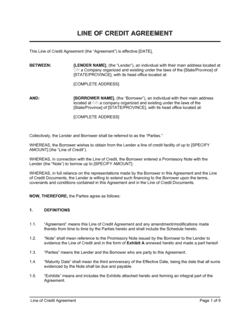
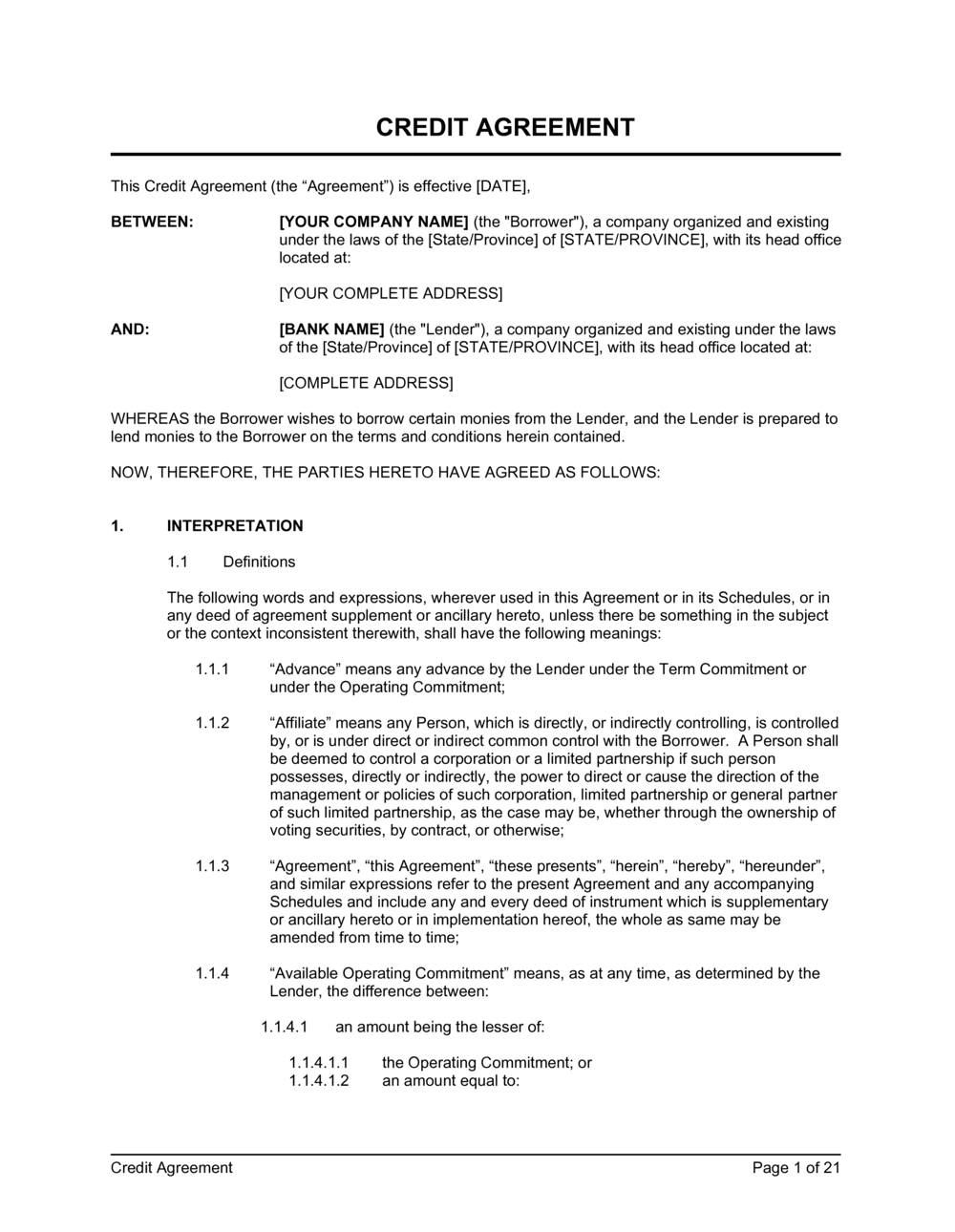
A Credit Agreement is a legally binding contract between a lender and a borrower that establishes the terms of a credit facility — covering principal amount, interest rate, repayment schedule, financial covenants, events of default, collateral, and remedies. This free Word download gives you a complete, editable template you can adapt for term loans, revolving credit lines, or bilateral commercial lending, then export as PDF for execution.
When you need it
Use it when a business is borrowing capital from a bank, private lender, or related party, and the parties need a formal, enforceable record of the loan terms that goes beyond a promissory note. It is also appropriate when the lender requires financial reporting covenants, a security interest, or structured default and remedy provisions.
What's inside
Facility description and commitment amount, interest rate and calculation method, drawdown and repayment schedule, affirmative and negative covenants, financial reporting obligations, representations and warranties, events of default, security and collateral provisions, and governing law and dispute resolution.

What is a Credit Agreement?

A Credit Agreement is a legally binding contract between a lender and a borrower that governs every material dimension of a loan or credit facility: the principal commitment, interest rate and benchmark, drawdown mechanics, repayment schedule, financial covenants, representations and warranties, events of default, security package, and the lender's remedies upon borrower failure. Unlike a simple promissory note, which records the bare debt obligation, a credit agreement establishes the entire framework under which funds are advanced and recovered — making it the foundational document for virtually all commercial lending relationships. It is equally relevant whether the lender is a bank, a private credit fund, a family office, or a related-party shareholder advancing funds to a portfolio company.

Why You Need This Document

A handshake loan or informal promissory note leaves both lender and borrower exposed in ways that typically become apparent only at the worst possible moment. Without a credit agreement specifying financial covenants and reporting obligations, a lender has no early-warning mechanism before a borrower's financial condition deteriorates — and no contractual basis to act before insolvency proceedings begin. Without a detailed events-of-default section, a lender who is not being repaid may have no clear right to accelerate the outstanding balance or enforce collateral. Without a security agreement properly referenced and perfected within the credit agreement framework, collateral pledges rank behind unsecured creditors in bankruptcy regardless of what was verbally agreed. For borrowers, a well-drafted credit agreement is equally valuable: it defines exactly what the lender can and cannot do, prevents unilateral changes to pricing or covenant terms, and limits the circumstances under which the lender can demand immediate repayment. This template gives both parties a professionally structured starting point that captures market-standard commercial lending terms — reducing negotiation time and the risk of critical provisions being overlooked before funds are advanced.

Which variant fits your situation?

If your situation is…Use this template
A single lump-sum loan with fixed repayments over a defined termTerm Loan Agreement
A revolving credit line the borrower can draw and repay repeatedlyRevolving Credit Agreement
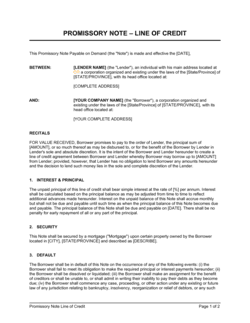
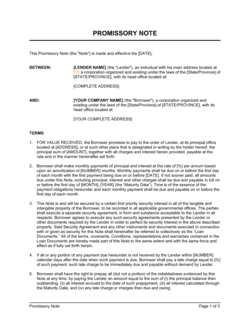
A short-term informal loan between two parties with minimal termsPromissory Note
A loan secured by real property as collateralMortgage Loan Agreement
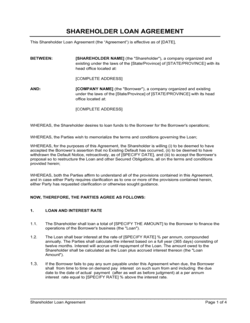
A loan between a company and one of its shareholders or directorsShareholder Loan Agreement
A short-term bridge loan pending permanent financingBridge Loan Agreement
A personal loan between two individuals outside a commercial contextPersonal Loan Agreement

Common mistakes to avoid

❌ No benchmark fallback for floating-rate interest

Why it matters: If SOFR, SONIA, or EURIBOR becomes temporarily unavailable, an agreement without a fallback has no agreed interest rate — leaving both parties in a contractual standstill and potentially triggering a technical default.

Fix: Include a benchmark replacement provision referencing an agreed fallback rate (e.g., the lender's cost of funds, or a fixed rate agreed at execution) and an amendment mechanism to adopt a replacement benchmark.

❌ Cross-default clause with no materiality threshold

Why it matters: A cross-default provision that triggers on any breach of any other financial obligation — with no minimum amount — means a minor trade dispute or a $5,000 overdraft can accelerate a multi-million-dollar credit facility.

Fix: Set an explicit minimum threshold for cross-default — typically expressed as a fixed currency amount (e.g., USD 250,000) — below which the cross-default clause does not apply.

❌ Failing to perfect the security interest before or at funding

Why it matters: An unperfected security interest is unenforceable against third-party creditors and a bankruptcy trustee. In insolvency, the lender ranks as an unsecured creditor despite holding a signed security agreement.

Fix: Make completion of all perfection steps — UCC-1 filing, land registry registration, share pledge completion — a condition precedent to the first drawdown, not a post-closing obligation.

❌ Financial covenants set without headroom modelling

Why it matters: Setting a DSCR covenant at exactly the borrower's projected ratio means any minor revenue miss or cost overrun produces an immediate technical default — forcing expensive waiver negotiations at the worst possible time.

Fix: Model at least a 15–20% downside scenario before finalising covenant thresholds. Build in a cure mechanism allowing the borrower to inject equity to remedy a financial covenant breach.

❌ Repayment schedule embedded in the body without an exhibit

Why it matters: If dates or amounts need to be adjusted — even a single payment date shifted by one month — the entire agreement must be formally amended, increasing legal cost and creating execution risk.

Fix: Move the repayment schedule to a numbered exhibit referenced in the body. Exhibit amendments typically require only a shorter amendment letter rather than a full agreement restatement.

❌ Governing law jurisdiction with no connection to the transaction

Why it matters: Courts in unrelated jurisdictions may refuse to apply the chosen law or may override it using conflict-of-laws principles, leaving the enforceability of key clauses — particularly security and default provisions — uncertain.

Fix: Select the governing law of the lender's home jurisdiction or the borrower's place of incorporation, and confirm enforceability with local counsel in any jurisdiction where security assets are located.

The 10 key clauses, explained

Facility description and commitment

In plain language: Defines the type of facility (term loan or revolving credit), the maximum committed amount, and the availability period during which the borrower may draw funds.

Sample language
The Lender agrees to make available to the Borrower a [TERM LOAN / REVOLVING CREDIT FACILITY] in an aggregate principal amount not exceeding [CURRENCY] [AMOUNT] (the 'Commitment'), available for drawdown during the Availability Period ending on [DATE].

Common mistake: Describing the facility type ambiguously — failing to specify whether it is a term loan or revolving line causes disputes about whether repaid amounts can be re-borrowed.

Interest rate and calculation

In plain language: Specifies the interest rate — fixed or floating — how it is calculated, the day-count convention, and when interest is due.

Sample language
Interest shall accrue on the outstanding principal at a rate equal to [SOFR / BASE RATE] plus [X]% per annum, calculated on a 365/actual day-count basis, and shall be payable on the [last business day of each calendar month / DATE].

Common mistake: Failing to specify the day-count convention and benchmark fallback. When SOFR or another benchmark is unavailable, no fallback means the rate — and every downstream calculation — becomes disputed.

Drawdown conditions

In plain language: Lists the conditions precedent the borrower must satisfy before each drawdown — such as delivery of a drawdown notice, no existing default, and accuracy of representations.

Sample language
Each drawdown is conditional upon: (a) receipt by the Lender of a Drawdown Notice no fewer than [X] Business Days prior to the proposed drawdown date; (b) no Default or Event of Default being continuing; and (c) the representations and warranties being true and correct as at the drawdown date.

Common mistake: Listing conditions precedent that are impossible to satisfy at the first drawdown — such as requiring audited financials for a newly formed entity — which inadvertently blocks the initial funding.

Repayment schedule

In plain language: Sets out the exact dates and amounts of principal repayments, the final maturity date, and the borrower's right (if any) to prepay voluntarily.

Sample language
The Borrower shall repay the outstanding principal in [X] equal consecutive [monthly / quarterly] instalments of [CURRENCY][AMOUNT], commencing on [DATE], with the final instalment on [MATURITY DATE]. The Borrower may prepay, in whole or in part, on [X] Business Days' prior written notice, subject to a prepayment fee of [X]%.

Common mistake: Omitting a prepayment premium or make-whole provision when the lender's funding is fixed-rate. Allowing free prepayment on a fixed-rate facility exposes the lender to reinvestment risk with no contractual remedy.

Representations and warranties

In plain language: Statements of fact made by the borrower at signing and repeated at each drawdown — confirming legal capacity, no litigation, accurate financials, and no undisclosed liabilities.

Sample language
The Borrower represents and warrants that: (a) it is duly incorporated and has full power to enter into this Agreement; (b) the financial statements delivered to the Lender fairly present its financial position; and (c) no litigation, arbitration, or regulatory proceeding is pending or threatened that would have a Material Adverse Effect.

Common mistake: Using representations that are undated or not repeated at each drawdown, allowing the borrower's circumstances to deteriorate between signing and funding without the lender having a contractual basis to refuse the advance.

Affirmative and negative covenants

In plain language: Ongoing obligations the borrower must fulfil (affirmative) or refrain from (negative) during the life of the loan — covering financial ratios, dividend restrictions, additional indebtedness, and asset disposal.

Sample language
The Borrower shall: (a) maintain a DSCR of not less than [1.25]x, tested [quarterly]; (b) not incur additional Financial Indebtedness exceeding [CURRENCY][AMOUNT] without prior written consent; (c) not declare or pay any dividend while a Default is continuing; and (d) not dispose of assets with a value exceeding [CURRENCY][AMOUNT] in any financial year.

Common mistake: Setting financial covenant thresholds — particularly DSCR and leverage ratios — without headroom modelling against the borrower's actual projections, resulting in technical defaults in the first reporting period.

Events of default

In plain language: Defines the specific triggers that give the lender the right to accelerate the loan, enforce security, and exercise other remedies.

Sample language
Each of the following is an Event of Default: (a) the Borrower fails to pay any amount due within [X] Business Days of its due date; (b) any representation or warranty proves to be materially incorrect; (c) the Borrower breaches any covenant and (where capable of remedy) fails to remedy within [30] days of notice; (d) an Insolvency Event occurs in relation to the Borrower.

Common mistake: Including cross-default provisions that reference undefined 'financial indebtedness' without a materiality threshold. A cross-default clause with no floor amount means a trivial default on a $1,000 trade payable can trigger the entire credit facility.

Security and collateral

In plain language: Describes the assets pledged as security for the loan — fixed and floating charges, personal guarantees, or specific asset pledges — and the steps required to perfect the security interest.

Sample language
As security for its obligations under this Agreement, the Borrower shall grant the Lender: (a) a first-ranking fixed charge over [SPECIFIED ASSETS]; (b) a floating charge over all present and future assets of the Borrower; and (c) a personal guarantee from [GUARANTOR NAME]. The Borrower shall take all steps necessary to perfect such security within [X] Business Days of the date of this Agreement.

Common mistake: Failing to specify perfection steps and timelines. An unperfected security interest is unenforceable against third-party creditors — including a trustee in bankruptcy — regardless of what the credit agreement says.

Fees

In plain language: Lists all lender fees payable by the borrower — arrangement fee, commitment fee on undrawn amounts, agency fee, and any exit or prepayment fees.

Sample language
The Borrower shall pay: (a) an arrangement fee of [X]% of the Commitment, payable on the date of this Agreement; (b) a commitment fee of [X]% per annum on the undrawn Commitment, accruing daily and payable [quarterly]; and (c) a prepayment fee of [X]% of the amount prepaid if prepayment occurs within [X] months of the first drawdown.

Common mistake: Omitting the commitment fee on the undrawn portion of a revolving facility — lenders price in the cost of holding capital available and omitting this term understates the true cost of the facility.

Governing law and dispute resolution

In plain language: Specifies which jurisdiction's law governs the agreement and how disputes are resolved — litigation, arbitration, or a hybrid — and each party's submission to jurisdiction.

Sample language
This Agreement is governed by the laws of [STATE / JURISDICTION]. Any dispute arising under or in connection with this Agreement shall be resolved by [binding arbitration administered by [AAA / LCIA / ICC] in [CITY] / the courts of [JURISDICTION]], and each party irrevocably submits to the exclusive jurisdiction of such forum.

Common mistake: Selecting a governing law jurisdiction with no connection to either party or the transaction. Courts in the chosen jurisdiction may decline to enforce the agreement or apply their own conflict-of-laws rules to override the parties' choice.

How to fill it out

  1. 1

    Identify the parties and the facility type

    Enter the full legal names of the lender and borrower — registered entity names, not trading names. Confirm in the facility description whether this is a term loan (single advance, fixed repayment schedule) or a revolving credit line (draw, repay, redraw within a commitment).

    💡 For multi-entity borrower groups, list each borrower individually and include a joint-and-several liability clause rather than trying to cover all entities in a single party definition.

  2. 2

    Set the commitment amount, currency, and availability period

    State the maximum facility size, the currency (spell it out — USD, CAD, GBP — not just '$'), and the final date by which the borrower must draw. Undrawn commitments after the availability period typically lapse automatically.

    💡 If the lender needs to syndicate or seek internal approval before funding, build in a minimum 10-business-day drawdown notice period — not 2 days.

  3. 3

    Define the interest rate and benchmark fallback

    Choose fixed or floating. For floating, identify the benchmark (SOFR for USD, SONIA for GBP, EURIBOR for EUR), the margin, and a fallback rate in case the benchmark is unavailable or discontinued.

    💡 Include an interest rate floor — e.g., SOFR shall not be less than 0.00% — to protect the lender in negative-rate environments.

  4. 4

    Build the repayment schedule

    Specify each repayment date and amount, or state the amortization formula. Set the final maturity date. If prepayment is allowed, state the notice period and any prepayment fee. For revolving facilities, confirm the clean-down period if required.

    💡 Attach a repayment schedule as a numbered exhibit rather than embedding all dates in the body — it is easier to amend without redrafting the main agreement.

  5. 5

    Calibrate financial covenants with headroom

    Model the borrower's projected financials for the full loan term and set DSCR, leverage, and liquidity covenant thresholds that the borrower can comfortably meet under a base-case scenario, with at least 15–20% headroom.

    💡 Request the borrower's latest three years of audited financials and a 12-month forecast before finalising covenant levels — covenants set without this data create avoidable technical defaults.

  6. 6

    Define events of default with materiality thresholds

    List each default trigger and include materiality thresholds where appropriate — particularly for cross-default (minimum financial indebtedness amount), covenant breach (cure period of at least 20–30 days), and MAC (objective criteria, not subjective judgment alone).

    💡 For borrower-side negotiators, push for a grace period on payment defaults of at least 3–5 business days to cover bank processing delays — missing this is the single most common source of unnecessary acceleration notices.

  7. 7

    Specify and perfect the security package

    List every asset being pledged — specific equipment, receivables, real property, or a general floating charge over all assets. Include the perfection steps (UCC-1 filing, land registry charge, share pledge registration) and the deadline by which each must be completed.

    💡 Never treat security perfection as administrative follow-up. An unperfected security interest ranks behind unsecured creditors in insolvency — losing priority on a multi-million-dollar loan because a UCC-1 was never filed is a recurring and entirely avoidable loss.

  8. 8

    Choose the governing law and execute before funding

    Select a governing jurisdiction with a clear connection to the transaction — typically the lender's jurisdiction or the borrower's place of incorporation. Both parties must sign before any funds are advanced.

    💡 For cross-border transactions, have local counsel in both jurisdictions confirm that the chosen governing law and jurisdiction clause is enforceable before execution.

Frequently asked questions

What is a credit agreement?

A credit agreement is a legally binding contract between a lender and a borrower that establishes the full terms of a loan or credit facility — including the principal amount, interest rate, repayment schedule, financial covenants, events of default, security, and the lender's remedies if the borrower fails to perform. It is the foundational document for most commercial lending relationships and is more detailed than a simple promissory note.

What is the difference between a credit agreement and a promissory note?

A promissory note is a short-form document in which the borrower unconditionally promises to repay a sum with interest — it records the obligation but typically lacks covenants, representations, security provisions, or detailed default mechanics. A credit agreement is the comprehensive governing document covering all of those elements. For commercial loans above a modest threshold, lenders typically require both: the credit agreement governs the relationship and the promissory note evidences the debt.

What financial covenants are typically included in a credit agreement?

The most common financial covenants are a Debt Service Coverage Ratio (DSCR, typically a minimum of 1.20x–1.25x), a leverage ratio (total debt to EBITDA, often capped at 3.0x–4.0x), a minimum liquidity or cash balance requirement, and a restriction on capital expenditure above a specified annual threshold. Financial covenants are tested quarterly against the borrower's management accounts and annually against audited financials.

What happens when a borrower breaches a financial covenant?

A covenant breach is typically an event of default, giving the lender the right to accelerate the loan and demand immediate repayment of all outstanding principal and interest. In practice, lenders often issue a waiver letter rather than accelerate — particularly for a first breach with a credible cure plan — but the waiver process is time-consuming, expensive, and may involve tightened terms or increased margins. Building headroom into covenant levels at the outset avoids this outcome.

Is a credit agreement legally enforceable without notarization?

In most jurisdictions, a credit agreement signed by authorized representatives of both parties is generally enforceable without notarization. However, if the agreement involves a mortgage, charge over real property, or security interests in certain asset classes, local registration or notarization requirements may apply — particularly in civil-law countries in continental Europe and Latin America. Consider consulting a lawyer in the relevant jurisdiction before execution.

What security can a lender take under a credit agreement?

Lenders commonly take a fixed charge over specific high-value assets (real property, major equipment, intellectual property), a floating charge over the borrower's general asset pool (receivables, inventory, cash), personal guarantees from directors or shareholders, and share pledges over the borrower's holding company. The security package is negotiated based on the loan size, the borrower's asset base, and the lender's risk appetite. All security interests must be perfected by filing or registration to be enforceable against third parties.

What is an event of default in a credit agreement?

An event of default is any defined trigger that gives the lender the right to accelerate the loan and enforce its security. Common events of default include failure to pay any amount when due (subject to a short grace period), breach of a representation or covenant, insolvency or bankruptcy proceedings, a material adverse change in the borrower's condition, and cross-default to other financial obligations above a threshold amount. Not every default leads to acceleration — lenders often prefer to issue waivers and negotiate amendments when the borrower remains viable.

Do I need a lawyer to prepare a credit agreement?

For commercial loans, legal review is strongly recommended. The interaction between covenant mechanics, default triggers, and security perfection requirements is jurisdiction-specific and technically complex. A template is appropriate for straightforward bilateral term loans where both parties are commercially sophisticated — but any facility above $250,000, any cross-border transaction, or any deal involving real property security warrants at minimum a 2–3 hour lawyer review of the completed template before signing.

How this compares to alternatives

vs Promissory Note

A promissory note is a short-form unconditional promise to repay a sum with interest — it records the debt obligation but lacks covenants, representations, detailed security provisions, or structured default mechanics. A credit agreement is the comprehensive governing contract that covers all of these elements. For commercial loans above a modest amount, both documents are typically used together: the credit agreement governs the relationship and the promissory note evidences the debt instrument itself.

vs Shareholder Loan Agreement

A shareholder loan agreement documents a loan from a shareholder to their own company — typically a simpler document with no external security, lighter covenants, and often a zero or below-market interest rate. A credit agreement is used for arm's-length commercial lending where the lender requires full covenant, security, and enforcement provisions. Related-party loans governed by a credit agreement template should be reviewed for transfer-pricing implications.

vs Personal Loan Agreement

A personal loan agreement governs lending between individuals or from a lender to a natural person for personal use — it is shorter, omits financial reporting covenants, and may be subject to consumer credit regulations that do not apply to commercial borrowers. A credit agreement is designed for business-to-business or institution-to-business lending where both parties are acting commercially. Using a commercial credit agreement for consumer lending may violate consumer protection disclosure requirements.

vs Security Agreement

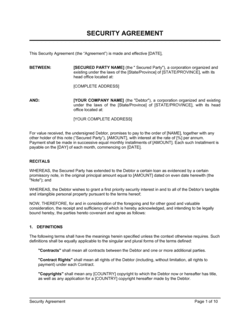
A security agreement is a standalone document creating a lender's security interest over specific borrower collateral — it governs only the collateral pledge. A credit agreement is the primary loan contract that contains or incorporates the security provisions, repayment terms, covenants, and default mechanics. A security agreement is often executed alongside a credit agreement to separately perfect the collateral interest, particularly where local law requires a distinct security instrument.

Industry-specific considerations

Commercial Real Estate

Loan-to-value covenants, interest-only periods, property-specific representations, and mortgage or deed-of-trust security perfection requirements.

Manufacturing

Equipment and inventory pledges as collateral, capex covenant baskets aligned to production cycle, and cross-default provisions referencing supply chain finance facilities.

Technology / SaaS

Venture debt structures with revenue-based covenants, IP assignment restrictions, MAC definitions referencing MRR thresholds, and equity warrant coverage provisions.

Professional Services

Receivables-based collateral, key-person provisions triggering MAC if named executives depart, and DSCR covenants calibrated to project-based revenue cycles.

Healthcare

Regulatory licence conditions as representations, reimbursement-rate change as MAC trigger, and HIPAA-compliant financial reporting obligations incorporated by reference.

Retail / E-commerce

Inventory financing with floating charge over stock, seasonal covenant testing adjustments, and cross-default provisions referencing trade credit and supplier payment terms.

Jurisdictional notes

United States

Article 9 of the Uniform Commercial Code (UCC) governs security interests in personal property in all 50 states — a UCC-1 financing statement must be filed in the borrower's state of incorporation to perfect a security interest in personal property collateral. Usury laws cap interest rates and vary significantly by state; some states exempt commercial loans above a threshold amount. The FTC and CFPB impose additional disclosure requirements for consumer credit — confirm the commercial nature of the transaction before using this template.

Canada

Personal Property Security Acts (PPSAs) in each common-law province govern security interests in personal property, requiring registration in the borrower's provincial PPSA registry to perfect. Quebec is a civil-law jurisdiction — security over movable property follows the Civil Code and requires a hypothec registered at the Register of Personal and Movable Real Rights (RPMRR). Federal criminal usury provisions cap the effective annual interest rate at 60% for all loans in Canada. Quebec credit agreements must comply with the Consumer Protection Act if the borrower is an individual, and French-language documentation may be required.

United Kingdom

Charges over UK company assets must be registered at Companies House within 21 days of creation — failure to register renders the charge void against a liquidator and unsecured creditors. The Loan Market Association (LMA) publishes standard-form credit agreements widely used in UK commercial lending. The Financial Conduct Authority (FCA) regulates consumer credit under the Consumer Credit Act 1974 — this template is intended for commercial borrowers only. Post-Brexit, SONIA has replaced LIBOR as the standard sterling benchmark rate.

European Union

Security perfection requirements vary significantly by member state — French sûretés, German Sicherungsübereignung, and Spanish prenda rules each require different registration steps and formalities. EURIBOR remains the standard floating-rate benchmark for euro-denominated commercial loans. The EU Mortgage Credit Directive and Consumer Credit Directive impose strict disclosure and cooling-off requirements for consumer lending — this template is not suitable for consumer use in EU member states. Cross-border enforcement of credit agreements within the EU is governed by the Brussels I Recast Regulation for judgment recognition and enforcement.

Template vs lawyer — what fits your deal?

PathBest forCostTime
Use the templateStraightforward bilateral term loans between two commercially sophisticated parties in a single jurisdiction, for amounts under $250,000Free1–3 hours
Template + legal reviewLoans above $250,000, any transaction involving real property security or cross-border elements, or deals with complex covenant structures$500–$1,5002–5 days
Custom draftedSyndicated facilities, regulated lenders, acquisition finance, multi-jurisdiction security packages, or deals above $2M$3,000–$15,000+2–6 weeks

Glossary

Credit Facility
A formal arrangement in which a lender commits to make a specified amount of credit available to a borrower under agreed conditions.
Principal
The original sum of money borrowed, excluding interest and fees, which must be repaid according to the agreed schedule.
Drawdown
The act of the borrower requesting and receiving funds from an available credit commitment on a specified date.
Amortization
The process of repaying a loan through regular scheduled payments that reduce the outstanding principal over the loan term.
Covenant
A contractual promise by the borrower to do something (affirmative covenant) or refrain from doing something (negative covenant) during the life of the loan.
Event of Default
A defined trigger — such as missed payment, covenant breach, or insolvency — that entitles the lender to accelerate the loan and enforce remedies.
Acceleration
The lender's right, upon an event of default, to declare the entire outstanding principal and accrued interest immediately due and payable.
Security Interest
A lender's legal right over specified borrower assets, allowing the lender to seize or sell those assets if the borrower defaults.
Intercreditor Agreement
An agreement between two or more lenders that defines the priority of their respective claims against the borrower's assets in a default scenario.
DSCR (Debt Service Coverage Ratio)
A financial covenant metric calculated as net operating income divided by total debt service — typically required to remain above 1.20x to 1.25x.
Material Adverse Change (MAC)
A clause allowing the lender to suspend drawdowns or call a default if a significant negative change occurs in the borrower's financial condition or business.
SOFR (Secured Overnight Financing Rate)
The benchmark interest rate used in US dollar loan agreements as the successor to LIBOR, reflecting overnight US Treasury repo transactions.

Part of your Business Operating System

This document is one of 3,000+ business & legal templates included in Business in a Box.

  • Fill-in-the-blanks — ready in minutes
  • 100% customizable Word document
  • Compatible with all office suites
  • Export to PDF and share electronically

Create your document in 3 simple steps.

From template to signed document — all inside one Business Operating System.
1
Download or open template

Access over 3,000+ business and legal templates for any business task, project or initiative.

2
Edit and fill in the blanks with AI

Customize your ready-made business document template and save it in the cloud.

3
Save, Share, Send, Sign

Share your files and folders with your team. Create a space of seamless collaboration.

Save time, save money, and create top-quality documents.

★★★★★

"Fantastic value! I'm not sure how I'd do without it. It's worth its weight in gold and paid back for itself many times."

Managing Director · Mall Farm
Robert Whalley
Managing Director, Mall Farm Proprietary Limited
★★★★★

"I have been using Business in a Box for years. It has been the most useful source of templates I have encountered. I recommend it to anyone."

Business Owner · 4+ years
Dr Michael John Freestone
Business Owner
★★★★★

"It has been a life saver so many times I have lost count. Business in a Box has saved me so much time and as you know, time is money."

Owner · Upstate Web
David G. Moore Jr.
Owner, Upstate Web

Run your business with a system — not scattered tools

Stop downloading documents. Start operating with clarity. Business in a Box gives you the Business Operating System used by over 250,000 companies worldwide to structure, run, and grow their business.

Start free · No credit card required