Retail Salesperson Job Description Template

Free Word download β€’ Edit online β€’ Save & share with Drive β€’ Export to PDF

2 pagesβ€’20–30 min to fillβ€’Difficulty: Standardβ€’Signature requiredβ€’Legal review recommended
Learn more ↓
FreeRetail Salesperson Job Description Template

At a glance

What it is
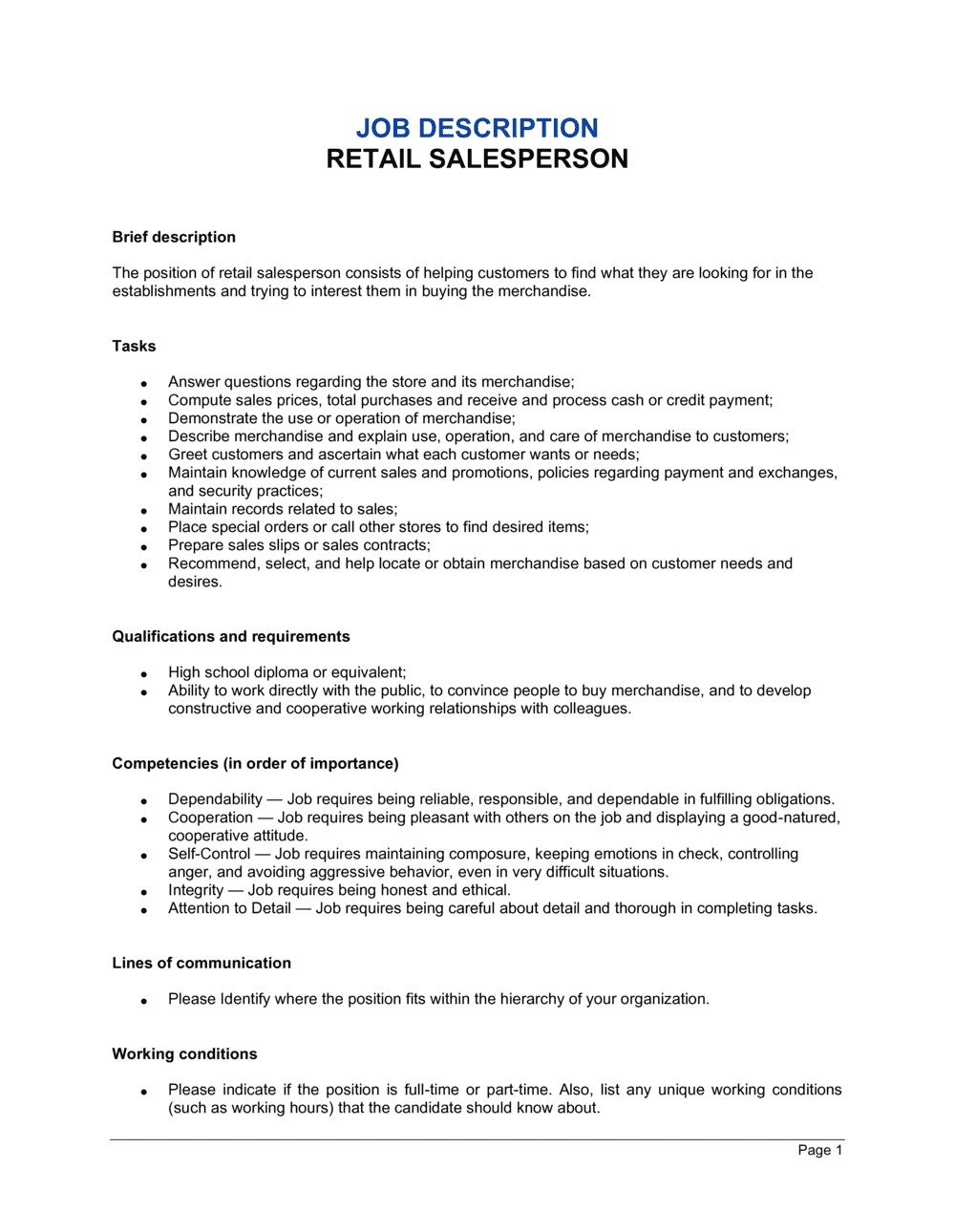
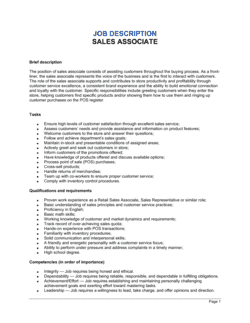
A Retail Salesperson Job Description is a formal document that defines the scope of a retail sales role β€” covering duties, performance expectations, required qualifications, compensation structure, and working conditions. This free Word download gives store owners and HR teams a structured, legally grounded starting point they can edit online and export as PDF to attach to employment offers or post on job boards.
When you need it
Use it when hiring a new sales associate, formalizing an existing role, or updating responsibilities after a promotion or restructuring. It is also required by most employment agreements and sets the enforceable baseline for performance reviews and disciplinary action.
What's inside
Job title and reporting structure, core duties and daily responsibilities, performance targets and sales metrics, required and preferred qualifications, compensation and commission structure, working hours and physical requirements, and an acknowledgment block for employee signature.

What is a Retail Salesperson Job Description?

A Retail Salesperson Job Description is a formal document that defines the scope, duties, performance expectations, qualifications, and compensation of a frontline retail sales role. It specifies exactly what the employee is expected to do β€” from greeting customers and processing transactions to meeting monthly sales targets β€” and establishes the written record against which performance is measured, managed, and, when necessary, disciplined. Unlike an informal role summary, a properly drafted and signed job description carries legal weight: it is admissible evidence in employment disputes, wage-and-hour audits, and discrimination claims, making precision in its language directly proportional to the employer's legal protection.

Why You Need This Document

Operating without a written, signed job description exposes retail employers to four distinct legal and operational risks. First, without documented duties, performance improvement plans have no objective standard to reference β€” making terminations for cause difficult to defend and wrongful termination claims easier to bring. Second, undocumented physical requirements mean ADA and human rights accommodation requests cannot be evaluated against actual job demands, forcing employers into costly, ad hoc decisions. Third, commission structures described only verbally become credibility contests when a departing employee claims unpaid wages β€” a written document with a clear formula and conditionality clause is the only reliable defense. Fourth, courts in multiple US states and Canadian provinces have implied contractual obligations from unsigned or vague job documents that were never intended as binding. This template gives retailers a structured, jurisdiction-aware starting point they can complete in under 30 minutes, attach to every offer letter, and rely on through the entire employment lifecycle.

Which variant fits your situation?

If your situation is…Use this template
Hiring a senior floor manager with supervisory dutiesRetail Store Manager Job Description
Documenting a commissioned sales role with variable paySales Representative Job Description
Hiring a cashier with limited upselling responsibilitiesCashier Job Description
Onboarding a part-time seasonal sales associatePart-Time Employment Contract
Formalizing the role into a binding employment agreementEmployment Contract (At-Will)
Hiring a visual merchandiser with sales floor dutiesMerchandiser Job Description
Documenting a remote or phone-based retail sales roleCustomer Service Representative Job Description

Common mistakes to avoid

❌ Using vague duty descriptions

Why it matters: A duty list that reads 'provide great customer service and support the team' cannot support a performance improvement plan, justify a termination for cause, or withstand scrutiny in an employment dispute.

Fix: Replace every vague phrase with a specific, observable action tied to a measurable outcome or named system β€” 'achieve a personal conversion rate of [X]% as tracked in [POS SYSTEM]' is enforceable; 'sell effectively' is not.

❌ Omitting the non-employment-contract disclaimer

Why it matters: A signed job description without a disclaimer can be introduced as evidence of a guaranteed role or duration in wrongful termination litigation β€” particularly in states that apply implied-contract exceptions to at-will employment.

Fix: Include a clear statement in the acknowledgment block that the document does not constitute a contract of employment for any defined period and may be modified by the employer with reasonable notice.

❌ Setting commission terms without a conditionality qualifier

Why it matters: Courts in several jurisdictions have found that consistently paid commissions described without a 'discretionary' qualifier become contractual entitlements β€” requiring payment even when targets are missed.

Fix: Add 'Commission payments are subject to achieving the applicable sales threshold and are not guaranteed' immediately after the commission formula.

❌ Skipping the physical requirements section

Why it matters: Without documented physical requirements, employers cannot objectively evaluate ADA accommodation requests or make defensible decisions when an employee cannot perform a physical duty.

Fix: List every physical demand as an essential function with specific parameters β€” 'ability to stand for up to 8 consecutive hours' and 'ability to lift merchandise weighing up to 30 lbs' β€” and have legal counsel confirm the list is complete.

❌ Listing qualifications that are not job-related

Why it matters: Requirements that cannot be tied to actual job performance β€” such as a bachelor's degree for a frontline cashier role β€” create disparate-impact discrimination exposure under Title VII, the EEOC's enforcement guidelines, and equivalent legislation in Canada, the UK, and the EU.

Fix: Audit every qualification requirement by asking 'can I demonstrate that lacking this qualification prevents the employee from performing an essential function?' Remove any requirement that fails this test.

❌ Obtaining the signature after the employee's start date

Why it matters: In common-law jurisdictions, restrictive clauses β€” confidentiality, non-solicitation β€” signed after employment has already begun may be unenforceable for lack of fresh consideration.

Fix: Make signature of the job description a pre-condition of the offer letter, and confirm both documents are executed on or before day one of employment.

The 9 key clauses, explained

Job Title and Department

In plain language: States the exact role title, the department it sits in, and the store location or region β€” anchoring every other clause in the document.

Sample language
Job Title: Retail Salesperson | Department: Sales Floor | Location: [STORE NAME], [CITY, STATE] | Reports To: [STORE MANAGER TITLE]

Common mistake: Using a generic title like 'Sales Staff' instead of a specific, level-differentiated title. Vague titles make performance benchmarking and FLSA classification harder to defend.

Reporting Structure

In plain language: Identifies who the employee reports to directly and any supervisory responsibilities they hold over other staff.

Sample language
The Retail Salesperson reports directly to the [STORE MANAGER / FLOOR SUPERVISOR] and has no direct reports unless otherwise specified in writing.

Common mistake: Omitting the reporting line entirely. Without a named or titled supervisor, accountability for daily performance and disciplinary escalation becomes ambiguous.

Core Duties and Responsibilities

In plain language: Lists the primary tasks the employee is expected to perform on a regular basis β€” the foundation of performance reviews and the legal record of what the role entails.

Sample language
The Retail Salesperson shall: (a) greet and assist customers on the sales floor; (b) achieve individual sales targets of $[AMOUNT] per [PERIOD]; (c) maintain product knowledge for all items in [DEPARTMENT]; (d) process transactions using [POS SYSTEM]; (e) support inventory replenishment as directed.

Common mistake: Using only vague phrases like 'provide excellent customer service.' Without measurable or observable duties, the description cannot support performance improvement plans or terminations for cause.

Sales Performance Expectations

In plain language: Defines the specific metrics the employee is expected to meet β€” revenue targets, units per transaction, conversion rate, or average order value β€” and the review cadence.

Sample language
Employee is expected to meet or exceed a monthly sales target of $[AMOUNT], a conversion rate of [X]%, and an average transaction value of $[AMOUNT]. Performance will be reviewed [monthly / quarterly].

Common mistake: Setting targets in the job description that conflict with what is communicated at hire. Courts treat written job descriptions as admissible evidence of promised role scope.

Qualifications and Experience Requirements

In plain language: Specifies the minimum education, prior experience, certifications, and skills required to perform the role β€” distinguishing mandatory from preferred.

Sample language
Required: [High school diploma or equivalent]; [1+ year of retail or customer-facing sales experience]. Preferred: [Experience with [POS SYSTEM NAME]]; [Fluency in [LANGUAGE]] .

Common mistake: Listing qualifications that are not demonstrably job-related. Overly broad or arbitrary requirements create disparate-impact discrimination liability under Title VII and equivalent laws.

Compensation and Commission Structure

In plain language: States the base hourly rate or salary, any commission formula, bonus eligibility, and pay frequency β€” the definitive written record of agreed compensation.

Sample language
Base Pay: $[HOURLY RATE] per hour, paid [bi-weekly]. Commission: [X]% of personal net sales above $[THRESHOLD] per pay period. Overtime: paid at 1.5Γ— the regular rate for hours exceeding 40 per week.

Common mistake: Describing commission as guaranteed when it is conditional. If a commission structure is included without a 'discretionary' or 'subject to achieving targets' qualifier, it may be deemed a contractual entitlement.

Working Hours, Schedule, and Physical Requirements

In plain language: Defines expected weekly hours, shift types (day, evening, weekend), scheduling flexibility requirements, and physical demands of the role.

Sample language
Expected hours: [X] hours per week, including at least [one] weekend shift. Physical requirements: ability to stand for up to [8] hours, lift up to [30] lbs, and operate within a retail floor environment.

Common mistake: Omitting physical requirements entirely. For ADA compliance, essential physical functions must be documented so that reasonable accommodation requests can be evaluated against actual job demands.

Confidentiality and Non-Solicitation

In plain language: Prohibits the employee from disclosing proprietary pricing, supplier information, or customer data, and from soliciting customers or colleagues after separation.

Sample language
Employee shall not disclose [EMPLOYER NAME]'s pricing strategies, supplier terms, or customer lists during or after employment. For [6] months following separation, Employee shall not solicit [EMPLOYER NAME]'s customers or employees.

Common mistake: Copying a generic confidentiality clause that references trade secrets the retail employee never actually accesses. Courts scrutinize whether the clause is proportionate to the employee's actual exposure.

Acknowledgment and Signature Block

In plain language: Confirms the employee has received, read, and understood the job description β€” and that it does not constitute a contract of guaranteed employment.

Sample language
I acknowledge that I have read and understood this job description, that it may be revised by [EMPLOYER NAME] at any time with reasonable notice, and that it does not constitute a guarantee of employment for any specific period. Employee Signature: _________________ Date: _______

Common mistake: Omitting the disclaimer that the job description is not an employment contract. Without it, the document can be introduced as evidence of a guaranteed role scope or duration in wrongful termination claims.

How to fill it out

  1. 1

    Enter the job title, department, and location

    Replace all placeholder text in the header with the exact job title you will use on payroll, the department name, the store location, and the direct supervisor's title.

    πŸ’‘ Use the same job title across all HR, payroll, and tax documents β€” inconsistencies create classification headaches during audits.

  2. 2

    Define core duties with observable, measurable language

    List every primary task the employee will perform regularly. Replace vague phrases with specific, observable actions β€” 'process returns using [POS SYSTEM]' rather than 'handle customer issues.'

    πŸ’‘ Aim for 8–12 duty statements. Fewer than six looks thin in a performance review; more than fifteen becomes unenforceable in practice.

  3. 3

    Set sales performance targets

    Enter specific, attainable sales metrics β€” monthly revenue target, conversion rate, units per transaction, or average basket size. Match these to the numbers communicated verbally during the hiring process.

    πŸ’‘ If targets will vary by season or store volume, note that they are 'set and communicated by [STORE MANAGER] at the start of each review period' rather than locking in a single number.

  4. 4

    List qualifications as required versus preferred

    Separate mandatory requirements (minimum education, years of experience) from preferred ones (specific system experience, bilingual ability). Ensure every mandatory requirement is defensibly job-related.

    πŸ’‘ Requiring a college degree for a frontline sales role with no analytical duties has been successfully challenged as disparate-impact discrimination β€” remove requirements you cannot justify.

  5. 5

    Complete the compensation and overtime block

    Enter the base hourly rate, commission formula with threshold, and pay frequency. Confirm the hourly rate meets or exceeds the federal, state, and local minimum wage applicable to the work location.

    πŸ’‘ In states with a tip credit (e.g., certain food-retail roles), document whether tips are credited toward minimum wage obligations β€” failure to do so creates back-pay liability.

  6. 6

    Specify physical requirements and scheduling expectations

    Document all physical demands (standing, lifting weight thresholds, repetitive motion) and scheduling requirements (weekend availability, shift types). Mark these as essential functions.

    πŸ’‘ Listing physical requirements as essential functions allows you to evaluate accommodation requests against objective job demands rather than subjective judgment.

  7. 7

    Review the confidentiality and non-solicitation scope

    Tailor the clause to what the employee actually accesses. A frontline salesperson typically needs a narrow confidentiality clause covering pricing and customer lists β€” not broad trade-secret language.

    πŸ’‘ Remove or shorten non-solicitation periods to 3–6 months for entry-level retail roles. Longer periods for low-seniority employees are regularly struck down as unreasonable.

  8. 8

    Obtain a dated signature before the first day

    Have the employee sign and date the acknowledgment block before or on their first day of work. File the signed copy in their personnel record and provide them a copy.

    πŸ’‘ Signatures obtained after the employee has already started may lack fresh consideration in common-law jurisdictions β€” making the confidentiality and non-solicitation clauses harder to enforce.

Frequently asked questions

What is a retail salesperson job description?

A retail salesperson job description is a formal document that defines the scope of a frontline sales role in a retail setting β€” covering job title, core duties, sales performance targets, required qualifications, compensation, working hours, and physical requirements. It serves as the primary written record of what the employer expects and what the employee agreed to perform, and is typically signed before or on the first day of employment.

Is a signed job description legally binding?

A job description is not a contract of employment on its own, but a signed acknowledgment block creates a legally admissible record that the employee received and understood the role's expectations. Courts in the US, Canada, and the UK have treated signed job descriptions as evidence of agreed duties in wrongful termination and discrimination claims. Including a clear disclaimer β€” that the document does not constitute a guarantee of employment β€” limits exposure to implied-contract arguments.

What duties should a retail salesperson job description include?

At minimum: greeting and assisting customers, achieving individual sales targets, maintaining product knowledge, processing transactions, handling returns and exchanges, supporting inventory replenishment, and maintaining a clean and organized sales floor. Additional duties β€” opening and closing procedures, visual merchandising, or training new associates β€” should be listed if they apply regularly, so they are documentable in performance reviews.

Should commission structures be included in a job description?

Yes, if the role includes variable compensation. State the commission formula, the sales threshold that triggers it, and the pay period clearly. Always qualify commission as conditional on meeting targets β€” language like 'subject to achieving applicable sales thresholds' prevents commissions from being treated as a guaranteed entitlement in jurisdictions where courts apply a contractual default to regularly paid variable pay.

Do I need to include physical requirements in a retail job description?

Yes β€” and for legal compliance, not just clarity. Under the Americans with Disabilities Act in the US (and equivalent legislation in Canada, the UK, and the EU), documenting physical requirements as essential functions allows employers to evaluate accommodation requests against objective job demands. A job description that omits physical requirements weakens the employer's position when an accommodation request or termination for inability to perform is challenged.

What is the difference between a job description and an employment contract?

A job description defines the scope of the role β€” duties, qualifications, targets, and physical requirements. An employment contract governs the legal relationship β€” compensation, IP assignment, confidentiality, non-compete terms, termination notice, and severance. Job descriptions are typically incorporated by reference into employment contracts as Schedule A. Relying on a job description alone leaves material legal obligations β€” particularly around termination and restrictive covenants β€” unaddressed.

How often should a retail salesperson job description be updated?

Review and update it whenever the role's core duties change materially β€” after a promotion, a store restructure, the addition of new product lines, or a change in POS or inventory systems. Courts have found that enforcing a job description that no longer reflects actual duties undermines its credibility as a performance management tool. Best practice is an annual review aligned to the performance review cycle, with employee signature confirming any updated version.

Can a job description be used to support a termination for cause?

Yes β€” a signed, specific job description is one of the most effective documents in a termination-for-cause defense. It establishes the documented standard the employee agreed to meet, which performance improvement plans and disciplinary records can then reference directly. Vague job descriptions β€” those that list only broad responsibilities without measurable standards β€” are significantly less useful in this context and may actively complicate a termination defense.

What qualifications can I legally require for a retail salesperson role?

You may require qualifications that are demonstrably connected to essential job functions β€” for example, a high school diploma, prior retail or customer-facing experience, or physical ability to stand and lift. Requiring qualifications that screen out protected classes without a business-necessity justification creates disparate-impact discrimination liability under Title VII in the US, the Equality Act 2010 in the UK, and provincial human rights codes in Canada. Have legal counsel audit requirements before posting the role publicly.

How this compares to alternatives

vs Employment Contract

An employment contract governs the full legal relationship β€” compensation, IP rights, non-compete terms, termination notice, and severance. A job description defines the scope of the role and performance expectations. The two documents work together: the job description is typically attached as Schedule A to the employment contract. Using a job description alone leaves termination obligations, restrictive covenants, and IP ownership legally unaddressed.

vs Offer Letter

An offer letter confirms the role, compensation, and start date to secure the candidate's acceptance. A job description is the detailed operational document defining duties, qualifications, targets, and physical requirements. Offer letters should reference the job description and attach it β€” a signed offer letter without an attached description leaves performance expectations legally undefined.

vs Retail Store Manager Job Description

A store manager job description adds supervisory responsibilities, P&L accountability, staff scheduling authority, and inventory management oversight. A salesperson job description is scoped to individual contributor duties with no management obligations. Misclassifying a manager as a salesperson β€” or vice versa β€” creates FLSA overtime exemption errors and wage-and-hour liability.

vs Independent Contractor Agreement

An independent contractor agreement engages a self-employed individual without employment entitlements β€” no overtime, no benefits, no payroll tax withholding. A retail salesperson job description establishes an employee relationship with full FLSA and payroll obligations. Misclassifying a regular sales floor worker as a contractor is one of the most litigated wage-and-hour violations in retail and carries back-tax and penalty exposure.

Industry-specific considerations

Specialty Retail

Product knowledge requirements are heightened β€” job descriptions in specialty stores (electronics, outdoor gear, cosmetics) must specify the depth of category expertise expected and tie it to training completion milestones.

Fashion and Apparel

Visual merchandising duties, styling assistance, and brand presentation standards are commonly embedded in the role alongside sales targets, requiring specific language about maintaining floor sets and adhering to brand guidelines.

Automotive Parts and Accessories

Technical product knowledge, warranty explanation duties, and compliance with parts compatibility standards are essential functions that must be documented to support accurate performance reviews and training accountability.

Grocery and Food Retail

Food safety certifications, perishable-handling procedures, and tip-credit wage considerations must be explicitly addressed β€” food retail roles face the highest rate of wage-and-hour claims of any retail sub-sector.

Jurisdictional notes

United States

FLSA requires non-exempt retail employees to receive overtime at 1.5Γ— their regular rate for hours exceeding 40 per week. California, New York, and Washington impose additional requirements β€” California mandates daily overtime after 8 hours and has strict rules on commission clawbacks. Physical requirements must qualify as essential functions under the ADA. Non-solicitation clauses are restricted or banned for low-wage workers in California, Illinois, Minnesota, and several other states.

Canada

Each province sets its own minimum wage, overtime threshold, and scheduling requirements. Ontario requires retail employees to receive premium pay for public holiday work. Human rights codes in all provinces prohibit job requirements that produce discriminatory effects without a bona fide occupational justification β€” qualification lists must be audited accordingly. Non-solicitation restrictions must be reasonable in duration and scope; courts apply a stricter standard for entry-level roles.

United Kingdom

Employers must provide a written statement of employment particulars on or before day one, incorporating or referencing the job description. The National Living Wage sets the minimum pay floor, updated annually each April. The Equality Act 2010 requires that all qualification requirements be proportionate and non-discriminatory. Non-solicitation clauses must be no wider than necessary to protect a legitimate business interest β€” courts regularly strike down post-employment restrictions for frontline retail staff.

European Union

The EU Transparent and Predictable Working Conditions Directive requires that core job terms be communicated in writing within 7 days of hire. Member states vary in overtime rules, scheduling protections, and commission documentation requirements β€” France and Germany impose particularly detailed requirements on variable-pay disclosures. Non-solicitation clauses that restrict economic activity after employment typically require financial compensation to the employee to be enforceable in France, Germany, and several other member states.

Template vs lawyer β€” what fits your deal?

PathBest forCostTime
Use the templateSingle-location retailers hiring frontline sales associates for standard at-will rolesFree15–30 minutes
Template + legal reviewMulti-location retailers, commission-heavy roles, or states with complex wage-and-hour laws (CA, NY, WA)$150–$4001–2 days
Custom draftedUnionized retail environments, roles with significant trade-secret exposure, or cross-border retail operations$500–$2,000+3–7 days

Glossary

Job Description
A formal written document specifying a role's title, duties, qualifications, compensation, and reporting structure β€” used in hiring, performance management, and employment litigation.
At-Will Employment
An employment arrangement where either party may end the relationship at any time for any lawful reason, without notice or severance β€” applicable in most US states.
Non-Exempt Employee
A worker classified under the FLSA as entitled to overtime pay at 1.5Γ— their regular rate for hours worked beyond 40 per week.
Commission Structure
A pay arrangement where a portion of the salesperson's compensation is tied to sales volume, margin, or units sold β€” expressed as a flat rate or percentage.
KPI (Key Performance Indicator)
A measurable value used to evaluate how effectively an employee is meeting specific performance targets β€” for retail sales roles, commonly units per transaction, conversion rate, or monthly revenue.
Acknowledgment Clause
A section at the end of a job description where the employee signs to confirm they have read, understood, and agreed to the role's defined duties and expectations.
Essential Functions
Core duties that are fundamental to the position β€” distinguishing them from marginal tasks matters for ADA compliance in the US and similar disability accommodation laws elsewhere.
FLSA (Fair Labor Standards Act)
US federal law establishing minimum wage, overtime pay eligibility, recordkeeping requirements, and child labor standards for most employers.
Probationary Period
A defined initial period β€” typically 30 to 90 days β€” during which performance is evaluated before the employee moves to permanent status.
Reporting Structure
The chain of authority defining who the employee reports to directly and, where applicable, who reports to them β€” critical for accountability and dispute resolution.

Part of your Business Operating System

This document is one of 3,000+ business & legal templates included in Business in a Box.

  • Fill-in-the-blanks β€” ready in minutes
  • 100% customizable Word document
  • Compatible with all office suites
  • Export to PDF and share electronically

Create your document in 3 simple steps.

From template to signed document β€” all inside one Business Operating System.
1
Download or open template

Access over 3,000+ business and legal templates for any business task, project or initiative.

2
Edit and fill in the blanks with AI

Customize your ready-made business document template and save it in the cloud.

3
Save, Share, Send, Sign

Share your files and folders with your team. Create a space of seamless collaboration.

Save time, save money, and create top-quality documents.

β˜…β˜…β˜…β˜…β˜…

"Fantastic value! I'm not sure how I'd do without it. It's worth its weight in gold and paid back for itself many times."

Managing Director Β· Mall Farm
Robert Whalley
Managing Director, Mall Farm Proprietary Limited
β˜…β˜…β˜…β˜…β˜…

"I have been using Business in a Box for years. It has been the most useful source of templates I have encountered. I recommend it to anyone."

Business Owner Β· 4+ years
Dr Michael John Freestone
Business Owner
β˜…β˜…β˜…β˜…β˜…

"It has been a life saver so many times I have lost count. Business in a Box has saved me so much time and as you know, time is money."

Owner Β· Upstate Web
David G. Moore Jr.
Owner, Upstate Web

Run your business with a system β€” not scattered tools

Stop downloading documents. Start operating with clarity. Business in a Box gives you the Business Operating System used by over 250,000 companies worldwide to structure, run, and grow their business.

Start freeΒ Β·Β No credit card required