Request for Advertising Rate Information Template

Free Word download β€’ Edit online β€’ Save & share with Drive β€’ Export to PDF

1 pageβ€’15–25 min to fillβ€’Difficulty: Standard
Learn more ↓
FreeRequest for Advertising Rate Information Template

At a glance

What it is
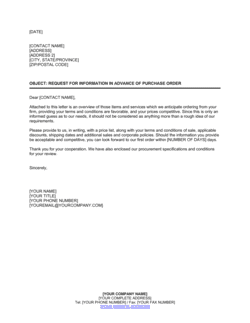
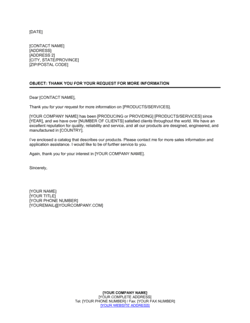
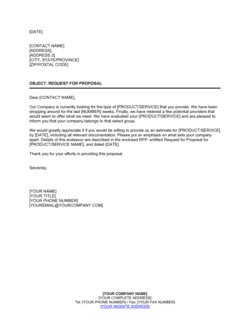
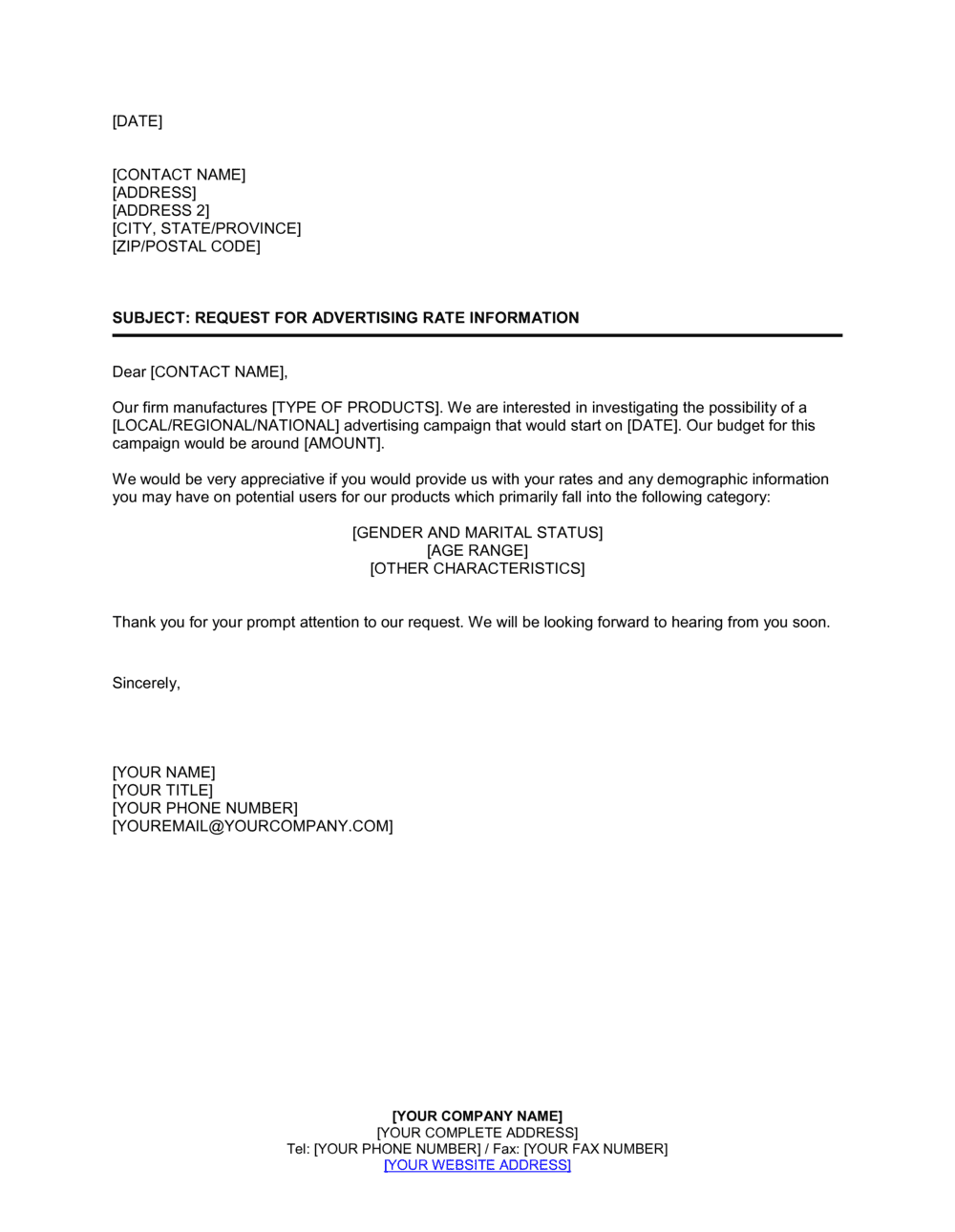
A Request for Advertising Rate Information is a formal business letter sent to a media outlet, publisher, or advertising platform to ask for pricing, placement options, audience demographics, and circulation or reach data. This free Word download gives you a professional, ready-to-edit starting point you can customize in minutes and send by email or post.
When you need it
Use it when evaluating new advertising channels β€” print, digital, radio, outdoor, or broadcast β€” before committing to a media buy. It is also useful when comparing multiple vendors or building a media plan for an upcoming campaign.
What's inside
Sender and recipient details, a clear statement of advertising interest, specific questions about rates and placement options, a request for audience and circulation data, a deadline for the response, and a professional closing with contact information.

What is a Request for Advertising Rate Information?

A Request for Advertising Rate Information is a formal business letter sent by an advertiser to a media outlet, publisher, or advertising platform to ask for pricing, placement options, audience demographics, and reach data before committing to a media buy. It serves as the first structured step in the media planning process β€” replacing informal phone inquiries with a documented, professional contact that gives both parties a clear record of what was asked and what was provided. The letter typically covers specific ad formats, campaign timelines, budget context, and requests for any available editorial calendar or third-party audience verification.

Why You Need This Document

Entering an advertising negotiation without verified rate and audience data puts you at an immediate disadvantage β€” you have no baseline to assess whether a quoted price is reasonable or whether the outlet's audience actually matches your target customer. Without a formal written inquiry, media sales representatives have no obligation to provide consistent, comparable information across the outlets you are evaluating, making side-by-side vendor comparison nearly impossible. A well-structured request letter signals that you are a serious, organized buyer, which typically results in faster and more thorough responses from sales teams. It also creates a paper trail of your outreach that supports internal budget justifications and vendor selection decisions. This template gives you a professional, ready-to-send starting point that takes less than fifteen minutes to complete.

Which variant fits your situation?

If your situation is…Use this template
Requesting rates from a print newspaper or magazineRequest For Advertising Rate Information (Print)
Inquiring about digital display or banner ad pricing from a websiteRequest For Advertising Rate Information (Digital)
Asking a radio station for spot rates and audience dataRequest For Advertising Rate Information (Broadcast)
Soliciting proposals from multiple ad vendors simultaneouslyRequest for Proposal (RFP)
Following up after receiving a rate card to negotiate pricingAdvertising Rate Negotiation Letter
Formally confirming agreed ad placement and termsAdvertising Agreement
Cancelling or withdrawing from an existing advertising arrangementAdvertising Cancellation Letter

Common mistakes to avoid

❌ Addressing the letter to a generic inbox

Why it matters: Letters sent to 'advertising@outlet.com' or 'info@outlet.com' sit in shared queues and are routinely deprioritized behind inquiries from named contacts. Response times are typically two to three times longer.

Fix: Spend two minutes on the outlet's website or LinkedIn to find the name of the advertising sales representative or media sales manager before sending.

❌ Omitting campaign timeline and budget

Why it matters: Without context, the outlet sends a full generic rate card that covers formats you don't need. Filtering it yourself wastes time and delays your media planning.

Fix: Include at minimum an approximate campaign window (e.g., 'Q3 2026') and a rough budget range. You are not committing to anything β€” just giving the outlet enough detail to respond usefully.

❌ Asking for rates without specifying formats

Why it matters: A publication with ten ad formats will send all ten. Comparing multi-outlet rate cards becomes an hours-long task when you only needed pricing for two or three formats.

Fix: List the two or three specific formats you are seriously considering. This focuses the response and makes side-by-side vendor comparison straightforward.

❌ Setting no response deadline

Why it matters: Media sales teams prioritize requests from advertisers with urgent timelines. An open-ended inquiry signals low urgency and gets pushed to the end of the queue.

Fix: State a specific date: 'We would appreciate a response by [DATE] to meet our media planning deadline.' Even if the date is soft, having one moves your request up the priority list.

The 9 key clauses, explained

Sender and recipient header

In plain language: Identifies who is writing the letter and to whom it is addressed, including company names, addresses, and the date.

Sample language
[YOUR COMPANY NAME] | [ADDRESS] | [CITY, STATE, ZIP] | [DATE] [RECIPIENT NAME / TITLE] [MEDIA OUTLET NAME] [ADDRESS]

Common mistake: Addressing the letter to the outlet generally rather than a named advertising sales contact. Generic addressing slows routing and reduces response rates.

Opening salutation and subject line

In plain language: Opens the letter professionally and states its purpose clearly so the recipient understands immediately what is being requested.

Sample language
Dear [ADVERTISING SALES REPRESENTATIVE NAME], Subject: Request for Advertising Rate Information and Media Kit

Common mistake: Using 'To Whom It May Concern' when a specific sales contact name is publicly available on the outlet's website β€” it signals minimal research effort.

Introduction and company background

In plain language: Briefly introduces the sender's company, its industry, and the context of the advertising interest to help the outlet assess fit.

Sample language
[YOUR COMPANY NAME] is a [DESCRIPTION OF BUSINESS] headquartered in [CITY]. We are currently planning our [QUARTER/YEAR] advertising campaign and are exploring opportunities with select media partners in the [INDUSTRY/REGION] space.

Common mistake: Writing a lengthy company history instead of a two-to-three sentence summary. Sales representatives skim; a concise introduction gets to the ask faster.

Statement of advertising interest

In plain language: Specifies the type of advertising being considered β€” print, digital, broadcast, outdoor β€” and indicates the approximate budget range or campaign timeline if known.

Sample language
We are specifically interested in [AD FORMAT β€” e.g., full-page print placements / digital banner ads / sponsored content] for a campaign running approximately [START DATE] to [END DATE], with an estimated budget of $[AMOUNT].

Common mistake: Omitting the campaign timeline or budget range entirely. Without these details, the outlet cannot tailor its response and may send an irrelevant general rate card.

Request for rate information

In plain language: Explicitly asks for current rate cards, pricing per format and size, and any available frequency or volume discounts.

Sample language
Please provide your current rate card for [AD FORMATS], including pricing for [FULL PAGE / HALF PAGE / DIGITAL BANNER SIZES], frequency discounts for [X] insertions, and any special rates for new advertisers.

Common mistake: Asking only for a general rate card without specifying formats or sizes. This leads to a generic response that requires multiple follow-up exchanges to get the detail needed for budgeting.

Request for audience and circulation data

In plain language: Asks for verified audience demographics, circulation figures, unique monthly visitors, or reach metrics to assess whether the outlet matches the advertiser's target audience.

Sample language
We would also appreciate your most recent audience demographics, total circulation or monthly unique visitors, and any third-party verified reach data (e.g., ABC audit, comScore report).

Common mistake: Accepting self-reported audience data without asking for third-party verification. Unaudited figures can overstate reach significantly.

Request for editorial calendar or placement schedule

In plain language: Asks for the outlet's upcoming editorial calendar so the advertiser can align placements with issues or segments relevant to their target audience.

Sample language
If available, please include your editorial calendar for [QUARTER/YEAR] so we can identify issues or content themes that align with our target audience of [TARGET AUDIENCE DESCRIPTION].

Common mistake: Skipping this request for digital or broadcast placements. Even non-print outlets have content schedules β€” themed weeks, product reviews, seasonal specials β€” that affect ad relevance.

Response deadline and preferred contact

In plain language: Specifies the date by which a response is needed and provides the sender's preferred contact details for the reply.

Sample language
We would appreciate receiving the requested information by [DATE]. Please direct your response to [NAME] at [EMAIL ADDRESS] or [PHONE NUMBER].

Common mistake: Setting no deadline at all. Without a response-by date, inquiries get deprioritized in favor of advertisers with firm commitments and near-term close dates.

Professional closing

In plain language: Closes the letter courteously, reiterates genuine interest, and signs off with the sender's name, title, and contact information.

Sample language
Thank you for your time and assistance. We look forward to reviewing your materials and exploring a potential partnership with [MEDIA OUTLET NAME]. Sincerely, [YOUR NAME] [YOUR TITLE] [YOUR COMPANY NAME] [EMAIL] | [PHONE]

Common mistake: Closing with language that implies a decision has already been made, such as 'We look forward to advertising with you.' This weakens your negotiating position before you have seen the rates.

How to fill it out

  1. 1

    Identify the correct advertising sales contact

    Look up the media outlet's advertising or sales department and find a named contact β€” typically listed under 'Advertise With Us' on their website. Use that person's name and direct email.

    πŸ’‘ Calling the outlet's main line to confirm the right contact name takes two minutes and significantly improves your response rate compared to emailing a generic inbox.

  2. 2

    Fill in your company details and campaign context

    Enter your company name, address, and a two-to-three sentence description of your business. Add the campaign timeline, approximate budget, and target audience to give the outlet enough context to tailor their response.

    πŸ’‘ Sharing even a rough budget range β€” 'approximately $5,000–$10,000 for the quarter' β€” signals seriousness and prompts a more detailed, prioritized reply.

  3. 3

    Specify the ad formats and placements you want pricing for

    List the specific formats you are evaluating β€” full-page print, half-page, digital leaderboard, sponsored email, 30-second radio spot β€” rather than asking for all rates generally.

    πŸ’‘ Limiting your request to two or three formats you are genuinely considering gets you a focused, comparable response. Asking for everything results in an overwhelming rate card you still have to filter.

  4. 4

    Request audience data and third-party verification

    Add a line asking for the outlet's most recent audience demographics, circulation or unique visitor figures, and any ABC-audited or comScore-verified reach data.

    πŸ’‘ Ask specifically for data from the last 12 months. Outlets sometimes provide older figures when recent numbers have declined.

  5. 5

    Set a firm response deadline

    Enter a specific date β€” typically 7 to 14 business days from the letter date β€” by which you need the information to stay on your media planning timeline.

    πŸ’‘ Framing the deadline with a reason ('We are finalizing our Q3 media plan by [DATE]') makes it more compelling than an uncontextualized cutoff.

  6. 6

    Review, personalize, and send

    Re-read the letter for any placeholder text left unfilled, confirm the contact name and address are correct, and send by email with a subject line matching the letter's subject field.

    πŸ’‘ Keep the email body brief β€” one sentence introducing the attached letter. Repeating the full content in the email body doubles the length without adding value.

Frequently asked questions

What is a request for advertising rate information?

A request for advertising rate information is a formal business letter sent to a media outlet, publisher, or ad platform asking for pricing, placement options, and audience data before committing to a media buy. It establishes a professional first contact with the outlet's sales team and gives you the structured information needed to compare vendors and build an accurate media budget.

When should I send a request for advertising rate information?

Send it during the research and planning phase of your advertising campaign β€” typically four to eight weeks before your campaign start date. It is most useful when you are evaluating multiple outlets and need comparable data points, or when you are entering a new advertising channel for the first time and need to understand the pricing landscape before budgeting.

What information should I ask for in the letter?

At minimum, request a current rate card for the specific formats you are considering, pricing for different ad sizes or durations, any frequency or volume discounts, and the outlet's most recent audience demographics and reach data. Adding a request for the editorial calendar helps you align placements with relevant content and audience intent.

Do I need to disclose my budget in the letter?

You do not have to share an exact figure, but providing an approximate range improves the quality of the response. Outlets prioritize inquiries that signal a realistic spend level and tailor their proposals accordingly. A range like '$5,000–$15,000 per quarter' gives them enough context without locking you into a number before negotiations begin.

What is the difference between a rate card and a media kit?

A rate card lists prices for each ad format, size, and placement option. A media kit is broader β€” it includes the rate card plus audience demographics, circulation figures, editorial calendar, case studies, and technical specifications for ad submissions. Request both: the media kit gives you the context to evaluate whether the outlet's audience matches your target, and the rate card gives you the numbers to budget against.

How long should I wait for a response before following up?

If you set a deadline in your letter, follow up by email the day after it passes. If you did not set a deadline, a follow-up after five to seven business days is reasonable. Sales teams at busy publications handle high inquiry volumes; a brief, polite follow-up referencing your original letter is standard practice and rarely considered intrusive.

Can I send this letter to multiple outlets at the same time?

Yes β€” sending to multiple outlets simultaneously is standard practice during media planning. Personalize each letter with the outlet's name, your specific format interests for that medium, and the correct contact name. Using a visibly generic template with the wrong outlet name is one of the fastest ways to reduce your response rate and credibility.

Is this letter legally binding in any way?

No. A request for advertising rate information is an informational inquiry, not a commitment to purchase. It creates no contractual obligation on either side. A binding commitment to advertise is only created when you sign an insertion order or advertising agreement confirming the specific placement, dates, and price.

How this compares to alternatives

vs Request for Proposal (RFP)

An RFP is a formal solicitation document that invites multiple vendors to submit detailed proposals against a defined set of requirements, evaluation criteria, and deadlines. A request for advertising rate information is a lighter, informal inquiry focused on collecting pricing and audience data β€” not a structured competitive bid process. Use an RFP when the advertising budget is large enough to warrant a formal vendor selection process; use the rate request letter for routine media research and planning.

vs Advertising Agreement

An advertising agreement is a binding contract that locks in placement details, pricing, creative specifications, cancellation terms, and payment schedules. A rate request letter comes much earlier in the process β€” before any commitment is made β€” and creates no legal obligations. Once you have selected an outlet and negotiated terms, the advertising agreement is what you sign to confirm the buy.

vs Media Inquiry Email

An informal media inquiry email is a quick, unstructured message asking for rates. A formal request letter is more structured, covers more ground in a single contact, and signals to the outlet that you are a serious, organized buyer β€” which typically results in a more thorough and prioritized response. For routine outreach to small local outlets, an email may suffice; for national or high-value media relationships, the formal letter is more appropriate.

vs Advertising Cancellation Letter

An advertising cancellation letter is sent after a buy has been committed to formally terminate an existing placement agreement. A rate request letter is sent before any commitment, purely for research and comparison. They represent opposite ends of the advertising relationship timeline and serve entirely different purposes.

Industry-specific considerations

Retail and E-commerce

Seasonal campaign timing makes rate inquiries critical β€” holiday and back-to-school inventory sells out months in advance, and early rate requests secure preferred placement windows.

Professional Services

Firms typically target niche trade publications and local business journals where CPM efficiency matters more than mass reach, making precise rate and audience data essential for ROI comparison.

Healthcare and Wellness

Regulatory restrictions on ad content in certain health categories make editorial calendar alignment especially important, as placements in relevant health-focused issues carry higher audience receptivity.

Food and Beverage

Brands often request rates from a mix of national consumer publications and regional food media, requiring rate cards that distinguish between national and regional edition pricing.

Template vs pro β€” what fits your needs?

PathBest forCostTime
Use the templateMarketing managers, small business owners, and anyone conducting standard media rate research independentlyFree10–15 minutes per letter
Template + professional reviewCompanies with large media budgets who want a communications specialist to tailor outreach to high-value national outlets$100–$300 (marketing consultant or agency review)1–2 hours
Custom draftedEnterprise advertisers managing multi-channel, multi-market media plans where formal vendor documentation is required by procurement$300–$800 (agency or in-house marketing team drafting)1–2 days

Glossary

Rate Card
A published document from a media outlet listing standard prices for each ad format, size, and placement option.
Media Kit
A package provided by a publisher or outlet that includes audience demographics, circulation figures, editorial calendar, and advertising rate card.
CPM (Cost Per Mille)
The cost an advertiser pays per one thousand impressions of an ad, used as a standard pricing metric across digital and print media.
Circulation
The number of distributed or sold copies of a print publication per issue, used as a proxy for potential audience reach.
Ad Placement
The specific location or position within a publication, broadcast, or website where an advertisement appears β€” such as front page, run-of-site, or prime-time slot.
Frequency Discount
A reduced rate offered to advertisers who commit to running ads a minimum number of times within a defined period.
Editorial Calendar
A publication's schedule of planned topics, themes, and special issues, used by advertisers to align placements with relevant content.
Insertion Order
A binding document that confirms the details of an agreed ad buy β€” publication, dates, sizes, placement, and price β€” between the advertiser and the outlet.
Reach
The total number of unique individuals who are exposed to an ad or medium within a defined time period.
Impressions
The total number of times an ad is displayed, regardless of whether the same person sees it more than once.

Part of your Business Operating System

This document is one of 3,000+ business & legal templates included in Business in a Box.

  • Fill-in-the-blanks β€” ready in minutes
  • 100% customizable Word document
  • Compatible with all office suites
  • Export to PDF and share electronically

Create your document in 3 simple steps.

From template to signed document β€” all inside one Business Operating System.
1
Download or open template

Access over 3,000+ business and legal templates for any business task, project or initiative.

2
Edit and fill in the blanks with AI

Customize your ready-made business document template and save it in the cloud.

3
Save, Share, Send, Sign

Share your files and folders with your team. Create a space of seamless collaboration.

Save time, save money, and create top-quality documents.

β˜…β˜…β˜…β˜…β˜…

"Fantastic value! I'm not sure how I'd do without it. It's worth its weight in gold and paid back for itself many times."

Managing Director Β· Mall Farm
Robert Whalley
Managing Director, Mall Farm Proprietary Limited
β˜…β˜…β˜…β˜…β˜…

"I have been using Business in a Box for years. It has been the most useful source of templates I have encountered. I recommend it to anyone."

Business Owner Β· 4+ years
Dr Michael John Freestone
Business Owner
β˜…β˜…β˜…β˜…β˜…

"It has been a life saver so many times I have lost count. Business in a Box has saved me so much time and as you know, time is money."

Owner Β· Upstate Web
David G. Moore Jr.
Owner, Upstate Web

Run your business with a system β€” not scattered tools

Stop downloading documents. Start operating with clarity. Business in a Box gives you the Business Operating System used by over 250,000 companies worldwide to structure, run, and grow their business.

Free Forever PlanΒ Β·Β No credit card required