Rent To Own Agreement Template

Free Word download β€’ Edit online β€’ Save & share with Drive β€’ Export to PDF

5 pagesβ€’25–35 min to fillβ€’Difficulty: Complexβ€’Signature requiredβ€’Legal review recommended
Learn more ↓
FreeRent To Own Agreement Template

At a glance

What it is
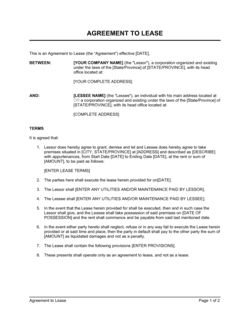
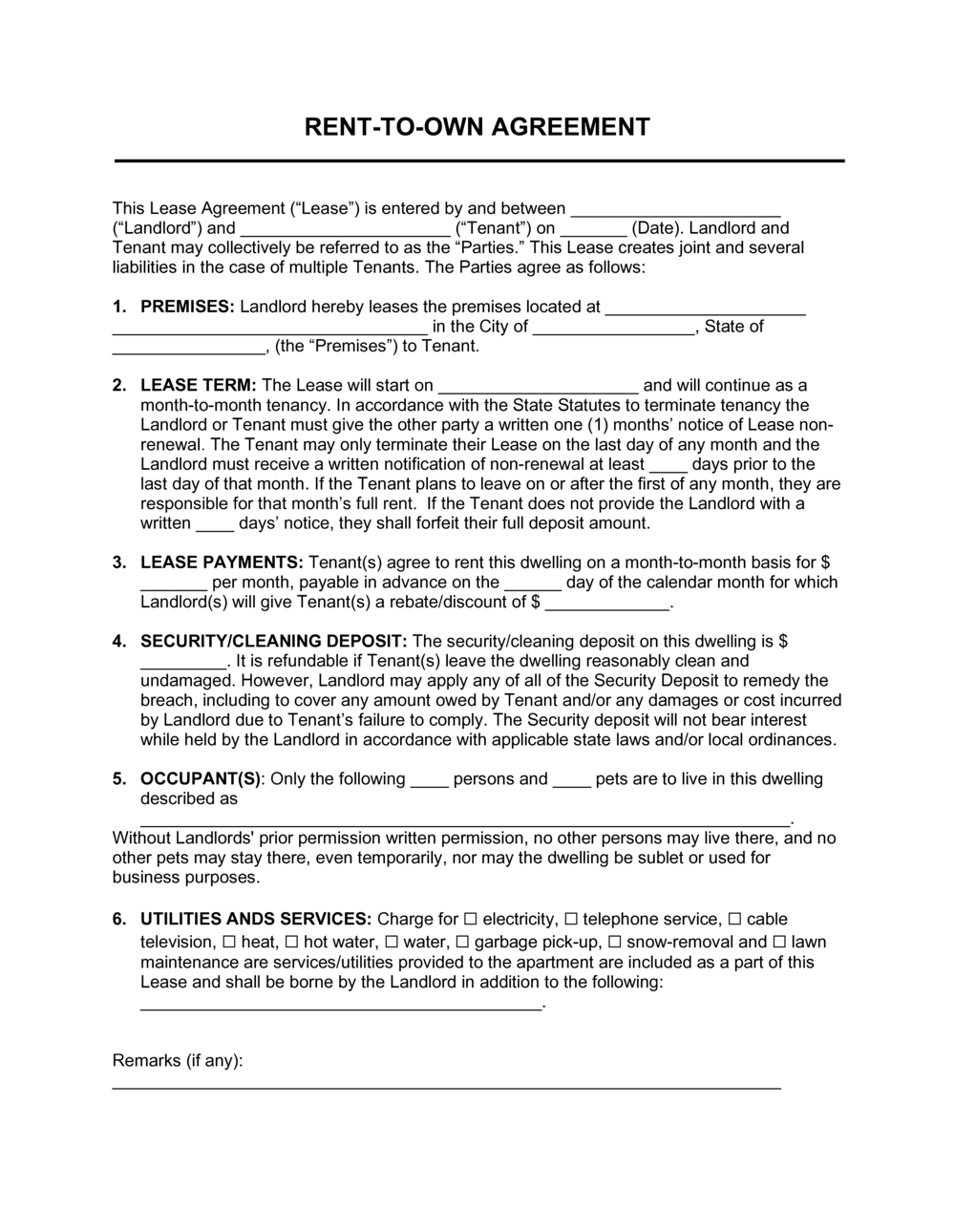
A Rent To Own Agreement is a legally binding contract that combines a standard residential or commercial lease with an option for the tenant to purchase the property at a predetermined price before or at the end of the lease term. This free Word download covers option fees, monthly rent credits, purchase price, maintenance obligations, and default terms β€” all in a single document you can edit online and export as PDF for signing.
When you need it
Use it when a buyer cannot qualify for a mortgage immediately but wants to lock in a purchase price and build equity through rent payments, or when a seller wants to generate rental income while moving toward a sale. It is also used for commercial equipment and vehicle transactions where a party prefers a trial-use period before committing to full purchase.
What's inside
Parties and property description, lease term and monthly rent, option fee and purchase price, rent credit provisions, maintenance and repair responsibilities, option exercise procedure, financing contingency, default and forfeiture terms, and governing law.

What is a Rent To Own Agreement?

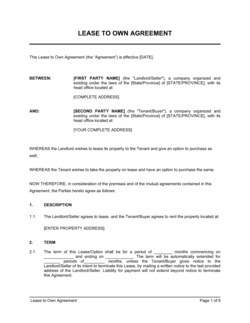
A Rent To Own Agreement is a legally binding contract that combines a property or equipment lease with an option for the tenant-buyer to purchase the asset at a predetermined price before or at the end of the lease term. The buyer pays an upfront, non-refundable option fee to secure the right to purchase, and a defined portion of each monthly rent payment accumulates as a credit toward the purchase price. If the buyer exercises the option by the agreed deadline, those credits apply at closing β€” locking in both the price and a portion of the equity from day one. If the buyer does not exercise the option, the seller retains the option fee and all accumulated credits. The agreement functions simultaneously as a lease and a unilateral purchase option, governed by both landlord-tenant law and general contract law in most jurisdictions.

Why You Need This Document

Without a properly drafted rent to own agreement, both parties are exposed to serious legal and financial risk. A seller who relies on a handwritten addendum or verbal understanding has no enforceable basis to retain the option fee if the buyer walks away, no clear standard for declaring default, and no mechanism to remove a holdover tenant. A buyer without a written, recorded agreement has no protection against the seller selling the property to a third party, refinancing against the equity the buyer is building, or simply refusing to honor the option when the time comes. Courts in the United States, Canada, and the UK have consistently declined to enforce oral or informally documented rent-to-own arrangements, leaving both parties to bear losses that a clear written contract would have prevented. This template provides the complete contractual structure β€” option fee, rent credits, default and forfeiture terms, financing contingency, and exercise procedure β€” so that both parties understand exactly what they have agreed to before the tenant takes a single day of possession.

Which variant fits your situation?

If your situation is…Use this template
Residential property where tenant intends to purchase at lease endRent To Own Agreement (Residential)
Buyer and seller want a binding obligation to purchase, not just an optionLease Purchase Agreement
Standard property rental with no purchase optionResidential Lease Agreement
Commercial property with option to buy at end of termCommercial Lease Agreement with Purchase Option
Equipment financing with structured ownership transferEquipment Lease Agreement
Vehicle acquisition with installment payments leading to ownershipVehicle Lease Agreement
Seller financing where seller holds title until final paymentLand Contract (Contract for Deed)

Common mistakes to avoid

❌ No explicit non-refundable language on the option fee

Why it matters: Courts have ordered option fee refunds when the contract was silent on refundability, particularly if the buyer can show the seller retained the fee while reselling the property to a third party at a higher price.

Fix: Include an explicit sentence stating the option fee is non-refundable under all circumstances, including the buyer's failure to qualify for financing or decision not to exercise the option.

❌ Vague or missing option exercise procedure

Why it matters: Without a defined notice method and deadline, disputes arise over whether the option was validly exercised β€” leaving both parties in legal limbo and potentially requiring litigation to resolve.

Fix: State the required notice method (certified mail to a specific address), the exercise deadline date, and the number of days to closing in unambiguous, sequential language.

❌ Omitting a financing contingency and deadline

Why it matters: Without a financing deadline, the seller may be unable to re-list or refinance the property for months while the buyer attempts to obtain a mortgage β€” with no contractual remedy to terminate.

Fix: Include a specific date by which the buyer must deliver a mortgage commitment letter. State that failure to meet the deadline terminates the purchase obligation and that the seller retains the option fee.

❌ No cure period before declaring default and forfeiture

Why it matters: Courts in tenant-protective jurisdictions routinely refuse to enforce forfeitures triggered without prior notice and a reasonable cure period, leaving the seller with an occupying non-paying tenant and no contractual basis to remove them.

Fix: Build in a written notice step and a minimum 10-day cure period for payment defaults before any forfeiture provision is triggered. Document every missed payment and notice in writing from day one.

❌ Shifting property tax liability to the tenant-buyer

Why it matters: The seller remains the owner of record and is legally liable for property taxes in virtually every jurisdiction β€” a contractual shift of that obligation to the buyer does not bind the tax authority, and unpaid taxes can result in a lien or tax sale that voids the buyer's option.

Fix: Keep property taxes in the seller's name and account. If the buyer contributes to taxes as part of the arrangement, have them pay the seller, who then remits to the authority β€” not directly to the tax office.

❌ Using a standard lease form and adding a purchase option as a handwritten addendum

Why it matters: Handwritten addenda that conflict with pre-printed lease terms create interpretive ambiguity. Courts apply the contra proferentem rule β€” ambiguities are read against the drafter β€” and the option may be partially or wholly unenforceable.

Fix: Use a purpose-built rent-to-own template that integrates the lease and option terms in a single cohesive document, with an entire-agreement clause confirming it supersedes all prior representations.

The 10 key clauses, explained

Parties and property description

In plain language: Identifies the seller-landlord and tenant-buyer by legal name and describes the property by full address and legal description.

Sample language
This Rent To Own Agreement is entered into on [DATE] between [SELLER FULL LEGAL NAME] ('Seller') and [BUYER FULL LEGAL NAME] ('Buyer') for the property located at [FULL PROPERTY ADDRESS], legally described as [LEGAL DESCRIPTION] ('Property').

Common mistake: Using a trade name or informal nickname instead of the full legal name of both parties. If the seller is an LLC or corporation, the entity name β€” not the owner's personal name β€” must appear, or the agreement may not bind the correct legal owner.

Lease term and monthly rent

In plain language: Sets the start and end date of the rental period, the monthly rent amount, due date, accepted payment methods, and any grace period or late fee.

Sample language
The lease term commences on [START DATE] and expires on [END DATE]. Buyer shall pay Seller $[AMOUNT] per month, due on the [DAY] of each month. Payments received after [X] days will incur a late fee of $[AMOUNT].

Common mistake: Failing to specify a grace period and late-fee amount. Without these, the seller has limited contractual basis to charge fees or declare default for minor payment delays.

Option fee and purchase price

In plain language: States the upfront option fee paid by the buyer, confirms it is non-refundable, and locks in the agreed purchase price for the duration of the option period.

Sample language
Buyer shall pay Seller a non-refundable option fee of $[AMOUNT] upon execution of this Agreement. If the purchase option is exercised, the total purchase price shall be $[AMOUNT], fixed for the duration of the option period.

Common mistake: Omitting language explicitly stating the option fee is non-refundable. Courts in several jurisdictions have ordered option fee refunds when the contract was silent on refundability and the buyer could argue unjust enrichment.

Rent credit provisions

In plain language: Defines what percentage or dollar amount of each monthly payment accumulates as a credit toward the purchase price, when credits accrue, and that they are forfeited if the option is not exercised.

Sample language
$[AMOUNT] of each monthly rent payment shall be credited toward the purchase price ('Rent Credit'), accumulating only if Buyer is current on all payments. Rent Credits are forfeited if the option is not exercised by [EXPIRY DATE].

Common mistake: Failing to condition rent credits on the buyer being current on rent. If credits accrue even during delinquency, the seller is effectively rewarding non-payment and loses leverage in a default scenario.

Option exercise procedure

In plain language: Describes exactly how and when the buyer must notify the seller of intent to purchase, what documentation must accompany the notice, and the closing timeline that follows.

Sample language
To exercise the purchase option, Buyer must deliver written notice to Seller no later than [DATE] at the address listed herein. Closing shall occur within [X] days of such notice. Buyer shall arrange financing and provide proof of mortgage commitment within [X] days of exercising the option.

Common mistake: Leaving the exercise procedure vague β€” stating only that the buyer must 'notify' the seller without specifying method, deadline, or what triggers closing. Courts have voided options where the exercise mechanism was insufficiently defined.

Maintenance and repair responsibilities

In plain language: Allocates responsibility for routine maintenance, major repairs, and property upkeep between the buyer and seller during the lease period.

Sample language
Buyer shall be responsible for all routine maintenance and repairs costing less than $[AMOUNT]. Seller shall be responsible for structural repairs, roof, and major systems (HVAC, plumbing, electrical) costing $[AMOUNT] or more, provided Buyer provides prompt written notice.

Common mistake: Placing all maintenance responsibility on the tenant-buyer without a dollar threshold. Rent-to-own buyers frequently lack the financial resources for large unexpected repairs β€” an uncapped obligation increases default risk and can lead to property deterioration.

Default and forfeiture

In plain language: Defines what constitutes a default, the notice and cure period the defaulting party receives, and the consequences β€” including forfeiture of the option fee and rent credits β€” if the default is not cured.

Sample language
If Buyer fails to pay rent within [X] days of the due date or otherwise materially breaches this Agreement, Seller shall provide written notice. If the breach is not cured within [X] days of notice, this Agreement terminates and Buyer forfeits all option fees and Rent Credits accumulated to date.

Common mistake: No cure period before forfeiture. Without a defined notice-and-cure window, courts in many jurisdictions will imply one β€” or refuse to enforce forfeiture β€” leaving the seller unable to act decisively on a legitimate default.

Property taxes, insurance, and HOA fees

In plain language: Clarifies which party pays property taxes, homeowner's insurance, and any HOA or strata fees during the lease term, and requires the buyer to maintain renter's or property insurance.

Sample language
Seller shall remain responsible for property taxes and homeowner's insurance during the lease term. Buyer shall obtain and maintain renter's insurance with minimum coverage of $[AMOUNT] and provide Seller with proof of coverage within [X] days of execution.

Common mistake: Shifting property tax responsibility to the tenant-buyer without ensuring they have the financial means or legal standing to pay β€” in most jurisdictions, the owner of record is liable for taxes regardless of what the contract says.

Financing contingency and closing conditions

In plain language: States that the purchase closing is conditional on the buyer obtaining a mortgage commitment by a specified deadline, and what happens if financing falls through β€” including whether the option fee is retained.

Sample language
The purchase is contingent upon Buyer obtaining a mortgage commitment for no less than $[AMOUNT] at a rate not exceeding [X]% by [DATE]. If Buyer is unable to obtain financing by the deadline, Seller shall retain the option fee and this Agreement shall terminate.

Common mistake: No financing contingency at all, or one with no deadline. Without a deadline, the seller may be unable to re-list the property for an indefinite period while the buyer attempts to secure financing.

Governing law and entire agreement

In plain language: Specifies which state's or province's law governs the contract, confirms the written document supersedes all prior oral agreements, and includes a severability clause.

Sample language
This Agreement is governed by the laws of [STATE/PROVINCE]. This Agreement constitutes the entire agreement between the parties and supersedes all prior representations. If any provision is found unenforceable, the remaining provisions shall remain in full force.

Common mistake: Choosing a governing law with no connection to where the property is located. Real property transactions are generally governed by the law of the jurisdiction where the property sits β€” regardless of what the contract states.

How to fill it out

  1. 1

    Enter the legal names of both parties and the property description

    Use the full registered legal name of the seller β€” if a company, confirm the entity type and state of registration. Include the property's full street address and its legal description from the deed or title record.

    πŸ’‘ Pull the legal description directly from the current title or land registry record β€” do not use an abbreviated or informal version, as errors here can cloud the title.

  2. 2

    Set the lease term start date, end date, and monthly rent

    Enter the exact commencement and expiry dates of the rental period. Set the monthly rent amount, the due date each month, the grace period, and the late-fee amount.

    πŸ’‘ Align the lease term end date with the option expiry date β€” a gap between the two creates ambiguity about whether the buyer still has possession rights after the lease ends but before the option lapses.

  3. 3

    Define the option fee and fix the purchase price

    State the upfront option fee amount, confirm it is non-refundable in explicit language, and lock in the purchase price. If both parties agree the price may be adjusted for market conditions, document the exact formula or index used.

    πŸ’‘ Market-linked purchase price adjustments are risky for both parties β€” a fixed price with a built-in premium for the option period (typically 3–7% above current market value) is simpler to enforce.

  4. 4

    Calculate and document the rent credit structure

    Decide what portion of each monthly payment (dollar amount or percentage) accumulates as a rent credit. State explicitly that credits accrue only when the buyer is current on all payments and are forfeited if the option is not exercised.

    πŸ’‘ Keep the rent credit to 10–25% of the monthly payment. Credits set too high attract buyers who intend to walk away after accumulating credits rather than completing the purchase.

  5. 5

    Specify the option exercise procedure and closing timeline

    State the exact written-notice method required to exercise the option (certified mail, email with read receipt, or in-person delivery), the deadline for notice, and the number of days from notice to closing.

    πŸ’‘ Require the exercise notice to be sent by certified mail or courier with tracking β€” email-only notice can be disputed if delivery confirmation is lost.

  6. 6

    Allocate maintenance responsibilities with a dollar threshold

    Set a clear dollar threshold separating routine maintenance (buyer's responsibility) from major system repairs (seller's responsibility). Require the buyer to notify the seller in writing before undertaking any repair above the threshold.

    πŸ’‘ A threshold of $200–$500 is typical for residential rent-to-own agreements β€” calibrate to the property's age and condition.

  7. 7

    Draft the default, cure period, and forfeiture terms

    Define what constitutes default (missed payments, property damage, unauthorized subletting), the written notice requirement, and the number of days the defaulting party has to cure. State that uncured default triggers forfeiture of all option fees and rent credits.

    πŸ’‘ A 10–15 day cure period is standard for payment defaults; a 30-day cure period is typical for non-payment breaches. Shorter cure periods may be deemed unconscionable by courts in tenant-protection jurisdictions.

  8. 8

    Add the financing contingency deadline and sign before the tenant takes possession

    Set a specific date by which the buyer must have a mortgage commitment if the option is exercised. Both parties must sign β€” and the document should be dated β€” before the tenant takes possession of the property.

    πŸ’‘ In some states and provinces, recording the agreement (or a memorandum of it) with the land registry protects the buyer's option rights against subsequent liens or a sale to a third party by the seller.

Frequently asked questions

What is a rent to own agreement?

A rent to own agreement is a contract that combines a property lease with an option for the tenant to purchase the property at a predetermined price before or at the end of the lease term. The tenant pays an upfront option fee for the right to buy, and a portion of each monthly rent payment typically accumulates as a credit toward the purchase price. If the tenant exercises the option, the credits apply at closing; if not, the option fee and credits are forfeited to the seller.

What is the difference between a rent to own agreement and a lease purchase agreement?

A rent to own agreement gives the tenant an option β€” the right, but not the obligation β€” to purchase the property. A lease purchase agreement creates a binding obligation on both parties: the tenant must buy and the seller must sell at the end of the term. Rent to own is more flexible for the buyer but carries the risk that the buyer walks away; lease purchase provides more certainty for the seller but can be harder to enforce if the buyer cannot obtain financing.

Is a rent to own agreement legally binding?

Yes, a properly executed rent to own agreement is generally enforceable as a binding contract when it meets the standard requirements β€” offer, acceptance, consideration, and mutual assent between parties with legal capacity. The option fee typically serves as consideration for the purchase option. Enforceability of specific provisions β€” particularly non-refundability of the option fee and forfeiture of rent credits β€” varies by jurisdiction and depends heavily on how clearly those terms are drafted.

How much is a typical option fee in a rent to own agreement?

Option fees typically range from 1% to 5% of the agreed purchase price, though amounts vary widely depending on the market, the property, and the negotiating position of the parties. A higher option fee signals stronger buyer commitment and gives the seller greater protection if the buyer ultimately does not purchase. The option fee is almost always non-refundable and, if the option is exercised, is applied toward the purchase price or closing costs.

What happens to rent credits if the tenant does not exercise the option?

If the tenant-buyer does not exercise the purchase option before the deadline, accumulated rent credits are forfeited to the seller. This is one of the most significant financial risks for the buyer in a rent to own arrangement. The agreement should state this forfeiture consequence explicitly β€” courts have sometimes required the seller to refund credits when the contract was silent on what happens to them upon non-exercise.

Can a seller sell the property to someone else during a rent to own agreement?

Generally, no β€” the seller is contractually obligated to honor the option for its full term. Selling to a third party during the option period would be a material breach. However, buyers can protect themselves further by recording a memorandum of the option agreement with the land registry, which puts subsequent purchasers on notice of the buyer's option rights and prevents the seller from conveying clear title to anyone else while the option is in force.

Who pays for repairs and maintenance in a rent to own agreement?

Responsibility is negotiated between the parties and spelled out in the agreement. A common structure assigns routine maintenance and minor repairs (typically under $200–$500) to the tenant-buyer and major system repairs β€” roof, HVAC, plumbing, structural β€” to the seller-landlord. Because the tenant-buyer has an ownership interest in the outcome, some agreements place more responsibility on the buyer than a standard lease would, but uncapped maintenance obligations increase default risk.

Do I need a lawyer to prepare a rent to own agreement?

For straightforward residential arrangements with a clear option period, fixed purchase price, and standard lease terms, a high-quality template is a practical starting point. Legal review is strongly recommended when the property value exceeds $300,000, when the buyer has complex credit or financing challenges, when the arrangement involves a corporate seller or investor, or when either party is in a jurisdiction with strong tenant-protection laws. A 1–2 hour review typically costs $300–$700 and reduces the risk of an unenforceable forfeiture clause or defective option exercise provision.

What happens at the end of a rent to own agreement if the tenant does not buy?

If the tenant does not exercise the option before the deadline, the agreement typically converts to a standard tenancy or terminates entirely, depending on how the document is drafted. The option fee and accumulated rent credits are forfeited to the seller. The seller regains full freedom to sell or re-let the property. If the tenant remains in possession past the lease end date without exercising the option, standard landlord-tenant law governs the relationship β€” which may require a formal eviction process to regain possession.

How this compares to alternatives

vs Residential Lease Agreement

A standard residential lease grants the tenant the right to occupy property for a fixed term with no path to ownership. A rent to own agreement adds an option to purchase at a locked-in price, with a portion of rent accumulating as equity credit. Choose a standard lease when no ownership transfer is intended; use rent to own when the goal is eventual sale.

vs Real Estate Purchase Agreement

A purchase agreement commits both parties to a sale on a specific closing date β€” the buyer must be ready to close, typically within 30–60 days. A rent to own agreement allows the buyer to occupy the property for 1–3 years before closing, using the period to build credit or save a down payment. Use a purchase agreement when financing is already secured; use rent to own when it is not.

vs Lease Purchase Agreement

A lease purchase agreement obligates the tenant to buy and the seller to sell at the end of the lease β€” there is no voluntary option. A rent to own agreement gives the tenant the right, but not the obligation, to purchase. Sellers prefer lease purchase for greater certainty; buyers prefer rent to own for flexibility. Both require careful attention to the consequences of a buyer who cannot obtain financing.

vs Equipment Lease Agreement

An equipment lease agreement grants the right to use equipment for a defined period in exchange for periodic payments, with ownership remaining with the lessor unless a separate buyout is negotiated. A rent to own agreement for equipment builds a purchase option and equity credit structure into the lease from the outset, giving the lessee a clear, pre-priced path to ownership from day one.

Industry-specific considerations

Residential Real Estate

Buyers who cannot yet qualify for a conventional mortgage use rent-to-own to lock in a purchase price, build credit, and accumulate a down payment through rent credits over a 1–3 year lease term.

Commercial Real Estate

Commercial landlords convert vacant retail or office units into rent-to-own arrangements to attract business tenants who want long-term control of a space but are not yet positioned to purchase outright.

Equipment and Machinery

Equipment dealers offer rent-to-own structures on industrial machinery, allowing businesses to operate equipment immediately while spreading the acquisition cost β€” with ownership transferring after a defined payment period.

Automotive and Fleet

Vehicle dealers and fleet operators use rent-to-own agreements for commercial vehicles and specialty equipment, with weekly or monthly payments accumulating toward full ownership without requiring traditional financing approval.

Jurisdictional notes

United States

Rent to own agreements are governed by state law, and requirements vary significantly. Several states β€” including Texas, Illinois, and North Carolina β€” have specific rent-to-own statutes that impose disclosure obligations, cooling-off periods, and restrictions on forfeiture. In some states, an agreement that resembles a land contract may trigger real property transfer rules rather than landlord-tenant law. Recording a memorandum of the option with the county recorder is advisable to protect the buyer's interest against subsequent liens.

Canada

Rent to own agreements in Canada must be assessed against both provincial residential tenancy legislation and contract law. In Ontario, British Columbia, and Alberta, residential tenancy acts impose minimum standards that may override contractual terms β€” including forfeiture provisions β€” if they are found to conflict with tenant rights. Quebec civil law treats option contracts and leases differently from common-law provinces, and French-language documentation requirements apply to provincially regulated transactions in Quebec.

United Kingdom

Rent to own arrangements for residential property in the UK must comply with the Landlord and Tenant Act 1985 and the Consumer Rights Act 2015. The government's Help to Buy and Shared Ownership schemes offer alternative pathways to homeownership that interact with private rent-to-own arrangements. SDLT (Stamp Duty Land Tax) implications arise at the point the option is exercised and the purchase price is paid; both parties should obtain tax advice before signing. Unfair contract terms scrutiny under the Consumer Rights Act 2015 applies to agreements where one party is a consumer.

European Union

Rent to own structures across EU member states are subject to local civil codes, consumer protection directives, and real property registration requirements that vary considerably. In France and Spain, notarial involvement is typically required for any agreement that creates an option on real property. GDPR compliance applies to any personal data collected during the contracting process. EU consumer protection law may restrict or void forfeiture clauses in agreements where the buyer is a private individual dealing with a professional seller.

Template vs lawyer β€” what fits your deal?

PathBest forCostTime
Use the templateStraightforward residential rent-to-own arrangements with an agreed price below $300,000 and a creditworthy buyerFree30–45 minutes
Template + legal reviewProperties above $300,000, buyers with complex credit situations, or either party in a jurisdiction with strong tenant-protection laws$300–$700 (1–2 hour attorney review)2–5 business days
Custom draftedCommercial properties, corporate sellers or investors, multi-unit arrangements, or cross-jurisdictional transactions$1,500–$5,000+1–3 weeks

Glossary

Option Fee
An upfront, non-refundable payment made by the tenant-buyer to the seller in exchange for the exclusive right to purchase the property at an agreed price during the lease term.
Option Period
The defined window of time β€” typically 1 to 3 years β€” during which the tenant-buyer may exercise the purchase option.
Purchase Price
The agreed sale price locked in at signing, which the tenant-buyer may pay to acquire full ownership if the option is exercised.
Rent Credit
A portion of each monthly rent payment β€” commonly 10–25% β€” that is credited toward the purchase price or down payment if the option is exercised.
Option Exercise
The formal act of notifying the seller in writing that the tenant-buyer intends to proceed with the purchase under the terms of the agreement.
Forfeiture
The loss of the option fee and accumulated rent credits by the tenant-buyer if they fail to exercise the option or default on the agreement.
Lease Purchase Agreement
A variant of rent-to-own where the tenant is legally obligated to purchase the property at the end of the lease, rather than holding a voluntary option.
Equity Build-Up
The gradual accumulation of ownership interest through rent credits applied to the purchase price over the course of the lease term.
Default
A material breach of the agreement β€” such as missed rent payments or failure to maintain the property β€” that may trigger forfeiture of the option and credits.
Title Transfer
The legal process by which ownership of the property passes from the seller to the buyer upon closing, following exercise of the purchase option.
Financing Contingency
A clause conditioning the purchase closing on the tenant-buyer obtaining a mortgage or other financing by a specified date.

Part of your Business Operating System

This document is one of 3,000+ business & legal templates included in Business in a Box.

  • Fill-in-the-blanks β€” ready in minutes
  • 100% customizable Word document
  • Compatible with all office suites
  • Export to PDF and share electronically

Create your document in 3 simple steps.

From template to signed document β€” all inside one Business Operating System.
1
Download or open template

Access over 3,000+ business and legal templates for any business task, project or initiative.

2
Edit and fill in the blanks with AI

Customize your ready-made business document template and save it in the cloud.

3
Save, Share, Send, Sign

Share your files and folders with your team. Create a space of seamless collaboration.

Save time, save money, and create top-quality documents.

β˜…β˜…β˜…β˜…β˜…

"Fantastic value! I'm not sure how I'd do without it. It's worth its weight in gold and paid back for itself many times."

Managing Director Β· Mall Farm
Robert Whalley
Managing Director, Mall Farm Proprietary Limited
β˜…β˜…β˜…β˜…β˜…

"I have been using Business in a Box for years. It has been the most useful source of templates I have encountered. I recommend it to anyone."

Business Owner Β· 4+ years
Dr Michael John Freestone
Business Owner
β˜…β˜…β˜…β˜…β˜…

"It has been a life saver so many times I have lost count. Business in a Box has saved me so much time and as you know, time is money."

Owner Β· Upstate Web
David G. Moore Jr.
Owner, Upstate Web

Run your business with a system β€” not scattered tools

Stop downloading documents. Start operating with clarity. Business in a Box gives you the Business Operating System used by over 250,000 companies worldwide to structure, run, and grow their business.

Start freeΒ Β·Β No credit card required