Addendum to Rent Agreement Template

Free Word download β€’ Edit online β€’ Save & share with Drive β€’ Export to PDF

2 pagesβ€’25–30 min to fillβ€’Difficulty: Standardβ€’Signature requiredβ€’Legal review recommended
Learn more ↓
FreeAddendum to Rent Agreement Template

At a glance

What it is
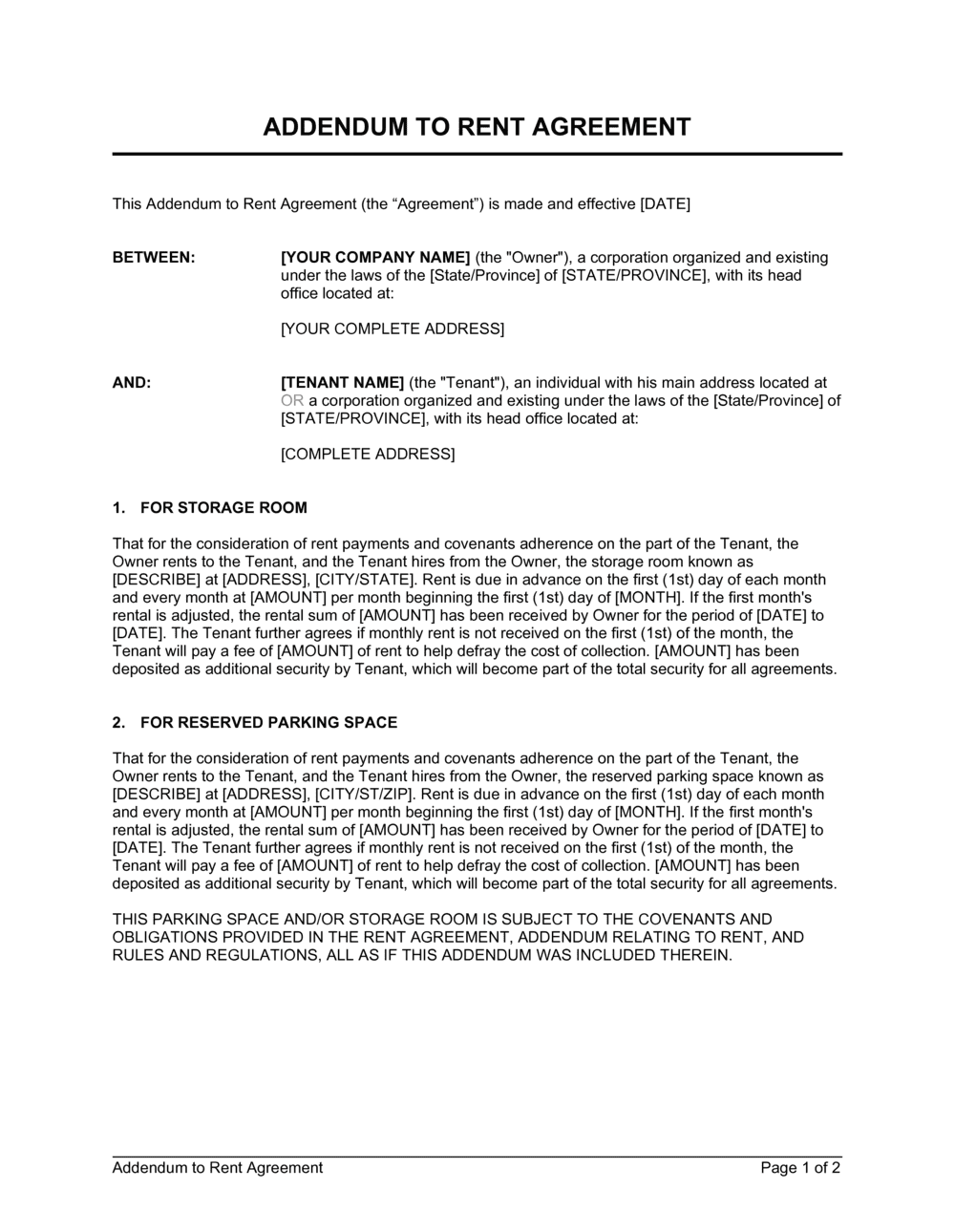
An Addendum To Rent Agreement is a legally binding document that modifies, supplements, or clarifies specific terms of an existing lease or rental agreement without replacing the original contract. This free Word download lets landlords and tenants add, remove, or update individual provisions β€” such as rent amount, pet permissions, parking rights, or lease duration β€” while leaving all other terms intact. Once signed by both parties, it carries the same legal force as the original agreement.
When you need it
Use it when a change in circumstances requires a formal update to an active lease β€” such as increasing monthly rent at renewal, adding a new roommate, granting pet permission, or extending the tenancy beyond the original end date. It is also used mid-lease when landlord and tenant agree on terms not addressed in the original contract.
What's inside
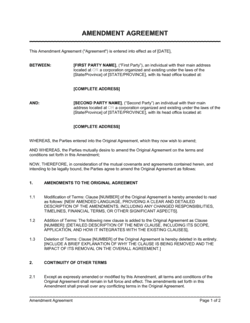
Reference to the original agreement with parties and property details, a clear statement of the specific terms being modified, the effective date of the change, governing-law confirmation, and signature blocks for all parties. Some versions include a recitals section explaining the reason for the modification.

What is an Addendum To Rent Agreement?

An Addendum To Rent Agreement is a legally binding document that modifies, supplements, or clarifies one or more specific terms of an existing lease without replacing the original contract. Rather than drafting an entirely new agreement, landlords and tenants use an addendum to record agreed changes β€” a rent increase, pet permission, parking assignment, subletting consent, or lease extension β€” while leaving every other term of the original lease intact. Once signed by all parties, the addendum carries the same legal force as the original agreement and is read together with it as a single binding document.

The addendum functions by incorporating the original lease by reference, identifying precisely which provision is being changed or added, setting an effective date, and obtaining the mutual assent of all parties. This structure preserves the stability of the existing relationship while giving both sides a clear, written record of what changed and when.

Why You Need This Document

Relying on a verbal agreement or an email thread to modify a lease is the most common β€” and most expensive β€” mistake landlords and tenants make. Without a signed, written addendum, disputes over what was agreed are resolved by courts based on conflicting recollections, and the outcome almost always defaults to the original lease terms regardless of what was actually negotiated. A landlord who verbally approved a tenant's dog has no defense when the tenant claims the deposit deduction for pet damage was improper. A tenant who verbally agreed to a rent increase can simply stop paying the higher amount.

A properly executed addendum eliminates that risk entirely. It protects the landlord's ability to enforce new terms, gives the tenant documented proof of permissions granted, and satisfies the written-modification requirements of landlord-tenant statutes in virtually every US state, Canadian province, and EU member country. For property managers running multi-unit portfolios, a standardized addendum template also reduces the inconsistency that creates liability across dozens of tenancies. This template gives you a professionally structured starting point you can complete in under 30 minutes β€” and that will hold up if the modification is ever disputed.

Which variant fits your situation?

If your situation is…Use this template
Increasing monthly rent at the end of a fixed termRent Increase Addendum
Granting permission for a tenant to keep a petPet Addendum to Lease
Extending the lease beyond the original end dateLease Extension Addendum
Adding or removing a co-tenant from the agreementRoommate Addendum
Allowing the tenant to sublease all or part of the unitSublease Addendum
Modifying commercial lease terms such as permitted use or CAM chargesCommercial Lease Addendum
Fully replacing the original lease with new termsLease Agreement

Common mistakes to avoid

❌ Vague modification language

Why it matters: An addendum that says 'rent will increase next month' without a dollar amount and effective date is unenforceable β€” and courts will default to the original lease terms.

Fix: State the exact new rent amount, the precise effective date, and the specific lease section being replaced. Every number and date should be written out in full.

❌ Missing signatures from all named parties

Why it matters: An addendum signed by only one of two co-tenants may be unenforceable against the non-signing tenant, leaving the landlord with inconsistent obligations across the same tenancy.

Fix: Cross-reference the original lease signature block and ensure every person named there signs the addendum. Send it to all parties simultaneously rather than sequentially.

❌ Executing an addendum while the tenant is in default

Why it matters: Signing a modification while rent is unpaid or a lease violation is unresolved can constitute a waiver of the default, making a subsequent eviction harder to prosecute.

Fix: Resolve any existing defaults in writing before executing the addendum, or include an explicit non-waiver clause stating that execution does not constitute waiver of prior breaches.

❌ Skipping the conflict-resolution priority clause

Why it matters: If the addendum and the original lease contradict each other β€” even inadvertently β€” a court must decide which document controls, often using a rule that penalizes the drafter.

Fix: Always include: 'In the event of any conflict between this Addendum and the Lease, the terms of this Addendum shall prevail.' This single sentence eliminates the ambiguity.

❌ Using a template from the wrong jurisdiction

Why it matters: Landlord-tenant law is state and province-specific. A California addendum that references AB 1482 rent-control exemptions is not valid in Texas β€” and may actively mislead the tenant.

Fix: Confirm the governing-law clause matches the property's actual location, and verify that any statutory references (notice periods, deposit limits, rent increase caps) reflect local law.

❌ Failing to attach the addendum physically to the original lease

Why it matters: A free-floating addendum without a clear physical or documentary link to the original lease can be disputed as unrelated to it, especially years later in an eviction or security-deposit dispute.

Fix: Store the addendum immediately behind the original lease in the same file. Note the addendum date on the original lease's cover page, and reference the addendum in any future renewal or further modification.

The 10 key clauses, explained

Preamble and recitals

In plain language: Identifies the original lease by date and parties, identifies the property by full address, and briefly states why the addendum is being executed.

Sample language
This Addendum ('Addendum') is entered into as of [DATE] by and between [LANDLORD FULL NAME] ('Landlord') and [TENANT FULL NAME] ('Tenant') with respect to the Lease Agreement dated [ORIGINAL LEASE DATE] for the premises located at [FULL PROPERTY ADDRESS] ('Premises'). The parties wish to modify the Lease as set forth below.

Common mistake: Referencing the original lease only by address without including the original execution date. When multiple leases exist for the same property β€” as with renewals β€” the addendum cannot be tied to the correct document.

Incorporation by reference

In plain language: States that the original lease remains in full force and that the addendum is made part of it, so the two documents are read together as one agreement.

Sample language
Except as expressly modified herein, all terms and conditions of the Lease Agreement dated [DATE] remain in full force and effect and are incorporated herein by this reference. In the event of any conflict between this Addendum and the Lease, the terms of this Addendum shall control.

Common mistake: Omitting a conflict-resolution rule. Without it, a contradiction between the addendum and the original lease creates ambiguity that a court must resolve β€” often against the drafter.

Description of modifications

In plain language: Clearly sets out exactly which lease term is being changed, what the old language was, and what the new language replaces it with β€” or adds, if it is a new provision.

Sample language
Section [X] of the Lease ('Monthly Rent') is hereby amended to read as follows: 'Commencing [DATE], Tenant shall pay monthly rent of $[NEW AMOUNT], due on the [DAY] of each month. All other rent provisions remain unchanged.'

Common mistake: Using imprecise language like 'rent will go up next month' without specifying the exact dollar amount, effective date, and lease section being modified. Vague modifications are the leading cause of disputes over whether a change was ever agreed.

Effective date

In plain language: States the specific date on which the modified terms take effect, which may be different from the signing date.

Sample language
The modifications set forth in this Addendum shall become effective as of [EFFECTIVE DATE], regardless of the date on which this Addendum is executed by the parties.

Common mistake: Leaving the effective date blank or writing 'immediately.' Without a specific date, parties often dispute when rent increases, pet permissions, or extended terms actually began.

Additional provisions (if any)

In plain language: Adds any entirely new obligations or permissions not addressed in the original lease β€” such as pet rules, parking assignments, storage access, or home-office use.

Sample language
Tenant is hereby granted permission to keep one (1) dog not exceeding [X] lbs at the Premises, subject to the following conditions: [CONDITIONS]. Tenant shall pay a non-refundable pet fee of $[AMOUNT] and an additional refundable pet deposit of $[AMOUNT] due on [DATE].

Common mistake: Adding provisions verbally and relying on a 'catch-all' paragraph to cover them. Each new obligation should be spelled out with specific terms β€” amount, date, and conditions β€” so neither party can later claim they didn't agree to specifics.

Tenant obligations and representations

In plain language: Confirms that the tenant acknowledges the modification, agrees to comply with the new terms, and represents that they are not in default under the original lease.

Sample language
Tenant represents that, as of the date of this Addendum, Tenant is not in default under the Lease Agreement and agrees to comply with all modified and additional terms set forth herein.

Common mistake: Executing an addendum while the tenant is in arrears on rent. A court may find the landlord waived the default by entering into a new agreement, complicating any subsequent eviction proceeding.

Landlord representations

In plain language: Confirms the landlord's authority to modify the lease β€” important when the property is managed by an agent or held in an LLC, trust, or partnership.

Sample language
Landlord represents that Landlord has full authority to enter into and execute this Addendum and that no third-party consent (other than as disclosed herein) is required to modify the Lease.

Common mistake: Having a property manager sign without confirming they have written authority to bind the owner. A modification signed by an unauthorized agent may be unenforceable against the actual property owner.

Entire agreement and integration

In plain language: States that the original lease plus this addendum constitute the entire agreement between the parties, replacing any prior verbal or written representations about the modified terms.

Sample language
This Addendum, together with the Lease Agreement and any prior addenda, constitutes the entire agreement of the parties with respect to the subject matter hereof and supersedes all prior negotiations, representations, or agreements, whether oral or written.

Common mistake: Omitting the integration clause when a series of emails or text messages preceded the addendum. Without it, the tenant may argue that earlier messages created binding commitments beyond what the addendum says.

Governing law

In plain language: Specifies which state, province, or country's landlord-tenant laws govern interpretation and enforcement of the addendum.

Sample language
This Addendum shall be governed by and construed in accordance with the laws of the State of [STATE], without regard to its conflict-of-laws principles.

Common mistake: Copying the governing-law clause from a template drafted for a different jurisdiction without updating it. Landlord-tenant law is highly local β€” using the wrong state's law can void the modification or lead to an unenforceable eviction clause.

Signatures and notarization

In plain language: Requires dated signatures from all parties named in the original lease β€” including all co-tenants, guarantors if required, and the landlord or their authorized agent.

Sample language
IN WITNESS WHEREOF, the parties have executed this Addendum as of the date first written above. LANDLORD: _________________________ [LANDLORD NAME], Date: _____ TENANT: _________________________ [TENANT NAME], Date: _____

Common mistake: Getting only one co-tenant's signature when two or more are named on the original lease. A modification signed by fewer than all tenants may be challenged as unenforceable against non-signing parties.

How to fill it out

  1. 1

    Identify the original lease with precision

    Enter the full legal names of all parties exactly as they appear on the original lease, the property address, and the original lease execution date. Pull the original document to confirm spelling and date.

    πŸ’‘ If the original lease named an LLC or trust as landlord, use that entity name β€” not the owner's personal name β€” to preserve the liability shield.

  2. 2

    State every modification with specific language

    For each term being changed, cite the section number of the original lease, quote the old language, and write the new language in full. Do not use shorthand like 'rent goes up $100.'

    πŸ’‘ If you are changing rent, include the new dollar amount, the effective date, and which payment section of the lease it replaces.

  3. 3

    Set a specific effective date

    Enter the exact calendar date on which the new terms take effect. This date can be the same as the signing date or a future date β€” but it must be explicit.

    πŸ’‘ For rent increases, the effective date should align with the start of a new rental period (e.g., the 1st of the month) to avoid pro-ration disputes.

  4. 4

    Add any new provisions not in the original lease

    Draft each new provision as a numbered paragraph with all conditions spelled out β€” amounts, timelines, and consequences for non-compliance.

    πŸ’‘ Pet addenda should specify species, breed, weight limit, additional deposit or fee, and liability for damage β€” courts enforce what is written, not what was intended.

  5. 5

    Include the incorporation and conflict-resolution clause

    Add a sentence stating the original lease remains in force except as modified, and that in case of conflict, the addendum controls. This prevents arguments about which document governs.

    πŸ’‘ Copy this clause verbatim from the template β€” improvised versions often miss the conflict-resolution rule, which is the most litigated sentence in lease addenda.

  6. 6

    Confirm authority and obtain all signatures

    Have every party named on the original lease sign β€” all co-tenants, guarantors if applicable, and the landlord or their documented authorized agent. Date every signature line.

    πŸ’‘ Use a date stamp rather than leaving parties to fill in dates manually β€” inconsistent or missing dates on signature lines are a common eviction-proceeding vulnerability.

  7. 7

    Deliver, store, and cross-reference the addendum

    Give each party a signed copy immediately after execution. File the addendum with your copy of the original lease. Note the addendum's date on the lease cover sheet so future reviewers know the full agreement includes both documents.

    πŸ’‘ For commercial leases, record the addendum if the underlying lease was recorded β€” an unrecorded modification may not be enforceable against a subsequent purchaser of the property.

  8. 8

    Verify jurisdiction-specific requirements

    Some states and provinces require landlord-tenant modifications to be in a specific format, include statutory disclosures, or be delivered by certified mail. Check local requirements before finalizing.

    πŸ’‘ California, New York, and Ontario each have rent-control rules that may limit the rent increase amounts permissible even with a signed addendum β€” confirm the number is lawful before presenting it to the tenant.

Frequently asked questions

What is an addendum to a rent agreement?

An addendum to a rent agreement is a legally binding document that modifies, adds to, or clarifies specific terms of an existing lease without voiding the original contract. Both the original lease and the addendum are read together as a single agreement. Common uses include changing the monthly rent, adding pet permissions, extending the lease term, or granting subletting rights. Once signed by all parties, it carries the same legal force as the original lease.

What is the difference between a lease addendum and a lease amendment?

The terms are often used interchangeably in practice, but technically an addendum adds new terms not addressed in the original lease, while an amendment changes language that already exists in the original document. Both require signatures from all parties to be enforceable, and both are read together with the original lease. For everyday residential and commercial lease modifications, the distinction rarely affects enforceability.

Do both the landlord and tenant have to sign a lease addendum?

Yes. For an addendum to be binding on both parties, it must be signed by all parties named on the original lease β€” including all co-tenants and, where applicable, guarantors. A landlord cannot unilaterally modify lease terms by sending an unsigned notice. Mutual assent β€” agreement by both sides β€” is a fundamental requirement of contract law in every major jurisdiction.

Can a landlord increase rent mid-lease using an addendum?

Only if the tenant agrees in writing. A landlord cannot increase rent during a fixed-term lease without the tenant's consent. An addendum formalizes that consent when both parties negotiate and sign it. In jurisdictions with rent control β€” including California, New York City, and Ontario β€” even a mutually signed rent increase addendum must comply with applicable caps and notice requirements or it will be unenforceable.

Is a verbal lease modification legally valid?

In most jurisdictions, verbal lease modifications are either unenforceable or very difficult to prove. Most states and provinces require residential lease changes to be in writing to be binding. Even where oral modifications are technically permitted, proving what was agreed without a written record is nearly impossible. A signed addendum eliminates the dispute entirely and protects both landlord and tenant.

When should I use an addendum versus writing a new lease?

Use an addendum when you want to change or add one or a few specific terms while keeping the rest of the original lease intact β€” for example, allowing a pet, adding parking, or adjusting rent. Draft a new lease when the changes are so extensive that the original agreement no longer reflects the parties' relationship, when a new tenancy is beginning, or when all prior terms need to be renegotiated. Writing a new lease for minor changes creates unnecessary paperwork and may waive favorable terms from the original document.

Does an addendum to a rent agreement need to be notarized?

In most US states and Canadian provinces, residential lease addenda do not require notarization to be enforceable. However, if the underlying lease was notarized or recorded β€” more common with long-term commercial leases β€” the addendum should follow the same formalities. Some states require notarization for lease modifications exceeding one year. Check local requirements before finalizing.

What happens if an addendum conflicts with the original lease?

When an addendum contains a clause that expressly states it controls in the event of conflict, the addendum prevails. Without that clause, courts typically apply rules of contract interpretation β€” often construing ambiguities against the drafter. To avoid this uncertainty entirely, always include a conflict-resolution clause: 'In the event of any conflict between this Addendum and the Lease, the terms of this Addendum shall govern.'

Can a tenant refuse to sign a lease addendum?

Yes. A tenant has the right to refuse any modification to an existing lease during the fixed term. The landlord cannot force a change mid-lease without the tenant's consent β€” attempting to do so may constitute constructive eviction. At the end of a fixed term, the landlord may condition a renewal on the tenant signing a new addendum. A tenant who refuses at renewal simply does not have their lease renewed on the proposed terms.

How this compares to alternatives

vs Lease Agreement

A lease agreement is the original binding contract that establishes all terms of the tenancy from the start. An addendum modifies or supplements a lease that is already in force. Use the addendum when changing specific terms mid-lease or adding new provisions; draft a new lease when starting a fresh tenancy or when changes are so extensive that starting over is cleaner than layering modifications.

vs Lease Renewal Agreement

A lease renewal agreement extends the tenancy for a new fixed term β€” it resets the clock and typically updates rent and any changed terms for the new period. A rent agreement addendum modifies the existing lease while it is still active. Use a renewal when the original term is expiring; use an addendum when the term has time remaining and you need to change a specific provision now.

vs Sublease Agreement

A sublease agreement creates a new tenancy between the original tenant and a subtenant. A rent agreement addendum documents the landlord's permission to sublease but does not itself establish the sublease relationship. Both documents are often needed together: the addendum grants consent, the sublease agreement governs the new relationship.

vs Notice of Rent Increase

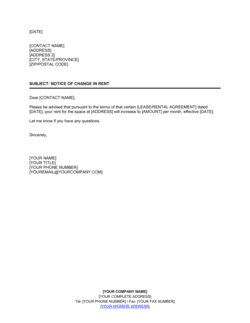
A notice of rent increase is a unilateral landlord communication informing the tenant of an upcoming change β€” it is not a binding contract modification. A rent agreement addendum is a bilateral signed agreement that documents both parties' consent to the new rent. In jurisdictions that permit mid-lease rent changes, only a signed addendum creates an enforceable modification; a notice alone does not.

Industry-specific considerations

Residential property management

Pet fees, rent adjustments, roommate additions, and parking assignments are the most frequent addenda in residential portfolios β€” standardizing the template cuts processing time per modification significantly.

Commercial real estate

CAM charge reconciliations, permitted-use expansions, tenant improvement allowances, and co-tenancy clause modifications require precisely drafted addenda that interact with complex underlying lease structures.

Retail and hospitality

Lease modifications for expanded signage rights, adjusted operating hours, percentage-rent recalculations, and exclusivity clauses are standard in retail and food-service tenancies.

Small business and startups

Office lease addenda frequently cover subletting rights, early-termination options, and technology infrastructure responsibilities as businesses scale up or down mid-lease.

Jurisdictional notes

United States

Landlord-tenant law is governed at the state level, and requirements vary significantly. Rent control ordinances in California (AB 1482), New York City, and other municipalities cap rent increases even when both parties consent in writing. Many states require written notice periods β€” typically 30 to 60 days β€” before a rent increase addendum can take effect. California also requires addenda to be in Spanish, Chinese, Tagalog, Vietnamese, or Korean if the lease was negotiated in those languages.

Canada

Provincial landlord-tenant statutes β€” including Ontario's Residential Tenancies Act and BC's Residential Tenancy Act β€” govern what can and cannot be modified by agreement. In Ontario, a landlord may only increase rent once every 12 months and must use a provincial guideline rate; above-guideline increases require Landlord and Tenant Board approval. Quebec leases must be modified using standard forms in French. Addenda that conflict with statutory minimums are void regardless of whether both parties signed.

United Kingdom

In England and Wales, assured shorthold tenancies (ASTs) are governed by the Housing Act 1988. Rent can only be increased at the end of a fixed term or by agreement using a deed of variation β€” a simple addendum format generally suffices if signed by both parties. Landlords must also comply with the Deregulation Act 2015 requirements, including providing an updated EPC and gas safety certificate before serving a valid section 21 notice. Scotland and Northern Ireland operate under separate regimes with distinct rent-increase rules.

European Union

Residential tenancy law varies substantially across EU member states and is not harmonized at the EU level. Germany's Mietrecht limits rent increases to 20% over three years in normal markets (15% in high-demand areas) even with tenant consent. France requires a specific index-linked formula for rent adjustments. The Netherlands requires written modifications in Dutch for residential leases. Always verify local statutory rent-increase caps and mandatory notice periods before presenting a modification addendum to a tenant.

Template vs lawyer β€” what fits your deal?

PathBest forCostTime
Use the templateStraightforward residential lease modifications β€” pet permissions, parking changes, or rent adjustments in non-rent-controlled jurisdictionsFree15–30 minutes
Template + legal reviewRent-controlled properties, multi-unit portfolios, or addenda that add significant new financial obligations$150–$400 for a one-hour attorney review1–3 days
Custom draftedComplex commercial lease modifications, high-value properties, or addenda involving permitted-use changes, CAM adjustments, or tenant improvement allowances$500–$2,500+3–10 days

Glossary

Addendum
A document attached to and incorporated into an existing contract that adds, removes, or clarifies specific terms without voiding the original agreement.
Amendment
A formal change to a contract's existing terms β€” often used interchangeably with addendum, though technically an amendment alters existing language while an addendum adds new terms.
Lease Agreement
The original binding contract between landlord and tenant establishing the terms of the tenancy, which the addendum modifies or supplements.
Effective Date
The specific calendar date on which the new or modified terms take legal effect, which may differ from the date the addendum is signed.
Mutual Assent
Voluntary agreement by both parties to the terms of a contract modification β€” both landlord and tenant must sign for an addendum to be enforceable.
Integration Clause
A provision stating that the written contract, together with its addenda, represents the entire agreement and supersedes prior oral or written representations.
CAM Charges
Common Area Maintenance charges β€” fees in a commercial lease for a tenant's proportionate share of maintaining shared spaces like lobbies, parking lots, and hallways.
Sublease
An arrangement in which the original tenant rents all or part of the leased premises to a third party, typically requiring written landlord consent.
Holdover Tenancy
A situation where a tenant remains in possession after the lease term expires without executing a renewal or extension, often triggering month-to-month status.
Consideration
Something of value exchanged between parties to make a contract modification legally binding β€” typically the mutual agreement to new terms, but sometimes an additional payment.
Governing Law
The jurisdiction whose laws apply to interpret and enforce the agreement β€” important when landlord and tenant are based in different states or provinces.

Part of your Business Operating System

This document is one of 3,000+ business & legal templates included in Business in a Box.

  • Fill-in-the-blanks β€” ready in minutes
  • 100% customizable Word document
  • Compatible with all office suites
  • Export to PDF and share electronically

Create your document in 3 simple steps.

From template to signed document β€” all inside one Business Operating System.
1
Download or open template

Access over 3,000+ business and legal templates for any business task, project or initiative.

2
Edit and fill in the blanks with AI

Customize your ready-made business document template and save it in the cloud.

3
Save, Share, Send, Sign

Share your files and folders with your team. Create a space of seamless collaboration.

Save time, save money, and create top-quality documents.

β˜…β˜…β˜…β˜…β˜…

"Fantastic value! I'm not sure how I'd do without it. It's worth its weight in gold and paid back for itself many times."

Managing Director Β· Mall Farm
Robert Whalley
Managing Director, Mall Farm Proprietary Limited
β˜…β˜…β˜…β˜…β˜…

"I have been using Business in a Box for years. It has been the most useful source of templates I have encountered. I recommend it to anyone."

Business Owner Β· 4+ years
Dr Michael John Freestone
Business Owner
β˜…β˜…β˜…β˜…β˜…

"It has been a life saver so many times I have lost count. Business in a Box has saved me so much time and as you know, time is money."

Owner Β· Upstate Web
David G. Moore Jr.
Owner, Upstate Web

Run your business with a system β€” not scattered tools

Stop downloading documents. Start operating with clarity. Business in a Box gives you the Business Operating System used by over 250,000 companies worldwide to structure, run, and grow their business.

Start freeΒ Β·Β No credit card required