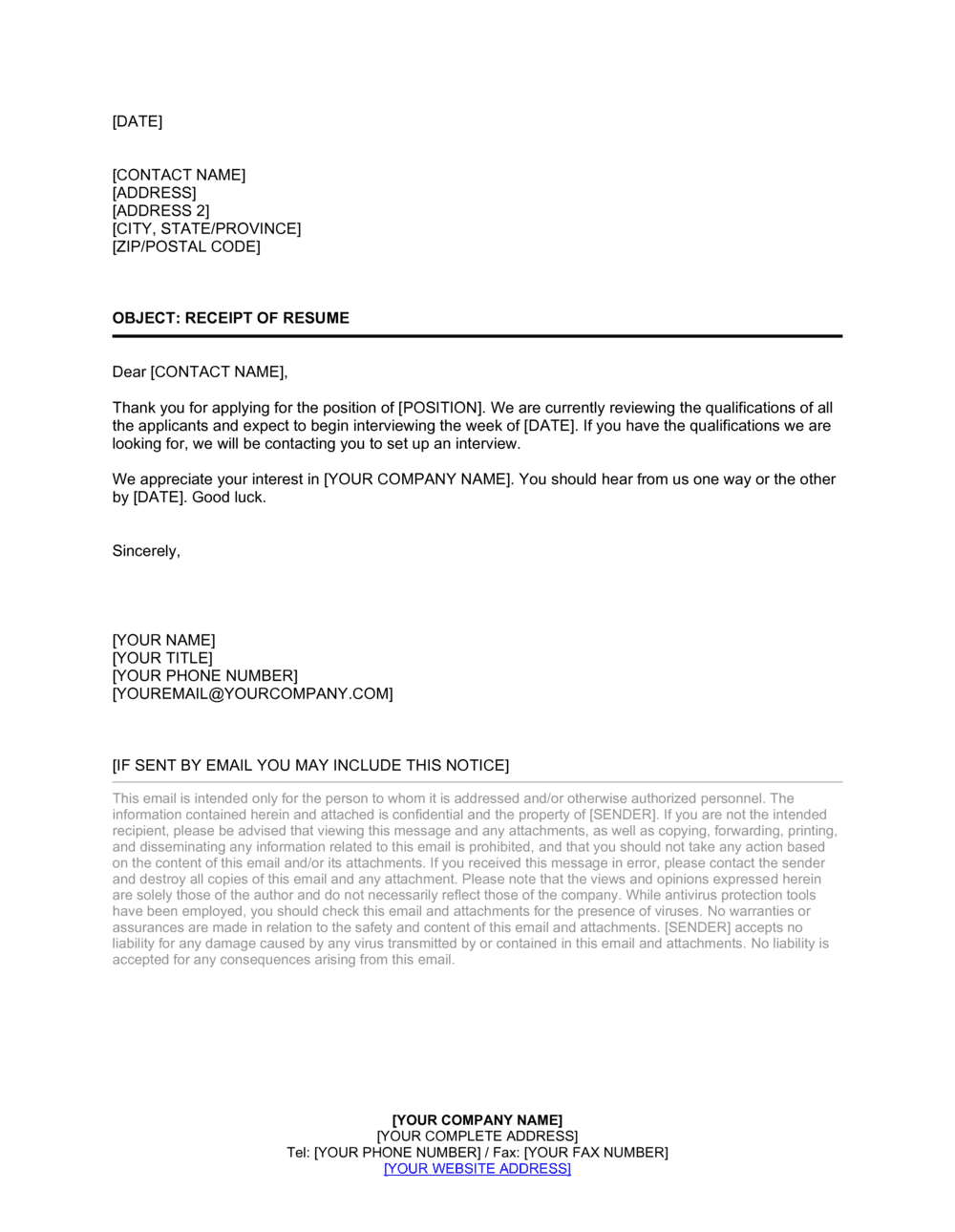
Receipt of Resume Template

Free Word download • Edit online • Save & share with Drive • Export to PDF

1 page20–30 min to fillDifficulty: StandardSignature requiredLegal review recommended
Learn more ↓
FreeReceipt of Resume Template

At a glance

What it is
A Receipt of Resume is a formal document an employer issues to a job applicant to confirm that their resume and application materials have been received and are under review. This free Word download gives you a professionally structured acknowledgment that can be edited online and exported as PDF, covering receipt confirmation, data privacy handling, retention terms, and next-steps communication.
When you need it
Use it whenever your organization receives unsolicited resumes, processes high-volume job applications, or operates in a jurisdiction where acknowledging personal data receipt is a compliance requirement. It is particularly important when collecting and storing candidate information under privacy legislation such as GDPR, PIPEDA, or applicable US state laws.
What's inside
Employer and applicant identification, receipt confirmation and date, position of interest, data privacy and retention policy, authorization for data processing, disclaimers regarding the hiring process, and signature blocks for both parties where required.

What is a Receipt of Resume?

A Receipt of Resume is a formal legal document issued by an employer to a job applicant confirming that their resume and application materials have been received, logged, and will be handled in accordance with stated data privacy obligations. It establishes the date and method of receipt, identifies the position or department of interest, sets out how long the applicant's personal data will be retained, and explicitly disclaims any obligation to interview or employ the applicant. Unlike an informal email acknowledgment, a receipt of resume creates a documented, mutually acknowledged record that satisfies privacy law requirements in jurisdictions such as the European Union, Canada, and US states with active consumer privacy legislation.

Why You Need This Document

Without a formal receipt of resume, employers face exposure on two fronts simultaneously. First, retaining a candidate's personal data without documented consent and a defined retention period is a direct violation of GDPR, PIPEDA, and state-level US privacy laws — penalties under GDPR alone can reach €20 million or 4% of global annual turnover. Second, the absence of a no-employment-obligation disclaimer leaves the door open for applicants to argue that prolonged retention of their materials, or subsequent contact, created an implied promise of consideration or hire. A signed receipt of resume closes both gaps: it gives the applicant transparent notice of how their data will be used and for how long, and it gives the employer a clear, dated record proving compliance. This template provides everything you need to issue a professional, legally defensible receipt in under 15 minutes — protecting your organization from the first moment a resume lands in your inbox.

Which variant fits your situation?

If your situation is…Use this template
Acknowledging an unsolicited resume with no open positionReceipt of Resume (Unsolicited)
Confirming receipt of an application for a specific posted roleJob Application Acknowledgment Letter
Informing a candidate their application was not selectedRejection Letter
Inviting a shortlisted candidate to an interviewInterview Invitation Letter
Extending a formal employment offer after selectionJob Offer Letter
Onboarding the hired candidate with full employment termsEmployment Contract
Collecting candidate consent for background checksBackground Check Authorization Form

Common mistakes to avoid

❌ No retention period specified

Why it matters: Retaining candidate personal data indefinitely without a defined expiry breaches GDPR, PIPEDA, and many US state privacy laws — penalties can reach €20M or 4% of global turnover under GDPR.

Fix: Set a specific retention period in months and link it to a documented deletion schedule in your HR records policy.

❌ Omitting the no-employment-obligation disclaimer

Why it matters: Without an explicit disclaimer, candidates who receive positive follow-up communication may argue that an implied contract to interview or hire was created.

Fix: Include a clear, unambiguous clause stating that receipt of a resume creates no obligation to interview, offer employment, or respond to the applicant.

❌ Failing to identify the legal basis for data processing

Why it matters: Under GDPR and PIPEDA, processing personal data without specifying the legal basis (consent, legitimate interest, or contractual necessity) renders the processing unlawful, regardless of whether consent was informally obtained.

Fix: Name the exact legal basis in the data privacy clause and, where relying on consent, ensure it is freely given, specific, and documented in writing.

❌ Using only the department name as the data controller

Why it matters: Data subjects have the right to contact and hold accountable a named legal entity, not an internal department. Naming only 'HR' creates ambiguity that undermines the document's enforceability.

Fix: Identify the employer's full legal entity name as the data controller and provide a specific named individual or role as the data privacy contact.

❌ Collecting only the applicant's signature

Why it matters: A receipt signed only by the applicant is not a mutual acknowledgment — it cannot be used to prove the employer accepted obligations regarding data privacy or confidentiality.

Fix: Require an authorized employer representative to countersign before the document is filed, making it a bilaterally acknowledged record.

❌ Providing a stale or unmonitored deletion-request contact

Why it matters: If an applicant submits a data deletion request and receives no response within the statutory timeframe (30 days under GDPR, 45 days under CCPA), the employer is in breach regardless of intent.

Fix: Name a specific monitored email address or role as the deletion-request contact and test it before the document goes live.

The 10 key clauses, explained

Parties and Identification

In plain language: Names the employer entity and the applicant, including contact details, to establish exactly whose resume was received and who is acknowledging it.

Sample language
This Receipt of Resume is issued by [EMPLOYER LEGAL NAME], a [STATE/PROVINCE] [ENTITY TYPE] ('Employer'), to [APPLICANT FULL NAME] ('Applicant'), in acknowledgment of the resume and supporting materials received on [DATE].

Common mistake: Using only a department name or recruiter's name instead of the employer's full legal entity name — creating ambiguity about which organization holds the applicant's data.

Receipt Confirmation and Date

In plain language: Formally confirms that the resume was received on a specific date and that it has been logged in the employer's applicant tracking system or hiring records.

Sample language
Employer confirms receipt of Applicant's resume and any accompanying materials on [DATE OF RECEIPT], submitted via [METHOD — email / online portal / in person]. Materials have been logged under reference number [REFERENCE ID].

Common mistake: Omitting the submission date and method. Without these, neither party has a clear record for follow-up or compliance audits, and candidates have no reference point for status inquiries.

Position of Interest

In plain language: States the specific role or department the applicant is being considered for, or notes that the submission is unsolicited with no current opening.

Sample language
Applicant has expressed interest in the position of [JOB TITLE] within the [DEPARTMENT] department. / This is an unsolicited resume. Employer will retain the materials on file for consideration should a suitable position arise within [RETENTION PERIOD].

Common mistake: Leaving this clause blank or using vague language like 'general interest.' Without a specific role reference, a candidate may later claim implied promises about future employment opportunities.

Data Privacy and Processing Authorization

In plain language: Informs the applicant how their personal data will be used, who will have access to it, and the legal basis under which the employer processes it.

Sample language
By submitting their resume, Applicant consents to Employer collecting, storing, and processing their personal information for recruitment purposes in accordance with [APPLICABLE PRIVACY LAW / EMPLOYER PRIVACY POLICY]. Applicant's data will be accessible only to [HR personnel / hiring managers] involved in the relevant hiring process.

Common mistake: Omitting the specific legal basis for processing (e.g., consent, legitimate interest) under GDPR or applicable law — making the clause non-compliant in jurisdictions that require an explicit basis.

Data Retention Period

In plain language: States how long the employer will keep the applicant's resume and personal data before securely destroying it, in compliance with applicable law.

Sample language
Employer will retain Applicant's resume and associated personal data for a period of [X months / years] from the date of receipt. Upon expiry of this period, Applicant's data will be securely deleted unless Applicant consents to an extended retention period.

Common mistake: Setting no retention period or an indefinitely open-ended one. Retaining candidate data beyond a defined period without consent exposes the employer to GDPR and PIPEDA violations.

No Employment Obligation

In plain language: Clearly states that receipt of a resume does not constitute an offer of employment, an interview guarantee, or any other obligation to hire the applicant.

Sample language
This receipt does not constitute an offer of employment, a promise to interview, or any representation that a suitable position currently exists or will become available. Employer retains full discretion over all hiring decisions.

Common mistake: Failing to include this disclaimer entirely. Without it, an applicant could argue that prolonged retention of their materials and subsequent contact created an implied obligation to consider or hire them.

Applicant's Right to Withdraw or Request Deletion

In plain language: Advises the applicant of their right to withdraw consent, request access to their data, or ask for their information to be deleted from the employer's records at any time.

Sample language
Applicant may at any time withdraw consent for data processing, request access to their personal data held by Employer, or request deletion of their data by contacting [CONTACT NAME / DATA PRIVACY OFFICER] at [EMAIL ADDRESS].

Common mistake: Providing a contact email that is monitored infrequently or no longer active — meaning deletion requests are never actioned, creating material compliance risk.

Confidentiality of Application Materials

In plain language: Confirms that the employer will treat the applicant's personal information, employment history, and references as confidential and will not share them without consent.

Sample language
Employer agrees to treat all application materials submitted by Applicant as confidential and will not disclose them to third parties without Applicant's prior written consent, except as required by law or as necessary to conduct the hiring process.

Common mistake: Not defining third parties — leaving open whether sharing with a parent company, subsidiary, or external recruiter requires additional consent under applicable law.

Governing Law

In plain language: Specifies which jurisdiction's laws govern the document, particularly data privacy obligations.

Sample language
This Receipt of Resume is governed by the laws of [STATE / PROVINCE / COUNTRY]. Any dispute arising in connection with this document shall be resolved in accordance with the applicable laws of [JURISDICTION].

Common mistake: Choosing a governing law that does not correspond to where the applicant resides or where the employer operates, which can render data privacy provisions unenforceable.

Acknowledgment and Signature

In plain language: Provides signature blocks for both the employer's authorized representative and the applicant, confirming mutual acknowledgment of the document's terms.

Sample language
By signing below, both parties acknowledge the terms of this Receipt of Resume. [EMPLOYER REPRESENTATIVE NAME], [TITLE], [DATE] / [APPLICANT NAME], [DATE].

Common mistake: Collecting only the applicant's signature and omitting the employer's authorized representative. A one-sided acknowledgment reduces the document's value as evidence in a dispute.

How to fill it out

  1. 1

    Enter the employer's full legal entity details

    Insert the employer's registered legal name, entity type, and jurisdiction of incorporation. Include the HR or data privacy contact name and email address who will handle data requests.

    💡 Cross-reference the entity name with your corporate registry to ensure the name on the document matches payroll and public records exactly.

  2. 2

    Identify the applicant and receipt date

    Fill in the applicant's full legal name, the date their resume was received, and the submission method (email, online portal, or in person). Assign a unique reference number for your applicant tracking system.

    💡 Log the reference number in your ATS on the same day you issue the receipt — this creates an auditable chain of records in case of a privacy complaint.

  3. 3

    Specify the position or note unsolicited status

    Name the exact job title and department the applicant is being considered for. If the resume was unsolicited, state that clearly and specify the retention period you will apply.

    💡 For unsolicited resumes, a 6-month retention period is a common standard — long enough to be useful, short enough to comply with most privacy frameworks.

  4. 4

    Complete the data privacy and processing clause

    Identify the applicable privacy law (GDPR, PIPEDA, CCPA, or other), the legal basis for processing, and who within the organization will have access to the applicant's data.

    💡 If your organization operates across multiple jurisdictions, name each applicable law separately — do not rely on a single generic reference to 'applicable law.'

  5. 5

    Set and document the retention period

    Enter a specific retention period in months or years. Ensure this aligns with your organization's documented data retention policy and any sector-specific requirements.

    💡 Most employment law advisors recommend 12–24 months for active candidates and 6 months for unsolicited submissions as a reasonable default in the absence of specific statutory guidance.

  6. 6

    Include the no-employment-obligation disclaimer

    Confirm that the disclaimer clause is present and clearly worded. Do not soften the language with phrases like 'we will do our best to consider' — neutral, unambiguous language is safer.

    💡 Have your legal or HR team review this clause if you are operating in a jurisdiction with strong implied-contract employment laws.

  7. 7

    Obtain signatures before retaining the resume

    Collect the applicant's signed acknowledgment before formally processing their application data. Add the authorized HR or hiring representative's signature on the employer side.

    💡 Use Business in a Box eSign to timestamp digital signatures — this is particularly important for GDPR compliance where you need to demonstrate that valid consent was obtained prior to processing.

  8. 8

    File the executed receipt with the applicant's materials

    Store the signed receipt alongside the resume in your ATS or secure HR records system. Set a calendar reminder for the retention period expiry date to trigger timely deletion.

    💡 Linking the deletion reminder to the reference number assigned in Step 2 ensures no applicant record is retained beyond its authorized period.

Frequently asked questions

What is a receipt of resume?

A receipt of resume is a formal written acknowledgment issued by an employer to a job applicant confirming that their resume and application materials have been received, logged, and will be handled in accordance with the employer's data privacy policy. It serves as both a professional courtesy and a compliance document, particularly in jurisdictions where acknowledging the receipt of personal data is required by law.

Is a receipt of resume legally required?

A receipt of resume is not universally mandated by employment law, but it functions as a practical compliance tool under privacy legislation such as GDPR, PIPEDA, and certain US state privacy laws. In jurisdictions governed by GDPR, employers must inform data subjects — including job applicants — of how their personal data will be processed, which a well-drafted receipt satisfies. Failure to provide this notice can expose employers to regulatory penalties even without a specific receipt requirement.

Does issuing a receipt of resume create an obligation to hire?

No. A receipt of resume is an acknowledgment of data receipt only, not an offer of employment or a guarantee of an interview. A properly drafted receipt includes an explicit no-employment-obligation disclaimer confirming this. Employers should ensure this clause is clear and unambiguous to prevent applicants from later claiming an implied contractual obligation arose.

How long should an employer keep a job applicant's resume?

Retention periods vary by jurisdiction and the nature of the submission. Under GDPR, personal data should be kept only as long as necessary for the purpose for which it was collected — typically 6–12 months for unsuccessful applications and up to 24 months for candidates placed in an active pipeline. In Canada, PIPEDA requires organizations to keep personal information only as long as needed. In the US, the EEOC recommends retaining job application records for at least one year. Setting a documented retention period in the receipt protects employers from both under-retention and over-retention risks.

What privacy laws apply to the receipt and processing of resumes?

In the EU and UK, the General Data Protection Regulation (GDPR) applies to all personal data in resumes, requiring a legal basis for processing, a retention policy, and the ability to fulfill data subject rights requests. In Canada, PIPEDA governs federally regulated employers, with provincial equivalents in Alberta, BC, and Quebec. In the US, there is no single federal law, but CCPA applies in California for certain employers, and many states are enacting similar legislation. Employers operating across borders should comply with the most stringent applicable framework.

Can an applicant request deletion of their resume after submitting it?

Yes, in jurisdictions governed by GDPR, the right to erasure (Article 17) allows individuals to request deletion of their personal data. Under CCPA, California residents have a similar right. A receipt of resume should document this right explicitly and provide a named contact for making such requests. Employers must respond within the applicable statutory timeframe — 30 days under GDPR, 45 days under CCPA — or risk enforcement action.

Should a receipt of resume be signed by both parties?

Best practice is to obtain acknowledgment from both the applicant and an authorized employer representative. The applicant's signature confirms informed consent to data processing; the employer's signature confirms acceptance of the stated data handling obligations. For digital submissions, a timestamped eSign or a clickwrap acknowledgment on an online portal can serve the same function and is generally accepted as valid consent under GDPR and PIPEDA.

What is the difference between a receipt of resume and a job application acknowledgment letter?

A job application acknowledgment letter is a brief, informal communication confirming receipt and setting expectations for next steps — it is primarily a candidate experience touchpoint. A receipt of resume is a formal legal document covering data privacy obligations, retention terms, consent to processing, and the no-employment-obligation disclaimer. In privacy-conscious organizations, the receipt of resume is the substantive compliance document; the acknowledgment letter is the friendly human follow-up.

Do I need a receipt of resume for unsolicited applications?

Unsolicited resumes create the same data privacy obligations as solicited ones — the applicant's personal data is being collected regardless of whether a role was posted. A receipt of resume for unsolicited submissions is particularly valuable because it documents the retention period and no-obligation disclaimer in a context where the applicant may have inflated expectations about being considered for future openings.

How this compares to alternatives

vs Job Application Acknowledgment Letter

An acknowledgment letter is a short, informal message confirming receipt and setting timeline expectations for the candidate. A receipt of resume is a formal legal document covering data privacy, retention, and consent obligations. Use the acknowledgment letter for candidate communication and the receipt of resume for compliance documentation — ideally both.

vs Rejection Letter

A rejection letter notifies a candidate that they will not be moving forward in the hiring process. A receipt of resume is issued at the beginning of the process to acknowledge receipt and establish data handling terms. The receipt comes first; the rejection letter, if needed, comes later and should reference the same application reference number.

vs Interview Invitation Letter

An interview invitation letter advances a shortlisted candidate to the next stage of selection. A receipt of resume precedes it in the hiring pipeline, establishing the formal record of when and how the application was received. The interview invitation should reference the original application date documented in the receipt.

vs Employment Contract

An employment contract governs the full working relationship after a hiring decision has been made. A receipt of resume operates at the front of the pipeline, before any employment decision, and explicitly disclaims any employment obligation. The two documents serve entirely different stages and should never be confused as substitutes for each other.

Industry-specific considerations

Technology / SaaS

High application volumes and distributed hiring teams mean formal receipts with reference numbers are essential for ATS compliance and GDPR audit readiness.

Financial Services

Regulated hiring processes and sensitive candidate background data require documented consent for processing and strict retention schedules to satisfy FCA and SEC record-keeping rules.

Healthcare

Candidate applications often include sensitive professional licensing and clinical credentials that require confidentiality clauses and defined access controls beyond standard HR use.

Professional Services

Staffing agencies and consulting firms that process resumes on behalf of client employers must clarify in the receipt which entity acts as data controller and which as data processor.

Retail / Hospitality

Seasonal and high-turnover hiring creates large backlogs of unsolicited resumes; a standardized receipt with a 6-month retention period helps manage data volumes and deletion obligations.

Manufacturing

Union-affiliated workplaces may require that resume receipt procedures align with collective bargaining agreements, particularly regarding how candidate data is shared with shop stewards or union representatives.

Jurisdictional notes

United States

No single federal law mandates a receipt of resume, but the EEOC requires employers with 15 or more employees to retain job application records for at least one year. California's CCPA grants residents the right to know what personal data is collected and to request deletion — making a formal receipt with a privacy clause advisable for any employer hiring California residents. Several other states including Virginia, Colorado, and Connecticut have enacted similar consumer privacy laws that apply to employee and applicant data.

Canada

PIPEDA applies to federally regulated employers and requires that personal information — including resume data — be collected with consent, used only for the stated purpose, and retained only as long as necessary. Alberta, British Columbia, and Quebec have substantially similar provincial legislation. Quebec's Law 25 (Bill 64), fully in force since September 2023, imposes additional breach notification and data minimization obligations. French-language requirements apply for Quebec-based employers under the Charter of the French Language.

United Kingdom

The UK GDPR (retained post-Brexit) and the Data Protection Act 2018 require employers to have a documented legal basis for processing applicant personal data, to inform applicants of their data rights at the point of collection, and to retain data only for a defined period. The ICO recommends retaining unsuccessful applicant data for no longer than 6 months. Employers should include a privacy notice or reference their full privacy policy within the receipt.

European Union

GDPR Article 13 requires employers to provide applicants with a data privacy notice at the time personal data is collected. The receipt of resume satisfies this obligation when it includes the data controller's identity, processing purposes, legal basis, retention period, and data subject rights. Relying on 'legitimate interest' as the legal basis for processing unsolicited resumes requires a documented balancing test. Member states including Germany, France, and the Netherlands have additional national employment data protection rules that may require sector-specific adaptations.

Template vs lawyer — what fits your deal?

PathBest forCostTime
Use the templateSmall to mid-size employers issuing receipts for standard domestic job applicationsFree10–15 minutes per issuance
Template + legal reviewEmployers handling cross-border applications or operating in GDPR, PIPEDA, or CCPA-regulated jurisdictions$150–$400 for a privacy counsel review1–3 days
Custom draftedLarge employers with global hiring pipelines, regulated industries, or complex multi-jurisdiction data processing obligations$800–$2,500+1–2 weeks

Glossary

Receipt of Resume
A formal written acknowledgment issued by an employer confirming that a candidate's resume and application materials have been received and logged.
Data Subject
The individual whose personal data is being collected and processed — in this context, the job applicant whose resume has been submitted.
Personal Data
Any information that can identify a living individual, including name, address, contact details, employment history, and education records contained in a resume.
Data Controller
The organization or person who determines the purpose and means of processing personal data — typically the employer receiving the resume.
Retention Period
The defined length of time an employer is permitted or required to keep a candidate's resume and application data before securely deleting it.
Consent Clause
A contractual provision in which the applicant explicitly agrees to the employer's collection, storage, and use of their personal information for hiring purposes.
Unsolicited Resume
A resume submitted by a candidate without a specific job posting — sometimes called a speculative or cold application.
Data Processing
Any operation performed on personal data, including collection, storage, review, sharing, or deletion of a candidate's resume or application information.
PIPEDA
The Personal Information Protection and Electronic Documents Act — Canada's federal private-sector privacy law governing how organizations collect and use personal information.
Right to Erasure
A legal right under GDPR and similar laws allowing individuals to request that their personal data be deleted from an organization's records.
Hiring Pipeline
The structured sequence of stages — from application receipt through screening, interview, offer, and onboarding — through which candidates move during a recruitment process.

Part of your Business Operating System

This document is one of 3,000+ business & legal templates included in Business in a Box.

  • Fill-in-the-blanks — ready in minutes
  • 100% customizable Word document
  • Compatible with all office suites
  • Export to PDF and share electronically

Create your document in 3 simple steps.

From template to signed document — all inside one Business Operating System.
1
Download or open template

Access over 3,000+ business and legal templates for any business task, project or initiative.

2
Edit and fill in the blanks with AI

Customize your ready-made business document template and save it in the cloud.

3
Save, Share, Send, Sign

Share your files and folders with your team. Create a space of seamless collaboration.

Save time, save money, and create top-quality documents.

★★★★★

"Fantastic value! I'm not sure how I'd do without it. It's worth its weight in gold and paid back for itself many times."

Managing Director · Mall Farm
Robert Whalley
Managing Director, Mall Farm Proprietary Limited
★★★★★

"I have been using Business in a Box for years. It has been the most useful source of templates I have encountered. I recommend it to anyone."

Business Owner · 4+ years
Dr Michael John Freestone
Business Owner
★★★★★

"It has been a life saver so many times I have lost count. Business in a Box has saved me so much time and as you know, time is money."

Owner · Upstate Web
David G. Moore Jr.
Owner, Upstate Web

Run your business with a system — not scattered tools

Stop downloading documents. Start operating with clarity. Business in a Box gives you the Business Operating System used by over 250,000 companies worldwide to structure, run, and grow their business.

Free Forever Plan · No credit card required