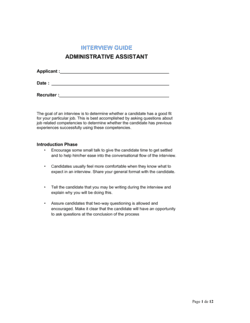
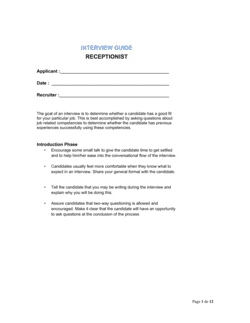
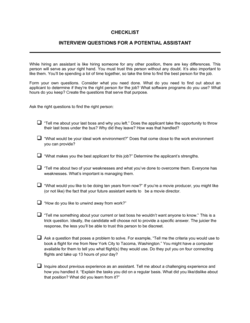
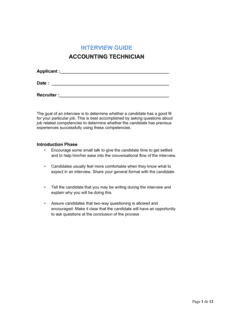
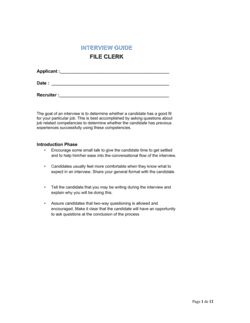
Interview Guide Human Resources Assistant

Free to read β€’ Save or share with one click

FreeInterview Guide Human Resources Assistant Template

At a glance

What it is
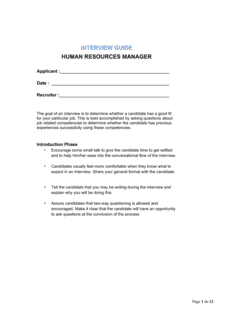
An Interview Guide for an HR Assistant is a structured document that standardizes every stage of the candidate evaluation process for this role β€” from opening questions through competency assessments to a scored debrief summary. This free Word download gives hiring managers and HR leads a consistent, defensible framework they can edit online and export as PDF for panel interviews or one-on-one screenings.
When you need it
Use it whenever you are hiring an HR assistant and need interviewers to evaluate candidates on the same criteria, reduce unconscious bias, and produce a documented record of the selection decision.
What's inside
Role overview and interview objectives, structured behavioral and situational questions mapped to core competencies, a numerical scoring rubric for each question, interviewer notes fields, a candidate comparison summary, and a hiring recommendation section with sign-off.

What is an Interview Guide for an HR Assistant?

An Interview Guide for an HR Assistant is a structured evaluation document that standardizes the questions, scoring criteria, and documentation process used to assess candidates for an HR assistant role. It maps each interview question to a defined competency β€” such as administrative accuracy, confidentiality, communication, and HRIS proficiency β€” and provides interviewers with a numerical rubric and note-taking fields so that every candidate is evaluated against the same baseline. Rather than leaving question selection to each interviewer's judgment, the guide ensures consistent, comparable, and defensible data across every candidate in a hiring round.

Why You Need This Document

Conducting an HR assistant interview without a structured guide produces inconsistent results and creates measurable legal exposure. When different candidates are asked different questions and scored on different implicit criteria, you cannot meaningfully compare finalists β€” and if a rejected candidate files a discrimination complaint, you have no documented evidence that the selection process was fair. Beyond compliance, the HR assistant role involves handling sensitive employee data, managing onboarding workflows, and communicating policy to staff from day one; a poorly designed interview that fails to probe these competencies directly increases the probability of a mis-hire that costs 6–9 months of the role's salary to correct. This template gives hiring managers a ready-to-use framework that reduces bias, speeds up panel calibration, and produces the written record that protects the business β€” without requiring a dedicated recruitment team to build it from scratch.

Which variant fits your situation?

If your situation is…Use this template
Conducting an initial 30-minute phone screen before a full interviewPhone Screen Interview Guide β€” HR Assistant
Running a structured panel interview with three or more interviewersPanel Interview Guide β€” HR Assistant
Evaluating a senior HR generalist or HR business partnerInterview Guide β€” HR Generalist
Assessing candidates for an HR director or VP-level roleInterview Guide β€” HR Manager
Hiring for a payroll or benefits administration focus specificallyInterview Guide β€” Payroll Administrator
Comparing multiple finalists after initial rounds are completeCandidate Comparison Matrix
Documenting the final hiring recommendation for sign-offHiring Recommendation Report

Common mistakes to avoid

❌ Using unstructured, conversational interviews instead of this guide

Why it matters: Unstructured interviews produce inconsistent data across candidates and expose the employer to discrimination claims because different candidates are evaluated on different criteria.

Fix: Require all interviewers to use the guide for every candidate in the same role. Deviations must be documented, not improvised.

❌ Skipping follow-up probes on behavioral questions

Why it matters: Without a follow-up probe, a candidate can give a rehearsed, vague STAR answer that sounds strong but contains no verifiable detail β€” and get a high score they do not deserve.

Fix: Prepare at least one follow-up per competency question, such as 'What was your specific role in that?' or 'What would you do differently now?'

❌ Scoring after the debrief instead of before

Why it matters: When interviewers hear others' opinions before recording scores, dominant voices inflate or deflate scores across the panel β€” eliminating the value of independent evaluation.

Fix: Require every interviewer to submit a fully scored guide to the hiring manager before the debrief meeting begins.

❌ Omitting technical and systems questions for junior HR roles

Why it matters: HR assistants typically manage HRIS data entry, benefits enrollment, and onboarding workflows from day one. An untested gap in systems competency creates an immediate productivity problem.

Fix: Include at least two technical questions specific to the platforms listed in the job description, scored on the same 1–5 rubric.

❌ Recording 'culture fit' as the sole hire rationale

Why it matters: Culture fit is subjective, legally risky, and produces homogeneous teams. It gives no actionable information to a hiring manager reviewing the guide after the fact.

Fix: Tie every hire or no-hire recommendation to specific competency scores and observed behaviors documented in the notes fields.

❌ Distributing the guide to interviewers with the scoring rubric blank

Why it matters: Without shared anchors for what a 1, 3, or 5 looks like on each competency, two interviewers rating the same answer will produce incomparable scores.

Fix: Complete the behavioral anchors in the rubric before any interviews begin and run a 15-minute calibration session with the panel so everyone is scoring from the same baseline.

The 9 key sections, explained

Role overview and interview objectives

Candidate information and interview logistics

Opening and rapport-building questions

Core competency questions β€” administration and attention to detail

Core competency questions β€” communication and employee relations

Core competency questions β€” discretion and confidentiality

Role-specific technical and systems questions

Candidate questions and close

Scoring summary and interviewer recommendation

How to fill it out

  1. 1

    Complete the role overview before distributing to interviewers

    Fill in the job title, reporting line, target start date, and the three to four core competencies this interview is designed to assess. Distribute the completed guide to all panel members at least 24 hours before the interview.

    πŸ’‘ Align the competency list with your job posting β€” if candidates prepared to discuss specific skills and your guide tests different ones, you will get less useful answers.

  2. 2

    Record candidate and logistics details at the start of each session

    Enter the candidate's full name, the interview date and format, all interviewers present, and the scheduled duration in the header section before the interview begins.

    πŸ’‘ Use a consistent naming convention for saved files β€” e.g., 'HR-Assistant-Interview-[LAST NAME]-[DATE]' β€” to make retrieval straightforward if a decision is later challenged.

  3. 3

    Ask opening questions without scoring

    Work through the two to three rapport-building questions to settle the candidate and gather background context. Do not score this section β€” it is for calibration only.

    πŸ’‘ Keep a visible timer running. Opening questions should take no more than 8–10 minutes so competency questions get the time they deserve.

  4. 4

    Ask each competency question exactly as written

    Read competency questions verbatim from the guide to ensure every candidate is evaluated on the same stimulus. Record notes in the notes field during or immediately after each answer.

    πŸ’‘ Silence after a question is acceptable β€” resist the urge to rephrase or hint. Candidates who need prompting signal something useful about how they handle ambiguity.

  5. 5

    Apply the scoring rubric immediately after each answer

    Assign a score of 1–5 for each question before moving to the next. Anchors: 1 = no relevant evidence, 3 = adequate with minor gaps, 5 = clear evidence exceeding expectations.

    πŸ’‘ Do not go back and change earlier scores after hearing later answers. Retroactive adjustment is how recency bias contaminates the record.

  6. 6

    Reserve time for candidate questions and record them

    Budget the last 8–10 minutes for the candidate to ask questions. Note the questions asked β€” strong candidates ask about team structure, onboarding, or current HR priorities, not just salary and benefits.

    πŸ’‘ The quality of a candidate's questions often tells you as much about their HR instincts as their answers to yours.

  7. 7

    Complete the scoring summary immediately after the interview ends

    Total competency scores, write your recommendation with a one-paragraph rationale, and submit the completed guide to the hiring manager within two hours while observations are fresh.

    πŸ’‘ If you are on a panel, submit your scores independently before the debrief meeting β€” group discussion before scoring contaminates individual evaluations.

  8. 8

    Use the guide as the basis for the debrief and final decision

    In the debrief, compare each interviewer's total scores and rationale section by section. Resolve significant score differences before making a final hire or no-hire decision.

    πŸ’‘ A score gap of more than 2 points on any single competency between two interviewers signals a calibration issue worth discussing β€” not necessarily a disagreement about the candidate.

Frequently asked questions

What is an interview guide for an HR assistant?

An interview guide for an HR assistant is a structured document that provides hiring managers and panel interviewers with predetermined questions, scoring rubrics, and note-taking fields to evaluate every candidate for the role consistently. It maps questions to specific competencies β€” such as attention to detail, confidentiality, and communication β€” and produces a documented record of the selection decision that supports both compliance and quality hiring.

What questions should you ask in an HR assistant interview?

Effective HR assistant interview questions cover four competency areas: administrative accuracy and records management, communication and employee relations, discretion with confidential information, and technical proficiency with HRIS and onboarding tools. Behavioral questions in the STAR format work best for the first three areas; situational or technical questions work better for systems and process knowledge. Including at least two questions per competency area gives you enough data to score reliably.

Why use a structured interview guide instead of a casual interview?

Structured interviews consistently outperform unstructured ones in predictive validity β€” they produce better hires because every candidate is evaluated on the same criteria. They also reduce the risk of unconscious bias, provide a defensible record if a hiring decision is challenged, and make panel debriefs more productive because interviewers are comparing scores on the same rubric rather than general impressions.

How long should an HR assistant interview be?

A complete structured interview covering opening questions, four competency areas, technical questions, and candidate questions typically takes 45–60 minutes. Phone screens can be compressed to 25–30 minutes by limiting to two competency questions and one technical question. Allowing less than 30 minutes for a full-round interview leaves insufficient time to work through the STAR elements of behavioral answers.

How do you score an HR assistant interview?

Use a 1–5 rubric with behavioral anchors: 1 indicates no relevant evidence provided, 3 indicates adequate performance with minor gaps, and 5 indicates clear evidence that exceeds the role's expectations. Score each competency question immediately after the answer, total scores by competency area, and compare totals across candidates after all interviews are complete. A candidate with a total below 60% of the maximum score is typically a no-hire regardless of individual strengths.

Can the same interview guide be used for multiple HR assistant candidates?

Yes β€” that is precisely the purpose of a standardized guide. The same questions, in the same order, scored with the same rubric, must be applied to every candidate in the same hiring round. Deviating from the guide for some candidates and not others undermines comparability and creates legal exposure. Print or save a fresh copy for each candidate rather than annotating a shared version.

What is the difference between behavioral and situational interview questions?

Behavioral questions ask candidates to describe a specific past event to predict future behavior β€” for example, 'Tell me about a time you handled a confidentiality breach.' Situational questions present a hypothetical scenario β€” for example, 'What would you do if a manager asked you for an employee's medical information?' Behavioral questions are generally more predictive for experienced candidates; situational questions are more useful for candidates earlier in their careers who may not yet have a direct example to draw from.

Do I need a separate interview guide for each HR role I hire?

Yes. An HR assistant guide should test different competencies and at different depth levels than a guide for an HR generalist, HR manager, or payroll administrator. Using the same guide across seniority levels produces inflated scores for junior candidates and deflated ones for senior candidates. Business in a Box offers separate interview guides for each HR role level in its template library.

How should I document the final hiring decision after using this guide?

After the debrief, the hiring manager should record the final hire or no-hire decision with a written rationale referencing specific competency scores β€” not general impressions. Retain all completed interview guides for a minimum of one year after the hire date in most jurisdictions, longer if the role is subject to government contractor or regulated industry record-keeping requirements. A hiring recommendation report template can formalize this step.

How this compares to alternatives

vs Interview Guide β€” HR Generalist

The HR generalist guide tests deeper strategic competencies β€” workforce planning, policy development, and employee relations management β€” at a higher seniority level. The HR assistant guide focuses on administrative accuracy, HRIS proficiency, and following established processes. Use the assistant guide for entry-to-mid-level roles and the generalist guide for candidates with 3 or more years of broad HR experience.

vs Interview Guide β€” HR Manager

The HR manager guide includes leadership, budget management, and organizational design competencies not relevant to an assistant role. Using a manager-level guide to hire an assistant will produce inflated expectations, poor candidate experiences, and misleading scores. Match the guide tier to the seniority and scope of the role being filled.

vs Job Application Form

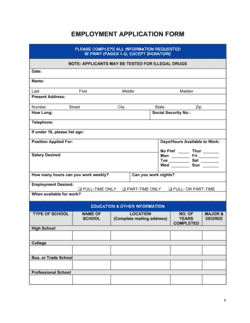
A job application form collects candidate background, work history, and eligibility information before the interview. An interview guide is used during the live evaluation to probe competencies the application form cannot assess. Both documents should be used in sequence: application form to screen, interview guide to evaluate.

vs Employee Performance Review

A performance review evaluates an existing employee's output against predefined goals and competencies over a past period. An interview guide evaluates a candidate's potential before hire. The competency frameworks in both documents should be aligned β€” the skills you test at hire should match the dimensions you measure at review.

Industry-specific considerations

Professional Services

HR assistants in law, accounting, and consulting firms handle high volumes of sensitive employee data and client-facing confidentiality protocols, making the discretion competency section especially critical.

Healthcare

Healthcare HR assistants manage credentialing records, HIPAA-compliant employee files, and high-turnover onboarding workflows, requiring specific technical questions around compliance-oriented HRIS platforms.

Retail and Hospitality

High headcount and seasonal hiring cycles mean HR assistants in retail and hospitality must demonstrate strong administrative throughput and the ability to process onboarding documentation accurately under volume pressure.

Manufacturing

Manufacturing HR assistants often manage union-related documentation, shift scheduling records, and Workers' Compensation intake, making attention to procedural detail and compliance accuracy the highest-weighted competencies.

Template vs pro β€” what fits your needs?

PathBest forCostTime
Use the templateHR managers, office managers, and small business owners conducting structured HR assistant interviews without a dedicated recruitment teamFree20–30 minutes to customize, 45–60 minutes per interview session
Template + professional reviewOrganizations hiring at volume or subject to EEO audits that want a compensation and HR consultant to validate the competency framework and scoring rubric$300–$800 for a one-hour HR consultant review2–3 days
Custom draftedRegulated industries (healthcare, financial services, government contractors) that require a legally reviewed, role-specific interview protocol aligned to a formal competency framework$1,000–$3,500 for a custom competency framework and interview guide developed by an I-O psychologist or HR consulting firm2–4 weeks

Glossary

Structured Interview
An interview format in which every candidate is asked the same predetermined questions in the same order, scored against the same rubric.
Behavioral Question
A question asking a candidate to describe a specific past situation to predict how they will behave in similar future situations β€” typically framed as 'Tell me about a time when…'
Situational Question
A hypothetical question presenting a realistic scenario and asking the candidate what they would do β€” useful when a candidate lacks direct experience.
Competency Framework
A defined set of skills, behaviors, and knowledge areas required to perform a role effectively, used as the basis for interview question design and scoring.
STAR Method
A response framework β€” Situation, Task, Action, Result β€” used by candidates to structure behavioral answers and by interviewers to evaluate completeness.
Scoring Rubric
A numerical scale (typically 1–5) with defined behavioral anchors at each level, used to rate candidate responses consistently across interviewers.
Adverse Impact
A statistically disproportionate negative effect of a selection practice on a protected group, which can expose an employer to discrimination claims even when unintentional.
Debrief
A structured post-interview meeting where all interviewers share scores and observations before any hiring decision is made, reducing recency bias and group-think.
Candidate Scorecard
A consolidated form that aggregates each interviewer's ratings across competencies to produce a comparable total score for each candidate.
Halo Effect
A cognitive bias where a positive impression in one area causes an interviewer to rate a candidate favourably across all other areas.

Part of your Business Operating System

This document is one of 3,000+ business & legal templates included in Business in a Box.

  • Fill-in-the-blanks β€” ready in minutes
  • Compatible with all office suites
  • Export to PDF and share electronically

Create your document in 3 simple steps.

From template to signed document β€” all inside one Business Operating System.
1
Download or open template

Access over 3,000+ business and legal templates for any business task, project or initiative.

2
Edit and fill in the blanks with AI

Customize your ready-made business document template and save it in the cloud.

3
Save, Share, Send, Sign

Share your files and folders with your team. Create a space of seamless collaboration.

Save time, save money, and create top-quality documents.

β˜…β˜…β˜…β˜…β˜…

"Fantastic value! I'm not sure how I'd do without it. It's worth its weight in gold and paid back for itself many times."

Managing Director Β· Mall Farm
Robert Whalley
Managing Director, Mall Farm Proprietary Limited
β˜…β˜…β˜…β˜…β˜…

"I have been using Business in a Box for years. It has been the most useful source of templates I have encountered. I recommend it to anyone."

Business Owner Β· 4+ years
Dr Michael John Freestone
Business Owner
β˜…β˜…β˜…β˜…β˜…

"It has been a life saver so many times I have lost count. Business in a Box has saved me so much time and as you know, time is money."

Owner Β· Upstate Web
David G. Moore Jr.
Owner, Upstate Web

Run your business with a system β€” not scattered tools

Stop downloading documents. Start operating with clarity. Business in a Box gives you the Business Operating System used by over 250,000 companies worldwide to structure, run, and grow their business.

Free Forever PlanΒ Β·Β No credit card required