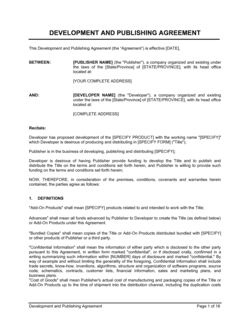
Publishing Agreement Template

Free Word download β€’ Edit online β€’ Save & share with Drive β€’ Export to PDF

9 pagesβ€’30–40 min to fillβ€’Difficulty: Complexβ€’Signature requiredβ€’Legal review recommended
Learn more ↓
FreePublishing Agreement Template

At a glance

What it is
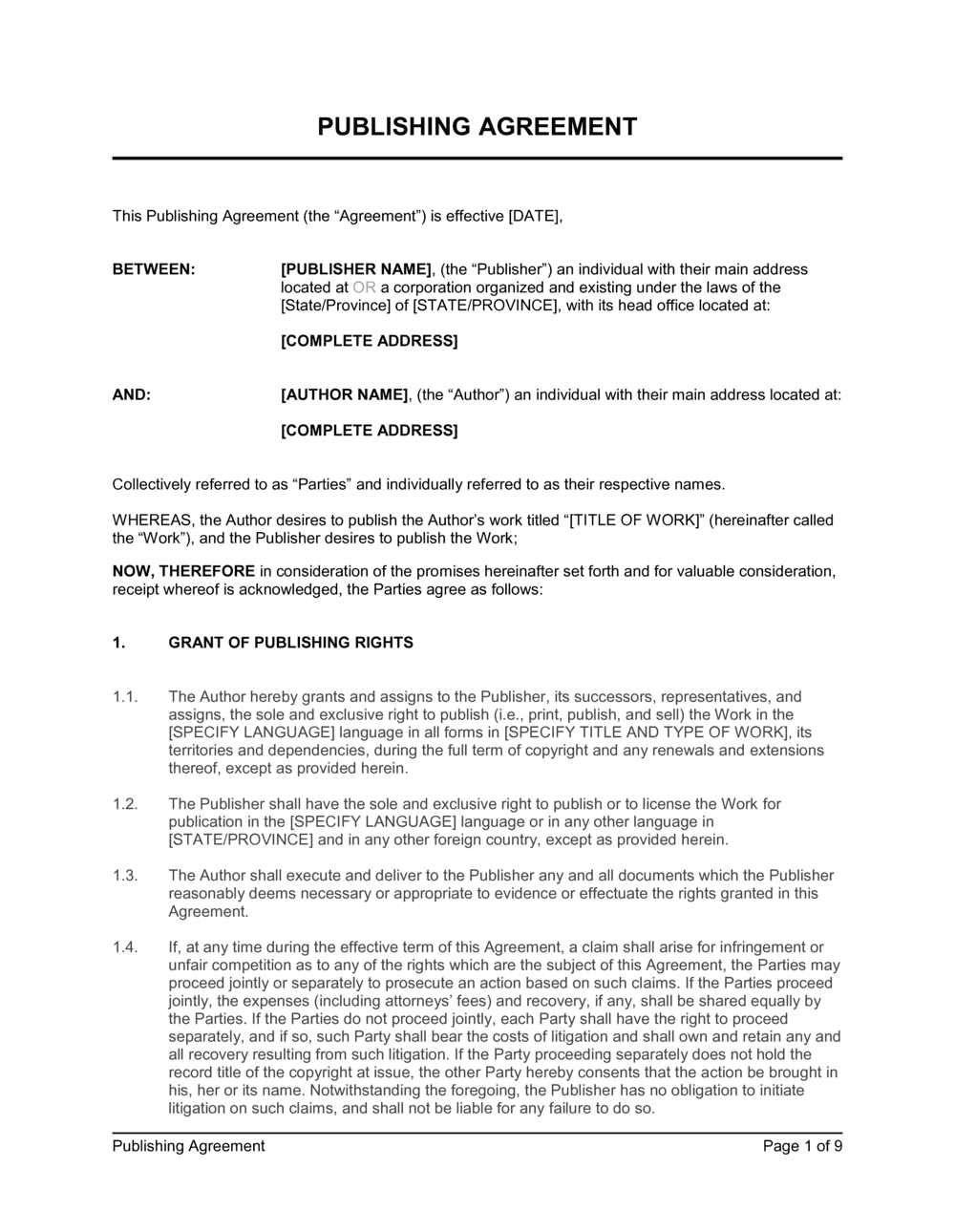
A Publishing Agreement is a legally binding contract between an author (or content creator) and a publisher that governs the rights, royalties, territory, and obligations associated with producing and distributing a creative work. This free Word download gives you a professionally structured starting point you can edit online and export as PDF β€” covering grant of rights, advance and royalty rates, delivery obligations, copyright ownership, and termination in a single document.
When you need it
Use it whenever a publisher agrees to produce, distribute, or license a creative work on behalf of an author β€” including books, music, digital content, academic works, or software documentation. It should be signed before any manuscript is delivered, recording is submitted, or content is transferred to the publisher.
What's inside
Grant of rights and territory, advance payment and royalty schedule, delivery and acceptance requirements, editorial control, copyright ownership and registration, sublicensing, out-of-print reversion, and termination provisions β€” plus warranties, indemnification, and governing law.

What is a Publishing Agreement?

A Publishing Agreement is a legally binding contract between an author or content creator and a publisher that governs the rights, financial terms, and mutual obligations associated with producing and distributing a creative work. Unlike a copyright assignment, a publishing agreement typically allows the author to retain ownership of their copyright while granting the publisher an exclusive or non-exclusive license to exploit specific formats β€” such as print, ebook, audio, or translation β€” within a defined territory and for a defined period. The agreement sets out the advance payment schedule, royalty rates by format, delivery and acceptance requirements, subsidiary rights splits, and the conditions under which rights revert to the author if the publisher fails to perform.

Why You Need This Document

Without a signed publishing agreement, the terms of the relationship between an author and publisher are governed by jurisdiction-specific defaults β€” and those defaults almost never favor the author. A verbal or loosely documented arrangement leaves the author with no enforceable basis to demand publication by a set date, no mechanism to reclaim rights if the book goes out of print, and no defined share of subsidiary rights income from translation or film adaptations. Publishers routinely present standard boilerplate contracts that grant broad rights, limit royalty bases, and impose uncapped indemnification obligations β€” clauses that experienced authors and agents negotiate out before signing. A complete, properly drafted publishing agreement protects the author's copyright, ensures the publisher is contractually obligated to publish within a defined window, establishes transparent royalty accounting with an audit right, and creates a clear path to rights reversion when the publisher is no longer actively exploiting the work. This template gives you that structure from the first conversation.

Which variant fits your situation?

If your situation is…Use this template
Traditional book deal between author and commercial publisherBook Publishing Agreement
Licensing original music compositions to a publisher for distributionMusic Publishing Agreement
Academic journal article submission with rights transferAcademic Publishing Agreement
Self-publishing with a distributor handling print-on-demandDistribution Agreement
Licensing existing content to a third-party media companyContent Licensing Agreement
Digital-only publishing deal for ebooks or online coursesDigital Publishing Agreement
Work-for-hire arrangement where publisher owns all rights from creationWork for Hire Agreement

Common mistakes to avoid

❌ Granting 'all rights' without format and territory limits

Why it matters: An unqualified rights grant gives the publisher full control over film, merchandise, translation, and every other exploitation of the work β€” often with no additional payment to the author.

Fix: List every specific format and territory granted. Retain all rights not explicitly listed. Review the grant clause line by line before signing.

❌ No publication deadline in the agreement

Why it matters: Without a longstop publication date, a publisher can sit on a delivered manuscript for years, blocking the author from publishing elsewhere while paying no additional compensation.

Fix: Include a clause requiring publication within 18–24 months of acceptance, with automatic rights reversion and no advance repayment obligation if the deadline is missed.

❌ Defining 'in print' as any form of digital availability

Why it matters: A single low-priced ebook listing on one platform keeps the work legally 'in print' indefinitely, preventing the author from ever triggering the reversion clause.

Fix: Define out-of-print using a minimum annual net receipts threshold β€” typically $[500]–$[1,000] β€” so the clause can actually be triggered when meaningful sales have ceased.

❌ Accepting an uncapped indemnification obligation

Why it matters: If a third party sues the publisher for defamation or copyright infringement, an uncapped clause exposes the author to liability far exceeding the value of the advance received.

Fix: Cap indemnification at the total advance received and require that claims be finally adjudicated (not merely alleged) before the indemnity obligation is triggered.

❌ Signing without defining subsidiary rights revenue splits

Why it matters: Publisher boilerplate often grants the publisher 50% of translation and audio revenue. Industry standard for translation is 75–80% to the author β€” accepting 50% costs thousands of dollars on a successful international title.

Fix: Negotiate subsidiary rights splits explicitly before signing. If the publisher insists on controlling these rights, push for a 75–80% author share across all categories.

❌ No audit right for royalty statements

Why it matters: Without a contractual right to audit, the author has no mechanism to verify that reported sales figures and net receipts calculations are accurate.

Fix: Include a clause granting the author the right to audit the publisher's sales records once per calendar year, with at least 30 days' notice, at the author's expense unless discrepancies exceed 5%.

The 10 key clauses, explained

Grant of rights and exclusivity

In plain language: Specifies exactly which rights are transferred to the publisher β€” print, ebook, audio, translation β€” whether the grant is exclusive, and the territory covered.

Sample language
Author hereby grants to Publisher the exclusive right to publish, produce, reproduce, distribute, and sell the Work in [print / digital / audio] format throughout [TERRITORY] for the duration of this Agreement.

Common mistake: Granting 'all rights' without listing formats and territory β€” this hands the publisher every conceivable exploitation right, including film and merchandise, with no residual control for the author.

Term and duration

In plain language: States how long the agreement lasts β€” typically the full copyright term unless a shorter period is negotiated β€” and whether it renews automatically.

Sample language
This Agreement shall commence on [DATE] and continue for the full term of copyright in the Work and any renewals or extensions thereof, unless earlier terminated pursuant to Section [X].

Common mistake: Agreeing to a full copyright-term grant without an out-of-print reversion clause β€” if the book stops selling, the author cannot reclaim rights without the reversion mechanism.

Advance payment schedule

In plain language: Sets out the total advance amount and the payment tranches β€” typically split between signing, delivery, acceptance, and publication.

Sample language
Publisher shall pay Author an advance of $[AMOUNT] against royalties, payable as follows: $[X] on execution; $[X] on delivery and acceptance of the complete manuscript; $[X] on first publication.

Common mistake: Leaving advance payment tied solely to 'publication' with no defined publication deadline β€” publishers can delay publication indefinitely and withhold the final tranche.

Royalty rates by format

In plain language: Defines the royalty percentage the author earns for each unit sold, broken down by format, and whether royalties are calculated on list price or net receipts.

Sample language
Publisher shall pay Author royalties as follows: [X]% of Publisher's net receipts on hardcover sales; [X]% of Publisher's net receipts on paperback sales; [X]% of Publisher's net receipts on ebook sales; [X]% of Publisher's net receipts on audiobook sales.

Common mistake: Agreeing to net receipts without defining what deductions are permitted β€” a publisher can inflate deductions to reduce the royalty base to near zero.

Delivery and acceptance

In plain language: Sets the manuscript delivery date, required word count and format, and the publisher's process for accepting or requesting revisions β€” including a timeline for the acceptance decision.

Sample language
Author shall deliver a complete manuscript of approximately [WORD COUNT] words in [FORMAT] by [DATE]. Publisher shall notify Author of acceptance or required revisions within [X] days of receipt. If Publisher requires revisions, Author shall have [X] days to resubmit.

Common mistake: No defined timeline for the publisher's acceptance decision β€” leaving the author in limbo for months with no right to withdraw or seek another publisher.

Copyright ownership and registration

In plain language: Confirms that copyright in the work remains with the author, with the publisher holding only a license, and specifies which party is responsible for copyright registration.

Sample language
Author retains all copyright in and to the Work. Publisher is granted a license to exploit the rights set out in Section [X]. Publisher shall register copyright in the Work with the [U.S. Copyright Office / applicable authority] in Author's name within [X] days of first publication.

Common mistake: Failing to confirm copyright ownership explicitly β€” in some jurisdictions, an exclusive publishing license can be misread as a copyright transfer if ownership language is absent.

Subsidiary rights and revenue splits

In plain language: Lists which subsidiary rights β€” translation, film, serialization, audio, merchandise β€” the publisher controls and what percentage of revenue from those rights the author receives.

Sample language
Publisher shall have the right to license the following subsidiary rights: translation rights ([X]% to Author); serialization rights ([X]% to Author); audio rights ([X]% to Author). All other subsidiary rights are retained by Author.

Common mistake: Granting the publisher broad subsidiary rights without negotiating the author's revenue share β€” industry standard for translation rights is 75–80% to the author, but unreviewed boilerplate often pays 50%.

Out-of-print and reversion of rights

In plain language: Defines the threshold at which a work is considered out of print β€” typically annual sales or net receipts below a defined floor β€” and the notice process for the author to reclaim rights.

Sample language
If, in any consecutive twelve-month period, Publisher's net receipts from all editions fall below $[AMOUNT], Author may notify Publisher in writing. Publisher shall have [X] days to demonstrate the Work is available for sale; failing which, all rights shall revert to Author.

Common mistake: Defining 'in print' as mere availability for order on any platform β€” a publisher can keep a single ebook listed at full price on one retailer to prevent reversion indefinitely.

Warranties and indemnification

In plain language: The author warrants the work is original, does not infringe third-party rights, and contains no defamatory content β€” and agrees to indemnify the publisher against claims arising from a breach.

Sample language
Author warrants that the Work is original, that Author has the right to grant the rights herein, and that the Work does not infringe any copyright, trademark, or other right. Author shall indemnify Publisher against any losses arising from a breach of these warranties, provided Author is notified promptly of any claim.

Common mistake: Accepting an indemnification clause with no cap on liability or no requirement that the publisher mitigate damages β€” exposing the author to unlimited financial risk for a single defamation claim.

Termination and consequences

In plain language: States the grounds on which either party may terminate β€” breach, failure to publish by a deadline, or insolvency β€” and what happens to rights, advances, and delivered materials upon termination.

Sample language
Either party may terminate this Agreement upon [X] days' written notice if the other party materially breaches this Agreement and fails to cure such breach within [X] days. Upon termination, all rights granted herein shall immediately revert to Author, and any unearned portion of the advance shall [not be / be] repayable.

Common mistake: No termination for failure to publish β€” if the publisher delays publication indefinitely without a deadline, the author has no contractual basis to exit and reclaim rights.

How to fill it out

  1. 1

    Identify the parties and the work precisely

    Enter the author's legal name (or pen name with legal name disclosed), the publisher's full registered entity name, and a precise description of the work β€” working title, genre, approximate word count, and format.

    πŸ’‘ Attach a one-paragraph description of the work as Schedule A to prevent disputes about whether a revised manuscript still constitutes the contracted work.

  2. 2

    Define the grant of rights by format and territory

    List every format the publisher is authorized to exploit β€” hardcover, paperback, ebook, audiobook β€” and specify the territory precisely. Avoid 'all rights' language unless you intend to assign every conceivable exploitation right.

    πŸ’‘ Retain translation and film rights unless the publisher offers a meaningful advance for them. These rights often generate more value than the primary publication deal.

  3. 3

    Set the advance amount and payment schedule

    Agree on the total advance and split it across clear trigger events: signing, delivery and acceptance, and publication. Include a longstop publication date β€” typically 18–24 months from acceptance β€” after which rights revert if the publisher has not published.

    πŸ’‘ Tie at least one payment tranche to delivery and acceptance rather than publication alone. This protects you if the publisher delays publication beyond the contracted window.

  4. 4

    Specify royalty rates and the royalty base

    Enter royalty percentages for each format and define the royalty base explicitly β€” list price or net receipts β€” along with permitted deductions. Standard ebook royalties in traditional publishing run 25% of net receipts; hardcover typically runs 10–15% of list price.

    πŸ’‘ Request a royalty statement schedule β€” semi-annual is standard β€” and a right to audit the publisher's sales records no more than once per year.

  5. 5

    Complete the delivery and acceptance terms

    Set a realistic delivery date, specify the required word count and manuscript format (double-spaced, Times New Roman, specific file type), and define the publisher's acceptance timeline β€” 60 days is standard.

    πŸ’‘ Include a cure period for requested revisions of at least 60 days. A clause that allows the publisher to reject a revised manuscript without explanation is standard boilerplate but should be resisted.

  6. 6

    Draft the out-of-print and reversion clause

    Define 'in print' using a minimum annual net receipts threshold rather than mere availability. Set the reversion notice period at 60–90 days and confirm that all rights revert without requiring any payment from the author.

    πŸ’‘ In the digital era, set the out-of-print threshold as a net receipts figure β€” not units sold β€” to prevent a $0.99 ebook listing from keeping rights locked up indefinitely.

  7. 7

    Review the warranties and indemnification clause

    Confirm that the warranty covers originality and non-infringement. Negotiate a cap on indemnification liability β€” typically the total advance received β€” and require the publisher to control its own defense in any third-party claim.

    πŸ’‘ Ask the publisher to carry media liability or errors-and-omissions insurance and name you as an additional insured. Many trade publishers carry this; it materially reduces your exposure.

  8. 8

    Set termination rights and governing law

    Include termination for failure to publish within a defined period, for insolvency, and for uncured material breach. Specify the governing law as the jurisdiction where you are based or where the publisher is incorporated β€” whichever is more favorable to your interests.

    πŸ’‘ If you are based in a different country from the publisher, negotiate for your home jurisdiction's governing law β€” it substantially reduces litigation cost if a dispute arises.

Frequently asked questions

What is a publishing agreement?

A publishing agreement is a legally binding contract between an author or content creator and a publisher that defines the rights licensed, the financial terms, and the obligations of both parties in connection with producing and distributing a creative work. It does not typically transfer copyright β€” the author retains ownership while granting the publisher an exclusive or non-exclusive license to exploit specific formats and territories. Without a written agreement, the terms of the relationship are governed by jurisdiction-specific defaults that rarely favor the author.

What rights should an author keep in a publishing agreement?

Authors should generally retain translation rights, film and television adaptation rights, merchandise rights, and dramatic rights unless the publisher offers a specific and meaningful advance for them. Ebook and audiobook rights are typically licensed to the publisher in a standard deal but should carry royalty rates of at least 25% of net receipts. The key principle is to grant only the rights the publisher is actively positioned to exploit β€” and reclaim rights that will sit unused.

What is a standard royalty rate in a publishing agreement?

Standard royalty rates in traditional book publishing typically run 10% of list price for hardcover, 7.5–10% for paperback, and 25% of net receipts for ebooks. Audiobook royalties typically range from 25–40% of net receipts depending on the distributor. Music publishing royalty structures differ significantly and depend on the type of right β€” mechanical, performance, or synchronization. Always confirm whether the royalty base is list price or net receipts, as the difference can halve effective earnings.

What is an advance against royalties?

An advance is an upfront payment from the publisher to the author that is deducted from future royalty earnings before any additional royalties are paid. If a book earns $5,000 in royalties against a $10,000 advance, the author receives no additional payment until royalties exceed $10,000. The advance is generally non-returnable even if the book never earns it back, unless the author fails to deliver an acceptable manuscript or breaches the agreement.

How long does a publishing agreement last?

Traditional publishing agreements typically run for the full term of copyright β€” life of the author plus 70 years in most jurisdictions β€” unless the work goes out of print and the author triggers the reversion clause. Some agreements, particularly for digital content and music licensing, use shorter fixed terms of 3–7 years with renewal options. Negotiating a meaningful out-of-print clause with a net receipts threshold is the most important protection against a perpetual lock-in.

Can I negotiate a publishing agreement?

Yes β€” publishing agreements are negotiable documents, and authors routinely improve terms on rights grants, royalty rates, advance payment schedules, subsidiary rights splits, and reversion thresholds. First-time authors typically have less leverage than established ones, but key protections β€” publication deadline, reversion clause, and indemnification cap β€” are frequently accepted by publishers with minimal pushback. A literary agent or publishing lawyer can identify which clauses are genuinely non-negotiable and which are standard boilerplate that can be changed.

What happens if the publisher goes bankrupt?

If a publisher becomes insolvent, published rights typically become assets of the bankruptcy estate and may be sold to a third party. Authors should include a clause providing that, upon the publisher's insolvency, all rights immediately revert to the author. Without this language, rights can be acquired by a buyer with no relationship to the author, who is then bound to that buyer for the remaining term of the agreement.

Does a publishing agreement need to be reviewed by a lawyer?

For any significant commercial publishing deal β€” an advance above $5,000, a multi-book commitment, or a rights grant covering film and translation β€” legal review is strongly recommended. A publishing lawyer typically charges $500–$1,500 for a contract review and can identify clauses that standard boilerplate from large publishers routinely includes to the author's disadvantage. Literary agents with legal expertise can perform a similar function at no direct cost if they represent the author.

What is the difference between a publishing agreement and a licensing agreement?

A publishing agreement is a specialized form of licensing agreement specific to creative works, covering not just rights but also production, editorial control, royalties, advances, and distribution obligations. A general licensing agreement grants permission to use IP in a defined way but does not typically govern the publisher's production obligations, delivery requirements, or royalty accounting. Use a publishing agreement whenever the relationship involves an ongoing production and distribution commitment from the publisher rather than a simple permission to use.

How this compares to alternatives

vs Licensing Agreement

A licensing agreement grants permission to use intellectual property in a defined way β€” a publishing agreement is a specialized licensing contract that also governs production obligations, editorial control, advance payments, royalty accounting, and reversion. Use a general licensing agreement for IP usage rights without a production relationship; use a publishing agreement when a publisher is responsible for producing and distributing the work.

vs Work for Hire Agreement

A work for hire agreement transfers full copyright ownership to the commissioning party from the moment of creation β€” the author has no residual rights. A publishing agreement licenses specific rights while the author retains copyright. Authors should use a publishing agreement whenever they intend to retain any ownership interest in their work; a work for hire is appropriate only when the author accepts payment in full exchange for all rights.

vs Distribution Agreement

A distribution agreement governs the logistics of getting a product to market β€” warehousing, territory, and sales channels β€” without granting production or publication rights. A publishing agreement covers the full relationship from creation through distribution, including editorial, financial, and rights dimensions. Use a distribution agreement when the publisher already holds rights and needs a separate party to handle sales and logistics.

vs Non-Disclosure Agreement

An NDA protects confidential information exchanged during early discussions β€” such as a manuscript shared with a prospective publisher before terms are agreed. It does not grant any rights or create any publishing obligations. Authors should use an NDA before sharing unpublished work with a publisher or agent, then follow with a publishing agreement once terms are negotiated.

Industry-specific considerations

Book Publishing

Manuscript delivery schedules, advance recoupment structures, subsidiary rights splits for translation and film, and out-of-print reversion based on annual net receipts thresholds.

Music and Entertainment

Mechanical royalty rates, performance rights society registration, sync licensing revenue splits, and copyright co-ownership arrangements between co-writers.

Academic and Educational Publishing

Open-access licensing obligations, institutional repository rights, copyright transfer versus licensing debates, and edition revision clauses that allow publishers to update without author consent.

Digital Media and Content Platforms

Non-exclusive digital licensing with defined platform exclusivity windows, revenue share based on streams or downloads, and takedown rights if content violates platform policies.

Jurisdictional notes

United States

Copyright in the US vests in the author at creation and lasts for life plus 70 years. Authors may terminate grants of rights made after January 1, 1978 during a five-year window beginning 35 years after the grant under 17 U.S.C. Β§203 β€” this termination right cannot be waived in the contract. Work-made-for-hire doctrine applies broadly to commissioned works; confirm employment status carefully. Non-compete clauses in publishing agreements are generally unenforceable in California.

Canada

Canadian copyright lasts for life plus 70 years following the 2022 Copyright Act amendment. Moral rights β€” the author's right to attribution and integrity β€” exist under the Copyright Act and cannot be transferred, only waived. Authors should include an explicit moral rights waiver if the publisher requires the right to adapt or modify the work. Quebec contracts must comply with the Civil Code rather than common law, which can affect enforceability of certain boilerplate clauses.

United Kingdom

UK copyright lasts for life plus 70 years. Moral rights are recognized under the Copyright, Designs and Patents Act 1988 and must be asserted in writing β€” authors typically assert them on the copyright page. The Unfair Contract Terms Act 1977 and Consumer Rights Act 2015 may affect enforceability of indemnification clauses where the author is a consumer. Publishers subject to the Publishers Association Code of Practice are expected to offer minimum standard terms.

European Union

The EU Directive on Copyright in the Digital Single Market (2019/790) requires member states to ensure authors receive appropriate and proportionate remuneration, a transparency obligation from publishers, and a contract adjustment mechanism if earnings are significantly higher than initially expected. Authors also have a right of revocation if the work is not exploited within a reasonable period. GDPR applies to any personal data processed as part of royalty accounting or author records.

Template vs lawyer β€” what fits your deal?

PathBest forCostTime
Use the templateAuthors and independent publishers negotiating straightforward domestic deals with advances under $5,000 and no subsidiary rights complexityFree30–60 minutes
Template + legal reviewFirst-time authors signing with a commercial publisher, multi-book deals, or agreements covering translation and film rights$500–$1,5003–7 days
Custom draftedMajor publishing deals, music publishing agreements covering multiple rights types, or cross-border deals with complex subsidiary rights structures$2,000–$8,000+2–4 weeks

Glossary

Grant of Rights
The clause through which the author transfers specified rights β€” such as print, digital, or audio β€” to the publisher for a defined territory and period.
Advance
An upfront payment made by the publisher to the author against future royalty earnings β€” the publisher recoups the advance before additional royalties are paid.
Royalty Rate
The percentage of net or gross sales revenue paid to the author for each unit sold, typically varying by format (hardcover, paperback, ebook, audio).
Territory
The geographic scope within which the publisher is authorized to produce, distribute, and sell the work β€” can be world rights, English-language only, or defined country lists.
Subsidiary Rights
Secondary exploitation rights beyond the primary publication format β€” including film, translation, serialization, audio, and merchandise β€” which may be retained by the author or licensed to the publisher.
Out-of-Print Clause
A provision that reverts rights to the author when the publisher allows the work to fall below a defined minimum sales or availability threshold.
Reversion of Rights
The return of publishing rights from the publisher to the author, triggered by out-of-print status, contractual breach, or expiration of the agreement term.
Moral Rights
An author's non-economic rights to attribution and to object to derogatory treatment of their work β€” recognized in most jurisdictions outside the United States.
Copyright
The exclusive legal right of the creator to reproduce, distribute, and adapt a work β€” a publishing agreement licenses some of these rights but does not typically transfer copyright ownership.
Net Receipts
The amount actually received by the publisher from sales after deducting returns, distributor discounts, and agreed fees β€” a royalty base that differs from the cover price or list price.
Indemnification
A clause requiring one party to compensate the other for losses arising from a specific breach β€” typically requiring the author to cover claims arising from defamatory or infringing content.
Delivery and Acceptance
The contractual requirement for the author to deliver a manuscript of specified length and quality by a set date, with the publisher's right to accept, request revisions, or reject.

Part of your Business Operating System

This document is one of 3,000+ business & legal templates included in Business in a Box.

  • Fill-in-the-blanks β€” ready in minutes
  • 100% customizable Word document
  • Compatible with all office suites
  • Export to PDF and share electronically

Create your document in 3 simple steps.

From template to signed document β€” all inside one Business Operating System.
1
Download or open template

Access over 3,000+ business and legal templates for any business task, project or initiative.

2
Edit and fill in the blanks with AI

Customize your ready-made business document template and save it in the cloud.

3
Save, Share, Send, Sign

Share your files and folders with your team. Create a space of seamless collaboration.

Save time, save money, and create top-quality documents.

β˜…β˜…β˜…β˜…β˜…

"Fantastic value! I'm not sure how I'd do without it. It's worth its weight in gold and paid back for itself many times."

Managing Director Β· Mall Farm
Robert Whalley
Managing Director, Mall Farm Proprietary Limited
β˜…β˜…β˜…β˜…β˜…

"I have been using Business in a Box for years. It has been the most useful source of templates I have encountered. I recommend it to anyone."

Business Owner Β· 4+ years
Dr Michael John Freestone
Business Owner
β˜…β˜…β˜…β˜…β˜…

"It has been a life saver so many times I have lost count. Business in a Box has saved me so much time and as you know, time is money."

Owner Β· Upstate Web
David G. Moore Jr.
Owner, Upstate Web

Run your business with a system β€” not scattered tools

Stop downloading documents. Start operating with clarity. Business in a Box gives you the Business Operating System used by over 250,000 companies worldwide to structure, run, and grow their business.

Start freeΒ Β·Β No credit card required