Programmer Java Job Description Template

Free Word download β€’ Edit online β€’ Save & share with Drive β€’ Export to PDF

2 pagesβ€’20–30 min to fillβ€’Difficulty: Standardβ€’Signature requiredβ€’Legal review recommended
Learn more ↓
FreeProgrammer Java Job Description Template

At a glance

What it is
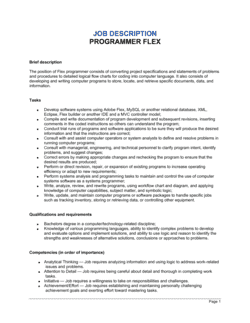
A Programmer Java Job Description is a formal employment document that defines the duties, technical requirements, reporting structure, compensation range, and binding terms β€” including IP assignment and confidentiality β€” for a Java software developer role. This free Word download gives you a professionally structured, legally grounded starting point you can edit online and export as PDF for job postings, offer letters, or employment contract annexures.
When you need it
Use it when opening a new Java developer position, backfilling a departing engineer, or standardizing role expectations across a development team. It also anchors performance reviews and employment contract negotiations by establishing documented expectations from day one.
What's inside
Role title and department, reporting structure, core Java development duties, required and preferred technical qualifications, compensation and benefits summary, IP assignment language, confidentiality obligations, and equal-opportunity compliance statements.

What is a Programmer Java Job Description?

A Programmer Java Job Description is a formal employment document that defines the scope, technical requirements, duties, compensation parameters, and binding legal obligations β€” including intellectual property assignment and confidentiality β€” for a Java software developer role within an organization. Unlike a casual job posting, a properly structured Java programmer job description functions as a legally operative document when signed by both employer and employee: it establishes the technical scope of the role, transfers ownership of all work product to the employer from day one, and creates enforceable non-disclosure obligations covering source code, system architecture, and proprietary business data. It is typically attached to or incorporated into the employment contract as a schedule or exhibit, making it part of the binding employment relationship.

Why You Need This Document

Without a signed Java programmer job description, your organization is exposed on several fronts simultaneously. Source code, APIs, and system designs developed by the programmer may not legally belong to you β€” particularly for remote or hybrid developers writing code on personal devices β€” because IP ownership without a written assignment clause is legally ambiguous in most jurisdictions. A departing developer faces no documented confidentiality obligations if none were established in writing at hire. Scope disputes during performance reviews become credibility contests rather than references to an agreed document. Recruiters posting roles without salary ranges risk regulatory fines in an expanding list of US states and Canadian provinces. A completed, signed Programmer Java Job Description closes all of these gaps in under an hour, anchors the employment contract, and gives your HR and legal teams a clear record to rely on from the developer's first day through any future dispute.

Which variant fits your situation?

If your situation is…Use this template
Hiring a senior Java architect with system design ownershipSenior Java Developer Job Description
Engaging a Java developer on a short-term project basisIndependent Contractor Agreement (Software)
Hiring a full-stack developer who uses Java alongside front-end frameworksFull-Stack Developer Job Description
Onboarding a recent graduate or entry-level Java programmerJunior Software Developer Job Description
Hiring a DevOps engineer who manages Java application deploymentsDevOps Engineer Job Description
Bringing on a Java developer under a formal employment contractEmployment Contract (At-Will)
Defining a Java team lead role with people-management responsibilitiesEngineering Team Lead Job Description

Common mistakes to avoid

❌ Omitting the salary range

Why it matters: Pay transparency laws in Colorado, New York, California, Washington, and British Columbia require salary ranges in job postings. Non-compliance can result in regulatory fines and reputational damage with candidates.

Fix: Publish a salary range aligned to your internal pay band for the role. If the range is wide, add a note that final compensation depends on experience.

❌ Treating the job description as non-binding

Why it matters: An unsigned job description cannot be enforced as part of an IP assignment dispute, performance-management proceeding, or scope-of-role disagreement in court.

Fix: Include a signature block, obtain signatures before day one, and attach the signed document to the employment contract as a schedule or exhibit.

❌ Scoping IP assignment to company hardware only

Why it matters: Java developers regularly write code on personal laptops, especially in remote or hybrid roles. A hardware-scoped clause leaves off-device work in a legal gray zone that courts may resolve in the employee's favor.

Fix: Use broad IP assignment language covering all work product created in connection with the company's business, regardless of device or location.

❌ Listing preferred qualifications as mandatory

Why it matters: Candidates read preferred qualifications as near-requirements and self-screen out. You lose qualified applicants who meet every genuine requirement but lack a nice-to-have credential.

Fix: Audit every 'required' qualification and reclassify any item a strong candidate could lack and still perform the role successfully.

❌ Using a US EEO statement for non-US roles

Why it matters: UK, Canadian, and EU protected classes differ from US Title VII categories. A copy-pasted US statement may omit legally required categories β€” age discrimination language, for example, is handled differently in the UK Equality Act 2010.

Fix: Use jurisdiction-specific EEO language for each country where the role is posted, reviewed against the applicable employment equality statute.

❌ No version control on the job description

Why it matters: If the document is updated after signing without both parties acknowledging the change, the signed version and the live version diverge β€” creating ambiguity in performance reviews and scope disputes.

Fix: Version-stamp each revision (e.g., v1.0, v1.1) and require fresh signatures whenever material duties, compensation, or IP terms change.

The 10 key clauses, explained

Role title, department, and reporting line

In plain language: Names the position formally, places it within the organizational chart, and identifies the direct manager or team the developer reports to.

Sample language
Position: Java Programmer | Department: Software Engineering | Reports To: [ENGINEERING MANAGER TITLE], [DEPARTMENT NAME] | Location: [CITY, STATE / REMOTE]

Common mistake: Using an informal title like 'Java coder' instead of a standardized role title. Inconsistent titles create pay-band ambiguity and complicate performance reviews.

Position summary

In plain language: A 3–5 sentence overview of what the Java developer does, the problems they solve, and how the role fits into the broader engineering organization.

Sample language
[COMPANY NAME] is seeking a Java Programmer to design, develop, and maintain enterprise-grade applications supporting [BUSINESS FUNCTION]. The successful candidate will collaborate with [TEAM NAME] to deliver scalable, maintainable code against sprint commitments and contribute to architectural decisions.

Common mistake: Writing the summary as a recruiter pitch rather than a factual role description. Inflated language attracts candidates whose expectations the role cannot meet, increasing early attrition.

Core duties and responsibilities

In plain language: An itemized list of primary technical and collaborative tasks β€” coding, code review, testing, documentation, and cross-functional collaboration β€” expected of the developer day to day.

Sample language
Design, develop, and unit-test Java applications using [SPRING / HIBERNATE / FRAMEWORK]; participate in code reviews; contribute to CI/CD pipeline maintenance; write technical documentation to [COMPANY] standards; attend daily standups and bi-weekly sprint planning sessions.

Common mistake: Listing every possible task without distinguishing primary from secondary duties. Candidates use this list to evaluate workload β€” an exhaustive dump signals a poorly scoped role.

Required qualifications and technical skills

In plain language: The non-negotiable education, experience level, and technical competencies β€” Java version proficiency, frameworks, databases, and tooling β€” a candidate must have to be considered.

Sample language
Bachelor's degree in Computer Science or equivalent; [X]+ years of professional Java development experience; proficiency in Java [VERSION], Spring Boot, and RESTful API design; experience with relational databases (PostgreSQL, MySQL); familiarity with Git and CI/CD tools.

Common mistake: Setting a degree requirement as mandatory when the role genuinely only needs demonstrated Java proficiency. This narrows the pool unnecessarily and may conflict with equal-opportunity obligations in some jurisdictions.

Preferred qualifications

In plain language: Desirable but not essential skills β€” cloud platforms, additional frameworks, certifications, or domain knowledge β€” that distinguish strong candidates from minimally qualified ones.

Sample language
Experience with AWS, Azure, or GCP; familiarity with microservices and containerization (Docker, Kubernetes); Oracle Certified Professional Java Programmer (OCPJP) certification; prior work in [INDUSTRY DOMAIN] is an asset.

Common mistake: Listing preferred qualifications as if they are required. Candidates self-screen out of roles when 'nice to have' items appear in mandatory-sounding language.

Compensation and benefits

In plain language: States the salary range or hourly rate, payment frequency, bonus eligibility, and a reference to the benefits program β€” health, PTO, retirement β€” without locking in specific plan details.

Sample language
Annual salary: $[MIN]–$[MAX] USD, commensurate with experience, paid bi-weekly. Eligible for annual discretionary bonus of up to [X]% of base. Benefits include [COMPANY NAME]'s standard health, dental, vision, and 401(k) program as amended from time to time.

Common mistake: Omitting a salary range entirely. Several US states and Canadian provinces now mandate pay transparency in job postings β€” publishing no range may violate applicable law.

Intellectual property assignment

In plain language: Transfers ownership of all code, software, tools, and related inventions the developer creates during employment to the employer, including work done on personal devices related to company projects.

Sample language
All software, code, documentation, and inventions developed by [EMPLOYEE NAME] in connection with [COMPANY NAME]'s business during the term of employment are the exclusive property of [COMPANY NAME] and are hereby irrevocably assigned to [COMPANY NAME].

Common mistake: Limiting IP assignment to work performed on company hardware only. Java developers frequently write code on personal laptops β€” an equipment-scoped clause leaves significant IP unprotected.

Confidentiality and non-disclosure

In plain language: Prohibits the developer from disclosing source code, system architecture, customer data, or proprietary business information during and after employment.

Sample language
Employee shall not, during or following employment, disclose or use any Confidential Information of [COMPANY NAME], including but not limited to source code, system architecture, API designs, customer data, and trade secrets, without prior written consent.

Common mistake: Failing to define 'Confidential Information' with specificity. Courts require reasonable definition β€” a clause that labels everything confidential may be deemed overbroad and unenforceable.

Equal opportunity and compliance statement

In plain language: Affirms that the employer hires without regard to protected characteristics and that the role complies with applicable employment and labor laws.

Sample language
[COMPANY NAME] is an Equal Opportunity Employer. All qualified applicants will receive consideration for employment without regard to race, color, religion, sex, national origin, disability, age, or any other characteristic protected by applicable law.

Common mistake: Copying a boilerplate EEO statement without updating it to reflect the specific jurisdiction's protected classes. UK, Canadian, and EU protected characteristics differ materially from US Title VII categories.

Acknowledgment and signature block

In plain language: Confirms that both the employer and the candidate have read, understood, and agreed to the role description as a binding document, typically attached to or incorporated into the employment contract.

Sample language
By signing below, [EMPLOYEE NAME] acknowledges receipt of this Job Description and agrees that it accurately describes the role's duties and requirements as of [DATE]. Employer: [AUTHORIZED SIGNATORY NAME], [TITLE] | Date: [DATE] | Employee: [EMPLOYEE NAME] | Date: [DATE]

Common mistake: Treating the job description as a non-binding informational document and skipping the signature block. Unsigned job descriptions cannot be enforced as part of performance-management or IP-assignment disputes.

How to fill it out

  1. 1

    Enter the role title, department, and reporting structure

    Use a standardized title aligned to your compensation bands. Identify the direct manager by title, not name, so the document remains valid through personnel changes.

    πŸ’‘ Cross-reference your HR system's job code to confirm the title matches the pay band before publishing the posting.

  2. 2

    Write the position summary

    Describe in three to five sentences what the Java developer does, which systems or products they work on, and how the role contributes to the engineering organization's goals.

    πŸ’‘ Mention the primary Java framework the team uses β€” Spring Boot, Micronaut, Quarkus β€” in the summary. Candidates self-screen based on stack alignment, which reduces unqualified applications.

  3. 3

    List core duties in priority order

    Start with the three or four activities that will occupy the majority of the developer's time, then add supporting responsibilities. Distinguish daily tasks from quarterly or project-based ones.

    πŸ’‘ Limit the duties list to 8–10 bullet points. More than 12 signals the role is two jobs β€” split it or accept that the hire will be overwhelmed.

  4. 4

    Separate required from preferred qualifications

    Required qualifications must be genuinely non-negotiable. Preferred qualifications are items that differentiate finalists. Review each item and ask: would you reject an otherwise excellent candidate who lacks this?

    πŸ’‘ Remove 'degree required' from the mandatory list if your team has strong Java engineers without formal CS degrees β€” this opens the pipeline without reducing technical bar.

  5. 5

    Set the compensation range and benefits reference

    Enter the minimum and maximum annual salary for the role based on your internal pay band. Reference the benefits program by category, not by specific plan details, so the document does not require updating annually.

    πŸ’‘ Check applicable pay transparency laws for the posting location β€” Colorado, New York, California, and British Columbia all have active requirements as of 2026.

  6. 6

    Complete the IP assignment and confidentiality clauses

    Confirm the IP assignment language covers work done on any device and at any location in connection with company business. Define 'Confidential Information' with at least four specific categories relevant to your stack and business.

    πŸ’‘ Have legal review the IP assignment clause if the developer will be contributing to open-source projects β€” contribution rights and employer IP ownership can conflict.

  7. 7

    Add the EEO statement for the applicable jurisdiction

    Use the EEO language appropriate for the country and state or province where the role is based. US, Canadian, UK, and EU protected-class lists differ β€” do not copy a US statement for a UK or EU role.

    πŸ’‘ For remote roles that may attract candidates in multiple jurisdictions, include a statement that covers the broadest set of protected characteristics.

  8. 8

    Obtain signatures before the start date

    Route the completed document for signature by the authorized employer representative and the incoming employee before day one of employment. Attach a signed copy to the employment contract.

    πŸ’‘ Use a timestamped eSign tool so execution date is unambiguous β€” this is critical if the IP assignment clause is ever challenged.

Frequently asked questions

What is a Java programmer job description?

A Java programmer job description is a formal document that defines the duties, technical qualifications, compensation, and binding employment terms β€” including IP assignment and confidentiality β€” for a Java software development role. It serves as the authoritative reference for recruiting, performance management, and legal enforcement of IP and non-disclosure obligations throughout the employment relationship.

What should a Java developer job description include?

At minimum: role title and reporting structure, position summary, core duties and responsibilities, required and preferred technical qualifications (Java version, frameworks, databases, tooling), compensation range, benefits reference, IP assignment clause, confidentiality obligations, an equal-opportunity compliance statement, and a signature block. Missing any of these creates gaps that complicate hiring, performance management, and IP protection.

Is a job description a legally binding document?

A job description becomes legally binding when it is signed by both the employer and the employee and incorporated into or attached to the employment contract. An unsigned job description is generally treated as informational only. Signed job descriptions are enforced in IP assignment disputes, scope-of-role disagreements, and performance-management proceedings in most jurisdictions.

What Java skills should be listed as required versus preferred?

Required skills should be limited to competencies without which the developer cannot perform the core role β€” typically core Java (specify the version), at least one major framework (Spring Boot is most common), RESTful API development, and version control with Git. Preferred skills include cloud platform experience, containerization (Docker, Kubernetes), certifications, and domain-specific knowledge. Inflating the required list reduces the qualified applicant pool without improving hire quality.

Do I need to include a salary range in a Java developer job posting?

In an increasing number of jurisdictions, yes. Colorado, New York, California, Washington, Illinois, and British Columbia all require employers to publish salary ranges in job postings as of 2026. Even where not legally mandated, including a range typically improves application quality and reduces time spent screening candidates whose compensation expectations don't align with the role.

How does IP assignment in a job description differ from a standalone IP agreement?

An IP assignment clause in a job description establishes the employer's ownership of work product as a condition of the role from day one. A standalone IP assignment agreement is a separate signed contract that may also cover pre-existing IP the employee brings to the role and handle more complex assignment scenarios. For most developer hires, a well-drafted clause in the job description and employment contract is sufficient; a standalone agreement adds value when the employee has prior inventions to carve out or when open-source contribution rights need explicit management.

Can I use the same job description for contractors and employees?

No. An employment job description includes at-will or notice-based termination terms, benefits eligibility, and IP assignment language appropriate for an employment relationship. Using it for an independent contractor can inadvertently support a misclassification claim, since the document signals an employment relationship. Contractors should be engaged under a separate Independent Contractor Agreement with a scope-of-work exhibit, not a job description.

How often should a Java programmer job description be updated?

Review it whenever the technology stack changes materially, the role's scope expands or contracts, compensation bands are adjusted, or pay transparency laws change in the role's jurisdiction. Annual review aligned to performance-cycle planning is a practical cadence. Any material change requires a signed acknowledgment from the current jobholder to remain enforceable against them.

What is the difference between a job description and an offer letter?

An offer letter summarizes compensation and start date to secure candidate acceptance. A job description defines the technical scope, duties, qualifications, IP terms, and confidentiality obligations in enforceable detail. The offer letter gets the candidate to say yes; the signed job description β€” ideally attached to a full employment contract β€” creates the binding framework for the working relationship.

How this compares to alternatives

vs Independent Contractor Agreement (Software)

A contractor agreement engages a self-employed Java developer for a defined project or period with no employment entitlements β€” no benefits, no tax withholding, and no at-will termination relationship. A job description is used exclusively for employment relationships. Misclassifying a contractor engagement using employment-style documents can trigger back taxes, penalties, and benefit liability in most jurisdictions.

vs Employment Contract (At-Will)

An employment contract is the governing legal agreement covering termination rights, severance, and the full scope of the working relationship. A job description defines the technical scope and duties of the specific role and is typically attached to or incorporated into the employment contract as a schedule. Both documents are needed β€” the contract provides the legal framework; the job description provides the role-specific content.

vs Software Developer Job Description (General)

A general software developer job description covers multi-language or full-stack roles without specifying a primary technology. A Java-specific job description names the exact language, version, frameworks, and tooling required, which reduces unqualified applications, accelerates technical screening, and produces more precise IP assignment language tied to the specific technology stack the developer will work with.

vs Offer Letter

An offer letter summarizes compensation, start date, and role title to secure candidate acceptance β€” it is not a comprehensive legal document. It lacks IP assignment, confidentiality obligations, detailed duties, and qualification standards. Relying on an offer letter alone for a Java developer hire leaves IP ownership and confidentiality unprotected from day one.

Industry-specific considerations

Financial Services and Fintech

Java remains the dominant language for trading platforms, payment systems, and core banking applications β€” job descriptions in this sector typically require Java EE, high-throughput API experience, and SOC 2 or PCI-DSS compliance awareness.

Enterprise SaaS and Technology

Descriptions emphasize microservices architecture, Spring Boot, cloud-native deployment on AWS or Azure, and Agile/Scrum participation across distributed engineering teams.

Healthcare and MedTech

HIPAA-compliant data handling is a standard required qualification; Java developers working on EHR integrations or medical device software need HL7/FHIR protocol experience noted explicitly.

Manufacturing and Industrial IoT

Java is used extensively in SCADA systems, MES platforms, and industrial IoT middleware β€” descriptions in this sector add embedded systems or OPC-UA protocol experience to the preferred qualifications.

Jurisdictional notes

United States

Pay transparency laws in Colorado (EPEWA), New York, California, Washington, and Illinois require salary ranges in job postings; non-compliance carries per-violation fines. IP assignment clauses must account for California Labor Code Β§2870, which voids assignments of inventions developed entirely on the employee's own time without use of company resources. Non-compete clauses for developers are banned in California and Minnesota and face FTC scrutiny federally β€” omit or narrow them accordingly.

Canada

Several provinces β€” including British Columbia and Prince Edward Island β€” require salary ranges in job postings. Quebec's Bill 96 requires that employment documents for provincially regulated employers be provided in French first; a bilingual job description is necessary for Quebec-based roles. IP assignment language must be explicit and signed before the start date to be enforceable β€” common-law provinces do not automatically vest employer IP rights without a written agreement.

United Kingdom

The UK Equality Act 2010 covers nine protected characteristics including age, disability, and gender reassignment β€” EEO statements must reflect all nine. Employers must provide a written statement of employment particulars on or before day one, which the signed job description can supplement but not replace. Post-employment restrictive covenants, including IP assignment for off-duty work, must be reasonable in scope to be enforceable and should be reviewed by UK employment counsel for senior developer hires.

European Union

The EU Transparent and Predictable Working Conditions Directive requires written terms of employment within seven days of hire; a signed job description satisfies part of this obligation. GDPR applies to any personal data collected during recruitment and onboarding β€” candidate data retention policies should be referenced. Post-employment non-competes typically require financial compensation to the employee (ranging from 25–100% of salary depending on member state) to be enforceable; Germany, France, and the Netherlands each have distinct statutory requirements.

Template vs lawyer β€” what fits your deal?

PathBest forCostTime
Use the templateStandard domestic Java developer hires at individual contributor level in a single jurisdictionFree30–45 minutes
Template + legal reviewSenior or principal Java engineers, cross-border hires, or roles with significant proprietary-IP exposure$300–$6001–3 days
Custom draftedPrincipal engineers or architects with equity, highly sensitive IP in competitive markets, or multi-jurisdiction distributed teams$1,000–$3,000+1–2 weeks

Glossary

JVM (Java Virtual Machine)
The runtime engine that executes compiled Java bytecode, enabling Java programs to run on any operating system without recompilation.
Spring Framework
An open-source Java application framework widely used for building enterprise web applications, RESTful APIs, and microservices.
Microservices Architecture
A design approach that structures an application as a collection of small, independently deployable services communicating over APIs.
RESTful API
An application programming interface that follows REST principles, using HTTP methods to exchange data between client and server in a stateless manner.
IP Assignment
A clause transferring ownership of all code, inventions, and software created by the employee in connection with their role to the employer.
CI/CD Pipeline
Continuous Integration and Continuous Delivery tooling β€” such as Jenkins or GitHub Actions β€” that automates building, testing, and deploying Java applications.
OOP (Object-Oriented Programming)
A programming paradigm that organizes code around objects and classes, which Java is built on as its core architectural model.
SDLC (Software Development Lifecycle)
The structured process β€” requirements, design, development, testing, deployment, and maintenance β€” used to plan and build software systematically.
At-Will Employment
An employment arrangement, common in most US states, that either party may end at any time for any lawful reason without advance notice.
Confidential Information
Non-public technical, business, or customer data the employer designates as proprietary, which the employee is contractually prohibited from disclosing.
Agile / Scrum
An iterative software development methodology that organizes work into short sprints, typically two weeks, with daily standups and regular sprint reviews.

Part of your Business Operating System

This document is one of 3,000+ business & legal templates included in Business in a Box.

  • Fill-in-the-blanks β€” ready in minutes
  • 100% customizable Word document
  • Compatible with all office suites
  • Export to PDF and share electronically

Create your document in 3 simple steps.

From template to signed document β€” all inside one Business Operating System.
1
Download or open template

Access over 3,000+ business and legal templates for any business task, project or initiative.

2
Edit and fill in the blanks with AI

Customize your ready-made business document template and save it in the cloud.

3
Save, Share, Send, Sign

Share your files and folders with your team. Create a space of seamless collaboration.

Save time, save money, and create top-quality documents.

β˜…β˜…β˜…β˜…β˜…

"Fantastic value! I'm not sure how I'd do without it. It's worth its weight in gold and paid back for itself many times."

Managing Director Β· Mall Farm
Robert Whalley
Managing Director, Mall Farm Proprietary Limited
β˜…β˜…β˜…β˜…β˜…

"I have been using Business in a Box for years. It has been the most useful source of templates I have encountered. I recommend it to anyone."

Business Owner Β· 4+ years
Dr Michael John Freestone
Business Owner
β˜…β˜…β˜…β˜…β˜…

"It has been a life saver so many times I have lost count. Business in a Box has saved me so much time and as you know, time is money."

Owner Β· Upstate Web
David G. Moore Jr.
Owner, Upstate Web

Run your business with a system β€” not scattered tools

Stop downloading documents. Start operating with clarity. Business in a Box gives you the Business Operating System used by over 250,000 companies worldwide to structure, run, and grow their business.

Free Forever PlanΒ Β·Β No credit card required