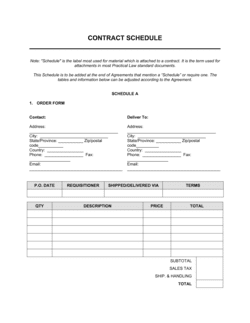
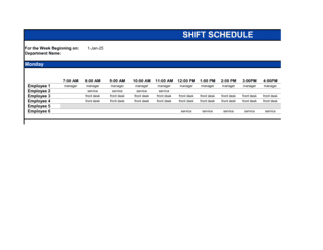
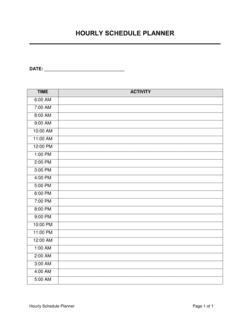
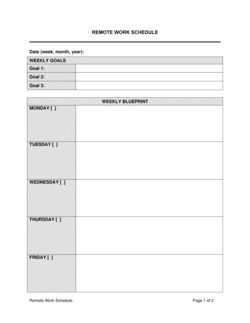
Production Schedule Template

Free Word download β€’ Edit online β€’ Save & share with Drive β€’ Export to PDF

2 pagesβ€’20–30 min to fillβ€’Difficulty: Standardβ€’Signature requiredβ€’Legal review recommended
Learn more ↓
FreeProduction Schedule Template

At a glance

What it is
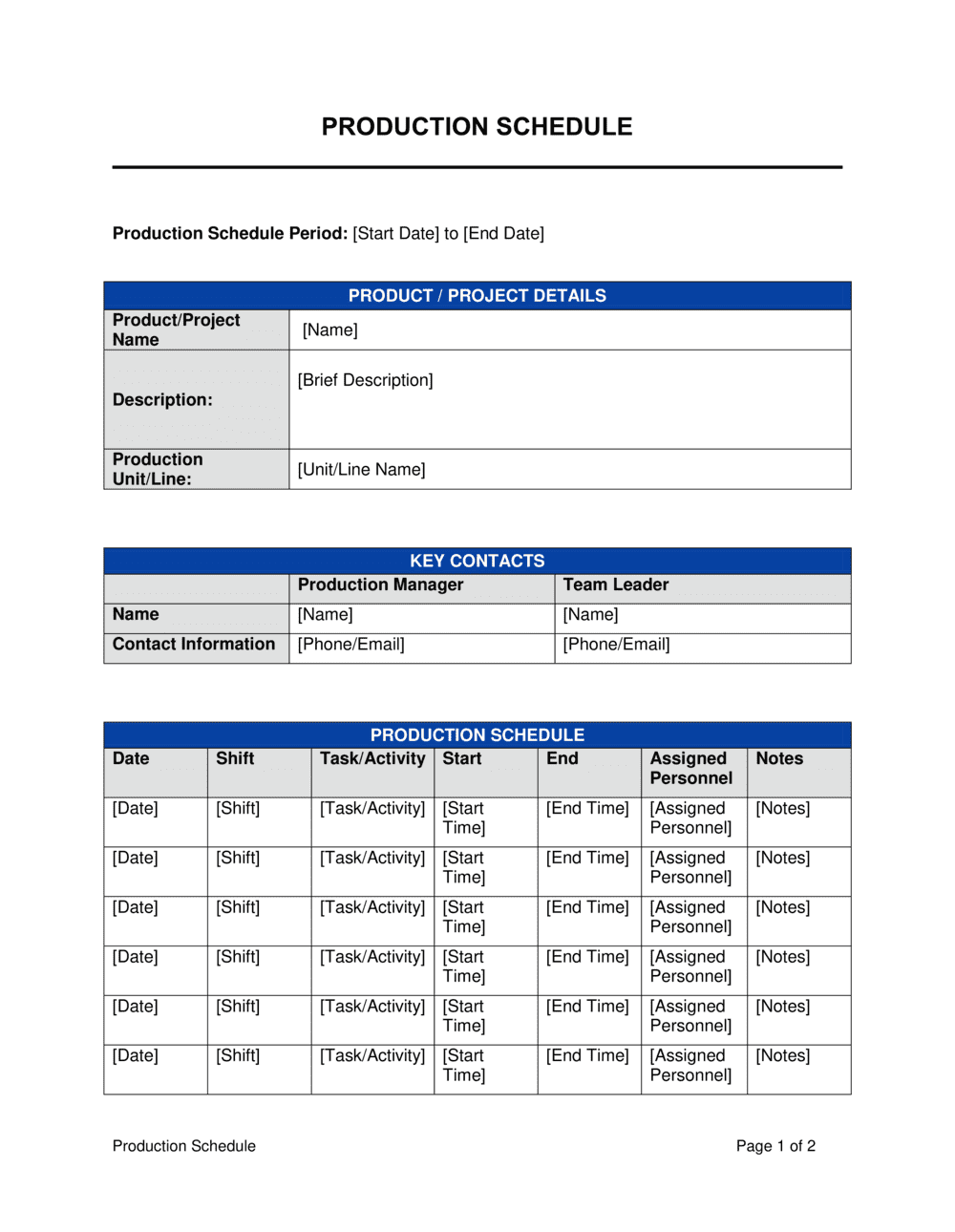
A Production Schedule is a binding operational and legal document that defines the sequence of tasks, milestones, deliverable dates, responsible parties, and resource allocations required to complete a production process β€” whether in manufacturing, film, publishing, software, or creative services. This free Word download gives you a structured, editable starting point you can adapt to your specific production context and export as PDF for signature and distribution.
When you need it
Use it when two or more parties β€” a manufacturer and a client, a production company and a broadcaster, a contractor and a project owner β€” need a written, enforceable agreement on what will be produced, in what order, by whom, and by when. It is essential any time missed deadlines carry financial or contractual consequences.
What's inside
Party identification, scope of production, milestone and delivery schedule, resource and staffing assignments, quality and approval checkpoints, change-order procedures, delay and force majeure provisions, payment tied to delivery stages, and governing law. Every clause is drafted to create clear, enforceable obligations on both sides.

What is a Production Schedule?

A Production Schedule is a binding legal document that defines the sequence of tasks, milestones, deliverable dates, responsible parties, resource assignments, and approval checkpoints required to complete a production engagement β€” whether in manufacturing, film and television, publishing, software development, or creative services. Unlike an internal project plan, a production schedule is executed by both parties and creates enforceable obligations with defined remedies for delay, non-conforming deliverables, and unauthorized scope changes. When properly drafted, it functions simultaneously as an operational roadmap and a contractual framework that protects both the producing party and the client.

Why You Need This Document

Without a signed production schedule, missed deadlines become credibility disputes rather than contract breaches β€” and the injured party is left proving actual damages in court instead of collecting a pre-agreed liquidated sum. Clients who do not respond to submitted deliverables face no consequence for stalling production, while producers who miss milestones face uncapped liability with no cure period. Change requests made by email accumulate into an undocumented scope expansion that neither party can untangle months later. A properly executed production schedule eliminates all four of these failure modes: it locks in dates, triggers deemed-approval when clients go silent, constrains changes to signed written orders, and caps delay liability at a defensible per-day figure β€” turning a relationship-management problem into a document-management one.

Which variant fits your situation?

If your situation is…Use this template
Scheduling a multi-run manufacturing order with a supplierManufacturing Production Schedule
Planning a film, TV, or commercial shoot day-by-dayFilm Production Schedule
Managing a phased construction or renovation projectConstruction Schedule
Coordinating a content marketing or editorial calendarContent Production Schedule
Tracking software development milestones and release windowsSoftware Development Schedule
Managing a product launch with cross-functional workstreamsProduct Launch Plan
Scheduling event production logistics and vendor deliverablesEvent Production Schedule

Common mistakes to avoid

❌ Vague deliverable descriptions with no attached specifications

Why it matters: When the schedule says 'final product' without an exhibit defining what that means, both parties have different expectations. Disputes over whether a deliverable meets the standard are the most common source of production litigation.

Fix: Attach a signed Exhibit A with precise technical, quality, and format specifications. Any deliverable not meeting those specifications is formally deficient β€” not subject to interpretation.

❌ Milestone dates with no time zone or day-type designation

Why it matters: A deadline of 'June 30' can fall on a weekend, mean end-of-business in different time zones for international parties, or be counted differently if one party uses calendar days and the other business days.

Fix: State every deadline as 'by 5:00 PM [TIME ZONE] on [SPECIFIC DATE], which is a [calendar/business] day.' For international parties, convert to UTC as a backstop.

❌ No deemed-approval clause for client reviews

Why it matters: Without a deemed-approval provision, a client who does not respond to a submitted deliverable can stall the entire production indefinitely. The Producer continues to incur costs and miss downstream milestones with no contractual remedy.

Fix: Include a clause stating that if the Client does not provide written approval or a specific list of deficiencies within the agreed review window, the deliverable is deemed approved and the next phase may proceed.

❌ Setting liquidated damages at a punitive level

Why it matters: Courts in the US, Canada, UK, and EU distinguish between a genuine pre-estimate of loss (enforceable) and a penalty designed to punish non-performance (unenforceable). An excessive per-day figure risks voiding the clause entirely, leaving the injured party to prove actual damages β€” often much harder.

Fix: Set the per-day amount to a figure you can defend as a reasonable forecast of actual harm at the time of contracting β€” lost revenue, downstream penalties, or carrying costs β€” and document that reasoning.

❌ Allowing change requests by email without a signed change order

Why it matters: A history of email approvals for scope changes can be treated by courts as a pattern of de facto amendments, overriding the original schedule and stripping the written change-order clause of effect.

Fix: Train all project team members that only signed written change orders modify the schedule. Respond to informal requests with a formal change-order form, even for minor adjustments.

❌ Executing the schedule after production has already started

Why it matters: In common-law jurisdictions, a party already performing under a verbal or informal arrangement may have provided no new consideration for restrictive clauses β€” liquidated damages, change-order requirements, and approval procedures β€” signed after the fact.

Fix: Execute the signed schedule before any production activity begins. If circumstances force a late execution, document a specific benefit provided to each party at signing as fresh consideration.

The 10 key clauses, explained

Parties, recitals, and effective date

In plain language: Identifies the full legal names of all parties, their roles in the production relationship, and the date the schedule becomes binding.

Sample language
This Production Schedule ('Schedule') is entered into as of [DATE] by and between [PARTY A LEGAL NAME], a [STATE/COUNTRY] [ENTITY TYPE] ('Producer'), and [PARTY B LEGAL NAME], a [STATE/COUNTRY] [ENTITY TYPE] ('Client').

Common mistake: Using a trade name or brand name instead of the registered legal entity name. If a dispute arises and the contracting entity is not the correct legal person, enforcement becomes significantly more complicated.

Scope of production

In plain language: Defines exactly what is being produced β€” the product, content, or output β€” including specifications, quantities, and any technical or quality standards that apply.

Sample language
Producer shall produce [QUANTITY] units of [PRODUCT/CONTENT DESCRIPTION] conforming to the specifications set out in Exhibit A ('Specifications'), attached hereto and incorporated by reference.

Common mistake: Referencing specifications by description only rather than attaching a signed exhibit. When specifications are disputed, an incorporated exhibit is the controlling document; a verbal or emailed description is not.

Milestone and delivery schedule

In plain language: Lists each production stage, the deliverable associated with it, the party responsible, and the date by which it must be completed.

Sample language
Production shall proceed according to the following schedule: Phase 1 β€” [DELIVERABLE], due [DATE], responsible party: [NAME/ROLE]; Phase 2 β€” [DELIVERABLE], due [DATE], responsible party: [NAME/ROLE]. All dates are calendar dates unless otherwise specified.

Common mistake: Listing target dates without specifying whether they are calendar days or business days, and without stating the time zone. A deadline of 'March 31' means different things in New York and London.

Resource and staffing obligations

In plain language: Identifies the key personnel, equipment, and materials each party is responsible for providing and the dates by which those resources must be available.

Sample language
Producer shall assign [KEY PERSONNEL NAMES/ROLES] to the production no later than [DATE]. Client shall provide [MATERIALS/ASSETS/ACCESS] by [DATE]. Substitution of key personnel requires prior written consent of Client, not to be unreasonably withheld.

Common mistake: Omitting a key-personnel substitution clause. If a named director, lead engineer, or specialist is replaced without consent, the Client has no contractual recourse and the Schedule continues to bind them.

Approval and acceptance checkpoints

In plain language: Sets the process and timeframe for the Client to review and approve each deliverable, and states what happens if no response is given within the approval window.

Sample language
Client shall review each deliverable within [X] business days of delivery and provide written approval or a detailed list of deficiencies. If Client does not respond within [X] business days, the deliverable shall be deemed approved.

Common mistake: Not including a deemed-approval provision. Without it, a non-responsive client can stall the entire production indefinitely while the Producer remains liable for the downstream deadline.

Change-order procedure

In plain language: Establishes the process for requesting, evaluating, and approving any modification to scope, timeline, or resources, and specifies that verbal or email-only change requests are not binding.

Sample language
Any modification to this Schedule must be documented in a written Change Order signed by authorized representatives of both parties. A Change Order shall specify the nature of the change, revised milestone dates, and any adjustment to fees. Verbal or electronic communications do not constitute a Change Order.

Common mistake: Allowing scope changes by email without a signed change order. Courts in most jurisdictions will consider a pattern of email approvals as a de facto amendment to the schedule, undermining the original timeline obligations.

Delay, remedies, and liquidated damages

In plain language: States the consequences of missing a milestone β€” including any per-day liquidated damages, the right to terminate for material delay, and cure periods before remedies are triggered.

Sample language
If Producer fails to deliver any milestone by the scheduled date, Producer shall pay Client liquidated damages of $[AMOUNT] per calendar day of delay, up to a maximum of [X]% of the total contract value. Client shall provide written notice and a cure period of [X] business days before invoking termination rights.

Common mistake: Setting liquidated damages so high that a court would treat them as an unenforceable penalty clause rather than a genuine pre-estimate of loss. Liquidated damages must be a reasonable forecast of actual harm at the time of contracting.

Force majeure

In plain language: Excuses both parties from performance when production is prevented by events outside their reasonable control, defines what qualifies, and sets the maximum suspension period before either party may terminate.

Sample language
Neither party shall be in breach for delays caused by acts of God, governmental orders, labor strikes, pandemics, or other events beyond reasonable control ('Force Majeure Events'), provided the affected party gives written notice within [X] days. If a Force Majeure Event continues for more than [X] days, either party may terminate this Schedule without liability.

Common mistake: Listing force majeure events so narrowly β€” e.g., only natural disasters β€” that supply-chain disruptions, regulatory shutdowns, or cyber incidents are excluded. Post-2020, courts expect broader definitions.

Payment tied to production milestones

In plain language: Links payment installments directly to the completion and approval of specific production milestones, rather than to calendar dates alone.

Sample language
Client shall pay Producer as follows: [X]% of total fees upon execution; [X]% upon approval of Phase [N] deliverable; [X]% upon final delivery and acceptance. All payments are due within [NET X] days of the triggering milestone.

Common mistake: Linking payment to delivery dates rather than acceptance of deliverables. If a deliverable is delivered but not approved, a date-linked payment clause can force payment before the Client has confirmed quality.

Governing law, dispute resolution, and entire agreement

In plain language: Specifies which jurisdiction's law governs the schedule, how disputes are resolved (arbitration, mediation, or litigation), and confirms this document is the complete agreement, superseding all prior discussions.

Sample language
This Schedule is governed by the laws of [STATE/PROVINCE/COUNTRY]. Disputes shall be resolved by [binding arbitration / mediation then litigation] in [CITY]. This Schedule constitutes the entire agreement between the parties with respect to its subject matter and supersedes all prior representations and understandings.

Common mistake: Choosing a governing-law jurisdiction that has no connection to either party's place of business or the place of production. Courts may disregard such a choice, leaving the governing law ambiguous.

How to fill it out

  1. 1

    Identify all parties with their full legal entity names

    Enter the registered legal name, entity type, and jurisdiction of incorporation for every party. Confirm names against corporate registry filings before signing.

    πŸ’‘ If one party is an individual rather than a company, include their full legal name and address to ensure enforceability against the correct person.

  2. 2

    Define the scope of production in a signed exhibit

    Write a precise description of what will be produced β€” quantities, formats, technical specifications, and quality standards β€” and attach it as Exhibit A, signed by both parties.

    πŸ’‘ Anything not in Exhibit A will be subject to dispute. If specifications are evolving, set a deadline for finalizing them and include that date in the schedule.

  3. 3

    Build the milestone table with specific dates and responsible parties

    List every production phase, the deliverable it produces, a specific calendar date with time zone, and the name or role of the responsible party. Distinguish calendar days from business days throughout.

    πŸ’‘ Work backwards from the final delivery date to set upstream milestones. If any single phase has more than a two-week float, split it into two milestones to catch delays earlier.

  4. 4

    Assign resource and staffing obligations to each party

    Name the key personnel each party will commit to the production, the equipment and materials each will supply, and the dates by which those resources must be in place.

    πŸ’‘ Include a key-personnel substitution clause requiring written consent for replacements. A sudden change in lead personnel is one of the most common causes of production delay disputes.

  5. 5

    Set approval windows and a deemed-approval fallback

    For each deliverable, specify the number of business days the receiving party has to review it and provide written approval or a list of specific deficiencies. Include a deemed-approval clause for non-response.

    πŸ’‘ Keep approval windows short for early-stage deliverables (5 business days) and longer for final deliverables (10 business days). A standard window for all stages often creates bottlenecks at the critical path.

  6. 6

    Draft the change-order clause and attach a blank change-order form

    State that all scope, timeline, or resource changes require a signed written change order. Attach a pre-formatted change-order form as an exhibit to reduce friction when changes arise.

    πŸ’‘ Require both parties' authorized signatories β€” not just project managers β€” to sign change orders. Unauthorized approvals of scope changes are a leading source of dispute in production contracts.

  7. 7

    Set liquidated damages at a defensible level

    Calculate a per-day delay figure that reflects a reasonable estimate of actual harm β€” lost revenue, downstream contract penalties, or carrying costs. Document your reasoning in a contemporaneous note.

    πŸ’‘ Courts in most jurisdictions strike down liquidated damages that appear punitive. A figure equal to 0.1–0.5% of total contract value per day is typically treated as a genuine pre-estimate rather than a penalty.

  8. 8

    Confirm governing law and execute before production begins

    Choose the governing jurisdiction based on where the work is performed or where both parties are located. Both authorized signatories must execute before any production activity starts.

    πŸ’‘ Use a timestamped electronic signature platform to create an audit trail. A schedule signed after production has begun may have enforceability problems with restrictive clauses in common-law jurisdictions.

Frequently asked questions

What is a production schedule?

A production schedule is a binding document that defines the sequence of tasks, milestones, deliverable dates, responsible parties, and resource commitments required to complete a production process. It is used across manufacturing, film and television, publishing, software development, construction, and creative services to create enforceable obligations around what will be produced, by whom, and by when.

Is a production schedule legally binding?

Yes, when signed by authorized representatives of both parties and supported by consideration β€” typically the exchange of services and payment β€” a production schedule is generally enforceable as a contract. It creates obligations on both the producing party (to deliver on time and to specification) and the client (to provide approvals, materials, and payment on schedule). As with any contract, enforceability depends on how clearly the obligations are defined and whether the document meets the formal requirements of the governing jurisdiction.

What should a production schedule include?

At minimum: party identification, scope of production with attached specifications, a milestone table with specific dates and responsible parties, resource and staffing obligations, an approval and acceptance procedure, a change-order process, delay and liquidated damages provisions, a force majeure clause, milestone-linked payment terms, and governing law. Omitting any of these creates gaps that disputes will quickly exploit.

What is the difference between a production schedule and a project plan?

A project plan is typically an internal operational document used to manage work within a single organization β€” it is not necessarily signed or legally binding. A production schedule is a bilateral contract between two or more parties that creates enforceable obligations and remedies for non-performance. The production schedule typically incorporates or references a project plan but adds the legal machinery β€” liquidated damages, change orders, acceptance criteria β€” that a project plan lacks.

How should delays be handled in a production schedule?

A well-drafted production schedule includes a notice requirement (the delayed party must notify the other in writing within a specified number of days), a cure period before remedies are triggered, and a liquidated damages clause setting a pre-agreed per-day compensation for unexcused delay. Force majeure provisions cover delays caused by events outside either party's control. Without these mechanisms, the injured party must prove actual damages β€” a significantly higher legal burden.

What are liquidated damages in a production schedule?

Liquidated damages are a pre-agreed sum β€” typically expressed as a dollar amount per day of delay β€” that the delaying party pays to the other without requiring proof of actual financial harm. They are enforceable in most jurisdictions when they represent a genuine pre-estimate of the loss caused by delay, rather than a punitive sum. Setting them too high risks a court treating them as an unenforceable penalty and voiding the clause entirely.

Can a production schedule be changed after it is signed?

Yes, but changes should be documented through a formal change-order process. Both parties sign a written change order specifying the nature of the modification, revised milestone dates, and any cost adjustment. Allowing changes by email or verbal agreement creates a risk that courts will interpret those communications as de facto amendments to the schedule, undermining the original written terms.

Do I need a lawyer to prepare a production schedule?

For straightforward domestic production relationships with standard deliverables and modest contract values, a high-quality template is typically sufficient. Engage a lawyer when the contract value is significant, when liquidated damages or penalty clauses are material, when the production involves cross-border parties, or when the deliverables are technically complex and acceptance criteria will be difficult to define precisely. A 1–2 hour template review typically costs $300–$600 and is worthwhile for any production contract over $50,000.

What happens if a party misses a milestone?

If the schedule includes a liquidated damages clause, the delaying party owes the pre-agreed per-day amount after any cure period expires. If the delay is material and uncured, the injured party may have the right to terminate the schedule and seek additional remedies depending on the jurisdiction and the specific termination provisions. Force majeure events may suspend obligations temporarily but typically trigger a termination right if the delay exceeds a defined maximum period.

How this compares to alternatives

vs Project Plan

A project plan is an internal operational document used to coordinate work within a single team or organization β€” it assigns tasks, tracks progress, and allocates resources but is not typically signed or legally binding. A production schedule is a bilateral contract that creates enforceable obligations between two parties, with remedies for non-performance built in. Use a project plan internally; use a production schedule when another party's obligations and payments are tied to milestone completion.

vs Statement of Work

A statement of work defines what will be delivered, at what quality standard, and for what price β€” it focuses on scope and output. A production schedule incorporates that scope and adds the time dimension: the specific sequence, milestone dates, approval windows, and delay remedies that the statement of work does not cover. For complex productions, both documents are used together, with the production schedule referencing the statement of work as an exhibit.

vs Service Agreement

A service agreement governs the ongoing relationship between a service provider and a client β€” payment terms, IP ownership, confidentiality, and general obligations. It typically does not include a detailed milestone schedule or liquidated damages for delay. A production schedule is more narrowly focused on sequencing and deadlines, and is often executed as a supplement to a master service agreement for a specific production engagement.

vs Construction Schedule

A construction schedule is a specialized production schedule for building and engineering projects, incorporating trade-sequencing logic, regulatory inspection hold points, and retainage mechanics specific to the construction industry. A general production schedule uses the same structural framework but applies across manufacturing, media, software, and creative industries. Use the construction-specific template when the project involves licensed trades, permits, and building codes.

Industry-specific considerations

Manufacturing and supply chain

Batch production runs, component lead times, quality-control inspection points, and supplier delivery obligations with liquidated damages for missed shipment windows.

Film, television, and media production

Day-out-of-days scheduling, cast and crew availability obligations, post-production milestone sign-offs, and broadcaster-mandated delivery dates with penalty clauses.

Construction and engineering

Phased trade-sequencing milestones, subcontractor coordination, regulatory inspection hold points, and practical completion tied to final payment release.

Software and technology

Sprint-based milestone commitments, user acceptance testing windows, go-live dates with rollback contingencies, and version-specific acceptance criteria.

Publishing and creative services

Editorial, design, and print milestone deadlines, rights-clearance checkpoints, and printer-delivery dates tied to distribution windows.

Retail and consumer goods

Seasonal launch windows, packaging approval milestones, purchase-order fulfillment timelines, and on-shelf date obligations with retailer-imposed penalty provisions.

Jurisdictional notes

United States

Production schedule enforceability is governed by state contract law, with the UCC applying to goods-producing contracts in all 50 states. Liquidated damages clauses are enforceable when they represent a reasonable forecast of harm and actual damages are difficult to estimate β€” courts in California and New York have well-developed case law on this standard. Non-compete and IP-assignment provisions sometimes embedded in production schedules are subject to state-specific restrictions, particularly in California.

Canada

Canadian courts apply a reasonableness standard to liquidated damages identical in substance to the US approach. Ontario and British Columbia are the most common governing-law choices for domestic production contracts. Quebec applies civil law principles under the Civil Code, which treats penalty clauses differently from common-law provinces β€” a clause that appears punitive may be reduced by a Quebec court rather than voided entirely. Federal copyright law governs IP produced under a schedule, and the producing party retains copyright unless assignment is explicit.

United Kingdom

Following the Supreme Court's 2015 ruling in Cavendish Square v. Makdessi, UK courts assess penalty clauses by asking whether they impose a detriment out of all proportion to the legitimate interest being protected β€” a more permissive standard than the older 'genuine pre-estimate of loss' test. Production schedules in film, TV, and publishing are often structured around PACT or Publishers Association standard terms. Statutory implied terms under the Supply of Goods and Services Act 1982 apply to service-based production contracts.

European Union

EU member states vary significantly in their treatment of penalty clauses β€” France and Germany allow courts to reduce excessive penalties rather than void them, while Scandinavian jurisdictions apply stricter proportionality tests. The Late Payment Directive (2011/7/EU) entitles business creditors to statutory interest on overdue milestone payments, which interacts with milestone-linked payment clauses. GDPR considerations arise when production schedules involve processing personal data of cast, crew, or end users.

Template vs lawyer β€” what fits your deal?

PathBest forCostTime
Use the templateStandard domestic production engagements with a single party, clear deliverables, and contract values under $50,000Free30–60 minutes
Template + legal reviewProduction contracts over $50,000, cross-border parties, or engagements with material liquidated damages clauses$300–$6001–3 days
Custom draftedLarge-scale manufacturing contracts, film or TV co-productions with broadcasters, or multi-party construction schedules with complex sequencing$1,500–$5,000+1–3 weeks

Glossary

Milestone
A defined checkpoint in the production timeline at which a specific deliverable or stage of work must be completed and approved before the next phase begins.
Deliverable
A concrete, measurable output β€” a finished batch, a completed episode, a signed-off module β€” that must be produced by a specified date.
Critical Path
The sequence of dependent tasks whose total duration determines the earliest possible completion date; any delay on the critical path delays the entire project.
Lead Time
The time required from initiation of a task or order to its completion, used to set upstream deadlines that ensure downstream milestones are met.
Change Order
A written amendment to the production schedule documenting a mutually agreed change in scope, timeline, or resources, along with any adjustment to cost or delivery dates.
Force Majeure
A clause excusing a party from performance obligations when production is prevented by events outside either party's reasonable control, such as natural disasters, strikes, or government orders.
Acceptance Criteria
The specific, pre-agreed standards a deliverable must meet for the receiving party to formally approve it and trigger the next stage or payment.
Float (or Slack)
The amount of time a non-critical task can be delayed without affecting the project's overall completion date.
Resource Allocation
The assignment of personnel, equipment, materials, and budget to specific tasks within the production schedule.
Liquidated Damages
A pre-agreed sum specified in the schedule that one party owes the other for each day of delay beyond a contractual deadline, compensating for losses without requiring proof of actual damage.
Baseline Schedule
The approved, signed version of the production schedule against which all future progress and deviations are measured.
Punch List
A final checklist of outstanding items or deficiencies that must be corrected before a production stage is considered complete and accepted.

Part of your Business Operating System

This document is one of 3,000+ business & legal templates included in Business in a Box.

  • Fill-in-the-blanks β€” ready in minutes
  • 100% customizable Word document
  • Compatible with all office suites
  • Export to PDF and share electronically

Create your document in 3 simple steps.

From template to signed document β€” all inside one Business Operating System.
1
Download or open template

Access over 3,000+ business and legal templates for any business task, project or initiative.

2
Edit and fill in the blanks with AI

Customize your ready-made business document template and save it in the cloud.

3
Save, Share, Send, Sign

Share your files and folders with your team. Create a space of seamless collaboration.

Save time, save money, and create top-quality documents.

β˜…β˜…β˜…β˜…β˜…

"Fantastic value! I'm not sure how I'd do without it. It's worth its weight in gold and paid back for itself many times."

Managing Director Β· Mall Farm
Robert Whalley
Managing Director, Mall Farm Proprietary Limited
β˜…β˜…β˜…β˜…β˜…

"I have been using Business in a Box for years. It has been the most useful source of templates I have encountered. I recommend it to anyone."

Business Owner Β· 4+ years
Dr Michael John Freestone
Business Owner
β˜…β˜…β˜…β˜…β˜…

"It has been a life saver so many times I have lost count. Business in a Box has saved me so much time and as you know, time is money."

Owner Β· Upstate Web
David G. Moore Jr.
Owner, Upstate Web

Run your business with a system β€” not scattered tools

Stop downloading documents. Start operating with clarity. Business in a Box gives you the Business Operating System used by over 250,000 companies worldwide to structure, run, and grow their business.

Start freeΒ Β·Β No credit card required