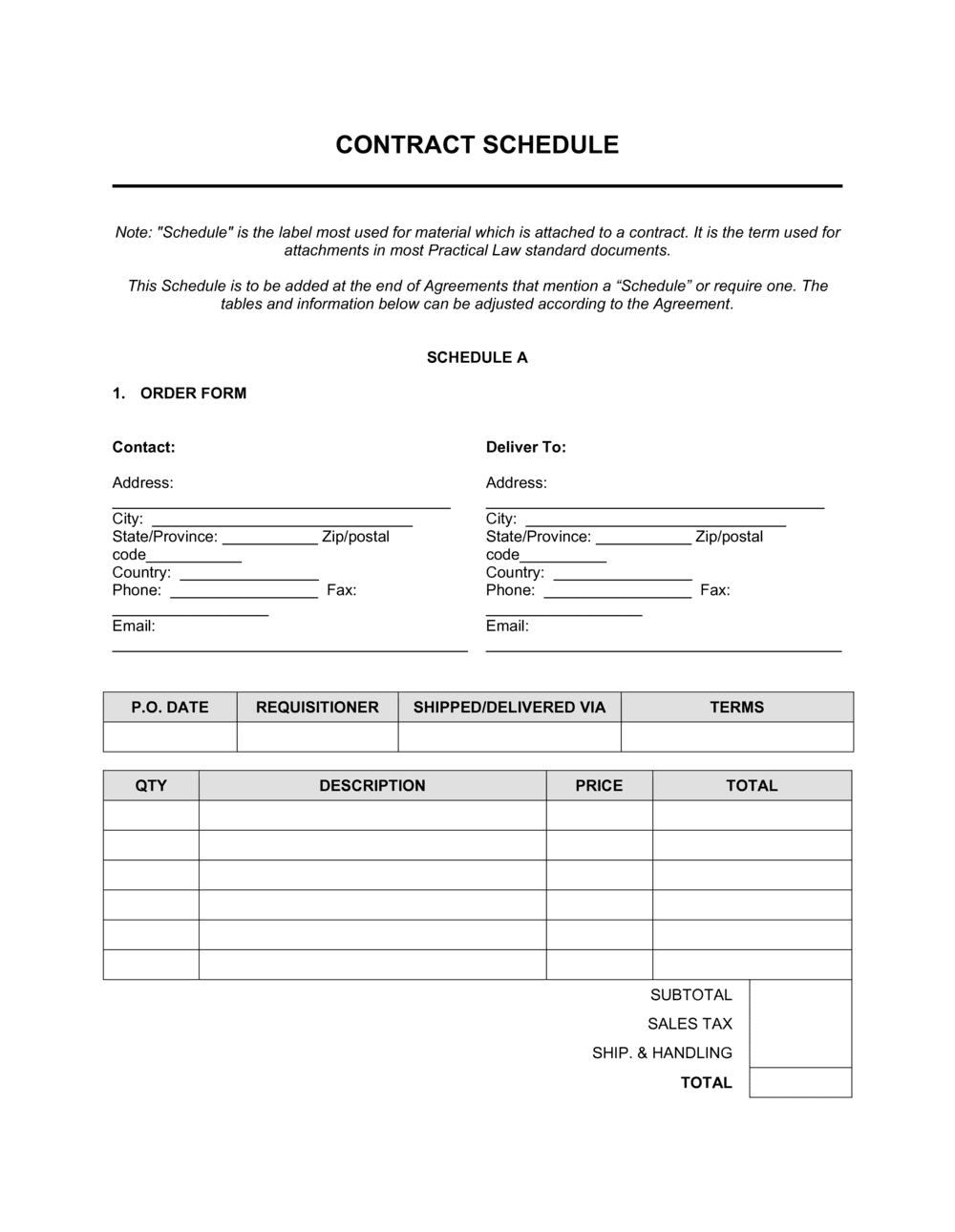
Contract Schedule Template

Free Word download β€’ Edit online β€’ Save & share with Drive β€’ Export to PDF

3 pagesβ€’25–30 min to fillβ€’Difficulty: Standardβ€’Signature requiredβ€’Legal review recommended
Learn more ↓
FreeContract Schedule Template

At a glance

What it is
A Contract Schedule is a formal attachment to a master agreement that sets out detailed obligations, specifications, pricing, timelines, or other technical terms that are too granular to include in the body of the main contract. This free Word download gives you a structured, professionally formatted schedule you can edit online, attach to any agreement, and export as PDF β€” binding on both parties by reference from the main contract.
When you need it
Use it whenever your main contract references detailed terms that need to be captured separately β€” such as deliverable specifications, pricing tables, service levels, or intellectual property lists. A schedule is also the right tool when the core agreement is already signed and a discrete set of new terms needs to be appended without redrafting the whole document.
What's inside
Schedule identification and incorporation clause, party details and agreement reference, defined terms carried forward from the main contract, the substantive content block (deliverables, pricing, timelines, or specifications), signature or acknowledgment block, and amendment provisions. The template is designed to work as a standalone annex to any governing agreement.

What is a Contract Schedule?

A Contract Schedule is a formal attachment to a master agreement that contains supplementary detail β€” pricing tables, deliverable specifications, service levels, timelines, personnel lists, or technical standards β€” incorporated into the main contract by reference. Rather than embedding granular terms in the body of the contract, where they would interrupt the legal framework, a schedule allows both parties to capture operational specifics in a separate, clearly labeled document that carries the same binding force as the agreement itself. Schedules keep the main contract concise and stable while enabling the detail to be updated or replaced without redrafting the primary document.

Why You Need This Document

Without a properly drafted schedule, the gap between what the main contract says and what each party expects is filled by assumption β€” and when those assumptions diverge, disputes follow. A vague scope clause that says "professional services as agreed" provides no enforceable basis for refusing substandard work or withholding payment. A pricing clause that references rates "to be confirmed" leaves both parties exposed to disagreement at billing time. A well-structured contract schedule closes these gaps by capturing every specific obligation, rate, milestone, and acceptance criterion in a document that is unambiguously part of the binding agreement. It also allows the main contract to remain a stable legal framework across multiple engagements, with each new project or pricing cycle handled through a fresh schedule rather than a full contract redraft β€” saving time and legal costs on every subsequent transaction.

Which variant fits your situation?

If your situation is…Use this template
Adding detailed pricing tiers and volume discounts to a supply agreementContract Schedule (Pricing)
Specifying technical deliverables and acceptance criteria for a development projectStatement of Work
Modifying an existing contract after signature to add or change termsContract Amendment
Documenting service levels and uptime commitments for a software productService Level Agreement
Capturing a list of assets, equipment, or IP assigned under an agreementContract Exhibit / Annex
Defining payment milestones tied to project completion stagesPayment Schedule
Outlining employee benefits or compensation details linked to an employment contractEmployment Contract Schedule A

Common mistakes to avoid

❌ No clear link to the master agreement

Why it matters: A schedule that does not name the specific agreement it attaches to can be argued to be a standalone document or to belong to a different contract, making enforcement unpredictable.

Fix: Include the full title, execution date, and party names of the master agreement in the first paragraph of every schedule, and confirm the matching reference exists in the main contract body.
❌ Omitting an order-of-precedence clause

Why it matters: Without one, a conflict between the schedule and the main contract requires a court to apply default rules β€” which may not reflect either party's intent and can produce unexpected outcomes.

Fix: Add a single sentence to the incorporation clause stating which document prevails in the event of conflict, and ensure the main contract's precedence clause is consistent.

❌ Vague scope descriptions

Why it matters: Schedules that describe deliverables as 'website redesign' or 'consulting services' rather than specific outputs with acceptance criteria are the leading source of payment and completion disputes.

Fix: Define each deliverable with a name, description, format, quantity, and acceptance criterion. If a deliverable is a document, specify the page range and sign-off procedure.

❌ Redefining terms that already appear in the main contract

Why it matters: A conflicting definition in the schedule creates interpretive ambiguity throughout the entire contract, and courts apply different rules on which definition wins depending on jurisdiction and order of precedence.

Fix: Before adding any definition to a schedule, search the main contract for the same term. Reuse the existing definition or, if the schedule needs a narrower meaning, label it explicitly as applying only to the schedule.

❌ Signing the schedule after the main contract takes effect

Why it matters: If the schedule was not executed when the main contract became effective, there may be a period during which the main contract's obligations applied without the schedule's detail β€” creating gaps in price, scope, or timeline.

Fix: Execute both documents simultaneously where possible. If the schedule is signed later, include an effective-date clause stating whether the schedule applies retroactively to the main contract's start date.

❌ No amendment mechanism specific to the schedule

Why it matters: Using the main contract's formal amendment process for every minor schedule change β€” such as updating a contact name or revising a milestone date β€” creates unnecessary friction and sometimes gets ignored, leading to undocumented oral changes.

Fix: Add a schedule-specific change-order clause that allows minor updates by email confirmation or a simplified one-page change order, reserving the full contract amendment process for material alterations.

The 10 key clauses, explained

Schedule identification and title

In plain language: Names the schedule (e.g., 'Schedule 1 β€” Pricing') and identifies the master agreement it belongs to by title, date, and parties.

Sample language
This Schedule 1 (Pricing) forms part of the [AGREEMENT NAME] dated [DATE] between [PARTY A LEGAL NAME] and [PARTY B LEGAL NAME] (the 'Agreement'). Capitalized terms used but not defined herein have the meanings given in the Agreement.

Common mistake: Omitting the reference to the master agreement's date and parties. A schedule without a clear anchor document is an unattached page that may be unenforceable if disputed.

Incorporation clause

In plain language: States explicitly that this schedule is incorporated into and forms an integral part of the main agreement.

Sample language
This Schedule is incorporated into and forms an integral part of the Agreement. In the event of any conflict between this Schedule and the body of the Agreement, the terms of [THE AGREEMENT BODY / THIS SCHEDULE] shall prevail.

Common mistake: Failing to specify an order of precedence. When the schedule and main contract conflict, courts will apply jurisdiction-specific default rules β€” which may not reflect what either party intended.

Defined terms carry-forward

In plain language: Confirms that capitalized defined terms from the main contract apply throughout the schedule, and introduces any new terms specific to this schedule.

Sample language
Terms defined in the Agreement have the same meaning in this Schedule. In addition: 'Deliverable' means [DEFINITION]; 'Acceptance Period' means [X] Business Days following delivery of each Deliverable.

Common mistake: Redefining terms in the schedule that are already defined differently in the main contract. Conflicting definitions create interpretive disputes that are expensive to resolve.

Scope and subject matter

In plain language: Sets out the specific content that this schedule governs β€” pricing tiers, deliverable descriptions, service levels, property details, or whatever information the main contract delegates to this schedule.

Sample language
This Schedule sets out the [DELIVERABLES / PRICING / SERVICE LEVELS / SPECIFICATIONS] applicable to the [PROJECT / SERVICES / PRODUCT] described in clause [X] of the Agreement.

Common mistake: Writing scope in vague summary terms rather than precise, measurable detail. A schedule that says 'website development services' instead of specifying pages, functions, and acceptance criteria provides no more clarity than the main contract.

Pricing and payment terms (where applicable)

In plain language: Lists fees, rates, milestones, or volume tiers tied to the services or goods covered by this schedule, including the currency and any escalation mechanism.

Sample language
Fees are payable as follows: (a) Phase 1: $[AMOUNT] on [DATE]; (b) Phase 2: $[AMOUNT] upon acceptance of [DELIVERABLE]. All amounts are in [CURRENCY] and exclusive of applicable taxes.

Common mistake: Embedding payment terms in the schedule that conflict with the payment clause in the main agreement β€” such as setting a different due date or currency β€” without an explicit override.

Timeline and milestones

In plain language: States specific dates or durations for key deliverables, acceptance periods, or performance obligations.

Sample language
The following milestones apply: (a) [MILESTONE 1]: [DATE]; (b) [MILESTONE 2]: [DATE]. Time is of the essence with respect to each milestone unless otherwise agreed in writing.

Common mistake: Including 'time is of the essence' language in the schedule when the main contract contains a general 'time is not of the essence' clause, without an explicit conflict-resolution provision.

Acceptance criteria

In plain language: Defines what 'done' means for each deliverable, including testing standards, sign-off procedures, and the consequences of rejection.

Sample language
[PARTY A] shall review each Deliverable within [X] Business Days of delivery. A Deliverable is accepted when [PARTY A] provides written acceptance or the Acceptance Period expires without written rejection specifying defects. Rejected Deliverables shall be corrected within [X] Business Days.

Common mistake: No defined acceptance criteria at all, leaving 'completion' subject to the client's subjective judgment. This is a leading cause of payment disputes on project-based contracts.

Key contacts and representatives

In plain language: Names the authorized representatives for each party responsible for managing obligations under this schedule, including escalation paths.

Sample language
[PARTY A] Representative: [NAME], [TITLE], [EMAIL]. [PARTY B] Representative: [NAME], [TITLE], [EMAIL]. Notices or approvals required under this Schedule shall be sent to the respective representatives.

Common mistake: Naming individuals by name only without a title or successor provision. When that person leaves, there is no clear mechanism for who inherits their authority under the schedule.

Amendments to the schedule

In plain language: States the process for modifying the schedule β€” typically requiring a written and signed change order or addendum β€” distinct from the process for amending the main contract.

Sample language
This Schedule may be amended only by a written change order signed by authorized representatives of both parties. No change order shall alter the terms of the Agreement itself unless it expressly states so and is countersigned by [TITLE].

Common mistake: Using the same amendment process for the schedule as for the main contract, so a change order inadvertently amends governing terms the parties intended to keep stable.

Execution block

In plain language: Signature lines for both parties, confirming agreement to the schedule's terms on a stated date.

Sample language
Agreed and accepted by the authorized representatives of the parties as of the date last signed below. [PARTY A LEGAL NAME]: Signature ___ Name ___ Title ___ Date ___. [PARTY B LEGAL NAME]: Signature ___ Name ___ Title ___ Date ___.

Common mistake: Executing the schedule on a different date from the main contract without addressing whether the schedule is retroactive. Gaps between execution dates can create questions about which terms applied during the intervening period.

How to fill it out

  1. 1

    Identify the master agreement this schedule attaches to

    Enter the exact title, date, and full legal names of both parties as they appear in the main contract. This anchors the schedule to a specific agreement and prevents it from being read as a standalone document.

    πŸ’‘ Copy the party names letter-for-letter from the main contract's signature block β€” any variation can create a dispute about which entity is bound.

  2. 2

    Number and title the schedule consistently

    Assign a sequential schedule number (Schedule 1, Schedule 2) and a descriptive title (e.g., 'Schedule 1 β€” Pricing and Payment Terms'). Confirm the numbering matches the reference in the main contract body.
    πŸ’‘ If the main contract says 'Schedule A' but you draft 'Schedule 1', the mismatch creates an incorporation gap. Lock the naming convention before circulating either document.

  3. 3

    Carry forward or cross-reference defined terms

    Add a sentence confirming that all capitalized terms have the meanings given in the main contract. List any new terms specific to this schedule with their definitions.

    πŸ’‘ Scan the schedule draft for every capitalized word before finalizing. If it isn't defined in the main contract or in this schedule, either add a definition or remove the capitalization.

  4. 4

    Draft the substantive content block

    Complete the core section β€” pricing table, deliverable list, service levels, or specifications β€” using specific, measurable language. Replace vague descriptions with quantities, dates, acceptance thresholds, and currency.

    πŸ’‘ For deliverables, the test is: could a third party reading this schedule determine objectively whether the deliverable was completed? If not, add more specificity.

  5. 5

    Set the order of precedence

    Decide whether the main contract or this schedule controls in the event of conflict, and state it explicitly in the incorporation clause. For most schedules, the main contract should prevail; for technical specifications, the schedule may need to override.

    πŸ’‘ Ask yourself which party negotiated harder on each document. The party with more leverage in the main contract typically insists it prevails β€” make sure that intent is written down.

  6. 6

    Name key contacts and define the amendment process

    Enter the authorized representative for each party and include a title and successor provision. State that schedule amendments require a signed change order and cannot alter the main contract without express language to that effect.

    πŸ’‘ Keep the amendment process for schedules simpler than for the main contract β€” requiring one fewer signatory or a shorter turnaround time makes day-to-day project management faster.

  7. 7

    Execute on or before the main contract date

    Both parties' authorized signatories should sign the schedule at the same time as β€” or before β€” the main contract. If execution occurs later, add a clause confirming the schedule's effective date and whether it applies retroactively.

    πŸ’‘ Countersignature by email PDF is generally enforceable in most jurisdictions, but for high-value schedules, use a tracked eSign platform to timestamp execution and store the final version.

Frequently asked questions

What is a contract schedule?

A contract schedule is a formal attachment to a main agreement that contains supplementary detail β€” such as pricing tables, deliverable specifications, service levels, or timelines β€” that is too granular to include in the body of the contract. It is incorporated by reference into the main agreement and carries the same legal weight as the contract itself. Schedules keep the main contract concise while ensuring all technical detail is captured in a binding document.

What is the difference between a schedule, an exhibit, and an annexure?

The terms are functionally equivalent β€” all three describe attachments that form part of a contract. 'Schedule' is the most common term in UK, Canadian, and Commonwealth drafting; 'exhibit' is the standard US term; 'annexure' is used primarily in Australian and South African practice. The label matters less than ensuring the main contract explicitly incorporates the attachment by name and number.

Does a contract schedule need to be signed separately?

Whether a schedule requires its own signature depends on the main contract's incorporation language. Many contracts incorporate schedules by reference in the body, so the parties' signatures on the main contract bind them to all attached schedules. However, for schedules executed after the main contract β€” such as project-specific statements of work added over time β€” a separate execution block on each schedule is strongly recommended to confirm agreement to that specific scope.

Can a contract schedule override the main contract?

Only if the main contract expressly allows it. Most contracts include an order-of-precedence clause stating that the body prevails over schedules in the event of conflict. Parties can agree that a specific schedule controls on technical matters β€” for example, a service level agreement schedule overriding the general performance standards in the body β€” but this must be stated explicitly. Without such language, the default in most jurisdictions is that the main contract controls.

What should a contract schedule include?

At minimum: the schedule's title and number, a reference to the master agreement by name and date, a carry-forward of defined terms, the substantive content block (pricing, deliverables, specs, or timelines), an order-of-precedence statement, an amendment mechanism, and an execution block. The content of the substantive block varies by purpose β€” a pricing schedule needs rates and currency; a deliverables schedule needs descriptions, formats, and acceptance criteria.

What is the difference between a contract schedule and a contract amendment?

A schedule adds detail to the original agreement β€” it captures terms that the main contract delegates to an attachment rather than altering what was already agreed. An amendment formally changes one or more terms of an existing contract β€” replacing a clause, adjusting a price, or extending a term. If you are adding new scope to an existing contract, a schedule or statement of work is the right tool. If you are changing something the contract already addresses, use an amendment.

How do I refer to a schedule from within the main contract?

Use a clear, consistent reference in the relevant clause of the main contract body: for example, 'Fees shall be calculated in accordance with Schedule 1 (Pricing).' The schedule's title and number in the reference must exactly match the heading on the attached document. A mismatch β€” such as the body saying 'Schedule A' and the attachment heading reading 'Exhibit 1' β€” creates an incorporation gap that can make the schedule unenforceable in a dispute.

Can I add a schedule to a contract that has already been signed?

Yes, but the process depends on what the main contract says about amendments and attachments. If the contract contemplates future schedules (for example, 'project-specific work orders shall be attached as schedules'), you can add them using the process the contract specifies. If the contract is silent, adding a new schedule requires a formal amendment confirming that the schedule is incorporated. Both parties must sign, and the effective date should be explicitly stated.

Do I need a lawyer to draft a contract schedule?

For routine commercial schedules β€” standard pricing tables or straightforward deliverable lists attached to a well-drafted master agreement β€” a quality template is generally sufficient. Legal review is recommended when the schedule contains technical specifications with significant acceptance or liability implications, when it will be used across many client engagements, or when it involves cross-border transactions with jurisdiction-specific compliance requirements. A 1–2 hour review typically costs $200–$500 and is worthwhile for schedules with high financial exposure.

How this compares to alternatives

vs Contract Amendment

A contract amendment formally changes terms already agreed in an existing contract β€” modifying a price, extending a deadline, or replacing a clause. A schedule adds supplementary detail that the main contract delegates to an attachment rather than altering existing terms. Use a schedule when adding new information; use an amendment when changing something the contract already covers. Mislabeling an amendment as a schedule can raise questions about whether the underlying terms were properly changed.

vs Statement of Work

A statement of work is a specific type of schedule focused entirely on describing services to be performed β€” scope, deliverables, timelines, and acceptance criteria for a single engagement. A contract schedule is the broader template format that can hold any supplementary content: pricing, SLAs, asset lists, or personnel details. For project-based service engagements, a statement of work is the right specific tool; for other types of supplementary detail, a general schedule is more appropriate.

vs Service Level Agreement

A service level agreement (SLA) is a standalone or schedule-format document that defines performance standards β€” uptime, response times, resolution targets β€” and the remedies for failing to meet them. A contract schedule is the structural vehicle that an SLA is often delivered through, but a schedule can hold many types of content beyond service levels. If the focus is exclusively on performance metrics and credits, use an SLA template; use a general contract schedule for mixed content.

vs Master Services Agreement

A master services agreement (MSA) is the primary governing contract that sets out the overarching legal relationship β€” liability, IP, confidentiality, payment, and dispute resolution. A contract schedule is an attachment to the MSA that captures engagement-specific detail. The MSA is designed to remain stable across multiple projects; the schedules change with each engagement. Neither document is complete without the other β€” the MSA provides the legal framework and the schedule provides the operational specifics.

Industry-specific considerations

Technology and SaaS

Service level schedules define uptime commitments (e.g., 99.9% monthly), incident response times, and support tier entitlements attached to a master subscription agreement.

Professional services

Statement-of-work schedules attach deliverable lists, acceptance criteria, and milestone billing dates to a master consulting or services agreement, allowing the main contract to remain stable across multiple engagements.

Construction and real estate

Schedules capture bill-of-quantities, materials specifications, progress payment tables, and defects-liability periods as distinct attachments to a head contract, enabling updates without redrafting the primary document.

Manufacturing and supply chain

Pricing schedules list SKUs, unit costs, minimum order quantities, and volume discount tiers attached to a framework supply agreement, allowing annual renegotiation without altering the governing terms.

Jurisdictional notes

United States

In US practice, schedules are commonly called exhibits and are incorporated by reference in the main contract body. Courts apply the order-of-precedence clause strictly β€” if none exists, many states default to the main contract body prevailing. California and New York courts have held that highly specific schedule terms can override general body provisions even without an express precedence clause, based on the principle that specific terms control over general ones.
Canada

Canadian courts treat schedules as integral parts of the main contract and apply similar order-of-precedence principles to US jurisdictions. Ontario and British Columbia courts have emphasized the need for clear incorporation language β€” a vague reference to 'attached documents' has been found insufficient in some cases. Quebec's civil law regime requires schedules to be explicitly incorporated and, for consumer contracts, French-language requirements under the Charter of the French Language may apply to schedule content.

United Kingdom

UK drafting convention strongly favors the term 'schedule' over 'exhibit' or 'annexure.' English courts apply a purposive approach to schedule interpretation, looking at the contract as a whole to resolve conflicts. The Unfair Contract Terms Act 1977 and Consumer Rights Act 2015 may affect schedule terms that limit liability or impose onerous obligations β€” particularly in B2C contexts. Standard form contracts used widely in construction (JCT, NEC) treat schedules as primary operational documents with well-established precedence hierarchies.

European Union

EU member states vary significantly in how schedules are treated β€” civil law jurisdictions such as France and Germany apply codified rules of contract interpretation that may treat a conflict between body and schedule differently from common law rules. GDPR requires that data processing schedules (data processing agreements) meet specific mandatory content requirements regardless of the main contract's form. Schedules used in cross-border commercial contracts should specify both the governing law and the language of interpretation to avoid ambiguity.

Template vs lawyer β€” what fits your deal?

PathBest forCostTime
Use the templateStandard commercial schedules for pricing, deliverables, or service levels attached to a clear master agreementFree30–60 minutes per schedule
Template + legal reviewSchedules with significant financial exposure, complex acceptance criteria, or cross-border obligations$200–$500 (1–2 hour legal review)1–3 days
Custom draftedHigh-value or regulated engagements where the schedule carries primary liability or sets compliance obligations$800–$3,000+1–2 weeks

Glossary

Schedule
A formal attachment to a contract that contains supplementary detail incorporated into the main agreement by reference.
Exhibit
Functionally equivalent to a schedule in US practice β€” an attachment that forms part of the contract but is separated from the body for clarity.
Annexure
The term used in Australian and some Commonwealth jurisdictions for a document attached to and forming part of a contract.
Incorporation by reference
A drafting technique whereby the main contract states that a named schedule forms part of it, making the schedule's terms legally binding without repeating them in the body.
Master agreement
The primary contract that governs the overall relationship between the parties, to which one or more schedules are attached.
Defined terms
Words or phrases given a specific meaning in the main contract β€” typically capitalized β€” that carry that same meaning when used in an attached schedule.
Order of precedence
A clause in the main contract that specifies which document controls if the body and a schedule conflict β€” usually the main contract prevails unless the schedule expressly overrides it.
Execution block
The signature section at the end of a document where authorized representatives sign and date to indicate agreement.
SOW (Statement of Work)
A type of schedule that describes in detail the specific services, deliverables, timelines, and acceptance criteria for a particular engagement.
Amendment
A separate document that formally changes the terms of an existing contract β€” distinct from a schedule, which adds detail rather than altering agreed terms.
Counterpart
A separately signed copy of the same document β€” schedules signed in counterpart are equally valid as a single signed original.

Part of your Business Operating System

This document is one of 3,000+ business & legal templates included in Business in a Box.

  • Fill-in-the-blanks β€” ready in minutes
  • 100% customizable Word document
  • Compatible with all office suites
  • Export to PDF and share electronically

Create your document in 3 simple steps.

From template to signed document β€” all inside one Business Operating System.
1
Download or open template

Access over 3,000+ business and legal templates for any business task, project or initiative.

2
Edit and fill in the blanks with AI

Customize your ready-made business document template and save it in the cloud.

3
Save, Share, Send, Sign

Share your files and folders with your team. Create a space of seamless collaboration.

Save time, save money, and create top-quality documents.

β˜…β˜…β˜…β˜…β˜…

"Fantastic value! I'm not sure how I'd do without it. It's worth its weight in gold and paid back for itself many times."

Managing Director Β· Mall Farm
Robert Whalley
Managing Director, Mall Farm Proprietary Limited
β˜…β˜…β˜…β˜…β˜…

"I have been using Business in a Box for years. It has been the most useful source of templates I have encountered. I recommend it to anyone."

Business Owner Β· 4+ years
Dr Michael John Freestone
Business Owner
β˜…β˜…β˜…β˜…β˜…

"It has been a life saver so many times I have lost count. Business in a Box has saved me so much time and as you know, time is money."

Owner Β· Upstate Web
David G. Moore Jr.
Owner, Upstate Web

Run your business with a system β€” not scattered tools

Stop downloading documents. Start operating with clarity. Business in a Box gives you the Business Operating System used by over 250,000 companies worldwide to structure, run, and grow their business.

Start freeΒ Β·Β No credit card required