Prior Secured Party Notice Template

Free Word download β€’ Edit online β€’ Save & share with Drive β€’ Export to PDF

1 pageβ€’15–20 min to fillβ€’Difficulty: Standard
Learn more ↓
FreePrior Secured Party Notice Template

At a glance

What it is
A Prior Secured Party Notice is a formal written letter sent by a new or junior secured creditor to an existing lienholder, notifying them of a subsequent security interest taken against the same collateral. This free Word download gives you a professionally formatted letter you can edit online and export as PDF to send to the earlier creditor in connection with a new financing arrangement.
When you need it
Use it when a borrower has existing liens on their assets and you are taking a new or subordinate security interest in the same collateral. Sending this notice is a standard step in multi-creditor lending arrangements to establish transparency and manage priority expectations between parties.
What's inside
Sender and recipient identification, a clear statement of the new security interest being taken, a description of the collateral involved, reference to the underlying financing agreement, and a request for acknowledgment or response from the prior secured party.

What is a Prior Secured Party Notice?

A Prior Secured Party Notice is a formal written letter sent by a new or junior creditor to an existing lienholder, informing them that a subsequent security interest has been taken against the same collateral pledged by a shared debtor. It is a standard component of commercial lending transactions where multiple creditors have claims against the same assets β€” accounts receivable, equipment, inventory, or general business assets β€” and serves as the documented first step in managing creditor relationships and priority expectations. The letter does not alter lien priority on its own, but it creates a transparent communication record and typically opens the dialogue that leads to a formal subordination or intercreditor agreement where one is needed.

Why You Need This Document

Entering a lending transaction involving already-encumbered collateral without notifying the prior secured party creates unnecessary risk on multiple fronts. If a dispute over collateral proceeds arises β€” through borrower default, insolvency, or competing enforcement actions β€” your documentation of timely notice to the earlier creditor becomes a critical element of the factual record. Sending this letter also builds professional credibility with the prior lienholder, who may control the collateral release or cooperation you need at the end of the transaction. Without a written notice in the file, your institution may struggle to demonstrate good faith or proper process during an audit or litigation. This template gives you a clear, correctly structured notice that takes under 15 minutes to complete, ensuring the right information reaches the right party with no gaps in your loan file.

Which variant fits your situation?

If your situation is…Use this template
Notifying a prior lienholder of a new subordinate security interestPrior Secured Party Notice
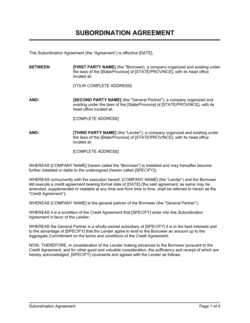
Formally subordinating an earlier lien to a new senior lenderSubordination Agreement
Releasing a lien after a debt has been fully paidLien Release Letter
Notifying a borrower that a new security interest has been registeredNotice of Security Interest
Documenting the relative priority of multiple creditors against shared collateralIntercreditor Agreement
Sending written demand to a debtor in default on a secured obligationDefault Notice Letter
Confirming a UCC filing has been made against a debtor's assetsUCC Financing Statement Cover Letter

Common mistakes to avoid

❌ Sending notice after the UCC-1 is already filed

Why it matters: Notifying the prior secured party only after your interest is already publicly recorded can appear presumptuous and damages the cooperative creditor relationship needed if a subordination agreement becomes necessary.

Fix: Send the notice concurrently with or immediately before executing the security agreement, so the prior party has a reasonable opportunity to respond before the interest is perfected.
❌ Using a collateral description that differs from the security agreement

Why it matters: Even minor wording differences between the notice and the underlying security agreement can create ambiguity about the scope of the new interest, which prior creditors and courts may exploit.

Fix: Paste the collateral description verbatim from the executed security agreement into every notice and UCC filing β€” never paraphrase it.

❌ Addressing the notice to the wrong contact

Why it matters: A notice routed to a relationship manager instead of a lien management or legal team can sit unactioned for weeks, undermining your documentation trail and delaying any needed intercreditor discussions.

Fix: Confirm the correct recipient department and officer by phone before sending, and include the attention line on the envelope and in the letter header.

❌ Omitting proof-of-delivery documentation

Why it matters: Without delivery confirmation, you cannot prove the prior secured party received the notice β€” which becomes critical if a priority dispute or litigation arises.

Fix: Send by certified mail with return receipt, or by courier requiring signature, and retain the delivery confirmation in the loan file alongside a copy of the notice.

The 8 key clauses, explained

Sender and recipient identification

In plain language: Opens the letter by identifying the party sending the notice, the prior secured party being notified, and their respective contact details and addresses.

Sample language
[SENDER COMPANY NAME], located at [SENDER ADDRESS], hereby provides notice to [PRIOR SECURED PARTY NAME], located at [RECIPIENT ADDRESS], in connection with the financing described below.

Common mistake: Addressing the letter to a general company address rather than the specific department or officer responsible for lien management, causing the notice to be misdirected and creating a documentation gap.

Date and reference line

In plain language: States the date the notice is being issued and includes a reference line identifying the debtor and the relevant loan or account number for easy cross-referencing.

Sample language
Date: [DATE] | Re: Notice of Subsequent Security Interest β€” Debtor: [DEBTOR FULL LEGAL NAME] | Account/Loan No.: [REFERENCE NUMBER]

Common mistake: Omitting the debtor's full legal name in the reference line, which can cause the receiving party's records team to fail to match the notice to the correct file.

Statement of new security interest

In plain language: Clearly states that the sender is taking or has taken a new security interest in specified collateral belonging to the named debtor, and identifies the effective date of that interest.

Sample language
Please be advised that [SENDER COMPANY NAME] has taken a security interest in the collateral described herein, held by [DEBTOR FULL LEGAL NAME], effective [EFFECTIVE DATE], pursuant to a [LOAN/FINANCING AGREEMENT] dated [AGREEMENT DATE].

Common mistake: Using vague language such as 'may be taking' rather than a definitive statement, which weakens the notice's legal clarity and undermines its purpose as formal documentation.

Collateral description

In plain language: Describes the specific assets subject to the new security interest β€” mirroring the collateral description used in the underlying security agreement and any UCC-1 filing.

Sample language
The collateral subject to [SENDER COMPANY NAME]'s security interest includes: [COLLATERAL DESCRIPTION, e.g., 'all accounts receivable, inventory, equipment, and general intangibles of [DEBTOR NAME] as more fully described in the Security Agreement dated [DATE]'].

Common mistake: Using a collateral description that is narrower or broader than the one in the underlying security agreement, creating inconsistency that could be exploited in a priority dispute.

Reference to underlying agreement

In plain language: Cites the specific financing or security agreement that gives rise to the new security interest, including its date and the parties involved.

Sample language
This security interest arises pursuant to that certain Security Agreement entered into between [SENDER COMPANY NAME] and [DEBTOR FULL LEGAL NAME] dated [AGREEMENT DATE], a copy of which is available upon written request.

Common mistake: Failing to reference the underlying agreement at all, leaving the prior secured party with no way to verify the basis for the claimed interest or assess its scope.

Acknowledgment of prior interest

In plain language: Explicitly recognizes that the recipient holds an existing, earlier security interest in the same collateral β€” demonstrating good faith and framing the priority relationship clearly.

Sample language
We acknowledge that [PRIOR SECURED PARTY NAME] holds a prior recorded security interest in some or all of the above-described collateral. This notice is being provided as a matter of professional courtesy and to facilitate open communication between secured creditors.

Common mistake: Omitting any acknowledgment of the prior interest, which can appear adversarial and may prompt the prior creditor to take defensive action rather than cooperate.

Request for response or acknowledgment

In plain language: Invites the prior secured party to confirm receipt of the notice and to raise any concerns about priority, collateral overlap, or the need for a subordination or intercreditor agreement.

Sample language
We respectfully request that you acknowledge receipt of this notice in writing by [RESPONSE DATE]. If you wish to discuss the priority arrangements or enter into an intercreditor agreement, please contact [CONTACT NAME] at [PHONE/EMAIL] at your earliest convenience.

Common mistake: Setting an unrealistically short response deadline β€” such as 48 hours β€” that forces a negative or defensive reply, when 5–10 business days is the standard reasonable window.

Sender signature block

In plain language: Closes the letter with the name, title, company, and contact information of the authorized representative sending the notice on behalf of the new secured party.

Sample language
Sincerely, [AUTHORIZED REPRESENTATIVE NAME] | [TITLE] | [SENDER COMPANY NAME] | [ADDRESS] | [PHONE] | [EMAIL]

Common mistake: Signing on behalf of a company without including the title or authority of the signatory, which can raise questions about whether the notice was issued by someone authorized to bind the company.

How to fill it out

  1. 1

    Identify all prior secured parties against the collateral

    Before drafting the notice, search the relevant UCC filing system or land registry to identify every creditor with an existing recorded interest in the collateral. A separate notice should be sent to each prior secured party.

    πŸ’‘ Run a UCC search under the debtor's exact legal name β€” not a trade name β€” to catch all filed interests, including those from asset-based lenders who may not have been disclosed by the borrower.

  2. 2

    Enter the sender and recipient details

    Fill in your company's full legal name, address, and contact information in the sender block. Enter the prior secured party's full legal name and the specific address for their lien management or legal department.

    πŸ’‘ Call the prior creditor ahead of sending to confirm the correct mailing address and contact name for lien-related correspondence β€” generic addresses cause delays.

  3. 3

    Complete the reference line with debtor information

    Enter the debtor's full legal name exactly as it appears in the security agreement and any UCC filings. Include your internal loan or account reference number so both parties can cross-reference the file easily.

    πŸ’‘ If the debtor operates under a trade name, include the legal entity name first and note the DBA β€” e.g., 'Acme Holdings LLC d/b/a FastParts.'

  4. 4

    State the new security interest clearly and precisely

    Write a definitive statement that you have taken a security interest, specifying the effective date and citing the underlying security agreement by name and date. Avoid conditional language.

    πŸ’‘ Use the same date as the executed security agreement, not the date the UCC-1 is filed β€” the security interest is created at execution, even if perfection occurs later.

  5. 5

    Describe the collateral consistently with your security agreement

    Copy the collateral description directly from your security agreement. Do not paraphrase or summarize β€” any difference between the notice and the security agreement can create ambiguity in a priority dispute.

    πŸ’‘ If your collateral description uses 'all assets' language, state that explicitly rather than listing categories β€” a partial list can imply that unlisted assets are excluded.

  6. 6

    Set a clear response deadline and contact point

    Specify a response deadline of 5–10 business days and provide a named contact with both phone and email. This makes follow-up straightforward and creates a documented communication chain.

    πŸ’‘ Send the notice by a method that generates proof of delivery β€” certified mail, courier with signature confirmation, or email with read receipt β€” and retain the delivery record with the loan file.

Frequently asked questions

What is a prior secured party notice?

A prior secured party notice is a formal letter sent by a new or junior creditor to an existing lienholder, informing them that a subsequent security interest has been taken against the same collateral. It is used to maintain transparency in multi-creditor lending arrangements, establish a documented communication record, and open dialogue about priority or subordination before any conflict arises.

When should a prior secured party notice be sent?

The notice should be sent at or near the time the new security agreement is executed β€” ideally before the corresponding UCC-1 financing statement is filed. Sending it at this stage gives the prior creditor an opportunity to respond, request additional information, or propose a subordination or intercreditor agreement before the new interest is publicly perfected.

Is a prior secured party notice legally required?

In most situations, there is no statutory requirement to notify a prior secured party before taking a junior security interest β€” the UCC filing system is the public notice mechanism. However, some loan agreements include contractual covenants requiring the debtor or a new lender to notify existing creditors. Sending the notice is widely considered best practice because it reduces the risk of disputes and supports a cooperative creditor relationship.

What is the difference between a prior secured party notice and a subordination agreement?

A prior secured party notice is a one-way communication informing an earlier creditor that a new security interest exists. A subordination agreement is a bilateral contract in which the earlier creditor formally agrees to step behind the new creditor in priority. The notice often prompts the discussion that leads to a subordination agreement, but the notice alone does not alter lien priority.

How does lien priority work when there are multiple secured creditors?

Lien priority is generally determined by the date of perfection β€” the creditor who filed a valid UCC-1 financing statement first has the senior claim on proceeds from the collateral. A later creditor has a junior or subordinate claim. Priority can be altered by a formal subordination agreement signed by the senior creditor, but not by the prior secured party notice alone.

Does the prior secured party need to respond to the notice?

There is no legal obligation for the prior secured party to respond, but the notice should request written acknowledgment within a specified window β€” typically 5–10 business days. If the prior creditor's loan agreement contains a cross-default or after-acquired collateral clause, they may need to respond to protect their own position. Non-response should be documented in the loan file.

Can this template be used for equipment financing and asset-based lending?

Yes. The template is suitable for any transaction where a new security interest is being taken against collateral that is already encumbered β€” including equipment loans, accounts receivable factoring, inventory financing, and general asset-based lending. Adjust the collateral description field to match the specific asset type and the language used in your security agreement.

Should the collateral description in the notice match the UCC-1 filing?

Yes β€” the collateral description in the notice should be consistent with both the security agreement and the UCC-1 financing statement. Discrepancies between these three documents can create ambiguity about the scope of your interest and give a prior creditor grounds to challenge coverage of specific assets in a priority dispute.

What records should I keep after sending a prior secured party notice?

Retain a copy of the signed or finalized notice, proof of delivery (certified mail receipt, courier confirmation, or email read receipt), and any written response from the prior secured party. These records belong in the loan file and should be preserved for the life of the financing plus any applicable statute of limitations for commercial disputes, which is typically 4–6 years depending on jurisdiction.

How this compares to alternatives

vs Subordination Agreement

A subordination agreement is a binding contract in which the senior creditor formally agrees to step behind a newer lender in priority β€” it changes lien priority. A prior secured party notice is an informational letter only; it does not alter priority. The notice often initiates the conversation that leads to a subordination agreement.

vs Intercreditor Agreement

An intercreditor agreement is a comprehensive bilateral contract between two or more creditors defining their rights, remedies, and priority against shared collateral and a common debtor. A prior secured party notice is a simple one-page letter that opens communication. Complex multi-lender structures typically require an intercreditor agreement, not just a notice.

vs Default Notice Letter

A default notice letter is sent to a borrower who has failed to meet their payment or covenant obligations, triggering remedies under the security agreement. A prior secured party notice is sent to another creditor as a courtesy and documentation measure before or at the time a new security interest is created β€” it has nothing to do with borrower default.

vs UCC Financing Statement Cover Letter

A UCC financing statement cover letter accompanies the UCC-1 form submitted to a state filing office to perfect a security interest publicly. A prior secured party notice goes directly to the existing lienholder, not to a government office. Both are part of a complete loan closing package, but they serve distinct purposes.

Industry-specific considerations

Commercial Banking and Lending

Banks and commercial lenders routinely send prior secured party notices when issuing second-lien term loans or revolving facilities against collateral already pledged to another financial institution.

Equipment Finance

Equipment lenders use these notices when financing machinery or vehicles that carry an existing lien from a prior purchase-money security interest holder or floor-plan lender.

Accounts Receivable and Invoice Factoring

Factoring companies notify prior secured parties before advancing funds against receivables to address potential competing claims under blanket lien filings that cover all of a debtor's assets.

Real Estate and Construction Finance

Construction lenders and mezzanine financiers send creditor notices when layering financing on properties with existing mortgage liens, often as a precursor to negotiating a formal intercreditor or subordination agreement.

Template vs pro β€” what fits your needs?

PathBest forCostTime
Use the templateCommercial lenders, finance companies, and business owners sending standard creditor notices on straightforward single-collateral transactionsFree10–15 minutes per notice
Template + professional reviewTransactions involving complex collateral packages, multiple prior lienholders, or situations where a subordination agreement may follow$150–$400 (attorney or paralegal review)1–2 business days
Custom draftedLarge multi-lender syndicated deals, mezzanine or subordinated debt structures, or cross-border financing with jurisdictional complexity$500–$2,000+3–7 business days

Glossary

Secured Party
A lender or creditor who holds a legally recognized interest in a debtor's collateral as security for a debt obligation.
Prior Secured Party
A creditor whose security interest in collateral was perfected before a subsequent creditor's interest was created or registered.
Security Interest
A creditor's legal right to take possession of specific collateral if the debtor defaults on their payment obligation.
Collateral
The specific asset or assets pledged by a debtor to secure a loan or other financial obligation.
Lien Priority
The ranked order in which competing creditors have the right to claim proceeds from collateral, generally determined by the date of perfection.
Perfection
The legal process of making a security interest enforceable against third parties, typically accomplished by filing a UCC-1 financing statement.
UCC-1 Financing Statement
A public notice document filed with a state authority to establish and publicize a creditor's security interest in a debtor's collateral.
Subordination
An agreement by a senior creditor to allow a junior creditor's claim to take priority over their own in the event of default or liquidation.
Intercreditor Agreement
A contract between two or more creditors that defines their respective rights and priorities against shared collateral or a common debtor.
Junior Lienholder
A secured creditor whose interest in collateral was perfected after an earlier creditor's, giving them a lower priority claim on proceeds.

Part of your Business Operating System

This document is one of 3,000+ business & legal templates included in Business in a Box.

  • Fill-in-the-blanks β€” ready in minutes
  • 100% customizable Word document
  • Compatible with all office suites
  • Export to PDF and share electronically

Create your document in 3 simple steps.

From template to signed document β€” all inside one Business Operating System.
1
Download or open template

Access over 3,000+ business and legal templates for any business task, project or initiative.

2
Edit and fill in the blanks with AI

Customize your ready-made business document template and save it in the cloud.

3
Save, Share, Send, Sign

Share your files and folders with your team. Create a space of seamless collaboration.

Save time, save money, and create top-quality documents.

β˜…β˜…β˜…β˜…β˜…

"Fantastic value! I'm not sure how I'd do without it. It's worth its weight in gold and paid back for itself many times."

Managing Director Β· Mall Farm
Robert Whalley
Managing Director, Mall Farm Proprietary Limited
β˜…β˜…β˜…β˜…β˜…

"I have been using Business in a Box for years. It has been the most useful source of templates I have encountered. I recommend it to anyone."

Business Owner Β· 4+ years
Dr Michael John Freestone
Business Owner
β˜…β˜…β˜…β˜…β˜…

"It has been a life saver so many times I have lost count. Business in a Box has saved me so much time and as you know, time is money."

Owner Β· Upstate Web
David G. Moore Jr.
Owner, Upstate Web

Run your business with a system β€” not scattered tools

Stop downloading documents. Start operating with clarity. Business in a Box gives you the Business Operating System used by over 250,000 companies worldwide to structure, run, and grow their business.

Start freeΒ Β·Β No credit card required