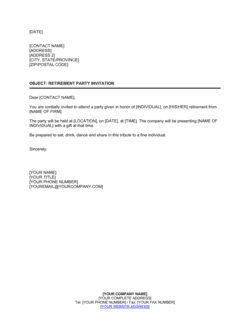
Retirement Party Invitation_Internal Template

Free Word download • Edit online • Save & share with Drive • Export to PDF

1 page20–25 min to fillDifficulty: StandardSignature requiredLegal review recommended
Learn more ↓
FreeRetirement Party Invitation_Internal Template

At a glance

What it is
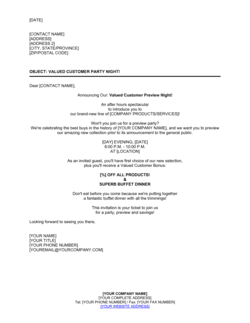
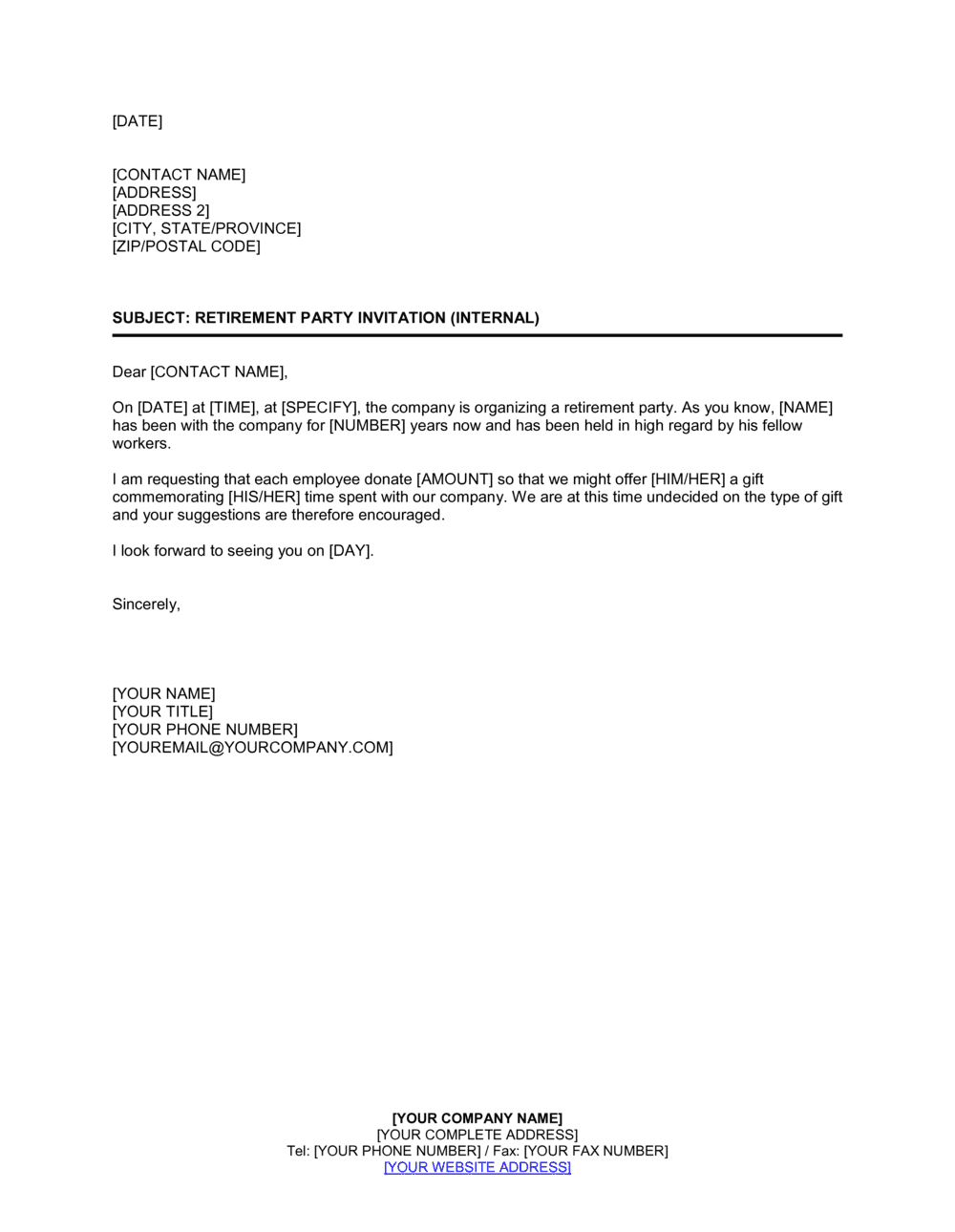
An Internal Retirement Party Invitation is a formal workplace communication issued by an employer, HR department, or manager to announce and invite employees to a colleague's retirement celebration. This free Word download gives you a professionally structured template you can edit online, brand with your company letterhead, and distribute by email or print in minutes.
When you need it
Use it as soon as a retirement date is confirmed and at least two to three weeks before the event — earlier for larger gatherings or when catering and venue bookings require a headcount. It is appropriate for any employee retirement, whether a long-tenured senior leader or a shorter-service team member.
What's inside
Honoree details and service recognition, event date, time, and location, RSVP instructions and deadline, dress code or theme notes, gift or contribution guidance, and a personal tribute message from leadership.

What is a Retirement Party Invitation (Internal)?

A Retirement Party Invitation (Internal) is a formal workplace communication issued by an employer, HR department, or manager to announce and invite employees to a retirement celebration for a departing colleague. It goes beyond a simple event notice — combining logistical details (date, time, venue, RSVP instructions) with a personal tribute to the honoree's years of service and professional legacy. Distributed exclusively within the organization, it signals to the entire team that the retirement is being marked as a significant milestone worthy of shared recognition, rather than a quiet departure.

Unlike an external retirement announcement addressed to clients or partners, an internal invitation speaks to the community of coworkers who knew the retiree day to day. It sets the tone for the celebration, manages attendance expectations, and handles practical coordination — gift contributions, dietary requirements, and accessibility needs — in a single, professional document that reflects well on the organization and on the care it shows departing employees.

Why You Need This Document

Without a structured internal invitation, retirement celebrations tend to be disorganized, poorly attended, or unintentionally exclusionary. Colleagues learn about the event through informal channels, RSVP numbers come in too late for catering, and the tribute — if there is one — gets improvised on the day rather than thoughtfully prepared. The retiree, who has given years of service to the organization, deserves better than a rushed email sent two days before the event.

A well-drafted invitation also protects the organization. Poorly worded gift contribution requests can expose the company to wage and hour complaints. Inaccessible events create Equality Act or ADA exposure. And invitations that inadvertently disclose details inconsistent with a separation agreement can undermine confidentiality obligations that HR worked hard to establish. This template gives you a professional, legally reviewed starting point that handles all of these risks — so your team can focus on making the celebration memorable rather than managing last-minute problems.

Which variant fits your situation?

If your situation is…Use this template
Celebrating a senior executive or C-suite retirementExecutive Retirement Party Invitation
Sending a digital-only invitation via company email or intranetRetirement Party Invitation (Digital)
Announcing the retirement to clients and external partnersRetirement Announcement Letter (External)
Inviting staff to a virtual or hybrid retirement celebrationVirtual Retirement Party Invitation
Providing a formal written tribute to accompany the invitationEmployee Recognition Letter
Combining the invitation with a retirement gift collection noticeRetirement Gift Collection Notice
Marking the retirement with a formal farewell letter from leadershipRetirement Farewell Letter

Common mistakes to avoid

❌ Sending the invitation without the honoree's consent

Why it matters: Some employees prefer a private departure. Announcing a party without the retiree's knowledge or agreement can cause genuine distress and may constitute a privacy or dignity-at-work issue in some jurisdictions.

Fix: Always confirm the honoree's preferences — date, scale, and attendee list — before drafting or distributing any invitation. Document their agreement in writing.

❌ Omitting accessibility information

Why it matters: Failing to address accessibility leaves employees with mobility, dietary, or sensory needs unable to participate fully, which can raise discrimination concerns under the ADA, Equality Act, or equivalent legislation.

Fix: Include a line inviting attendees to contact the organizer with accessibility or dietary requirements, and confirm the venue meets applicable accessibility standards before sending.

❌ Using mandatory-sounding language for gift contributions

Why it matters: Phrasing like 'all staff are asked to contribute $20' can be interpreted as a workplace deduction or financial pressure, creating HR complaints or legal exposure under wage and hour rules.

Fix: Replace mandatory language with clearly voluntary phrasing: 'if you would like to contribute to a group gift, please contact [NAME] — no obligation is implied or expected.'

❌ Distributing without managerial or HR sign-off

Why it matters: An unsanctioned invitation can commit company resources — catering, venue, working time — without budget approval, or contradict a separate communication from HR about the employee's departure.

Fix: Route the draft through the relevant manager and HR contact for approval before sending. Keep a record of the approval in your event planning file.

❌ Setting too short an RSVP window

Why it matters: An RSVP deadline of two or three days before the event leaves insufficient time to finalize catering numbers, order custom materials, or arrange accessibility accommodations, resulting in last-minute chaos or cost overruns.

Fix: Set the RSVP deadline at least seven business days before the event date and build catering and venue cutoffs into your planning timeline.

❌ Addressing the invitation to 'all staff' without filtering by appropriate audience

Why it matters: Sending a department-level retirement party invitation to the entire company inflates attendance expectations and may be inappropriate for intimate celebrations. Conversely, excluding close colleagues creates hurt feelings.

Fix: Determine the intended audience in advance — team only, department-wide, or company-wide — and use an appropriate distribution list. Note this clearly at the top of the invitation.

The 8 key clauses, explained

Honoree identification and service summary

In plain language: Names the retiring employee, their job title, department, and total years of service — giving recipients context for who is being celebrated.

Sample language
Please join us in celebrating the retirement of [EMPLOYEE FULL NAME], [JOB TITLE], [DEPARTMENT], who is concluding [X] years of dedicated service to [COMPANY NAME].

Common mistake: Omitting the honoree's department or title. Without this, employees in large organizations may not know who is retiring or recognize the significance of the occasion.

Event date, time, and location

In plain language: Specifies the exact date, start and end time, and physical or virtual location of the retirement party.

Sample language
The celebration will be held on [DAY], [DATE] from [START TIME] to [END TIME] at [VENUE NAME], [ROOM/FLOOR], [ADDRESS / PLATFORM LINK].

Common mistake: Listing only the start time without an end time. Employees need to know when the event concludes to plan their workday and travel accordingly.

RSVP instructions and deadline

In plain language: Tells recipients how to confirm attendance, who to contact, and by what date their response is required.

Sample language
Kindly RSVP by [DATE] to [CONTACT NAME] at [EMAIL ADDRESS] or [PHONE NUMBER]. Please indicate any dietary restrictions or accessibility requirements.

Common mistake: Setting the RSVP deadline fewer than five business days before the event. This leaves insufficient time to finalize catering, seating, and any personalized materials.

Tribute and recognition statement

In plain language: A short, genuine acknowledgment from the sender — typically a manager, HR leader, or executive — recognizing the retiree's contributions and legacy.

Sample language
During [his/her/their] [X] years with [COMPANY NAME], [HONOREE NAME] has [SPECIFIC ACHIEVEMENT OR CONTRIBUTION]. [He/She/They] leaves a lasting impact on our [TEAM / CLIENTS / ORGANIZATION].

Common mistake: Writing a generic tribute that could apply to any employee. A vague statement — 'a valuable member of the team' — feels impersonal and diminishes the recognition.

Program or agenda outline

In plain language: Gives attendees a brief overview of what to expect — speeches, dinner, toast, gift presentation — so the event feels organized and purposeful.

Sample language
The afternoon will include light refreshments, remarks from [SPEAKER NAME / TITLE], a photo slideshow, and an opportunity to share memories with [HONOREE NAME].

Common mistake: Omitting the agenda entirely, which can result in attendees leaving before key moments like the gift presentation or the honoree's farewell speech.

Dress code or theme

In plain language: States the expected attire or event theme so all attendees arrive appropriately dressed and the event has a cohesive atmosphere.

Sample language
Attire: [Business Casual / Smart Casual / Formal]. Theme: [OPTIONAL THEME, e.g., 'Garden Party' or 'Decades of Dedication'].

Common mistake: Leaving out dress code guidance entirely for a formal or themed event. Attendees default to office attire, which may clash with venue expectations or the honoree's preferences.

Gift or contribution guidance

In plain language: Explains whether a group gift is being organized, how employees can contribute financially, and any alternative options such as a charity donation or memory book.

Sample language
If you would like to contribute to a group gift for [HONOREE NAME], please contact [COORDINATOR NAME] at [EMAIL] by [DATE]. Contributions of $[X] or any amount are welcome. Alternatively, a donation to [CHARITY NAME] may be made in [his/her/their] honor.

Common mistake: Requesting gift contributions in a mandatory-sounding tone. Language implying financial pressure can create discomfort and potential HR complaints. Keep participation clearly optional.

Contact details and organizer signature

In plain language: Identifies the person or team organizing the event, their contact information, and a closing from a named leader or HR representative.

Sample language
For questions, please contact [ORGANIZER NAME], [TITLE], at [EMAIL] or extension [X]. Warmly, [SENDER NAME] | [TITLE] | [COMPANY NAME]

Common mistake: Using a generic 'HR Team' sign-off with no individual contact. Employees need a named person to reach for questions about accessibility, dietary needs, or schedule conflicts.

How to fill it out

  1. 1

    Confirm retirement details with the honoree

    Before drafting the invitation, verify with the retiring employee that they are comfortable with a party, the timing, and the level of formality. Some employees prefer a low-key gathering; others welcome a larger celebration.

    💡 Ask the honoree whether they prefer the announcement to come from HR, their direct manager, or a senior leader — the sender line affects how recipients perceive the event's significance.

  2. 2

    Fill in the honoree's name, title, and years of service

    Use the employee's full legal name as they are known in the workplace, their official job title, department, and their precise length of service — check HR records for accuracy.

    💡 Double-check the years-of-service figure against the original hire date in your HRIS. A publicly stated incorrect number is embarrassing and can upset the honoree.

  3. 3

    Set the event date, time, and venue details

    Enter the confirmed date, start and end times, and the full venue address or virtual meeting link. If the party is in a specific room or floor of your building, include wayfinding details.

    💡 Include a calendar invite file or a 'add to calendar' link if distributing the invitation digitally — it reduces the chance attendees forget to attend.

  4. 4

    Write a specific, personalized tribute

    Replace the placeholder tribute text with two to three sentences that name a specific project, client win, or quality that made this employee memorable. Confirm factual details — project names, years, outcomes — before publishing.

    💡 Ask two or three colleagues who worked closely with the honoree for a one-line memory to weave into the tribute. It makes the recognition feel authentic rather than drafted by committee.

  5. 5

    Set the RSVP deadline and contact details

    Calculate your RSVP deadline by working backward from catering cutoff dates — typically 7–10 business days before the event. Name a specific person as the RSVP contact with their direct email or extension.

    💡 Add a dietary restrictions prompt to the RSVP request — it takes one sentence and prevents you from scrambling for alternatives on the day.

  6. 6

    Include optional gift contribution language

    If a group gift is planned, add the contribution clause with a named coordinator, contribution amount, and deadline. Use clearly optional language — 'if you would like to contribute' rather than 'all staff are expected to contribute.'

    💡 Set the gift contribution deadline at least three business days before the RSVP deadline so the coordinator can order or purchase in time.

  7. 7

    Review for inclusivity and tone

    Read the completed invitation for language that assumes attendance, implies social pressure, or inadvertently excludes remote employees or part-time staff. Ensure the venue is accessible and stated accessibility support is offered.

    💡 Have someone outside the planning team — ideally from a different department — read the draft for tone before distribution.

  8. 8

    Obtain sign-off and distribute

    Route the final draft to the relevant manager or HR lead for approval, then distribute via company email, intranet, or printed notice boards at least two weeks before the event.

    💡 Send a reminder notice one week before the RSVP deadline, especially for large organizations where the first email may be missed.

Frequently asked questions

What is an internal retirement party invitation?

An internal retirement party invitation is a formal workplace communication sent by an employer, HR team, or manager to announce and invite employees to a retirement celebration for a departing colleague. It provides all the practical details — date, time, venue, RSVP instructions — alongside a personal tribute recognizing the honoree's service. Unlike a general announcement, it is addressed to the employee audience rather than external clients or partners.

How far in advance should I send a retirement party invitation?

Send the invitation at least two to three weeks before the event date for a standard office gathering. For larger events requiring catering deposits, venue booking, or travel by out-of-town colleagues, four to six weeks is more appropriate. A follow-up reminder one week before the RSVP deadline significantly improves response rates in large organizations.

Does a retirement party invitation need to be approved by HR?

In most organizations, yes — particularly if the invitation commits company resources such as catering, venue space, or working-hours attendance. HR or the relevant manager should approve the content before distribution to ensure it aligns with any confidential departure arrangements, budget parameters, and the honoree's own wishes. Unauthorized invitations can conflict with contractual confidentiality obligations around the employee's exit terms.

Should I include gift contribution details in the invitation?

You can, but only with careful, voluntary language. State clearly that contributions are optional and provide a named, individual contact for those who wish to participate. Never imply that participation is expected or that non-contributors will be noted. In some jurisdictions, a financial request tied to employment could raise wage deduction concerns if phrased ambiguously.

How do I handle the invitation if the retirement is involuntary or sensitive?

If the retirement was not entirely voluntary — for example, following an ill-health retirement, redundancy, or a managed exit — consult HR and employment counsel before issuing any party invitation. The framing of the event and the tribute language must align with any settlement agreement or confidentiality obligations. In some cases, a smaller private gathering coordinated by the employee's team is more appropriate than a formal company-wide event.

Can I use this template for a virtual or hybrid retirement party?

Yes. Replace the physical venue details with the virtual meeting platform, link, and any access instructions. For hybrid events, include both the in-person venue address and the digital access details, and confirm that remote attendees can fully participate in key moments such as the toast or gift presentation. Note any time zone differences if your team is distributed across multiple regions.

Is an internal retirement invitation a legally binding document?

The invitation itself is not a binding contract in the way an employment agreement or service contract would be. However, it does create organizational commitments — to the honoree, the venue, and the catering provider — and its content can have legal implications if it discloses confidential departure terms, implies financial obligations on employees, or fails to meet workplace inclusivity requirements. Having HR review the final draft addresses most of these risks.

What should the tribute message include?

The tribute should name at least one specific contribution, project, or quality that made the honoree memorable — not just generic praise. A good format is: a statement of tenure, a named achievement or characteristic, and a warm closing wish for their next chapter. Two to four sentences is the right length. Longer tributes belong in the speech at the event, not in the invitation.

How do I manage RSVPs for a large retirement party?

For events with more than 30 expected attendees, use a dedicated RSVP email address or an online form rather than a personal inbox. Include a dietary restrictions field in the RSVP to capture catering needs in one step. Close RSVPs seven to ten business days before the event and send your final headcount to the caterer and venue no later than five business days prior.

How this compares to alternatives

vs Retirement announcement letter

A retirement announcement letter formally notifies staff — and sometimes clients — that an employee is retiring, focusing on the transition, successors, and handover plan. An internal retirement party invitation is an event communication focused on celebrating the individual. The announcement typically precedes the invitation and should be issued first to avoid employees learning about the retirement through the party invite.

vs Retirement congratulations letter

A retirement congratulations letter is a personal written tribute from a colleague, manager, or leader to the retiree — sent directly to the individual, not distributed to staff. A retirement party invitation is a group communication inviting employees to a shared event. Both serve the purpose of recognition, but they operate at different levels of formality and distribution.

vs Employee recognition letter

An employee recognition letter formally acknowledges a specific achievement, milestone, or exemplary performance during active employment. A retirement party invitation celebrates the entire arc of a career at the point of departure. Recognition letters are typically issued during employment; party invitations mark the conclusion of it.

vs Farewell party invitation (general)

A general farewell party invitation covers any employee departure — resignation, relocation, or redundancy — without the career-celebration framing of a retirement event. Retirement invitations include years-of-service recognition and a tribute tone that would be inappropriate for a resignation farewell. Use a retirement-specific template when the departure is framed as a planned career conclusion.

Industry-specific considerations

Corporate and enterprise

Multi-department coordination, budget approval workflows, and alignment with any concurrent external retirement announcement to clients or the board.

Healthcare

Scheduling constraints around shift patterns require extended notice periods; clinical staff retirements often involve regulatory credentialing considerations that affect the tribute language.

Education

Academic year timing means retirement parties are commonly planned around term-end dates; faculty retirements frequently involve a public recognition element alongside the internal celebration.

Government and public sector

Pension entitlements and formal service records are often referenced in the tribute; public sector events may require procurement approval for catering and venue spend above a defined threshold.

Jurisdictional notes

United States

The ADA requires that workplace events held in company facilities or at company expense be accessible to employees with disabilities. Gift contribution language must not create an implied wage deduction. In states with strong employee privacy laws — such as California — any public recognition of an employee's departure should be consistent with the terms of any separation agreement.

Canada

PIPEDA and provincial privacy legislation (notably Quebec's Law 25) restrict how personal information about a departing employee — including years of service and role history — may be communicated internally without the employee's explicit consent. In Quebec, all internal written communications should ideally be available in French. Ensure any financial contribution request is clearly voluntary to avoid conflict with employment standards wage protection rules.

United Kingdom

The Equality Act 2010 requires that workplace events be reasonably accessible to employees with disabilities and that invitations do not create a hostile or exclusionary environment. If the retirement follows an ill-health or capability process, invitation content must align with any settlement or compromise agreement. GDPR under the UK Data Protection Act 2018 applies to processing the honoree's personal data in the invitation.

European Union

GDPR restricts the use and internal distribution of an employee's personal data — including their name, role, and length of service — without a lawful basis. Legitimate interests or the employee's explicit consent typically covers a retirement party invitation, but consent should be documented. In jurisdictions such as France and Germany, works council or staff representative notification may be required before circulating certain internal employee communications.

Template vs lawyer — what fits your deal?

PathBest forCostTime
Use the templateStandard internal retirement celebrations where the departure is voluntary, amicable, and without complex exit termsFree15–30 minutes
Template + legal reviewRetirements involving settlement agreements, confidentiality obligations, or an honoree in a senior or regulated role$150–$400 for an HR advisor or employment counsel review1–2 business days
Custom draftedExecutive retirements with board-level communication, cross-jurisdiction employment, or complex confidentiality and disclosure requirements$500–$1,500 for a combined HR communications and employment law review3–5 business days

Glossary

Honoree
The retiring employee in whose honor the event is being held.
RSVP
A response request (from the French 'répondez s'il vous plaît') asking recipients to confirm attendance by a specified deadline.
Headcount
The confirmed number of attendees, used to finalize catering orders, seating arrangements, and venue capacity.
Tribute Message
A brief, personalized statement from leadership recognizing the honoree's service, contributions, and character.
Years of Service
The total length of an employee's continuous or cumulative employment with the organization, typically acknowledged in the invitation.
Dress Code
A stated standard of attire for the event — such as business casual, smart casual, or formal — included in the invitation so attendees can prepare appropriately.
Internal Communication
Any message distributed exclusively within an organization to employees, as opposed to external communications sent to clients or the public.
RSVP Deadline
The specific date by which attendees must confirm or decline attendance so organizers can finalize logistics.
Venue
The physical or virtual location where the retirement celebration will be held, including the room, floor, building, or online platform details.
Contribution Note
Optional language in the invitation explaining how colleagues can participate in a group gift, card, or charitable donation in the honoree's name.

Part of your Business Operating System

This document is one of 3,000+ business & legal templates included in Business in a Box.

  • Fill-in-the-blanks — ready in minutes
  • 100% customizable Word document
  • Compatible with all office suites
  • Export to PDF and share electronically

Create your document in 3 simple steps.

From template to signed document — all inside one Business Operating System.
1
Download or open template

Access over 3,000+ business and legal templates for any business task, project or initiative.

2
Edit and fill in the blanks with AI

Customize your ready-made business document template and save it in the cloud.

3
Save, Share, Send, Sign

Share your files and folders with your team. Create a space of seamless collaboration.

Save time, save money, and create top-quality documents.

★★★★★

"Fantastic value! I'm not sure how I'd do without it. It's worth its weight in gold and paid back for itself many times."

Managing Director · Mall Farm
Robert Whalley
Managing Director, Mall Farm Proprietary Limited
★★★★★

"I have been using Business in a Box for years. It has been the most useful source of templates I have encountered. I recommend it to anyone."

Business Owner · 4+ years
Dr Michael John Freestone
Business Owner
★★★★★

"It has been a life saver so many times I have lost count. Business in a Box has saved me so much time and as you know, time is money."

Owner · Upstate Web
David G. Moore Jr.
Owner, Upstate Web

Run your business with a system — not scattered tools

Stop downloading documents. Start operating with clarity. Business in a Box gives you the Business Operating System used by over 250,000 companies worldwide to structure, run, and grow their business.

Start free · No credit card required