Business Development Strategy

Free Word download β€’ Edit online β€’ Save & share with Drive β€’ Export to PDF

11 pagesβ€’25–35 min to fillβ€’Difficulty: Complex
Learn more ↓
FreeBusiness Development Strategy Template

At a glance

What it is
A Business Development Strategy is a structured planning document that maps a company's target markets, revenue growth initiatives, partnership opportunities, and competitive positioning into a prioritized 12–36 month action plan. This free Word download gives you a ready-to-edit framework you can customize for your industry and export as PDF to share with leadership, investors, or your sales and BD team.
When you need it
Use it when entering a new market, launching a new revenue stream, formalizing a BD function, or aligning executive leadership around a concrete growth plan with measurable targets. It is also the right tool when existing sales efforts have stalled and a structured reset is needed.
What's inside
Executive summary, current-state assessment, target market definition, revenue and growth goals, competitive landscape, partnership and channel strategy, go-to-market action plan, resource requirements, KPIs and measurement framework, and a risk and contingency section.

What is a Business Development Strategy?

A Business Development Strategy is a structured planning document that defines how a company will grow revenue by entering new markets, building partnership channels, and targeting specific customer segments over a 12 to 36-month horizon. Unlike a sales plan β€” which focuses on converting pipeline that already exists β€” a BD strategy identifies and creates entirely new categories of revenue opportunity. It translates the company's broader growth ambitions into a prioritized, time-phased action plan with defined owners, resource requirements, and measurable KPIs that leadership can track and hold the BD function accountable to.

Why You Need This Document

Without a written business development strategy, revenue growth efforts default to reactive, opportunistic deal-chasing β€” the BD team pursues whatever comes in, resources spread across too many segments, and no repeatable acquisition motion ever takes hold. The cost is concrete: high customer concentration risk as one or two accounts drive the majority of revenue, partnership programs that generate signed agreements but zero pipeline, and leadership unable to tell whether BD activity is actually working. A well-built BD strategy forces the three decisions that most directly determine whether a company grows: which markets to prioritize, which channel model to bet on, and what resource investment the targets actually require. This template gives you the structure to make those decisions explicitly β€” and to defend them to a board, investor, or leadership team with data rather than instinct.

Which variant fits your situation?

If your situation is…Use this template
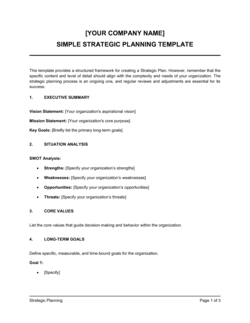
High-level strategic planning for a 3–5 year horizonStrategic Plan
Focused plan for entering a specific new market or geographyMarket Entry Plan
Documenting partnership agreements and channel commitmentsPartnership Agreement
Detailed plan for launching a single new product or serviceProduct Launch Plan
Aligning marketing spend with revenue targetsMarketing Plan
Setting sales team quotas, territories, and tacticsSales Plan
Full company plan needed for investors or a bank loanBusiness Plan

Common mistakes to avoid

❌ Setting goals without a pipeline model

Why it matters: A revenue target stated without pipeline coverage, win rate, and activity requirements is a wish, not a plan. Teams hit arbitrary targets by luck, not by execution.

Fix: Back every revenue goal into required pipeline, qualified meetings per month, and outreach volume using your actual or benchmarked conversion rates.

❌ Targeting too many segments simultaneously

Why it matters: BD teams that spread effort across five segments in year one typically generate shallow pipeline in all of them and close deals in none β€” resources are too thin to build real momentum anywhere.

Fix: Select two primary segments for Year 1. Add a third only after you have closed at least three reference deals in segment one.

❌ Launching a partner program with no activation resources

Why it matters: Signed partner agreements without training materials, a dedicated partner manager, and a co-marketing budget produce zero pipeline. Partners deprioritize vendors who cannot help them sell.

Fix: Budget for a partner portal, onboarding program, and at least 0.5 FTE of partner management before signing the first partner.

❌ Tracking activity metrics instead of pipeline outcomes

Why it matters: Reporting on calls made and emails sent feels productive but tells you nothing about whether the strategy is generating qualified revenue opportunities.

Fix: Replace activity KPIs with pipeline metrics β€” qualified opportunities created, pipeline value added per month, and stage conversion rates β€” in the monthly BD review.

❌ No risk section and no contingency triggers

Why it matters: When the first major assumption proves wrong β€” and it will β€” a strategy without contingency plans forces reactive decisions under pressure, often in the wrong direction.

Fix: Identify the three assumptions the strategy depends on most heavily. For each, define the metric threshold that signals the assumption is failing and the specific action to take in response.

❌ Omitting the resource requirements section

Why it matters: A strategy approved without a budget and headcount commitment is not approved β€” it is deferred. Teams end up accountable for targets they were never given the tools to hit.

Fix: Present the resource section alongside the goals in every leadership review. Frame it as: 'These are the targets; this is what executing them requires.'

The 10 key sections, explained

Executive summary

Current-state assessment

Target market definition

Revenue and growth goals

Competitive landscape

Partnership and channel strategy

Go-to-market action plan

Resource requirements

KPIs and measurement framework

Risk and contingency planning

How to fill it out

  1. 1

    Complete the current-state assessment before setting goals

    Gather actual data on revenue mix, customer concentration, pipeline coverage, and BD team capacity. Document what is working and what is not in the existing BD motion.

    πŸ’‘ Pull win/loss data for the last 12 months before writing a single word of strategy β€” the patterns in why you win and lose tell you more than any market research report.

  2. 2

    Define and size your target segments

    Select two to three primary segments to pursue in Year 1. For each, estimate the number of addressable accounts, average deal size, and realistic win rate based on historical data or comparable benchmarks.

    πŸ’‘ Prioritize segments where you already have at least two to three reference customers β€” a warm proof point cuts sales cycles by 30–50% in most B2B markets.

  3. 3

    Set revenue goals with bottom-up modeling

    Build your revenue targets from the pipeline up: target new-logo count Γ— average deal size = target revenue. Then back into the pipeline and activity requirements using your win rate and pipeline conversion ratios.

    πŸ’‘ If your win rate is 20%, reaching $1M in new-logo revenue requires $5M in qualified pipeline β€” state this explicitly so leadership understands what the target actually demands.

  4. 4

    Map the competitive landscape with evidence

    List four to six competitors or alternatives in each target segment. For each, note their pricing, key strengths, and the specific objection your team hears when they lose to that competitor.

    πŸ’‘ Interview three to five recently won and lost prospects before completing this section β€” their actual words are far more useful than analyst reports.

  5. 5

    Design the partnership program with commercial terms

    Define partner tiers, the commercial model for each (referral fee, reseller margin, co-sell split), and the specific activation steps and resources for each tier.

    πŸ’‘ Start with one partner tier and five to ten high-quality partners rather than launching three tiers with fifty uncommitted partners β€” depth beats breadth in year one of any partner program.

  6. 6

    Build the quarterly action plan with owners and deadlines

    Translate each strategic initiative into a specific action, a single accountable owner, a deadline, and a measurable output. Organize by quarter across the plan period.

    πŸ’‘ Limit Year 1 to no more than three to four major initiatives β€” more than that spreads a small BD team too thin to execute any of them well.

  7. 7

    Define the KPIs and review cadence

    Select five to seven metrics that cover both leading indicators (pipeline added, meetings booked) and lagging indicators (revenue closed, win rate). Set a monthly review rhythm with a specific owner for reporting.

    πŸ’‘ Establish the baseline value for every KPI before the strategy launches β€” you cannot assess progress against a metric you never measured.

  8. 8

    Write the executive summary last

    Summarize the key opportunity, the primary growth lever, the Year 1 revenue target, and the resource investment required in no more than one page.

    πŸ’‘ The executive summary is what leadership reads in a budget meeting β€” if it does not make the case for investment in two paragraphs, the detail sections will not save it.

Frequently asked questions

What is a business development strategy?

A business development strategy is a structured plan that defines how a company will grow revenue through new markets, customer segments, partnerships, or channels over a defined period β€” typically 12 to 36 months. It differs from a sales plan in scope: while a sales plan focuses on converting existing pipeline, a BD strategy identifies and opens new categories of opportunity. It covers market targeting, competitive positioning, partnership design, resource requirements, and measurable KPIs.

What is the difference between a business development strategy and a sales plan?

A sales plan focuses on converting qualified opportunities in the existing pipeline β€” quotas, territories, forecasts, and sales process. A business development strategy focuses upstream: identifying new markets, building partnership channels, and creating the conditions for future pipeline that does not yet exist. In practice, BD generates the opportunities that sales closes. Both documents are needed, but they operate on different time horizons and address different problems.

How long should a business development strategy be?

A complete BD strategy runs 15 to 25 pages for most mid-market companies, plus supporting appendices (pipeline model, competitive analysis data, partner tier details). Startups often produce a leaner 8 to 12-page version. The right length is whatever it takes to cover the ten core sections without padding β€” executive summaries that run to four pages and competitive analyses that list every known company in the space are the most common sources of unnecessary length.

Who should own the business development strategy?

The VP of Business Development or Chief Revenue Officer typically owns the strategy document, but building it requires input from sales, marketing, product, and finance. In companies without a dedicated BD function, the CEO or Head of Sales typically takes ownership. What matters more than the title is that a single person is accountable for both the plan and the quarterly progress review β€” shared ownership consistently produces deferred accountability.

How often should a business development strategy be updated?

Conduct a full strategy review annually, aligned to the fiscal year planning cycle. Run a lightweight mid-year checkpoint to update the pipeline model against actuals and reassess whether the primary target segments are still correctly prioritized. In fast-moving markets or during a significant competitive shift, a quarterly reset of the action plan section is appropriate β€” but revising the full strategy more frequently than annually typically signals poor initial planning rather than genuine strategic agility.

What KPIs should a business development strategy track?

The most useful BD KPIs combine leading indicators and outcome metrics. Leading indicators β€” qualified pipeline added per month, meetings booked with target ICPs, partner-sourced opportunities β€” tell you whether the strategy is generating activity. Outcome metrics β€” new-logo revenue, win rate by segment, partner contribution as a percentage of total pipeline β€” tell you whether that activity is converting. Tracking only one category gives you an incomplete and often misleading picture.

What is the difference between a business development strategy and a business plan?

A business plan is a comprehensive company document covering market analysis, operations, management team, and full financial projections β€” typically produced to raise capital or secure a bank loan. A business development strategy is a focused operational document that addresses one specific function: how the company will generate new revenue through BD activities. A business plan may include a BD strategy as one of its sections, but the two serve different audiences and purposes.

Can a small business use a business development strategy template?

Yes, and small businesses often benefit most from the discipline the template imposes. Without a formal BD strategy, small businesses tend to pursue every opportunity reactively and end up with a scattered customer base, high client concentration risk, and no repeatable acquisition motion. A structured template forces prioritization of two to three segments and a clear partnership hypothesis β€” the two decisions that most directly accelerate growth for businesses under $5M in revenue.

How is business development different from marketing?

Marketing generates awareness and inbound demand at scale β€” content, paid channels, brand, and events that bring prospects to the top of the funnel. Business development creates specific, targeted revenue opportunities through outbound prospecting, partnerships, and strategic relationships β€” typically for complex, high-value deals that do not convert through a self-serve funnel. The two functions are complementary: marketing feeds volume; BD targets specific accounts and partners that marketing alone cannot close.

How this compares to alternatives

vs Strategic Plan

A strategic plan covers the entire company across all functions β€” operations, finance, HR, product, and go-to-market β€” typically over a 3–5 year horizon. A business development strategy is a single-function document focused exclusively on revenue growth through new markets, channels, and partnerships. Use the strategic plan to set company direction; use the BD strategy to operationalize the revenue growth component of that direction.

vs Sales Plan

A sales plan governs how existing pipeline is converted β€” territories, quotas, forecasts, and sales process for the current period. A business development strategy governs how new pipeline categories are created over a longer horizon. Both are needed in a mature revenue organization, and their goals and KPIs should be explicitly connected.

vs Marketing Plan

A marketing plan defines how the company will generate awareness, inbound demand, and top-of-funnel volume across channels. A business development strategy focuses on targeted, relationship-driven revenue creation β€” partnerships, strategic accounts, and outbound programs. In most companies, the BD strategy and marketing plan should be built simultaneously and cross-referenced, since BD depends on marketing materials and market positioning to be effective.

vs Business Plan

A business plan is a comprehensive external document covering every dimension of the company β€” market analysis, operations, team, and full financial projections β€” produced primarily to raise capital or secure a loan. A business development strategy is an internal operational document focused on one function. A business plan may include a BD strategy as one section, but the two serve different audiences and should not be conflated.

Industry-specific considerations

SaaS / Technology

Integration partnership strategy, reseller and VAR program design, and segment-specific GTM motions with CAC and LTV by channel.

Professional Services

Referral network development, practice area expansion into adjacent services, and client concentration reduction through ICP diversification.

Manufacturing

Distribution channel expansion, OEM partnership development, and geographic market entry sequenced by logistics and regulatory readiness.

Financial Services

Strategic alliance with complementary service providers, segment-specific compliance requirements built into the partnership model, and regulatory-aware go-to-market timelines.

Template vs pro β€” what fits your needs?

PathBest forCostTime
Use the templateInternal BD planning, small business growth strategy, or aligning a founding team around a revenue planFree1–2 weeks (15–30 hours)
Template + professional reviewMid-market companies formalizing a BD function or preparing the strategy for board or investor review$500–$2,000 for a strategy consultant or fractional CRO session2–3 weeks
Custom draftedSeries B+ companies entering new geographies, launching a channel program at scale, or preparing a BD strategy for M&A due diligence$5,000–$15,000 for a specialized growth strategy engagement4–8 weeks

Glossary

Business Development (BD)
The function responsible for identifying and executing opportunities that create long-term value β€” through new markets, partnerships, channels, or revenue streams.
Total Addressable Market (TAM)
The total revenue opportunity available if a company captured 100% of its target market, used to size the growth opportunity.
Ideal Customer Profile (ICP)
A detailed description of the company or individual most likely to buy your product or service and generate the highest lifetime value.
Pipeline
The tracked set of active business development opportunities β€” prospects, partnerships, or deals β€” at various stages of qualification and negotiation.
Channel Strategy
The plan for reaching target customers through specific routes β€” direct sales, resellers, distributors, affiliates, or technology partners.
Strategic Partnership
A formal relationship between two organizations that creates mutual commercial benefit β€” joint go-to-market, co-selling, integration, or revenue sharing.
KPI (Key Performance Indicator)
A measurable value that tracks progress against a specific business development goal, such as number of qualified partnerships, meetings booked, or new-logo revenue.
Go-to-Market (GTM) Motion
The specific combination of target segment, sales approach, pricing model, and channel mix a company uses to acquire new customers or partners.
Win Rate
The percentage of qualified opportunities that convert into closed deals or signed agreements, used to forecast pipeline requirements.
Revenue Run Rate
An annualized projection of current revenue based on a shorter recent period β€” e.g., current monthly revenue Γ— 12 β€” used to track growth trajectory.
Part of your Business Operating System

This document is one of 3,000+ business & legal templates included in Business in a Box.

  • Fill-in-the-blanks β€” ready in minutes
  • 100% customizable Word document
  • Compatible with all office suites
  • Export to PDF and share electronically

Create your document in 3 simple steps.

From template to signed document β€” all inside one Business Operating System.
1
Download or open template

Access over 3,000+ business and legal templates for any business task, project or initiative.

2
Edit and fill in the blanks with AI

Customize your ready-made business document template and save it in the cloud.

3
Save, Share, Send, Sign

Share your files and folders with your team. Create a space of seamless collaboration.

Save time, save money, and create top-quality documents.

β˜…β˜…β˜…β˜…β˜…

"Fantastic value! I'm not sure how I'd do without it. It's worth its weight in gold and paid back for itself many times."

Managing Director Β· Mall Farm
Robert Whalley
Managing Director, Mall Farm Proprietary Limited
β˜…β˜…β˜…β˜…β˜…

"I have been using Business in a Box for years. It has been the most useful source of templates I have encountered. I recommend it to anyone."

Business Owner Β· 4+ years
Dr Michael John Freestone
Business Owner
β˜…β˜…β˜…β˜…β˜…

"It has been a life saver so many times I have lost count. Business in a Box has saved me so much time and as you know, time is money."

Owner Β· Upstate Web
David G. Moore Jr.
Owner, Upstate Web

Run your business with a system β€” not scattered tools

Stop downloading documents. Start operating with clarity. Business in a Box gives you the Business Operating System used by over 250,000 companies worldwide to structure, run, and grow their business.

Start freeΒ Β·Β No credit card required