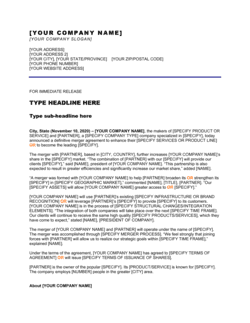
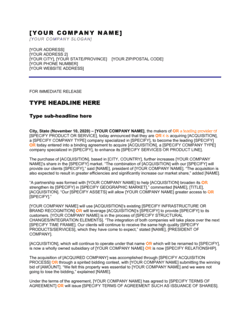
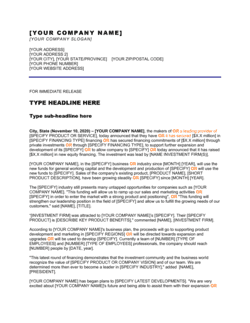
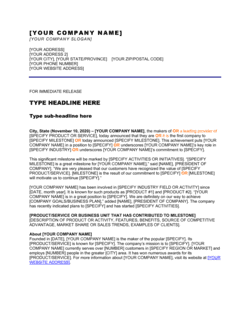
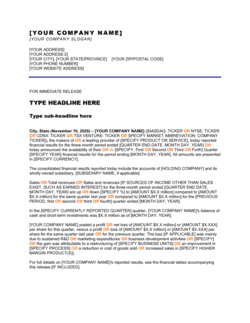
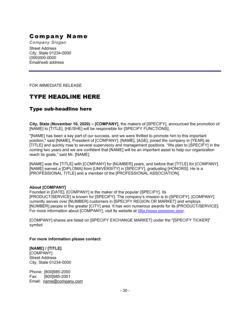
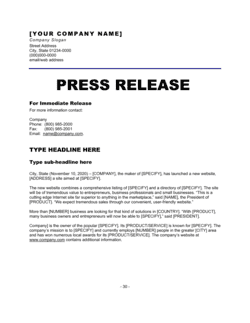
Press Release Company Has Expanded its Facilities Template

Free Word download • Edit online • Save & share with Drive • Export to PDF

2 pages20–30 min to fillDifficulty: StandardSignature requiredLegal review recommended
Learn more ↓
FreePress Release Company Has Expanded its Facilities Template

At a glance

What it is
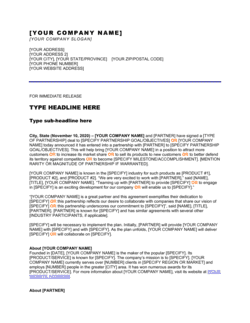
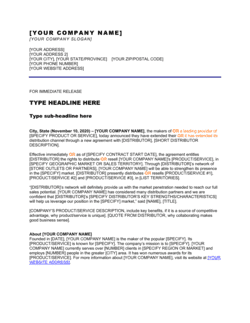
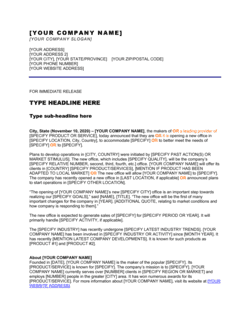
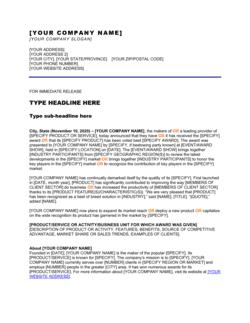
A Press Release: Company Has Expanded Its Facilities is a formal written announcement a business issues to media outlets, trade publications, and stakeholders to publicly communicate a facility expansion — new location, additional square footage, upgraded manufacturing capacity, or a new regional office. This free Word download gives you a structured, editor-ready starting point you can edit online and export as PDF to distribute to journalists, wire services, and your own communication channels.
When you need it
Issue it when your company opens a new facility, relocates to a larger space, adds a distribution center, or significantly upgrades existing premises — any time the physical growth of your operations is newsworthy to customers, partners, investors, or the local community. Timing matters: release it on or shortly before the day the expansion becomes operational or publicly visible.
What's inside
A compelling headline and dateline, a lead paragraph capturing the who-what-when-where-why, supporting paragraphs with expansion details and business rationale, executive and stakeholder quotes, a company boilerplate, and a media contact block — everything a journalist or editor needs to publish or broadcast the story without a follow-up call.

What is a Press Release: Company Has Expanded Its Facilities?

A Press Release: Company Has Expanded Its Facilities is a formal written announcement a business distributes to journalists, wire services, trade publications, and stakeholders to communicate that it has opened, enlarged, or significantly upgraded a physical location — whether a manufacturing plant, distribution center, retail site, or corporate office. Structured according to the inverted pyramid format used by every major newsroom, it delivers the complete story in the first paragraph and supports it with specific figures, executive perspective, and community context in the paragraphs that follow. The document ends with a standardized company boilerplate and a named media contact, giving editors and journalists everything they need to publish or broadcast the story without a follow-up call.

Why You Need This Document

A facility expansion is a significant business milestone — one that signals growth to customers, investment credibility to financial stakeholders, and employment opportunity to the surrounding community. Without a structured press release, that story goes untold or, worse, gets told inaccurately by third parties. A poorly formatted or factually incomplete announcement is ignored by editors who have no time to chase down missing details, and an announcement distributed without legal review can inadvertently create regulatory exposure for publicly traded companies or businesses operating under government incentive agreements. This template gives you a proven, editor-ready structure so the right story reaches the right audiences on the day your expansion becomes news — protecting your credibility and maximizing the earned media value of an investment your organization worked hard to make.

Which variant fits your situation?

If your situation is…Use this template
Announcing the opening of a brand-new company location from scratchPress Release — New Office Opening
Communicating a company relocation to a new addressPress Release — Company Relocation
Publicizing a new product line launching alongside the expansionPress Release — New Product Launch
Announcing a merger or acquisition that triggered the expansionPress Release — Merger and Acquisition
Sharing a significant company milestone alongside facility newsPress Release — Company Milestone
Notifying stakeholders of a facility expansion driven by new investmentPress Release — Funding Announcement
Informing employees about internal facility changes before the public announcementInternal Announcement Memo

Common mistakes to avoid

❌ Leading with the company name instead of the news

Why it matters: Editors receive hundreds of releases daily. A headline that starts with your company name instead of the actual news is skipped — your announcement never gets read or published.

Fix: Open the headline with the most compelling fact: square footage, job count, investment amount, or a specific market impact. Reserve the company name for the dateline and lead paragraph.

❌ Using vague figures instead of specific numbers

Why it matters: Phrases like 'significant expansion' and 'major investment' give journalists nothing to quote and signal that the company is either uninformed or evasive — both reduce pickup rates.

Fix: Replace every vague qualifier with a specific metric: exact square footage, dollar investment, headcount added, and percentage capacity increase. If a number is genuinely confidential, say 'eight-figure investment.'

❌ Omitting the media contact or using a shared inbox

Why it matters: Journalists on deadline will not track down a contact. A release with no named individual and direct phone number effectively has no chance of generating earned media coverage.

Fix: Include a named PR or communications contact with a direct phone number and dedicated email address. Confirm that person is reachable and briefed before distribution.

❌ Distributing before receiving executive and legal sign-off

Why it matters: A released announcement with factual errors, unauthorized disclosures, or inadvertent legal claims cannot be retracted cleanly — corrections compound reputational risk rather than resolving it.

Fix: Build a mandatory review step into every release workflow: legal reviews for accuracy and liability, the named executive approves their quote, and a senior communications lead does a final fact-check against source documents.

❌ Writing the boilerplate differently for each release

Why it matters: Inconsistent boilerplates confuse journalists who track your company across multiple announcements and can create contradictions in public-record databases that aggregate press releases.

Fix: Maintain a single approved boilerplate file, update it quarterly, and paste the identical paragraph at the end of every release without modification.

❌ Missing the embargo instruction or release date

Why it matters: A release distributed without a clear 'For Immediate Release' or embargo date will be published at whatever time the recipient decides — often before your organization, partners, or executives are ready to respond to inquiries.

Fix: Place the release instruction at the very top of the document in capitals, and if embargoed, specify the exact date, time, and time zone of the release window.

The 10 key clauses, explained

Release instruction and headline

In plain language: States whether the release is for immediate publication or under embargo, followed by a bold, attention-grabbing headline that summarizes the expansion news in one line.

Sample language
FOR IMMEDIATE RELEASE [COMPANY NAME] Expands [CITY/REGION] Facilities to [X] Square Feet, Adding [X] New Jobs

Common mistake: Writing a headline that leads with the company name instead of the news. Editors scan hundreds of releases; a name-first headline is ignored — lead with the most compelling fact.

Dateline and lead paragraph

In plain language: Opens with the city and date, then delivers the complete story in two to three sentences — who expanded, what they expanded, when it opens, where it is located, and why they expanded.

Sample language
[CITY], [STATE], [DATE] — [COMPANY NAME], a leading [INDUSTRY DESCRIPTION], today announced the expansion of its [FACILITY TYPE] at [ADDRESS], adding [X] square feet of [MANUFACTURING / OFFICE / DISTRIBUTION] space to support [BUSINESS RATIONALE].

Common mistake: Burying the news in the second or third paragraph. Journalists who don't get the story in the first three sentences move on — never make them search for the lead.

Expansion details paragraph

In plain language: Provides specific, verifiable facts about the facility: new square footage, investment amount, completion date, capacity increase, number of jobs created, and any notable features of the space.

Sample language
The expanded facility, located at [ADDRESS], totals [X,XXX] square feet — a [X]% increase over the company's previous [FACILITY TYPE]. The $[X]M investment will add [X] full-time positions by [QUARTER/YEAR] and increase production capacity by [X]% annually.

Common mistake: Using vague language like 'significant expansion' or 'major investment' without numbers. Specific figures — square footage, dollar amount, headcount — are what editors and business journalists actually quote.

Business rationale paragraph

In plain language: Explains the strategic reason for the expansion: demand growth, new market entry, operational consolidation, or customer proximity — connecting the facility news to the company's broader direction.

Sample language
The expansion reflects [COMPANY NAME]'s response to a [X]% increase in customer orders over the past [TIMEFRAME] and positions the company to serve [TARGET MARKET / GEOGRAPHY] more effectively. [COMPANY NAME] has operated in [CITY/REGION] since [YEAR].

Common mistake: Skipping the business rationale entirely and describing only the physical facility. Readers — especially investors and business press — need to understand what drove the decision, not just what was built.

Executive quote block

In plain language: An attributed, direct quotation from the CEO or a senior leader that adds strategic context, human voice, and a perspective the surrounding facts cannot convey.

Sample language
"This expansion is a direct response to the trust our customers have placed in us," said [EXECUTIVE NAME], [TITLE] of [COMPANY NAME]. "The new facility puts us in a position to [SPECIFIC OUTCOME — e.g., cut lead times by 30% for our [REGION] customers]."

Common mistake: Writing a generic, promotional quote like 'We are excited about this opportunity.' Journalists rarely publish quotes that contain no information. Make the quote specific: reference a metric, a customer outcome, or a strategic decision.

Community or stakeholder impact paragraph

In plain language: Addresses the local economic, environmental, or community significance of the expansion — job creation, local contractor involvement, sustainability features, or partnership with regional development bodies.

Sample language
[COMPANY NAME] worked with [LOCAL CONTRACTOR / DEVELOPER] on the build-out and expects to create [X] permanent positions and [X] construction jobs in [CITY/REGION]. The new facility incorporates [SUSTAINABILITY FEATURE, e.g., solar panels / LED lighting / water recycling systems].

Common mistake: Omitting community impact details when expanding into a new region. Local media — which drives significant pickup for facility announcements — prioritizes job creation and community investment over corporate strategy.

Secondary quote or third-party endorsement

In plain language: An optional second attributed quotation from a partner, public official, customer, or industry body that validates the expansion's significance from an outside perspective.

Sample language
"[COMPANY NAME]'s investment in [CITY] is exactly the kind of growth that strengthens our regional economy," said [NAME], [TITLE], [ORGANIZATION]. "We congratulate them on this milestone and look forward to their continued presence in our community."

Common mistake: Including a second internal quote from another company executive instead of a genuine third-party voice. Two internal quotes signal no external validation — they weaken, not strengthen, the release.

Call to action and additional information

In plain language: Directs journalists, customers, and partners to a website, an event (e.g., open house or ribbon cutting), or a contact for more information or site visits.

Sample language
For more information about [COMPANY NAME]'s expanded [FACILITY TYPE] or to schedule a media tour, visit [URL] or contact [MEDIA CONTACT NAME] at [EMAIL / PHONE].

Common mistake: Pointing readers to a generic homepage rather than a dedicated landing page or press kit URL. A specific URL makes it easier for journalists to find assets and reduces follow-up friction.

Company boilerplate

In plain language: A standardized paragraph describing the company — founding year, industry, product or service description, geographic reach, and key differentiators — used consistently across all press releases.

Sample language
About [COMPANY NAME]: Founded in [YEAR], [COMPANY NAME] is a [CITY]-based [INDUSTRY] company that [DESCRIPTION OF WHAT IT DOES] for [TARGET CUSTOMER DESCRIPTION]. With [X] employees across [X] locations, [COMPANY NAME] serves [X] customers in [X] countries. Learn more at [URL].

Common mistake: Updating the boilerplate with expansion-specific language. The boilerplate should stay evergreen and consistent across all releases — expansion details belong in the body, not the boilerplate.

Media contact block and end marker

In plain language: Lists the name, title, direct phone number, and email of the PR contact, followed by the standard '###' end-of-release marker.

Sample language
Media Contact: [NAME] [TITLE] [COMPANY NAME] [PHONE NUMBER] [EMAIL ADDRESS] ###

Common mistake: Providing a general company inbox instead of a named individual's direct contact. Journalists on deadline skip releases that route them to info@ addresses — a named contact with a direct line gets callbacks.

How to fill it out

  1. 1

    Set the release instruction and write the headline

    Decide whether the release is for immediate publication or under embargo with a specific date and time. Then write a headline that leads with the most compelling fact — square footage, job count, or investment amount — rather than the company name.

    💡 Test your headline by reading it in isolation: does a stranger understand the news without reading a word of the body? If not, rewrite it.

  2. 2

    Complete the dateline and lead paragraph

    Enter the city of origin and today's date. Write two to three sentences that answer who, what, when, where, and why. Every essential fact should appear here — treat the rest of the release as supporting evidence.

    💡 Read the lead out loud. If you need more than 15 seconds to say it, it's too long.

  3. 3

    Add specific facility and investment details

    Fill in exact square footage, investment amount, address, opening date, new headcount, and capacity metrics. Round numbers are acceptable for projections; use actuals wherever possible.

    💡 If the exact investment figure is confidential, write 'a multi-million-dollar investment' — but always include square footage and headcount, which are routinely public.

  4. 4

    Write the business rationale paragraph

    Explain in two to three sentences why the expansion happened now — demand growth, market entry, consolidation, or operational need. Tie it to a specific business metric or trend to give editors context.

    💡 Link the rationale to a number: 'driven by a 40% increase in orders over the past 18 months' is publishable; 'driven by strong demand' is not.

  5. 5

    Draft and attribute executive quotes

    Write a first-person quote from the CEO or most senior relevant executive. Make it specific — reference a customer outcome, a metric, or a strategic intent. Get written approval from the executive before releasing.

    💡 Write the quote yourself and get sign-off; executives rarely produce quotable language on their own and the delay will hold up your release.

  6. 6

    Add community impact and a third-party quote

    State the number of jobs created, any local partners involved, and any sustainability features of the new facility. If a public official, customer, or partner is willing to be quoted, include their attribution here.

    💡 Reach out to the relevant economic development office or city council contact at least two weeks before your release date — they often need internal approval to provide a quote.

  7. 7

    Insert the boilerplate and media contact

    Paste your standard company boilerplate paragraph after the '###' end marker, then fill in the media contact block with a named individual's direct phone and email.

    💡 Keep one master boilerplate file and version it quarterly — nothing looks less professional than a boilerplate that lists outdated headcount or an old address.

  8. 8

    Proofread, approve, and distribute

    Verify every fact — addresses, dollar amounts, dates, and names — against source documents before sign-off. Route for internal legal and executive approval, then distribute via wire service and direct media contacts simultaneously.

    💡 A factual error in a press release — wrong address, incorrect job count, misspelled executive name — requires a correction release and damages credibility with editors you will need again.

Frequently asked questions

What is a press release for a facility expansion?

A facility expansion press release is a formal written announcement a company issues to media outlets, wire services, and stakeholders to communicate that it has opened, enlarged, or upgraded a physical location. It follows standard press release structure — headline, dateline, lead paragraph, supporting detail, executive quotes, boilerplate, and media contact — and is designed so a journalist can publish or broadcast the story without needing additional information.

When should I send a press release about a facility expansion?

The ideal timing is on or within one to two days of the expansion becoming publicly visible or operationally active — such as an opening day or a ribbon-cutting event. For major expansions involving significant investment or job creation, distributing two to three days before the opening gives journalists time to prepare stories. Avoid releasing on Fridays or before public holidays, when newsroom coverage is lightest.

What should a facility expansion press release include?

At minimum: a news-forward headline, a dateline, a lead paragraph covering the five W's, specific facility details (square footage, address, investment amount, jobs created), a business rationale, an attributed executive quote, community or economic impact information, a company boilerplate, and a media contact with a direct phone number and email. Missing any of these reduces the likelihood of media pickup.

Does a press release need to be signed or legally reviewed?

Press releases do not require a signature to be distributed, but legal review is strongly recommended before release. Any public statement about investment amounts, job commitments, expansion timelines, or environmental claims can create legal or regulatory exposure — particularly for publicly traded companies subject to securities disclosure rules. A brief legal review catches inadvertent material disclosures, unverified claims, and language that could trigger regulatory scrutiny.

How long should a facility expansion press release be?

The standard length is 400 to 600 words — roughly one printed page. This gives enough space for all essential facts, two quotes, and the boilerplate without padding. Editors rarely read beyond 600 words; anything longer signals that the communicator does not understand how newsrooms work. Detailed backgrounders, fact sheets, or photos should be attached separately or linked from a press kit URL.

Should I use a wire service to distribute a facility expansion press release?

For expansions involving significant investment, job creation, or new geographic markets, yes — a wire service like PR Newswire or Business Wire reaches thousands of journalists and indexes the release in financial databases investors and analysts monitor. For purely local announcements (a single storefront move, for example), direct outreach to local business editors and the relevant trade press is often more cost-effective than a full wire distribution.

What is the difference between a press release and a media advisory?

A press release is a complete, publish-ready announcement distributed when the news has happened or is happening. A media advisory invites journalists to cover an upcoming event — such as a ribbon-cutting ceremony — and provides logistical details (date, time, location, who will be available for comment) rather than a complete news story. For a facility expansion, companies often issue both: a media advisory before the opening and a press release on the day.

Can a small business use this press release template?

Yes. The same structure that works for a Fortune 500 facility opening works for a local manufacturer moving to a larger shop or a regional retailer opening a second location. Adjust the scale of the facts (square footage, investment, headcount) and target local business journals, trade publications, and community news outlets rather than national wire services. Local editors are often more receptive to small business facility announcements than national outlets, particularly when the story includes meaningful local job creation.

How do I get local officials or economic development agencies to provide a quote?

Contact the relevant mayor's office, city council communications team, or regional economic development authority at least two to three weeks before your release date. Provide a draft quote for them to approve or modify — officials rarely write their own press release quotes, and offering a starting draft accelerates the process significantly. Frame the request around the community benefit (jobs, investment, tax base) rather than your company's promotional goals.

How this compares to alternatives

vs Press Release — New Office Opening

A new office opening release announces the establishment of a location that did not previously exist, typically emphasizing market entry and new team presence. A facility expansion release communicates growth at an existing or adjacent site, emphasizing investment, capacity, and operational scaling. Both use the same structural format but differ in the business rationale and supporting metrics they highlight.

vs Press Release — Company Relocation

A relocation release focuses on a change of address — closing one site and opening another — and must address continuity of service and the reason for the move. A facility expansion release communicates growth without closure, making it a purely positive announcement. Relocation releases require more careful handling of any negative implications for existing staff or customers at the departing location.

vs Internal Announcement Memo

An internal memo communicates facility changes to employees before or instead of external publication — covering operational details, moving schedules, and impact on day-to-day work that should not appear in a public press release. A press release is written for journalists and external audiences and should never include internal operational detail. Companies typically issue the internal memo first, then the external press release.

vs Media Advisory

A media advisory invites journalists to cover a specific event — such as a ribbon-cutting or facility tour — and provides logistical details rather than a full story. A press release is a complete, publish-ready announcement. For significant facility expansions, both are typically used in sequence: the media advisory precedes the event, and the press release distributes on opening day for outlets that do not attend in person.

Industry-specific considerations

Manufacturing

Production capacity increases, new equipment installation, and workforce additions are the headline metrics — trade press and B2B customers respond to specific throughput and lead-time improvements.

Retail and E-commerce

New distribution center openings, flagship store expansions, and fulfillment capacity increases tie directly to customer delivery speed commitments and regional market entry.

Technology / SaaS

Engineering hub openings, data center expansions, and new regional offices signal hiring intent and product investment — particularly relevant to talent acquisition and enterprise customer confidence.

Healthcare

Clinic expansions, new laboratory facilities, and medical office buildouts require additional regulatory compliance language and careful framing of patient capacity and service area claims.

Food and Beverage

Production facility expansions typically highlight food safety certifications, expanded SKU capacity, and regional distribution reach — key signals for retail buyers and foodservice partners.

Professional Services

New regional office openings emphasize headcount growth, client proximity, and market commitment — the announcement targets both prospective clients and talent recruitment simultaneously.

Jurisdictional notes

United States

Publicly traded companies must ensure facility expansion announcements do not constitute material non-public information released selectively — Regulation FD requires simultaneous broad distribution. Companies receiving state or local economic development incentives (tax abatements, grants) may have contractual obligations to issue a public announcement. The SEC monitors press releases from listed companies for misleading forward-looking statements about job creation or investment figures.

Canada

TSX and TSX Venture Exchange-listed companies are subject to timely disclosure requirements under National Instrument 51-102; a significant facility expansion may constitute a material change requiring a news release filed on SEDAR+. Companies receiving federal or provincial investment incentives — such as through the Canada Growth Fund or provincial economic development agencies — often have grant-condition obligations tied to public announcement timing. Quebec-based companies should ensure the French-language version of the release is filed simultaneously for provincially regulated entities.

United Kingdom

AIM and Main Market-listed companies must assess whether a facility expansion constitutes 'inside information' requiring a Regulatory Information Service (RIS) announcement under the UK Market Abuse Regulation. Press releases making forward-looking statements about employment or investment must include standard forward-looking statement disclaimers to comply with the Companies Act 2006 and Financial Conduct Authority guidance. UK releases typically include a registered office address and Companies House registration number in the boilerplate.

European Union

EU-listed companies are subject to the Market Abuse Regulation (MAR), which governs disclosure of inside information including material facility investments. GDPR considerations arise if the press release names individual employees beyond C-suite executives — obtaining consent or limiting personal data to senior leaders is advisable. Companies receiving EU Cohesion Funds or state aid for facility expansions are typically required to acknowledge public funding in communications materials and may have logo and acknowledgment obligations tied to grant conditions.

Template vs lawyer — what fits your deal?

PathBest forCostTime
Use the templatePrivate companies announcing routine facility expansions with no regulatory disclosure obligationsFree2–4 hours to draft and finalize
Template + legal reviewCompanies making specific financial claims, job commitments, or environmental statements that could attract scrutiny$150–$400 for a communications attorney or PR counsel review1–2 business days
Custom draftedPublicly traded companies subject to securities disclosure rules, or expansions involving government incentives, environmental permits, or labor agreements$500–$2,000+ for legal and communications counsel3–7 business days

Glossary

Dateline
The line at the start of a press release body that states the city of origin and the release date, e.g., 'NEW YORK, May 2, 2026 —'.
Boilerplate
A standardized paragraph at the end of every press release that describes the company — who it is, what it does, where it operates, and where to learn more.
For Immediate Release
An instruction at the top of the document telling recipients they may publish the content as soon as they receive it, with no embargo.
Embargo
A request that recipients hold the story until a specified date and time, typically used to coordinate simultaneous publication across outlets.
Lead Paragraph
The opening paragraph of the press release body, answering who, what, when, where, and why in no more than two or three sentences.
Quote Block
A section containing attributed, direct quotations from executives or stakeholders that add human voice and editorial authority to the announcement.
Wire Service
A distribution network — such as PR Newswire or Business Wire — that syndicates press releases to thousands of media outlets simultaneously.
Media Contact
The name, title, phone number, and email of the person journalists should call for interviews, follow-up questions, or additional assets.
Inverted Pyramid
A standard news-writing structure where the most important information appears first and supporting detail follows in descending order of significance.
Call to Action (CTA)
A closing instruction pointing readers to a website, event, or contact point for more information — typically the last line before the boilerplate.
###
Three hash symbols centered below the final line of the press release body, serving as the universal editorial signal that the document has ended.

Part of your Business Operating System

This document is one of 3,000+ business & legal templates included in Business in a Box.

  • Fill-in-the-blanks — ready in minutes
  • 100% customizable Word document
  • Compatible with all office suites
  • Export to PDF and share electronically

Create your document in 3 simple steps.

From template to signed document — all inside one Business Operating System.
1
Download or open template

Access over 3,000+ business and legal templates for any business task, project or initiative.

2
Edit and fill in the blanks with AI

Customize your ready-made business document template and save it in the cloud.

3
Save, Share, Send, Sign

Share your files and folders with your team. Create a space of seamless collaboration.

Save time, save money, and create top-quality documents.

★★★★★

"Fantastic value! I'm not sure how I'd do without it. It's worth its weight in gold and paid back for itself many times."

Managing Director · Mall Farm
Robert Whalley
Managing Director, Mall Farm Proprietary Limited
★★★★★

"I have been using Business in a Box for years. It has been the most useful source of templates I have encountered. I recommend it to anyone."

Business Owner · 4+ years
Dr Michael John Freestone
Business Owner
★★★★★

"It has been a life saver so many times I have lost count. Business in a Box has saved me so much time and as you know, time is money."

Owner · Upstate Web
David G. Moore Jr.
Owner, Upstate Web

Run your business with a system — not scattered tools

Stop downloading documents. Start operating with clarity. Business in a Box gives you the Business Operating System used by over 250,000 companies worldwide to structure, run, and grow their business.

Start free · No credit card required