Press Release Company Has Received Financing Template

Free Word download • Edit online • Save & share with Drive • Export to PDF

2 pages20–30 min to fillDifficulty: StandardSignature requiredLegal review recommended
Learn more ↓
FreePress Release Company Has Received Financing Template

At a glance

What it is
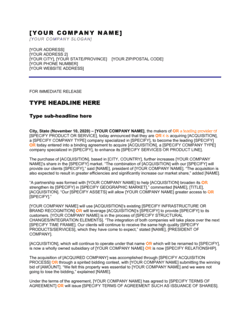
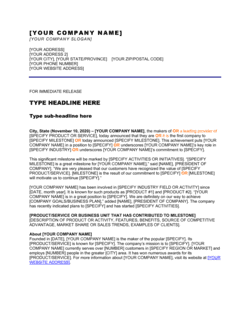
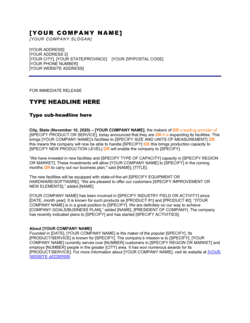
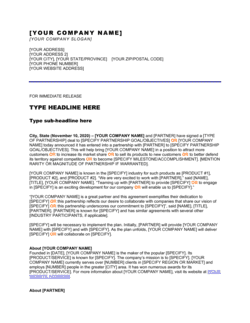
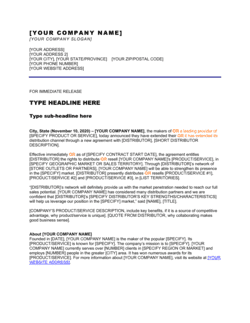
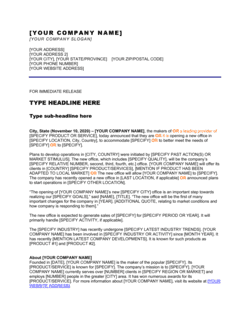
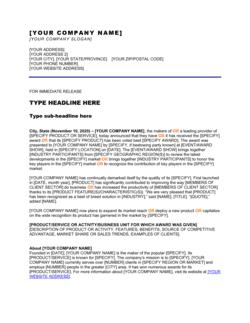
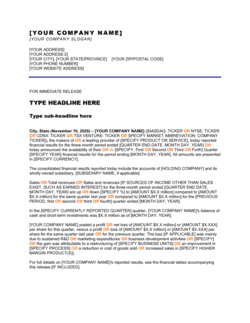
A Press Release: Company Has Received Financing is a formal public announcement issued by a company to notify media, investors, partners, and the public that the business has secured a new round of debt or equity financing. This free Word download gives you a structured, investor-ready template you can edit online and export as PDF — covering headline, deal summary, investor details, use of funds, executive quotes, and boilerplate in a single professional document.
When you need it
Issue it immediately after closing a financing round — seed, Series A through C, venture debt, bank loan, or strategic investment — once all legal documents are signed and any applicable securities disclosure requirements are satisfied. Timing is typically coordinated with the lead investor's communications team.
What's inside
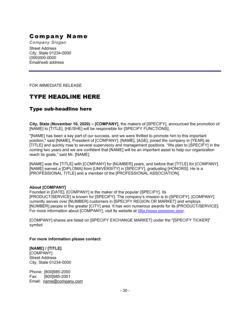
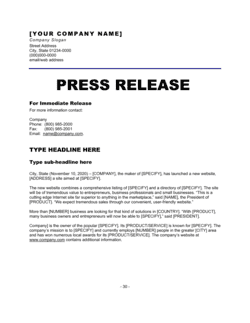
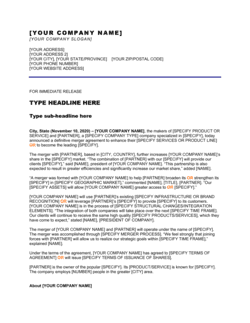
A compelling headline and dateline, a lead paragraph summarizing the round size and investor names, supporting paragraphs on use of funds and company milestones, attributed quotes from the CEO and lead investor, a boilerplate company description, and media contact information.

What is a Press Release: Company Has Received Financing?

A Press Release: Company Has Received Financing is a formal public announcement issued by a company to notify journalists, investors, partners, and the broader market that the business has successfully closed a new financing round — whether equity, convertible debt, venture debt, or a bank facility. It establishes the official public record of the transaction by naming the investors, stating the amount raised, specifying the intended use of proceeds, and providing attributed quotes from company leadership and the lead investor. For publicly traded and pre-IPO companies, the release also functions as part of the regulated disclosure framework, making accuracy, timing, and proper legal qualification of its contents legally significant — not merely a communications formality.

Why You Need This Document

Failing to issue a professional, legally reviewed financing announcement creates risks on multiple fronts simultaneously. For public companies, delayed or incomplete disclosure of a material financing event can trigger regulatory enforcement under Regulation FD, UK MAR, or EU MAR. For private companies, a poorly drafted release that names investors without their written consent or includes unqualified forward-looking metrics can damage investor relationships, invite retraction demands, and create liability exposure if the company later pursues a public offering and the release is incorporated into prospectus diligence. Beyond compliance, a financing announcement is one of the highest-leverage marketing and credibility signals a company can issue — attracting talent, reassuring customers, and signaling momentum to future investors. This template gives you the structure to get it right the first time, with the correct legal language, the right approval workflow, and the professional format that wire services and financial journalists expect.

Which variant fits your situation?

If your situation is…Use this template
Announcing an equity seed or pre-seed round from angel investorsPress Release Company Has Received Financing
Announcing a Series A or later venture capital roundPress Release New Investor
Announcing a strategic partnership with a corporate investorPress Release New Partnership
Announcing an acquisition or merger alongside financingPress Release Acquisition
Announcing a bank loan or credit facility to trade partnersPress Release Company Has Received Financing
Publicly traded company disclosing a material financing event8-K Filing Announcement Template
Announcing a grant or government funding awardPress Release Award Received

Common mistakes to avoid

❌ Releasing before the deal legally closes

Why it matters: Announcing a financing before documents are signed creates potential securities liability, investor relations problems, and reputational risk if the deal subsequently falls through.

Fix: Establish a formal go/no-go gate requiring confirmation from legal counsel and the CFO that all transaction documents are fully executed before the release is distributed.

❌ Using unverified or forward-looking metrics without qualification

Why it matters: Including projected or unaudited figures as if they were confirmed results can trigger securities fraud exposure for public companies and mislead journalists into publishing inaccurate stories.

Fix: Label all projections explicitly as forward-looking, include the safe harbor disclaimer, and have the CFO sign off on every metric before distribution.

❌ Naming investors without written approval

Why it matters: Some institutional funds, family offices, and corporate investors have strict policies against being named in external communications without prior approval — violating this can damage the relationship and trigger a retraction request.

Fix: Build a written approval checklist for every investor named in the release and archive the approvals with your deal records before submitting to the wire.

❌ Generic or unattributed executive quotes

Why it matters: Quotes that consist of boilerplate phrases like 'we are excited to partner' are routinely cut by journalists and reduce the overall quality and credibility of the release.

Fix: Draft quotes that include a specific claim about market opportunity, product roadmap, or investment thesis — and obtain written approval from the named executive before publication.

❌ Omitting the safe harbor disclaimer for pre-IPO companies

Why it matters: Press releases issued in the 12–24 months before an IPO can be incorporated into prospectus diligence; unqualified forward-looking statements create material liability under securities law.

Fix: Have securities counsel review any press release containing financial projections, growth targets, or market share claims if an IPO is reasonably anticipated within two years.

❌ Distributing to wire services with an outdated boilerplate

Why it matters: Archived press releases with inconsistent company descriptions, wrong headcounts, or discontinued products create factual conflicts that journalists and analysts will notice during due diligence.

Fix: Maintain a master boilerplate file reviewed quarterly by the communications team and approved by the CEO — pull from this file for every external release.

The 10 key clauses, explained

Headline

In plain language: A single declarative sentence that names the company, states the funding amount, and identifies the lead investor — the first element journalists read.

Sample language
[COMPANY NAME] Raises $[AMOUNT] [ROUND TYPE] Led by [LEAD INVESTOR] to [PRIMARY USE OF FUNDS]

Common mistake: Writing a headline that omits the dollar amount or investor name. Editors routinely spike releases whose headlines don't answer 'who, how much, and from whom' at a glance.

Dateline and Release Timing

In plain language: States the city, date, and whether the release is 'for immediate release' or under embargo until a specified time.

Sample language
[CITY], [STATE] — [MONTH DD, YYYY] — FOR IMMEDIATE RELEASE / EMBARGOED UNTIL [DATE] AT [TIME] [TIMEZONE]

Common mistake: Marking a release 'for immediate release' before all legal transaction documents have been signed and any required regulatory notifications have been filed.

Lead Paragraph (The Lede)

In plain language: Answers who, what, when, where, and why in two to three sentences — the single most important paragraph because most journalists read no further.

Sample language
[COMPANY NAME], a [BRIEF DESCRIPTION], today announced it has raised $[AMOUNT] in [ROUND TYPE] financing led by [LEAD INVESTOR], with participation from [CO-INVESTORS]. The funds will be used to [PRIMARY USE OF PROCEEDS].

Common mistake: Burying the funding amount in the second or third paragraph. Journalists who don't see the key facts in the lede move to the next release.

Company and Milestone Context

In plain language: Two to four sentences providing business context — what the company does, its traction metrics, and the milestone that motivated the raise.

Sample language
Founded in [YEAR], [COMPANY NAME] has [TRACTION METRIC — e.g., served over X customers / reached $X ARR / expanded to X markets]. This round follows [RECENT MILESTONE] and positions the company to [STRATEGIC GOAL].

Common mistake: Including unverified or aspirational metrics alongside confirmed ones without distinguishing between them. A single inaccurate claim can prompt a correction request or retraction.

Use of Funds

In plain language: Explains specifically how the capital will be deployed — product development, headcount, geographic expansion, infrastructure, or debt paydown.

Sample language
The proceeds will be used to accelerate [PRODUCT INITIATIVE], expand the team from [CURRENT HEADCOUNT] to [TARGET HEADCOUNT] by [DATE], and enter [NEW MARKET/GEOGRAPHY].

Common mistake: Stating only 'general corporate purposes' as the use of funds. This is acceptable in securities filings but reads as evasive in a press release and reduces journalist and investor interest.

CEO Quote

In plain language: An attributed statement from the CEO or founder that provides strategic context, expresses confidence in the business, and is approved verbatim before distribution.

Sample language
'[QUOTE ABOUT COMPANY VISION AND WHAT THIS FINANCING ENABLES],' said [CEO NAME], [TITLE] of [COMPANY NAME]. '[SECOND SENTENCE ON PARTNER OR MARKET OPPORTUNITY].'

Common mistake: Using generic executive-speak like 'We are delighted to welcome our valued partners on this exciting journey.' Specific statements about market opportunity or product roadmap are more credible and more likely to be reproduced by journalists.

Lead Investor Quote

In plain language: An attributed statement from a partner or managing director at the lead investment firm explaining the investment thesis and the investor's confidence in the company.

Sample language
'[QUOTE EXPLAINING INVESTMENT THESIS AND WHAT IMPRESSED THE INVESTOR],' said [INVESTOR NAME], [TITLE] at [FUND NAME]. '[SECOND SENTENCE ON COMPANY'S DIFFERENTIATION OR MARKET POSITION].'

Common mistake: Omitting the investor quote entirely or using a placeholder that was never approved. An unverified quote published on a wire service creates legal exposure and damages the investor relationship.

Investor and Round Details

In plain language: Lists all participating investors, states the round type (equity, convertible note, SAFE, venture debt), and — where disclosed — mentions any board seats or observer rights granted.

Sample language
The [ROUND TYPE] round included participation from [CO-INVESTOR 1], [CO-INVESTOR 2], and [CO-INVESTOR 3]. [LEAD INVESTOR PARTNER NAME] will join [COMPANY NAME]'s Board of Directors.

Common mistake: Listing an investor without their written approval to be named publicly. Some institutional funds have policies against being named in portfolio company press releases without prior sign-off.

Safe Harbor / Forward-Looking Statement Disclaimer

In plain language: A legal disclaimer — required for public companies and advisable for pre-IPO companies — stating that forward-looking statements are not guarantees and that actual results may differ materially.

Sample language
This press release contains forward-looking statements within the meaning of [APPLICABLE SECURITIES ACT]. These statements involve known and unknown risks and uncertainties. Actual results may differ materially from those expressed or implied.

Common mistake: Omitting the safe harbor disclaimer for pre-IPO companies preparing for a public offering. Statements in press releases can be incorporated into IPO prospectus diligence and create liability if not properly qualified.

Boilerplate and Media Contact

In plain language: A standardized 'About [Company]' paragraph summarizing the business for journalists, followed by the name, phone number, and email of the designated media contact.

Sample language
About [COMPANY NAME]: [COMPANY NAME] is a [DESCRIPTION] that [WHAT IT DOES] for [TARGET CUSTOMER]. Founded in [YEAR] and headquartered in [CITY], the company has [KEY FACT]. For more information, visit [WEBSITE]. Media Contact: [NAME] | [EMAIL] | [PHONE]

Common mistake: Using an outdated boilerplate that references superseded metrics, a prior headquarters address, or products that have been discontinued — creating factual inconsistencies across archived media coverage.

How to fill it out

  1. 1

    Confirm legal close and disclosure clearance before drafting

    Verify that all transaction documents are fully executed and that your legal counsel has confirmed no regulatory disclosure restrictions apply. For publicly traded companies, coordinate with securities counsel on Reg FD compliance.

    💡 Set a single internal 'go/no-go' sign-off date so the release does not circulate externally before the deal is legally complete.

  2. 2

    Draft the headline with the five key facts

    Include the company name, the round amount, the round type, the lead investor name, and the primary use of funds. Every word in the headline should carry weight.

    💡 Write three headline variants and test them with a colleague unfamiliar with the deal — the one that generates the most questions is the clearest.

  3. 3

    Write the lede with the full deal summary

    Compress the most newsworthy facts into the first two to three sentences: company description, amount raised, round type, lead investor, co-investors, and primary use of proceeds.

    💡 Read the lede aloud. If it takes longer than 15 seconds, it is too long.

  4. 4

    Insert verified traction metrics in the context paragraph

    Pull two to three quantified metrics that demonstrate business momentum — revenue, customer count, ARR growth, or geographic footprint. Confirm each figure with the CFO before including it.

    💡 Match the metric to what matters most to your investor audience: ARR for SaaS, GMV for marketplaces, units shipped for hardware.

  5. 5

    Obtain and finalize all executive and investor quotes

    Draft proposed quotes for the CEO and lead investor, then circulate for written approval from each party. Do not finalize the release until every named individual has approved their own quote in writing.

    💡 Send quotes with a 48-hour approval deadline so approval tracking does not become the bottleneck on your release timeline.

  6. 6

    Add the investor list with written consent from each party

    List every participating investor by their fund's legal name. Obtain written approval from each fund's communications team before naming them.

    💡 Create a simple approval tracker spreadsheet — fund name, contact, approval status, date received — and archive it with your deal documents.

  7. 7

    Insert the safe harbor disclaimer if required

    For publicly traded or late-stage pre-IPO companies, include a forward-looking statement disclaimer drafted or reviewed by securities counsel. Include references to the applicable securities act for your jurisdiction.

    💡 Use a jurisdiction-specific safe harbor template rather than copying a generic disclaimer — US, Canadian, and UK/EU formulations differ in material ways.

  8. 8

    Update the boilerplate and verify the media contact

    Confirm the boilerplate accurately reflects current headcount, headquarters, product description, and website. Assign a single named media contact who will be available on the day of distribution.

    💡 Create a calendar hold for the media contact on the release day — inbound press inquiries typically arrive within 30 minutes of wire distribution.

Frequently asked questions

What is a press release announcing a financing round?

A financing press release is a formal public announcement issued by a company to inform media, investors, customers, and partners that the business has closed a new round of capital — equity, debt, or a convertible instrument. It states the amount raised, the investors involved, the intended use of proceeds, and provides attributed quotes from the CEO and lead investor. Distributed via wire services and direct media outreach, it creates the official public record of the financing event.

When should a company issue a press release about receiving financing?

Issue the release only after all transaction documents are fully executed and any applicable regulatory or securities disclosure requirements have been satisfied. For publicly traded companies, material financing events typically require an 8-K filing before or simultaneously with the press release. For private companies, the release can go out immediately upon legal close or under embargo to coordinate simultaneous media coverage.

What information should a financing press release include?

A complete financing press release includes: a headline naming the company, amount, and lead investor; a dateline and release timing; a lede paragraph summarizing the deal; context on company traction and milestones; use of proceeds; an attributed CEO quote; an attributed lead investor quote; the full investor list with their consent; a safe harbor disclaimer if applicable; and a boilerplate company description with media contact details.

Do I need investor approval before naming them in the press release?

Yes, in practice. While there is no universal legal requirement to obtain investor consent before naming them in a press release, most institutional funds, corporate venture arms, and family offices have explicit policies requiring prior written approval before being named in external communications. Naming an investor without consent can damage the relationship and may require a public retraction. Build a written approval process into your release timeline.

Should a private company include a safe harbor disclaimer?

Private companies are not subject to the same Regulation FD and securities disclosure rules as public companies, but including a safe harbor disclaimer is advisable for any late-stage private company that anticipates an IPO within two years, has issued public debt, or is subject to reporting obligations under its financing documents. The disclaimer protects against liability if projected metrics cited in the release differ materially from actual results.

How long should a financing press release be?

The standard length for a financing press release is 400–600 words, excluding the boilerplate and safe harbor disclaimer. Longer releases lose journalist attention; shorter ones omit context investors and reporters need. The lede and context paragraphs should carry the essential facts, with quotes and investor detail in the middle section, and the boilerplate at the close.

How do I distribute a financing press release?

Use a paid wire service such as PR Newswire, Business Wire, or Globe Newswire to reach financial databases, news outlets, and investor aggregators simultaneously. Simultaneously email the release directly to beat reporters, sector analysts, and industry newsletters that cover your space. Coordinate distribution timing with your lead investor's communications team and any syndication partners who plan their own announcement.

What is an embargo and when should I use one for a financing announcement?

An embargo is an agreement with journalists to hold the story until a specified date and time. Use an embargo when you want coordinated coverage across multiple outlets — allowing reporters time to write their stories and have them ready to publish simultaneously at the lift time. Embargoes work best with reporters who cover your sector regularly; breaking an embargo is rare but does happen, so limit pre-briefings to journalists with a track record of honoring them.

How this compares to alternatives

vs Press Release New Product

A new-product press release announces a specific offering to customers and the media — its focus is features, availability, and pricing. A financing press release targets investors, analysts, and financial media with deal terms, investor names, and use of proceeds. The audience, tone, and required approvals differ substantially between the two.

vs Press Release New Partnership

A partnership press release announces a commercial or strategic alliance between two companies, requiring approval and quotes from both parties. A financing press release announces a capital transaction requiring investor consent and, for public companies, securities disclosure compliance. Both require attributed quotes but serve different strategic communication goals.

vs Investor Term Sheet

A term sheet is a private, non-binding document setting out the proposed terms of an investment before legal close. A financing press release is a public communication issued after close, announcing the completed deal to the market. The term sheet precedes the transaction; the press release follows it — and should never be issued until the term sheet has converted into fully executed transaction documents.

vs Shareholder Letter

A shareholder letter is addressed directly to existing equity holders and provides a detailed narrative on business performance, strategy, and capital allocation — typically on a quarterly or annual basis. A financing press release is a public-facing media document announcing a single capital event to a broad external audience. The shareholder letter goes deeper; the press release goes wider.

Industry-specific considerations

Technology / SaaS

ARR growth, net revenue retention, and product roadmap milestones are the traction metrics investors and journalists expect to see in a SaaS financing announcement.

Healthcare / MedTech

Clinical trial progress, FDA clearance milestones, and reimbursement code approvals provide the regulatory context that makes a healthcare financing announcement credible to specialist media.

Financial Services / Fintech

Regulatory licensing status, transaction volume, and regulatory compliance milestones are material context that fintech press releases must include to satisfy both media and regulator expectations.

Manufacturing and Industrial

Capacity expansion plans, capex deployment timelines, and supply chain investment details give manufacturing financing announcements the operational specificity that trade press and B2B audiences require.

Jurisdictional notes

United States

Publicly traded companies must comply with SEC Regulation FD, which prohibits selective disclosure of material information. A financing event typically triggers an 8-K filing requirement within four business days of closing. Forward-looking statements require safe harbor language under the Private Securities Litigation Reform Act of 1995. Private companies face fewer mandatory disclosure rules but must still comply with state blue sky laws and any disclosure obligations embedded in their financing documents.

Canada

Publicly reporting issuers in Canada must file a material change report under National Instrument 51-102 when a financing constitutes a material change, typically within ten days. The TSX and TSXV require timely disclosure of financings that meet materiality thresholds. Forward-looking information in press releases must comply with NI 51-102 forward-looking information disclosure requirements, including identification of material assumptions and risk factors. Quebec-incorporated companies should issue bilingual releases for French-language media markets.

United Kingdom

Companies listed on the London Stock Exchange or AIM must comply with the UK Market Abuse Regulation (UK MAR) and disclose inside information — including material financings — as soon as possible via a Regulatory Information Service. Unlisted private companies have no mandatory public disclosure obligation but should ensure the release does not constitute a financial promotion under the Financial Services and Markets Act 2000 without appropriate approvals. The FCA monitors press releases of listed issuers for compliance.

European Union

EU-listed companies are subject to the Market Abuse Regulation (EU MAR), which requires immediate disclosure of inside information, including material financing events, through an approved publication mechanism. GDPR considerations apply if the release includes personal data about named individuals beyond basic professional information. Member state securities regulators — the AMF in France, BaFin in Germany, CONSOB in Italy — each apply EU MAR through national enforcement frameworks, so local counsel review is advisable for cross-border listings.

Template vs lawyer — what fits your deal?

PathBest forCostTime
Use the templatePrivate companies announcing a seed or Series A round with no public securities obligationsFree2–4 hours
Template + legal reviewLate-stage private companies, pre-IPO issuers, or any company including forward-looking financial metrics$300–$800 for a communications attorney or securities counsel review1–2 days
Custom draftedPublicly traded companies, regulated financial institutions, or companies with complex multi-jurisdiction disclosure obligations$1,500–$5,000+ for full securities counsel drafting and review3–7 days

Glossary

Lead Investor
The investor or firm that contributes the largest share of a financing round and typically sets its terms.
Pre-money Valuation
The agreed value of the company immediately before the new investment is added, used to calculate each investor's ownership percentage.
Use of Proceeds
A description of how the company intends to deploy the capital raised — product development, hiring, geographic expansion, and so on.
Boilerplate
A standardized paragraph at the end of every press release describing the company's business, founding date, and key facts for journalists who are unfamiliar with the firm.
Wire Service
A paid distribution service — such as PR Newswire or Business Wire — that delivers a press release to thousands of news outlets and financial databases simultaneously.
Embargo
An agreement with journalists to hold a story until a specified date and time, allowing the company to coordinate coverage across multiple outlets.
Safe Harbor Statement
A legal disclaimer included in press releases by publicly traded or pre-IPO companies stating that forward-looking statements involve risks and may differ from actual results.
Material Information
Information that a reasonable investor would consider important when making an investment decision — a financing round typically qualifies and triggers disclosure obligations for public companies.
Attributed Quote
A direct quotation credited to a named executive or investor, approved in advance, that adds a human perspective to the announcement and is reproduced verbatim by media.
Round Size
The total amount of capital committed or closed in a single financing event, expressed in dollars or the relevant currency.
Accredited Investor
An individual or entity meeting SEC (or equivalent) financial thresholds — typically $200,000 annual income or $1M net worth — permitted to invest in unregistered securities.

Part of your Business Operating System

This document is one of 3,000+ business & legal templates included in Business in a Box.

  • Fill-in-the-blanks — ready in minutes
  • 100% customizable Word document
  • Compatible with all office suites
  • Export to PDF and share electronically

Create your document in 3 simple steps.

From template to signed document — all inside one Business Operating System.
1
Download or open template

Access over 3,000+ business and legal templates for any business task, project or initiative.

2
Edit and fill in the blanks with AI

Customize your ready-made business document template and save it in the cloud.

3
Save, Share, Send, Sign

Share your files and folders with your team. Create a space of seamless collaboration.

Save time, save money, and create top-quality documents.

★★★★★

"Fantastic value! I'm not sure how I'd do without it. It's worth its weight in gold and paid back for itself many times."

Managing Director · Mall Farm
Robert Whalley
Managing Director, Mall Farm Proprietary Limited
★★★★★

"I have been using Business in a Box for years. It has been the most useful source of templates I have encountered. I recommend it to anyone."

Business Owner · 4+ years
Dr Michael John Freestone
Business Owner
★★★★★

"It has been a life saver so many times I have lost count. Business in a Box has saved me so much time and as you know, time is money."

Owner · Upstate Web
David G. Moore Jr.
Owner, Upstate Web

Run your business with a system — not scattered tools

Stop downloading documents. Start operating with clarity. Business in a Box gives you the Business Operating System used by over 250,000 companies worldwide to structure, run, and grow their business.

Start free · No credit card required