Press Release New Website Template

Free Word download β€’ Edit online β€’ Save & share with Drive β€’ Export to PDF

1 pageβ€’20–30 min to fillβ€’Difficulty: Standardβ€’Signature requiredβ€’Legal review recommended
Learn more ↓
FreePress Release New Website Template

At a glance

What it is
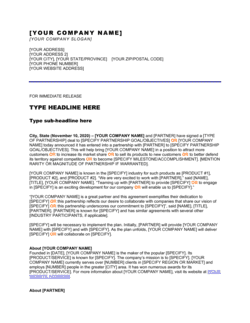
A Press Release New Website is a formal written announcement a company issues to media outlets, journalists, and online news distributors to publicize the launch of a new or redesigned website. This free Word download gives you a structured, editor-ready template you can fill in, export as PDF, and distribute to press contacts or wire services in under an hour.
When you need it
Use it when your company is launching a brand-new website, completing a major redesign, migrating to a new domain, or adding a significant feature such as an e-commerce store or customer portal that warrants public attention.
What's inside
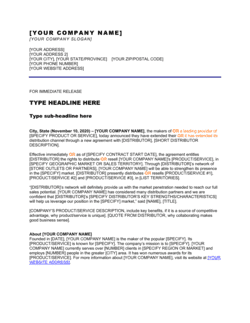
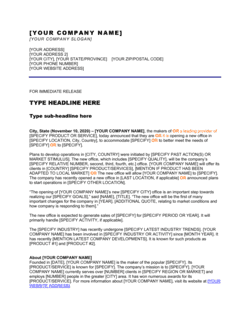
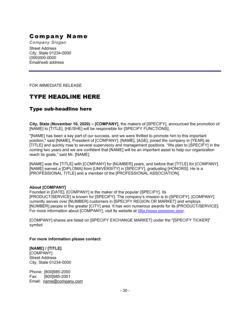
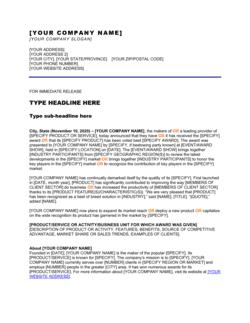
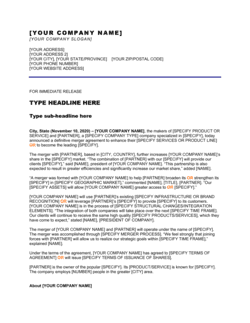
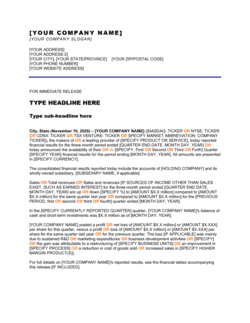
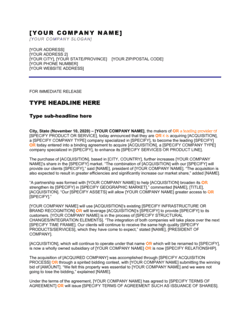
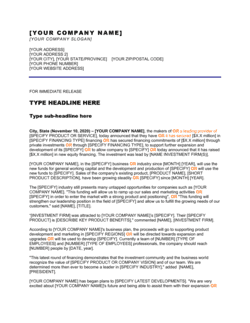
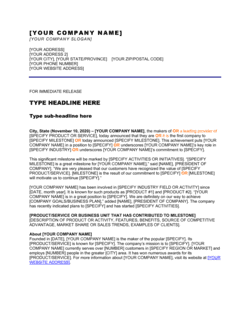
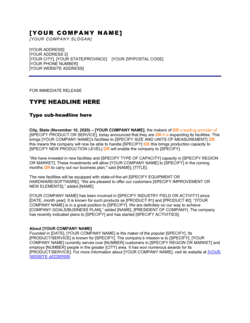
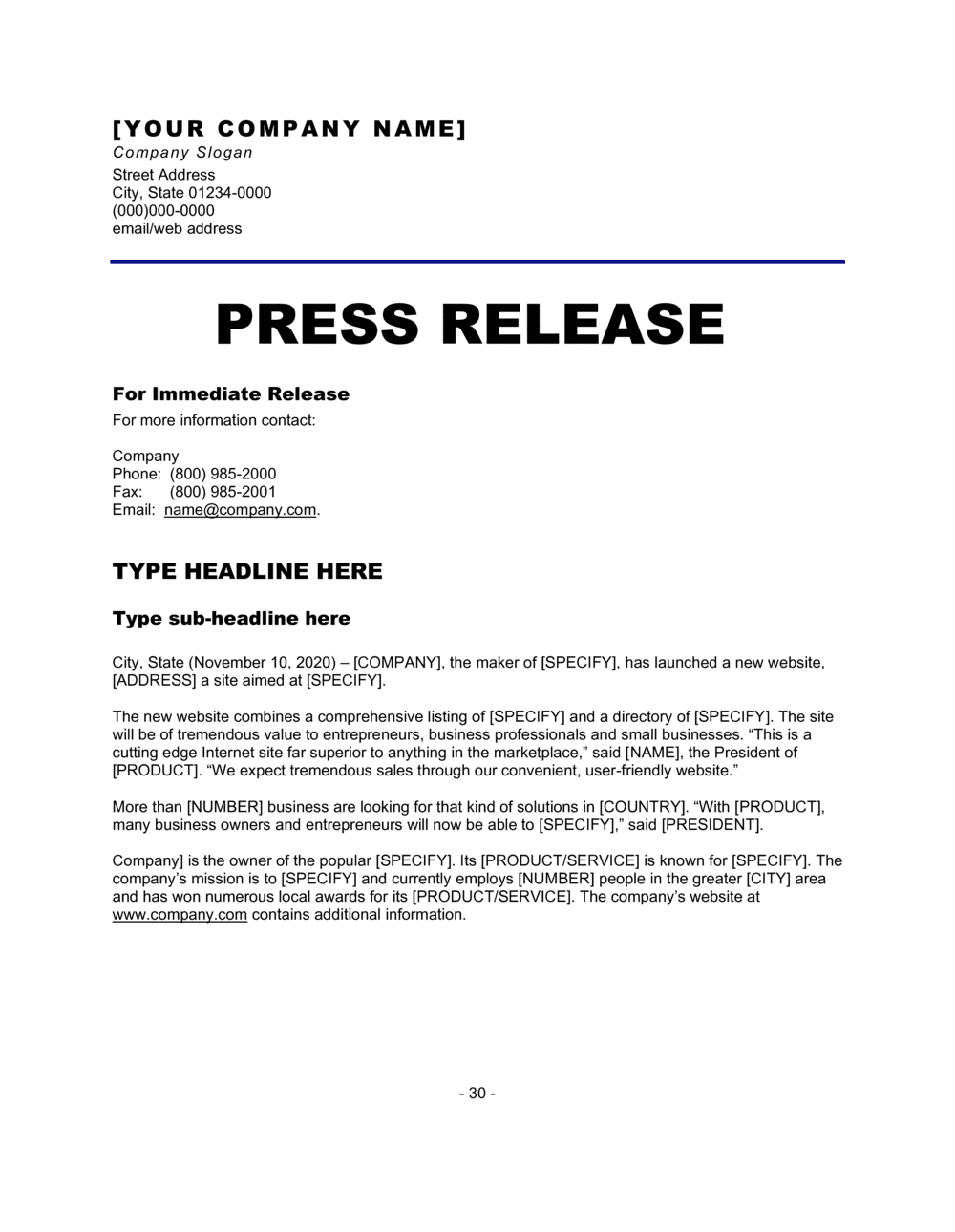
A dateline and embargo notice, attention-grabbing headline and subheadline, lead paragraph summarizing the who-what-when-where-why, supporting body paragraphs with key details and differentiators, executive quote, company boilerplate, and media contact information.

What is a Press Release New Website?

A Press Release New Website is a structured public announcement a company issues to media outlets, journalists, bloggers, and press-distribution services to publicize the launch of a new or significantly redesigned website. It follows the inverted-pyramid format standard in professional communications: the most critical information β€” company name, what launched, the URL, and the primary reason it matters β€” appears in the first paragraph, with supporting detail and executive quotes following in descending order of importance. Beyond generating media coverage, the document creates a dated, citable record of the launch that supports brand credibility, search visibility through syndicated pickup, and internal alignment on the public messaging around a major digital milestone.

Why You Need This Document

A new website without a press release is a launch without an audience. Journalists and editors do not monitor company websites for updates β€” they respond to structured, well-timed announcements that arrive in the right format with a clear news hook. Without a press release, your launch earns no third-party coverage, no SEO-valuable editorial backlinks, and no syndicated news mentions that signal authority to search engines and prospective customers alike. Poorly structured announcements β€” missing the URL, burying the news below the third paragraph, or listing a generic media contact β€” are discarded within seconds. A properly completed press release template ensures every required element is present, reduces the risk of legally problematic unsubstantiated claims, and gives your communications team a repeatable, consistent format for every future announcement. This template handles the structure so your team can focus on the substance.

Which variant fits your situation?

If your situation is…Use this template
Announcing an entirely new company website for a just-launched businessPress Release New Website
Publicizing a major website redesign for an established brandPress Release New Product
Announcing a new e-commerce store or online sales capabilityPress Release New Product
Announcing a company rebrand that includes a new website and namePress Release Company Rebrand
Distributing a general corporate news update without a website focusGeneral Press Release
Announcing a new mobile app alongside or instead of a websitePress Release New Product
Notifying media of a new partnership that includes a co-branded websitePress Release New Partnership

Common mistakes to avoid

❌ Vague headline with no specific news

Why it matters: Editors discard releases with headlines like 'Company Improves Online Presence' because they communicate nothing editors can use as a story hook. The release is deleted before the first paragraph is read.

Fix: Name the company, state exactly what launched, and include one specific benefit or differentiator β€” all in the headline itself, in 12 words or fewer.

❌ Burying the core news below the first paragraph

Why it matters: Journalists edit from the bottom up and often publish only the first two to three paragraphs. If the new URL, launch date, or key differentiator appears in paragraph four, it will not appear in the coverage.

Fix: Apply the inverted-pyramid rule strictly: every essential fact β€” what launched, when, where, and why β€” must appear in the lead paragraph.

❌ Listing a generic media contact email

Why it matters: A generic info@ or press@ address signals that no one is specifically responsible for media relations. Journalists who cannot quickly reach a real person move on to the next release in their inbox.

Fix: Name a specific individual with a direct phone number and email address. Confirm that person is briefed, available, and has access to high-resolution image assets before distribution.

❌ Omitting the new website URL from the body

Why it matters: If the URL appears only in the boilerplate, it is frequently stripped when journalists excerpt quotes or facts. The entire purpose of the release β€” driving traffic to the new site β€” is defeated.

Fix: Include the full URL in the lead paragraph and again in the call-to-action sentence. Use a tracked link to measure press-driven traffic.

❌ Using superlatives with no supporting data

Why it matters: Claims like 'industry-leading design' or 'the most intuitive interface' are unverifiable and alert experienced journalists that the release lacks real substance, reducing pickup rates.

Fix: Replace every adjective with a specific fact: page load time in milliseconds, number of features added, customer satisfaction score before and after, or a direct customer quote.

❌ Distributing without an embargo strategy for major launches

Why it matters: Sending a release for immediate distribution to a large list gives no journalist time to prepare a story, resulting in brief wire-service mentions instead of feature coverage.

Fix: For high-priority launches, offer a 24–48-hour embargo to two or three targeted publications, giving them time to write a feature before the general release goes out.

The 10 key clauses, explained

Release timing header

In plain language: States whether the release is for immediate publication or embargoed until a specific date and time, and in which time zone.

Sample language
FOR IMMEDIATE RELEASE β€” or β€” EMBARGOED UNTIL [DATE] AT [TIME] [TIME ZONE]

Common mistake: Omitting the time zone on embargoed releases. Journalists in different regions interpret 9:00 AM differently, causing premature or staggered publication.

Headline

In plain language: A single active-voice sentence that communicates the core news β€” company name, what launched, and the primary benefit or differentiator β€” in under 12 words.

Sample language
[COMPANY NAME] Launches Redesigned Website to Streamline [SPECIFIC CUSTOMER OUTCOME] for [TARGET AUDIENCE]

Common mistake: Writing a vague headline like 'Company Announces Website Update.' Editors receive hundreds of releases daily and discard any that do not state the specific news in the headline itself.

Subheadline

In plain language: A supporting line that adds a key secondary detail β€” a feature, a statistic, or the launch date β€” to reinforce the headline without repeating it.

Sample language
New platform offers [KEY FEATURE], reducing [PAIN POINT] by [X]% for [AUDIENCE SEGMENT] starting [DATE]

Common mistake: Treating the subheadline as a second headline. It should complement, not restate, the main headline β€” redundancy wastes the reader's attention.

Dateline and lead paragraph

In plain language: Opens with city and date, then answers who, what, when, where, and why in two to three sentences using the inverted-pyramid structure.

Sample language
[CITY], [DATE] β€” [COMPANY NAME], a [BRIEF COMPANY DESCRIPTION], today announced the launch of its redesigned website at [URL], offering [TARGET AUDIENCE] a faster, more intuitive experience for [PRIMARY USE CASE].

Common mistake: Burying the core news in the second or third sentence. Journalists edit from the bottom up β€” if the news is not in the first sentence, it is likely cut.

Body paragraphs β€” key details and features

In plain language: Two to three paragraphs expanding on the website's capabilities, the problem it solves, and any metrics or evidence that support the claim of improvement.

Sample language
The redesigned [COMPANY NAME] website features [FEATURE 1], [FEATURE 2], and [FEATURE 3]. Since the soft launch on [DATE], [X] users have [SPECIFIC ACTION], resulting in [MEASURABLE OUTCOME].

Common mistake: Filling body paragraphs with marketing superlatives like 'best-in-class' and 'revolutionary.' Journalists strip adjectives β€” every claim needs a specific fact or metric behind it.

Executive quote

In plain language: A one-to-two sentence attributed quote from a named executive β€” typically the CEO or CMO β€” that provides a human perspective on why the launch matters.

Sample language
'[SPECIFIC INSIGHT OR CUSTOMER BENEFIT],' said [EXECUTIVE NAME], [TITLE] of [COMPANY NAME]. 'With [NEW WEBSITE URL], [TARGET AUDIENCE] can now [SPECIFIC OUTCOME] in [TIMEFRAME].'

Common mistake: Writing a quote that could have been said by anyone, such as 'We are excited to share this news.' Effective quotes contain a specific claim, observation, or forward-looking statement unique to the speaker.

Call to action and URL

In plain language: A brief, direct sentence directing readers to visit the new website, explore a specific section, or sign up β€” followed by the full URL.

Sample language
To explore the new platform and access [SPECIFIC RESOURCE], visit [FULL URL] or contact [MEDIA CONTACT NAME] at [EMAIL].

Common mistake: Listing the website URL only in the boilerplate and not in the body. Journalists frequently lift quotes and facts without the closing section, losing the link entirely.

Company boilerplate

In plain language: A standardized 3–5 sentence paragraph describing the company β€” its founding year, what it does, who it serves, and the company's main website β€” used at the bottom of every release.

Sample language
About [COMPANY NAME]: Founded in [YEAR], [COMPANY NAME] is a [ENTITY TYPE] headquartered in [CITY] that [CORE OFFERING] for [TARGET CUSTOMER]. The company serves [X] customers across [GEOGRAPHY]. For more information, visit [WEBSITE].

Common mistake: Updating the boilerplate with launch-specific language. The boilerplate should be evergreen and reusable across all press releases β€” time-sensitive details belong in the body.

Media contact block

In plain language: Provides the full name, title, phone number, and email address of the person journalists should contact for interviews, additional information, or image assets.

Sample language
MEDIA CONTACT: [FULL NAME] | [TITLE] | [COMPANY NAME] | [PHONE NUMBER] | [EMAIL ADDRESS]

Common mistake: Listing a generic info@ email address instead of a named contact. Journalists expect a real person they can call and will often skip releases that do not name a specific media contact.

End notation

In plain language: Three pound signs (###) or the word END centered below the final line, signaling to editors that no additional pages follow.

Sample language
###

Common mistake: Omitting the end notation entirely. Without it, editors scanning a multi-page document cannot confirm they have received the complete release.

How to fill it out

  1. 1

    Set the release timing header

    Decide whether to release immediately or set an embargo. If embargoed, specify the exact date, time, and time zone at the top of the document. Confirm this with your PR distribution partner before sending.

    πŸ’‘ For major website launches, a 24-hour embargo gives wire-service partners time to prepare coverage and coordinate a simultaneous publish.

  2. 2

    Write the headline last, not first

    Draft the full body of the release first, then return to write a headline that captures the single most newsworthy fact in active voice, under 12 words.

    πŸ’‘ Test your headline by asking: if a journalist only read this line, would they understand exactly what launched and why it matters? If not, rewrite it.

  3. 3

    Complete the dateline and lead paragraph

    Enter the city of origin and today's date, then write two to three sentences that answer who, what, when, where, and why. The URL of the new website should appear in the lead paragraph.

    πŸ’‘ Read the lead aloud β€” if it takes more than 10 seconds to deliver the core news, it is too long.

  4. 4

    Add two to three body paragraphs with specific details

    Expand on the top three features or improvements the new website delivers. Anchor each claim to a specific metric, customer outcome, or before/after comparison rather than adjectives.

    πŸ’‘ If you do not yet have post-launch metrics, use a specific design or technical fact β€” page load time, number of new content sections, or supported languages β€” as a stand-in.

  5. 5

    Draft and attribute the executive quote

    Write a quote from your CEO, CMO, or most relevant executive that contains a specific observation about why the website matters to customers. Confirm the wording directly with the executive before sending.

    πŸ’‘ Quotes approved at the last minute often get watered down into corporate-speak. Brief the executive with a draft quote and request only minor edits.

  6. 6

    Insert the call to action and website URL

    Add a clear, single sentence directing readers to visit the new website, with the full URL spelled out. If there is a specific landing page for media or press assets, link to that directly.

    πŸ’‘ Use a tracked URL or UTM parameter for the press release link so you can measure how much traffic originates from media coverage.

  7. 7

    Paste in your company boilerplate

    Use the standardized company description paragraph your communications team maintains. Do not customize it for this release β€” keep it evergreen.

    πŸ’‘ Review the boilerplate every six months for accuracy; an outdated customer count or old headquarters address in a widely distributed release is hard to retract.

  8. 8

    Complete the media contact block and add ### to close

    Enter the full name, title, direct phone number, and email of the person handling press inquiries. Confirm that person is available and briefed before the release goes out. Close with ###.

    πŸ’‘ If you are using a PR agency, list both the agency contact and the internal communications lead so journalists have two paths to a response.

Frequently asked questions

What is a press release for a new website?

A press release for a new website is a formal written announcement a company sends to journalists, editors, and media distribution services to publicize the launch of a new or redesigned website. It follows a standard structure β€” headline, lead paragraph, body, executive quote, boilerplate, and media contact β€” designed to make it easy for journalists to quickly understand the news and decide whether to cover it.

When should I send a press release for a new website?

Send it on the day of launch or under a short embargo ending at launch time. Avoid sending it weeks before the site is live β€” journalists who click the URL and find nothing will not return. For major redesigns or e-commerce launches, a 24-hour embargo to select media partners followed by a general distribution gives you the best chance of coordinated coverage.

How long should a website launch press release be?

One page β€” typically 400 to 500 words β€” is the accepted standard. A second page is acceptable only if the release includes a significant amount of supporting detail such as product specifications or executive bios. Editors receive hundreds of releases per week; anything longer than one page is unlikely to be read in full.

Do I need a lawyer to approve a press release?

Legal review is advisable before distributing any press release that contains performance claims, comparative statements about competitors, customer data, financial metrics, or references to pending patents or regulatory approvals. A single inaccurate or unsubstantiated claim in a widely distributed press release can trigger defamation, false advertising, or securities-disclosure issues depending on your industry and jurisdiction.

What is a company boilerplate in a press release?

The boilerplate is a standardized paragraph at the end of every press release that describes the company β€” founding year, what it does, who it serves, and the main website URL. It is used unchanged across all press releases so that every piece of coverage contains a consistent company description. Update it only when core company facts change, such as headquarters location, customer count, or product focus.

Should I use a wire service to distribute my website launch press release?

Wire services like PR Newswire, Business Wire, or GlobeNewswire are worth the cost for national or industry-wide launches where broad media pickup is the goal. For local business launches or niche B2B audiences, a targeted direct distribution to a curated media list of 30–50 relevant journalists typically produces better results at lower cost. Free services like PRLog or EIN Presswire provide SEO backlink value but minimal editorial pickup.

Can a press release be used for SEO purposes?

Yes, in a limited way. Press releases distributed via paid wire services generate indexed pages and backlinks from news aggregators. However, Google does not pass significant PageRank through press release wire links due to their volume and low editorial selectivity. The primary SEO benefit comes from genuine media pickup β€” when a journalist writes an original article that links to your new website, that editorial backlink carries meaningful authority.

What makes journalists ignore a press release?

The four most common reasons journalists discard releases are: a headline that does not state specific news, a lead paragraph that does not answer who, what, when, where, and why, claims that rely on superlatives with no supporting data, and a generic media contact with no named person. A release that clears all four of these hurdles has a substantially higher chance of generating coverage or at least a follow-up inquiry.

Is a press release a legally binding document?

A press release is not a contract and is not binding in the way that an agreement or contract is. However, statements made in a press release can carry legal consequences β€” particularly for public companies subject to securities disclosure rules, companies making comparative claims about competitors, or businesses referencing unverified customer outcomes. Always have legal counsel review releases containing financial projections, regulatory claims, or competitive comparisons before distribution.

How this compares to alternatives

vs General press release

A general press release covers any company news β€” executive appointments, awards, partnerships, or financial results. A website launch press release is structured specifically to highlight a digital property, with emphasis on the URL, user experience improvements, and online call to action. Use the general template for announcements that do not center on a website.

vs Press release new product

A new-product press release announces a physical product, software application, or service offering. A website launch release announces the channel through which products and services are accessed. When a new website is the vehicle for a product launch, consider issuing both releases simultaneously or combining them into a single announcement.

vs Press release new partnership

A partnership press release focuses on the business relationship between two named companies, including mutual benefits and joint commitments. A website launch release focuses on a single company's digital presence. When a co-branded website launches as part of a partnership, a partnership press release with a website-focused paragraph is typically more appropriate than a standalone website release.

vs Media kit

A media kit is a comprehensive package of background materials β€” company history, executive bios, high-resolution images, and fact sheets β€” provided to journalists on request. A press release is the initial announcement that prompts journalists to request the media kit. Distribute the press release first; send the media kit only to journalists who respond with interest.

Industry-specific considerations

Technology / SaaS

Emphasizes uptime, feature velocity, and integration count; often coordinates with a product hunt launch or developer community announcement on the same date.

Retail / E-commerce

Focuses on the new shopping experience, checkout improvements, and any launch promotions; timing is critical around seasonal peaks or major sale events.

Professional Services

Highlights new client portal features, resource libraries, or thought-leadership content as the primary news hook to attract both clients and recruits.

Healthcare / MedTech

Requires careful legal review before distribution; any claims about patient outcomes, clinical tools, or HIPAA-compliant features must be vetted by counsel and compliance.

Jurisdictional notes

United States

Public companies must ensure website launch releases do not constitute material disclosures under SEC Regulation FD without simultaneous broad dissemination. Comparative advertising claims referencing competitor websites are subject to Lanham Act false-advertising standards β€” any claim of superiority must be substantiated. FTC guidelines require clear disclosure if launch content includes paid endorsements or affiliate links prominently featured in the release.

Canada

Publicly traded Canadian companies are subject to continuous disclosure obligations under National Instrument 51-102; a website launch that reveals material information must be distributed via a recognized newswire. Quebec-based companies distributing releases to local media should consider a French-language version to comply with the Charter of the French Language. CASL implications arise if the release links to a website that collects email addresses β€” ensure opt-in consent mechanisms are in place at launch.

United Kingdom

UK-listed companies must assess whether a new website launch constitutes inside information requiring disclosure under the UK Market Abuse Regulation. The ASA's CAP Code governs online advertising claims; any claims featured in the release and repeated on the new website must be substantiated and not misleading. GDPR-compliant privacy notices must be live on the new website before any press release drives public traffic to it.

European Union

GDPR requires that a new website collecting personal data from EU residents have a compliant privacy policy, cookie consent mechanism, and data processing agreements in place before the launch press release drives traffic. The EU Market Abuse Regulation (MAR) applies to listed companies in the same way as UK MAR. Member states with strong consumer protection agencies β€” Germany's Wettbewerbszentrale, for example β€” actively pursue press releases containing unsubstantiated comparative or superlative claims.

Template vs lawyer β€” what fits your deal?

PathBest forCostTime
Use the templateSmall businesses and startups announcing a new website with no regulatory, financial, or competitive claimsFree1–2 hours
Template + legal reviewCompanies making comparative claims, referencing customer data, or operating in regulated industries such as healthcare or financial services$150–$400 for a legal or PR professional review1–2 days
Custom draftedPublic companies with securities disclosure obligations, launches involving clinical or financial performance claims, or global multi-language distributions$500–$2,000+ for legal counsel and PR agency drafting3–7 days

Glossary

Dateline
The city and date at the start of a press release body that tells journalists where and when the news originates.
Embargo
An instruction to journalists not to publish the information until a specified date and time, allowing coordinated coverage.
Boilerplate
A standardized paragraph at the end of every press release that describes the company β€” who it is, what it does, and where to learn more.
Lead Paragraph
The opening paragraph of a press release that answers the five Ws β€” who, what, when, where, and why β€” in two to three sentences.
Wire Service
A distribution platform such as PR Newswire or Business Wire that syndicates press releases to thousands of media outlets simultaneously.
Media Contact
The named person β€” typically a PR manager or communications director β€” journalists should call or email for quotes, interviews, or follow-up information.
Subheadline
A secondary line below the main headline that adds context or a supporting detail to draw the reader further into the release.
Quote Attribution
The formal credit line following an executive quote that identifies the speaker's name and title β€” e.g., 'said Jane Smith, CEO of Acme Corp.'
Call to Action (CTA)
A brief, direct instruction near the close of the release directing readers to visit the new website, sign up, or contact the company.
For Immediate Release
A header phrase indicating that journalists may publish the information as soon as they receive it, with no embargo in effect.
Inverted Pyramid
The standard journalistic writing structure where the most critical information appears first, followed by supporting details in descending order of importance.

Part of your Business Operating System

This document is one of 3,000+ business & legal templates included in Business in a Box.

  • Fill-in-the-blanks β€” ready in minutes
  • 100% customizable Word document
  • Compatible with all office suites
  • Export to PDF and share electronically

Create your document in 3 simple steps.

From template to signed document β€” all inside one Business Operating System.
1
Download or open template

Access over 3,000+ business and legal templates for any business task, project or initiative.

2
Edit and fill in the blanks with AI

Customize your ready-made business document template and save it in the cloud.

3
Save, Share, Send, Sign

Share your files and folders with your team. Create a space of seamless collaboration.

Save time, save money, and create top-quality documents.

β˜…β˜…β˜…β˜…β˜…

"Fantastic value! I'm not sure how I'd do without it. It's worth its weight in gold and paid back for itself many times."

Managing Director Β· Mall Farm
Robert Whalley
Managing Director, Mall Farm Proprietary Limited
β˜…β˜…β˜…β˜…β˜…

"I have been using Business in a Box for years. It has been the most useful source of templates I have encountered. I recommend it to anyone."

Business Owner Β· 4+ years
Dr Michael John Freestone
Business Owner
β˜…β˜…β˜…β˜…β˜…

"It has been a life saver so many times I have lost count. Business in a Box has saved me so much time and as you know, time is money."

Owner Β· Upstate Web
David G. Moore Jr.
Owner, Upstate Web

Run your business with a system β€” not scattered tools

Stop downloading documents. Start operating with clarity. Business in a Box gives you the Business Operating System used by over 250,000 companies worldwide to structure, run, and grow their business.

Start freeΒ Β·Β No credit card required