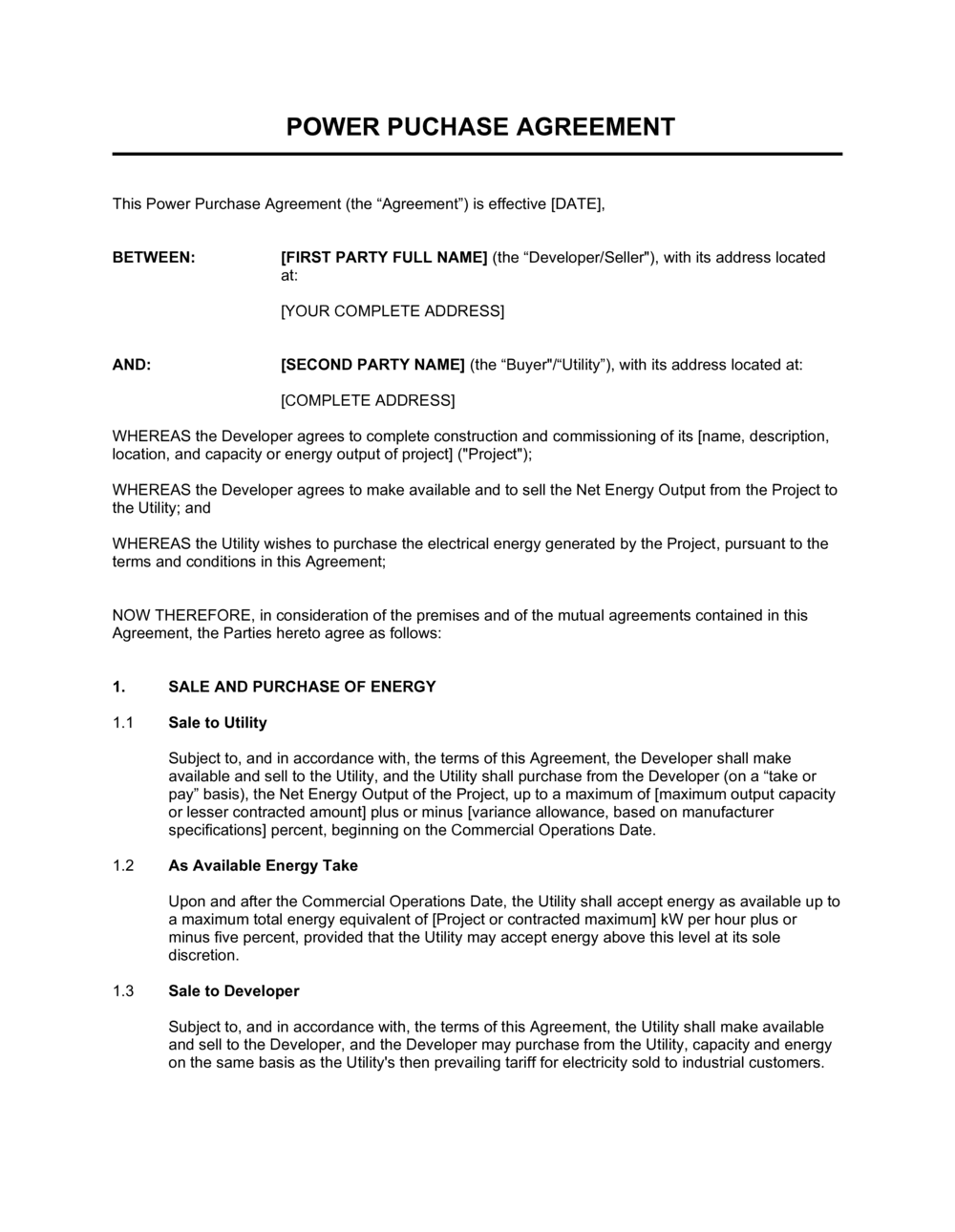
Power Purchase Agreement Template

Free Word download • Edit online • Save & share with Drive • Export to PDF

32 pages40–55 min to fillDifficulty: ExpertSignature requiredLegal review recommended
Learn more ↓
FreePower Purchase Agreement Template

At a glance

What it is
A Power Purchase Agreement (PPA) is a long-term contract between an electricity generator — typically a solar, wind, or hydro developer — and an offtaker such as a utility, corporate buyer, or energy aggregator. It locks in the price, volume, delivery point, and conditions under which generated electricity is sold and transferred. This free Word download gives developers and offtakers a structured, bankable starting point they can edit online and export as PDF for negotiation and execution.
When you need it
Use it when a renewable energy project needs committed revenue to secure project financing, or when a corporate or utility buyer wants price certainty and verifiable green-energy credentials for a defined term. PPAs are typically negotiated before construction begins and run 10–25 years.
What's inside
Contract term and commercial operation date, energy price structure (fixed, indexed, or escalating), delivery point and metering obligations, curtailment and deemed energy provisions, credit support and collateral, representations and warranties, force majeure, default and termination, and governing law with dispute resolution.

What is a Power Purchase Agreement?

A Power Purchase Agreement (PPA) is a long-term contract between an electricity generator — typically a renewable energy developer operating a solar, wind, or hydroelectric facility — and an offtaker such as a utility, corporate buyer, or energy aggregator. It defines the price, volume, delivery point, and conditions under which generated electricity is purchased over a term that typically spans 15 to 25 years. Beyond setting commercial terms, a PPA is the foundational revenue contract that makes project financing possible: lenders advance construction debt only when a creditworthy offtaker has committed to purchase the project's output at a known price for a term long enough to service the debt. Without a signed PPA, most utility-scale renewable energy projects cannot reach financial close.

Why You Need This Document

For generators, operating without a signed PPA means selling electricity into a volatile spot market with no revenue floor — exposing lenders, equity investors, and the project company itself to price swings that can make debt service impossible. For offtakers, entering a generation relationship without a PPA leaves price, volume, REC ownership, and curtailment rights undefined, creating disputes that typically surface at the worst moment: a grid emergency or a sustainability audit. The consequences of a poorly drafted PPA are equally severe: an ambiguous curtailment clause can eliminate the revenue certainty a lender requires; a missing REC provision can void a corporate buyer's RE100 or CDP claim after years of reporting; an undefined longstop date can lock an offtaker into a 20-year contract for a project that is never built. This template gives developers and offtakers a structured, bankable starting point that reflects market-standard terms across pricing, curtailment, credit support, and termination — reducing drafting time and the risk of missing provisions that experienced energy counsel and project lenders will require.

Which variant fits your situation?

If your situation is…Use this template
Utility-scale solar or wind project seeking project financeUtility-Scale Power Purchase Agreement
Corporate buyer procuring renewable electricity off-siteCorporate Virtual PPA (VPPA)
Behind-the-meter rooftop solar on commercial or industrial propertyOn-Site Solar PPA
Community solar or shared renewable energy projectCommunity Solar Subscription Agreement
Short-term tolling or capacity agreement pending long-term PPAElectricity Tolling Agreement
Storage-paired project with both generation and dispatch obligationsEnergy Storage Offtake Agreement
Green hydrogen offtake linked to dedicated renewable generationGreen Hydrogen Offtake Agreement

Common mistakes to avoid

❌ No longstop date on the commercial operation date

Why it matters: Without a longstop date, the offtaker is indefinitely bound to a contract for a project that may never be built, with no exit mechanism other than a costly breach claim.

Fix: Set a longstop date 18–24 months after target COD. If the project misses it, either party may terminate, and the PPA should specify whether any break fee applies.

❌ Allowing unlimited offtaker curtailment without deemed energy payment

Why it matters: Lenders model revenue against curtailment scenarios when underwriting project debt — unlimited free curtailment rights remove the revenue certainty that makes debt service possible.

Fix: Cap offtaker-instructed curtailment at a defined annual percentage of contract capacity (e.g., 10%), and require deemed energy payment at the contract price for any curtailment exceeding that cap or caused by offtaker-side reasons.

❌ Ambiguous or missing REC ownership provisions

Why it matters: If REC ownership is not explicitly assigned, the offtaker cannot make verifiable renewable energy claims for ESG reporting, and the generator risks making conflicting claims that violate applicable tracking registry rules.

Fix: State explicitly in the contract that all RECs and environmental attributes transfer to the offtaker simultaneously with delivery of electricity, and prohibit the generator from any public renewable energy claim on energy sold under the PPA.

❌ Accepting unrated or financially unverified credit support

Why it matters: A parent guarantee from a private entity with no audited financials provides no bankable security — lenders will require replacement credit support at financial close, potentially causing delay or deal failure.

Fix: Require credit support from a financial institution rated at least A- by S&P or Moody's, or from a publicly rated corporate entity with audited financials. Include a ratings-trigger replacement obligation in the credit support annex.

❌ Including market price volatility as a force majeure event

Why it matters: Market price changes are foreseeable commercial risks, not force majeure events. Listing them as such eliminates the price certainty that is the primary reason either party enters a long-term PPA.

Fix: Limit force majeure to physical events outside either party's control — storms, floods, grid outages, or government emergency orders — and address pricing risk separately through the indexed-price or floor/cap mechanism.

❌ Governing law with no nexus to the project jurisdiction

Why it matters: Energy regulation is jurisdiction-specific. A PPA governed by a law that conflicts with local electricity rules on interconnection, dispatch priority, or RPS compliance creates ambiguity that can void key provisions.

Fix: Use the governing law of the state or country where the project is located and the electricity is delivered, unless both parties agree on a neutral arbitration seat with energy law expertise.

The 10 key clauses, explained

Parties, recitals, and defined terms

In plain language: Identifies the generator and offtaker as legal entities, states the purpose of the agreement, and defines every capitalized term used throughout the contract.

Sample language
This Power Purchase Agreement is entered into as of [DATE] between [GENERATOR LEGAL NAME], a [STATE/JURISDICTION] [ENTITY TYPE] ('Generator'), and [OFFTAKER LEGAL NAME], a [STATE/JURISDICTION] [ENTITY TYPE] ('Offtaker'). Capitalized terms have the meanings set out in Schedule 1.

Common mistake: Using trade names instead of registered legal entity names. If the contracting entity does not match the project company holding the generation license or interconnection agreement, lenders may reject the PPA as unbankable.

Term, commercial operation date, and conditions precedent

In plain language: Sets the contract start and end date, defines the commercial operation date milestone, and lists the conditions — permits, interconnection approval, financing close — that must be met before the delivery obligation activates.

Sample language
The Agreement commences on [EXECUTION DATE] and expires [20] years after the Commercial Operation Date ('COD'). COD shall occur no later than [LONGSTOP DATE]. Conditions Precedent to delivery obligations are set out in Schedule 2 and include: (a) receipt of all required permits; (b) execution of the Interconnection Agreement; (c) financial close of project financing.

Common mistake: No longstop date on COD. Without one, the offtaker is indefinitely exposed to a project that never reaches commercial operation — a position project finance lenders and utilities consistently reject.

Energy price, escalation, and payment

In plain language: States the price per MWh — fixed, indexed, or escalating — the payment calculation methodology, invoicing frequency, and the due date for payments.

Sample language
Offtaker shall pay Generator [$XX.XX] per MWh of Delivered Energy ('Contract Price'), subject to an annual escalation of [X]% per year commencing on the first anniversary of COD. Invoices shall be issued monthly within [5] Business Days of month-end. Payment is due [30] days after invoice receipt.

Common mistake: Omitting an escalation mechanism entirely on a 20-year fixed price. Inflation over a 20-year term can erode the generator's economics to the point of project distress — which then triggers termination provisions that expose the offtaker to replacement cost risk.

Delivery obligation, metering, and volume

In plain language: Defines how electricity volume is measured, who owns and maintains the meters, the settlement methodology for imbalances, and whether the generator has a firm or as-available delivery obligation.

Sample language
Generator shall deliver all Net Electrical Output from the Facility to the Delivery Point on an as-available basis. Metering shall be performed by [METER OWNER] using revenue-grade meters meeting [STANDARD]. Monthly settlement shall be based on meter data subject to a [30]-day dispute window.

Common mistake: Defining delivery as 'firm' for a variable renewable asset with no storage. Firm delivery from an intermittent source requires backup procurement or storage — without that, the generator faces perpetual shortfall penalties it cannot operationally avoid.

Curtailment and deemed energy

In plain language: Addresses who can order a reduction in output, under what circumstances, and whether the offtaker owes payment for curtailed energy that the generator was ready and able to produce.

Sample language
Offtaker may curtail generation by written notice for grid or system reasons. For any Offtaker-instructed curtailment, Offtaker shall pay Generator the Contract Price for Deemed Energy equal to the P50 forecast output for the curtailed period as certified by [INDEPENDENT ENGINEER].

Common mistake: Allowing unlimited offtaker curtailment without deemed energy payment. Lenders stress-test revenue against curtailment scenarios — unlimited free curtailment rights make a project unfinanceable by eliminating revenue certainty.

Renewable energy certificates and environmental attributes

In plain language: Allocates ownership of RECs or equivalent green certificates generated by the facility and confirms that environmental claims (e.g., carbon-free energy matching) belong to the party receiving the certificates.

Sample language
All Renewable Energy Certificates and Environmental Attributes associated with Delivered Energy shall transfer to Offtaker at the Delivery Point simultaneously with title to the electricity. Generator shall not make any public renewable energy claims with respect to energy sold under this Agreement.

Common mistake: Failing to address REC ownership at all. When REC ownership is ambiguous, the offtaker cannot make verified renewable energy claims for sustainability reporting, and the generator may inadvertently double-count the same attributes.

Credit support and collateral

In plain language: Requires one or both parties to post collateral — typically a letter of credit, parent company guarantee, or cash deposit — sized to cover a defined number of months of payment or performance exposure.

Sample language
Offtaker shall deliver to Generator, on or before the date [30] days prior to COD, a Letter of Credit from a Qualifying Financial Institution in the amount equal to [6] months of estimated Contract Payments at P50 generation. Generator shall maintain the Letter of Credit in full force throughout the Agreement Term.

Common mistake: Accepting a parent guarantee from an entity with no audited financials or unrated credit. Lenders require credit support from a counterparty whose financial strength can actually be verified — an unrated subsidiary guarantee provides no bankable security.

Force majeure

In plain language: Defines events beyond a party's reasonable control that excuse performance, states the notice and mitigation obligations, and limits the duration for which force majeure can suspend obligations before either party may terminate.

Sample language
Neither party shall be in default for failure to perform caused by a Force Majeure Event, provided that: (a) the affected party gives written notice within [5] Business Days of the event's occurrence; (b) the affected party uses commercially reasonable efforts to mitigate and restore performance; and (c) if Force Majeure persists beyond [18] months, either party may terminate on [30] days' written notice.

Common mistake: Including grid curtailment or market price changes as force majeure events. These are foreseeable commercial risks that should be addressed in the curtailment and price clauses — elevating them to force majeure eliminates the compensation mechanism and creates an uninsurable gap.

Default, remedies, and termination

In plain language: Lists events of default for each party, cure periods, and the remedies available to the non-defaulting party — including termination and a liquidated-damages calculation for early contract exit.

Sample language
Events of Default include: (a) failure to pay undisputed amounts within [10] Business Days of the due date; (b) insolvency or bankruptcy; (c) failure to achieve COD by the Longstop Date. Upon an Event of Default, the non-defaulting party may terminate by [30] days' written notice and recover a Termination Payment equal to the present value of the remaining Contract Payments discounted at [X]%.

Common mistake: No termination payment formula for generator default. Without one, the offtaker's only remedy is cover damages — replacing a 20-year contract in a changed market — which are speculative and expensive to prove in litigation.

Governing law, dispute resolution, and jurisdiction

In plain language: Specifies the applicable law, the dispute resolution process (negotiation, mediation, then arbitration or court), the seat and rules for arbitration, and whether interim injunctive relief is preserved.

Sample language
This Agreement is governed by the laws of [STATE / JURISDICTION]. Disputes shall be resolved first by senior management negotiation for [20] Business Days, then by binding arbitration under [AAA / ICC / LCIA] rules, seated in [CITY]. Either party may seek interim injunctive relief in any court of competent jurisdiction without waiving arbitration.

Common mistake: Choosing a governing law with no nexus to the project location or the parties' home jurisdictions. Energy regulatory requirements are jurisdiction-specific — a governing law that conflicts with the site's local electricity law creates unresolvable ambiguity on issues like interconnection disputes and curtailment obligations.

How to fill it out

  1. 1

    Identify the parties using full legal entity names

    Enter the generator's project company name exactly as registered — this is typically a special-purpose vehicle (SPV), not the parent developer. Enter the offtaker's full legal name and confirm it matches the entity with authority to purchase electricity in the relevant jurisdiction.

    💡 Confirm both entity names against the project's interconnection agreement and the offtaker's most recent audited financials before drafting — mismatches flag immediately in lender due diligence.

  2. 2

    Set the contract term and longstop date

    Enter the intended PPA term (typically 15–25 years from COD), the target COD date, and a longstop date no more than 24 months after target COD. The longstop date gives both parties a defined exit if construction stalls without triggering open-ended liability.

    💡 Align the longstop date with the project's construction financing maturity date — lenders will require it to match.

  3. 3

    Define the energy price and escalation mechanism

    Choose fixed, indexed, or escalating pricing. For fixed: enter the $/MWh rate and annual escalation percentage. For indexed: name the market benchmark (e.g., CAISO day-ahead LMP at [HUB NAME]) and the floor/cap range. Confirm the pricing methodology matches the financial model used to underwrite the project.

    💡 For corporate buyers with long-term sustainability targets, a fixed price with a modest escalator (1–2% per year) is typically preferred over a market-indexed price — it allows accurate carbon accounting and budget forecasting.

  4. 4

    Specify the delivery point and metering standard

    Name the exact delivery point — the interconnection busbar or grid node where title transfers. Specify the metering standard (ANSI C12.20 Class 0.2 or equivalent) and which party owns, installs, and maintains the revenue meter and any backup check meter.

    💡 Include a right for the non-metering party to install a check meter at its own cost. This is standard practice and prevents metering disputes from escalating into formal proceedings.

  5. 5

    Draft curtailment rights and deemed energy payment

    Limit offtaker-instructed curtailment to grid emergency or system constraint conditions. For each permitted curtailment scenario, specify whether deemed energy payment applies and how the P50 reference generation is calculated and certified.

    💡 Use an independent engineer's P50 forecast — not the generator's own — as the reference for deemed energy calculation. This is the standard lenders require and eliminates disputes over self-serving output estimates.

  6. 6

    Allocate REC ownership and sustainability reporting rights

    State explicitly which party receives RECs or equivalent green certificates, and confirm that the right to make public renewable energy claims follows the certificates. If the offtaker is purchasing for RE100 or CDP reporting, confirm the certificate standard (e.g., I-REC, NAR, GO) required for their registry.

    💡 If the project is in a state with a renewable portfolio standard (RPS), confirm whether compliance RECs are included in the PPA price or priced separately — this distinction can be worth $5–$15/MWh.

  7. 7

    Size and structure credit support requirements

    Calculate the credit support amount as a multiple of monthly payment exposure — 3 to 6 months is market standard for investment-grade offtakers; 6 to 12 months for non-investment-grade or unrated buyers. Specify acceptable credit support instruments and the financial institution minimum rating (typically A- or better).

    💡 Include an automatic replenishment obligation: if the credit support provider's rating falls below the floor, the offtaker must replace or top up the instrument within 10 business days.

  8. 8

    Have an energy lawyer review before execution

    PPAs are long-term, project-finance-grade contracts. Have a lawyer with energy regulatory experience review the final draft for jurisdiction-specific compliance — interconnection rules, RPS eligibility, FERC authorization requirements, and local electricity law.

    💡 Lenders conducting project finance due diligence will require a legal opinion confirming PPA enforceability. Engaging counsel early reduces the chance of material revisions at financial close.

Frequently asked questions

What is a Power Purchase Agreement (PPA)?

A Power Purchase Agreement is a long-term contract between an electricity generator and an offtaker that defines the price, volume, and conditions under which generated electricity is bought and sold. PPAs are the foundational commercial document for renewable energy projects — they provide the revenue certainty that allows developers to raise project finance and give buyers price stability and verifiable green-energy credentials for sustainability reporting.

How long does a typical PPA last?

Most utility-scale renewable energy PPAs run 15 to 25 years, calibrated to match the useful life of the generating asset and the tenor of the project debt. Corporate PPAs tend to be shorter — 10 to 15 years — to align with corporate planning horizons and budget cycles. Behind-the-meter and community solar agreements typically run 10 to 20 years depending on the host's lease term.

What is the difference between a physical PPA and a virtual PPA?

A physical PPA involves actual delivery of electricity from the generator to the offtaker at a defined delivery point — the buyer receives the power and the associated renewable attributes. A virtual PPA (VPPA) is a financial contract: the generator sells power into the wholesale market, and the parties settle the difference between the contract price and the market price. VPPAs are common for corporate buyers who are not in the same grid region as the generating asset. Both transfer RECs to the buyer.

What price structures are used in PPAs?

The three main structures are fixed price, indexed price, and escalating fixed price. A fixed price provides revenue certainty for the generator and cost certainty for the buyer. An indexed price ties payments to a published market benchmark such as the day-ahead LMP at a named hub, exposing both parties to market movements. An escalating fixed price starts at a defined rate and increases by a fixed percentage annually, balancing predictability with inflation protection. Many PPAs combine a fixed floor with a market-linked upside.

What are RECs and who owns them under a PPA?

Renewable Energy Certificates — also called RECs in North America, Guarantees of Origin (GOs) in Europe, or I-RECs internationally — are tradeable instruments that represent the environmental attributes of one MWh of renewable generation. Ownership of RECs determines who can make verified renewable energy claims for ESG reporting, RE100 commitments, or regulatory compliance. Most PPAs assign RECs to the offtaker simultaneously with delivery of electricity, but this must be stated explicitly — ambiguity creates double-counting risk.

What is deemed energy in a PPA?

Deemed energy is the notional volume of electricity a generator would have produced but was prevented from producing by an offtaker-instructed curtailment or an offtaker-caused grid constraint. In most bankable PPAs, the offtaker owes payment at the contract price for deemed energy, even though no electricity was actually delivered. This provision protects the generator's revenue and is a prerequisite for project lenders who model debt service against curtailment scenarios.

What credit support does a PPA typically require?

Market practice for utility-scale PPAs is for the offtaker to post a letter of credit or parent guarantee sized at three to six months of estimated contract payments. For non-investment-grade or unrated offtakers, six to twelve months is more common. The credit support instrument must come from a financial institution or corporate parent rated at least A- by a major rating agency. Some PPAs also require the generator to post performance security during the construction period.

Does a PPA need regulatory approval?

In the United States, utility-scale PPAs between independent power producers and utilities may require FERC authorization under the Federal Power Act, and state public utility commissions often have review rights. In Canada, provincial energy boards typically oversee utility PPAs. In the EU, electricity market regulations and state aid rules can apply to government-backed offtakers. Behind-the-meter and corporate PPAs generally face lighter regulatory requirements but should be reviewed for local licensing and retail supply rules.

What happens if the generator misses the commercial operation date?

If the generator misses the target COD, most PPAs allow a grace period — typically three to six months — before the offtaker's delay remedies activate. If the longstop date is reached without COD, the offtaker may terminate the agreement and recover any posted credit support or agreed break fee. Developers typically manage COD risk through liquidated damages provisions in the engineering, procurement, and construction (EPC) contract, which are sized to cover PPA delay damages.

Do I need a lawyer to draft a PPA?

Yes, for any project-financed or utility-scale PPA. These are complex, long-term contracts with significant financial exposure — lenders will require a legal opinion on enforceability, regulatory compliance, and lender step-in rights as a condition of financial close. A template provides a strong structural starting point and reduces drafting time, but review by an energy lawyer with jurisdiction-specific experience is essential before any PPA is executed. For small behind-the-meter or community solar arrangements, a lighter review may suffice.

How this compares to alternatives

vs Energy Supply Agreement

An energy supply agreement covers the procurement of electricity from a retailer or supplier at a market-linked or fixed tariff, typically for 1–3 years. A PPA is a long-term generation-level contract that transfers price risk and environmental attributes directly from a specific generating facility to the buyer. PPAs are used when the buyer wants REC ownership, price certainty, and a direct relationship with a named renewable asset — not just a green tariff from a retailer.

vs Interconnection Agreement

An interconnection agreement governs the technical and commercial terms for connecting the generating facility to the transmission or distribution grid — it is a contract between the developer and the system operator, not the offtaker. A PPA is the commercial offtake contract between generator and buyer. Both are required for a project to operate; the PPA does not substitute for interconnection rights.

vs Engineering, Procurement and Construction (EPC) Contract

An EPC contract governs the design, procurement, and construction of the generating facility between the developer and a contractor. A PPA governs the sale of electricity once the facility is built. Lenders review both documents together — the EPC contract backstops construction risk, while the PPA backstops revenue risk. They serve complementary roles in project finance.

vs Lease Agreement (Solar Roof Lease)

A solar roof lease transfers use of a property's roof to a developer in exchange for rent, with the developer selling electricity separately. A behind-the-meter solar PPA keeps the property owner as the electricity buyer — the developer installs and owns the panels, and the owner purchases the generated electricity at a contracted rate. The PPA gives the property owner direct savings on electricity bills; the lease gives the owner passive rent income instead.

Industry-specific considerations

Renewable energy development

PPAs are the primary revenue contract for utility-scale solar, wind, and hydro projects and the document lenders require to advance construction financing.

Technology and data centers

Hyperscalers and large data center operators use corporate PPAs and VPPAs to match 24/7 carbon-free energy consumption against clean generation assets.

Manufacturing and industrial

Energy-intensive manufacturers use long-term PPAs to hedge electricity price volatility and meet Scope 2 emissions reduction targets under CDP or SBTi frameworks.

Real estate and commercial property

Commercial landlords and REITs use behind-the-meter solar PPAs to reduce building operating costs and meet green building certification requirements without capital outlay.

Utilities and grid operators

Regulated utilities execute PPAs with independent power producers to satisfy renewable portfolio standards and integrated resource plan commitments.

Financial services and infrastructure funds

Infrastructure investors and green bonds rely on contracted PPA revenue as the basis for project valuation, debt sizing, and yield distribution to fund investors.

Jurisdictional notes

United States

Utility-scale PPAs between independent power producers and utilities may require FERC authorization as a qualifying facility under PURPA or market-based rate authority under the Federal Power Act. State public utility commissions retain approval rights over utility resource plans and long-term procurement in most states. Non-compete enforcement of curtailment rights varies by ISO/RTO market rules — CAISO, PJM, MISO, and ERCOT each have distinct dispatch and curtailment protocols that must be reflected in the delivery and curtailment clauses.

Canada

Electricity regulation in Canada is primarily provincial — Ontario's IESO, Alberta's AESO, and BC Hydro each operate under distinct market structures and procurement frameworks. Federal jurisdiction applies only to inter-provincial and international transmission. Quebec PPAs for provincially-regulated utilities must comply with Hydro-Québec's standard contract terms. Provincial REC or attribute tracking systems vary: NEPOOL GIS and M-RETS standards apply in eastern and western provinces respectively.

United Kingdom

UK PPAs are subject to Ofgem oversight and must be consistent with the Contracts for Difference (CfD) scheme framework for government-supported renewables. Corporate PPAs and sleeved PPAs are increasingly common as CfD support steps down for mature technologies. Balancing and Settlement Code (BSC) obligations apply to generators and suppliers, and any PPA must address Renewable Obligation Certificate (ROC) or REGO allocation clearly, as these are the UK equivalents of RECs for corporate sustainability claims post-Brexit.

European Union

The EU Renewable Energy Directive (RED III) and the internal electricity market regulation shape the framework for corporate PPAs and renewable auctions across member states. Guarantees of Origin (GOs) are the EU-standard instrument equivalent to RECs, and their issuance and transfer are governed by the AIB (Association of Issuing Bodies) framework. State aid rules restrict the terms on which governments or state-owned offtakers can enter long-term PPAs. Cross-border PPAs face additional complexity from national grid access rules and varying balancing responsibility regimes.

Template vs lawyer — what fits your deal?

PathBest forCostTime
Use the templateSmall behind-the-meter or community solar arrangements where no project financing is involvedFree2–4 hours to complete
Template + legal reviewMid-size corporate PPAs or VPPAs where the buyer is investment-grade and no lender step-in rights are required$2,000–$8,000 for energy counsel review and negotiation support2–6 weeks
Custom draftedUtility-scale project-financed PPAs, lender-required bankable contracts, or cross-border energy transactions$15,000–$75,000+ depending on project size, jurisdiction, and negotiation complexity2–6 months

Glossary

Offtaker
The buyer of electricity under a PPA — typically a utility, corporate entity, or aggregator obligated to purchase generated output.
Commercial Operation Date (COD)
The date on which the generating facility is certified as fully commissioned and begins delivering electricity under the PPA.
Contract Capacity
The maximum installed generating capacity (in MW or kW) covered by the PPA, used to calculate deemed energy and curtailment provisions.
Energy Price
The rate per megawatt-hour (MWh) the offtaker pays the generator — may be fixed, indexed to a market benchmark, or subject to annual escalation.
Curtailment
A directive from the offtaker, grid operator, or system operator requiring the generator to reduce or stop output below available capacity.
Deemed Energy
The notional volume of electricity the generator would have produced but for an offtaker-caused curtailment, for which the offtaker typically remains financially liable.
Delivery Point
The physical or metering location — typically a grid interconnection point or busbar — where title and risk in the electricity transfer from generator to offtaker.
Renewable Energy Certificate (REC)
A tradeable instrument representing the environmental attributes of one MWh of renewable generation, whose ownership and transfer are typically addressed in the PPA.
Credit Support
Collateral — such as a letter of credit, parent guarantee, or cash deposit — posted by one or both parties to backstop payment or performance obligations.
Indexed Price
An energy price formula tied to a published market index (e.g., day-ahead LMP at a named hub), so the contract price moves with wholesale market prices.
Force Majeure
An event beyond a party's reasonable control — storm, flood, grid failure, or government action — that excuses non-performance for its duration.
Interconnection Agreement
A separate agreement with the transmission or distribution system operator governing the technical and commercial terms for connecting the generating facility to the grid.

Part of your Business Operating System

This document is one of 3,000+ business & legal templates included in Business in a Box.

  • Fill-in-the-blanks — ready in minutes
  • 100% customizable Word document
  • Compatible with all office suites
  • Export to PDF and share electronically

Create your document in 3 simple steps.

From template to signed document — all inside one Business Operating System.
1
Download or open template

Access over 3,000+ business and legal templates for any business task, project or initiative.

2
Edit and fill in the blanks with AI

Customize your ready-made business document template and save it in the cloud.

3
Save, Share, Send, Sign

Share your files and folders with your team. Create a space of seamless collaboration.

Save time, save money, and create top-quality documents.

★★★★★

"Fantastic value! I'm not sure how I'd do without it. It's worth its weight in gold and paid back for itself many times."

Managing Director · Mall Farm
Robert Whalley
Managing Director, Mall Farm Proprietary Limited
★★★★★

"I have been using Business in a Box for years. It has been the most useful source of templates I have encountered. I recommend it to anyone."

Business Owner · 4+ years
Dr Michael John Freestone
Business Owner
★★★★★

"It has been a life saver so many times I have lost count. Business in a Box has saved me so much time and as you know, time is money."

Owner · Upstate Web
David G. Moore Jr.
Owner, Upstate Web

Run your business with a system — not scattered tools

Stop downloading documents. Start operating with clarity. Business in a Box gives you the Business Operating System used by over 250,000 companies worldwide to structure, run, and grow their business.

Free Forever Plan · No credit card required