Subscription Form and Power of Attorney Template

Free Word download • Edit online • Save & share with Drive • Export to PDF

6 pages30–40 min to fillDifficulty: Complex
Learn more ↓
FreeSubscription Form and Power of Attorney Template

At a glance

What it is
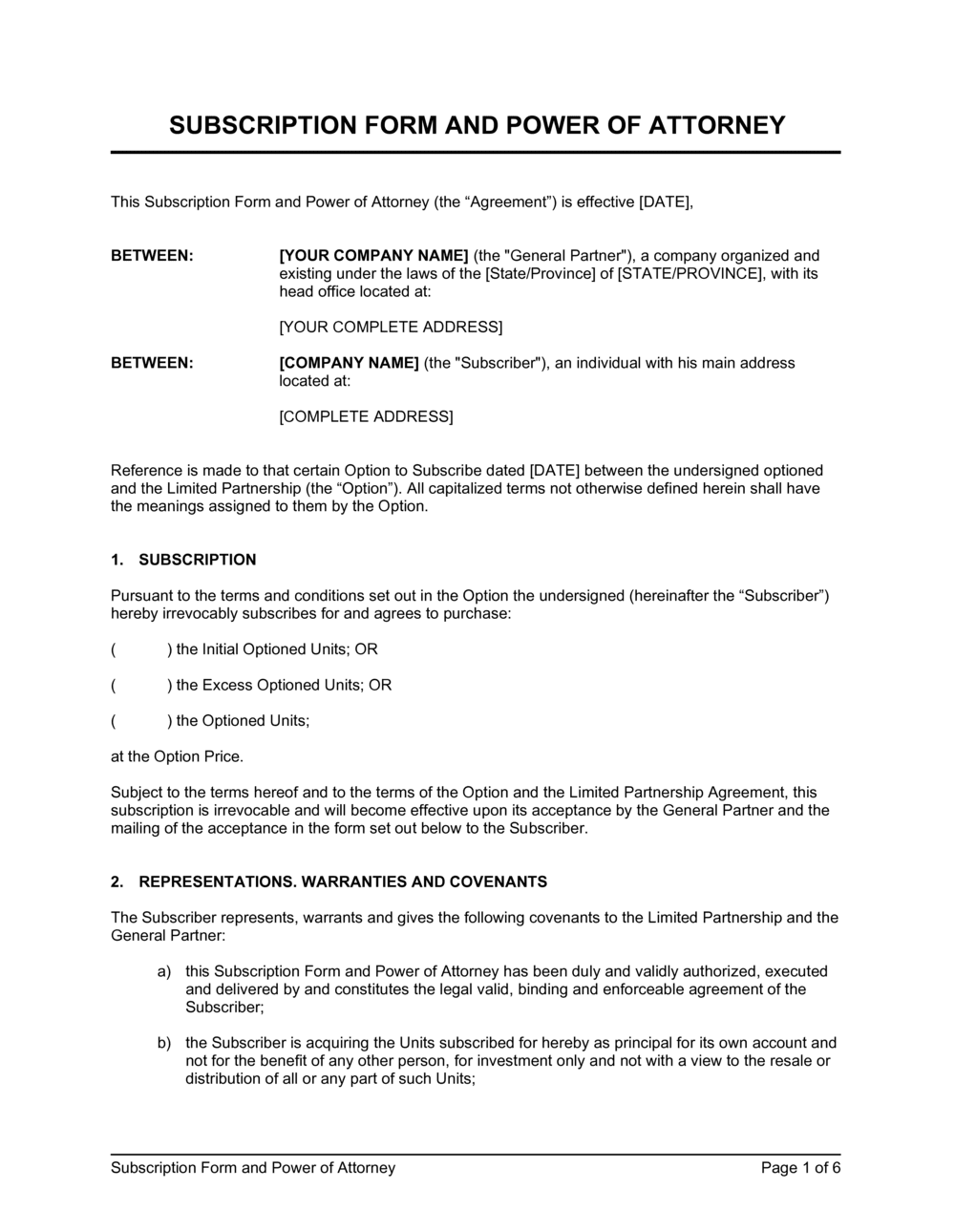
A Subscription Form and Power of Attorney is a combined document that records an individual's or entity's formal application to subscribe for shares, units, or other securities, and simultaneously grants a named agent the authority to act on the subscriber's behalf in completing and executing the subscription. This free Word download lets you fill in subscriber details, share quantities, and agent authorization fields, then export as PDF in minutes.
When you need it
Use it when issuing new shares or fund units to investors who need an authorized representative to sign closing documents on their behalf, or when a subscription process requires a single agent to execute instruments across multiple investors simultaneously.
What's inside
Subscriber identification, share class and quantity, subscription price, payment instructions, power of attorney grant naming the authorized agent, scope and duration of the agent's authority, and declaration and acknowledgment fields for both parties.

What is a Subscription Form and Power of Attorney?

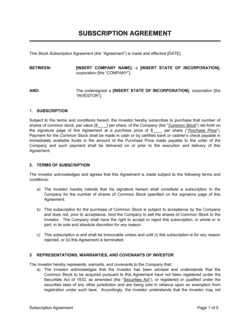
A Subscription Form and Power of Attorney is a combined document that records an investor's formal application to purchase shares, fund units, or other securities, and simultaneously authorizes a named agent to execute closing documents on the subscriber's behalf. It merges two functions into one instrument: the subscription form captures the subscriber's identity, share class, quantity, and payment commitment, while the power of attorney component grants a specific, time-limited authority to an attorney-in-fact to sign and deliver any instruments needed to complete the transaction. This free Word download covers all standard fields and can be edited online and exported as PDF in under 15 minutes.

Why You Need This Document

Without a properly executed subscription form, a company has no written record of an investor's application — making allotment, registry filings, and KYC compliance difficult to defend in an audit or dispute. Without the power of attorney component, closing a round that involves multiple investors across different locations requires every subscriber to personally sign every document, creating delays that can push closing dates and frustrate the entire process. A combined form eliminates both problems: it creates an auditable record of each investor's commitment and grants a designated agent — typically legal counsel or a fund administrator — the authority to execute on the subscriber's behalf, so the round closes on schedule regardless of where investors are located.

Which variant fits your situation?

If your situation is…Use this template
Subscribing for shares in a private company roundSubscription Form and Power of Attorney
Subscribing for units in a private investment fundFund Unit Subscription Form
Full contractual subscription terms without a POA componentShare Subscription Agreement
Granting broad ongoing business authority to an agentGeneral Power of Attorney
Authorizing a specific one-time transaction onlyLimited Power of Attorney
Recording shareholder details and allotments post-subscriptionStock Ledger
Issuing shares to founders at incorporationFounders Share Subscription Agreement

Common mistakes to avoid

❌ Using a trading name instead of the registered legal name

Why it matters: Allotments registered under a trading name may be rejected by the share registrar, delaying closing and triggering KYC re-work.

Fix: Confirm the exact registered legal name from the subscriber's certificate of incorporation or government ID before completing the form.
❌ Omitting an expiry date on the power of attorney

Why it matters: An open-ended POA gives the agent continuing authority after the subscription closes, exposing the subscriber to unauthorized actions.

Fix: Always set a specific expiry date or a triggering event — such as the allotment of shares — that automatically terminates the authority.

❌ Leaving payment terms vague

Why it matters: Without a specific payment method and deadline, the issuer has no enforceable basis to demand funds by closing and may miss regulatory payment windows.

Fix: State the exact payment method, full bank details, unique payment reference, and a calendar deadline on the face of the form.

❌ Skipping the subscriber representations section

Why it matters: Without representations confirming the subscriber's legal capacity and review of offering documents, the issuer loses a key defense against claims of misrepresentation.

Fix: Include a standard representations block and require the subscriber to initial it separately to confirm they read and understood each statement.

The 8 key fields, explained

Subscriber identification

Share class and quantity

Subscription price and total consideration

Payment instructions

Power of attorney grant

Scope and duration of authority

Subscriber representations and warranties

Declaration and signature block

How to fill it out

  1. 1

    Enter the subscriber's full legal details

    Fill in the subscriber's registered legal name, address, email, and phone number. For corporate subscribers, use the entity's exact registered name and include the registration number.

    💡 Collect a copy of government-issued ID or corporate registration certificate before sending the form — this satisfies KYC requirements before allotment.

  2. 2

    Specify the share class and quantity

    Enter the exact share class as it appears in the company's articles of incorporation and the precise number of shares the subscriber is applying for.

    💡 Cross-reference the company's cap table before issuing the form to confirm available shares in each class.

  3. 3

    Calculate and enter the total consideration

    Multiply the price per share by the number of shares and enter the total in the consideration field. State the currency explicitly.

    💡 For multi-currency subscriptions, fix the exchange rate on the form date and note the source rate — this prevents disputes at closing.

  4. 4

    Add complete payment instructions

    Include the company's full bank details, the required payment reference, and the payment deadline. Confirm the account name matches the issuing entity's legal name exactly.

    💡 Use a unique reference code per subscriber so incoming payments can be matched automatically without manual reconciliation.

  5. 5

    Name the attorney-in-fact with full legal details

    Enter the agent's full legal name, address, and the exact scope of authority being granted. Avoid role titles — use the person's name.

    💡 If the agent is a law firm or corporate trustee, include the entity's full registered name and the name of the individual signing officer.

  6. 6

    Define the scope and expiry of the POA

    State precisely which actions the agent may take and set an expiry date or triggering event — typically the closing date of the subscription round.

    💡 A sunset date tied to the closing date (e.g., 'expires 30 days after the closing date') prevents the authority from running indefinitely after the deal is done.

  7. 7

    Complete the declaration and signature block

    Have the subscriber sign and date the form. Add a witness signature if required by local practice or the registrar's requirements.

    💡 For electronic execution, use a timestamped eSign platform and retain the audit trail alongside the completed form.

Frequently asked questions

What is a subscription form and power of attorney?

A subscription form and power of attorney is a combined document that records a subscriber's application to purchase shares or securities and simultaneously authorizes a named agent to sign and execute closing documents on the subscriber's behalf. It is commonly used in private placement rounds and fund closings where multiple investors subscribe and a single agent coordinates execution across all subscribers.

When do I need a power of attorney in a subscription form?

You need a POA component when the subscriber cannot personally sign every document required to complete the subscription — for example, when an investor is in a different country during a rapid closing process, or when a lead investor or GP is authorized to execute on behalf of all participants in a syndicate. The POA eliminates delays caused by chasing individual signatures across time zones.

Who can act as attorney-in-fact on a subscription form?

Any legally competent individual or entity with no conflict of interest can be named as attorney-in-fact, including a lawyer, fund administrator, corporate trustee, or lead investor. The agent must be identified by full legal name and address on the form. In practice, issuers most commonly appoint their legal counsel or a fund GP as the authorized agent.

Does this form replace a full share subscription agreement?

No. A subscription form and power of attorney is a streamlined execution document typically issued alongside a full subscription agreement or offering memorandum that sets out all commercial terms. The form captures the subscriber's application and agent authorization; the underlying agreement governs representations, warranties, conditions, and investor protections in detail.

How long should the power of attorney remain valid?

Best practice is to tie the POA's expiry to the closing date of the subscription round or to the allotment of shares — whichever comes first. An open-ended authority that runs beyond closing exposes the subscriber to risk of unauthorized actions. A 30-day post-closing window is the maximum duration most practitioners recommend.

Can a corporate entity sign as subscriber?

Yes. A corporation, partnership, or trust can subscribe for shares, but the form must use the entity's full registered legal name and the signatory must be an authorized officer or director. For corporate subscribers, it is good practice to attach a board resolution or incumbency certificate confirming the signatory's authority.

Is this document legally binding without notarization?

In most jurisdictions, a subscription form and limited power of attorney for a private share subscription does not require notarization to be effective. However, some registrars and jurisdictions — particularly for cross-border transactions — may require notarization or apostille certification of the POA component. Review the specific requirements of the applicable share registrar before execution.

What happens if a subscriber revokes the power of attorney after signing?

Revocation is generally effective from the date the issuer receives written notice. If the agent has already executed documents before revocation is received, those actions are typically binding. Include a clause requiring the subscriber to provide written revocation notice directly to the issuer, not just to the agent, so the issuer can halt further agent actions promptly.

How this compares to alternatives

vs Share Subscription Agreement

A share subscription agreement is a full contract setting out all commercial terms — representations, warranties, conditions precedent, and covenants — between the subscriber and the company. A subscription form and power of attorney is a shorter execution document used alongside the agreement to record the subscriber's application and authorize an agent to sign at closing. Both are typically used together in a formal share issuance.

vs General Power of Attorney

A general power of attorney grants broad, ongoing authority to an agent across a wide range of personal or business matters. The POA component of a subscription form is narrow and transaction-specific, expiring at closing. Use a general POA only when broad continuing authority is genuinely needed; using it for a single subscription grants far more authority than the situation requires.

vs Stock Purchase Agreement

A stock purchase agreement governs the secondary sale of existing shares between a seller and a buyer, including representations about the shares' title and condition. A subscription form records the primary issuance of new shares directly from the company to an investor. The parties, mechanics, and legal considerations are materially different.

vs Investment Commitment Letter

A commitment letter is an informal or semi-formal document expressing an investor's intent to subscribe, often issued before definitive documents are ready. A subscription form and power of attorney is the binding execution document that formalizes and completes the commitment. The commitment letter precedes the form; the form closes the transaction.

Industry-specific considerations

Private Equity and Venture Capital

Used at each funding round close to collect LP or investor authorizations and appoint the GP or lead counsel to execute subscription documents across all participants simultaneously.

Financial Services and Asset Management

Fund administrators use this form to process unit subscriptions at each fund closing, with the POA enabling the administrator to sign transfer forms and registry filings on investors' behalf.

Real Estate

Property syndicates and REITs use subscription forms with POA to onboard multiple investors quickly, authorizing the syndicator to execute title and settlement documents at closing.

Professional Services

Law firms and accounting practices structuring partner or shareholder buy-ins use this form to document the subscription and delegate execution authority to a named managing partner.

Template vs pro — what fits your needs?

PathBest forCostTime
Use the templateSmall share issuances, startup funding rounds under $250K, or internal partner subscriptionsFree10–15 minutes per subscriber
Template + professional reviewRounds involving multiple share classes, international subscribers, or regulated fund closings$200–$500 for a one-time legal review1–2 days
Custom draftedSeries A or later rounds, regulated financial products, or cross-border issuances requiring jurisdiction-specific POA formalities$1,000–$3,000+1–2 weeks

Glossary

Subscriber
The individual or entity applying to purchase shares, units, or other securities from the issuing company.
Power of Attorney (POA)
A written authorization granting one person or entity the legal authority to act on behalf of another in specified matters.
Attorney-in-Fact
The person named in a power of attorney who is authorized to act on the subscriber's behalf — also called the agent.
Share Class
A category of shares with defined rights such as voting, dividend preference, or liquidation priority — for example, Class A common or Series A preferred.
Subscription Price
The price per share or unit that the subscriber agrees to pay at the time of subscription.
Allotment
The formal act by which a company issues and assigns a specific number of shares to an accepted subscriber.
Consideration
The total amount of money or other value the subscriber agrees to provide in exchange for the shares or units.
Revocation
The formal cancellation of a power of attorney, ending the agent's authority to act on the subscriber's behalf.
KYC (Know Your Customer)
A regulatory due-diligence process requiring the issuer to verify the identity of each subscriber before accepting the subscription.
Closing Date
The date on which share allotments are finalized, payment is received, and the subscription process is formally completed.

Part of your Business Operating System

This document is one of 3,000+ business & legal templates included in Business in a Box.

  • Fill-in-the-blanks — ready in minutes
  • 100% customizable Word document
  • Compatible with all office suites
  • Export to PDF and share electronically

Create your document in 3 simple steps.

From template to signed document — all inside one Business Operating System.
1
Download or open template

Access over 3,000+ business and legal templates for any business task, project or initiative.

2
Edit and fill in the blanks with AI

Customize your ready-made business document template and save it in the cloud.

3
Save, Share, Send, Sign

Share your files and folders with your team. Create a space of seamless collaboration.

Save time, save money, and create top-quality documents.

★★★★★

"Fantastic value! I'm not sure how I'd do without it. It's worth its weight in gold and paid back for itself many times."

Managing Director · Mall Farm
Robert Whalley
Managing Director, Mall Farm Proprietary Limited
★★★★★

"I have been using Business in a Box for years. It has been the most useful source of templates I have encountered. I recommend it to anyone."

Business Owner · 4+ years
Dr Michael John Freestone
Business Owner
★★★★★

"It has been a life saver so many times I have lost count. Business in a Box has saved me so much time and as you know, time is money."

Owner · Upstate Web
David G. Moore Jr.
Owner, Upstate Web

Run your business with a system — not scattered tools

Stop downloading documents. Start operating with clarity. Business in a Box gives you the Business Operating System used by over 250,000 companies worldwide to structure, run, and grow their business.

Start free · No credit card required