Personal Protective Equipment Policy Template

Free Word download β€’ Edit online β€’ Save & share with Drive β€’ Export to PDF

4 pagesβ€’20–30 min to fillβ€’Difficulty: Standard
Learn more ↓
FreePersonal Protective Equipment Policy Template

At a glance

What it is
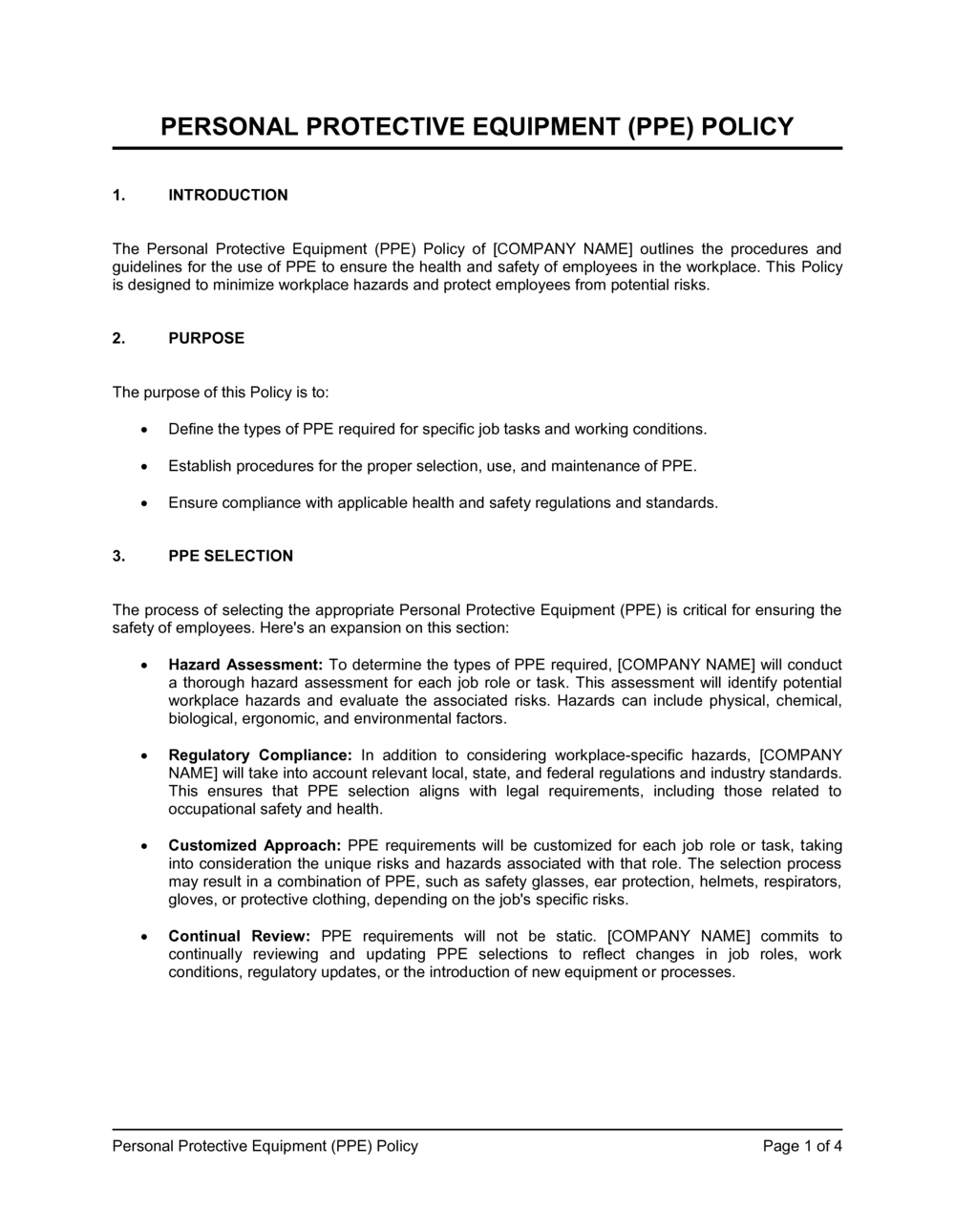
A Personal Protective Equipment Policy is an EHS (Environmental Health and Safety) document that specifies which PPE is required for each role and task, how equipment is issued and fitted, what training employees must complete, and how PPE is inspected, maintained, and replaced. This free Word download gives OSHA-regulated workplaces a structured, editable starting point they can tailor by hazard type and job classification, then export as PDF for posting, training, and audit purposes.
When you need it
Use it when onboarding workers in environments with identified physical, chemical, or airborne hazards β€” or when an OSHA inspection, incident report, or internal audit reveals a gap in your current hazard-control documentation. It is also required any time a new task, chemical, or piece of equipment introduces a hazard not covered by existing safety procedures.
What's inside
Purpose and scope, hazard assessment framework, PPE requirements by category (eye, hearing, respiratory, hand, foot, and fall protection), issuance and fit procedures, employee training requirements, inspection and maintenance standards, replacement and disposal procedures, and enforcement and recordkeeping.

What is a Personal Protective Equipment Policy?

A Personal Protective Equipment Policy is an EHS (Environmental Health and Safety) document that specifies which protective equipment employees must wear for each role and task, how that equipment is selected against OSHA performance standards, how it is issued and fitted, what training workers must complete before entering hazard areas, and how equipment is inspected, maintained, and replaced throughout its service life. It translates the general obligation under OSHA 29 CFR 1910.132 β€” and the parallel construction standard at 29 CFR 1926 Subpart E β€” into specific, auditable procedures tied to the hazards present in your workplace. This free Word download gives EHS managers, operations teams, and small business owners a structured starting point they can tailor by job classification and hazard type, then export as PDF for posting, new-hire onboarding, and regulatory inspection purposes.

Why You Need This Document

Without a written PPE policy, OSHA citations follow a predictable pattern: no written hazard assessment certification, no documented training records, and no evidence that employees received required equipment at no cost. Each item carries a separate penalty β€” up to $16,550 per violation as of 2025 β€” and PPE deficiencies routinely appear as clusters rather than single citations. Beyond fines, the operational cost is higher: a worker injured because a defective hard hat was not replaced, or a supervisor who looked the other way, creates workers' compensation claims, lost productivity, and potential civil liability that far exceeds the cost of a documented program. A signed PPE policy with a completed hazard assessment, task-level equipment matrix, and training records gives you a defensible paper trail before an inspection or incident occurs β€” and gives every worker clear, consistent guidance on what they are required to wear before they step into a hazard area.

Which variant fits your situation?

If your situation is…Use this template
General industry facility with multiple hazard typesPersonal Protective Equipment Policy
Construction site with fall and struck-by hazardsConstruction Safety Plan
Chemical handling or laboratory environmentHazard Communication (HazCom) Policy
Respiratory hazards requiring NIOSH-approved respiratorsRespiratory Protection Program
Noise-exposure environments requiring hearing conservationHearing Conservation Program
Documenting all workplace hazard controls in one placeHealth and Safety Policy
Recording a workplace injury or near-miss involving PPE failureIncident Report

Common mistakes to avoid

❌ No written hazard assessment certification

Why it matters: OSHA 29 CFR 1910.132(d)(2) explicitly requires a written certification document. A verbal or informal assessment does not satisfy the regulation, and its absence is one of the most frequently cited PPE violations.

Fix: Complete and sign a hazard assessment certification form for each work area before implementing PPE requirements, and update it whenever tasks or chemicals change.

❌ Generic PPE language not tied to specific tasks

Why it matters: Saying 'gloves required in the warehouse' without specifying glove type and cut level by task means workers may use chemical-handling gloves for cut hazards or vice versa β€” neither protects against the wrong hazard.

Fix: Build a task-level PPE matrix that maps each identified hazard to the required PPE type, performance standard, and applicable job title.

❌ Treating PPE training as a one-time event

Why it matters: OSHA requires retraining when an employee is observed using PPE improperly, when new PPE is introduced, or when workplace conditions change. A single new-hire session creates a documented gap that investigators look for after an incident.

Fix: Add explicit retraining triggers to the policy and track training completion by employee so gaps are visible before an inspection or injury occurs.

❌ No documented PPE issuance records

Why it matters: Without a signed issuance log, an employer cannot prove that an employee received required equipment β€” turning any PPE-related injury into an OSHA citation for failure to provide.

Fix: Require employees to sign an issuance acknowledgment form for every item issued and retain signed records for the duration of employment plus three years.

❌ Enforcement language that applies only to workers, not supervisors

Why it matters: OSHA holds employers accountable when supervisors knowingly allow PPE non-compliance. An asymmetric policy signals that enforcement is selective and undermines the entire program.

Fix: Add a supervisor accountability clause stating that supervisors who fail to enforce PPE requirements are subject to the same disciplinary process as employees who fail to comply.

❌ No defined replacement timeline after PPE is reported defective

Why it matters: An employee who reports damaged equipment and receives no replacement within a defined period is unprotected β€” and the documented report creates a record that the employer knew and failed to act.

Fix: Specify a maximum replacement window (typically one business day for critical PPE) and designate an alternate source of PPE if the primary supply is unavailable.

The 9 key sections, explained

Purpose and scope

Hazard assessment framework

PPE requirements by category

PPE issuance and fit procedures

Employee training requirements

Inspection and maintenance standards

Replacement and disposal procedures

Enforcement and disciplinary procedures

Recordkeeping and program review

How to fill it out

  1. 1

    Identify all covered locations and job classifications

    List every facility, department, and job title within scope. Include contractors and temporary workers who access hazard areas. Attach the list as Schedule A.

    πŸ’‘ If your company uses a staffing agency, confirm in writing who is responsible for providing and enforcing PPE for temporary workers β€” OSHA holds the host employer accountable by default.

  2. 2

    Conduct and certify written hazard assessments

    Walk each work area with a competent person to identify physical, chemical, airborne, and ergonomic hazards. Document findings on a hazard assessment form and sign the certification block as required by OSHA 29 CFR 1910.132(d)(2).

    πŸ’‘ Use OSHA's PPE Hazard Assessment Checklist (available at osha.gov) as a starting framework and attach it as an appendix to the policy.

  3. 3

    Complete the PPE requirements table by task

    For each identified hazard, specify the required PPE category, the minimum performance standard (e.g., ANSI Z87.1, ANSI A4 cut level), and the job titles required to wear it.

    πŸ’‘ Map PPE requirements at the task level, not just the job-title level β€” the same employee may need different gloves for chemical handling versus assembly work.

  4. 4

    Define issuance, fit verification, and recordkeeping procedures

    Name the issuing department, describe the fit-check procedure for each PPE type, and attach the issuance log form employees will sign. Specify the minimum retention period for signed issuance records.

    πŸ’‘ For respirators, the fit check must be a documented fit test β€” a supervisor eyeballing the seal does not meet OSHA 29 CFR 1910.134 requirements.

  5. 5

    Set training content, delivery, and retraining triggers

    List the required training topics from OSHA 1910.132(f), name who delivers training, and attach the training sign-in form. Add explicit retraining triggers: new PPE type, observed misuse, post-incident review.

    πŸ’‘ Deliver hands-on donning and doffing practice for every PPE type β€” reading a procedure without physical practice does not satisfy the OSHA training requirement.

  6. 6

    Fill in inspection, maintenance, and replacement timelines

    Set inspection frequency (before each use for most PPE; monthly for SCBA and fall-protection harnesses), list disqualifying defects by equipment type, and specify the replacement request and fulfillment timeline.

    πŸ’‘ Pull the manufacturer's inspection criteria for each PPE item and incorporate them directly β€” manufacturer guidelines are treated as authoritative by OSHA compliance officers.

  7. 7

    Add enforcement language covering supervisors and employees equally

    Write discipline language that applies to employees who refuse PPE and supervisors who fail to enforce it. Reference your existing progressive discipline policy for consistency.

    πŸ’‘ OSHA's multi-employer worksite doctrine means that if a contractor's employee is injured due to PPE non-compliance you failed to enforce, you may share citation liability.

  8. 8

    Schedule annual program review and communicate the policy

    Set an annual review date, name the EHS manager responsible, and document how the policy will be communicated β€” posted in hazard areas, included in new-hire onboarding, and distributed to all supervisors.

    πŸ’‘ Post the PPE requirements table (not the full policy) at the entry to each hazard area so workers can verify requirements before entering without having to locate the full document.

Frequently asked questions

What is a personal protective equipment policy?

A personal protective equipment policy is a formal workplace document that defines which PPE is required for specific roles and tasks, how equipment is selected and issued, what training employees must complete before using it, and how PPE is inspected, maintained, and replaced. It translates OSHA's general requirement to provide PPE at no cost to employees into specific, enforceable procedures tied to your workplace's identified hazards.

Is a PPE policy required by OSHA?

OSHA 29 CFR 1910.132 requires employers in general industry to assess the workplace for hazards, select and provide appropriate PPE, train employees in its use, and certify the hazard assessment in writing. While OSHA does not require the word "policy" specifically, it does require written hazard assessment certification and documented training β€” a formal PPE policy is the standard way employers satisfy and demonstrate compliance with these requirements. Construction employers are governed by the parallel standard at 29 CFR 1926 Subpart E.

Who is responsible for providing PPE β€” the employer or the employee?

OSHA requires employers to provide required PPE at no cost to the employee in almost all circumstances. The employer must also ensure that PPE is appropriate for the hazard, properly fitted, and maintained in sanitary and reliable condition. Employees are responsible for wearing issued PPE as required, inspecting it before use, and reporting damage or loss. Employers may discipline employees who refuse to wear required PPE, but may not charge employees for the PPE itself.

What types of PPE should a workplace policy cover?

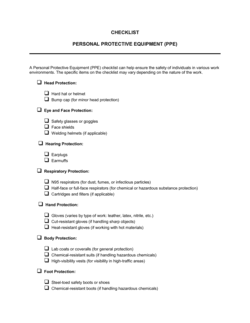
A complete PPE policy typically covers six protection categories: eye and face (safety glasses, face shields), hearing (earplugs, earmuffs), respiratory (disposable masks, half-face respirators, SCBA), hand (cut-resistant, chemical-resistant, and thermal gloves), foot (safety-toed and chemical-resistant footwear), and fall protection (harnesses, lanyards, anchor points). The specific categories included should match the hazards identified in the workplace hazard assessment.

How often should a PPE policy be reviewed and updated?

Annual review is the standard for most OSHA-regulated workplaces. Additionally, the policy and underlying hazard assessment must be updated whenever a new task, chemical, or piece of equipment introduces a hazard not previously addressed, after any recordable incident involving PPE failure or non-use, and when regulatory changes affect the applicable performance standards. An outdated policy that no longer reflects actual work conditions can increase liability rather than reduce it.

What is the difference between a PPE policy and a PPE program?

The terms are often used interchangeably, but a PPE program typically refers to the full operational system β€” hazard assessment, equipment selection, issuance, fit testing, training, inspection, and recordkeeping β€” while a PPE policy is the governing document that defines the rules and responsibilities. This template serves as the written policy that anchors the broader program, and it references supporting forms and procedures that make up the operational program.

Does a PPE policy need to cover contractors?

Yes. Under OSHA's multi-employer worksite doctrine, a controlling employer can share citation liability when a contractor's workers are exposed to hazards the controlling employer knew about and could have corrected. Best practice is to explicitly include contractors in the policy scope, require them to comply with site PPE requirements, and confirm in written contract terms who is responsible for providing PPE to each contractor's workers.

How should PPE training be documented?

Training documentation should capture the employee's name, date of training, PPE types covered, training method (classroom, hands-on, online), and signatures of both the trainer and the employee. OSHA does not prescribe a specific form, but the record must demonstrate that training content met the requirements of 29 CFR 1910.132(f). Records should be retained for the duration of employment plus three years as a minimum.

Can employees be disciplined for refusing to wear PPE?

Yes. Employees who refuse to use required PPE may be disciplined consistent with the employer's progressive discipline policy, up to and including termination. However, discipline must be applied consistently β€” selectively enforcing PPE requirements against some employees but not others exposes the employer to discrimination claims and undermines the program's credibility with OSHA. Document each instance of non-compliance and corrective action taken.

How this compares to alternatives

vs Health and Safety Policy

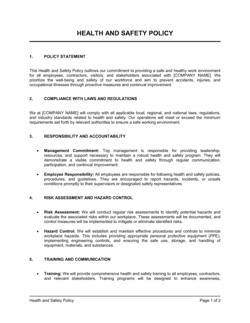
A health and safety policy is the overarching EHS governance document covering all hazard-control programs, management responsibilities, and incident reporting obligations. A PPE policy is a subordinate document that addresses one specific control tier β€” personal protective equipment β€” in the detail required by OSHA. Organizations need both: the safety policy sets the framework; the PPE policy provides the task-level operating procedures.

vs Hazard Communication Policy

A hazard communication policy addresses employee right-to-know obligations for chemical hazards β€” SDS management, container labeling, and chemical inventory. A PPE policy specifies the protective equipment required when handling those chemicals. The two documents work in tandem: HazCom identifies the chemical hazard; the PPE policy specifies the gloves, respirator, or face shield required to control it.

vs Incident Report

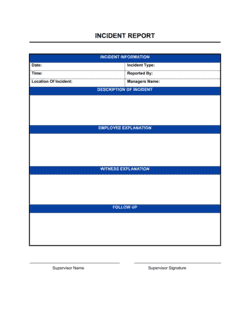
An incident report is a reactive document used after an injury, near-miss, or property damage event to record what happened, identify root causes, and track corrective actions. A PPE policy is proactive, defining controls before incidents occur. When a PPE-related incident report identifies a gap in the PPE program, the policy should be updated within the specified review window.

vs Employee Handbook

An employee handbook communicates general workplace policies β€” conduct, benefits, and leave β€” to all employees. A PPE policy is a specialized EHS document with regulatory standing under OSHA that must include specific technical content: hazard assessment certifications, performance standards by equipment type, and documented training requirements. Summarizing PPE expectations in the handbook is appropriate, but the handbook reference cannot substitute for the standalone PPE policy.

Industry-specific considerations

Manufacturing

Machine-guarding gaps, chemical splash, noise levels above 90 dBA, and hand injury risk from cut hazards drive the most comprehensive PPE matrices in manufacturing environments.

Construction

Fall protection (harnesses, guardrails), hard hats, high-visibility vests, and safety-toed footwear are regulated under OSHA 29 CFR 1926 Subpart E rather than the general industry standard.

Healthcare

PPE overlaps with infection control β€” gloves, gowns, N95 respirators, and face shields are governed jointly by OSHA's bloodborne pathogens standard (29 CFR 1910.1030) and CDC guidelines.

Warehousing and Logistics

Forklift traffic, manual material handling, and high-rack storage create foot, hand, and struck-by hazards that typically require safety footwear, cut-resistant gloves, and high-visibility apparel.

Template vs pro β€” what fits your needs?

PathBest forCostTime
Use the templateSmall to mid-size employers with straightforward general industry hazards who need a documented PPE program to satisfy OSHA compliance requirementsFree2–4 hours to complete and review
Template + professional reviewMulti-site facilities, employers with chemical process hazards, or workplaces where respiratory protection programs require fit testing$500–$2,000 for an EHS consultant review3–5 business days
Custom draftedHigh-hazard industries (petrochemical, mining, confined space), facilities subject to OSHA PSM or EPA RMP requirements, or employers with a history of OSHA citations$3,000–$8,000 for a certified industrial hygienist engagement2–6 weeks

Glossary

PPE (Personal Protective Equipment)
Wearable gear β€” goggles, gloves, hard hats, respirators, and similar items β€” designed to protect an individual worker from specific identified hazards.
Hazard Assessment
A systematic job-by-job or task-by-task review that identifies physical, chemical, biological, and ergonomic hazards to determine which PPE controls are required.
OSHA 29 CFR 1910.132
The primary OSHA general industry regulation requiring employers to conduct hazard assessments and provide appropriate PPE at no cost to employees.
Hierarchy of Controls
A ranked framework for hazard mitigation: elimination, substitution, engineering controls, administrative controls, and PPE β€” in that order of preference.
ANSI/ISEA Standards
American National Standards Institute performance standards for PPE categories β€” such as ANSI Z87.1 for eye and face protection β€” specifying minimum impact, optical, and coverage requirements.
Fit Test
A qualitative or quantitative test confirming that a specific respirator model creates an adequate seal on an individual wearer's face, required annually under OSHA 29 CFR 1910.134.
PPE Hazard Assessment Certification
A written document signed by a competent person certifying that a workplace hazard assessment was performed, identifying the site, evaluator, and date β€” required by OSHA.
Class E Hard Hat
An electrical-rated hard hat designed to reduce electrical shock from conductors up to 20,000 volts, required in utility and electrical work environments.
NIOSH Approval
Certification by the National Institute for Occupational Safety and Health confirming that a respirator meets minimum filtration and performance standards β€” required for all respirators used under OSHA programs.
SDS (Safety Data Sheet)
A standardized document accompanying hazardous chemicals that specifies physical hazards, exposure limits, and required PPE for safe handling.
Competent Person
An individual designated by the employer as capable of identifying existing and predictable hazards and authorized to take prompt corrective action β€” a term used throughout OSHA regulations.

Part of your Business Operating System

This document is one of 3,000+ business & legal templates included in Business in a Box.

  • Fill-in-the-blanks β€” ready in minutes
  • 100% customizable Word document
  • Compatible with all office suites
  • Export to PDF and share electronically

Create your document in 3 simple steps.

From template to signed document β€” all inside one Business Operating System.
1
Download or open template

Access over 3,000+ business and legal templates for any business task, project or initiative.

2
Edit and fill in the blanks with AI

Customize your ready-made business document template and save it in the cloud.

3
Save, Share, Send, Sign

Share your files and folders with your team. Create a space of seamless collaboration.

Save time, save money, and create top-quality documents.

β˜…β˜…β˜…β˜…β˜…

"Fantastic value! I'm not sure how I'd do without it. It's worth its weight in gold and paid back for itself many times."

Managing Director Β· Mall Farm
Robert Whalley
Managing Director, Mall Farm Proprietary Limited
β˜…β˜…β˜…β˜…β˜…

"I have been using Business in a Box for years. It has been the most useful source of templates I have encountered. I recommend it to anyone."

Business Owner Β· 4+ years
Dr Michael John Freestone
Business Owner
β˜…β˜…β˜…β˜…β˜…

"It has been a life saver so many times I have lost count. Business in a Box has saved me so much time and as you know, time is money."

Owner Β· Upstate Web
David G. Moore Jr.
Owner, Upstate Web

Run your business with a system β€” not scattered tools

Stop downloading documents. Start operating with clarity. Business in a Box gives you the Business Operating System used by over 250,000 companies worldwide to structure, run, and grow their business.

Start freeΒ Β·Β No credit card required